
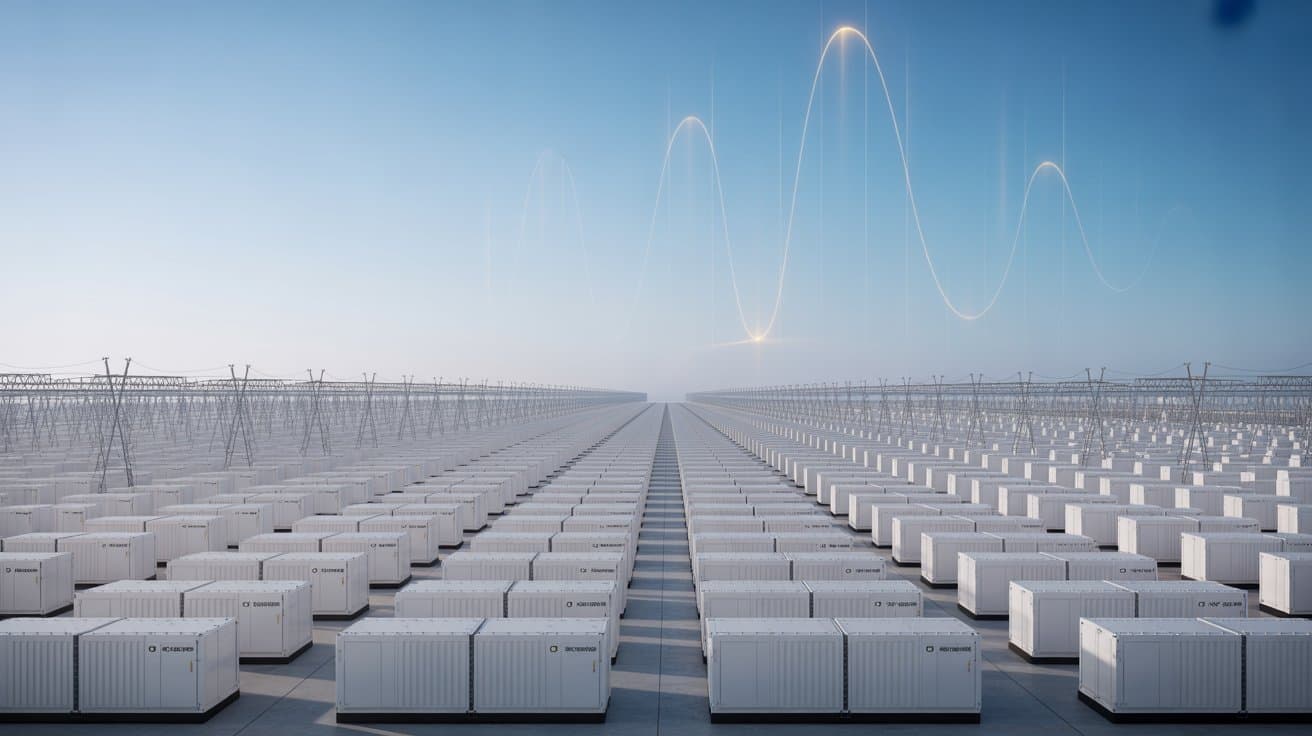
The Arbitrage Shift: From Generation to Temporal Displacement
As of February 2026, the battery energy storage market is undergoing a fundamental transition driven by the July 2025 passage of OBBBA domestic content rules, accelerating ancillary service saturation, and the industry-wide shift toward the Four-Hour Capacity Rule in major RTOs.
The global energy transition infrastructure landscape is navigating a structural transformation where the primary value of electricity is decoupling from the act of generation and reattaching to the capacity for temporal displacement. Historically, power markets were designed around the dispatchability of fossil fuels, where fuel was stored and converted to electrons on demand. In a decarbonizing grid dominated by variable renewable energy (VRE), the storage medium is no longer the fuel itself, but the energy storage system.
This structural metamorphosis represents the Arbitrage Shift—a transition entering a critical phase where 4-hour battery energy storage systems (BESS) are evolving from complementary grid assets to the primary backbone of system reliability. The investment thesis for longer-duration storage is underpinned by the 2030 Crossover, an economic inflection point where the levelized cost of storage for multi-hour systems falls below the net cost of new entry (Net CONE) for traditional natural gas peaking infrastructure.
Key Investment Takeaways
What Changes by 2030:
- 4-hour batteries achieve cost parity with natural gas peakers, displacing thermal generation as lowest-cost reliability infrastructure
- Wholesale energy arbitrage becomes dominant revenue stream as ancillary service markets saturate from capacity additions
- Capacity accreditation rules punish short-duration assets through ELCC derates, creating stranded asset risk for 1-2 hour systems
Critical Due Diligence Requirements:
- OBBBA domestic content compliance rising from 55% (2026) to 75% (2030+) to capture additional ITC bonus credits
- Nodal pricing analysis identifying high-alpha congestion zones with persistent spread premiums above system averages
- AI-driven optimization platform capabilities separating top-quartile operators by several hundred basis points IRR versus median performers
Where Alpha Still Exists:
- Real-time dispatch markets in CAISO and ERCOT where sub-second response captures volatility spikes during evening ramps
- Behind-the-meter industrial applications providing demand charge reduction and backup power with stable contracted returns
- Data center firming contracts meeting corporate clean energy mandates for 24/7 baseload AI power requirements
While early market participants achieved outsized returns through short-duration frequency regulation, these shallow markets are facing rapid saturation and price cannibalization. The future of energy as an alternative asset class lies in the ability to bridge the widening daily gaps between peak renewable supply and peak electricity demand—a task for which 4-hour and longer assets are uniquely suited.
The Macro Dynamics of Market Saturation
Cannibalization of Ancillary Services and the Revenue Migration
The first decade of the BESS boom was defined by 1-hour and 2-hour systems designed for frequency regulation and other ancillary services. These markets are high-margin but low-volume. As the global fleet of battery storage expanded significantly in recent years, ancillary services began to saturate. In the Electric Reliability Council of Texas (ERCOT), ancillary services revenue shares have declined substantially as new capacity came online, shifting the revenue burden toward energy arbitrage.
This cannibalization effect occurs when an influx of storage capacity compresses the very price spreads it aims to exploit. In the Italian market, simulations for 2030 indicate that massive BESS deployment will significantly erode arbitrage profits unless offset by the volatility inherent in even higher levels of renewable penetration. Consequently, the industry is observing a pivot toward 4-hour systems which can capture value from the deeper, more resilient wholesale energy markets that ancillary-focused assets cannot reach.
The saturation dynamic creates a fundamental shift in investment strategy. Where early vintage projects achieved strong IRRs through pure frequency regulation, new capacity must now compete in wholesale markets where alpha generation requires sophisticated optimization algorithms and real-time trading capabilities rather than passive participation in predictable ancillary service auctions.
Load Growth and the Data Center Demand Explosion
The demand side of the equation is being fundamentally reshaped by the rapid expansion of data centers, particularly those supporting generative AI workloads. Industry estimates suggest that U.S. data center demand could roughly double from current levels by 2028. These facilities require 24/7 baseload power, yet they are increasingly contracting for clean energy to meet corporate sustainability mandates.
This creates a massive structural mismatch: the baseload demand of artificial intelligence cannot be met by intermittent solar without multi-hour storage firming. Private equity is increasingly viewing 4-hour and 8-hour batteries as essential infrastructure for the digital economy, creating a new revenue stream where batteries provide capacity firming services to hyperscale data centers under long-term power purchase agreements that sit outside traditional grid arbitrage models.
The intersection of AI load growth and renewable penetration creates what analysts term the firming premium—a willingness to pay premium rates for storage that can guarantee dispatchability during peak demand hours. This premium is particularly pronounced in markets like CAISO where solar penetration creates deep midday price canyons but severe evening ramps when AI workloads remain constant while solar output crashes.
The 2030 Crossover: Economic Displacement of Thermal Generation
The Mathematics of Cost Parity and Thermal Value Erosion
The 2030 Crossover thesis posits that by 2030, the cost of installing and operating 4-hour BESS will be lower than the cost of building new natural gas combined-cycle (NGCC) or simple-cycle gas turbine (SCGT) plants across major U.S. and European markets. This is not merely a technological forecast but a consequence of two converging economic forces: battery cost deflation and thermal value erosion.
The cost of thermal generation is currently facing structural headwinds. As renewables take a larger share of the energy mix, gas plants run fewer hours, which increases their per-unit cost of energy. Simultaneously, the capital cost of frame combustion turbines has risen substantially in recent years, with industry estimates ranging from approximately $2,000/kW to $2,700/kW due to supply chain constraints, labor shortages, and the declining economies of scale as fewer plants are constructed.
Conversely, battery costs continue their aggressive decline trajectory. Battery cell prices have fallen substantially and are projected to continue declining according to BloombergNEF forecasts. This divergence creates a scenario where storage underbids gas in capacity markets, especially when accounting for the rising costs of carbon allowances under state and federal climate policies and the persistent volatility of natural gas fuel pricing.
Note on cost metrics: Battery storage costs are typically expressed as $/kWh (energy capacity) while thermal generation uses $/kW (power capacity). For a 4-hour battery system, the rough conversion is: Total $/kW ≈ 4 × ($/kWh for cells) + EPC and balance-of-system costs. This structural difference reflects that storage must pay for both power conversion equipment and energy storage capacity, while thermal plants only pay for power generation equipment with fuel purchased separately.
| Metric | 4-Hour BESS (2030 Projection) | Natural Gas Peaker (2030 Projection) |
|---|---|---|
| Capital Cost (CONE) | $150-$240/kWh | ~$2,000-$2,700/kW |
| Capacity Market Competitiveness | High (Underbids NGCC in most markets) | Declining due to low capacity factors |
| Merchant Margin Potential | High (Captures price volatility bidirectionally) | Low (Eroded by renewable baseload) |
| Revenue Stream Focus | Arbitrage + Capacity + Ancillary Services | Capacity + Emergency Peaking Only |
The displacement dynamic is further accelerated by the operational flexibility of batteries compared to thermal assets. Gas peakers require minimum run times, face ramp rate constraints, and incur start-up costs that batteries do not. In markets with high renewable penetration, the ability to instantly respond to price signals and provide bidirectional services (both charging and discharging) creates a structural advantage that thermal generation cannot replicate regardless of fuel cost.
Capacity Accreditation and the Four-Hour Rule
A critical regulatory driver accelerating the shift toward 4-hour duration is the Four-Hour Capacity Rule adopted by several Regional Transmission Organizations (RTOs), including CAISO, NYISO, and MISO. Under this framework, a storage asset must be able to discharge at its rated capacity for at least four hours to receive full resource adequacy (RA) or capacity credits.
As the grid becomes more saturated with storage, the marginal reliability value of shorter-duration assets declines, a phenomenon captured by Effective Load Carrying Capability (ELCC) metrics. In PJM, for example, the use of non-linear derates means that a 2-hour battery might only receive a fraction of the capacity payment given to a 4-hour battery, significantly impacting the internal rate of return for short-duration projects.
This regulatory shift creates potential stranded asset risk for short-duration systems in markets that are increasingly prioritizing long-duration reliability. The capacity accreditation mechanics create a bifurcation where batteries unable to meet minimum duration thresholds face economic disadvantages as the market evolves toward rewarding assets that can support the grid through extended stress periods rather than brief frequency events.
| Storage Duration | ELCC Capacity Credit Range (%) | Primary Revenue Focus | Stranded Asset Risk |
|---|---|---|---|
| 1-Hour | 20-40% (Severe derate) | Frequency regulation only | High |
| 2-Hour | 50-70% (Partial credit) | Ancillary services + limited arbitrage | Medium-High |
| 4-Hour | 90-100% (Full credit) | Energy arbitrage + capacity + ancillary | Low |
| 8-Hour+ | 100% (Premium positioning) | Multi-day arbitrage + firm capacity | Very Low |
The OBBBA Catalyst: Legislative Reshaping of Supply Chains
Domestic Content Requirements and Foreign Entity Restrictions
The regulatory environment for energy storage was fundamentally altered by the passage of the One Big Beautiful Bill Act (OBBBA) in July 2025. This legislation significantly changed the clean energy tax credit landscape established by the 2022 Inflation Reduction Act, introducing stringent new restrictions aimed at securing the domestic supply chain and limiting participation by Foreign Entities of Concern (FEOC).
Projects for which construction begins after December 31, 2025, are ineligible for tax credits if they include Material Assistance from FEOC tied to China, Russia, North Korea, or Iran. Taxpayers must now certify that their energy storage technology was built with specific percentages of domestic content to qualify for bonus credits. For the Investment Tax Credit (ITC), satisfying domestic content requirements can qualify projects for an additional 10-percentage-point domestic content bonus (where applicable), lifting the effective ITC above the base 30% rate.
| Construction Start Year | Domestic Content Threshold (Energy Storage) | ITC Rate (Base / With Domestic Content Bonus) |
|---|---|---|
| 2026 | 55% | 30% / up to 40% |
| 2027 | 60% | 30% / up to 40% |
| 2028 | 65% | 30% / up to 40% |
| 2029 | 70% | 30% / up to 40% |
| 2030+ | 75% | 30% / up to 40% |
The escalating thresholds create a quality barrier that favors domestic, long-duration infrastructure over imports unable to meet domestic content safe harbor provisions. Battery manufacturers with U.S.-based cell production, such as those building gigafactories in the Southeast and Midwest, gain a structural advantage in the tax credit market. See Treasury guidance on clean energy credits for detailed implementation requirements.
Tax Credit Transferability and Monetization Mechanics
The OBBBA maintained the transferability of tax credits under Section 6418, allowing developers to monetize credits by selling them to third parties. However, transfers to FEOC entities are strictly prohibited, creating due diligence requirements around the ultimate beneficial ownership of credit purchasers.
The legislation also established a clear phaseout schedule for non-wind and solar technologies, including storage, starting in 2033. This creates a sunset window that incentivizes rapid deployment in the latter half of the 2020s, creating urgency for developers to advance projects through permitting and construction before the credit begins stepping down from its current 30% base rate.
The combination of domestic content requirements and transferability creates a bifurcated market where projects that can certify compliance trade at premium valuations in the tax equity market, while non-compliant projects face material discounts or outright inability to monetize credits. This dynamic has led to increasing integration between battery developers and domestic cell manufacturers, with long-term offtake agreements becoming standard practice to ensure domestic content certification.
Conclusion: Owning the Temporal Displacement Infrastructure
The convergence of falling battery costs, rising thermal replacement needs, and a supportive yet restrictive legislative framework has created a window for investment in 4-hour and longer energy storage. The Arbitrage Shift represents the natural evolution of a grid that is becoming increasingly dominated by variable renewable generation, where the value of electricity is migrating from the act of generation to the capacity for temporal displacement.
For alternative investors, the 2030 Crossover thesis provides a framework for understanding why batteries are transitioning from complementary assets to grid backbone infrastructure. The saturation of shallow ancillary service markets, the implementation of capacity accreditation rules that reward duration, and the explosive growth of data center loads requiring clean firm power all point toward long-duration storage as essential infrastructure rather than speculative technology.
Success in this evolving market requires mastery of multiple domains simultaneously: the technical characteristics of competing storage technologies, the regulatory mechanics of ELCC accreditation and OBBBA compliance, the operational sophistication to generate alpha through AI-driven real-time trading, and the strategic foresight to identify high-alpha nodes before they become consensus investments.
The path forward is defined by duration. As the grid moves from 2-hour ancillary peaks to 8-hour daily ramps and multi-day stress events, the definition of a winning asset will be linked to its ability to provide reliability through extended periods of system stress. Those who focus on the 2030 Crossover today—understanding that batteries are not merely a green technology but the lowest-cost option for grid reliability—will be positioned as the backbone of the next-generation global power system.
The alternative investors who recognize that the Arbitrage Shift is a multigenerational cycle transition from virtual-focused technology to physical-focused infrastructure will capture outsized returns as the market reprices storage from a niche renewable enabling technology to the primary mechanism for grid reliability. This is the arbitrage shift that remains underpriced—but by 2030, it will define how markets value electrons themselves.