
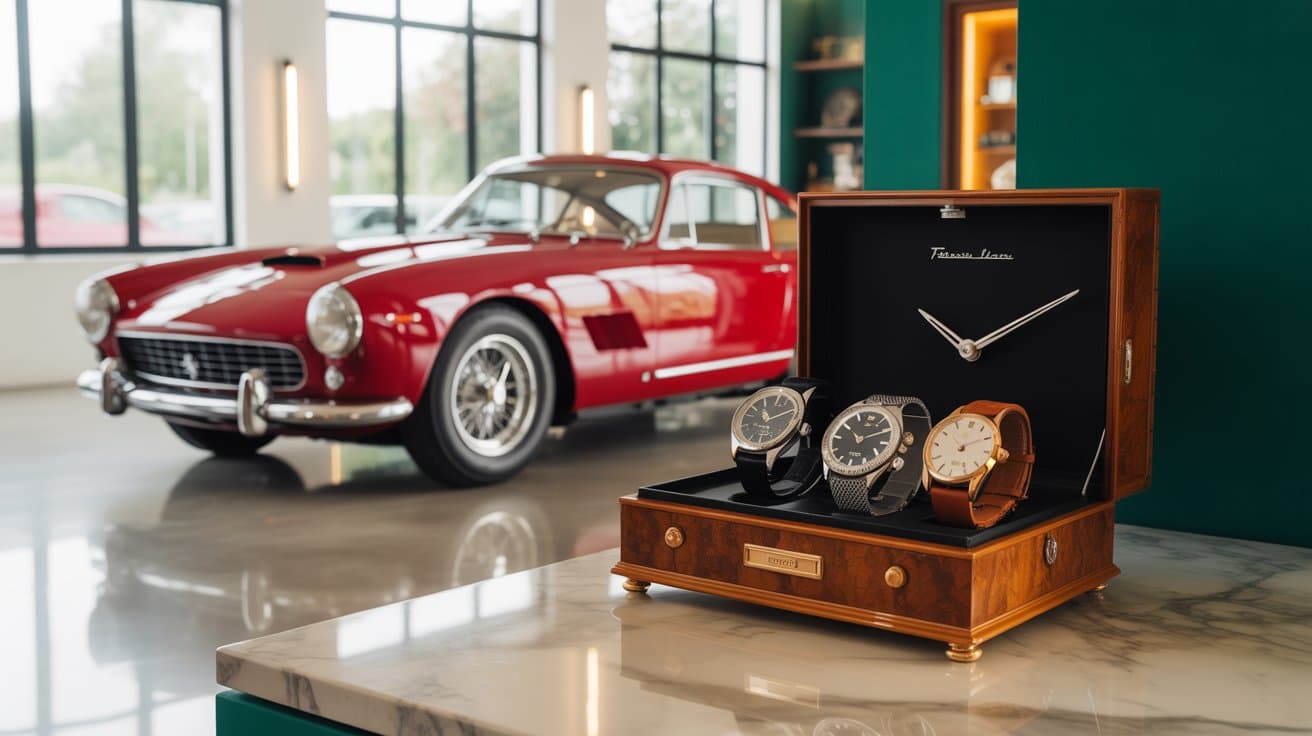
At a Christie's auction in Monterey, California, a 1962 Ferrari 250 GTO sold for $48.4 million in 2018—the most expensive car ever sold at auction. Across the Atlantic, a Patek Philippe Grandmaster Chime ref. 6300A-010 fetched $31 million in Geneva in 2019—the most expensive watch ever auctioned. These aren't just collectibles. They're financial instruments with hundred-million-dollar track records.
Between 2008 and 2019, the HAGI Top Index—tracking blue-chip classic cars—delivered over 500% returns while gold managed just 2% annually. Patek Philippe watches posted 207% ROI from 2017 to 2022. Yet by late 2022, the watch market had corrected 31% from its peak, exposing the volatility beneath the glamour. Today, as markets stabilize and fractional platforms democratize access, sophisticated investors face a critical question: Can passion assets deliver institutional returns without institutional capital?
Are Classic Cars and Luxury Watches Good Investments?
Investing in tangible assets like classic cars and luxury watches represents a fundamentally different proposition than traditional portfolio construction. Unlike stocks or bonds, these are passion assets vs financial assets—you can wear a Rolex Daytona or drive a Porsche 911 Carrera RS, experiences that generate utility beyond financial returns. This "enjoyment premium" attracts collectors willing to accept illiquidity and holding costs for assets they genuinely appreciate.
The alternatives to stocks and bonds thesis centers on three core advantages: low correlation to traditional markets, scarcity-driven appreciation, and inflation hedge characteristics. For investors asking "are watches good investments", the historical data suggests they can be—when purchased strategically. Classic cars move independently of equity cycles—the Historic Automobile Group International (HAGI) has documented that blue-chip automobiles appreciate based on collector demand dynamics rather than macroeconomic factors that drive stock prices. Luxury watches similarly demonstrated resilience during the 2008 financial crisis, recovering in just two years versus four-plus years for the S&P 500.
But this thesis requires nuance. The global luxury watch market is projected to reach $72 billion by 2025, with the pre-owned segment valued at $24 billion in 2023 and projected to exceed $37 billion by 2028. Yet this growth masked significant volatility—the watch market experienced a speculative surge in 2021-2022 driven by stimulus-fueled liquidity, followed by a sharp correction as interest rates rose and cryptocurrency wealth evaporated. Investors who bought at the March 2022 peak saw portfolio values decline 31% by late 2023 before stabilization began.
Compared to traditional assets like stocks or real estate, classic cars and watches offer distinct advantages and trade-offs. Unlike stocks, they provide tangible ownership with personal utility—you can drive a Ferrari or wear a Patek Philippe, generating enjoyment beyond financial returns. They also demonstrate low correlation to equity markets, appreciating based on collector demand rather than corporate earnings or economic cycles. Unlike real estate, they require no property management, generate no rental income complications, and offer superior portability—a $500,000 watch collection fits in a safe deposit box versus managing tenants and maintenance. However, they also lack the income generation of dividend stocks or rental properties, carry higher transaction costs (10-20% auction fees versus 5-6% real estate commissions), and require specialized expertise that most investors lack. The HAGI Top Index's 500%+ return (2008-2019) exceeded the S&P 500's ~200% total return during the same period, but with dramatically higher illiquidity and concentration risk. These assets work best as portfolio satellites (5-10% allocation) complementing—not replacing—traditional stock/bond/real estate core holdings.
⚠️ CRITICAL INVESTMENT CONSIDERATION
Collectibles as an investment require specialized expertise, acceptance of illiquidity, and realistic expectations about holding costs. Unlike income-producing assets (dividend-paying stocks, rental real estate, bonds), classic cars and watches generate zero cash flow while incurring annual costs of 2-5% of asset value. They belong in portfolios as satellite holdings (5-10% of investable assets maximum) within a broader alternatives allocation, not as core positions displacing traditional diversified investments.
How to Invest in Classic Cars (Using the HAGI Index & Blue-Chip Brands)
For investors who want to go deeper than headline HAGI performance, the edge is knowing which models appreciate—and why. Our Classic Car Investment Guide: Collectible Vehicles breaks down investment-grade criteria in detail, including numbers-matching, condition grading, marque-specific demand drivers, and realistic entry points across Ferrari, Porsche, and Mercedes-Benz. It also covers the most common return killers—restoration quality issues, provenance gaps, and overpaying for non-investment-grade examples.
The HAGI Index, established in 2008, tracks the classic car market using rigorous financial methodology typically reserved for traditional asset classes. The HAGI Top Index measures the overall market for exceptional historic automobiles across the top 50 most valuable models from approximately 11 manufacturers. This is crucial context: classic car investment brands that deliver meaningful appreciation represent a tiny fraction of the broader collector car universe.
The numbers tell a compelling story. Over the decade ending in 2019, the HAGI Top Index delivered over 500% returns, vastly outperforming gold's approximately 2% annual appreciation. In November 2024, the index increased 2.3% month-over-month, with specific marque indices showing varied performance: the HAGI F (Ferrari) index grew 14% year-to-date, while the HAGI P (Porsche) index gained 1.1%.
| Index | Coverage | 2024 YTD Performance | Key Characteristics |
|---|---|---|---|
| HAGI Top | Top 50 models across all brands | +2.3% (Nov) | Broad market measure for exceptional automobiles |
| HAGI F (Ferrari) | Rare Ferrari models | +14.0% | Highest appreciation, ultra-rare prancing horses |
| HAGI P (Porsche) | Rare Porsche models | +1.1% | 911 variants, RS models, air-cooled classics |
| HAGI MBCI (Mercedes) | Rare Mercedes-Benz classics | Data varies | 300 SL Gullwing, Pagoda SL, classic racing models |
| HAGI Top ex P&F | Market excluding Porsche/Ferrari | Data varies | Broader brands: Alfa Romeo, Bugatti, Aston Martin |
Classic car vs luxury watch returns demonstrate different risk-return profiles. Cars require significantly higher capital ($50,000+ for entry-level investment-grade vehicles, $250,000+ for blue-chip models), carry substantial holding costs ($5,000-$15,000 annually), but offer longer appreciation runways and lower market correlation. The 1962 Ferrari 250 GTO that sold for $48.4 million in 2018 represented a roughly 4,800x return from its original $10,000 1963 price—though admittedly, that's the apex of the market.
Focus on Blue-Chip Brands: Where Appreciation Happens
Not all classic cars appreciate. The Federation of British Historic Vehicle Clubs reported that 51% of historic vehicles in the UK were valued under £10,000 in 2021—hardly the realm of "exceptional historic" automobiles tracked by HAGI. Long-term appreciation classic cars cluster in specific marques and models with racing provenance, limited production, technological significance, or design icon status.
Ferrari
Why They Appreciate: Racing pedigree, limited production, brand prestige, Maranello mystique. The Ferrari brand is synonymous with automotive excellence.
Key Models: 250 GTO ($48M+ auction record), 250 GT California Spider ($17M+), Daytona, F40, various GTB and Spider variants
HAGI F Index: +14% YTD 2024
Porsche
Why They Appreciate: Engineering excellence, motorsport success, air-cooled 911 variants, 356 Speedster rarity. Passionate collector base.
Key Models: 911 Carrera RS 2.7, 356 Speedster, 959, Carrera GT, 911 Sport Classic, early 911 models
HAGI P Index: +1.1% YTD 2024
Mercedes-Benz
Why They Appreciate: Engineering heritage, gullwing doors (300 SL), racing history (W196, 300 SLR), German craftsmanship
Key Models: 300 SL Gullwing, 300 SL Roadster, 280/300 SL Pagoda, W113 series, classic S-Class variants
Dedicated HAGI MBCI Index
Others: Bugatti, Alfa Romeo, Aston Martin
Why They Appreciate: Pre-war elegance (Bugatti Type 57), Italian soul (Alfa Romeo 8C), British luxury (Aston DB4/DB5)
Market Position: Select models achieve seven-figure valuations. Pre-war Bugattis command $10M+, DB5s $1M+
Covered in HAGI Top ex P&F
Understand Condition Grading: Why Numbers-Matching Matters
Numbers matching classic car value refers to vehicles where major components (engine, transmission, differential) retain their original factory-assigned serial numbers. Manufacturers maintained detailed production records, and serious collectors verify authenticity through these numbers. A numbers-matching Ferrari 275 GTB might command 30-50% premiums over an otherwise identical car with a replacement engine—even if that replacement is period-correct.
Condition grading follows established frameworks (Hagerty uses a 1-5 scale, with #1 being Concours-level perfection). Investment-grade vehicles typically fall in Condition #1-2 range, with comprehensive documentation including build sheets, service history, ownership provenance, and photographic records. Cars with gaps in history, questionable restoration quality, or missing documentation face significant value discounts regardless of current cosmetic appearance.
How to Invest in Luxury Watches After the 2022–2023 Correction
Navigating the post-correction watch market requires more than brand recognition or retail waitlists. Our Luxury Watch Investing Playbook provides a reference-level framework for identifying investment-grade watches—comparing Rolex vs Patek Philippe vs Audemars Piguet on liquidity and upside—and explains how reference numbers, production cycles, and market timing influence returns. It also outlines realistic portfolio sizing, exit strategies, and how to avoid speculative traps that punished buyers at the 2022 peak.
The luxury watch investment performance story divides into three distinct periods: pre-pandemic steady appreciation (2010-2019), pandemic-era surge (2020-early 2022), and post-correction stabilization (late 2022-2025). Understanding this cycle is essential for current investors evaluating entry points. The best investment watches navigated these cycles differently, with blue-chip references from Rolex and Patek Philippe showing resilience, while special editions like the Omega Speedmaster Silver Snoopy watch investment demonstrated how limited production drives premiums even from non-Big Three brands.
From 2017 to 2022, Patek Philippe watches delivered 207% ROI, with the Nautilus 5711/1A becoming the poster child for watch-as-investment thesis. Originally retailing for approximately $30,000, secondary market prices reached $140,000+ by 2022—a 4.7x markup over retail. Similarly, sought-after Rolex models appreciated an average of 20% annually from 2018 to 2023, outpacing the S&P 500 during that period.
Then came the correction. The average secondhand luxury watch price fell 31% from the March 2022 peak according to WatchCharts. The Bloomberg Subdial Watch Index—tracking the 50 most-traded watches by transaction value—dropped 42% from April 2022 highs to October 2023 lows. Rolex prices declined 27%, while Patek Philippe fell 47% during this period.
| Period | Market Dynamics | Average Price Movement | Driving Factors |
|---|---|---|---|
| 2010-2019 | Steady appreciation | ~8-12% annually | Growing collector base, Asian demand, limited supply |
| 2020-Mar 2022 | Pandemic surge to peak | +40% (12 months to June 2022) | Stimulus liquidity, crypto wealth, boutique wait lists |
| Mar 2022-Oct 2023 | Sharp correction | -31% (avg), -42% (Subdial Index) | Rising rates, crypto collapse, supply flooding market |
| Late 2023-2025 | Stabilization & selective recovery | +1.18% (2H 2024), Blue-chip firming | Flight to quality, Big Three dominance, normalized demand |
Critically, the correction was not a complete bubble burst but a reversion to sustainable valuation patterns. By 2024-2025, the market stabilized with demand concentrated on specific reference models from the "Big Three" brands—Rolex, Patek Philippe, and Audemars Piguet—which dominate secondary market liquidity and transaction value.
Rolex vs Patek Philippe Investment: Which Brand Performs Better?
The Rolex vs Patek Philippe investment comparison reveals complementary rather than competing propositions. Each brand offers distinct advantages depending on investor priorities, capital availability, and risk tolerance.
ALTSTREET ANALYSISBrand Comparison Framework
Rolex: Liquidity & Accessibility
- Production: ~1.1 million watches annually
- Market Share: 34.2% of global secondary trade volume (Q1 2020–Q4 2024)
- Entry Points: $8,000–$15,000 (Submariner, GMT-Master)
- Appreciation: 20% annually (2018–2023 for sought-after models)
- Liquidity: Sell within days–weeks through established dealers
- Best For: Investors prioritizing liquidity, broader market participation
Patek Philippe: Maximum Appreciation
- Production: ~70,000 watches annually (6% of Rolex volume)
- Scarcity: Extreme undersupply drives perpetual premiums
- Entry Points: $30,000–$50,000 (Aquanaut, Calatrava)
- Appreciation: 207% ROI (2017–2022), 3–5× retail for Nautilus
- Liquidity: Smaller buyer pool, longer transaction timelines
- Best For: Investors with higher capital targeting maximum appreciation
The data-driven answer: For liquidity and ease of entry/exit, Rolex. For maximum appreciation potential on select references—with higher entry costs and longer hold periods—Patek Philippe. Most sophisticated collectors maintain exposure to both.
Audemars Piguet: The Third Pillar
Audemars Piguet rounds out the Big Three with the Royal Oak—designed by Gérald Genta in 1972 and featuring the iconic octagonal bezel, visible screws, and integrated bracelet. The Royal Oak created the luxury sports watch category and maintains strong investment performance, with AP watches appreciating 100% from August 2020 to 2022 peak.
As of 2024-2025, Audemars Piguet has the highest percentage of current production models trading above retail at 67%, versus Rolex's 53% and Patek Philippe's 38%. This reflects the brand's successful production management and collector demand concentration in flagship Royal Oak references.
The Math Behind Ownership: True Costs Beyond Purchase Price
Financial models for collectibles as an investment must account for substantial holding costs that erode gross returns. This is where passion assets diverge most sharply from income-producing investments—not only do they generate zero cash flow, they actively consume capital for preservation.
Account for Costs: Classic Car Annual Expenses
The cost of ownership classic car reality involves multiple recurring expense categories. Based on comprehensive research across collector car insurance providers and storage facilities:
| Expense Category | Annual Range | Key Variables | Notes |
|---|---|---|---|
| Insurance (Agreed Value) | $200-$1,000 (typical) $1,000-$10,000 (high-value) | Vehicle value, mileage limits, storage location | Requires garage storage, mileage restrictions (2,000-7,500 mi/yr) |
| Storage (Climate-Controlled) | $1,000-$5,000 | Location (urban vs. rural), facility quality, security level | Climate control essential for value preservation, prevents rust/mildew |
| Maintenance & Repairs | $500-$3,000 | Vehicle rarity, parts availability, specialist labor rates | Rare/foreign models significantly higher, proper maintenance preserves value |
| Registration & Fees | $200-$1,000 | State requirements, vehicle value | Antique/collector plates may offer reduced fees in some states |
| Detailing & Preservation | $500-$2,000 | Frequency of shows/events, preservation standards | Essential for concours-level vehicles, protects paint/chrome/interiors |
| TOTAL ANNUAL COSTS | $5,000-$15,000 | Budget 2–5% of vehicle value annually | |
For a $100,000 classic Porsche 911, annual costs of $5,000 represent a 5% drag on returns before any appreciation. If the vehicle appreciates 8% annually (HAGI-level performance), net returns after costs drop to 3%—comparable to municipal bonds but with vastly higher illiquidity and concentration risk.
Watch Ownership Economics: Lower Costs, Higher Liquidity
Luxury watches offer more favorable holding cost economics. Primary expenses include insurance (typically bundled with homeowner's/renter's policies at minimal marginal cost for watches under $50,000), servicing every 5-7 years ($800-$2,000 for mechanical overhaul), and secure storage (safe deposit box $50-$200 annually, or home safe one-time $1,000-$5,000).
Annual holding costs for a $30,000 Rolex Submariner might total $300-$500 (insurance, amortized service costs, storage), representing just 1-1.7% annual drag versus 5% for classic cars. This cost advantage, combined with superior liquidity, makes watches more accessible entry points for passion asset investing, though absolute appreciation potential may be lower given smaller capital deployed.
🚨 KEY RISKS OF CLASSIC CAR & WATCH INVESTING
- Illiquidity and long selling timelines — especially for six-figure classic cars requiring specialty auctions or dealer consignment
- High transaction costs — auction fees 10-20%, dealer spreads 15-25%, fractional platform fees typically 2 and 20 structure
- Holding costs that erode value — 2–5% of asset value annually for cars (insurance, storage, maintenance), lower but still material for watches
- Expertise risk — easy to overpay or miss critical authenticity issues without specialized knowledge or professional inspection
- Economic cyclicality — discretionary luxury spending correlates with wealth effects; recessions pressure collectible markets
- Market timing risk — as 2022-2023 watch correction demonstrated, buying at cycle peaks can result in years of negative returns
- No income generation — unlike dividend stocks or rental properties, these assets produce zero cash flow while incurring costs
Start with Fractional Platforms: Democratizing Access to Mechanical Masterpieces
Fractional classic car investment platforms have emerged as the primary democratization vehicle for passion assets previously accessible only to ultra-high-net-worth collectors. The fractional classic car investment market reached $1.38 billion in 2024 and is projected to grow at 12.7% CAGR to $4.13 billion by 2033, reflecting expanding investor appetite for accessible alternative assets.
The Rally Model: How Fractional Ownership Works
Rally, founded in 2016, pioneered the fractional classic car model and remains the category leader. The platform's mechanics are straightforward:
- Asset Acquisition: Rally purchases classic cars, watches, sports memorabilia, and other collectibles after expert authentication and valuation
- Securitization: Each asset is divided into equity shares, typically priced at $5, $10, or $25 per share depending on total asset value
- Initial Offering: Investors purchase shares during IPO-style offerings, with each asset requiring minimum investment typically $10-$100
- Professional Management: Rally handles storage (climate-controlled facilities), insurance (comprehensive coverage), and maintenance (preventive care by specialists)
- Secondary Trading: After initial lock-up periods, shareholders can trade via Rally's secondary market during designated trading windows
- Exit Events: When Rally proposes selling an asset, shareholders vote on approval. Proceeds distribute proportionally to equity ownership
Rally has raised $27 million in venture capital, including investments from Reddit co-founder Alexis Ohanian and Porsche Ventures. The platform has exited multiple assets profitably—a Banksy canvas purchased for $1,039,000 sold one year later for $1,500,000, representing 44% appreciation (32% net of fees).
Top Platforms & Investment Options: Rally, Public, and Alternatives
| Platform | Asset Classes | Minimum Investment | Key Features |
|---|---|---|---|
| Rally | Classic cars, watches, sports memorabilia, comics, books | $10-$100/asset | Category leader, 50+ vehicles, secondary market trading, shareholder voting on exits |
| Public (acquired Otis) | Collectibles including classic cars, art, sports cards | $10-$100/asset | Integrated with Public's stock/crypto platform, expanding collectibles offerings post-merger |
| The Car Crowd (UK) | Classic cars (UK market focus) | Varies by offering | FCA-regulated, UK's first fractional classic car platform, viewing privileges for shareholders |
| aShareX | Classic car auctions | $500+ fractional bids | Auction-based model, "Test Drive an Auction" preview features, pooled fractional bidding |
| Masterworks | Blue-chip fine art only | $15,000+ (lowered from $20K) | Art-focused, higher minimums, proven exit track record, not classic cars/watches |
Best classic car fractional apps share common infrastructure requirements: SEC registration for securities offerings, compliance frameworks for ongoing reporting, authentication and insurance partnerships, and secondary market facilitation. Rally's app-centric interface (iOS/Android + web) became the model others emulated, emphasizing visual engagement with assets and community features like asset-specific discussion forums.
⚠️ FRACTIONAL PLATFORM RISKS
While fractional platforms democratize access, investors face specific risks beyond traditional collectible ownership:
- Platform Dependency: If Rally or another platform fails, asset ownership and liquidation become complex
- Limited Liquidity: Secondary markets operate on designated trading windows, not continuous trading like stocks
- No Physical Possession: You cannot drive the Ferrari or wear the watch—ownership is purely financial
- Exit Uncertainty: Asset sales require shareholder votes and platform decision-making, with no guaranteed timelines
- Fee Structures: Platforms typically charge management fees and take percentages of sale proceeds (often 2 and 20 structure)
Fractional Market Growth: 2024-2033 Projections
The fractional classic car investment market demonstrates institutional-grade growth projections. North America represents approximately 55% of the $1.38 billion global market ($759 million) in 2024, driven by high concentrations of collectors, strong automotive heritage, and mature digital investment platforms. Europe accounts for 32% ($442 million) with projected 13.2% CAGR through 2033, outpacing other regions due to deep automotive history and supportive regulatory frameworks in the UK, Germany, France, and Italy.
Asia-Pacific, currently just 13% of the market ($179 million), represents the highest growth potential as emerging wealth in China, Singapore, and Hong Kong discovers passion asset investing. Middle East markets, particularly UAE and Saudi Arabia, show strong interest in luxury collectibles, though infrastructure development lags behind established markets.
How Much of Your Portfolio Should Be in Classic Cars and Watches?
Constructing a disciplined approach to passion assets vs financial assets requires accepting fundamental differences in valuation, liquidity, and portfolio role. These are not core holdings displacing equity and fixed income allocations—they're satellite positions within a broader alternatives bucket.
Portfolio Construction: Conservative to Growth Allocations
Conservative Profile
Total Alternatives: 10-15% of portfolio
Passion Assets: 2-5% (within alternatives)
Preferred Vehicles: Fractional platforms, watch investments
Characteristics: Minimal illiquidity tolerance, prioritizes capital preservation, prefers lower holding costs
Example: $50K in Rally/Public fractional shares in $1M portfolio
Moderate Profile
Total Alternatives: 15-20% of portfolio
Passion Assets: 5-8% (within alternatives)
Preferred Vehicles: Mix of fractional, direct watch ownership (Rolex sports models, Omega Speedmaster Silver Snoopy limited editions), potential classic car funds
Characteristics: Accepts moderate illiquidity, genuine collector interest, can absorb holding costs. Focuses on best investment watches from blue-chip brands.
Example: $80K fractional + $70K watch collection in $2M portfolio
Growth Profile
Total Alternatives: 20-30% of portfolio
Passion Assets: 8-12% (within alternatives)
Preferred Vehicles: Direct classic car ownership, blue-chip watch portfolio, fractional for diversification
Characteristics: Comfortable with illiquidity, deep collector knowledge, can sustain substantial holding costs
Example: $150K classic car + $100K watches + $50K fractional in $3M+ portfolio
Due Diligence Checklist: What to Verify Before Investing
Whether pursuing direct ownership or fractional platforms, rigorous due diligence separates disciplined investing from expensive mistakes:
CRITICAL DILIGENCEPre-Investment Verification Framework
For Classic Cars (Direct Ownership):
- Verify numbers-matching status through marque registries and manufacturer records
- Obtain comprehensive pre-purchase inspection from marque specialists ($500-$2,000 investment essential)
- Review complete ownership history, service records, and restoration documentation
- Confirm authenticity through VIN/chassis number verification and body panel stampings
- Assess condition grade honestly (not what you hope it is, what specialists verify)
- Research comparable sales through HAGI data, Hagerty valuation tools, recent auction results
- Calculate total cost of ownership including insurance, storage, maintenance before committing
For Luxury Watches (Direct Ownership):
- Verify authenticity through authorized dealers or certified watch authentication services
- Confirm original components (dial, hands, bracelet, bezel) versus replaced parts
- Obtain box, papers, warranty cards, service history—each significantly impacts value
- Assess service needs and factor $800-$2,000 overhauls into acquisition cost
- Check current market pricing across Chrono24, WatchCharts, Bob's Watches for comparable references
- Understand production year, serial number range, and any special characteristics (dial variants, limited editions)
- For Rolex: verify serial/reference combinations through Rolex serial databases to detect frankenwatches
For Fractional Platforms:
- Verify platform SEC registration and compliance standing (search EDGAR database)
- Review platform's exit track record—how many assets sold, at what returns, over what timelines
- Understand fee structures clearly (initial fees, annual management fees, exit fees/carried interest)
- Assess secondary market liquidity—how frequently do trading windows occur, what spreads exist
- Review asset authentication and valuation methodology—who verifies authenticity and appraises value
- Understand shareholder rights regarding exit decisions, voting procedures, information access
- Consider platform financial stability and venture funding (can they sustain operations if growth slows)
Where to Start: Recommended Path Forward
For Investors with $5,000-$25,000:
Start with fractional platforms (Rally, Public) to gain exposure across multiple blue-chip assets. Allocate $10,000 across 5-10 different classic cars and watches to diversify. Use this to learn market dynamics, understand appreciation patterns, and discover which asset types genuinely interest you. Supplement with watch market tracking via WatchCharts, Chrono24 data to understand pricing.
For Investors with $25,000-$100,000:
Consider direct watch ownership—the best investment watches for this tier include Rolex Submariner, GMT-Master, or Omega Speedmaster in the $8K-$15K range. These investment watches provide personal ownership experience while maintaining diversification. Attend watch shows, join collector forums, build knowledge base. If classic car enthusiast, continue fractional while researching entry-level classics ($40K-$60K Porsche 914, Jaguar E-Type, muscle cars).
For Investors with $100,000+:
Pursue direct ownership strategies with proper infrastructure. Budget $150K-$300K for investment-grade classic car (Porsche 911 variants, Mercedes SL models, select Ferraris) ONLY if you have garage storage, understand maintenance requirements, and can sustain $10K-$15K annual costs. Build watch portfolio with 3-5 blue-chip references from Rolex/Patek/AP. Consider classic car funds if available and you meet accredited investor standards. Maintain 5-10% total portfolio allocation across all passion assets.
🚫 COMMON INVESTMENT MISTAKES TO AVOID
The biggest mistakes classic car and watch investors make:
- Buying at cycle peaks — purchasing watches at 3-5x retail during 2022 hype resulted in 30-40% losses during correction
- Neglecting authentication — failing to verify numbers-matching cars or original watch components leads to 20-50% value discounts at resale
- Underestimating holding costs — not budgeting for annual maintenance ($5K-$15K cars, $500-$1K watches) erodes returns significantly
- Chasing mid-tier brands — buying watches outside the Big Three that trade at 30-40% retail discounts creates immediate losses
- Over-allocating portfolio percentage — treating collectibles as core holdings (10%+ of portfolio) rather than satellite positions (5-10% maximum)
- Buying for speculation without passion — lacking genuine interest leads to poor due diligence and panic selling during corrections
- Ignoring liquidity timelines — expecting quick exits when classic cars can take 6-18 months to sell at fair market value
- Skipping professional inspections — $1,500 pre-purchase inspection on $100K car can prevent $20K-$50K in hidden repair costs
Market Outlook: Where Are We in the Cycle?
As of late 2024-early 2025, both classic car and luxury watch markets show stabilization following the 2022-2023 correction. The HAGI indices demonstrate steady growth with Ferrari leading at +14% year-to-date, though as noted earlier these represent historical performance during specific periods that may not reflect future results. The watch market, measured by various indices, showed the slowest quarterly decline (-0.4%) since Q2 2022, suggesting correction exhaustion.
Several factors support cautious optimism for medium-term performance:
- Supply Constraints Persisting: Rolex produces ~1.1M watches annually, Patek Philippe ~70,000, AP even less. Classic car production ended decades ago. Scarcity fundamentals remain intact.
- Flight to Quality: Market corrections concentrated losses in speculative mid-tier brands. The Big Three watches and blue-chip classic cars maintained relative strength.
- Wealth Generation Continues: Despite economic headwinds, global UHNW population grows. New collectors from Asia, Middle East entering markets.
- Fractional Access Expanding: Platforms lowering barriers bring new capital and broader investor base to previously closed markets.
- Inflation Hedge Narrative: With persistent inflation concerns, tangible stores of value maintain appeal versus fiat currency exposure.
However, risks remain significant: economic recession could pressure discretionary luxury spending, rising interest rates make alternative investments more attractive, generational shifts in collecting preferences (will younger buyers value mechanical watches over smartwatches?), and potential supply flooding if current owners liquidate simultaneously during stress periods.
The Passion-Profit Balance: Making the Investment Decision
The question isn't whether classic cars and rare watches can deliver investment returns—the historical data shows that, in certain periods, blue-chip examples have appreciated faster than traditional assets over multi-decade windows. The HAGI Top Index's 500%+ return from 2008-2019 (a period that may not reflect future performance) and Patek Philippe's 207% ROI from 2017-2022 demonstrate genuine appreciation potential during those specific timeframes.
The real question is whether you can sustain the illiquidity, absorb the holding costs, navigate the expertise requirements, and accept the cyclical volatility that comes with passion asset investing. A $100,000 Ferrari 308 that appreciates 8% annually but costs $5,000 to own nets just 3% returns before transaction costs. The same $100,000 in a diversified REIT index might yield 4-5% with daily liquidity and zero maintenance headaches.
You buy these assets because you love them. Because wearing a Patek Philippe Nautilus or driving a Porsche 911 Carrera RS generates utility that transcends financial returns. Because you can discuss provenance with fellow collectors, attend concours events, participate in rally drives. Because you want to preserve mechanical artistry for future generations.
The investment returns are the bonus, not the primary objective. Approached with this mindset—genuine passion first, financial discipline second—collectibles as an investment can enhance portfolio diversification while delivering experiences impossible with traditional assets. Approached as pure financial speculation without collector knowledge or genuine interest, they're expensive ways to underperform index funds while locking up capital in illiquid assets.
The mechanical masterpieces—whether 1960s Ferrari V12s or complications-laden Patek Philippe calibers—represent human achievement at the intersection of art, engineering, and craftsmanship. They deserve preservation. They deserve collectors who understand their significance beyond mere financial assets. If that describes you, the investment case becomes compelling. If not, there are easier ways to compound capital.
Continue Your Alternative Investment Education
Explore more alternative asset strategies and investment frameworks at AltStreet's Classic Cars & Watches hub, where we analyze everything from HAGI index methodology to fractional platform due diligence.