
Arrived
Fractional real estate platform with 966K registered investors and $414M total invested — offering non-accredited investors $100 entry into individual single-family rentals, short-term rentals, and a private credit fund via Regulation A — with going-concern disclosures on every equity entity it operates and a Debt Fund that is the only profitable product in the portfolio.
What the data actually shows - TL;DR
Arrived is the most accessible fractional real estate platform for non-accredited investors — $100 minimum, Regulation A, 1099-DIV — but its Debt Fund is the only audited-profitable entity. Every equity product carries a going-concern qualification for the second consecutive year.
Financial data sourced from SEC EDGAR 1-K filings (FY2024 and FY2025) for all nine Arrived entities. Platform stats from arrived.com homepage and product pages (May 2026). All figures independently verified against EDGAR primary documents.
Quick Verdict
Is this platform right for you?
Arrived's Debt Fund is the standout product — audited profitable, clean opinion, 8.7% current yield, monthly distributions, $100 minimum. The equity entities are genuinely novel (non-accredited, $100, property-level selection) but carry going-concern qualifications for a second consecutive year and layered affiliate fees that constrain investor returns. Best for: Debt Fund yield allocation. Worst for: STR or 'core real estate' framing.
Best for
- Non-accredited investors wanting private credit income at $100 minimum (Debt Fund)
- Investors who want 1099-DIV simplicity rather than K-1 complexity
- Small speculative SFR allocations where the investor has modeled total fee drag
- Retirement accounts (REIT structure avoids UBTI, IRA-compatible)
Avoid if
- You need capital back within 12–24 months
- You are allocating to STR — both entities are loss-making with declining revenue
- You are treating Arrived equity as a core real estate holding
- You have not modeled the complete affiliate fee stack on individual series
Top strengths
- Lowest minimum in fractional real estate ($100) for non-accredited investors
- Debt Fund: audited profitable, clean opinion, 8.1%+ yield for 22 months
- 1099-DIV tax reporting — no K-1 complexity
- Nine SEC-registered entities with annual audited financials — transparent relative to unregistered alternatives
- IRA-compatible (REIT structure, no UBTI)
Key limitations
- Going-concern qualifications on all equity entities for second consecutive year
- Affiliate fee stack (3.5% + 8% + 6-7%) constrains equity returns without material appreciation
- NAV is manager-calculated, non-GAAP — cannot independently verify
- Core SFR redemption queue depth not publicly disclosed
- STR entities: declining revenue, impairment, 20% property management fee on STR 2
Compare Before Deciding
Where Arrived fits against alternatives
Use these hooks to pressure-test whether this is the right platform, or whether a nearby alternative matches the job better.
How this compares to Fundrise
Fundrise
Larger scale ($3B+ AUM), vertically integrated eREITs and interval funds, going-concern at corporate parent level — similar structural dynamic, different product mix and longer track record
How this compares to Steward
Steward
Agricultural lending via promissory notes, zero defaults across 26 quarters, non-accredited eligible, 1099-INT tax treatment — private credit comparison to Arrived Debt Fund
How this compares to AcreTrader
AcreTrader
Accredited-only farmland equity platform; no going-concern issues; EDGAR-verified exit data; K-1 tax reporting; higher minimums — institutional-quality alternative to Arrived SFR equity
Quick Answers
What most investors want to know first
The highest-signal facts first: minimums, liquidity reality, K-1 timing, and whether distributions are actually part of the experience.
Minimum
$100 minimum for all individual property series, SFR Genesis fund, STR funds, and Debt Fund. Non-accredited investors subject to 10% annual income/net worth cap under Reg A Tier 2. No accreditation requirement.
Liquidity
PPEX ATS secondary market exists but transaction volume, pricing, and bid-ask spreads are not publicly disclosed. 'Arrived Market Hours' periodic windows are a positive development but do not constitute liquid secondary trading. Redemption queue capacity at Core SFR is undisclosed. Investors should underwrite these as illiquid 5–7 year holds with best-efforts secondary options.
K-1 Timing
Not applicable — all entities issue 1099-DIV, not K-1.
Distributions
Debt Fund: monthly. SFR and STR pooled funds and individual series: quarterly. First dividend for new investments may take up to 120 days per SFR Fund disclosure.
Overview
Platform Overview
A concise read on what the platform is, how the structure works, and where the practical friction shows up for real investors.
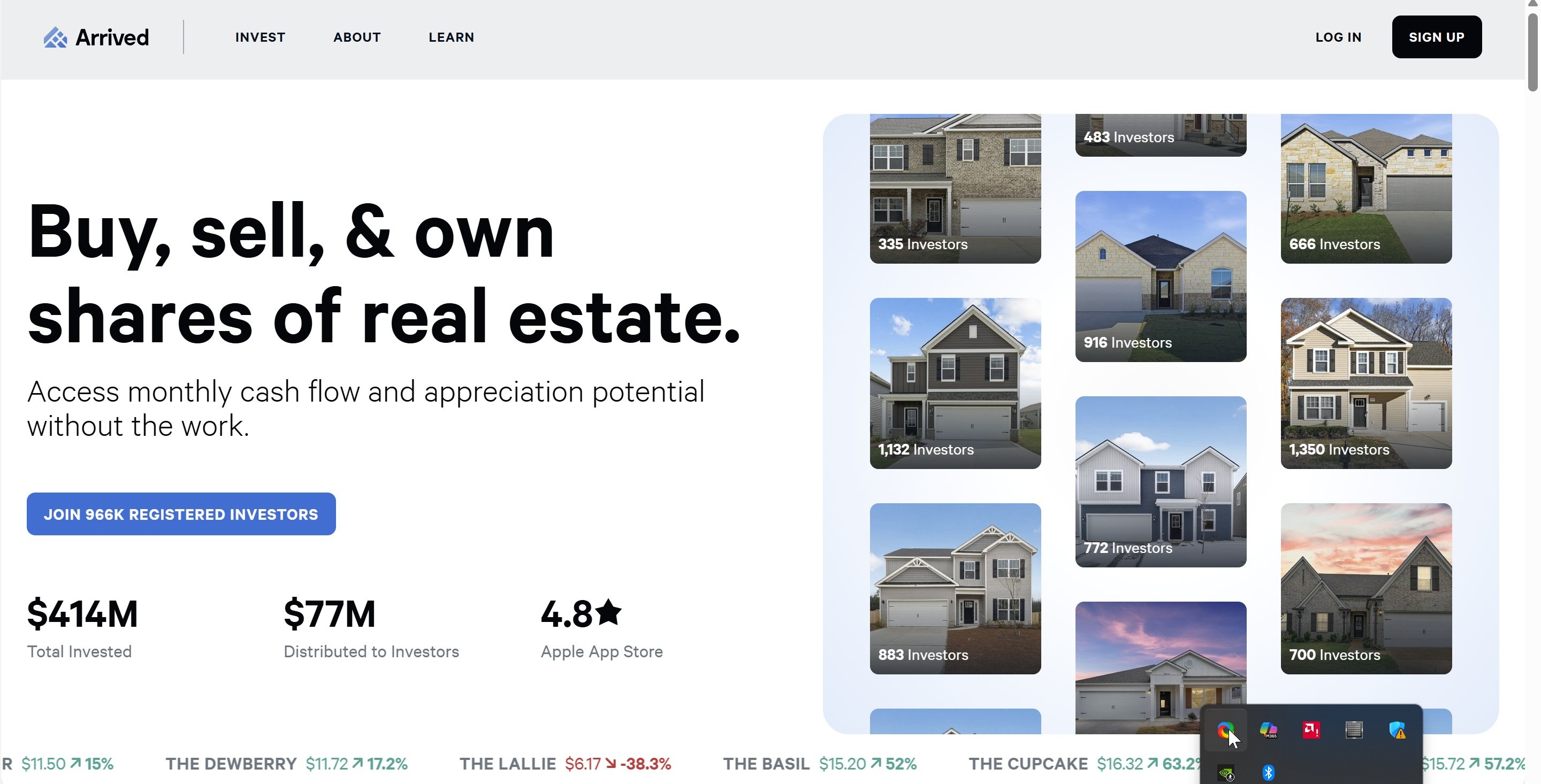
Arrived operates a Regulation A fractional real estate platform enabling non-accredited investors to purchase individual series interests in single-family rentals, short-term rentals, and a private credit fund for as little as $100. Each property is structured as a separate series within a Delaware series LLC — legally segregating assets and liabilities by property. The manager entity, Arrived Fund Manager LLC (a wholly-owned subsidiary of Arrived Holdings Inc.), sources properties, handles acquisitions, manages day-to-day operations, and processes redemptions. Investors receive monthly or quarterly distributions and participate in appreciation upon eventual property sale. The Arrived Debt Fund, a separate Regulation A entity, lends against residential real estate at 9.125%–12.50% interest rates and distributes income monthly. A secondary market exists via PPEX ATS for investors seeking early exits, though liquidity is limited and not guaranteed. Broker-dealer: Dalmore Group LLC (1% fee on offerings). Platform reports 966K registered investors, $414M total invested, $77M distributed as of May 2026.
The platform reports 966K registered investors, $414M total invested, and $77M distributed to investors (May 2026). The portfolio spans 562+ properties funded across equity entities plus a private credit fund ($83.39M total net assets per platform, 50 active loans, 155 loans repaid in full). The Private Credit Fund has delivered 8.1%+ annualized dividend for 22 consecutive months, with a current yield of 8.7% and is the only Arrived entity with audited profitability and a clean opinion. Every equity entity carries a going-concern qualification from Stephano Slack LLC, reflecting the manager entity's continued fundraising reliance to cover operating expenses. Broker-dealer is Dalmore Group LLC (1% fee). Secondary market access via PPEX ATS, including periodic 'Arrived Market Hours' trading windows. NAV determined quarterly by manager using estimated property values — not GAAP fair value compliant. Terms of Service include binding arbitration clause.
Founded & Structure
2019 by Ryan Frazier; headquartered Seattle WA; Arrived Holdings Inc. parent company; nine active Regulation A Tier 2 entities; $40M+ total company funding including Amazon/Bezos strategic investment; broker-dealer Dalmore Group LLC (FINRA registered); secondary market via PPEX ATS (North Capital Private Securities).
Platform Scale (Self-Reported, May 2026)
966K registered investors; $414M total invested; $77M distributed to investors; 562+ properties funded; 66+ active markets across US; 4.8 Apple App Store rating. Note: audited financials show $148M raised in Core SFR through FY2025 — platform figures include all nine entities and unaudited accruals.
Investment Minimums
$100 minimum for all individual property series, SFR Genesis fund, STR funds, and Debt Fund. Non-accredited investors subject to 10% annual income/net worth cap under Reg A Tier 2. No accreditation requirement.
Fee Structure (Individual SFR/STR Series)
3.5% sourcing fee at acquisition (one-time); 1% annual asset management fee; 8% gross rent property management fee (SFR); 20% gross rent property management fee (STR 2); 6–7% gross sale price disposition fee. Plus 1% Dalmore Group broker-dealer fee on offering proceeds. All fees paid to Arrived affiliates.
Fee Structure (Pooled Funds)
Core SFR Fund: 0.25% quarterly (1% annual) AMF — no sourcing or disposition fees disclosed on product page. SFR Genesis: 1% annual AMF. Debt Fund: 1.2% AMF + 1.2% offering service fee + 1% redemption fee (6mo–3yr hold). Meaningfully lower fee burden than individual series.
Disclosed Returns (Platform, May 2026)
Private Credit Fund: 8.7% current annualized dividend yield, 8.1%+ for 22 consecutive months. SFR Fund (Core SFR): 4.4% current dividend. Seattle City Fund: 5.4% current dividend. Individual SFR series: varies by property. Past performance does not guarantee future results.
Tax Treatment
All entities elect REIT status for tax purposes; investors receive 1099-DIV annually. No K-1s. Required to distribute 90% of REIT taxable income. Distributions from equity entities partially represent return of capital given audited net losses.
Redemption & Liquidity
6-month minimum hold period before redemption eligibility. Quarterly redemption windows. SFR Genesis: 100% of $2.81M in FY2025 requests honored. Core SFR: no public disclosure of queue depth or capacity. Redemption fee: 1% for shares held 6 months–3 years; 0% after 3 years (per SFR Fund page). PPEX ATS secondary market available; volume not publicly disclosed.
Audit Status
Auditor: Stephano Slack LLC (PCAOB registered). Going-concern qualification on all equity entities FY2024 and FY2025. Debt Fund: clean opinion FY2025. NAV methodology: manager-calculated quarterly estimates, explicitly stated as non-GAAP fair value compliant.
Visual Summary
Arrived Product Comparison
The nine Arrived entities are not equivalent products. Investors should distinguish between them based on audited financial health, fee structure, and risk profile.
Debt Fund
SFR Genesis / Core SFR
STR / STR 2
Individual SFR Series
ASThe Arrived Structure vs. Reality
- The platform feels like: fractional real estate investing at $100 with monthly income. It behaves like: a Reg A fund complex with going-concern qualifications, affiliate fee dependencies, non-GAAP NAV, and a manager entity whose continued fundraising reliance is the foundation of the entire structure.
- The Debt Fund is the honest product in the portfolio. It earns 5.23% on audited assets, grows organically, and distributes monthly from identifiable loan interest. The equity products are speculative real estate ventures with layered affiliate fees and no audited-profitable entity in the group.
- Fee drag compounds on SFR equity series. A property generating 6% gross rental yield with 8% property management, 1% annual management, and 3.5% sourcing (amortized over 7 years: ~0.5%/yr) results in an investor net rental yield of approximately 3.5-4% before any financing costs or disposition fees. Total return depends entirely on price appreciation.
- Going-concern at the manager level is a structural dependency risk, not an immediate payment default. But if Arrived Holdings slows Reg A fundraising for 12-18 months due to market conditions, regulatory action, or investor sentiment, the bridge loan model that pre-funds property acquisitions collapses. This is the scenario the auditors are flagging.
Key Gaps & Non-Disclosures
- No audited consolidated financials for Arrived Holdings Inc. are publicly available. Investors cannot assess the corporate entity's cash position or debt obligations.
- No disclosure of the total volume or queue depth for Core SFR redemption requests, the largest entity with the most investor capital at stake.
- No public disclosure of PPEX ATS pricing, volume, or bid-ask spreads for individual property series interests.
- No resolution timeline or financial quantification of the STR property manager transition revenue impact.
Platform Intelligence
Arrived Platform Timeline
Key platform events, regulatory turns, liquidity stress points, and product launches that shape how the review should be read.
Founded
Arrived Homes Inc. founded in Seattle by Ryan Frazier. Concept: fractional SFR investing at $100 minimum for non-accredited investors.
First Reg A qualification
Arrived Homes LLC (CIK 1821720) qualifies first Reg A Tier 2 offering. First 1-K filed with SEC.
STR entity launched
Arrived STR LLC launches as separate Reg A entity for short-term rental investments. Dalmore Group LLC named as broker-dealer.
SFR Genesis & Debt Fund launched
Arrived SFR Genesis Fund LLC (pooled SFR fund) and Arrived Debt Fund LLC (private credit) launch as separate Reg A entities.
Amazon / Bezos backing disclosed
Arrived discloses strategic investment from Jeff Bezos and Amazon. Raises platform profile and signals institutional validation.
Going-concern appears across entities
FY2024 1-Ks filed April 2025. Every equity entity receives going-concern qualification from Stephano Slack LLC for the first time.
Homes 4 & 5 rapid scaling
Homes 4 grows from 0 to 31 properties in its first year. Homes 5 launches July 2024, acquires 3 properties by year-end.
Debt Fund triples in size
Arrived Debt Fund grows from $24.4M to $70.3M total assets. 43 loans → 59 loans. Only Arrived entity with clean audit and positive net income ($3.55M).
First property impairment
STR 2 FY2025 filing discloses Vita series classified as held for sale at $621K with $25,339 impairment loss — first impairment across any Arrived entity.
STR revenue declines
Arrived STR reports rental income declining from $2.05M to $1.75M due to property manager transition. Going-concern persists into second consecutive filing year.
Seattle Fund launches
Arrived Seattle Fund LLC (CIK 2065598) files first 1-K. Hybrid SFR/private credit entity focused on Seattle-area properties.
DR Horton builder partnership
Arrived announces partnership with DR Horton on The Rucker (Chattanooga TN): investors receive $89,140 price reduction plus three years of free property management.
FY2025 filings: going-concern persists
All nine FY2025 1-Ks filed April–May 2026. Going-concern qualifications persist on all equity entities for second consecutive year. Debt Fund maintains clean opinion.
Arrived Market Hours launched
Platform introduces 'Arrived Market Hours' — periodic secondary market trading windows hosted by CEO Ryan Frazier. Signals attempt to improve secondary liquidity beyond PPEX ATS.
Investor Operations
The practical questions investors actually care about: when tax documents arrive, how cash distributions work, and whether capital can be exited before the underlying asset is sold.
Tax Documents
K-1 Timing
What to expect
Not applicable — all entities issue 1099-DIV, not K-1.
Extension risk
Generally not required. 1099-DIV typically issued by mid-February, well ahead of April 15 filing deadline.
Confidence: High
Cash Flow
Distributions
Timing
Debt Fund: monthly. SFR and STR pooled funds and individual series: quarterly. First dividend for new investments may take up to 120 days per SFR Fund disclosure.
Consistency
Debt Fund has maintained 8.1%+ annualized yield for 22 consecutive months as of May 2026. SFR equity entities distribute quarterly but amounts vary with occupancy and operating expenses. STR entities have shown declining distribution amounts with revenue decline in FY2025.
Liquidity
Exit Reality
Holding period
6-month minimum holding period before redemption eligibility. Quarterly redemption windows thereafter.
Exit options
- Quarterly redemption through Arrived platform — subject to platform discretion and undisclosed capacity limits
- Secondary market sale via PPEX ATS — volume and pricing not publicly disclosed
- Eventual property sale — proceeds distributed to series investors; no guaranteed timeline
- Periodic 'Arrived Market Hours' secondary trading windows — introduced February 2026
Secondary market
PPEX ATS secondary market exists but transaction volume, pricing, and bid-ask spreads are not publicly disclosed. 'Arrived Market Hours' periodic windows are a positive development but do not constitute liquid secondary trading. Redemption queue capacity at Core SFR is undisclosed. Investors should underwrite these as illiquid 5–7 year holds with best-efforts secondary options.
Confidence: Medium
Investment Structures
Individual SFR Property Series
Each single-family rental property is structured as a separate series within a Delaware series LLC. Investors purchase series interests representing fractional ownership of a single property.
Minimum $100. Rental income distributed quarterly as 1099-DIV.
Property appreciation realized on sale. 6-month holding period before redemption eligibility; quarterly redemption windows thereafter.
Fee structure: 3.5% sourcing fee at acquisition, 1% annual management fee, 8% gross rent property management fee, 6–7% gross price disposition fee. Going-concern qualification on all SFR equity entities.
Best for: investors who want property-level selection and can model fee drag over a 5–7 year hold..
SFR Genesis Pooled Fund / Core SFR Fund
Pooled evergreen funds diversifying across multiple SFR properties within a single entity. SFR Genesis: 47 properties as of FY2025 with 1% annual AMF.
Core SFR (Arrived Homes LLC): 248 properties as of FY2025 with 0.25% quarterly (1% annual) AMF — no sourcing or disposition fees disclosed on fund page. Both pay 1099-DIV quarterly.
Both carry going-concern qualifications. Core SFR has the highest redemption volume but does not publicly disclose queue capacity.
Most appropriate for investors wanting SFR diversification without property-level selection..
STR Property Series and STR Pooled Funds
Short-term rental exposure via individual series (STR LLC, STR 2 LLC). STR 2 carries 20% property management fee (vs 8% on SFR), a disclosed property impairment (Vita series, $25,339 FY2025), and declining revenue from a property manager transition.
Both entities carry going-concern qualifications with audited net losses. STR 2 FY2025: revenue $968K, operating expenses $1.44M, net loss $531K.
Not suitable as primary real estate allocation — treat as speculative given revenue trajectory and fee burden..
Arrived Debt Fund (Private Credit Fund)
The only audited-profitable Arrived entity. Lends against residential real estate (fix-and-flip, bridge, new construction) at 9.125%–12.50% interest.
FY2025: $70.3M total assets, $3.55M net income, 59 active loans, 155 repaid in full, $10.00 NAV/share, clean audit opinion from Stephano Slack LLC. Platform reports current yield 8.7% annualized (May 2026) with 8.1%+ maintained for 22 consecutive months.
Monthly distributions, quarterly liquidity, $100 minimum. Loan mix: 40% fix & flip, 36% bridge, 24% new construction.
$19.75M unfunded loan commitments. This is the Arrived product most supported by audited financials..
Seattle City Fund
Hybrid entity (SFR + private credit) focused on Seattle-area residential real estate. FY2025: $4.8M total assets, 3 properties, 2 loans, $2.3M in related-party notes at 6.5% from Arrived Short Term Notes LLC.
Current dividend yield 5.4% per platform. Going-concern qualification.
At current scale the entity's economics are dependent on related-party financing — limited track record and high operational cost ratios relative to assets under management..
Risk
Risk Structure
This is where the marketplace pitch gives way to the actual operating reality: delayed exits, limited disclosure, fee drag, and path-dependent outcomes.
Continued fundraising reliance at manager level
Arrived Fund Manager LLC depends on continued Regulation A capital raising to fund operating expenses. If fundraising slows materially, the bridge loan model that pre-funds property acquisitions via Arrived Short Term Notes LLC becomes strained. This is the specific risk flagged by auditors — not property-level distress.
Non-GAAP NAV methodology
NAV per share ($10.00–$10.05 across entities) is determined quarterly by the manager using estimated property values. Every 1-K explicitly states this is 'not based on or intended to comply with fair value standards under U.S. GAAP.' Investors cannot independently verify NAV accuracy.
Affiliate fee concentration
All material fees flow to Arrived affiliates: sourcing, management, property management, and disposition. The manager entity controls both the platform and the service providers collecting fees. There is no independent oversight of fee arm's-length pricing.
Liquidity constraints
6-month minimum hold, quarterly redemption windows, undisclosed queue capacity at Core SFR level, and PPEX secondary market with no public volume data. Investors cannot guarantee exit on any specific timeline.
STR operational risk
Both STR entities show declining revenue, going-concern qualifications, and the first impairment in the portfolio (STR 2). The 20% property management fee on STR 2 creates a high cost basis relative to gross rental income.
Related-party financing
Arrived Short Term Notes LLC (related party) provides bridge financing across four entities at 6.5–7.5% interest: Homes 3 ($2.35M), Homes 4 ($8.2M), Homes 5 ($5.6M), Seattle Fund ($2.3M). These intra-platform financial dependencies create refinancing risk if any entity cannot secure third-party debt.
Continued fundraising reliance and operational dependency
Risk Summary
The manager entity depends on uninterrupted Regulation A capital raising to cover operating expenses and service bridge loans from Arrived Short Term Notes LLC. Every equity entity's going-concern qualification reflects this dependency.
Why It Matters
If Arrived Holdings reduced fundraising for 12–18 months due to market conditions, regulatory action, or investor sentiment, the bridge loan model that pre-funds acquisitions would require alternative financing. The auditors flag this specifically as the basis for the going-concern.
Mitigation / Verification
Review the specific going-concern language in each entity's 1-K. Evaluate your position-sizing relative to the operational dependency risk. The Debt Fund is insulated from this dynamic — it earns independently from loan interest.
Fee drag on SFR equity returns
Risk Summary
Individual SFR series carry: 3.5% sourcing fee (one-time, amortized ~0.5%/yr over 7 years), 1% annual management fee, 8% gross rent property management fee, and 6–7% gross price disposition fee.
Why It Matters
At 6% gross rental yield, the property management fee alone (8%) removes 0.48% from annual income. Combined with management and amortized sourcing, investor net rental yield before appreciation may be 3.5–4%. Total return thesis depends entirely on appreciation in a constrained fee environment.
Mitigation / Verification
Use the offering circular fee schedule (not marketing materials) to model net yield. Compare pooled fund fee structures (Core SFR: 1% AMF only) against individual series before allocating.
STR revenue decline and operational disruption
Risk Summary
STR LLC and STR 2 LLC both reported revenue declines in FY2025 attributed to a property manager transition. STR 2 carries a 20% property management fee and disclosed a property impairment.
Why It Matters
Both STR entities generated audited net losses in FY2025. Revenue trajectories are negative. The property manager transition has no disclosed resolution timeline. STR 2 issued the first impairment across any Arrived entity.
Mitigation / Verification
Avoid new STR allocations until at least one full fiscal year demonstrates revenue recovery under the new property manager and going-concern qualifications resolve.
Non-GAAP NAV creates valuation opacity
Risk Summary
Manager-calculated NAV ($10.00–$10.05 across entities) is explicitly stated as non-GAAP fair value compliant in every 1-K. Independent appraisals are not required.
Why It Matters
Investors buying at disclosed NAV cannot independently verify that NAV reflects current market values. In a declining property market, manager-estimated NAV could lag observable market price declines.
Mitigation / Verification
Review the NAV methodology section in the relevant offering circular. Treat disclosed NAV as an approximation. Cross-reference Zillow ZHVI for comparable markets if evaluating specific property series.
Biggest Misconceptions & What Actually Happens
- Common misconception: 'Going-concern means my properties are at risk' → The going-concern is at the manager entity level, not the property series level. The properties hold real assets with positive equity.
- Common misconception: 'The Debt Fund is the same as the SFR funds' → The Debt Fund is a separate entity, audited profitable, clean opinion — structurally different from every equity entity Arrived operates.
- Common misconception: 'I can redeem whenever I need to' → Quarterly windows with platform discretion, 6-month minimum hold, and undisclosed Core SFR queue capacity. Budget for the illiquidity.
- Common misconception: '8% property management is the total fee' → For individual SFR series, the total affiliate fee stack includes sourcing (3.5%), management (1%), property management (8%), and disposition (6–7%). Model the complete stack.
Regulatory & Legal Posture
Security Status
Regulation A Tier 2 securities (Regulation A+), qualified by the SEC. Open to non-accredited and accredited investors. Not registered under the Securities Act of 1933.
All nine Arrived entities qualify offerings under Regulation A Tier 2, which allows raises up to $75M per 12-month period from the general public including non-accredited investors. Investors must meet the 10% income/net worth annual cap for non-accredited participants.
Entities file annual 1-K, semi-annual 1-SA, and current 1-U reports with the SEC — providing more disclosure than Reg D (exempt from registration, no public filing) but less than Reg S-1 (full registration). Broker-dealer: Dalmore Group LLC (FINRA registered).
Secondary market: PPEX ATS (North Capital Private Securities, registered ATS)..
Disclosure Quality
Moderate. Entities file audited annual 1-Ks with full financial statements — a genuine disclosure strength relative to unregistered alternatives. Going-concern qualifications are clearly disclosed in auditor reports. However, individual series-level financial performance within the consolidated entity is not separately reported, NAV methodology is non-GAAP, and the parent company (Arrived Holdings Inc.) files no public financials.
Custody Model
Delaware series LLC structure: each property is a separate series with legally segregated assets and liabilities. Series interests are purchased directly by investors. Arrived Fund Manager LLC controls all management decisions. PPEX ATS provides secondary market matching.
Regulatory Backing
SEC Regulation A Tier 2 qualification provides ongoing reporting obligations and investor protections. PCAOB-registered auditor (Stephano Slack LLC).
Broker-dealer (Dalmore Group LLC) subject to FINRA oversight. No SIPC coverage — these are not brokerage accounts.
No FDIC insurance..
Tax Treatment
Reporting
1099-DIV annually for all nine entities. No K-1s.
1099-DIV issued annually, typically by mid-February following the tax year. All entities elect REIT status and are required to distribute 90%+ of REIT taxable income annually. Distributions from equity entities with audited net losses may include return of capital components.
Income Character
Ordinary REIT dividend income (1099-DIV Box 1a); qualified REIT dividends (Box 5, 20% pass-through deduction eligible under Sec. 199A); return of capital in years with net losses
REIT dividends are generally taxed as ordinary income (not capital gains rates), but the 20% qualified business income deduction under Section 199A may apply to qualified REIT dividends, effectively reducing the tax rate for eligible investors. In years when distributions exceed REIT taxable income — which is likely for equity entities generating audited net losses — a portion of distributions will be classified as return of capital (non-taxable but reduces cost basis) rather than dividend income.
Upon eventual property sale, investors recognize capital gains based on reduced basis..
Limitation
Tax treatment varies by entity and by investor's personal tax situation. The Debt Fund distributes primarily interest income (ordinary income rate). Equity entities with net losses may report complex 1099-DIV composition. Investors should consult a tax professional familiar with REIT distributions and return of capital accounting. IRAs may hold Arrived investments without UBTI concerns (REIT dividends generally do not generate UBTI).
Account Suitability
Taxable
Suitable. 1099-DIV reporting is straightforward relative to K-1 alternatives. Qualified REIT dividend deduction (Sec. 199A) may reduce effective rate. Return of capital tracking required for cost basis management.
Roth IRA
Suitable. REIT dividends generally do not generate UBTI, making Arrived entities more IRA-compatible than partnership-structured alternatives. Tax-free compounding of distributions inside Roth is a genuine advantage for long-hold equity series.
Traditional IRA
Suitable with same UBTI considerations as Roth. Illiquidity creates RMD planning complexity for investors over 73.
HSA
Not suitable. HSA custodians do not accommodate private placements or illiquid alternative investments.
Before You Invest
Get Arrived investor insights before you invest
K-1 timing, distribution updates, yield insights, and risk signals for Arrived and similar platforms.
- Weekly platform research focused on tax timing and liquidity reality.
- Signals on distributions, risks, and structural tradeoffs before capital is locked up.
- Coverage of adjacent platforms so you can compare better options faster.
Get weekly platform signals
Track fee changes, liquidity updates, risk flags, and adjacent platforms before you invest.
Independent intelligence from AltStreet. No hype. No sponsor spin.
AltStreet Data Layer
What the data actually shows
AltStreet analyzed nine SEC-registered Arrived entities from primary 1-K filings (FY2024 and FY2025) plus the arrived.com platform scrape (82 pages, May 2026). Key findings from the primary source data layer:
Debt Fund is a fundamentally different product from the equity entities
Arrived Debt Fund LLC (CIK 2007995): $70.3M total assets FY2025, $3.55M net income, 59 active loans at 9.125%–12.50%, clean audit opinion, $10.00 NAV/share. All other Arrived entities: audited net losses, going-concern qualifications. The Debt Fund grew from $24.4M to $70.3M in one year while maintaining NAV and a 5.23% net income yield.
What this means
Investors should evaluate the Debt Fund separately from the equity product suite. The Debt Fund's audited financials support its marketing; the equity entities do not.
Going-concern is structural, not property-level distress
The going-concern qualification appears in identical language across all nine equity entity 1-Ks: 'lack of liquidity raises substantial doubt.' Individual series hold positive equity — SFR Genesis: $15.9M real estate, $609K liabilities. The concern is at the manager entity level, specifically about continued fundraising reliance.
What this means
Investors conflating going-concern with property-level distress are misreading the risk. The real question is: what happens to the management infrastructure if Reg A fundraising slows materially?
SFR Genesis approaching operational breakeven
SFR Genesis net loss narrowed from $912,934 (FY2024) to $77,166 (FY2025) on a portfolio that grew from 37 to 47 properties. 100% of $2.81M in redemption requests honored FY2025.
What this means
SFR Genesis is the most mature equity entity with the clearest trajectory toward sustainability. If the pooled fund model reaches breakeven, the going-concern may resolve here first.
STR 2 fee and impairment signal warranted caution
STR 2 carries a 20% property management fee (vs 8% on SFR entities), recorded the first impairment across any Arrived entity (Vita series, $25,339), and generated a $531K net loss on $968K revenue in FY2025.
What this means
STR 2 is the highest-risk Arrived entity by audited financials. The 20% property management fee significantly constrains return potential even in a recovering revenue environment.
Data as of 2026-05-10 . AltStreet review evidence layer . Public-source analysis
Full datasetDecision Fit
Investor Fit
Who this works for, who it does not, and what level of patience and complexity tolerance the platform really demands.
Non-accredited investors seeking real estate income exposure
Arrived's Regulation A structure and $100 minimum are genuinely differentiated for non-accredited investors. The Debt Fund specifically — audited profitable, clean opinion, monthly distributions, 8.7% current yield — is the most defensible product by primary source analysis.
For income-oriented non-accredited investors, the Debt Fund offers a rare combination of low minimum, 1099-DIV simplicity, and audited track record..
Accredited investors seeking fractional SFR exposure with property selection
Accredited investors have access to better-capitalized alternatives without going-concern qualifications. Arrived's SFR equity series are appropriate only for small speculative satellite allocations where the investor has modeled total fee drag and is comfortable with the operational dependency risk at the manager level..
Income investors targeting private credit yield
The Debt Fund is the highest-quality Arrived product by audited financials. 8.1%+ yield for 22 consecutive months, $70.3M in assets, clean audit, monthly distributions, $100 minimum.
For investors who want private credit exposure without K-1 complexity or accreditation requirements, this is a credible option — noting that unfunded loan commitments ($19.75M) and related-party note ($2M) warrant monitoring..
Short-term rental investors
Both STR entities carry going-concern qualifications, declining revenue from a property manager transition, 20% property management fees (STR 2), and the first impairment in the portfolio. STR investors have better-established alternatives without these compounding risk factors..
Investors needing near-term liquidity
Quarterly redemption windows with undisclosed Core SFR capacity limits, 6-month minimum hold, and illiquid secondary market make any Arrived equity series inappropriate for capital needed within 12–24 months..
Tradeoffs
Key Tradeoffs
The attraction of pre-IPO access is real, but every benefit comes bundled with a corresponding liquidity, transparency, or pricing cost.
Accessibility vs. financial stability
No platform offers lower minimums ($100) or broader non-accredited access for fractional real estate. The tradeoff is that every equity entity carries going-concern qualifications from its auditor — a structural dependency risk that more established platforms do not carry..
Debt Fund quality vs. equity entity uncertainty
The Debt Fund is audited profitable with a clean opinion and 8.1%+ yield for 22 months. The SFR and STR equity entities are audited loss-making with going-concern qualifications.
Investors who conflate these products will misunderstand the risk profile of their allocation..
Property selection control vs. fee drag
Individual property series allow specific property selection at $100 minimum — genuinely unique. The fee stack (3.5% sourcing + 8% property mgmt + 6–7% disposition) leaves narrow margin for investor return without meaningful appreciation.
Pooled funds reduce fees but eliminate selection..
1099-DIV simplicity vs. return of capital complexity
All entities issue 1099-DIV — dramatically simpler than K-1 alternatives. However, distributions from equity entities with audited net losses include return of capital components that reduce cost basis, creating capital gain recognition complexity on eventual property sale..
Avoid
Who This Is Not For
This section should be read as a filter, not an afterthought. If you need income, simplicity, or near-term access to capital, the structure is working against you.
Emergency Reserves or Near-Term Capital Needs
Six-month holding period, quarterly redemption windows with undisclosed capacity limits, and illiquid secondary market make any Arrived entity inappropriate for capital needed within 12–24 months..
Investors Seeking STR Platform Stability
Both STR entities carry going-concern qualifications, declining or loss-making revenue, a 20% property management fee on STR 2, and the first property impairment in the portfolio. STR-focused investors have better-established alternatives..
Core Real Estate Portfolio Holdings
Going-concern disclosures across all equity entities, affiliate fee complexity, non-GAAP NAV methodology, and limited redemption transparency make Arrived equity series inappropriate as a core real estate allocation. Treat as a speculative satellite position..
Investors comparing Arrived to public REITs
Public REITs offer daily liquidity, independent board oversight, GAAP-compliant financials, transparent NAV on exchange, and no broker-dealer acquisition fees. The only Arrived advantage over public REITs is the $100 minimum and direct property-level selection — features that matter primarily at very small allocation sizes..
Editorial View
AltStreet Perspective
The compressed version of the review: what matters, what marketing tends to obscure, and how we would frame the platform for a serious allocator.
Verdict
The most accessible real estate platform in America — with the most audited uncertainty about whether it can keep operating.
Positioning
Arrived has built something genuinely novel: a Regulation A platform offering $100 fractional SFR and STR investments to non-accredited investors, with 1099-DIV tax treatment, a functional secondary market, and a private credit product that actually generates audited income. That is real. The Debt Fund specifically stands apart — profitable, growing, audited clean, and representing a legitimate retail private credit option at a $100 minimum.
The harder truth is that every equity entity Arrived operates carries a going-concern qualification for the second consecutive year. The auditor's concern is structural — the manager entity's continued fundraising reliance finances operations and bridge loans to property acquisitions. The underlying properties are not distressed: SFR Genesis holds $15.9M in real estate against $609K in liabilities. But the management infrastructure around those properties carries real operational dependency risk not resolved by pointing to property-level equity.
The affiliate fee stack on equity entities is aggressive relative to investor return potential. A 3.5% sourcing fee, 8% property management on gross rents, and 6–7% disposition fee on sale — all flowing to Arrived affiliates — leaves a narrow margin for investor return in a flat or moderately appreciating market. Arrived's strongest investors will be those who understand this math and size positions accordingly: small allocations in the Debt Fund for income, modest speculative positions in mature SFR entities like Homes 3 approaching operational breakeven, and nothing in STR until the property manager transition resolves.
What Arrived is not: a substitute for direct real estate ownership, a public REIT, or a platform with a multi-cycle track record. It is a technology-enabled experiment in retail fractional ownership scaling faster than its financials currently support — with full SEC disclosure, which is precisely what makes it worth analyzing.
The Bottom Line
Arrived is the most accessible real estate platform in America — and the financials of every equity entity it operates raise audited doubt about its ability to continue.
Action
Next Steps
If you still want to engage after reading the review, these are the practical next moves that reduce avoidable mistakes.
The Private Credit Fund page at arrived.com/properties/the-private-credit-fund shows current monthly yield data (8.7% as of May 2026) and the loan mix breakdown. Cross-reference against the Debt Fund 1-K (CIK 2007995): $70.3M assets, $3.55M net income, 59 loans. The platform's $83.39M total net assets figure reflects growth since the FY2025 filing date. Understand the $19.75M in unfunded loan commitments and $2M related-party note before sizing a position.
For SFR equity entities, pull the specific series offering circular from arrived.com/circulars and review the full fee disclosure — sourcing, management, property management, and disposition fees stack in ways that materially affect return modeling.
Model your expected return net of all fees over a 5–7 year hold before investing in any individual SFR series. At 5% gross yield with 8% property management and 3.5% sourcing amortized over 7 years, investor net rental yield before appreciation is thin.
Verify current redemption policy and any pending queue information through the Arrived investor portal — the 1-K filings do not disclose Core SFR redemption volume or capacity limits.
Treat any Arrived equity allocation as a small satellite position — not a core real estate holding — until the going-concern qualifications resolve and at least one full property cycle demonstrates audited investor returns.
For tax planning: confirm with a tax professional how return of capital distributions from equity entities (reporting audited net losses) will affect your cost basis and eventual capital gain recognition on property sale.
Appendix
Sources, Disclosures, and Supporting Context
The lower section is structured like a report appendix: relationship context first, adjacent reading second, and evidence last.
Report Appendix
Disclosure
Relationship and compensation context
+
Report Appendix
Disclosure
Relationship and compensation context
Report Appendix
Related Resources
Adjacent platform comparisons, frameworks, and category links
+
Report Appendix
Related Resources
Adjacent platform comparisons, frameworks, and category links
Further Reading
Related Resources
Adjacent frameworks and reviews that help place the platform in a broader allocation or due-diligence context.
Explore Asset Class
Residential Real Estate / Private CreditDeep Dive Guide
Arrived vs Fundrise: Primary Source ComparisonFund Landscape
Similar Platform Reviews
- Fundrise
Larger scale ($3B+ AUM), vertically integrated eREITs and interval funds, going-concern at corporate parent level — similar structural dynamic, different product mix and longer track record
- Steward
Agricultural lending via promissory notes, zero defaults across 26 quarters, non-accredited eligible, 1099-INT tax treatment — private credit comparison to Arrived Debt Fund
- AcreTrader
Accredited-only farmland equity platform; no going-concern issues; EDGAR-verified exit data; K-1 tax reporting; higher minimums — institutional-quality alternative to Arrived SFR equity
Report Appendix
Evidence & Methodology
Sources, scope, and how the review was assembled
+
Report Appendix
Evidence & Methodology
Sources, scope, and how the review was assembled
ASReview Evidence
Methodology
Analysis based exclusively on primary SEC filings: nine Form 1-K annual reports filed April-May 2025 (FY2024) and April-May 2026 (FY2025) by all active Arrived entities; Form 1-SA semi-annual statements; Regulation A offering circulars and amendments. All financial figures from audited financial statements prepared by Stephano Slack LLC (PCAOB ID #03523). Secondary: arrived.com platform scrape (82 pages, May 10 2026) and arrived_dossier_20260510_093821_enhanced.json.
Scope
Primary: Nine SEC-registered entities: Arrived Homes LLC (CIK 1821720), Arrived SFR Genesis Fund LLC (CIK 1982615), Arrived STR LLC (CIK 1942208), Arrived STR 2 LLC (CIK 1968039), Arrived Homes 3 LLC (CIK 1962723), Arrived Homes 4 LLC (CIK 2015697), Arrived Homes 5 LLC (CIK 2032732), Arrived Debt Fund LLC (CIK 2007995), Arrived Seattle Fund LLC (CIK 2065598). Secondary: arrived.com platform scrape (82 pages, May 10 2026).
Key Findings
- *Going-concern qualification appears in identical form across all nine equity entity 1-Ks for FY2024 and FY2025: 'lack of liquidity raises substantial doubt about the ability to continue as a going concern' — Stephano Slack LLC audit reports
- *Arrived Debt Fund FY2025: $70.3M total assets, $3.55M net income, 59 loans at 9.125%-12.50%, $10.00 NAV/share, clean audit opinion — per audited balance sheet and income statement
- *SFR Genesis net loss narrowed from $912,934 (FY2024) to $77,166 (FY2025); $2.81M in redemptions honored FY2025 with 100% of requests fulfilled — per FY2025 1-K
- *STR 2 FY2025: 20% property management fee (vs 8% on SFR entities); Vita series impairment loss $25,339; revenue $968K vs. expenses $1.44M — per audited income statement
- *Arrived Short Term Notes LLC related-party bridge financing: Homes 3 ($2.35M), Homes 4 ($8.21M mortgage FY2025), Homes 5 ($5.6M FY2025), Seattle Fund ($2.3M) — per respective 1-K notes to financial statements
- *NAV methodology disclosure in every 1-K: 'NAV determination is not based on nor intended to comply with fair value standards under U.S. GAAP' — verbatim from offering circulars and 1-K filings
- *Platform homepage (May 2026): 966K registered investors, $414M total invested, $77M distributed to investors, 4.8 Apple App Store rating — platform self-reported figures
- *Private Credit Fund product page: 8.1%+ annualized dividend for 22 consecutive months; current yield 8.7%; $83.39M total net assets; 50 active loans; 155 loans repaid in full — platform disclosure
- *SFR Fund product page: 1% annual asset management fee (0.25% quarterly); 6-month holding period before redemption; 1% redemption fee for shares held 6mo-3yr; 0% redemption fee after 3 years; first dividend may take up to 120 days — platform disclosure
- *Terms of Service (last updated Dec 2020): binding arbitration clause waiving class action and jury trial rights — arrived.com/terms-of-service
- *DR Horton partnership (The Rucker, Chattanooga TN): $89,140 price reduction plus three years of free property management fees for Arrived investors — platform product page
Primary Source Pages
FAQ
Frequently Asked Questions
High-intent search questions answered directly, without making users hunt through the full review.
What does the going-concern disclosure actually mean for investors?
The going-concern qualification in every Arrived equity entity's audit report reflects the manager entity's continued fundraising reliance to cover operating expenses — not distress in the underlying properties. Individual series hold real assets with positive equity. If Arrived Holdings ceased operations, the properties would still exist and could be managed by a third party or liquidated. The risk is operational disruption and management transition, not property-level loss.
Is the Debt Fund different from the equity entities?
Yes, materially. The Arrived Debt Fund (CIK 2007995) is the only Arrived entity with a clean audit opinion and positive net income — $3.55M in FY2025 on $70.3M in assets. It lends against residential real estate at 9.125%-12.50% with monthly distributions. It is structurally separate from the SFR/STR entities, has stable $10.00 NAV, and grew nearly 3x in FY2025. For yield-seeking investors, it is the most defensible Arrived product by audited financials.
What are the total fees on SFR equity entities?
Sourcing fee: 3.5% of acquisition price (one-time). Annual management fee: 1% of NAV. Property management fee: 8% of gross rents (SFR) or 20% (STR 2). Disposition fee: 6-7% of gross sale price. Plus 1% Dalmore Group broker-dealer fee on offering proceeds. All fees flow to Arrived affiliates. The Debt Fund carries: 1.2% AMF plus 1.2% offering service fee plus 1% redemption fee for shares held 6 months to 3 years.
How does redemption actually work?
Investors must hold shares for at least six months before requesting redemption. Requests are processed quarterly. SFR Genesis honored 100% of $2.81M in FY2025 requests. Core SFR (248 properties) does not disclose redemption volume, queue depth, or capacity limits in public filings. A PPEX ATS secondary market also exists, but transaction volume and pricing are not publicly disclosed.
How is NAV calculated and can I trust it?
Arrived determines NAV quarterly using estimated property values and market data — a process controlled by the manager. Every 1-K filing explicitly states that 'NAV determination is not based on nor intended to comply with fair value standards under U.S. GAAP.' Treat disclosed NAV ($10.00-$10.05 across entities) as an approximation, not a market-clearing price.
Is Arrived suitable for IRAs?
Yes — REIT structures generally do not generate unrelated business taxable income (UBTI), making Arrived entities more IRA-compatible than partnership-structured alternatives. The Debt Fund's monthly distributions are the most predictable cash flow for RMD planning. Confirm with your IRA custodian and tax adviser before investing.
What is the Private Credit Fund's current yield?
The Arrived Private Credit Fund reported a current annualized yield of 8.7% as of May 2026, with 8.1%+ annualized yield maintained for 22 consecutive months. The fund held $83.39M in total net assets (platform disclosure, May 2026) vs. $70.3M in the FY2025 audited balance sheet — reflecting continued growth after the reporting date. Loan mix: 40% fix and flip, 36% bridge, 24% new construction. Monthly distributions. $100 minimum.
How does Arrived compare to Fundrise?
Both platforms offer fractional real estate at low minimums with 1099-DIV tax treatment. Fundrise is larger ($3B+ AUM), has more diverse product types, and a longer operating history. Both carry going-concern disclosures at the manager/parent level. Arrived's key differentiator is property-level selection and the $100 minimum. Fundrise's key differentiator is scale, product breadth, and more established redemption track record.