
Energea
Energea is not a solar ETF — it's a private equity structure with a $100 entry point. Four global portfolios (USA, Brazil, Africa, LATAM), 6-8% hurdle rates, 20% carry, C-corp tax election (1099-DIV not K-1 on most funds), 3-year minimum hold with no guaranteed redemption.
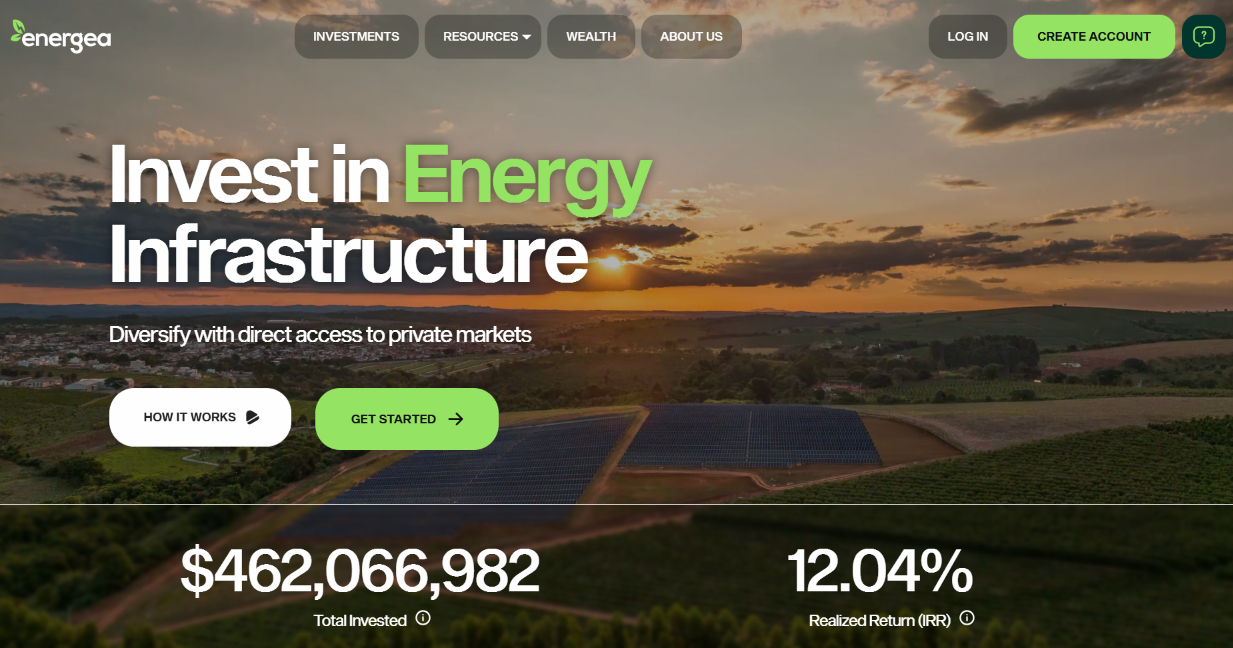
What the data actually shows - TL;DR
Energea is not a solar ETF with a $100 entry point — it's a private equity structure that happens to have a $100 entry point. Four global portfolios, C-corp tax election on most funds (1099-DIV), 20% carry, and discretionary redemptions.
Key fields confirmed from AltStreet PPM extractions of Portfolios 2, 3, 4, and 5 offering circulars. Form D data covers all 7 Energea EDGAR entities.
Quick Verdict
Is this platform right for you?
Energea offers genuine retail access to international solar infrastructure investing at $100 minimum — a real structural differentiator. The C-corp tax election on most portfolios eliminates K-1 complexity and is investor-friendly. The concerns are specific and documented: three funds disclose prior Reg A compliance issues, the platform controls all operational decisions with limited investor recourse, FX risk on international portfolios can offset strong project returns, and redemption approval is discretionary with no published approval rate. Best as a 5-15% satellite allocation for patient capital seeking real asset exposure and impact alignment.
Best for
- Impact-focused investors seeking direct renewable energy exposure at low minimums
- Non-accredited investors wanting alternative asset access — rare at this price point
- Investors who want C-corp tax treatment (1099-DIV) rather than K-1 complexity
- Patient capital with 5-10 year horizons comfortable with illiquidity and FX risk
Avoid if
- You need liquidity within 5 years — redemptions are discretionary, not guaranteed
- You require zero compliance risk tolerance — three portfolios disclose rescission exposure
- You need certainty on Portfolio 4 (USA) tax treatment before committing
- You are relying on this as core income — distributions are variable and not guaranteed
Top strengths
- C-corp tax election on Portfolios 2, 3, and 5 — 1099-DIV, not K-1 complexity
- $100 minimum with non-accredited access via Reg A+ Tier 2
- Four geographies with distinct risk/return profiles and confirmed hurdle rates
- Monthly distribution model from operating solar projects with long-term PPAs
- 20% carry only above hurdle rates — no fee if no outperformance
Key limitations
- Prior Reg A compliance issues across three of four OC-sourced portfolios
- Redemptions are discretionary — no guaranteed exit after minimum hold
- FX risk on Brazil (BRL), Africa (ZAR), LATAM (multi-currency) with no hedging policy
- Platform acts as developer, operator, and fund manager simultaneously — conflict risk
- Portfolio 4 (USA) tax election unconfirmed — may issue K-1
Compare Before Deciding
Where Energea fits against alternatives
Use these hooks to pressure-test whether this is the right platform, or whether a nearby alternative matches the job better.
How this compares to WattFunders
WattFunders
USA-focused solar crowdfunding with different fee structure
How this compares to Brookfield Renewable Partners (BEP)
Brookfield Renewable Partners (BEP)
Publicly-traded yieldco offering daily liquidity, 6-9% yields
Quick Answers
What most investors want to know first
The highest-signal facts first: minimums, liquidity reality, K-1 timing, and whether distributions are actually part of the experience.
Liquidity
3-year minimum hold required. After 3 years, may request redemption but platform not obligated to approve—granted at Energea's discretion based on capital availability. No secondary market, no guaranteed pricing. Actual hold periods likely 5-10+ years.
Overview
Platform Overview
A concise read on what the platform is, how the structure works, and where the practical friction shows up for real investors.
Crowdfunding platform offering equity ownership in portfolios of operating solar energy projects across four geographies: USA (Portfolio 4), Brazil (Portfolio 2), Africa/South Africa (Portfolio 3), and Latin America (Portfolio 5). Investors purchase LLC membership interests in geographic portfolio companies (SPVs) that own and operate solar installations selling power under long-term contracts (PPAs). Minimum investment $100, accessible to non-accredited investors through Regulation A+ offerings. Platform manages entire project lifecycle: development, construction, operation, monitoring. Investors receive monthly distributions from project cash flows and potential equity appreciation upon project sale/refinancing. Target returns 7-14% IRR depending on geography, with hurdle rates of 6-8% before 20% carried interest. Critical tax note: Portfolios 2 (Brazil), 3 (Africa), and 5 (LATAM) have elected C-corp treatment — investors receive 1099-DIV, not K-1. Portfolio 4 (USA) tax election unconfirmed as of April 2026. Fee structure: ~2% annual management fee on invested capital (0.167%/month; Africa PPM states 1.5% — discrepancy under review) plus 20% carried interest above hurdle rates.
Platform operates through SEC-registered offerings (Regulation CF and Regulation A+) allowing both accredited and non-accredited investors to participate with $100 minimums. Investment structure: LLC membership interests in geographic portfolio companies owning operating solar installations selling electricity under long-term power purchase agreements (PPAs) with utilities and commercial customers. Per platform materials: Over $100M AUM, 11%+ historical IRR, team participated in 500+ directly developed projects plus 14,000+ across prior roles and partnerships totaling 365MW. Target returns by geography: USA ~11-12% IRR, Brazil ~14-16% IRR, Africa similar to Brazil. CRITICAL: For Brazil and Africa portfolios, currency movement may matter as much as solar performance—local revenue in BRL and African currencies exposes USD investors to FX depreciation potentially offsetting operational returns. Fee structure confirmed from OCs: ~2% annual management fee on invested capital (0.167%/month; Africa states 1.5%) plus 20% carried interest above hurdle rates of 6-8% by geography. Monthly distributions paid from project cash flows; investors also receive equity appreciation upon project sales/refinancing. Minimum 3-year holding period with redemption requests considered after 3 years but not guaranteed—no formal secondary market. Platform provides monthly updates, quarterly webinars, project monitoring apps (iOS/Android), and educational content. Regulatory: Offerings registered under Regulation A+ Tier 2. Non-accredited investors subject to annual investment limits. Critical: Portfolios 2, 3, and 5 have elected C-corp treatment — investors receive 1099-DIV, not K-1. Portfolio 4 (USA) tax election unconfirmed. All three OC-sourced portfolios disclose prior Reg A compliance issues with rescission exposure. Suitable for: Impact-focused investors, those comfortable with 3+ year illiquid holds, diversification seekers adding uncorrelated real assets, and income-oriented investors who accept variable distributions. Not suitable for: Investors requiring liquidity or short hold periods, conservative investors uncomfortable with emerging market risks, those expecting bond-like stability, and investors unable to evaluate complex international project structures.
Platform Structure & Access
SEC-registered crowdfunding platform (Reg CF and Reg A+) open to accredited and non-accredited investors. $100 minimum per portfolio, $10 increments thereafter. Non-accredited subject to annual investment limits based on income/net worth. Web dashboard plus iOS/Android apps for portfolio management.
Investment Products
Four active geographic portfolios: Portfolio 2 — Solar in Brazil (C-corp, 1099-DIV, 7% hurdle, BRL exposure, ~$50M target raise); Portfolio 3 — Solar in Africa/South Africa (C-corp, 1099-DIV, 8% hurdle, ZAR/USD FX risk, 36-month lockup); Portfolio 4 — Solar in USA (tax election unconfirmed, 6% hurdle, Plankton Asset Mgmt affiliate); Portfolio 5 — Solar in LATAM (C-corp, 1099-DIV, 7% hurdle, multi-country). Energea Core provides automated allocation across open portfolios. Each portfolio is a separate LP with distinct PPA counterparties, currency profiles, and risk/return targets.
Fee Structure
Two-tier fees confirmed from offering circulars: (1) Management Fee: ~2% annually (0.167%/month) on invested capital — Africa PPM states 1.5%, discrepancy under review; no fee if no capital deployed that month. (2) Carried Interest: 20% of returns above hurdle rates (6% USA, 7% Brazil/LATAM, 8% Africa). Marketing reimbursement up to 5% of total raise and origination fees up to 5% are additional cost layers disclosed in offering circulars. All performance figures shown on platform are net of fees.
Geographic Diversification
Four geographies, four risk profiles: USA/Portfolio 4 (USD-denominated, 6% hurdle, regulatory stability, ITC/PTC eligible, tax election unconfirmed); Brazil/Portfolio 2 (BRL exposure, 7% hurdle, 15-25yr PPAs, rescission $10.53M disclosed); Africa-South Africa/Portfolio 3 (ZAR exposure, 8% hurdle, 36-month lockup, BTG/Brookfield/Victory Hill JV relationships, rescission $1.82M); LATAM/Portfolio 5 (multi-country, 7% hurdle, multi-currency, rescission disclosure pending). Higher hurdle rates on international portfolios compensate for FX and political risk.
Liquidity & Hold Period
3-year minimum hold required. After 3 years, may request redemption but platform not obligated to approve—granted at Energea's discretion based on capital availability. No secondary market, no guaranteed pricing. Actual hold periods likely 5-10+ years.
Revenue Model & Distributions
Solar projects generate revenue from selling electricity under long-term PPAs (typically 15-25 year contracts with utilities, corporations, governments); contracts often include inflation escalators providing inflation protection. Monthly distributions paid to investors from project cash flows after operating expenses and reserve accounts. Distribution amounts variable depending on solar production (weather-dependent), electricity prices, O&M costs, and debt service; not guaranteed and may be reduced/suspended.
Team & Track Record
Founded by Mike Silvestrini (500+ solar projects developed) and Chris Sattler (energy and private markets background); team includes Gray Reinhard (CTO) and Isabella Mendonça (General Counsel). Team participated in 500+ directly developed projects plus 14,000+ across prior roles and partnerships (23 states, 3 continents, 365MW installed). Platform positioned itself as an early mover in renewable energy crowdfunding in the United States.
Performance Data
Platform reports 11%+ historical IRR (net of fees). IRR represents total return including monthly distributions AND equity appreciation—not distribution yield alone. Limited granularity on individual projects or vintage performance. Performance may reflect survivorship bias if failed projects excluded.
Project Types & Contracts
Operating solar projects: utility-scale ground arrays, commercial rooftop, community solar. All backed by long-term PPAs (15-25 years) with counterparties ranging from utilities to corporate/government offtakers. Contract structures may include fixed-price or escalation clauses, and may involve REC sales. Most projects operational before investor inclusion (some development-stage possible).
Regulatory Compliance
Offerings registered under SEC Reg A+ Tier 2; allows non-accredited participation with investment limits. Platform files Offering Circulars with business and project details, financials, risk factors, and use of proceeds. Ongoing annual reports required. Critical tax note: Portfolios 2, 3, and 5 have elected C-corp treatment — investors receive 1099-DIV (dividends) and 1099-B (return of capital), not K-1. Portfolio 4 (USA) tax election unconfirmed — may issue K-1. All three OC-sourced portfolios disclose prior offering rescission exposure from Reg A compliance issues.
Investor Communication
Monthly email updates with production data and operational status. Quarterly investor webinars with management Q&A. Online dashboard showing portfolio value, distributions earned, and project details. Educational content library including glossary resources.
Currency Exposure & FX Risk
USA portfolio: USD-denominated (no FX risk for US investors). Brazil: Revenue in Brazilian Real (BRL)—depreciation versus USD reduces returns. Africa: Multiple currencies (ZAR, others) create additional FX complexity. Platform does not disclose hedging strategies; investors bear currency risk.
Investment Structures
Geographic Portfolio LLCs (Reg CF / Reg A+)
Individual portfolios organized by geography: USA Solar, Brazil Solar, Africa Solar. Each portfolio is a separate LLC registered under SEC Regulation CF (smaller raises) or Regulation A+ (larger raises) allowing non-accredited investor participation.
Investors purchase membership interests representing fractional ownership in an LLC that owns operating solar projects in that region. $100 minimum per portfolio; subsequent $10 increments.
LLC pays monthly distributions from project cash flows pro-rata to members. 3-year minimum hold with potential redemptions at platform discretion thereafter.
Structure provides direct exposure to specific geography and associated risks/returns (USA lower risk ~11-12% target, Brazil/Africa higher risk ~14-16% targets). Tax reporting depends on portfolio: Portfolios 2, 3, and 5 issue 1099-DIV (C-corp election); Portfolio 4 (USA) unconfirmed.
Suitable for investors wanting targeted geographic exposure or willing to manually diversify across regions..
Energea Core (Automated Diversification)
Automated investment product allowing investors to customize allocation percentages across all open portfolios (USA, Brazil, Africa) in a single workflow. Investors set desired portfolio weights (e.g., 50% USA, 30% Brazil, 20% Africa) and the platform allocates capital across regions accordingly.
Enables diversification with one decision versus purchasing each portfolio individually. Minimum $100 total investment with customizable splits.
Same fee structure and holding period as individual portfolios (~2% management fee on invested capital, 20% carry above hurdle rates, 3-year minimum). Suitable for investors seeking simplified geographic diversification; requires understanding each underlying portfolio's risks to make informed allocation decisions..
Self-Directed IRA Investments
Platform is compatible with some self-directed IRA custodians, allowing investors to hold solar project equity in tax-advantaged retirement accounts. Investors work with an IRA custodian to direct funds into Energea portfolio offerings; distributions flow back to the IRA maintaining tax-deferred or tax-free status (traditional or Roth).
However, most Energea portfolios have elected C-corp treatment, which reduces (but may not eliminate) UBTI risk compared to partnership structures. Portfolio 4 (USA) tax election unconfirmed — verify before using IRA funds for that portfolio.
Renewable energy tax credits (ITC) typically provide limited benefit inside tax-exempt accounts. Some self-directed IRA custodians charge additional fees for alternative assets.
Illiquidity can also create a mismatch with RMD needs for older investors. Consult a tax advisor experienced with UBTI before using retirement funds..
Risk
Risk Structure
This is where the marketplace pitch gives way to the actual operating reality: delayed exits, limited disclosure, fee drag, and path-dependent outcomes.
Illiquidity and 3-year minimum hold
No formal secondary market; redemptions after 3 years at platform discretion, not guaranteed—investors should assume 5-10 year actual hold periods treating redemption option as uncertain exit feature rather than reliable liquidity. Monthly distributions provide some cash return but underlying equity positions are long-term illiquid investments.
Currency exposure in Brazil/Africa portfolios
Projects in Brazil generate revenue in Brazilian Real (BRL), Africa projects in local currencies (ZAR, others)—currency depreciation versus USD reduces investor returns when converted. No disclosed currency hedging means investors bear FX risk. Diversification across currencies provides some natural hedge, but emerging market exposure during sustained USD strength cycles can materially impact realized returns.
Crowdfunding structure and regulatory exemptions
Regulation CF and Reg A+ offerings involve different disclosure and reporting regimes than fully registered securities (mutual funds, ETFs)—investor protections and transparency may be more limited, and redemption/liquidity is not standardized. Non-accredited access expands availability, but investors should expect less uniform disclosure than public-market funds and conduct independent due diligence.
Platform operational dependency
Energea serves as managing member of portfolio LLCs with control over project operations, vendor selection, capital decisions, and redemption approvals—investors are passive members with limited recourse. Platform failure, mismanagement, or key-person departures can affect all holdings. Independent oversight is limited in many portfolio structures.
Fee structure impact on net returns
Confirmed fees from OCs: ~2% annual management on invested capital plus 20% carried interest above hurdle rates (6-8% by geography). For projects achieving 15% gross IRR, carry on excess returns reduces net investor IRR by roughly 1-2 percentage points. GP has discretion to reduce or defer fees, creating uncertainty about total cost.
Illiquidity and uncertain redemption timing
Risk Summary
3-year minimum holding period with no formal secondary market—after 3 years, investors may request redemptions but the platform is not obligated to approve. Redemption timing, pricing methodology, and approval criteria are not consistently disclosed, creating a realistic possibility of 5-10+ year holds or extended lock-up periods.
Why It Matters
Monthly distributions can create an expectation of liquidity similar to publicly traded income vehicles, but these positions are private LLC interests. Investors needing principal access within 3-5 years face exit risk. Redemption pricing (if granted) could reflect a discount to internal valuations depending on platform-set terms.
Mitigation / Verification
Only invest capital that can remain committed for 5-10 years; treat redemption as an optional feature, not a plan. Diversify across platforms and structures to reduce single-platform exposure. Request disclosure on historical redemption approvals, timing, and pricing methodology. Consider public-market alternatives if liquidity is required.
Currency risk and emerging market exposure
Risk Summary
Brazil and Africa portfolios generate revenues in local currencies (BRL, ZAR, others), exposing USD investors to FX swings. Currency depreciation can offset operational performance: a strong local project may still deliver weaker USD returns if FX moves against investors. The platform does not disclose systematic FX hedging, so investors generally bear currency risk.
Why It Matters
Emerging market currencies can depreciate sharply during risk-off cycles, potentially reducing or negating the return premium versus USA-only portfolios. FX risk compounds operational risk—both can move against investors at once.
Mitigation / Verification
Limit Brazil/Africa exposure within the Energea allocation if FX volatility is a concern; overweight USD-denominated portfolios for simplicity. Ask for disclosure on any hedging policies and how FX impacts reported performance. Diversify the broader portfolio with USD assets to offset EM currency exposure.
Project operational and performance risk
Risk Summary
Solar project returns depend on production (weather and irradiance), uptime, O&M costs, equipment degradation, interconnection/grid constraints, and PPA terms. Projects can underperform projections due to lower-than-modeled production, outages, maintenance surprises, or counterparty payment issues.
Why It Matters
Target IRRs assume baseline operating performance. Persistent production shortfalls, higher costs, or PPA disputes can reduce cash available for distributions and lower realized total returns. Aggregate portfolio reporting may obscure dispersion across projects.
Mitigation / Verification
Review offering documents for project assumptions, PPA counterparties, and stress cases. Diversify across geographies and vintages. Track monthly updates for production vs projections and ask for historical forecast accuracy if available.
Platform dependency and key-person risk
Risk Summary
Energea controls portfolio LLCs as managing member, including operations, vendor relationships, reserves, and redemption approvals. Investors are passive with limited governance rights. Operational missteps, personnel changes, or platform distress could affect all holdings.
Why It Matters
This is a single-operator risk concentration. Unlike public funds with standardized governance and external oversight, many crowdfunding structures depend heavily on the sponsor’s competence and integrity.
Mitigation / Verification
Avoid concentration in a single platform. Review disclosures on related-party transactions, governance, and asset segregation. Monitor communication cadence, operational consistency, and any delays in distributions or reporting quality.
Fee drag and carried interest impact
Risk Summary
Management fees (~2% on invested capital) plus carried interest (20% above hurdle rates of 6-8%) can materially reduce net returns. Even moderate outperformance triggers carry, shifting upside to the sponsor. Additional cost layers (origination up to 5%, marketing reimbursement up to 5%) disclosed in offering circulars.
Why It Matters
Fees reduce compounding over multi-year holds and may leave investors with a smaller share of upside than headline project economics imply. Comparing net-of-fee outcomes to public alternatives (ETFs/yieldcos) is essential.
Mitigation / Verification
Model net returns under multiple scenarios. Compare to liquid renewables exposure (yieldcos/ETFs/green bonds). Confirm whether performance figures shown are net of fees and how carry is calculated for each offering.
Regulatory & Legal Posture
Security Status
Securities offered under SEC Regulation Crowdfunding (Reg CF, Section 4(a)(6) exemption) and/or Regulation A+ (Tier 2 qualified offering); LLC membership interests representing equity ownership in portfolio companies; offerings open to accredited and non-accredited investors, with annual investment limits for non-accredited investors based on income/net worth
Crowdfunding exemptions allow companies to raise capital from the general public without full SEC registration. Reg CF permits smaller raises with simplified disclosure requirements and Form C filings; Reg A+ Tier 2 permits larger raises with offering circulars and ongoing reporting, but still differs from fully registered offerings.
Both frameworks require disclosures covering business description, financial statements (requirements vary by exemption and raise size), risk factors, and use of proceeds. However, disclosure and investor protections are generally less comprehensive than registered securities (mutual funds, REITs, ETFs).
Non-accredited investors are subject to annual investment limits across crowdfunding offerings; specific thresholds can change over time and should be confirmed in current SEC guidance and in the active offering documents (limits referenced by platforms are often updated periodically). Platform materials indicate ongoing filings and periodic reporting; investors should review current offering documents on the platform and/or SEC EDGAR before investing..
Disclosure Quality
Moderate transparency through offering documents, monthly updates, and quarterly webinars—often better than some crowdfunding platforms, but less standardized than public companies or registered funds. Offering documents may include project locations, capacity, PPA descriptions, projections, and risk factors. However, project-level attribution is limited, redemption policy details are often vague, FX impact is not always quantified, and fee waterfalls can be hard to model without full disclosures. Investors should expect crowdfunding-level disclosure, not public-fund-level transparency.
Custody Model
Investor funds held via platform payment rails (e.g., ACH transfer partners) before deployment into specific portfolio LLCs; after investment, ownership interests are private LLC membership records maintained via cap tables rather than brokerage custody. These are private company interests, not exchange-traded shares; SIPC-style brokerage protections generally do not apply to investment performance.
Regulatory Backing
Reg CF and Reg A+ provide a securities-law framework for offering and disclosure, but they do not provide FDIC insurance (bank deposits) or SIPC protection (broker insolvency) for investment outcomes. Investor rights are primarily contractual (Operating Agreements) and statutory (anti-fraud securities laws).
LLC structures can provide some asset segregation, but operational control typically rests with the managing member; investors should evaluate governance, related-party disclosures, and sponsor reliability..
Tax Treatment
Reporting
1099-DIV and 1099-B for Portfolios 2 (Brazil), 3 (Africa), and 5 (LATAM) — C-corp election confirmed. Schedule K-1 (Form 1065) possible for Portfolio 4 (USA) — tax election unconfirmed as of April 2026.
Portfolios with C-corp election (2, 3, 5) issue 1099-DIV for dividend distributions and 1099-B for return of capital events. This is significantly simpler than K-1 partnership reporting — no multi-state pass-through complexity, no phantom income, no partnership-level deductions. However, C-corp treatment means foreign tax credits generated by international operations (Brazil, Africa) are retained at the entity level and not passed to investors. Portfolio 4 (USA) tax election unconfirmed — check current offering circular before assuming 1099 treatment.
Income Character
Dividend income (1099-DIV) for most portfolios — C-corp election confirmed on Portfolios 2, 3, and 5. Return of capital events reported on 1099-B. Portfolio 4 (USA) may issue K-1 if partnership taxation applies.
C-corp tax election means investors are treated as shareholders in a corporation rather than partners in a pass-through entity. Distributions are classified as dividends (1099-DIV) or return of capital (1099-B) depending on whether the entity has earnings and profits.
This is materially simpler than K-1 partnership taxation — no phantom income, no passive activity limitations, no multi-state pass-through filings. The tradeoff: foreign tax credits generated by Brazilian and African operations are retained at the C-corp entity level rather than being passed to investors.
For investors in the international portfolios, this is a meaningful structural disadvantage relative to a pass-through that would allow foreign tax credits to flow through. Portfolio 4 (USA) tax treatment unconfirmed — review current offering circular for confirmation..
Limitation
C-corp election eliminates K-1 complexity for most investors but creates a layer of entity-level taxation before distributions reach investors. Foreign tax credits on international income are not available to investors. Portfolio 4 (USA) may differ — verify tax treatment in the offering circular before assuming 1099 reporting. Consult a tax professional familiar with C-corp fund structures and international solar investments.
Account Suitability
Taxable
Suitable — C-corp election on Portfolios 2, 3, and 5 eliminates K-1 complexity and multi-state pass-through burden. Distributions taxed as qualified dividends or return of capital. Simpler than traditional partnership structures; foreign tax credit pass-through not available on international portfolios.
Roth IRA
More viable than with K-1 structures — C-corp election reduces UBTI risk since distributions are dividends rather than partnership income. Self-directed IRA custodians still charge administrative fees for alternative assets, and illiquidity creates RMD mismatch for investors 73+. Confirm with custodian before proceeding.
Traditional IRA
Similar to Roth IRA — C-corp election reduces UBTI risk relative to K-1 partnerships. Requires self-directed IRA custodian. Illiquidity can conflict with RMD requirements. Verify with custodian and tax advisor. Portfolio 4 (USA) tax treatment unconfirmed — may carry K-1 risk.
HSA
Not recommended — most HSA custodians restrict alternative assets regardless of tax election; illiquidity conflicts with HSA purpose as a medical expense fund.
Before You Invest
Get Energea investor insights before you invest
K-1 timing, distribution updates, yield insights, and risk signals for Energea and similar platforms.
- Weekly platform research focused on tax timing and liquidity reality.
- Signals on distributions, risks, and structural tradeoffs before capital is locked up.
- Coverage of adjacent platforms so you can compare better options faster.
Get weekly platform signals
Track fee changes, liquidity updates, risk flags, and adjacent platforms before you invest.
Independent intelligence from AltStreet. No hype. No sponsor spin.
AltStreet Data Layer
What the data actually shows
AltStreet extracted and verified key fields from offering circulars for Portfolios 2 (Brazil), 3 (Africa), 4 (USA), and 5 (LATAM), plus Form D data for all 7 Energea EDGAR entities. Key findings:
C-corp election confirmed on three of four portfolios
PPM extractions confirmed C-corp tax elections on Portfolios 2 (Brazil), 3 (Africa), and 5 (LATAM) — investors receive 1099-DIV, not K-1. Portfolio 4 (USA) tax election unconfirmed. This is a meaningful structural differentiator versus other alternative energy platforms that use partnership structures with K-1 reporting.
What this means
For most Energea investors, the tax complexity concern is lower than expected. Verify Portfolio 4 (USA) treatment before allocating — it may issue K-1. International portfolios cannot pass foreign tax credits to investors under C-corp structure.
Rescission exposure pattern across three portfolios
All three OC-sourced portfolios disclose prior Reg A compliance issues: Portfolio 2 Brazil ($10,531,901 rescission exposure), Portfolio 3 Africa ($1,820,739), Portfolio 4 USA ($1,840,517). All stem from missed post-qualification amendments and at-the-market violations under Regulation A — not fraud-related.
What this means
The pattern across three independent fund vehicles suggests a systemic compliance gap rather than an isolated incident. Monitor whether any investors exercise rescission rights and whether this affects platform operations.
Fee basis confirmed as invested capital, not distributions
PPM extractions confirmed management fee basis is invested capital (0.167%/month, ~2% annualized) — not distributions as previously assumed. Africa PPM states 1.5% annually, creating a discrepancy with the monthly rate. Carry is 20% (not the 20-30% range previously cited) above hurdle rates of 6% (USA), 7% (Brazil/LATAM), and 8% (Africa).
What this means
The fee basis correction is material — fees accrue on invested capital regardless of distributions, not only when cash flows to investors. Total fee drag is predictable but continuous.
Concurrent Reg D 506(c) offerings parallel retail Reg A+ tranches
All four active portfolios filed concurrent Reg D Rule 506(c) offerings on November 5, 2025 with identical terms: $200M cap, $25,000 minimum, accredited investors only — pari passu with the Reg A retail shares. This creates two share classes on the same fund vehicle.
What this means
Accredited investors can access Energea portfolios via either the $100 minimum Reg A retail offering or the $25,000 minimum Reg D accredited-only tranche. The economic terms are equivalent but the investor eligibility and disclosure requirements differ.
Data as of 2026-04-30 . AltStreet review evidence layer . Public-source analysis
Full datasetDecision Fit
Investor Fit
Who this works for, who it does not, and what level of patience and complexity tolerance the platform really demands.
Impact-focused investors seeking direct renewable energy exposure
Provides direct equity ownership in operating solar projects generating clean energy and displacing fossil fuels—appeals to impact investors who want measurable outcomes beyond public ESG funds. Monthly distributions align returns with project cash flows.
Suitable for investors comfortable with illiquidity and long holds..
Diversification seekers adding uncorrelated real assets to portfolios
Solar project cash flows can be less correlated with public equities, and long-term PPAs may provide revenue visibility. Best used as a satellite allocation within a diversified portfolio, acknowledging illiquidity and sponsor risk..
Income-oriented investors seeking monthly cash flow
Monthly distributions can be attractive, but they are variable and not guaranteed. The C-corp election on most portfolios (1099-DIV) simplifies tax reporting versus K-1 structures, but illiquidity remains a meaningful constraint for investors seeking simple, liquid income..
Non-accredited investors seeking alternative asset access
Reg CF/Reg A+ enables non-accredited access at low minimums, providing a pathway to infrastructure-style exposure that would otherwise be inaccessible. Best as a small satellite position given liquidity and sponsor risks..
Conservative investors requiring capital preservation
Equity risk, illiquidity, emerging market exposure, and sponsor dependence conflict with capital preservation objectives. Better suited to investment-grade bonds, cash equivalents, and conservative funds..
Investors requiring liquidity or short holding periods (<3 years)
A 3-year minimum hold plus discretionary redemptions makes this unsuitable for short horizons or investors with foreseeable liquidity needs. Public yieldcos/ETFs offer daily liquidity for renewable exposure..
Investors requiring certainty on tax treatment before committing capital
Portfolios 2, 3, and 5 have confirmed C-corp treatment (1099-DIV) — simpler than K-1. Portfolio 4 (USA) tax election unconfirmed as of April 2026.
International portfolios cannot pass through foreign tax credits under C-corp structure. Most investors will find the tax treatment simpler than expected, but verify the current offering circular before allocating..
Growth investors seeking capital appreciation over income
Operating solar projects tend to emphasize cash flow over high growth. Fees can also reduce compounding.
Growth-oriented investors may prefer renewable equities, growth funds, or venture-stage cleantech exposure..
Tradeoffs
Key Tradeoffs
The attraction of pre-IPO access is real, but every benefit comes bundled with a corresponding liquidity, transparency, or pricing cost.
Direct renewable energy exposure vs complexity
Direct project ownership provides tangible real asset exposure and impact alignment, but the structure introduces complexity (multi-country operations, PPA contracts, FX exposure, C-corp entity taxation) versus simpler public-market options like renewable ETFs or green bonds..
Target returns (11-14% IRR) vs illiquidity
Higher stated IRR targets can be attractive, but the 3+ year minimum hold and lack of guaranteed redemption materially reduce liquidity compared with public alternatives..
Non-accredited access vs regulatory protections
Crowdfunding exemptions allow broad participation at low minimums, but disclosure and investor protections differ from fully registered securities. Investors should expect crowdfunding-level transparency and do deeper diligence..
Geographic diversification vs currency/political risks
International portfolios diversify geography and solar resources but introduce FX volatility and political/regulatory uncertainty that can outweigh operational performance in USD terms..
Monthly distributions vs tax complexity
Monthly distributions can be useful for compounding and budgeting. The C-corp election on most portfolios (1099-DIV) simplifies tax reporting versus K-1 partnership structures — but illiquidity, discretionary redemptions, and UBTI uncertainty for IRA investors remain relevant considerations..
Avoid
Who This Is Not For
This section should be read as a filter, not an afterthought. If you need income, simplicity, or near-term access to capital, the structure is working against you.
Conservative investors requiring capital preservation or stable NAV
Equity risk, illiquidity, and (for international portfolios) FX and political risks conflict with capital preservation. Monthly distributions do not guarantee principal safety..
Investors requiring liquidity or holding periods under 5 years
A 3-year minimum hold plus discretionary redemptions means there is no reliable exit timeline. This is unsuitable for investors with medium-term liquidity needs..
Investors who need certainty on tax treatment before committing — particularly for Portfolio 4 (USA)
Most portfolios issue 1099-DIV (C-corp election confirmed). Portfolio 4 (USA) tax election unconfirmed as of April 2026 — may issue K-1.
International portfolios cannot pass foreign tax credits to investors under C-corp structure. Investors requiring complete tax clarity before investing should wait for Portfolio 4 confirmation..
Growth-focused investors prioritizing capital appreciation over income
Operating solar portfolios are typically cash-flow oriented rather than high-growth. Fees and illiquidity can further reduce attractiveness for growth-first investors..
Investors unable to conduct independent due diligence on international solar projects
International operations add FX, regulatory, and enforcement complexity. Limited project-level attribution can make it hard to assess dispersion and risk drivers without deep diligence..
Investors seeking ESG purity or excluding all fossil fuel industry connections
Projects often sell power to utilities or grids with mixed generation sources; investors seeking strict exclusion may prefer other approaches aligned to their screening constraints..
Editorial View
AltStreet Perspective
The compressed version of the review: what matters, what marketing tends to obscure, and how we would frame the platform for a serious allocator.
Verdict
Legitimate crowdfunding platform providing non-accredited investor access to renewable energy infrastructure with reasonable target returns, but illiquidity, fee drag, and emerging market risks demand careful consideration
Positioning
Energea is not a solar ETF with a $100 entry point — it's a private equity structure that happens to have a $100 entry point. The retail-facing design masks an institutional-grade fee structure (20% carry, origination fees, marketing reimbursements) and institutional-grade illiquidity (3-year minimum, discretionary redemptions, no secondary market). The C-corp tax election on most portfolios (1099-DIV, not K-1) is a genuine investor-friendly differentiator that eliminates partnership tax complexity for the majority of participants. The multi-fund structure (Brazil, Africa, USA, LATAM) with confirmed offering circulars and audited financials is legitimate infrastructure investing at accessible minimums. The concerns are real but specific: three of four OC-sourced funds disclose prior Reg A compliance issues (rescission exposure); the platform controls all operational decisions with limited investor recourse; FX risk on international portfolios can offset strong project returns in USD terms; and redemption approval is discretionary with no published approval rate. Suitable as a 5-15% satellite allocation for patient capital seeking real asset exposure and impact alignment. Not suitable as a core holding, a liquidity source, or a replacement for public market income.
The Bottom Line
Solar infrastructure investing at $100 minimums — but treat it as a private equity fund, not a retail product.
1099-DIV tax reporting on most portfolios (C-corp election), 20% carry, discretionary redemptions, and compliance disclosures across three funds require careful evaluation before allocating.
Action
Next Steps
If you still want to engage after reading the review, these are the practical next moves that reduce avoidable mistakes.
Review current offering documents and portfolio options—read the full Form C / offering circular materials (not just summaries) for risk factors, fees, financial statements, and PPA details; compare USA vs Brazil/Africa portfolios.
Assess liquidity needs and timeline—assume 5-10 year holding periods; treat redemption as uncertain. Only invest capital you do not need in the foreseeable future.
Model fee impact on net returns—run scenarios for gross project returns vs net investor outcomes after management fees and carry; compare to liquid alternatives (yieldcos, ETFs, green bonds).
Evaluate FX risk tolerance—consider limiting Brazil/Africa exposure within the Energea allocation; ask about hedging practices and how FX impacts performance reporting.
Confirm tax treatment per portfolio before investing — Portfolios 2, 3, and 5 are confirmed C-corp (1099-DIV); Portfolio 4 (USA) is unconfirmed. Consult a tax professional on C-corp fund taxation, foreign tax credit limitations on international portfolios, and IRA UBTI considerations.
Start small to learn the mechanics—make a modest initial allocation (e.g., USA portfolio) and monitor reporting quality, distributions, and communications for 6-12 months before scaling.
Diversify across platforms and structures—avoid over-concentrating in a single sponsor; use Energea as a satellite allocation rather than a core portfolio holding.
Ask for redemption transparency—request historical redemption approval rates, pricing approach, and typical timelines; incorporate the uncertainty into allocation sizing.
Benchmark against public alternatives—compare to yieldcos and renewable ETFs for liquidity and fee simplicity; decide if Energea’s direct project exposure justifies the added complexity and lock-up.
Appendix
Sources, Disclosures, and Supporting Context
The lower section is structured like a report appendix: relationship context first, adjacent reading second, and evidence last.
Report Appendix
Disclosure
Relationship and compensation context
+
Report Appendix
Disclosure
Relationship and compensation context
Report Appendix
Related Resources
Adjacent platform comparisons, frameworks, and category links
+
Report Appendix
Related Resources
Adjacent platform comparisons, frameworks, and category links
Further Reading
Related Resources
Adjacent frameworks and reviews that help place the platform in a broader allocation or due-diligence context.
Explore Asset Class
Solar Project EquitySimilar Platform Reviews
- WattFunders
USA-focused solar crowdfunding with different fee structure
- Brookfield Renewable Partners (BEP)
Publicly-traded yieldco offering daily liquidity, 6-9% yields
Report Appendix
Evidence & Methodology
Sources, scope, and how the review was assembled
+
Report Appendix
Evidence & Methodology
Sources, scope, and how the review was assembled
ASReview Evidence
Methodology
Review synthesized from Energea platform materials, SEC filings (Reg A+ offering circulars), AltStreet PPM extractions for Portfolios 2 (Brazil), 3 (Africa), 4 (USA), and 5 (LATAM), and third-party reviews. PPM extractions confirmed C-corp tax elections, fee basis on invested capital, 20% carried interest (not 20-30%), hurdle rates by portfolio, and rescission disclosures. Analysis focuses on platform structure, fee mechanics, regulatory framework, liquidity profile, tax treatment, key risks, and investor suitability.
Scope
Platform history, offering structure (Reg CF/Reg A+), investment products (geographic portfolios and Core), fees (management + carry), target returns (IRR), minimums, holding periods, distribution mechanics, geographic/FX exposure, project contract types (PPAs), tax treatment (K-1), and operational/sponsor risks.
Key Findings
- *PLATFORM-CONFIRMED: Founded by Mike Silvestrini and Chris Sattler; team participation claims include 500+ directly developed projects plus 14,000+ across prior roles and partnerships (23 states, 3 continents, 365MW).
- *PLATFORM-CONFIRMED: Over $100 million in assets under management and 11%+ historical IRR (net of fees) per platform materials.
- *PLATFORM-CONFIRMED: $100 minimum per portfolio with incremental investments thereafter; open to accredited and non-accredited investors via Reg CF/Reg A+ offerings.
- *PLATFORM-CONFIRMED: Fee structure includes management fees on distributions plus carried interest above hurdle rates; performance figures shown are reported as net of fees.
- *PLATFORM-CONFIRMED: 3-year minimum hold; redemption requests may be considered after 3 years but are not guaranteed.
- *PPM-CONFIRMED (Portfolios 2, 3, 5): C-corp tax election confirmed — investors receive 1099-DIV and 1099-B, not K-1. Foreign tax credits retained at entity level.
- *PPM-CONFIRMED (Portfolios 2, 3, 4): Rescission exposure disclosed — Portfolio 2 Brazil $10,531,901; Portfolio 3 Africa $1,820,739; Portfolio 4 USA $1,840,517. Pattern of missed post-qualification amendments and at-the-market violations under Reg A.
- *PPM-CONFIRMED: Management fee basis is invested capital (not distributions). 0.167%/month (~2% annualized) confirmed for Portfolios 2, 4, 5. Africa PPM states 1.5% — discrepancy pending OC confirmation.
- *PPM-CONFIRMED: Carried interest is 20% (not 20-30%). Hurdle rates: 6% USA, 7% Brazil/LATAM, 8% Africa.
- *THIRD-PARTY REPORTED: No formal secondary market and limited transparency on redemption approval rates, pricing, and timing.
- *THIRD-PARTY REPORTED: Currency risk is material for Brazil/Africa portfolios and hedging practices are not clearly disclosed.
- *THIRD-PARTY REPORTED: IRA-specific complications (UBTI risk) are potential friction points — reduced but not eliminated by C-corp election on most portfolios. Portfolio 4 (USA) tax election unconfirmed; verify before allocating IRA funds.
Primary Source Pages
FAQ
Frequently Asked Questions
High-intent search questions answered directly, without making users hunt through the full review.
What is Energea and how does it work?
Energea is a renewable energy crowdfunding platform allowing investors to purchase equity stakes in portfolios of operating solar projects across the USA, Brazil, and Africa. Investors buy LLC membership interests through SEC Reg CF or Reg A+ offerings ($100 minimums, open to non-accredited investors). Projects generate revenue from selling electricity under long-term contracts (PPAs); investors receive monthly distributions from cash flows plus potential equity appreciation upon project sales or refinancings. Target returns are typically described as 11-14% IRR depending on geography. There is a 3-year minimum holding period, and redemptions are considered at the platform’s discretion thereafter—no guaranteed liquidity or secondary market.
What are Energea's fees and how do they impact returns?
Confirmed from offering circulars: (1) Management fee of ~2% annually (0.167%/month) on invested capital — Africa PPM states 1.5%, discrepancy under review. (2) 20% carried interest on returns above hurdle rates: 6% for USA, 7% for Brazil and LATAM, 8% for Africa. Additional cost layers include marketing reimbursement up to 5% of total raise and origination fees up to 5%. Performance figures on the platform are presented net of fees. Fees can materially reduce net outcomes versus gross project economics over multi-year holds.
How liquid are Energea investments and when can I get my money back?
Investments are illiquid with a 3-year minimum holding period. After 3 years, investors may request redemptions, but the platform is not obligated to repurchase interests and there is no formal secondary market. Exit timing and pricing are therefore uncertain. Investors should assume 5-10+ year holds and only invest capital that can remain committed long-term.
What are the currency risks in Energea's Brazil and Africa portfolios?
Brazil portfolios generate revenues in BRL and Africa portfolios in various local currencies (e.g., ZAR and others). Currency depreciation versus USD can reduce investor returns when converted. The platform does not clearly disclose systematic FX hedging, so FX risk is generally borne by investors. The higher stated IRR targets for emerging market portfolios are intended to compensate for this risk, but FX headwinds can still overwhelm operational performance in USD terms.
Is Energea suitable for IRA or retirement accounts?
Energea may be accessible through some self-directed IRA custodians, but it can create complications. Pass-through LLC interests may generate UBTI, which can require Form 990-T and taxes within the IRA above $1,000 of UBTI. Tax credits are typically less useful inside tax-exempt accounts, and K-1 administration through custodians can be burdensome. Consult a UBTI-experienced tax advisor before using retirement funds.
How does Energea compare to publicly-traded renewable energy investments?
Energea offers direct project equity exposure and potential net IRR targets around 11-14%, but with illiquidity, higher fee drag, and K-1 tax complexity. Public alternatives (yieldcos and renewable ETFs) offer daily liquidity, lower fees, and simpler tax reporting, but may provide lower income or different risk exposures. Energea is best evaluated as a satellite alternative allocation rather than a replacement for liquid public renewables exposure.
What risks should I be most concerned about with Energea?
Primary risks include illiquidity and uncertain redemption timing, currency risk in Brazil/Africa portfolios, project operational underperformance, platform dependency and sponsor risk, fee drag from management and carried interest, and limited project-level transparency relative to public markets. Only suitable for investors comfortable with long holds and sponsor-driven structures.
How are Energea investments taxed?
Investments are typically structured as LLC interests that issue Schedule K-1 forms. Tax outcomes depend on annual allocations of income, deductions (including depreciation), and potential credits, as well as any gains on project exits. This can be materially more complex than 1099-based public investments, especially with multi-portfolio participation, multi-state/foreign considerations, and IRA-specific issues like UBTI. Many investors will want a qualified tax professional.
What is Energea Core and how does it work?
Energea Core is an allocation tool that lets investors set desired weights across open portfolios (e.g., USA, Brazil, Africa) with a single workflow. It simplifies diversification, but the underlying holdings remain separate portfolio LLC interests, with the same fee structure and illiquidity profile as the individual portfolios.
Should I invest in Energea's USA portfolio or emerging market portfolios?
USA portfolios are generally simpler for USD-based investors because they avoid FX risk and tend to target lower but potentially steadier IRRs. Brazil/Africa portfolios may target higher IRRs but introduce FX and political/regulatory risks that can materially affect USD outcomes. Many investors start with the USA portfolio and add emerging market exposure only if they understand and accept currency risk and longer-horizon uncertainty.