
Patch
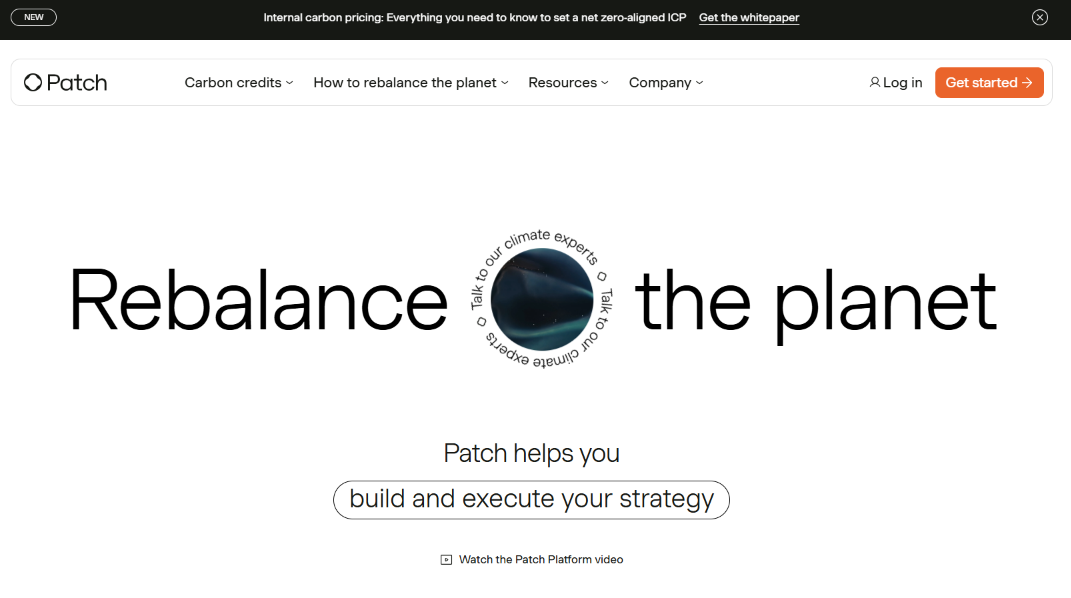
Patch is a carbon credit procurement and management platform combining an AI-native diligence engine, a multi-supplier marketplace, and human Embedded Climate Strategists. It is procurement infrastructure — not investment exposure or tradable carbon assets.
What the data actually shows - TL;DR
Patch is procurement infrastructure for the voluntary carbon market — not an investment vehicle, and not primarily a removal supplier. Unlike Charm Industrial (a direct removal operator), Patch is the sourcing, diligence, transaction, and portfolio-management layer between buyers and third-party Supply Partners. The June 2026 platform has materially evolved from the API-first marketplace of the original December 2025 review: it now combines AI-powered project diligence (a stated 25,000+ project database with ICROA-endorsed registry coverage and a quality filter that excludes a stated ~62% of projects), human Embedded Climate Strategists as a service product, and a multi-product legal architecture (Customer, Vista, Sourcing Platform beta, multiple Supply Partner variants). Buyers underwrite contract enforceability, MRV scope, supplier execution, and the durability of Patch's replacement and remediation pathways — not yield, capital appreciation, or carbon price exposure.
Quick Verdict
Is this platform right for you?
Patch is procurement infrastructure with an integrity gate — not a pass-through marketplace, not a removal supplier, not an investment vehicle. Unlike Charm Industrial (which is a direct removal operator), Patch is the sourcing, diligence, transaction, and portfolio-management layer between buyers and third-party Supply Partners. The June 2026 platform is materially more developed than the original December 2025 review framing reflected: AI-native diligence engine plus Embedded Climate Strategist advisory plus multi-product legal architecture. The marketing-promoted replacement commitment for forward credit defaults is a meaningful product feature, but contract-level codification is the diligence requirement. Don't let the platform's AI-native polish substitute for contract-level due diligence.
Best for
- Enterprises with material ongoing carbon procurement programs subject to CSRD, AB 1305, or similar reporting frameworks
- Buyers committing to multi-year offtake agreements who can negotiate contract-level codification of the replacement commitment
- Organizations with the contracting sophistication to identify which Patch terms govern which interaction across the multi-product legal architecture
- Sustainability teams that value Embedded Climate Strategist advisory services as a complement to in-house expertise
Avoid if
- You're an investor seeking yield, capital appreciation, or tradable exposure to carbon prices — Patch is procurement, not investing
- You're a retail or one-time individual buyer — the June 2026 platform is materially more enterprise-oriented than the original December 2025 review framing reflected
- Your compliance or audit framework requires methodology transparency for delegated diligence — Patch's Trust and Safety framework methodology is not publicly documented
- You're considering reliance on the beta Sourcing Platform for decision-critical workflows — the US$100 beta liability cap may be incompatible with material procurement decisions
- Your organization requires vendors to carry proportional liability for project outcomes — Patch's terms continue to disclaim warranty and limit liability at modest caps
Top strengths
- End-to-end procurement workflow spanning strategy, sourcing, diligence, purchase, and portfolio management
- AI-native diligence across a stated database of more than 25,000 projects
- Embedded Climate Strategist support for enterprise sustainability teams
- Multi-supplier purchasing consolidated into a single contract and payment workflow
Key limitations
- Contract-level codification: the homepage-promoted replacement commitment for forward credit defaults appears in marketing materials but is not surfaced in the dossier's formal terms language; contract-level confirmation required.
- Methodology transparency: Patch's Trust and Safety framework filters a stated ~62% of projects as 'unlikely best-fit', but the underlying methodology is not publicly documented.
- Pricing transparency: no standardized public fee schedule was surfaced in the June 2026 dossier; enterprise pricing remains negotiated.
- Capital-structure transparency: AltStreet did not identify SEC primary-source filings for Patch in its June 18, 2026 EDGAR searches; capital stack and investor identities are documented in third-party databases (Crunchbase, PitchBook) rather than SEC filings.
Compare Before Deciding
Where Patch fits against alternatives
Use these hooks to pressure-test whether this is the right platform, or whether a nearby alternative matches the job better.
How this compares to Charm Industrial
Charm Industrial
Direct durable removal supplier vs Patch's neutral multi-supplier procurement platform.
How this compares to Cloverly
Cloverly
Supplier-side embedded offsetting SaaS vs Patch's buyer-side procurement platform.
Overview
Platform Overview
A concise read on what the platform is, how the structure works, and where the practical friction shows up for real investors.
Carbon credit procurement and management platform combining an AI-native diligence engine, a multi-supplier marketplace, human Embedded Climate Strategists, and an end-to-end workflow spanning strategy, sourcing, diligence, purchase, and ongoing portfolio management. Patch publicly positions itself as a procurement infrastructure layer rather than a credit owner or principal credit issuer, with credits sourced from third-party Supply Partners and retired through registry-linked workflows. Patch is supplier-neutral in that it does not present itself as owning the underlying credits, but its Trust and Safety framework and Embedded Climate Strategist advisory mean it is not a passive marketplace.
The platform does not issue securities or offer investment returns; buyers procure credits for retirement / claims workflows rather than holding them for resale or price appreciation. Patch positions itself as an intermediary between buyers and third-party Supply Partners — not as a party to credit transactions or a credit principal — and contractually disclaims warranties on credit quality, permanence, and actual climate impact, even as the marketing-layer materials introduce a stated replacement commitment for forward credit defaults. The June 2026 platform is materially more developed than the marketplace-only product captured in the original December 2025 review.
Platform Model
AI-Native Carbon Procurement Infrastructure + Embedded Advisory
Primary Function
Carbon Credit Strategy, Sourcing, Diligence, Purchase, Management
Target Users
Enterprises with material sustainability programs, including organizations subject to CSRD, AB 1305, and similar reporting frameworks
Investment Structures
Notice: Marketplace + Infrastructure Provider — not a securities issuer
Stated workflow
5 stages — Strategy → Sourcing → Diligence → Purchase → Manage
Project database
Platform-reported 25,000+ projects with stated full ICROA-endorsed registry coverage
Trust and Safety filter
Patch-stated ~62% of projects classified 'unlikely best-fit' under the platform's proprietary integrity framework
Legal architecture
Multi-product: Customer Terms, Vista Terms, Supply Partner Terms (two variants), beta Sourcing Platform Terms with US$100 liability cap
EU presence
French-language legal stack indicates active European operations
ASHow It Works
- Strategy: Embedded Climate Strategists work with buyers to define environmental resource strategies aligned to sustainability goals and budgets, including both spot purchases and multi-year offtake agreements
- Sourcing: Buyers access Patch's stated 25,000+ project database covering avoidance and removal pathways. Patch publicly positions itself as supplier-neutral in that it does not present itself as owning the underlying credits, with credits sourced from third-party Supply Partners
- Diligence: AI-native data engine plus expert human review filters the project pool through Patch's Trust and Safety framework; platform-reported ~62% of projects are classified 'unlikely best-fit'
- Purchase: Multi-project purchases consolidated under a single contract and payment workflow; Patch negotiates with multiple suppliers on the buyer's behalf
- Manage: Portfolio management including audit-ready evidence aligned to CSRD, AB 1305, and similar reporting frameworks; visibility into off-platform credits is supported
- Replacement commitment (per Patch's homepage marketing): Patch publicly states it will replace credits at no additional fee if a project fails to deliver a future credit vintage — buyers should obtain contract-level confirmation of this commitment
- Embedded Climate Strategists serve as a paid advisory layer with Patch acting as an extension of the buyer's sustainability team
Key Gaps & Non-Disclosures
- No standardized public pricing schedule — enterprise pricing remains negotiated and not publicly posted
- No public methodology disclosure for the Trust and Safety framework's project scoring (which attributes drive the ~62% filter)
- The replacement commitment for forward credit defaults appears in marketing materials but is not surfaced as formal terms language in the dossier's legal snippets
- Beta Sourcing Platform US$100 liability cap is materially lower than the main customer terms — buyers should evaluate beta product terms separately
- No SEC EDGAR primary-source filings located — capital stack, board composition, and investor identities are not documented in publicly accessible SEC filings
Platform Intelligence
Patch Timeline
Key platform events, regulatory turns, liquidity stress points, and product launches that shape how the review should be read.
Patch founded
Brennan Spellacy (CEO) and Aaron Grunfeld incorporate Patch in San Francisco to build API-first carbon credit procurement infrastructure. Per Patch's own materials: 'When we started Patch in 2020, the sky was an unprecedented orange from raging fires…'.
Series A — $20M raised
Patch closes a $20M Series A round per public sources. AltStreet has not identified an SEC Form D filing in EDGAR for this round; the round appears to have been conducted through private-offering pathways that did not generate public SEC filings.
Series B — $55M led by Energize Ventures
Patch announces a $55M Series B in September 2022 per Patch's own blog and Energize Capital materials. Participants include Andreessen Horowitz, Coatue Management, Version One Ventures, B Capital Group, Schneider Electric, GIC, AENU, Contrary, Blue Impact, MCJ Collective, and individuals Andrew Robb and Frank Slootman. Tyler Lancaster of Energize joins Patch's board. AltStreet did not locate an SEC Form D filing for this round in its June 18, 2026 EDGAR searches.
Customer terms revision (March 22, 2024)
Patch's customer terms-of-service revision date observed in the original December 2025 review. Liability cap codified at the greater of US$1,000 or twelve months of fees paid; mandatory arbitration under AAA Commercial Rules, Northern California venue; no warranties for credit quality, permanence, or actual climate impact achieved.
AI-native platform relaunch
Patch publicly launches a redesigned platform positioned as 'AI-native' with software, data, and expert services aimed at streamlining purchasing and management of carbon credits. The platform expansion adds AI-driven project diligence and Embedded Climate Strategist services.
Trust and Safety framework + 25,000+ project database
Patch publicly discloses a 25,000+ project database with stated full ICROA-endorsed registry coverage and a proprietary Trust and Safety framework that filters a stated ~62% of projects as 'unlikely to be best-fit'. The positioning shift moves Patch from neutral marketplace toward active quality gate.
AltStreet snapshot: multi-product legal architecture surfaced
The June 19, 2026 dossier surfaces 14 legal documents — meaningfully more than the original December 2025 review captured. Distinct terms apply to: customer use, Vista product, Supply Partner relationships (two variants), and a beta Sourcing Platform (with explicit US$100 liability cap). Full French-language legal stack indicates active EU operations. AltStreet's June 18, 2026 EDGAR searches confirm no SEC primary-source filings for Patch.
Investment Structures
Patch facilitates carbon credit procurement and portfolio management for emissions claims and sustainability reporting. The platform does not issue securities, offer financial returns, or provide mechanisms for credit resale or price appreciation. Patch's product framework is built around procurement and retirement for claims workflows, not holding credits as tradable inventory. Patch's terms continue to include 'no warranties' language for credit quality and impact, even as the marketing-layer materials introduce a replacement commitment for forward credit defaults. This is a procurement and advisory workflow, not an investment product.
- Credits are generally procured for retirement / claims workflows rather than held as tradable inventory
- No financial return expectations; not a vehicle for carbon price exposure
- No securities issued; procurement, diligence, and advisory workflow only
- Buyers continue to assume residual risk for project outcomes despite Patch's expanded diligence and trust-and-safety filtering layer
Risk
Risk Structure
This is where the marketplace pitch gives way to the actual operating reality: delayed exits, limited disclosure, fee drag, and path-dependent outcomes.
Multi-product legal architecture
The June 19, 2026 dossier surfaces fourteen distinct legal documents covering Customer Terms, Vista Terms, Supply Partner Terms (two variants), Beta Sourcing Platform Terms, Privacy Policy, and full French-language equivalents. Buyers should confirm which terms apply to each interaction — the legal posture is meaningfully more complex than a single ToS document.
Marketing-vs-terms divergence on replacement commitment
Patch's public homepage materials promote a credit replacement guarantee for forward credit defaults ('Patch will replace the credits at no additional fee'). The dossier's terms snippets continue to include 'no warranties' and 'limited liability' provisions and do not surface a formal replacement obligation. The marketing commitment is a meaningful product feature, but contract-level codification is the diligence requirement.
Beta Sourcing Platform — $100 liability cap
The dossier surfaces explicit language: 'liability to you for your use of the sourcing platform during beta is limited to USD$100.' This is materially lower than the customer terms' cap (greater of US$1,000 or twelve months of fees paid). Buyers using the beta Sourcing Platform should treat it as a distinct contract with materially reduced platform liability.
Intermediary contractual structure
Patch continues to position itself as an intermediary — not a party to the underlying buyer-supplier credit transaction. Terms reflect that Patch facilitates discovery, diligence, payment processing, and retirement but does not warrant credit quality, permanence, or actual climate impact achieved at a formal contractual level.
Liability allocation
Customer-terms liability remains capped at the greater of US$1,000 or twelve months of fees paid. Mandatory individual arbitration waives class action and representative proceedings across the platform's legal stack.
Pricing transparency
No standardized public fee schedule was surfaced in the June 2026 dossier. Enterprise pricing remains negotiated. Patch's revenue model spans transaction fees, per-credit spreads, and advisory service fees for Embedded Climate Strategist engagements.
Permanence and quality framework
Patch's stated Trust and Safety framework now performs an active integrity gate role — platform-reported ~62% of projects filtered as 'unlikely best-fit'. The framework's underlying methodology and project-scoring criteria are not publicly documented. Buyers should request the framework's methodology before relying on Patch-supplied integrity classifications.
No SEC EDGAR primary-source footprint
AltStreet conducted three SEC EDGAR Form D searches against Patch entity name variations on June 18, 2026; none returned matches. Patch's capital structure, board composition, and investor identities are not documented in publicly accessible SEC filings (though some details are documented in press releases and third-party databases like Crunchbase and PitchBook). The capital rounds likely reflect private financing conducted through pathways that did not generate public SEC filings.
Marketing-vs-terms divergence on replacement commitment
Risk Summary
Patch's homepage materials publicly promote a credit replacement guarantee for forward credit defaults, but the dossier's terms snippets continue to include 'no warranties' and 'limited liability' provisions without surfacing a corresponding formal replacement obligation.
Why It Matters
If the replacement commitment is not codified in the executed enterprise contract, buyers may be relying on a marketing promise rather than a contractual right. The legal recourse for non-replacement after a forward credit default may be materially weaker than the marketing language suggests.
Mitigation / Verification
Before signing, request that the replacement commitment be incorporated explicitly into the executed enterprise agreement, with defined triggers (what counts as a 'failure to deliver a future credit vintage'), defined timing (how quickly replacement credits will be delivered), defined quality (must the replacement credit match the original vintage and methodology), and defined fallback if Patch is unable to source comparable replacement credits.
Project performance, permanence, and quality risk
Risk Summary
Buyers continue to assume residual risk that purchased credits may not deliver promised climate impact, could be invalidated due to methodology disputes, or experience reversal events — especially for nature-based projects.
Why It Matters
Despite Patch's enhanced Trust and Safety framework and AI-native diligence layer, the formal terms language continues to disclaim responsibility for credit quality, permanence, and actual climate outcomes. If a project fails or a credit becomes controversial, the buyer's legal recourse is shaped by contract — not by Patch's marketing positioning as an integrity gate.
Mitigation / Verification
Conduct independent due diligence on selected projects beyond Patch's Trust and Safety framework outputs: verify project methodology, registry standing, verification cadence, third-party audits, and supplier financial stability. For nature-based projects, understand specific reversal buffer mechanisms and supplier-level replacement terms.
Pricing opacity and fee structure risk
Risk Summary
No standardized public enterprise pricing schedule surfaced in the June 2026 dossier — enterprise pricing remains negotiated via custom quotes. The dossier and Patch's public materials reference transaction fees, per-credit markup or spread, and advisory service fees, but a unified public fee schedule is not posted.
Why It Matters
Without standardized public fee schedules, buyers cannot benchmark Patch's pricing against alternatives or verify they are receiving competitive market rates. Patch's revenue model now also includes advisory service fees for Embedded Climate Strategist engagements — the cost split between transaction fees, per-credit spreads, and advisory services is not publicly disclosed.
Mitigation / Verification
Request a comprehensive pricing breakdown before committing: per-credit markup or spread above supplier-quoted price; advisory or Embedded Climate Strategist service fees with hours and scope; platform or API access fees; minimum purchase volumes and volume discounts; how pricing varies between spot purchases and multi-year offtake agreements.
Beta Sourcing Platform — reduced liability cap
Risk Summary
The Beta Sourcing Platform terms surface an explicit US$100 liability cap during the beta period — materially lower than the US$1,000-or-twelve-months-fees cap in the main customer terms.
Why It Matters
Buyers using the beta Sourcing Platform for material procurement decisions should evaluate whether the US$100 cap is acceptable given the workflow's role in the broader purchase decision. The cap effectively means Patch has very limited financial responsibility if the beta sourcing software produces incorrect outputs or fails to surface a material project attribute.
Mitigation / Verification
Evaluate whether the beta Sourcing Platform should be used for decision-critical workflows or limited to non-binding research uses while in beta. Confirm Patch's beta-graduation criteria and the terms migration path when the product exits beta.
Supplier fulfillment and business continuity risk
Risk Summary
Patch's terms continue to acknowledge Supply Partners may inadvertently or intentionally provide inaccurate information, be unable to create or transfer certain credits, or experience business disruptions causing failures.
Why It Matters
If a supplier fails to deliver, Patch's stated approach is to notify the buyer and request selection of alternative credits or a refund — combined with the homepage marketing replacement commitment for forward defaults. Whether the replacement commitment binds Patch contractually (beyond the marketing language) is a contract-level diligence question, not a terms-of-service answer.
Mitigation / Verification
Independently verify supplier track record, financial stability, and errors-and-omissions insurance before large commitments. For ongoing procurement programs, diversify across multiple suppliers to reduce concentration risk. Confirm Patch's replacement commitment is codified in the executed enterprise agreement.
Trust and Safety framework methodology opacity
Risk Summary
Patch's stated ~62% project quality filter is now a central differentiator, but the underlying methodology (which project attributes drive the 'unlikely best-fit' classification) is not publicly documented.
Why It Matters
If buyers rely on Patch's integrity classifications to satisfy their own diligence obligations, the methodology underlying those classifications becomes material. A black-box quality filter is a procurement convenience but may be insufficient for buyers whose own compliance or audit framework requires methodology transparency.
Mitigation / Verification
Request methodology documentation for the Trust and Safety framework, including the specific attributes evaluated, weighting between attributes, and how the framework handles edge cases. Verify the framework's outputs align with the buyer's own integrity criteria before delegating diligence.
ASRisk signals to watch
- Material changes to the beta Sourcing Platform's liability cap or its graduation criteria from beta status
- Updates to Patch's terms documents that codify (or materially limit) the replacement commitment for forward credit defaults
- Patch SEC filings appearing in EDGAR (would indicate a shift toward securities-issuer structure, possibly IPO preparation or a regulated offering)
- Material changes to the Trust and Safety framework's stated coverage (the ~62% filter rate or the 25,000+ project database scale)
- Reports of forward credit default events where the replacement commitment was tested in practice — outcome documentation would be highly informative
Biggest Misconceptions & What Actually Happens
- Is the homepage-promoted replacement commitment for forward credit defaults codified in the executed enterprise contract? What are the defined triggers, timing, quality, and fallback if Patch cannot source comparable replacement credits?
- What specific terms govern the executed engagement — Customer Terms, Vista Terms, beta Sourcing Platform Terms, or some combination? Where do they diverge?
- What is the methodology underlying the Trust and Safety framework's project quality filter? Which attributes drive the ~62% 'unlikely best-fit' classification?
- How are Embedded Climate Strategist services priced and scoped? Are they retained or transactional? What service-level commitments apply?
- What recourse do buyers have if Patch undergoes a control transfer, ceases operations, or materially alters its terms during the duration of a multi-year offtake?
Regulatory & Legal Posture
Security Status
Procurement Product / Not Securities-Style Access
Patch's core activity, as observable from the June 19, 2026 dossier and the public terms documents, is providing carbon credit procurement, diligence, and management infrastructure for emissions claims and sustainability reporting workflows. Patch does not issue securities, pool capital for financial returns, or operate a regulated investment vehicle.
AltStreet has reviewed only public web flows and dossier-surfaced legal documents; carbon credits and removal rights can be legally nuanced depending on how they are packaged, financed, resold, tokenized, pooled, or marketed in specific transactions..
- Not SEC-registered. AltStreet's June 18, 2026 EDGAR searches did not identify Form D or other primary-source filings for Patch entity name variations.
- Patch operates US and European business lines per the dossier's full French-language legal stack.
- Multiple distinct terms documents govern different parts of the platform: Customer Terms (general), Vista Terms (product-specific), Supply Partner Terms (two variants), Beta Sourcing Platform Terms (US$100 cap).
- Mandatory arbitration appears across the legal stack — buyer remedies for disputes are individual rather than class.
Disclosure Quality
Moderate. The dossier surfaces a meaningfully more complex multi-product legal architecture than the original December 2025 review captured. Key gaps remain: contract-level codification of the replacement commitment, methodology documentation for the Trust and Safety framework, public pricing transparency, and SEC primary-source filings for the platform's capital structure.
Custody Model
Not Investor Custody
Regulatory Backing
Patch is not presented as a traditional custodian of investor assets. Registry-linked credit issuance, transfer, and retirement occur through third-party carbon registries (Verra, Gold Standard, American Carbon Registry, Climate Action Reserve, and the broader ICROA-endorsed registry set per Patch's June 2025 public disclosures) and Supply Partner workflows.
Patch publicly positions itself as a procurement infrastructure layer rather than a credit owner or principal credit issuer; buyers should confirm in the executed agreement whether Patch ever temporarily controls, facilitates, or directs transfer or retirement of credits under the applicable order terms..
Tax Treatment
Reporting
Not Applicable
Carbon credit purchases for retirement and sustainability reporting are procurement expenses, not investment transactions. No 1099 or investment-related tax reporting expected from Patch.
Income Character
Business Expense / Procurement
Credits purchased through Patch are procured for retirement / claims workflows aligned to sustainability reporting (CSRD, AB 1305, internal sign-off). These are operational expenses for sustainability programs, not investments generating taxable income or capital gains..
Limitation
Tax treatment depends on the buyer's specific use case, accounting standards, and jurisdiction. Treatment of carbon credit expenses for tax and accounting purposes is evolving. Consult tax and accounting advisors for treatment in the buyer's specific operational structure, particularly for multi-year offtake commitments where the timing of expense recognition matters.
Before You Invest
Get Patch investor insights before you invest
K-1 timing, distribution updates, yield insights, and risk signals for Patch and similar platforms.
- Weekly platform research focused on tax timing and liquidity reality.
- Signals on distributions, risks, and structural tradeoffs before capital is locked up.
- Coverage of adjacent platforms so you can compare better options faster.
Get weekly platform signals
Track fee changes, liquidity updates, risk flags, and adjacent platforms before you invest.
Independent intelligence from AltStreet. No hype. No sponsor spin.
AltStreet Data Layer
What the data actually shows
AltStreet's June 2026 review identified material legal, diligence, and disclosure findings across Patch's procurement platform.
Multi-product legal architecture surfaced in June 2026 dossier
The June 19, 2026 dossier surfaced 14 distinct legal documents covering Customer Terms, Vista Terms, Supply Partner Terms (two variants), Beta Sourcing Platform Terms, Privacy Policy, and full French-language equivalents — meaningfully more complex than the original December 2025 review's single-ToS framing.
What this means
Buyers should not assume the main customer terms govern all interactions with Patch. The beta Sourcing Platform terms surface a materially lower (US$100) liability cap. Multi-year enterprise engagements may interact with Vista terms, Supply Partner terms (depending on workflow), and possibly French-jurisdiction equivalents for EU operations. Contract-level diligence must identify which terms apply to which interaction.
Marketing-layer replacement commitment not surfaced in formal terms
Patch's homepage materials publicly promote 'Patch will replace the credits at no additional fee' for forward credit defaults. The dossier's terms snippets continue to surface 'no warranties' and 'limited liability' language and do not surface a corresponding contractual replacement obligation.
What this means
The replacement commitment is a meaningful product feature for offtake buyers, but its legal recourse strength depends on contract-level codification rather than marketing language. Buyers committing to multi-year forward delivery arrangements should obtain explicit incorporation of the replacement commitment into the executed enterprise agreement with defined triggers, timing, quality standards, and fallback obligations.
AI-native diligence shift from pass-through marketplace to integrity gate
Patch's stated April 2025 platform relaunch and September 2025 disclosures position the platform as performing an active Trust and Safety integrity gate role — platform-reported filtering of ~62% of projects as 'unlikely best-fit' from a stated 25,000+ project database. The original December 2025 review framed Patch primarily as a neutral marketplace; the June 2026 platform is meaningfully more active in the diligence layer.
What this means
The shift creates value for enterprise buyers (procurement burden reduction, more credible default supplier set) but also creates a methodology-transparency obligation. Black-box integrity classifications may be insufficient for buyers whose compliance or audit framework requires methodology documentation. Buyers should request methodology disclosure before delegating diligence to Patch's framework outputs.
No SEC EDGAR primary-source footprint despite $80M+ raised
AltStreet conducted three SEC EDGAR Form D searches against Patch entity name variations on June 18, 2026; all returned zero matches. Public sources document Series A ($20M, September 2021) and Series B ($55M, September 2022) but no corresponding SEC Form D filings were located.
What this means
Patch's capital structure, board composition, and investor identities are not documented in publicly accessible SEC filings (though some details are documented in press releases and third-party databases like Crunchbase and PitchBook). This is structurally consistent with a non-securities-issuer model — software and services businesses commonly raise through Section 4(a)(2), Regulation S, state-law exemptions, or other private-offering pathways that do not generate Form D filings. The structural implication for procurement buyers is that capital-structure transparency depends on third-party databases rather than SEC primary sources.
EU operations confirmed via French-language legal stack
The June 19, 2026 dossier surfaces full French-language equivalents for every public legal document — Customer Terms, Supply Partner Terms (two variants), Sourcing Platform Terms, Privacy Policy. This indicates active European market operations.
What this means
EU-resident buyers and EU-jurisdiction enterprise contracts may interact with French-jurisdiction terms differently than US engagements. Buyers should confirm which jurisdiction's terms govern their executed agreement and how dispute resolution, data protection (GDPR), and consumer protection regimes apply.
Data as of 2026-06-19 . AltStreet review evidence layer . Public-source analysis
Decision Fit
Investor Fit
Who this works for, who it does not, and what level of patience and complexity tolerance the platform really demands.
Enterprise sustainability teams with material procurement programs
Enterprises with material carbon procurement programs and existing or developing sustainability strategies benefit from Patch's combined AI-native diligence engine, Embedded Climate Strategist advisory layer, and multi-supplier marketplace consolidation. The platform is designed for ongoing program management aligned to CSRD, AB 1305, and similar reporting frameworks.
Best fit for organizations capable of contract-level diligence on Patch's terms architecture and the replacement commitment..
ESG SaaS platforms embedding offsetting workflows
SaaS platforms embedding carbon offsetting into customer workflows benefit from Patch's API infrastructure, automated retirement, and reporting exports. Platform enables product-level carbon neutrality claims with audit-trail documentation.
Requires technical integration capability and acceptance of the platform's terms architecture..
Forward offtake buyers building multi-year removal portfolios
Buyers committing to multi-year offtake agreements for forward removal credits benefit from Patch's stated negotiation services and the homepage-promoted replacement commitment for forward credit defaults. Suitability depends materially on whether the replacement commitment is codified in the executed enterprise agreement and on independent diligence of the underlying suppliers..
Retail / one-time individual buyers
Patch's June 2026 platform is materially more enterprise-oriented than the original December 2025 review reflected. The five-stage workflow (Strategy through Manage) and Embedded Climate Strategist services are designed for organizations with material procurement programs.
Pricing opacity and enterprise-focused workflows create barriers for individual or one-time buyers..
Investors seeking financial returns or carbon price exposure
Patch is procurement infrastructure, not an investment platform. Credits are procured for retirement / claims workflows rather than held for resale or price appreciation.
Platform explicitly disclaims financial return expectations. Unsuitable for investors seeking carbon price exposure or tradable assets..
Tradeoffs
Key Tradeoffs
The attraction of pre-IPO access is real, but every benefit comes bundled with a corresponding liquidity, transparency, or pricing cost.
AI-native diligence vs methodology opacity
Patch's AI-native Trust and Safety framework filters a stated ~62% of projects as 'unlikely best-fit', materially reducing buyer diligence burden. The underlying methodology — which attributes drive the filter and how they are weighted — is not publicly documented, leaving buyers reliant on Patch's classifications without methodology visibility..
Embedded Climate Strategists vs advisory cost opacity
Embedded Climate Strategist services represent a meaningful expert advisory layer that may materially improve procurement quality, but pricing, scope, and service-level commitments are not publicly posted. Buyers commit to advisory engagements without standardized pricing benchmarks..
Multi-product legal architecture vs contract complexity
The June 2026 platform's multi-product legal stack (Customer Terms, Vista Terms, beta Sourcing Platform Terms, Supply Partner Terms variants) supports differentiated product offerings, but increases the contract-level diligence burden for buyers who must identify which terms govern which interaction..
Stated replacement commitment vs terms-level codification
Patch's homepage promotes a credit replacement guarantee for forward credit defaults — a meaningful product feature for offtake buyers — but the dossier's formal terms snippets continue to include 'no warranties' and 'limited liability' provisions. Marketing-level commitment without terms-level codification creates risk that recourse is weaker in practice than in promise..
Beta Sourcing Platform access vs reduced liability cap
The beta Sourcing Platform extends Patch's AI-native capabilities, but operates under a US$100 liability cap during beta — materially lower than the main customer terms. Early access is a meaningful capability gain but trades against materially reduced platform liability..
Avoid
Who This Is Not For
This section should be read as a filter, not an afterthought. If you need income, simplicity, or near-term access to capital, the structure is working against you.
Investors seeking financial returns or tradable carbon exposure
Patch is procurement infrastructure for emissions offsetting, not an investment vehicle. Credits are procured for retirement / claims workflows rather than held for resale or price appreciation.
Platform explicitly disclaims financial return expectations..
Retail / one-time individual buyers
The June 2026 platform is materially more enterprise-oriented than the original December 2025 review framing. Embedded Climate Strategist services and the five-stage workflow (Strategy through Manage) are designed for material ongoing programs, not individual one-time purchases..
Organizations requiring full supplier liability allocation
Patch's terms continue to disclaim responsibility for credit quality, permanence, and actual climate impact at a formal contractual level — even while marketing materials promote a replacement commitment. Organizations requiring vendors to carry proportional liability for project outcomes should obtain contract-level codification of any liability promises before reliance..
Organizations requiring methodology transparency for delegated diligence
Patch's Trust and Safety framework is a central differentiator but the underlying methodology is not publicly documented. Organizations whose compliance or audit framework requires methodology visibility for delegated diligence should obtain methodology documentation directly before reliance..
Editorial View
AltStreet Perspective
The compressed version of the review: what matters, what marketing tends to obscure, and how we would frame the platform for a serious allocator.
Verdict
Patch is procurement infrastructure that has materially evolved since the original December 2025 review — from an API-first marketplace into an AI-native diligence engine plus Embedded Climate Strategist advisory layer plus multi-product legal architecture. The platform now performs an active integrity-gate role (filtering a stated ~62% of projects) rather than a neutral pass-through marketplace role.
Positioning
Suitable for enterprises with material ongoing carbon procurement programs, especially those subject to CSRD, AB 1305, or similar reporting frameworks. Best for buyers with: (1) the contracting sophistication to extract terms-level codification of marketing-promised commitments like the replacement guarantee, (2) the integrity standards to evaluate Patch's Trust and Safety framework rather than delegate entirely, and (3) the procurement scale to justify Embedded Climate Strategist engagements. Inappropriate for investors seeking financial returns, retail buyers, or organizations requiring full supplier liability allocation.
The Bottom Line
Patch is procurement infrastructure with an integrity gate — not a removal supplier, not a pass-through marketplace, not an investment vehicle.
Don't let the AI-native polish substitute for contract-level diligence on replacement commitments and methodology transparency.
Action
Next Steps
If you still want to engage after reading the review, these are the practical next moves that reduce avoidable mistakes.
Confirm which terms govern your engagement — Customer Terms, Vista Terms, beta Sourcing Platform Terms, or some combination — and identify the divergences in liability caps, warranty disclaimers, and dispute resolution.
Request contract-level codification of the homepage-promoted replacement commitment for forward credit defaults, including defined triggers, timing, replacement quality, and fallback if Patch cannot source comparable replacement credits.
Request methodology documentation for the Trust and Safety framework's project quality filter (which attributes drive the ~62% 'unlikely best-fit' classification, how attributes are weighted, how edge cases are handled).
Request a comprehensive pricing breakdown: per-credit markup or spread, Embedded Climate Strategist service fees with scope, API or platform access fees, volume discounts, and the difference between spot and offtake pricing.
If considering the beta Sourcing Platform, evaluate the US$100 liability cap against the workflow's role in your procurement decisions. Confirm Patch's beta-graduation criteria.
Conduct independent due diligence on selected projects: methodology, registry standing, verification cadence, third-party audits, and supplier financial stability. Patch's diligence is a useful starting point, not a substitute.
For multi-year offtake commitments, confirm Patch's obligations in the event of a control transfer, terms change, or business cessation. The dossier surfaces 'transferred to a third party acquirer' language without detailed buyer protections.
Appendix
Sources, Disclosures, and Supporting Context
The lower section is structured like a report appendix: relationship context first, adjacent reading second, and evidence last.
Report Appendix
Disclosure
Relationship and compensation context
+
Report Appendix
Disclosure
Relationship and compensation context
Report Appendix
Related Resources
Adjacent platform comparisons, frameworks, and category links
+
Report Appendix
Related Resources
Adjacent platform comparisons, frameworks, and category links
Further Reading
Related Resources
Adjacent frameworks and reviews that help place the platform in a broader allocation or due-diligence context.
Explore Asset Class
Carbon & ClimateFrameworks
Similar Platform Reviews
- Charm Industrial
Direct durable removal supplier vs Patch's neutral multi-supplier procurement platform.
- Cloverly
Supplier-side embedded offsetting SaaS vs Patch's buyer-side procurement platform.
Report Appendix
Evidence & Methodology
Sources, scope, and how the review was assembled
+
Report Appendix
Evidence & Methodology
Sources, scope, and how the review was assembled
ASReview Evidence
Methodology
Review originally synthesized December 18, 2025 and updated June 19, 2026 using a fresh June 19, 2026 Firecrawl dossier of 107 pages and enhanced dossier analysis covering 14 legal documents (Customer Terms, Vista Terms, Supply Partner Terms in two variants, Beta Sourcing Platform Terms, Privacy Policy, and full French-language equivalents). The June 2026 update incorporates substantive product evolution since the original December 2025 review. AltStreet conducted three SEC EDGAR Form D searches against Patch entity name variations on June 18, 2026; all returned zero matches for 'Patch Technologies' variants, consistent with Patch operating as a software and services business rather than a securities issuer.
Scope
June 19, 2026 dossier JSON and enhanced dossier analysis covering 107 raw content URLs and 14 distinct legal documents. Coverage includes customer-facing pages, supply partner agreements (two variants), the beta Sourcing Platform terms, Vista product terms, privacy policy, and full French-language equivalents. AltStreet's SEC EDGAR search returned no Patch filings; the review therefore does not include SEC primary-source evidence for capital structure.
Key Findings
- *DOSSIER-CONFIRMED: 14 distinct legal documents identified — meaningfully more complex multi-product legal architecture than the original December 2025 review captured.
- *DOSSIER-CONFIRMED: Beta Sourcing Platform terms surface explicit language 'liability to you for your use of the sourcing platform during beta is limited to USD$100' — materially lower than the main customer terms cap.
- *DOSSIER-CONFIRMED: Customer terms continue to include 'no warranties' and 'limited liability' provisions across legal documents.
- *DOSSIER-CONFIRMED: Mandatory arbitration language present across the terms documents.
- *DOSSIER-CONFIRMED: Full French-language legal stack indicates active EU operations.
- *DOSSIER-CONFIRMED: Supply Partner Terms surface in two variants — standard and 'marketplace' — indicating differentiated supplier-side product structures.
- *DOSSIER-CONFIRMED: Service license language is 'non-transferable, non-assignable' and account transfers require prior written permission.
- *DOSSIER-CONFIRMED: Refunds available before payment release from holding account, but not after redemption with Supply Partner.
- *PLATFORM-CONFIRMED (marketing-layer): Patch's homepage materials promote a credit replacement guarantee for forward credit defaults ('Patch will replace the credits at no additional fee'). The formal terms language in the dossier does not surface a corresponding contractual obligation.
- *PLATFORM-CONFIRMED (marketing-layer): Patch's stated 25,000+ project database with full ICROA-endorsed registry coverage and Trust and Safety framework filtering ~62% of projects as 'unlikely best-fit'.
- *PLATFORM-CONFIRMED (marketing-layer): Embedded Climate Strategist services positioned as an extension of the buyer's sustainability team.
- *PLATFORM-CONFIRMED (marketing-layer): Five-stage workflow — Strategy → Sourcing → Diligence → Purchase → Manage.
- *PLATFORM-CONFIRMED (marketing-layer): Customer testimonial from Sam Israelit (Chief Sustainability Officer at Bain & Company); other named customers include Docusign, Etsy, and Nokia per recent Patch materials.
- *STRUCTURAL FINDING: AltStreet conducted three SEC EDGAR Form D searches against Patch entity name variations on June 18, 2026; all returned zero matches. AltStreet did not identify SEC primary-source filings for Patch in those searches.
- *ECOSYSTEM-SOURCED: Public-source-reported $80M+ total raised across Seed, Series A, and Series B rounds. Series B announced September 13, 2022 led by Energize Ventures with participation from Andreessen Horowitz, Coatue Management, Version One Ventures, B Capital Group, Schneider Electric, GIC, AENU, Contrary, Blue Impact, and MCJ Collective. AltStreet has not independently verified the specific deal terms beyond the public reporting.
Primary Source Pages
Comparable Platforms
- Charm Industrial
Direct durable removal supplier vs Patch's neutral multi-supplier procurement platform.
- Cloverly
Supplier-side embedded offsetting SaaS vs Patch's buyer-side procurement platform.
FAQ
Frequently Asked Questions
High-intent search questions answered directly, without making users hunt through the full review.
Is Patch an investment platform?
No. Patch is carbon credit procurement and management infrastructure. Buyers purchase credits for retirement / claims workflows to support sustainability claims and reporting — not for financial returns, resale, or carbon price exposure. Patch's product framework is built around procurement and retirement for claims, not holding credits for resale or price appreciation; there is no secondary market or price-appreciation mechanism in the product framework.
What changed in the June 2026 update vs the original December 2025 review?
Substantial product evolution. The original December 2025 review captured Patch primarily as an API-first marketplace with the March 22, 2024 customer terms. The June 19, 2026 dossier surfaces a materially more complex platform: 14 distinct legal documents (vs the single ToS originally analyzed), an AI-native Sourcing Platform in beta with its own US$100 liability cap, Vista-product-specific terms, two Supply Partner Terms variants, full French-language equivalents indicating active EU operations, and a marketing-layer replacement commitment for forward credit defaults that does not appear to be codified in the formal terms. The platform also publicly disclosed a 25,000+ project database with a Trust and Safety framework filtering ~62% of projects as 'unlikely best-fit' — a meaningful shift from pass-through marketplace toward active integrity gate.
Does Patch guarantee the quality or permanence of carbon credits sold through its platform?
The answer differs between marketing materials and formal terms. Patch's homepage materials promote a credit replacement guarantee for forward credit defaults ('Patch will replace the credits at no additional fee'). The dossier's formal terms snippets continue to include 'no warranties' and 'limited liability' provisions and do not surface a corresponding formal replacement obligation. Buyers committing to multi-year offtake agreements should obtain explicit contract-level codification of the replacement commitment with defined triggers, timing, replacement quality standards, and fallback obligations — relying on marketing language alone is materially weaker than a codified contractual right.
What is the Beta Sourcing Platform and why is its liability cap different?
The Beta Sourcing Platform is a distinct Patch product with its own terms document (patch.io/sourcing-terms) surfaced in the June 19, 2026 dossier. The terms include explicit language: 'liability to you for your use of the sourcing platform during beta is limited to USD$100.' This is materially lower than the main customer terms cap (greater of US$1,000 or twelve months of fees paid). Buyers using the beta Sourcing Platform for decision-critical workflows should evaluate whether the US$100 cap is acceptable given the workflow's role in their procurement decisions.
What fees does Patch charge for carbon credit purchases?
Patch does not publicly disclose a standardized fee schedule. Pricing is negotiated via custom quotes. The June 2026 platform's revenue model spans transaction fees (per-credit markup or spread above supplier-quoted price), Embedded Climate Strategist advisory service fees, and possibly platform or API access fees. Buyers should request a comprehensive pricing breakdown before committing, including how pricing varies between spot purchases and multi-year offtake agreements.
Does Patch have SEC filings I can review?
AltStreet conducted three SEC EDGAR Form D searches against Patch entity name variations on June 18, 2026; all returned zero matches. AltStreet did not identify SEC primary-source filings for Patch in those searches. This is consistent with Patch being a software and services business rather than a securities issuer — Patch's capital rounds (Series A and Series B per public sources) likely reflect private financing conducted through pathways that did not generate public SEC filings, such as reliance on Section 4(a)(2), Regulation S, state-law exemptions, or other private-offering pathways. Patch's capital structure, board composition, and investor identities are not documented in publicly accessible SEC filings (though some details are documented in press releases and third-party databases like Crunchbase and PitchBook).
Can I resell carbon credits purchased through Patch?
No. Credits are procured for retirement / claims workflows rather than held for resale or price appreciation. The dossier's terms snippets surface 'non-transferable, non-assignable' license language and require Patch's prior written permission for account transfers. Patch is procurement infrastructure for emissions offsetting, not an investment vehicle for carbon price speculation.
What legal recourse do I have if there's a dispute with Patch or a supplier?
The terms include mandatory binding arbitration requiring individual (not class) resolution under AAA Commercial Rules with venue in Northern California. The dossier surfaces consistent arbitration language across the customer terms, supply partner terms, and beta Sourcing Platform terms. Pre-arbitration notice and informal resolution procedures may apply per the customer terms. For supplier disputes, Patch's stated approach is to facilitate notice and request alternative credit selection or refund — combined with the homepage marketing replacement commitment for forward credit defaults. Whether the replacement commitment is contractually binding depends on whether it is codified in the executed enterprise agreement.
What is the Trust and Safety framework and should I rely on it?
Patch's stated Trust and Safety framework is a proprietary integrity scoring framework that, per Patch's public materials, filters a stated ~62% of projects from a 25,000+ project database as 'unlikely best-fit'. The framework is a central differentiator and a meaningful procurement-burden reducer, but the underlying methodology (which project attributes drive the filter, how attributes are weighted, how edge cases are handled) is not publicly documented. Buyers whose compliance or audit framework requires methodology transparency for delegated diligence should request methodology documentation directly from Patch before reliance — black-box quality filters are a procurement convenience but may be insufficient for some compliance frameworks.