
Wefunder
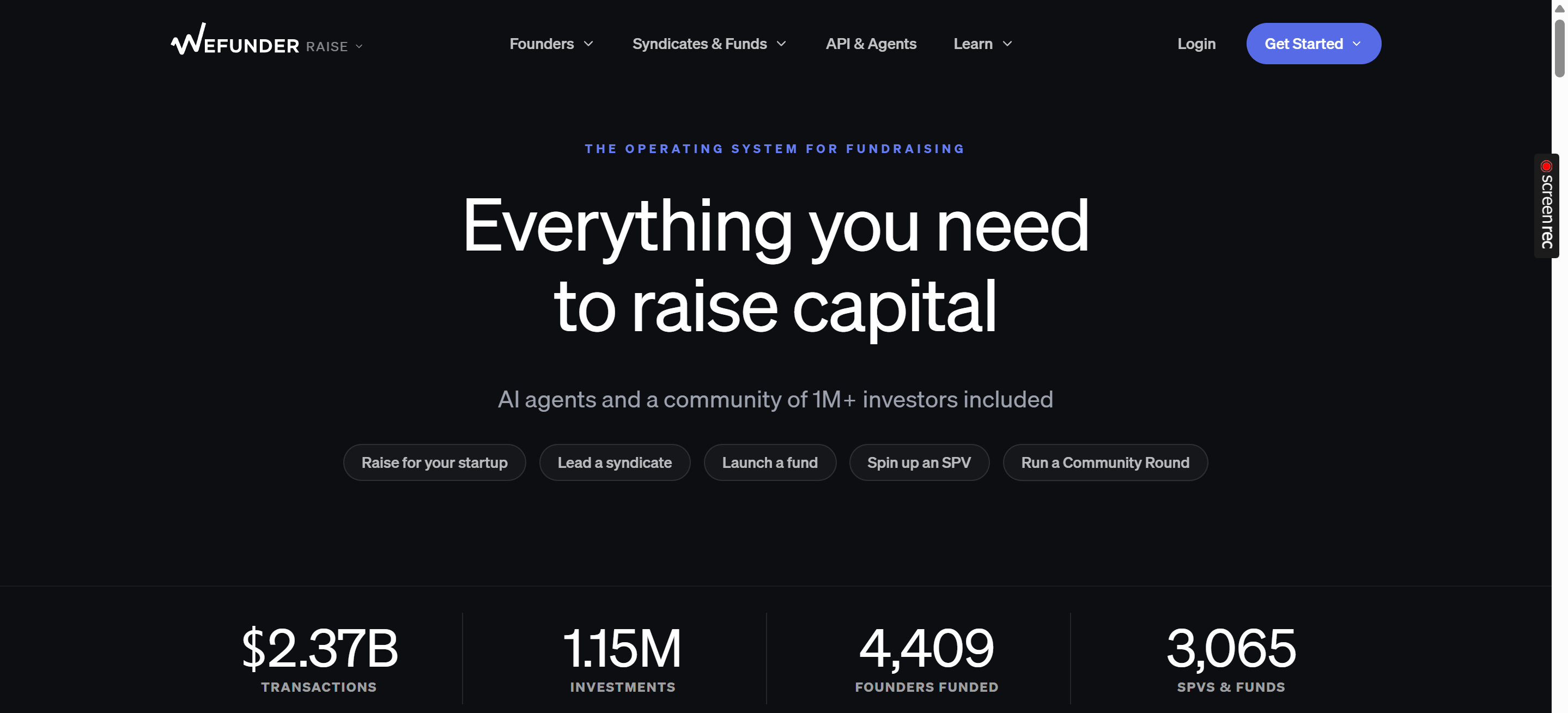
Wefunder is one of the largest US Reg CF funding portals by capital volume — described by FINRA in the 2022 AWC as the largest participant in the crowdfunding space — a regulated marketplace hosting third-party startup offerings at $100+ minimums, no secondary market, and a documented but resolved 2022 FINRA settlement that covered the platform's first five years of operation.
What the data actually shows - TL;DR
Wefunder is legitimate retail access to startup equity, not curated venture alpha. The platform provides the regulatory infrastructure for Reg CF offerings at $100+ minimums, but AltStreet's filing-level analysis shows an outcome distribution that behaves like seed-stage venture: long holds, sparse exits, power-law dispersion, limited reporting continuity, and rare outliers driving most apparent gains. FINRA described Wefunder in the 2022 AWC as the largest participant in the crowdfunding space by capital raised; Wefunder remains one of the largest US Reg CF funding portals by capital volume.
Form C and Form D data sourced from SEC EDGAR. AltStreet coverage spans 2016-2026 across Wefunder Portal LLC (CIK 0001670254), Wefunder Inc (CIK 0001641389), and Wefunds LLC (CIK 0001855033). Outcome classification methodology uses cash-delta-burn (cash position change year-over-year) as the primary operational burn signal rather than GAAP net income, because Reg CF-stage SAFE/note conversions at later priced rounds produce non-cash GAAP losses that materially overstate operational distress.
Quick Verdict
Is this platform right for you?
Wefunder is legitimate retail access to startup equity, not curated venture alpha — one of the largest US Reg CF funding portals by capital volume, operating as a FINRA-registered funding portal with no subsequent disclosed FINRA enforcement following a $1.4M AWC settlement in May 2022 that addressed 2016-2021 conduct. The underlying realized outcome distribution behaves like seed-stage venture capital generally: long-hold, sparse exits, power-law dispersion driven by rare outliers. The $100 minimum makes Wefunder genuinely unique in providing retail-eligible early-stage equity access. The tradeoffs are real: 5-10+ year illiquidity, ~70% of top-200 analyzed capital in distressed or declining companies, and a dual Reg CF + Reg D structure that creates fee and tax-treatment choices not surfaced comparatively. Best suited for retail and accredited investors building diversified venture-stage risk-capital allocations with multi-decade time horizons.
Best for
- Retail investors building diversified venture-stage allocations at $100-$1,000 per position across 10+ positions
- Accredited investors seeking concurrent Reg CF + Reg D 506(c) side-car allocations alongside other private equity
- Long-horizon investors comfortable with 5-10+ year hold periods and seed-stage failure rate expectations
- Investors with independent due diligence capability who don't rely on platform-level investment-quality screening
Avoid if
- You need liquidity within 5+ years or expect any meaningful interim cash distributions
- You expect platform-level investment-quality vetting, curation, or selection
- You confuse 'aggregate capital raised' marketing with individual investor outcomes
- You cannot absorb K-1 complexity if you participate in Wefunds LLC SPV side-car offerings
- You are seeking principal protection, stable returns, or capital preservation
Top strengths
- One of the largest US Reg CF funding portals by capital volume; longest operating history (~10 years)
- $100 minimum democratizes startup equity access — genuinely unique among investment platforms
- Substantive SEC regulatory filing layer enables independent due diligence from primary sources
- Reg CF direct equity positions are tax-simple (no K-1) at 0% Wefunder fee
- Operating as a FINRA-registered funding portal with no subsequent disclosed FINRA enforcement for ~4 years post-AWC settlement
Key limitations
- 55% of top-200 analyzed capital is in companies showing distressed structural financial signals
- No platform-operated secondary market; 5-10+ year realistic hold for any liquidity event
- Dual Reg CF + Reg D structure not surfaced comparatively; fee and tax-treatment choices materially affect outcomes
- Documented FINRA AWC compliance history (May 2022 settlement, $1.4M fine) covering 2016-2021 conduct
- Cap-table subordination through subsequent priced rounds is the structural reality for the rare 'graduated' issuers
Quick Answers
What most investors want to know first
The highest-signal facts first: minimums, liquidity reality, K-1 timing, and whether distributions are actually part of the experience.
Minimum
Reg CF offerings: typically $100 minimum (varies by issuer; some allow lower). The $100 floor democratizes access in a way no other equity-investment vehicle replicates. Wefunds LLC SPV side-car offerings: minimums vary by deal, typically $1,000-$10,000+ for accredited-investor allocations. Maximum investment limited by Reg CF Rule 100(a)(2) annual investment cap for non-accredited investors; no per-deal cap for accredited investors in SPV side-cars.
Liquidity
Per Wefunder offering materials: 'The Securities have numerous transfer restrictions and will likely be highly illiquid, with no secondary market on which to sell them.' Investors should underwrite Reg CF and Wefunds SPV positions as effectively locked through any practical liquidity event. The 12-month statutory restriction is the regulatory floor, not a practical liquidity timeline. After the restriction lifts, bilateral resale of Reg CF Common Stock or Wefunds SPV interests is practically negligible — no platform infrastructure exists, no centralized order book, no clearing mechanism. The realistic exit assumption for any Wefunder position is an issuer-level liquidity event (acquisition, IPO, dissolution) which most positions will not experience.
K-1 Timing
Tax document obligations differ by Wefunder investment vehicle. Reg CF direct equity (Common Stock, SAFE, Crowd SAFE, convertible notes): no K-1 obligation; gain/loss reported only at sale; no phantom income during hold. Wefunds LLC Reg D 506(c) SPV side-car investments: partnership K-1 issued annually, with reference to February timing per the June 2026 Wefunder dossier (confidence: low; only weak attributed evidence available in platform materials). Dual-layer Wefunds structures with upstream third-party fund reporting can extend K-1 delivery further. Investors holding both Reg CF and Wefunds SPV positions for the same issuer will receive K-1 only for the SPV position.
Distributions
Wefunder offerings are early-stage venture equity with no recurring distribution expectations. Reg CF direct equity positions (Common Stock, SAFE, Crowd SAFE) typically produce no cash distributions during hold — economic outcomes are entirely back-end loaded to liquidity events (acquisition, IPO, dissolution). Wefunds LLC SPV side-car positions follow the same back-end pattern; the SPV holds preferred securities in the issuer and distributes proceeds to SPV members when the underlying issuer produces a liquidity event affecting the held preferred class. Per the June 2026 Wefunder dossier, the platform references 'quarterly' in connection with SPV administration services (capital calls, distributions, K-1 preparation, quarterly financial statements, LP portal reporting) — though no recurring distribution schedule should be inferred at the platform or issuer level.
Overview
Platform Overview
A concise read on what the platform is, how the structure works, and where the practical friction shows up for real investors.
FINRA-registered funding portal facilitating Regulation Crowdfunding (Reg CF) offerings under SEC Rule 4(a)(6), enabling private companies to raise up to $5 million from any US investor (accredited and non-accredited) over rolling 12-month windows. Wefunder Portal LLC operates the Reg CF intermediary function; Wefunds LLC operates a parallel Reg D 506(c) SPV side-car structure for accredited-investor allocations alongside Reg CF rounds. Investors purchase securities directly from the issuer (Reg CF) or LLC membership interests in a Wefunds-managed SPV that holds issuer securities (Reg D side-car). The platform performs funding-portal compliance review and issuer eligibility checks but does not underwrite offerings for investment quality, recommend investments, or provide manager-style selection — it provides the regulatory intermediary infrastructure required by Reg CF and Reg D, plus marketing and onboarding tooling. Wefunder charges a $10,000 per-offering setup fee, 5% management fee + 10% carry on Wefunds-sourced SPV investors (investors arriving through Wefunder's investor network), and 0% on founder-direct invitee investors (investors sourced directly by the issuer rather than through Wefunder's network). Securities are restricted from resale for 12 months under SEC Rule 501; after the restriction lifts, no platform-operated secondary market exists. Realistic hold to any liquidity event spans 5-10+ years (venture-stage exit timeline) or indefinite (the typical outcome). Approximately 3,000 lifetime offerings, with Wefunder-marketed aggregate lifetime capital raised in the high hundreds of millions of dollars, and approximately 10 years of operating history.
The platform operates Wefunder Portal LLC (the FINRA-registered funding portal entity, CIK 0001670254), Wefunder Inc (parent corporate entity, CIK 0001641389), and Wefunds LLC (Reg D 506(c) SPV series sponsor, CIK 0001855033) as a coordinated marketplace for early-stage company offerings. Investor access is broad: any US investor (accredited or non-accredited) can participate in Reg CF offerings subject to per-issuer and aggregate annual investment limits under SEC Rule 100(a)(2); the Wefunds LLC side-car structure adds Reg D 506(c) accredited-investor allocations alongside Reg CF rounds. Minimum investments start at $100 for most Reg CF offerings and vary by deal for SPV allocations. Per the FINRA AWC settled May 2022, Wefunder is described as 'the largest participant in the crowdfunding space' by capital raised as of that time; Wefunder remains one of the largest US Reg CF funding portals by capital volume. Approximately 3,000 lifetime offerings have launched on the platform with Wefunder-marketed aggregate lifetime capital raised in the high hundreds of millions of dollars. AltStreet's analysis of 254 closed offerings with parseable Form C-U progress updates shows median realized funding of $283K, mean $619K, with 21% of closed offerings raising $1M+. Outcome analysis of the top-200 highest-capitalized offerings (representing approximately $141M of analyzed capital) shows approximately 55% of analyzed capital in companies with distressed structural signals at most recent SEC filing, 15% declining, 13% stable, and 17% growing — with the growing cohort concentrated in smaller raises and dominated by venture-stage cash-consuming companies rather than profitable businesses. Six issuers in the top-200 analyzed cohort reached public reporting status through Reg A+ graduation or institutional reporting; none show a profile of straightforward Reg CF investor equity appreciation, with cap-table subordination through subsequent senior preferred rounds being the consistent pattern. The platform's documented compliance history (FINRA AWC No. 2021071940801, $1.4M fine settled May 2022) addressed conduct from 2016-2021 including 39 offerings circumventing Reg CF maxima; the matter is formally resolved and no subsequent disclosed FINRA enforcement has occurred. The platform is best understood as a major US Reg CF marketplace operating as a FINRA-registered funding portal, in an asset class (Reg CF / seed-stage venture equity) with structurally long-hold, illiquid, and power-law-distributed outcome characteristics.
Founded & Structure
Founded May 2016 as the first SEC-registered Reg CF funding portal (effective with Title III of the JOBS Act). Three coordinated entities: Wefunder Portal LLC (the FINRA-registered funding portal, CIK 0001670254), Wefunder Inc (parent, CIK 0001641389), Wefunds LLC (Reg D SPV series sponsor, CIK 0001855033). Headquartered in San Francisco; remote/distributed team. Founders include Mike Norman, Greg Belote, Nick Tommarello.
Platform Scale
Wefunder is one of the largest US Reg CF funding portals by capital volume. Per the FINRA AWC settled May 2022, Wefunder was at that time 'the largest participant in the crowdfunding space' by capital raised. Approximately 3,000 lifetime offerings have launched on the platform. AltStreet's structured analysis covers 4,738 SEC EDGAR filings tracing the platform's offering history. Lifetime aggregate raised per Wefunder marketing materials is in the high hundreds of millions of dollars. AltStreet verified 254 successfully closed offerings with parseable Form C-U progress updates: median $283K, mean $619K.
Asset Class Focus
Early-stage venture equity through Reg CF — pre-revenue or early-revenue startups raising seed-to-Series-A scale capital under the $5M Reg CF cap. Industry coverage spans technology, consumer products, food and beverage, biotech, hardware, media, real estate operations, and miscellaneous early-stage business categories. Wefunds LLC SPV side-cars apply to a subset of issuers raising concurrent Reg D 506(c) accredited-investor allocations.
Eligibility
Reg CF offerings: any US investor (accredited or non-accredited) subject to SEC Rule 100(a)(2) annual investment limits — for non-accredited investors, the greater of $2,500 or 5% of the lesser of annual income or net worth (for income/net worth below $124K), or 10% (for $124K+). Wefunds LLC Reg D 506(c) side-car offerings: SEC-defined accredited investor status required ($200K+ annual income, $300K+ joint, or $1M+ net worth excluding primary residence). Verification methods vary by offering structure.
Investment Structures
Two structural tracks. (1) Reg CF direct investment in issuer-issued securities — typically Common Stock or SAFE notes, sometimes Crowd SAFE or revenue-share notes, purchased directly from the issuer with Wefunder as intermediary. (2) Wefunds LLC SPV side-car for accredited-investor allocations under Reg D 506(c) — investors purchase LLC membership interests in a Wefunds-managed SPV that holds preferred securities in the underlying issuer. The two tracks have different fees, different securities, different voting/information rights, and different tax document obligations.
Investment Minimums
Reg CF offerings: typically $100 minimum (varies by issuer; some allow lower). The $100 floor democratizes access in a way no other equity-investment vehicle replicates. Wefunds LLC SPV side-car offerings: minimums vary by deal, typically $1,000-$10,000+ for accredited-investor allocations. Maximum investment limited by Reg CF Rule 100(a)(2) annual investment cap for non-accredited investors; no per-deal cap for accredited investors in SPV side-cars.
Fee Structure
Wefunder Portal LLC (Reg CF): $10,000 per-offering setup fee paid by issuer (covers SPV formation when applicable, entity setup, legal documents, banking, blue sky filings, K-1 preparation when applicable). 0% fee on Reg CF investors purchasing direct issuer securities. Wefunds LLC (Reg D 506(c) SPV side-car): 5% management fee + 10% carry on Wefunder-sourced SPV investors (investors arriving through Wefunder's investor network); 0% fee on founder-direct invitee investors (investors sourced directly by the issuer rather than through Wefunder's network). This creates a structural reality where two investors in the same SPV can have different fee economics depending on how they arrived at the deal. Per platform syndicate page: 'Wefunder investors: 0.5% fee + 5% carry' for some syndicate structures (note: terms vary by specific offering, review offering materials).
Tax Treatment
Tax document obligations differ by investment vehicle. Reg CF direct equity (Common Stock): no K-1 issued; gain/loss reported only at sale; no phantom income. Reg CF Crowd SAFE / SAFE / convertible notes: similar treatment until conversion event. Wefunds LLC SPV interests (Reg D 506(c)): partnership K-1 issued annually, with phantom income potentially triggering tax obligations before cash distributions; multi-state filing may apply. The same investor can hold both types of positions for the same underlying issuer. Per the June 2026 Wefunder dossier, K-1 timing for Wefunds SPV investors is referenced around February with low explicit signal on extension requirements.
Hold Periods & Exits
Reg CF securities are restricted from resale for 12 months under SEC Rule 501. After the restriction lifts, no platform-operated secondary market exists. Realistic hold to any liquidity event spans 5-10+ years (typical venture-stage exit timeline) or indefinite — most Reg CF investments do not produce a liquidity event. Exit mechanisms: (1) issuer acquisition with cash or stock consideration to Reg CF investors, (2) issuer IPO or Reg A+ graduation followed by independent listing where Reg CF investors may eventually be able to sell, (3) bilateral private resale (negligible volume, no platform infrastructure), or (4) issuer dissolution/wind-down (typically with no investor return).
Secondary Market Reality
Per Wefunder offering materials: 'The Securities have numerous transfer restrictions and will likely be highly illiquid, with no secondary market on which to sell them.' A small subset of issuers that have graduated to Reg A+ or public-reporting status (e.g., Boxabl historically on tZERO) have securities trading on alternative venues, but this is structurally exceptional. The typical Reg CF investor should underwrite the position as effectively locked through any practical liquidity event.
Should You Use Wefunder?
Use it if||you want broad-access startup equity exposure at $100+ minimums, are comfortable with 5-10+ year illiquidity and power-law outcome distributions, treat positions as small venture-risk allocations (5-10% portfolio discipline, not retirement allocation), and understand that the dual Reg CF/Reg D structure affects fees, securities, and tax treatment. The retail-accessible $100 minimum is genuinely unique.||Avoid it if||you need liquidity within 5+ years, expect dividend-style returns or recurring distributions, are looking for investment-quality vetting or manager-style selection, need K-1-free taxes for SPV positions, or treat 'aggregate raised' marketing figures as predictive of individual investor outcomes.
Reality Scorecard
Access: broad ($100+ minimums, retail-eligible). Liquidity: structurally low (12-month statutory lockup floor, no secondary market for most issuers, 5-10+ year realistic hold). Outcome distribution: power-law, skewed heavily toward distressed and declining issuers per AltStreet outcome analysis. Information access: SEC primary filing layer substantive; platform analytics layer absent. Regulatory history: documented and resolved (FINRA AWC May 2022, no subsequent action in four years).
Historical Performance
No publicly reported platform-level realized return data exists. AltStreet has not independently verified platform-wide investor IRR or exit proceeds. Third-party analyses (e.g., CrowdWise via Angel Investors Network) suggest a single non-replicable outlier (Zenefits) accounts for approximately 55% of Wefunder's historical aggregate investor gains. AltStreet's analysis of the top-200 analyzed cohort by realized capital found 55% of analyzed capital in distressed-financial-health companies, 15% declining, 13% stable, 17% growing (with only ~30% of the growing cohort showing genuine profitability at most recent filing). No Wefunder issuer in the analyzed sample has produced a confirmed acquisition exit with documented investor returns; six have graduated to public reporting status but all show subordinated Reg CF positions or going-concern disclosures.
Dual Structure (Reg CF + Reg D Side-Car)
Wefunder operates parallel Reg CF (Wefunder Portal LLC) and Reg D 506(c) (Wefunds LLC SPV series) offering structures. The same underlying issuer can have both a Form C Reg CF offering (retail-eligible, $100+ minimums, typically Common Stock at 0% Wefunder fee) and a concurrent Wefunds LLC SPV side-car (accredited-only, higher minimums, typically preferred securities through SPV, 5% management + 10% carry). The FINRA AWC documented that during the 2016-2021 period this dual structure was used to circumvent the Reg CF maxima across 39 offerings. Post-2022 the structures remain dual-track but are documented in offering materials. Investors should review both Reg CF and any concurrent Reg D offering documents before committing capital.
Regulatory History
FINRA Acceptance, Waiver and Consent (AWC) No. 2021071940801, settled May 2022, $1.4 million civil penalty. Five categories of violations during May 2016 - October 2021 conduct period: (1) circumventing Reg CF maxima via Reg D redirection across 39 offerings (~$20M aggregate), (2) failure to transmit or return ~$290K in dormant escrow funds, (3) supervisory system failures including manual investment tracking by an untrained employee, (4) more than 1 million emails violating funding portal solicitation rules under SEC Rule 402, (5) former executive retaining dormant account access years after departure. Wefunder filed a corrective action statement describing remediation beginning early 2021. No subsequent FINRA enforcement in the four years since the AWC settled. Wefunder Portal LLC remains a FINRA-registered funding portal in good standing.
Investor Operations
The practical questions investors actually care about: when tax documents arrive, how cash distributions work, and whether capital can be exited before the underlying asset is sold.
Tax Documents
K-1 Timing
What to expect
Tax document obligations differ by Wefunder investment vehicle. Reg CF direct equity (Common Stock, SAFE, Crowd SAFE, convertible notes): no K-1 obligation; gain/loss reported only at sale; no phantom income during hold. Wefunds LLC Reg D 506(c) SPV side-car investments: partnership K-1 issued annually, with reference to February timing per the June 2026 Wefunder dossier (confidence: low; only weak attributed evidence available in platform materials). Dual-layer Wefunds structures with upstream third-party fund reporting can extend K-1 delivery further. Investors holding both Reg CF and Wefunds SPV positions for the same issuer will receive K-1 only for the SPV position.
Delay signals
- Wefunds LLC SPV side-car positions are the K-1-generating vehicle; Reg CF direct equity positions do not generate K-1s.
- Multi-layer SPV structures where Wefunds SPV holds an interest in another fund or vehicle can delay K-1 delivery further because upstream reporting must arrive first.
- Platform materials reference K-1 timing 'around February' for Wefunds SPV positions but do not explicitly confirm consistency or guarantee delivery before April 15 tax deadline.
- If you hold both a Reg CF position and a Wefunds SPV position for the same issuer, you should receive a K-1 only for the SPV — the Reg CF position is a direct equity holding not subject to partnership tax reporting.
Extension risk
Extension requirements depend on specific Wefunds SPV structure and timing. The platform does not explicitly disclose whether extensions are routinely required, occasionally required for specific deal structures, or not required for the typical Wefunds SPV. Investors with Wefunds SPV positions should verify expected K-1 timing for their specific deal before assuming standard April 15 filing will be possible. Reg CF direct equity positions do not generate K-1s and therefore do not create extension considerations.
Confidence: Low
Cash Flow
Distributions
Timing
Wefunder offerings are early-stage venture equity with no recurring distribution expectations. Reg CF direct equity positions (Common Stock, SAFE, Crowd SAFE) typically produce no cash distributions during hold — economic outcomes are entirely back-end loaded to liquidity events (acquisition, IPO, dissolution). Wefunds LLC SPV side-car positions follow the same back-end pattern; the SPV holds preferred securities in the issuer and distributes proceeds to SPV members when the underlying issuer produces a liquidity event affecting the held preferred class. Per the June 2026 Wefunder dossier, the platform references 'quarterly' in connection with SPV administration services (capital calls, distributions, K-1 preparation, quarterly financial statements, LP portal reporting) — though no recurring distribution schedule should be inferred at the platform or issuer level.
Consistency
No reliable recurring distribution schedule exists at the platform or issuer level. These are venture-stage equity investments, not dividend instruments. Any cash flow to investors is contingent on realized issuer-level liquidity events, not on a quarterly or annual income policy. The 'quarterly' references in Wefunder syndicate materials describe administrative reporting cadence (financial statements, LP portal updates) rather than cash distributions.
Confidence: Low
Liquidity
Exit Reality
Holding period
Reg CF securities are restricted from resale for 12 months under SEC Rule 501 (the regulatory floor). Wefunds LLC SPV interests are subject to SEC Rule 144 restricted-security restrictions (typically 12 months for accredited investor positions in operating companies). After statutory restrictions lift, no platform-operated secondary market exists for either vehicle. Realistic hold to any liquidity event spans 5-10+ years (typical venture-stage exit timeline) or indefinite — most positions do not produce a liquidity event at all.
Exit options
- Primary exit path is an issuer-level liquidity event: acquisition with cash or stock consideration distributed to Reg CF holders / Wefunds SPV members, IPO with eventual saleability after lockup, or Reg A+ graduation followed by independent secondary trading on alternative venues (e.g., tZERO for some graduated issuers).
- Bilateral private resale is theoretically possible for Reg CF Common Stock after the 12-month restriction lifts but is practically negligible — no platform infrastructure exists to match buyers and sellers, and Reg CF positions are typically too small and too illiquid to attract bilateral interest.
- Issuer dissolution or wind-down typically produces no recovery for Reg CF or Wefunds SPV positions; these are last-money-out positions in the cap table.
- Some graduated issuers (Boxabl, others) have securities trading on alternative venues like tZERO post-Reg-A+ graduation, providing limited secondary liquidity for that subset. This is structurally exceptional, not the typical Wefunder outcome.
Secondary market
Per Wefunder offering materials: 'The Securities have numerous transfer restrictions and will likely be highly illiquid, with no secondary market on which to sell them.' Investors should underwrite Reg CF and Wefunds SPV positions as effectively locked through any practical liquidity event. The 12-month statutory restriction is the regulatory floor, not a practical liquidity timeline. After the restriction lifts, bilateral resale of Reg CF Common Stock or Wefunds SPV interests is practically negligible — no platform infrastructure exists, no centralized order book, no clearing mechanism. The realistic exit assumption for any Wefunder position is an issuer-level liquidity event (acquisition, IPO, dissolution) which most positions will not experience.
Confidence: Medium
Investment Structures
Reg CF Direct Investment (Common Stock, SAFE, Crowd SAFE, Notes)
Investor purchases securities directly from the issuer with Wefunder Portal LLC serving as the FINRA-registered funding portal intermediary. Securities are typically Common Stock, SAFE notes (Simple Agreement for Future Equity), Crowd SAFE (Wefunder-templated SAFE for retail-eligible offerings), convertible notes, or revenue-share notes.
Investor receives direct ownership of the security with the issuer (no SPV intermediary). Minimum investment typically $100; varies by deal.
Investor's name appears on the issuer's cap table. No K-1 obligation; gain/loss reported only on sale.
Subject to 12-month statutory resale restriction under SEC Rule 501. After restriction lifts, no platform-operated secondary market exists; bilateral resale theoretically possible but practically negligible.
Wefunder fee to investor: 0% (issuer pays $10,000 setup fee). Exit path: issuer acquisition, IPO/Reg A+ graduation, or bilateral private resale.
Most positions never produce a liquidity event..
Wefunds LLC Reg D 506(c) SPV Side-Car
Accredited investors purchase LLC membership interests in a Wefunds LLC-sponsored SPV that holds preferred securities (or other senior securities) in the underlying issuer. The SPV side-car typically operates concurrently with the issuer's Reg CF round, providing accredited-investor allocation alongside the retail-eligible Reg CF offering.
Minimum investment varies by deal, typically $1,000-$10,000+. Investor receives partnership K-1 annually with potential phantom income before cash distributions.
Subject to 12-month restricted-security holding period under SEC Rule 144. Multi-state filing may apply depending on issuer and investor location.
Wefunder fee: 5% management fee + 10% carry on Wefunder-sourced SPV investors; 0% on founder-direct invitee investors. Per platform syndicate page, certain syndicate structures use 0.5% fee + 5% carry — review specific offering materials.
Exit path: same as Reg CF (acquisition, IPO/Reg A+, dissolution) but with SPV intermediary in the chain; investor receives distributions when SPV receives proceeds. The historical Wefunds LLC structure included 96 SPV series ($60.1M aggregate Form D capital) in two eras — per-issuer SPVs 2014-2017 and generic 'fund' branding pools 2022+..
Combined Reg CF + Reg D Side-Car (Dual-Track Offering)
Some issuers conduct concurrent Reg CF (retail-eligible) and Reg D 506(c) (accredited-only) offerings, with the dual-track structure providing access to both retail and accredited investor pools. Investors who qualify for accredited status face a structural choice: invest in the Reg CF round directly (typically Common Stock, $100+ minimum, 0% Wefunder fee, no K-1) or invest in the Wefunds SPV side-car (typically preferred securities, higher minimum, 5% mgmt + 10% carry, K-1 issued).
Different securities carry different voting rights, liquidation preferences, and information rights. The FINRA AWC documented that during the 2016-2021 period this dual structure was used to circumvent Reg CF maxima across 39 offerings (~$20M aggregate).
Post-2022 the structures remain dual-track and are documented in offering materials. Investors evaluating concurrent Reg CF and Reg D offerings should review both sets of offering documents and PPMs to understand the structural tradeoffs before deciding which vehicle (or both) to use..
Risk
Risk Structure
This is where the marketplace pitch gives way to the actual operating reality: delayed exits, limited disclosure, fee drag, and path-dependent outcomes.
Statutory illiquidity and undefined practical hold periods
Reg CF securities are restricted from resale for 12 months under SEC Rule 501 (the regulatory floor). After the restriction lifts, no platform-operated secondary market exists. Realistic hold to any liquidity event spans 5-10+ years (typical venture-stage exit timeline) or indefinite — most Reg CF investments do not produce a liquidity event at all. Per Wefunder offering materials: 'The Securities have numerous transfer restrictions and will likely be highly illiquid, with no secondary market on which to sell them.'
Power-law outcome distribution and concentration in outliers
Reg CF as an asset class produces a power-law outcome distribution typical of seed-stage venture equity. AltStreet's outcome analysis of the top-200 Wefunder offerings by realized capital found ~55% of analyzed capital in companies showing distressed financial signals, ~15% declining, ~13% stable, ~17% growing — with the growing cohort dominated by venture-stage cash-consuming companies rather than profitable businesses. AltStreet has not independently verified platform-wide investor IRR or exit proceeds; third-party analyses suggest a single non-replicable outlier (Zenefits) accounts for approximately 55% of Wefunder's historical aggregate investor gains.
Cap-table subordination through subsequent priced rounds
Issuers that successfully graduate from Reg CF to subsequent Reg A+ or institutional rounds typically issue senior preferred securities at progressively higher valuations. Original Reg CF investors (typically holding Common Stock or junior preferred) become structurally subordinated to subsequent senior preferred classes in any liquidation event. Boxabl illustrates the canonical pattern: original Reg CF investors hold Series A preferred behind $812 million of senior preferred (Series A-1: $634.5M basis, A-2: $101M, A-3: $77M) raised through Reg A+ offerings.
Information asymmetry and limited platform-level reporting
SEC Reg CF requires issuers to file annual Form C-AR for as long as they have outstanding Reg CF securities and have not formally terminated reporting. The SEC filing layer is substantive (Form C, C-A, C-U, C-AR, C-TR, Form D all available on EDGAR for the platform's offering history). However, approximately 11% of issuers in the top-200 analyzed cohort never filed a C-AR despite mandatory reporting obligations; approximately 47% filed at least one annual report and subsequently ceased filing without formal termination ('lapsed reporting'). Wefunder does not aggregate or surface outcome distributions at the platform level.
C-AR data quality at the issuer level
Approximately 9% of issuer C-AR filings reviewed by AltStreet show GAAP net income figures inconsistent with revenue scale and cash burn dynamics — typically non-cash SAFE/note conversion accounting that produces large reported losses without corresponding cash consumption. The SEC schema validates filing format but not magnitude reasonableness. Investors relying on reported GAAP net income without cross-checking against cash position deltas may form materially incorrect views of issuer financial health.
Documented but resolved regulatory history
FINRA AWC No. 2021071940801 (May 2022, $1.4M fine) addressed five categories of violations during the May 2016 - October 2021 conduct period: 39 offerings circumventing Reg CF maxima via Reg D redirection (~$20M aggregate), failure to transmit/return ~$290K dormant escrow, more than 1 million emails violating solicitation rules, supervisory system failures, and former-executive account access. Wefunder filed a corrective action statement; no subsequent FINRA enforcement in the four years since. The matter is formally resolved but covered the platform's first five years of operation.
Marketplace business model alignment
Wefunder's revenue model is principally per-offering fees ($10,000 setup) and Wefunds SPV management/carry. The model does not require successful investor outcomes to generate platform revenue — it requires offering volume and Wefunds SPV participation. This is structural to marketplace platforms generally (not Wefunder-specific) but means platform-level incentives are weakly aligned with investor outcome quality.
Reg CF asset class outcome distribution
Risk Summary
Reg CF investments are structurally seed-stage venture equity. The expected outcome distribution mirrors seed-stage VC: approximately 60-70% of investments produce <1x return, a minority produce modest returns, and a small number of outliers drive aggregate platform performance. AltStreet's analysis of the top-200 analyzed cohort by realized capital found ~55% of analyzed capital in companies showing distressed financial signals and ~17% in growing-signal companies (of which only ~30% show genuine profitability).
Why It Matters
Most Reg CF investments will not produce returns. This is asset-class reality, not Wefunder-specific failing — but investors evaluating Wefunder marketing that emphasizes aggregate capital raised should understand that platform throughput does not equal investor outcomes. Position sizing should reflect 60-70% failure rate expectations: this is high-risk venture capital allocation, not retirement-grade or income-replacement investing.
Mitigation / Verification
Treat any Reg CF position as venture-stage risk capital subject to the 5-10% allocation discipline of professional venture investors. Diversify across multiple positions (10+ positions reduces single-issuer binary risk but requires $1K+ per position for meaningful diversification at scale). Build positions across vintage years to create rolling exposure rather than concentrating in a single market period. Review each issuer's Form C disclosures, financial position, and management team independently — Wefunder does not vet deals for quality.
Cap-table subordination through subsequent priced rounds
Risk Summary
When a Reg CF issuer successfully raises subsequent capital through Reg A+ or institutional rounds, the new investors typically receive senior preferred securities with liquidation preferences senior to the original Reg CF position. Over multiple rounds, original Reg CF investors can become structurally subordinated to substantial amounts of senior preferred — often more than the company's eventual exit value.
Why It Matters
Reg CF investor success is not just about issuer success; it depends on whether the eventual liquidity event produces enough enterprise value to satisfy senior preferred liquidation preferences and still leave economic value for the most-junior preferred class (where Reg CF positions typically sit). The Boxabl case study: original Reg CF investors hold Series A preferred beneath $812 million of senior preferred basis. Boxabl's pending $3.5B SPAC merger would need to clear that $812M senior basis before Reg CF investors participate meaningfully.
Mitigation / Verification
Before investing in any Reg CF round, understand the issuer's likely subsequent fundraising path — if the company plans Reg A+ or institutional rounds, the Reg CF position will likely be subordinated. Some issuers offer Reg CF investors anti-dilution protection or pro-rata rights in subsequent rounds; most do not. Review the issuer's Form C disclosures for any rights granted to Reg CF investors and any planned subsequent fundraising. Recognize that 'graduation' to Reg A+ or public reporting is a milestone for the company but not necessarily for Reg CF investors.
Structural illiquidity and indefinite hold periods
Risk Summary
Reg CF securities are restricted for 12 months under SEC Rule 501 (the regulatory floor) and have no platform-operated secondary market thereafter. Realistic hold to any liquidity event is 5-10+ years or indefinite. Most Reg CF investments never produce a liquidity event.
Why It Matters
Capital invested in Reg CF should be treated as long-term risk capital, not liquid emergency reserves. Time-value of money erodes returns substantially over 10+ year holds. Investors needing access to capital for emergencies, home purchases, education, or other near-term goals should not invest in Reg CF positions.
Mitigation / Verification
Only invest capital that can be locked up for 10+ years without affecting financial obligations. Diversify across vintage years to create rolling potential exit opportunities (though most positions still never produce exits). Treat the 12-month statutory restriction as the regulatory floor, not a practical liquidity timeline. Underwrite each position as effectively locked through any practical liquidity event.
Reg CF vs Wefunds SPV structural choice
Risk Summary
The same underlying issuer can be available through both a Reg CF direct offering (Common Stock, $100+ minimum, 0% Wefunder fee, no K-1) and a Wefunds LLC SPV side-car (preferred securities, higher minimum, 5% mgmt + 10% carry, partnership K-1 issued). The two vehicles carry different fees, different securities with different rights, and different tax document obligations.
Why It Matters
Accredited investors evaluating an issuer face a structural choice that materially affects investment terms. The Reg CF Common Stock vehicle is fee-free and tax-simple but typically junior in the cap table; the Wefunds SPV vehicle carries higher fees and K-1 complexity but typically receives senior preferred securities. Wefunder does not surface this comparison side-by-side in its offering pages.
Mitigation / Verification
When evaluating an issuer with both Reg CF and Reg D offerings, review both sets of offering documents and PPMs. Compare the securities being issued (Common vs preferred, liquidation preferences, voting rights, information rights, anti-dilution provisions), the fee structures (0% vs 5% mgmt + 10% carry), and the tax document obligations (no K-1 vs partnership K-1). The structural choice can be more important than the choice of which issuer to invest in.
Information asymmetry and reporting opacity
Risk Summary
SEC Reg CF requires issuer Form C-AR annual reports as long as Reg CF securities remain outstanding and reporting is not formally terminated. Approximately 11% of issuers in the top-200 analyzed cohort never filed a C-AR despite mandatory obligations; approximately 47% filed at least one annual report and subsequently ceased filing without formal termination. C-AR data quality is variable — approximately 9% of filings show GAAP net income figures inconsistent with revenue scale and cash burn.
Why It Matters
Investors relying on platform-surfaced information may have materially incomplete or inaccurate views of issuer financial trajectory. The 'Meow Wolf pattern' describes the experience of investors who filed one C-AR after a Reg CF round and then received no further SEC visibility into company outcomes for years while the company continued operating and raising capital privately. Apparent issuer financial health (per reported GAAP net income) may diverge significantly from actual cash position trajectory.
Mitigation / Verification
Review issuer SEC filings directly on EDGAR rather than relying solely on platform marketing. For C-AR financial data, cross-check reported net income against cash position deltas year-over-year — divergence indicates non-cash items (SAFE/note conversion accounting, stock-based compensation) that may not reflect operational distress. Recognize that the absence of SEC filings does not mean the issuer is dissolved — many continue operating privately without filing.
Documented but resolved compliance history
Risk Summary
FINRA AWC No. 2021071940801 (settled May 2022, $1.4M fine) addressed five categories of violations during May 2016 - October 2021: 39 offerings circumventing Reg CF maxima via Reg D redirection (~$20M aggregate), failure to transmit/return ~$290K dormant escrow, supervisory failures, solicitation rule violations exceeding 1 million emails, and former-executive account access. AltStreet's analysis of pre-2022 Wefunder data identified six confirmed AWC pattern candidates with documented Reg CF cap overshoots (Heroic Enterprises 4.67×, Rad Technologies 3.88×, DRONEDEK 3.25×, Pencilish Animation 2.05×, plus Subverse and PIROUETTE PHARMA with dual-track Reg CF + Reg D structure).
Why It Matters
The AWC is formally resolved and Wefunder has operated for approximately four years post-settlement without subsequent enforcement. The matter is meaningfully different from an active enforcement matter or unremediated misconduct. However, the conduct period (2016-2021) covered the platform's first five years of operation, the practices were systemic rather than isolated, and the remediation has not been independently verified. Investors performing due diligence should be aware of the historical record without treating it as a persistent operational impairment.
Mitigation / Verification
Review the FINRA AWC primary source document (publicly available on FINRA BrokerCheck for Wefunder Portal LLC). Recognize that the AWC describes resolved historical conduct, not current operations. Wefunder remains a FINRA-registered funding portal in good standing. For investors particularly concerned about historical compliance matters, peer Reg CF platforms (StartEngine, Republic) may be evaluated as alternatives, though AltStreet has not independently analyzed their compliance histories for comparable findings.
Biggest Misconceptions & What Actually Happens
- Common misconception: 'Wefunder vets the deals on its platform for investment quality' -> Wefunder is a funding portal under Reg CF. It performs regulatory eligibility checks, fraud screening, and compliance review on issuers per FINRA funding portal rules, but it does not underwrite offerings for investment merit, select for quality, or recommend specific investments.
- Common misconception: 'I'm getting startup equity exposure like a VC' -> VCs typically receive preferred securities with liquidation preferences, board seats or observer rights, information rights, anti-dilution protection, and pro-rata rights in subsequent rounds. Reg CF retail investors typically receive Common Stock or Crowd SAFE with none of these protections.
- Common misconception: 'If the company succeeds, my Reg CF investment will too' -> Subsequent priced rounds typically introduce senior preferred classes that subordinate the original Reg CF position. The Boxabl example demonstrates that even apparent success cases (Reg A+ graduation, pending SPAC merger) can leave Reg CF investors materially subordinated to $800M+ of subsequent senior preferred.
- Common misconception: 'The 12-month lockup means I can sell after one year' -> The 12-month restriction is the regulatory floor. After it lifts, there is no platform-operated secondary market and bilateral resale of Reg CF securities is practically negligible. Realistic hold to any liquidity event spans 5-10+ years.
- Common misconception: 'Reg CF investments and Wefunds SPV investments are the same thing' -> They are structurally different vehicles with different securities, different fees, different voting/information rights, and different tax document obligations. The same underlying issuer can be available through both vehicles with different terms.
- Typical post-investment reality: invest, hold through 12-month statutory restriction, receive sporadic issuer updates (sometimes only a single annual C-AR before reporting lapses), wait through multi-year period with no platform-level visibility into outcome trajectory, and if the issuer eventually produces a liquidity event, evaluate whether the original Reg CF position retains meaningful economic value after subsequent dilution.
Regulatory & Legal Posture
Security Status
Mixed exempt-offering marketplace: Regulation Crowdfunding offerings for retail and accredited investors, plus Reg D 506(c) Wefunds LLC SPV side-car offerings for accredited investors.
Wefunder Portal LLC operates as a FINRA-registered funding portal for Reg CF offerings under SEC Rule 4(a)(6). Reg CF investors generally buy issuer securities directly and are subject to Reg CF investment limits and the 12-month transfer restriction.
Wefunds LLC operates a parallel Reg D 506(c) SPV side-car structure for accredited-investor allocations, where investors buy LLC membership interests in an SPV holding issuer securities. The same issuer can appear across both channels, but investor rights, fees, tax reporting, resale restrictions, and disclosure documents differ by exemption and vehicle..
Disclosure Quality
SEC Form C, C-A, C-U, C-AR, C-TR, and Form D filings create a substantive primary-source disclosure layer, but the platform does not aggregate outcome distributions, compare Reg CF and Wefunds SPV terms side by side, or surface post-offering dilution and cap-table subordination for completed offerings. Historical compliance matters are publicly documented through FINRA AWC No. 2021071940801, settled in May 2022.
Custody Model
Reg CF investors generally hold securities directly from the issuer through the offering and transfer-agent records rather than through a Wefunder-custodied pooled fund. Wefunds LLC SPV investors hold membership interests in an LLC that holds issuer securities on behalf of the SPV investors. No platform-operated secondary market exists for typical Wefunder positions.
Regulatory Backing
Wefunder Portal LLC is a FINRA-registered funding portal for Reg CF activity. Wefunds LLC side-car vehicles rely on Reg D 506(c) private-placement exemptions for accredited investors.
These regimes regulate offering process and disclosure, but they do not protect against issuer failure, dilution, lack of liquidity, or loss of invested capital..
Tax Treatment
Account Suitability
Taxable
Suitable for Reg CF direct equity (no K-1, gain/loss at sale, simple tax treatment) treated as venture-stage risk capital (5-10% of investable assets). Wefunds LLC SPV side-car interests add K-1 complexity, potential phantom income, multi-state filing considerations — tax professional consultation recommended for SPV positions. Long-hold structure aligns with long-term capital gains treatment if positions produce realized gains after 12+ month hold.
Roth IRA
Usually impractical for Reg CF direct equity due to custodian operational complexity, K-1 reporting incompatibility for Wefunds SPV positions, and illiquidity creating challenges for required minimum distributions at age 73+. Self-directed IRA custodians may accommodate Reg CF positions but with substantial fees, administrative burden, and potential UBTI tax complications for partnership-structure investments. Not recommended for typical IRA accounts; confirm with specialized custodian and tax adviser if considering.
Traditional IRA
Usually impractical — same custodian restrictions, UBTI concerns, and RMD challenges as Roth IRA. Self-directed IRA custodians may allow but with significant fees, complexity, and potential tax liabilities on Wefunds SPV partnership-structure investments. Illiquidity creates RMD distribution challenges as investments cannot be readily sold to fund required distributions. Not recommended for typical IRA accounts.
HSA
Not suitable — HSA custodians do not accommodate private placement investments; HSA investments must be in liquid securities (stocks, bonds, mutual funds, ETFs); illiquid alternative investments prohibited under standard HSA structures.
Before You Invest
Get Wefunder investor insights before you invest
K-1 timing, distribution updates, yield insights, and risk signals for Wefunder and similar platforms.
- Weekly platform research focused on tax timing and liquidity reality.
- Signals on distributions, risks, and structural tradeoffs before capital is locked up.
- Coverage of adjacent platforms so you can compare better options faster.
Get weekly platform signals
Track fee changes, liquidity updates, risk flags, and adjacent platforms before you invest.
Independent intelligence from AltStreet. No hype. No sponsor spin.
AltStreet Data Layer
What the data actually shows
AltStreet's structured analysis of Wefunder's SEC EDGAR filing history covers 4,738 filings across the platform's ~10-year operating life. Key findings from the data layer:
Deal-flow distribution: median $283K, only ~2.3% of universe reach $1M+
Of 254 successfully closed offerings with parseable Form C-U progress updates, median realized funding is $283,699 and mean is $619,156. 21% of closed offerings raise $1M+; 34% raise $500K+. Adjusted for the full ~3,000-listing universe, only approximately 2.3% of all initiated Wefunder offerings reach the $1M+ tier that drives marketing narratives.
What this means
Investors evaluating Wefunder marketing that emphasizes aggregate capital raised should understand the underlying distribution. The platform throughput is real but the typical deal is materially smaller than headline figures suggest. Position sizing should reflect realistic deal scale, not marketing aggregates.
Outcome distribution: 70% of top-200 analyzed capital in distressed or declining companies
AltStreet's outcome classification of the top-200 analyzed cohort by realized capital (representing ~$141M aggregate analyzed capital) found 55% of analyzed capital in companies showing distressed structural signals (debt exceeding assets, cash runway under 6 months at operational burn, or revenue collapse >50% YoY) and 15% in declining-signal companies. 17% are in growing-signal companies — but only ~30% of that growing cohort shows genuine profitability at most recent C-AR filing. 6 issuers reached public-reporting-company milestone; none show a profile suggesting clean Reg CF investor equity appreciation.
What this means
The realized outcome distribution is consistent with seed-stage venture norms (power-law dispersion, high failure rates) rather than anomalously worse — but it is also not retail-friendly. Investors should treat Reg CF positions as venture-stage risk capital with seed-stage failure rate expectations, not income-replacement or retirement-grade investing.
Cap-table subordination pattern in graduated cohort
Of the 6 issuers in the top-200 analyzed cohort that reached public-reporting-company status (Boxabl, DRONEDEK, Beta Bionics, TG-17, Curtiss Motorcycle, FAFCO), all show some combination of: subordinated original Reg CF position via subsequent senior preferred rounds, going-concern disclosure, revenue trajectory concerns, or net losses materially exceeding revenue at most recent filing. Boxabl illustrates the canonical pattern — original Reg CF investors hold Series A preferred beneath $812M of senior preferred (Series A-1: $634.5M, A-2: $101M, A-3: $77M) raised through subsequent Reg A+ offerings.
What this means
Reg CF investor success is not equivalent to issuer success. The graduation cases that anchor platform marketing narratives consistently show cap-table dynamics that subordinate the original Reg CF position. This does not mean the Reg CF class necessarily receives zero value at exit; it means investors should evaluate whether subsequent senior preferred capital must be considered in any liquidation waterfall before assuming company-level valuation translates into Reg CF investor returns.
Six confirmed AWC pattern candidates from 2016-2021 conduct period
AltStreet identified six issuers showing the AWC fact pattern of circumventing Reg CF maxima via Reg D redirection: Heroic Enterprises (4.67× the $1.07M Reg CF max), Rad Technologies (3.88×), DRONEDEK (3.25×), Pencilish Animation (2.05×), plus Subverse Inc. and PIROUETTE PHARMA with dual-track Reg CF + Reg D structure. Aggregate documented overshoot across these six is approximately $10.54 million, or about 53% of FINRA's stated $20M aggregate finding across all 39 sanctioned offerings.
What this means
The 2022 FINRA AWC is real and documented in primary sources, with specific examples identifiable in AltStreet's structured data layer. The matter is formally resolved but covered the platform's first five years of operation. Investors performing due diligence should be aware of the historical record without treating it as an active operational concern.
Wefunds LLC dual structure: 96 SPVs, $60.1M aggregate Form D capital
AltStreet documented 96 Wefunds LLC SPV series in EDGAR Form D filings totaling $60.1 million aggregate raised. Two distinct operating eras: per-issuer SPVs from 2014-2017 (before unified Wefunds LLC entity formation) and generic 'fund' branding pools from 2022 onward. Six dual-track issuers identified with concurrent Reg CF + Reg D 506(c) offerings: Subverse, LiquidPiston, Neurohacker, Experience Tech, misterb&b, PIROUETTE PHARMA.
What this means
The Reg D 506(c) side-car structure is a meaningful component of Wefunder's offering universe with $60M+ of Form D-documented capital — though substantially smaller than the Reg CF side. Accredited investors should understand the structural choice between Reg CF direct equity and Wefunds SPV side-car positions, including the different fees, securities, and tax document obligations.
C-AR data quality: ~9% of filings show GAAP net income inconsistent with cash dynamics
Approximately 9% of issuer Form C-AR filings reviewed (across the top-200 outcome analysis cohort) show GAAP net income figures inconsistent with revenue scale and cash burn dynamics. The Boxabl FY2022 C-AR reports a net loss of $610.7M against $10.9M revenue — verified non-cash SAFE/note conversion accounting (FY2022 actual cash burn was $12.4M based on year-over-year cash position delta).
What this means
Investors relying on reported GAAP net income for Reg CF issuers without cross-checking against cash position deltas may form materially incorrect views of issuer financial health. The SEC schema validates filing format but not magnitude reasonableness, and Wefunder does not surface or validate these inconsistencies. AltStreet's outcome classification methodology uses cash-delta-burn (cash position year-over-year change) as the primary operational burn signal rather than GAAP net income — this avoids contamination from non-cash conversion accounting.
Data as of 2026-06-15 . AltStreet review evidence layer . Public-source analysis
Full datasetDecision Fit
Investor Fit
Who this works for, who it does not, and what level of patience and complexity tolerance the platform really demands.
Retail investors seeking small-allocation startup equity exposure
Wefunder is one of the few vehicles providing retail-eligible startup equity exposure at $100+ minimums. Suitable for sophisticated retail investors treating positions as 5-10% venture-stage risk capital, comfortable with power-law outcome distributions, and capable of underwriting issuers from Form C disclosures without relying on platform-level vetting (which does not exist)..
Accredited investors seeking small early-stage allocations alongside other private investments
Accredited investors can access both Reg CF direct equity and Wefunds LLC Reg D 506(c) SPV side-car allocations. The structural choice between vehicles (Common Stock at 0% fee, no K-1 vs preferred via SPV at 5% mgmt + 10% carry, with K-1) matters and is worth evaluating per-deal.
Suitable for accredited investors with existing private equity allocation experience, comfort with K-1 complexity, and diversified position sizing..
Investors seeking exposure to specific named companies via Wefunder offerings
Wefunder periodically features marquee or recognizable companies in its offering universe. Suitable for investors with independent conviction about a specific named issuer who have researched the company's market position, fundraising trajectory, and likely subsequent cap-table dynamics.
Recognize that 'graduation' from Reg CF to Reg A+ or institutional rounds may subordinate the original Reg CF position structurally..
Long-horizon investors building diversified startup-equity exposure
Investors building diversified Reg CF exposure across 10-30 positions over multiple vintage years can construct a portfolio that approximates seed-stage venture exposure with retail accessibility. Suitable for investors with $10K-$100K+ allocation to venture-stage risk capital, capable of independent due diligence across multiple issuers, and willing to accept that 60-70% of positions will likely produce <1x return..
Income-focused investors requiring regular distributions
Reg CF and Wefunds SPV positions generate zero cash distributions during hold periods — economics are entirely back-end loaded to issuer-level liquidity events. Wefunds SPV positions may issue K-1s reporting phantom income that triggers tax obligations without corresponding cash.
Not suitable for retirees or investors requiring cash flow..
Risk-averse investors seeking principal protection or stable returns
Reg CF investments are venture-stage equity with seed-stage failure rate expectations (~60-70% producing <1x return). Many positions produce 100% capital loss.
No principal protection, no minimum return guarantee, no asset-backing typical of debt investments. Not suitable for capital preservation strategies or conservative investor risk profiles..
Investors requiring liquidity for emergencies or near-term goals
Reg CF and Wefunds SPV positions are illiquid for the 12-month statutory restriction and practically illiquid thereafter. Realistic hold to any liquidity event is 5-10+ years.
Not suitable for investors needing access to capital for emergencies, home purchases, education, or other near-term financial obligations..
Passive investors seeking set-and-forget index strategies
Wefunder performs funding-portal compliance review and issuer eligibility checks but does not underwrite offerings for investment quality, select for quality, or curate based on investment merit. Investors must conduct independent due diligence on each issuer using Form C disclosures and external research.
Not suitable for passive investors seeking simple buy-and-hold index strategies. Requires engagement with complex offering documents, understanding of venture capital cap-table dynamics, and monitoring of issuer trajectory through SEC primary sources..
Tradeoffs
Key Tradeoffs
The attraction of pre-IPO access is real, but every benefit comes bundled with a corresponding liquidity, transparency, or pricing cost.
Access vs outcome distribution
Wefunder provides retail investors broad access to startup equity at $100+ minimums in a way no other vehicle replicates — but the realistic outcome distribution is seed-stage venture (60-70% failure rate, power-law dispersion, rare outliers driving aggregate gains). The access is real; the expected outcome is not retail-friendly..
Reg CF simplicity vs Wefunds SPV complexity
Reg CF direct equity positions are tax-simple (no K-1, gain/loss at sale) and fee-free at 0% Wefunder charge — but typically junior in the cap table (Common Stock). Wefunds LLC SPV side-car positions carry K-1 complexity, phantom income potential, and 5% mgmt + 10% carry fees — but typically include senior preferred securities.
The structural choice matters and is not surfaced comparatively..
Platform regulatory transparency vs platform analytics
Wefunder files all required SEC disclosures consistently (Form C, C-A, C-U, C-AR, C-TR, Form D) — the regulatory transparency layer is substantive and lets investors reconstruct offering history from EDGAR primary sources. But the platform does not aggregate outcome distributions, surface realized return data, or provide comparative analytics across offerings.
The regulatory layer is strong; the platform analytics layer is consistent with Reg CF industry norms (no Reg CF platform publishes outcome distributions)..
Low minimums vs realistic position-sizing
The $100 minimum democratizes startup investing in a way no other vehicle replicates — but $100 positions are too small to matter at the portfolio level. Meaningful diversification across the Reg CF asset class typically requires $10K-$50K+ allocated across 10-30 positions over multiple vintage years.
The low minimum is access; the meaningful allocation is multi-position discipline..
Documented compliance history vs current operations
The FINRA AWC settled May 2022 is a real historical compliance matter covering five categories of violations during the platform's first five years of operation. It is also four years resolved with no subsequent disclosed FINRA enforcement, formally remediated, and Wefunder remains a FINRA-registered funding portal in good standing.
Treating the history as a persistent operational impairment overstates current risk; ignoring it entirely understates the record. The honest framing is documented, remediated, and currently operating as a FINRA-registered funding portal with no subsequent disclosed FINRA enforcement..
Avoid
Who This Is Not For
This section should be read as a filter, not an afterthought. If you need income, simplicity, or near-term access to capital, the structure is working against you.
Income investors requiring regular cash distributions or dividends
Reg CF and Wefunds SPV positions generate zero cash distributions during 5-10+ year hold periods — no dividends, interest, or recurring distributions until issuer-level liquidity event. Wefunds SPV K-1s may report phantom income triggering tax obligations without corresponding cash.
Not suitable for retirees or investors needing cash flow..
Risk-averse investors seeking principal protection or stable returns
Reg CF investments are venture-stage equity with seed-stage failure rate expectations (~60-70% producing <1x return). Many positions produce 100% capital loss.
No principal protection, no minimum return floor. Not suitable for capital preservation strategies..
Investors requiring liquidity within 1-5 years
12-month statutory restriction is the regulatory floor; realistic hold to any liquidity event is 5-10+ years and often indefinite. No platform-operated secondary market.
Not suitable for investors needing capital access for known near-term financial goals..
Investors expecting platform-level investment-quality vetting
Wefunder is a funding portal under Reg CF. It performs funding-portal compliance review and issuer eligibility checks per FINRA rules, but it does not underwrite offerings for investment quality, recommend specific investments, or provide manager-style selection.
Investors must conduct independent due diligence on each issuer..
Investors unable to tolerate K-1 complexity for Wefunds SPV positions
Wefunds LLC Reg D 506(c) SPV side-car positions generate annual partnership K-1s with potential phantom income, possible multi-state filing requirements, and timing that may require tax filing extensions. Reg CF direct equity positions do not generate K-1s — investors averse to K-1 complexity should stay in the direct equity vehicles..
Investors expecting marketing aggregates to predict individual outcomes
Wefunder marketing emphasizes total capital raised across the platform. The median realized funding per closed offering is $283K; only 21% of closed offerings raise $1M+; only 2.3% of all initiated offerings reach $1M+.
Individual investor outcomes follow seed-stage venture power-law distribution where rare outliers drive aggregate gains..
Editorial View
AltStreet Perspective
The compressed version of the review: what matters, what marketing tends to obscure, and how we would frame the platform for a serious allocator.
Verdict
One of the largest US Reg CF funding portals providing genuinely unique retail-eligible startup equity access, with structural illiquidity, power-law outcome distribution, and a documented but resolved 2022 FINRA compliance history
Positioning
The platform feels like access to startup investing. It behaves like a seed-stage venture portfolio with even less information access than VCs receive, no platform-level outcome aggregation, no secondary market, and a power-law outcome distribution where rare outliers drive almost all aggregate returns. The $100 minimum makes Wefunder genuinely unique — no other vehicle provides retail-eligible early-stage equity access at this price point. The tradeoffs are equally real: AltStreet's analysis of the top-200 analyzed cohort by realized capital shows approximately 70% of analyzed capital in companies with distressed or declining structural signals at most recent SEC filing, with the rare 'graduated' cases showing consistent cap-table subordination patterns through subsequent senior preferred rounds. The 2022 FINRA AWC ($1.4M fine settled May 2022) is documented and resolved — the matter is meaningfully different from active enforcement, but the conduct period covered the platform's first five years of operation and warrants awareness. Suitable for retail and accredited investors building diversified venture-stage risk-capital allocations across 10+ positions over multiple vintage years, with 5-10+ year time horizons, comfortable with seed-stage failure rate expectations, and capable of independent due diligence from SEC primary sources. The platform is not suitable for investors who confuse 'aggregate raised' marketing with individual investor outcomes, expect platform-level investment-quality vetting that does not exist, or require liquidity within practical investment horizons.
The Bottom Line
Major US Reg CF marketplace with $100 minimums and broad retail access, but best treated as long-duration seed-stage venture exposure with power-law outcome distribution and structural illiquidity.
Action
Next Steps
If you still want to engage after reading the review, these are the practical next moves that reduce avoidable mistakes.
Determine appropriate allocation discipline — Reg CF positions should be treated as venture-stage risk capital subject to professional venture investors' 5-10% portfolio allocation discipline, not income-replacement or retirement-grade investing.
Plan diversification across multiple positions and vintage years — meaningful Reg CF exposure typically requires 10-30 positions across multiple market periods to approximate seed-stage venture portfolio dynamics; $100 minimums make this practical but require deliberate position sizing.
Understand the Reg CF vs Wefunds SPV structural distinction — for any deal where both vehicles are offered, review both Form C and Reg D offering documents to compare securities issued, fees charged, voting/information rights, and tax document obligations before deciding which vehicle (or both) to use.
Conduct independent due diligence from SEC primary sources — Wefunder performs regulatory eligibility and compliance review under FINRA funding portal rules but does not underwrite offerings for investment quality or provide manager-style selection; investors must evaluate issuers using Form C disclosures, financial statements, management team backgrounds, and external research before investing.
Review the issuer's likely subsequent fundraising path — if the issuer plans Reg A+ or institutional rounds, the original Reg CF position will likely be subordinated structurally to subsequent senior preferred classes; understand the cap-table dynamics before assuming 'company success' equals 'investor success.'
Recognize the realistic outcome distribution — Reg CF as an asset class produces seed-stage venture outcome patterns (60-70% failure rate, power-law dispersion); position sizing should reflect these expectations.
Plan for K-1 complexity if participating in Wefunds SPV side-car offerings — partnership K-1s, potential phantom income, possible multi-state filing requirements, and timing that may require tax filing extensions; consult a tax adviser for SPV positions.
Review the FINRA AWC primary source document (publicly available on FINRA BrokerCheck for Wefunder Portal LLC) to understand the documented historical compliance matters and the platform's corrective action statement before forming an opinion on Wefunder's regulatory posture.
Treat the 12-month statutory resale restriction as the regulatory floor, not a practical liquidity timeline — underwrite each position as effectively locked through any practical liquidity event (acquisition, IPO, dissolution), which most positions will not experience.
Avoid concentration in any single Wefunder issuer regardless of conviction — venture-stage equity outcomes are inherently uncertain, and even apparent success cases (graduation to Reg A+) can produce subordinated returns for original Reg CF investors via cap-table dynamics.
Appendix
Sources, Disclosures, and Supporting Context
The lower section is structured like a report appendix: relationship context first, adjacent reading second, and evidence last.
Report Appendix
Disclosure
Relationship and compensation context
+
Report Appendix
Disclosure
Relationship and compensation context
Report Appendix
Related Resources
Adjacent platform comparisons, frameworks, and category links
+
Report Appendix
Related Resources
Adjacent platform comparisons, frameworks, and category links
Further Reading
Related Resources
Adjacent frameworks and reviews that help place the platform in a broader allocation or due-diligence context.
Report Appendix
Evidence & Methodology
Sources, scope, and how the review was assembled
+
Report Appendix
Evidence & Methodology
Sources, scope, and how the review was assembled
ASReview Evidence
Methodology
Review synthesized from multiple primary source categories: (1) SEC EDGAR — 4,738 Wefunder-associated filings across Form C (initial Reg CF offerings), Form C-A (amendments), Form C-U (post-close progress updates with parseable realized funding amounts for 254 deals), Form C-AR (annual reports — 145 issuers with full financial extraction for top-200 outcome analysis), Form C-TR (termination filings), and Form D (Reg D 506(c) side-car structure documenting 96 Wefunds LLC SPV series, $60.1M aggregate); (2) FINRA Acceptance, Waiver and Consent No. 2021071940801 settled May 2022 ($1.4M fine, five categories of violations covering 2016-2021 conduct period); (3) Wefunder platform materials (wefunder.com) including homepage, syndicate page, funds page, articles, and legal-primer; (4) June 15, 2026 Wefunder dossier (wefunder_dossier_20260615_102613_enhanced.json) covering platform positioning, fee structure references, K-1 timing signals, distribution frequency references, secondary market reality language, and liquidity disclosures; (5) Boxabl Inc. Form 10-Q filing (Q1 2026, filed April 2026) providing canonical cap-table subordination case study for graduated-cohort analysis; (6) AltStreet outcome classification analysis applying cash-delta-burn methodology (cash position year-over-year change as primary operational burn signal, not GAAP net income) across the top-200 Wefunder offerings by realized capital. Analysis focuses on platform structure, regulatory history, deal-flow distribution, post-offering investor outcomes, cap-table dynamics, dual Reg CF + Reg D structure, fee model alignment, and structural illiquidity characteristics.
Scope
Platform identity and corporate structure (three coordinated entities), SEC filing footprint across the platform's full ~10-year history, Form C realized funding distribution across 254 verified deals, Reg D side-car structure across 96 Wefunds LLC SPVs, FINRA 2022 AWC primary source analysis with six AWC pattern candidates identified, outcome classification methodology and findings across top-200 issuers, cap-table subordination analysis in graduated-cohort issuers (Boxabl as canonical case study), C-AR data quality observations (~9% anomaly rate from SAFE/note conversion accounting), investor operations including K-1 timing and distribution patterns per dossier, secondary market reality per platform materials, and structural risk characterization.
Key Findings
- *CONFIRMED (SEC EDGAR primary sources): Wefunder operates three coordinated entities — Wefunder Portal LLC (CIK 0001670254, FINRA-registered funding portal), Wefunder Inc (CIK 0001641389, parent corporate entity), Wefunds LLC (CIK 0001855033, Reg D 506(c) SPV series sponsor). All three CIKs verified active on EDGAR.
- *CONFIRMED (FINRA AWC primary source): FINRA Acceptance, Waiver and Consent No. 2021071940801 settled May 2022, $1.4 million civil penalty. Five categories of violations during May 2016 - October 2021 conduct period including 39 offerings circumventing Reg CF maxima via Reg D redirection (~$20M aggregate), ~$290K dormant escrow not transmitted, more than 1 million emails violating funding portal solicitation rules, supervisory failures, and former-executive account access. Wefunder Portal LLC remains a FINRA-registered funding portal in good standing.
- *DATA-VERIFIED: AltStreet's analysis of 254 successfully closed Wefunder offerings with parseable Form C-U progress updates: median realized funding $283,699, mean $619,156, 21% of closed offerings raising $1M+, 34% raising $500K+. Universe-adjusted to ~3,000 lifetime listings, approximately 2.3% of all Wefunder offerings reach the $1M+ tier.
- *DATA-VERIFIED: AltStreet outcome classification of top-200 analyzed cohort by realized capital: 55% of analyzed capital in distressed-financial-health companies, 15% declining, 13% stable, 17% growing. Of the 20 growing-cohort issuers, only ~6 show genuinely positive net income at most recent C-AR filing — the remainder are venture-stage cash-consuming companies. 6 issuers reached public-reporting-company milestone (Boxabl, DRONEDEK, Beta Bionics, TG-17, Curtiss Motorcycle, FAFCO); all show subordinated Reg CF positions, going-concern disclosures, or revenue trajectory concerns.
- *DATA-VERIFIED (Wefunds LLC Form D analysis): 96 Wefunds LLC SPV series documented in EDGAR Form D filings, $60.1 million aggregate raised. Two operating eras: per-issuer SPVs (2014-2017, before unified Wefunds LLC entity formation) and generic 'fund' branding pools (2022+). Six dual-track issuers identified with concurrent Reg CF + Reg D offerings: Subverse, LiquidPiston, Neurohacker, Experience Tech, misterb&b, PIROUETTE PHARMA.
- *DATA-VERIFIED (AWC pattern candidates): Six confirmed AWC pattern candidates from the 2016-2021 conduct period — Heroic Enterprises (4.67× Reg CF maximum overshoot), Rad Technologies (3.88×), DRONEDEK (3.25×), Pencilish Animation (2.05×), plus Subverse Inc. and PIROUETTE PHARMA with dual-track Reg CF + Reg D structure consistent with AWC fact pattern. Aggregate documented overshoot ~$10.54M, or ~53% of FINRA's stated $20M aggregate finding.
- *DOCUMENTED (Boxabl Q1 2026 Form 10-Q): Boxabl raised on Wefunder Reg CF in late 2020 at the $1.07M cap. Per Q1 2026 10-Q: $22.3M unrestricted cash, $7.6M quarterly net loss (narrowing from $10.3M Q1 2025), $1.56M quarterly revenue (12× YoY growth from small base), $783.6M cumulative accumulated deficit, going-concern disclosure, pending $3.5B SPAC merger with FG Merger II Corp. Cap-table position: Series A (Reg CF) at $2.57M basis sits beneath $812M of senior preferred (Series A-1: $634.5M, A-2: $101M, A-3: $77M) raised through subsequent Reg A+ offerings.
- *DATA-OBSERVED (C-AR data quality): Approximately 9% of issuer Form C-AR filings reviewed show GAAP net income figures inconsistent with revenue scale and cash burn dynamics. The Boxabl FY2022 C-AR reports net loss of $610.7M against $10.9M revenue — verified non-cash SAFE/note conversion accounting (FY2022 actual cash burn was $12.4M based on cash position delta). The SEC schema validates filing format but not magnitude reasonableness.
- *PLATFORM-CONFIRMED (Wefunder dossier and platform materials): Per Wefunder offering materials: 'The Securities have numerous transfer restrictions and will likely be highly illiquid, with no secondary market on which to sell them.' Platform materials reference K-1 timing 'around February' for Wefunds SPV positions with low explicit confidence on extension requirements. Distribution frequency references 'quarterly' in connection with administrative reporting cadence rather than cash distributions.
- *PLATFORM-CONFIRMED (fee structure): $10,000 per-offering setup fee paid by issuer; 0% fee on Reg CF direct equity investors; 5% management fee + 10% carry on Wefunder-sourced Wefunds SPV investors; 0% on founder-direct invitee SPV investors. Per syndicate page reference: 'Wefunder investors: 0.5% fee + 5% carry' for certain syndicate structures (specific terms vary by offering).
- *RESEARCH-SUPPORTED (third-party analyses; AltStreet has not independently verified): CrowdWise via Angel Investors Network analysis suggests a single non-replicable outlier (Zenefits) accounts for approximately 55% of Wefunder's historical aggregate investor gains. The platform's lifetime track record is heavily concentrated in this rare outlier rather than reflecting a broad pattern of investor return generation.
- *DOCUMENTED (Meow Wolf pattern observation): Meow Wolf raised on Wefunder Reg CF in 2017, filed one annual C-AR showing $9.2M revenue and -$7.7M operating loss, then filed Form C-TR to terminate SEC reporting. From the Reg CF investor's perspective: invested 2016-2017, received one annual report, then nine years of no SEC visibility into company trajectory while the company continued raising capital privately and expanding operations.
Primary Source Pages
FAQ
Frequently Asked Questions
High-intent search questions answered directly, without making users hunt through the full review.
What is Wefunder and how does it work?
Wefunder is one of the largest US Regulation Crowdfunding (Reg CF) funding portals by capital volume, founded May 2016 as the first SEC-registered Reg CF intermediary. It hosts third-party startup offerings where US investors (accredited and non-accredited) can invest in early-stage companies starting at $100 minimums. Wefunder operates as a regulated marketplace, not a fund manager — it performs funding-portal compliance review and issuer eligibility checks per FINRA rules but does not underwrite offerings for investment quality, recommend investments, or provide manager-style selection. Investors purchase securities directly from issuers (Reg CF) or LLC membership interests in Wefunds LLC SPV side-cars (Reg D 506(c) for accredited investors). Realistic hold to any liquidity event is 5-10+ years.
What are Wefunder's investment minimums?
Reg CF direct equity offerings typically have $100 minimums, with some allowing lower — this is genuinely unique among investment platforms and democratizes early-stage startup equity access in a way no other vehicle replicates. Wefunds LLC Reg D 506(c) SPV side-car offerings vary by deal, typically $1,000-$10,000+ for accredited investors. Maximum investment is limited by the SEC Rule 100(a)(2) annual investment cap for non-accredited investors (the greater of $2,500 or 5% of the lesser of annual income or net worth for income/net worth below $124K, or 10% for $124K+).
What fees does Wefunder charge?
Wefunder Portal LLC (Reg CF): $10,000 per-offering setup fee paid by the issuer; 0% fee charged to Reg CF investors purchasing direct issuer securities. Wefunds LLC (Reg D 506(c) SPV side-car): 5% management fee + 10% carry on Wefunder-sourced SPV investors; 0% on founder-direct invitee investors. Per syndicate page reference, certain syndicate structures use 0.5% fee + 5% carry — specific terms vary by offering. The fee structure differs by vehicle: Reg CF direct equity is fee-free at the investor level, while Wefunds SPV side-car investors pay the management fee and carry.
How long do I have to hold Wefunder investments?
The regulatory floor is 12 months — Reg CF securities are restricted from resale for 12 months under SEC Rule 501. After that statutory restriction lifts, no platform-operated secondary market exists. The realistic hold to any liquidity event is 5-10+ years (typical venture-stage exit timeline) or indefinite — most Reg CF investments do not produce a liquidity event at all. Investors should treat positions as effectively locked through any practical liquidity event such as an issuer acquisition, IPO, or Reg A+ graduation.
Who can invest on Wefunder?
Reg CF offerings: any US investor (accredited or non-accredited) subject to SEC Rule 100(a)(2) annual investment limits — for non-accredited investors with income/net worth below $124K, the greater of $2,500 or 5% of the lesser; for income/net worth at or above $124K, 10%. Wefunds LLC Reg D 506(c) SPV side-car offerings: SEC-defined accredited investors only ($200K+ annual income, $300K+ joint, or $1M+ net worth excluding primary residence). The Reg CF retail channel is what makes Wefunder structurally different from accredited-only platforms.
What are Wefunder's historical returns?
No publicly reported platform-level realized return data exists. AltStreet has not independently verified platform-wide investor IRR or exit proceeds. Third-party analyses (e.g., CrowdWise via Angel Investors Network) suggest a single non-replicable outlier (Zenefits) accounts for approximately 55% of Wefunder's historical aggregate investor gains — meaning headline platform returns are heavily concentrated in a rare outlier rather than reflecting a broad pattern. AltStreet's analysis of the top-200 analyzed cohort by realized capital found 55% of analyzed capital in companies with distressed financial signals, 15% declining, 13% stable, 17% growing. Reg CF as an asset class produces seed-stage venture outcome patterns (~60-70% of positions producing <1x return).
What is the FINRA AWC and is Wefunder still in good standing?
FINRA Acceptance, Waiver and Consent (AWC) No. 2021071940801 was settled May 2022 with a $1.4 million civil penalty. The AWC addressed five categories of violations during the May 2016 - October 2021 conduct period: 39 offerings circumventing Reg CF maxima via Reg D redirection (~$20M aggregate), ~$290K dormant escrow not transmitted, supervisory failures, more than 1 million emails violating solicitation rules, and former-executive account access. Wefunder filed a corrective action statement describing remediation beginning early 2021. No subsequent FINRA enforcement has occurred in the four years since the AWC settled. Wefunder Portal LLC remains a FINRA-registered funding portal in good standing.
What's the difference between Reg CF and Wefunds SPV investments?
Reg CF direct equity: investor purchases securities (typically Common Stock or SAFE notes) directly from the issuer with Wefunder as funding portal intermediary. Tax-simple (no K-1, gain/loss at sale), 0% Wefunder fee, $100+ minimum, typically junior in cap table. Wefunds LLC SPV side-car: accredited investor purchases LLC membership interests in a Wefunds-managed SPV that holds preferred securities in the underlying issuer. Partnership K-1 issued annually, potential phantom income, 5% mgmt + 10% carry on Wefunder-sourced investors, higher minimums, typically senior preferred securities. The same issuer can be available through both vehicles concurrently — the structural choice materially affects investment terms.
Can I sell my Wefunder investment before the company exits?
Practically no. The 12-month statutory resale restriction is the regulatory floor, but after it lifts, no platform-operated secondary market exists. Bilateral private resale of Reg CF Common Stock or Wefunds SPV interests is practically negligible — no platform infrastructure, no centralized order book, no clearing mechanism. A small subset of issuers that have graduated to Reg A+ status (e.g., Boxabl) have securities trading on alternative venues like tZERO, but this is structurally exceptional. The realistic exit assumption is an issuer-level liquidity event (acquisition, IPO, dissolution) which most positions will not experience.
What companies have raised on Wefunder?
Approximately 3,000 lifetime offerings have launched on the platform across categories including technology, consumer products, food and beverage, biotech, hardware, media, and miscellaneous early-stage business. Specific issuers include Boxabl (modular housing, graduated to Reg A+ and pending SPAC merger), DRONEDEK (drone delivery, graduated to public reporting), Beta Bionics (medical devices, IPO'd January 2025), Meow Wolf (immersive entertainment), Heroic Enterprises (cybersecurity public benefit corporation), and many others. Wefunder performs regulatory eligibility and compliance review under FINRA funding portal rules, but investors should not treat platform inclusion as investment-quality underwriting.
How do Wefunder taxes work?
Tax treatment differs by vehicle. Reg CF direct equity (Common Stock, SAFE, Crowd SAFE, convertible notes): no K-1 obligation; gain/loss reported only on sale; no phantom income during hold; simple tax treatment. Wefunds LLC SPV side-car (Reg D 506(c)): partnership K-1 issued annually, with potential phantom income that may trigger tax obligations before cash distributions; multi-state filing may apply depending on issuer and investor location; K-1 timing referenced 'around February' in platform materials with low explicit signal on extension requirements. The same investor can hold both types of positions for the same underlying issuer — they will receive a K-1 only for the SPV position.
How does Wefunder compare to StartEngine and Republic?
Wefunder, StartEngine, and Republic are among the largest US Reg CF funding portals by capital volume. All operate under the same SEC regulatory framework with similar asset-class characteristics: long-hold, illiquid, power-law outcome distribution, sparse realized IRR data. FINRA described Wefunder in the 2022 AWC as the largest participant in the crowdfunding space by capital raised as of that time. Platform-specific differences include offering categories, dual-structure mechanics (Wefunder's Wefunds Reg D side-car vs StartEngine's StartEngine Capital), fee specifics, and historical compliance records. Investors evaluating Reg CF platforms should review each platform's specific structures, fee disclosures, and regulatory history independently. AltStreet has not yet completed structured outcome analyses comparable to the Wefunder top-200 analysis for StartEngine or Republic.
What happens to my Reg CF investment if the company succeeds?
It depends on how the company succeeds. If the company is acquired, Reg CF investors typically receive their pro-rata share of cash or stock consideration based on their cap-table position (often Common Stock or junior preferred). If the company graduates to Reg A+ or institutional rounds, the new investors typically receive senior preferred securities with liquidation preferences senior to the original Reg CF position — meaning the Reg CF investor may be subordinated. The Boxabl case illustrates this: original Reg CF investors hold Series A preferred beneath $812M of senior preferred raised through subsequent Reg A+ rounds, and a pending $3.5B SPAC merger would need to clear that senior basis before Reg CF investors participate meaningfully. 'Company success' does not automatically equal 'Reg CF investor success.'
What are the main risks of investing through Wefunder?
Major risks: (1) Reg CF asset class outcome distribution — ~60-70% of seed-stage venture investments produce <1x return, with rare outliers driving aggregate gains; (2) cap-table subordination through subsequent priced rounds — original Reg CF positions become structurally junior to senior preferred classes introduced in later rounds; (3) structural illiquidity — 12-month statutory restriction is the regulatory floor, but realistic hold is 5-10+ years and most positions never produce a liquidity event; (4) Reg CF vs Wefunds SPV structural choice — different fees, securities, and tax document obligations not surfaced comparatively; (5) information asymmetry — SEC filing layer substantive but platform-level outcome reporting absent, ~9% of C-AR filings show data quality issues; (6) documented historical compliance matter — FINRA AWC settled May 2022 covering 2016-2021 conduct, resolved but warrants awareness.