
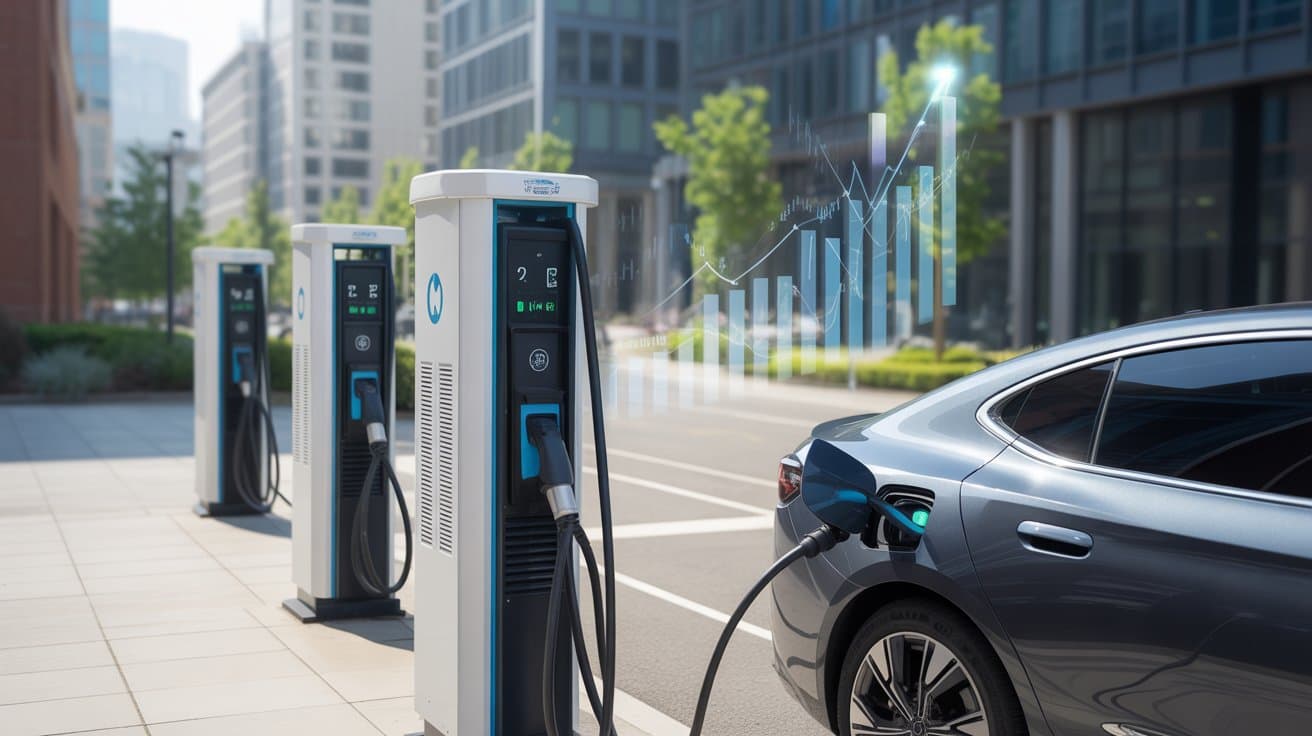
The $82,000 Station vs. The Abandoned Charger
In August 2024, a QuikCharge station in Weymouth, Massachusetts came online with a configuration that appeared unremarkable on paper: several DC fast chargers positioned near a commuter route with adjacent retail amenities. Within months, the site reached 50% utilization—exceptional in an industry where average DCFC utilization hovers around 13%—and now generates approximately $82,000 in monthly gross profit.
Twenty miles away, another charging station tells a different story. Equipped with state-of-the-art 350 kW ultra-fast hardware capable of adding 200 miles of range in under 15 minutes, the location sees perhaps two sessions per day. The owner faces monthly utility bills exceeding $12,000—driven primarily by demand charges based on peak power draw rather than actual energy consumption—while collecting revenue from fewer than 60 charging sessions. The economics are catastrophic: the station will never achieve positive cash flow under current conditions, and the operator quietly explores whether to continue paying for electricity to a mostly-idle asset.
The difference between these stations isn't technology, brand recognition, or even the number of electric vehicles in the surrounding area. It's spatial-temporal alignment—the matching of charging infrastructure to actual human behavior patterns, utility rate structures, and location-specific demand characteristics. This is the essence of what industry participants call the "EV Charger Trap."
Defining the Trap
The EV Charger Trap occurs when operators deploy high-power hardware where the economics cannot work: low utilization combined with demand charges and dwell-time mismatch creates permanent negative unit economics.
This is not a critique of EV adoption or charging demand, but of deploying capital without aligning location, utility economics, and user behavior.
As global electric vehicle sales reached one in four cars sold in 2024 and the U.S. public charging network surpassed 200,000 ports, charge point operators continue reporting negative EBITDA while prioritizing network growth over financial sustainability. For investors building portfolios of fractional real assets and energy transition infrastructure, understanding why some charging stations generate substantial returns while many operate at losses reveals critical lessons about location-based infrastructure investing in emerging markets.
Data Note
All figures reflect publicly reported industry analysis, operator disclosures, and market research available as of early 2025. Utilization rates, demand charges, and breakeven utilization thresholds vary significantly by location, utility territory, tariff structure, and site-specific factors. Statistics cited represent network averages or industry estimates where specified as DCFC vs. Level 2. Figures are illustrative of order-of-magnitude economics rather than precise replicable outcomes. Successful sites represent exceptional cases; many deployments face persistent profitability challenges.
TL;DR — The EV Charger Profitability Crisis in Four Points
- The utilization gap: Average DC fast charger utilization (network-wide estimates) sits around 12.9% against an often-cited 25-35% breakeven utilization range depending on capital costs and tariff structure. Profitability typically emerges only after utilization clears breakeven. The gap persists despite surging EV adoption, revealing fundamental spatial-temporal mismatch between infrastructure placement and actual user demand patterns.
- The demand charge impact: Utility demand charges—fees based on peak power draw, not energy consumed—can dominate site economics in low-utilization scenarios. A site with six 150 kW chargers running simultaneously for just 15 minutes generates a 600 kW demand spike, illustrating how a brief concurrent charging event can drive substantial monthly costs at typical commercial rates.
- The dwell time mismatch: Deploying 350 kW ultra-fast chargers at extended-dwell locations (shopping centers, entertainment venues) creates a profitability paradox: faster charging reduces utilization by shortening sessions without compensating volume increases, while inviting demand charge exposure. Location-appropriate technology matters more than nameplate capacity.
- The reliability challenge: Industry data shows average charging station reliability around 78%, meaning approximately one in five charging attempts may fail. Hardware unreliability drives customer avoidance and creates abandonment risk where operators leave broken chargers in service when repair costs exceed projected revenue.
1BLUF — What the EV Charger Trap Teaches About Infrastructure Deployment
- The case: A Weymouth, MA station generates substantial monthly returns through strategic location selection, reliability focus, and battery-backed demand charge mitigation—while nearby sites with superior hardware operate at persistent losses. The profitability gap reflects operational intelligence matching site characteristics to user behavior, not technology specifications or market growth.
- The mechanics: Charging station economics depend on three interconnected variables: (1) Utilization rate against capital and operating costs, (2) Utility tariff structures where demand charges can dominate economics in low-utilization scenarios, and (3) Dwell time alignment between charging speed and typical customer stay duration. Optimizing only one variable while ignoring others ensures failure.
- The broader challenge: With over 1,000 operators deploying charging infrastructure and utilization rates persistently below profitable thresholds for many sites, the industry faces consolidation favoring operators who treat deployment as a location analytics problem rather than a hardware race. The transition from growth-at-any-cost to margin-focused operations will define which players survive the 2025-2030 shakeout.
- Investment implication: EV charging infrastructure represents a location-based real asset play requiring expertise in utility economics, traffic pattern analysis, and energy management—fundamentally different from traditional infrastructure's stable-yield profile. Returns depend on avoiding systematic deployment errors that trap operators in unprofitable assets, not on broad EV adoption trends.
Unit Economics 101: The Charging Station Profitability Framework
Before examining why specific stations fail or succeed, understanding the fundamental unit economics clarifies what drives charging station profitability. The framework is deceptively simple but becomes complex in execution due to utility tariff structures and usage pattern variability.
Basic Unit Economics Model
Revenue
Revenue = Sessions × kWh per Session × Price per kWh
Costs
Costs = Energy + Network Fees + O&M + Demand Charges + Rent/Revshare
Profitability Driver
Break-even is primarily a function of utilization (which drives revenue) and utility tariff structure (which determines cost behavior). The demand charge component makes costs highly non-linear—a site at 15% utilization may have similar demand charges to a site at 25% utilization if both experience similar peak concurrent usage.
The Utilization Mirage: Why More EVs Don't Automatically Mean More Profit
The EV charging industry operates under a seductive but dangerous assumption: as electric vehicle adoption grows, charging station utilization and profitability will naturally follow. Industry analysis reveals this premise fundamentally misunderstands commercial energy infrastructure economics, where the relationship between demand growth and asset returns is mediated by utility rate structures, spatial distribution patterns, and temporal concentration effects.
The Breakeven Utilization Range and Current Reality
For Direct Current Fast Chargers (DCFC), industry analysis often cites a breakeven utilization range of 25–35%, though this varies substantially based on capital costs, electricity tariff structure, and financing terms. Utilization represents the percentage of time a charger actively delivers electricity relative to its total capacity. Analysis of U.S. charging networks shows average Level 3 DC fast charger utilization remains in the low teens (approximately 12–13%)—below commonly discussed breakeven thresholds despite year-over-year EV sales growth exceeding 25% in many markets.
Level 2 AC chargers demonstrate utilization around 14.6%, combined with dramatically lower capital expenditure ($2,000-5,000 per port vs. $20,000-120,000+ for DCFC). This creates a counterintuitive reality: slower charging technology often generates better returns than ultra-fast hardware at certain site archetypes, despite inferior customer experience metrics.
| Charger Category | CapEx per Port | Annual Maintenance | Avg. Utilization (Network Estimates) | Often-Cited Breakeven Range |
|---|---|---|---|---|
| Level 2 (AC) | $2,000 - $5,000 | $500 - $1,000 | ~14.6% | 15-20% (site-dependent) |
| DCFC (50 kW) | $20,000 - $50,000 | $2,000 - $5,000 | ~11.5% | ~25-30% |
| DCFC (150 kW) | $75,000 - $100,000 | $5,000 - $10,000 | ~12.9% | ~25-35% |
| Ultra-Fast (350 kW+) | $120,000+ | $15,000+ | <10% | ~30-40% |
Note: Utilization figures represent network-wide estimates. Individual site performance varies dramatically by location type, traffic patterns, and local EV adoption. Breakeven thresholds depend heavily on local utility tariff structure, particularly demand charge rates.
Key takeaway: Slower chargers often outperform faster hardware at extended-dwell sites.
The Paradox of Faster Charging
The deployment of ultra-fast charging hardware introduces a specific utilization paradox: faster charging speeds can actively reduce utilization rates by shortening the time each vehicle occupies a port, even if total session volume increases. A 350 kW charger might complete a session in 12-15 minutes compared to 45-60 minutes for a 50 kW unit. Unless the site can attract proportionally higher daily traffic to compensate for shorter sessions—requiring roughly 3-4x the vehicle volume—the ultra-fast hardware achieves lower utilization despite superior customer experience.
AltStreet Analysis
The Utilization-Profitability Formula: Why the 25-35% Range Matters
The often-cited 25-35% breakeven utilization range for DCFC derives from the balance between capital recovery and operating costs. Consider a representative 150 kW DCFC installation:
- Capital expenditure: $85,000 (hardware + installation)
- Financing: 7-year loan at 8% = ~$15,600 annual debt service
- Operating costs: ~$8,000 annually (maintenance, network fees, insurance)
- Utility costs: Variable by demand charges and usage
- Total annual fixed costs: ~$23,600+ before utility expenses
At 30% utilization, a 150 kW charger operates approximately 2,628 hours annually. Delivering 100 kW average during operating hours yields ~262,800 kWh annual throughput. At typical DCFC pricing of $0.40/kWh and $0.15/kWh volumetric utility cost:
- Annual revenue: 262,800 kWh × $0.40 = ~$105,000
- Energy costs: 262,800 kWh × $0.15 = ~$39,000
- Gross margin before demand charges: ~$66,000
- Net margin potential (after debt service and OpEx): ~$42,000
Critical insight: This model assumes favorable demand charge management. Without battery storage or load management, demand charges can add substantial costs annually, potentially eliminating all margin. At current average utilization around 12.9%, the same station operates only ~1,130 hours annually, generating ~$45,000 revenue against ~$24,000+ in fixed costs before demand charges—approaching break-even in best-case scenarios but typically operating at a loss after demand charge variability. The gap between 12.9% and 30% represents the difference between structural losses and potentially sustainable operations.
If you remember nothing else from this section:
- DCFC breakeven utilization often cited in the 25-35% range; network averages sit around 12.9%
- Faster charging can reduce utilization by shortening sessions without proportional volume increases
- Breakeven thresholds vary substantially by local tariff structure and capital costs
- The utilization gap persists despite strong EV adoption growth, revealing spatial-temporal mismatch
The Invisible Killer: How Utility Demand Charges Destroy Margins
While utilization challenges are visible in session data and customer complaints, the most devastating economic force in charging station operations remains largely invisible to outside observers: utility demand charges. Unlike residential customers who pay only for energy consumed (measured in kilowatt-hours), commercial facilities face a two-part tariff structure where demand charges—fees based on the highest instantaneous power draw during a billing cycle—can dominate total costs in low-utilization scenarios.
The Mechanics of Demand Charge Impact
Demand charges are calculated based on peak power consumption measured in kilowatts (kW), not total energy delivered in kilowatt-hours (kWh). When multiple high-power chargers operate simultaneously, they create demand spikes that set the billing baseline for the entire month. The fundamental equation governing total utility costs becomes:
Commercial Utility Cost Structure
Ctotal = (E × Renergy) + (Ppeak × Rdemand)
Where: E = total energy consumed (kWh)
Renergy = volumetric energy rate ($/kWh)
Ppeak= highest power draw during billing cycle (kW)
Rdemand = demand charge rate ($/kW)
Consider a site with six 150 kW DC fast chargers. If just four chargers operate simultaneously at 100 kW each for 15 minutes during a billing cycle, the peak demand reaches 400 kW. At commercial rates that can range from $10-20/kW depending on territory, this single 15-minute interval generates substantial monthly demand charges—regardless of total energy consumed during the month. In low-utilization scenarios, the demand charge component can dominate total utility costs.
Battery-Backed Charging: The Emerging Standard
Battery Energy Storage Systems integrated with EV charging stations represent a comprehensive approach to demand charge mitigation. By deploying batteries typically in the 300–500 kWh range alongside multiple fast chargers, operators can “peak shave” during simultaneous charging events—discharging stored energy to supplement grid power and keeping utility draw below demand charge thresholds.
The Weymouth, Massachusetts QuikCharge site illustrates this model in practice. Its battery-backed design mitigates demand charges during peak usage, enables faster deployment by reducing required electrical infrastructure upgrades, and creates optionality for additional value through grid services during non-peak charging hours.
AltStreet Analysis
Battery Storage ROI: The Demand Charge Mitigation Math
Consider a six-charger DCFC site facing chronic demand charge challenges:
Without Battery Storage (Current State)
- Configuration: Six 150 kW chargers, average utilization 15%
- Peak demand scenario: 500 kW (4 chargers at 125 kW simultaneously)
- Monthly demand charge at $15/kW: 500 kW × $15 = $7,500
- Annual demand charges: $90,000
- Energy charges: ~$35,000 annually
- Total utility costs: ~$125,000/year
- Result: Demand charges represent ~72% of utility costs
With 400 kWh Battery Storage
- Battery capital cost: ~$250,000 (installed)
- Grid connection maintained at 200 kW maximum draw
- Battery supplements during simultaneous charging events
- Monthly demand charge: 200 kW × $15 = $3,000
- Annual demand charges: $36,000 (60% reduction)
- Annual demand charge savings: $54,000
- Simple payback: ~4.6 years
- Additional benefits: Faster deployment, potential grid services revenue
Key insight: The battery transforms unpredictable demand charges into fixed capital expenditure with calculable payback. For sites expecting moderate-to-high utilization, battery-backed systems merit serious consideration, as demand charge mitigation alone can justify the investment before accounting for deployment speed or ancillary revenue opportunities.
If you remember nothing else from this section:
- Demand charges can dominate site economics in low-utilization scenarios
- A single 15-minute concurrent charging event can set peak demand for an entire billing cycle
- Battery storage transforms demand charges into manageable CapEx with multi-year payback
- Tariff structure varies significantly by utility territory—local analysis essential
The Dwell Time Fit Test: Matching Technology to Location
The most common manifestation of the EV Charger Trap is the deployment of ultra-fast charging hardware at locations where vehicle dwell times fundamentally mismatch the charging speed. This creates a cascading profitability failure: rapid charging completes before customers finish their primary activity, reducing utilization while inviting demand charge exposure.
The Dwell Time Matching Framework
Successful charging deployment requires matching technology to typical customer stay duration at each location archetype. The optimal alignment maximizes both utilization (charger operates throughout customer stay) and business value (extended stay may increase ancillary spending for retail hosts).
| Dwell Time | Location Type | Recommended Tech | Business Goal |
|---|---|---|---|
| < 20 min | Highway Corridor / C-Store | 150-350 kW DCFC | Quick top-off; high turnover |
| 30-60 min | Grocery / Big-Box Retail | 50 kW DCFC or Level 2 | Complete charge during shopping |
| 2-4 hours | Entertainment / Dining | Level 2 (AC) | Destination charging for extended stays |
| 8+ hours | Workplace / Hotels / Multi-Family | Level 2 (AC) | Full charge during work/overnight |
Key takeaway: Reliability and first-attempt success drive utilization as much as hardware specs.
Key takeaway: Match charging speed to dwell time or utilization collapses.
The Movie Theater Paradox
Consider the economics of deploying a 350 kW ultra-fast charger at a movie theater complex where typical customer stays run 2.5-3 hours. The charger can deliver substantial charge in 15-20 minutes, meaning customers arrive, plug in, watch their movie, and return to find their vehicle fully charged hours ago. From the charger's perspective, it operated for perhaps 18 minutes of a 3-hour customer visit—achieving only ~10% utilization despite full customer satisfaction.
Meanwhile, the 350 kW hardware created demand spikes whenever it operated. The capital expenditure of $120,000+ for ultra-fast hardware generated inferior utilization compared to Level 2 chargers costing $3,000 that would operate for the full 2.5 hour movie duration.
AltStreet Analysis
Dwell Time Mismatch: The Economics of Wrong-Speed Deployment
Compare two scenarios at a shopping center with 90-minute average customer stays:
Scenario A: 350 kW Ultra-Fast Charger
- CapEx: $140,000 per port (4 ports = $560,000)
- Charge time: ~15 minutes average
- Utilization: ~17% (15 min / 90 min dwell time)
- Demand exposure: High during concurrent sessions
- Result: Low utilization + demand charge exposure = persistent loss
Scenario B: Level 2 (19.2 kW) Chargers
- CapEx: $4,000 per port (12 ports = $48,000)
- Charge duration: 60-75 minutes (partial charge)
- Utilization: ~72% (65 min average / 90 min dwell time)
- Demand exposure: Materially lower due to power draw
- Result: Higher utilization + lower CapEx + manageable demand charges
- Additional benefit: Customers remain on-site for full shopping duration
Key insight: The Level 2 deployment costs materially less upfront, achieves substantially higher utilization, generates lower demand charge exposure, and creates better business alignment for the retail host. For extended-dwell locations, slower charging isn't a compromise—it's the optimal financial strategy.
The Reliability Crisis: What Actually Breaks
Beyond utilization and demand charge challenges, the charging industry faces a reliability challenge where industry data shows average uptime around 78%. This reliability gap undermines network utility and creates "abandonment risk" where operators leave broken chargers in service when repair costs exceed projected revenue.
What Actually Fails: A Forensic Breakdown
Charging reliability failures stem from multiple compounding issues:
- Payment/authentication failures: Credit card readers, RFID systems, and mobile app authentication add failure points before charging even begins
- Connector/handshake errors: Vehicle-to-charger communication via CCS, CHAdeMO, or NACS protocols can fail during initial connection
- Communications/networking: Backend connectivity for billing, load management, and remote monitoring requires persistent network uptime
- Thermal derates: Power electronics overheat in extreme weather, forcing chargers to reduce output or shut down for cooling
- Vandalism/cable damage: Outdoor equipment exposed to weather and misuse experiences accelerated wear
- Maintenance latency ("truck roll economics"): Remote sites requiring specialized technicians face multi-day repair cycles
| Reliability Metric | Top Performing | Industry Average | Bottom Performers |
|---|---|---|---|
| Uptime Percentage | 99%+ | ~78% | <70% |
| First-Attempt Success | 92%+ | ~75% | <60% |
| Maintenance Response | <24 hours | 3-7 days | Unknown / No response |
The Abandonment Economics
The reliability crisis creates a particularly destructive feedback loop at low-utilization sites. When a charger fails at a location generating modest monthly revenue, and the repair requires substantial service costs (particularly for remote sites requiring truck rolls and specialized technicians), the rational economic decision may be abandonment—leaving the equipment out of service indefinitely.
This helps explain why major charging networks have slowed expansion as profits remain elusive, shifting focus from rapid deployment to improving uptime and utilization at existing sites. Maintaining high reliability at fewer locations often beats spreading operations thin across a larger, harder-to-maintain footprint.
Why a Few Stations Succeed: The QuikCharge Weymouth Case Study
Despite the systematic challenges, a small subset of stations achieves impressive returns. The QuikCharge station in Weymouth, Massachusetts provides a case study in avoiding the EV Charger Trap through strategic location selection, operational excellence, and technology integration.
The Strategic Foundation
Launched in August 2024, the site reached 50% utilization within months and generates substantial monthly returns—exceptional performance relative to industry averages. The success derives from alignment across multiple operational dimensions:
- Location intelligence: Positioned at the convergence of high-traffic commuter routes with adjacent retail amenities, creating demand density throughout operating hours
- Reliability focus: Partnership emphasizing high uptime and rapid maintenance response builds customer confidence and repeat usage
- Battery-backed infrastructure: Integrated energy storage enables demand charge management while facilitating faster deployment (under 6 months)
- Appropriate charging speeds: Moderate-speed DCFC balances customer experience with utilization economics for the typical dwell time
AltStreet Analysis
Why Weymouth Works: The Alignment Factors
The QuikCharge success demonstrates systematic alignment across the factors that determine charging economics:
- Traffic density: Commuter corridor location ensures consistent daily traffic regardless of day-of-week variations
- Dwell time match: Moderate-speed charging (20-45 minute sessions) aligns with typical convenience stop duration
- Demand charge mitigation: Battery storage eliminates the primary operational cost variable that destroys profitability at conventional sites
- Reliability premium: High uptime creates reputation that drives organic traffic growth through word-of-mouth
- Deployment speed: Six-month timeline reduced financing carrying costs compared to typical longer deployments
Key insight: No single factor explains the Weymouth success—it's the systematic alignment of location, technology, operations, and partnership structure. Replicating this success requires comprehensive site analysis and operational sophistication, not just hardware deployment.
The Path Forward: AI and Precision Deployment
The maturation of the charging industry from rapid expansion to margin-focused operations is accelerating the adoption of sophisticated site-selection and pricing methodologies. McKinsey notes that operators and mobility retailers are increasingly using advanced analytics and AI to improve EV-charging economics—modeling demand patterns, customer behavior, and local constraints before committing capital.
Predictive Site Selection
Modern site selection tools combine traffic flow modeling, local EV adoption forecasting, grid constraint mapping, competitive gap analysis, and environmental risk assessment—allowing operators to move from reactive deployment based on subsidy availability to proactive precision placement at sites with validated demand patterns and favorable economics.
The Future of Grid Integration
The next evolution of charging economics involves transformation from simple loads into dynamic grid assets through bidirectional charging / Vehicle-to-Grid (V2G) technology. V2G enables electric vehicles to discharge power back to the grid during peak demand periods, creating bidirectional energy flow that can support grid services beyond charging fees. Analysis suggests these grid services could provide meaningful secondary revenue streams, though V2G technology remains in relatively early commercial deployment.
Investment Framework: Due Diligence Checklist
For investors evaluating charging infrastructure opportunities, a systematic due diligence framework separates viable investments from value traps:
Investor/Operator Due Diligence Checklist
Site Economics
- Utilization by hour/day/season + growth trajectory vs. breakeven threshold
- Local EV adoption rates and projected penetration
- Competitive density within 5-mile radius
Utility & Tariff
- Demand charge structure, TOU rates, ratchet provisions
- Interconnection scope + potential upgrade costs
- Availability of EV-specific tariffs or demand charge waivers
Operational
- Historical uptime SLA + maintenance response times
- First-attempt success rates vs. network benchmarks
- Peak shaving strategy (battery-backed vs. load management)
Business Model
- Host economics (rent/revshare terms, foot traffic value)
- Pricing power vs. nearby competitors
- Revenue diversification beyond electricity sales
Investment Framework Comparison
EV Charging vs. Traditional Infrastructure: Risk-Return Characteristics
| Characteristic | Traditional Infrastructure | EV Charging Networks |
|---|---|---|
| Revenue predictability | High (contracted, regulated) | Low (merchant, utilization-dependent) |
| Location sensitivity | Moderate (broad tolerance) | Extreme (location determines viability) |
| Operating leverage | Moderate | High (utilization drives exponential margin) |
| Technology risk | Low (stable systems) | Moderate (connector standards evolving) |
| Operational intensity | Low to moderate | High (constant monitoring required) |
| Typical investor profile | Core infrastructure funds | Opportunistic, energy transition specialists |
Investment thesis: EV charging infrastructure offers exposure to the energy transition with potential for outsized returns compared to traditional infrastructure, but requires active management and tolerance for binary outcomes. The sector suits opportunistic infrastructure allocators comfortable with 5-7 year value creation timelines and operational complexity.
Key takeaway: EV charging behaves like a merchant asset, not regulated infrastructure.
Key Takeaways: Lessons from the EV Charger Trap
The systematic profitability challenges facing many EV charging stations reveal critical lessons about infrastructure deployment in emerging markets and the importance of matching technology to actual user behavior.
Lesson 1
Utilization Gaps Persist Despite EV Growth
Average DCFC utilization (network estimates) remains around 12.9% against often-cited 25-35% breakeven utilization range despite year-over-year EV adoption growth exceeding 25% in many markets. The gap reflects spatial-temporal mismatch between infrastructure placement and actual demand patterns—more EVs don't automatically translate to higher utilization at poorly-sited chargers.
Lesson 2
Demand Charges Dominate Low-Utilization Economics
Utility demand charges can dominate site economics in low-utilization scenarios. A single 15-minute concurrent charging event can set peak demand for an entire billing cycle, generating substantial costs at typical commercial rates. Battery storage or special utility tariffs transform from optional enhancements to essential economics for DCFC viability.
Lesson 3
Technology Must Match Dwell Time or Fail
Deploying 350 kW ultra-fast chargers at extended-dwell locations creates the profitability paradox: faster charging reduces utilization by completing sessions before customers finish their primary activity, while triggering demand charge exposure. Success requires matching charging speed to typical customer stay duration using the Dwell Time Fit Test framework.
Lesson 4
Reliability Determines Long-Term Viability
Industry data shows average uptime around 78%, meaning approximately one in five charging attempts may fail. Top-performing networks achieve substantially higher uptime through proactive maintenance and rapid response, building customer loyalty that drives organic utilization growth. The reliability premium compounds over time as reputation effects concentrate traffic at dependable locations.
Lesson 5
Retail Integration Beats Electricity Margins
Successful retail hosts treat chargers as customer acquisition tools rather than profit centers from electricity sales. Research shows in-store revenue can increase following charger installation as stations attract exploratory visitors. A grocery customer spending incrementally more generates more host value than modest electricity margin. This model requires charging speeds that align with shopping duration.
Most Important
Location Intelligence Is The Only Sustainable Advantage
The profitability gap between top-performing sites (generating outsized returns) and persistent losers isn't technology, brand, or capital access—it's systematic alignment of location characteristics to utility economics, traffic patterns, and user behavior. As hardware commoditizes and competition intensifies, operators with superior location analytics and operational execution will capture disproportionate returns while competitors deploying based on coverage maps or subsidy availability face structural losses.
Conclusion: Escaping the Trap Through Strategic Alignment
The EV Charger Trap represents a systematic failure to match infrastructure deployment to economic reality—treating charging as a simple hardware problem when it requires sophisticated integration of location analytics, utility economics, user behavior modeling, and operational excellence. The gap between the QuikCharge success story and the thousands of sites struggling with profitability demonstrates that successful charging is possible, but only when every element aligns favorably.
The industry is experiencing a necessary transition from growth-at-any-cost to margin-focused operations. The operators who survive this transition will be those who recognize that location is the only sustainable competitive advantage . Hardware commoditizes, software capabilities converge, and brand loyalty proves fleeting when reliability and pricing differ marginally. But a well-selected site at the intersection of traffic density, appropriate dwell time, favorable utility rates, and minimal competition creates defensible economics that persist regardless of technological evolution or competitive entry.
For investors, the charging infrastructure opportunity requires a fundamental mindset shift. This is not traditional infrastructure offering stable yields from regulated monopolies or contracted cash flows. It's a location-based real asset play demanding expertise in utility rate structures, traffic pattern analysis, energy management, and operational execution. Returns will accrue to those who can systematically identify the subset of locations where economics actually work, rather than deploying capital based on coverage mandates or subsidy availability. Investors should apply infrastructure due diligence frameworks before underwriting site-level returns.
These same dynamics appear in grid-scale batteries and microgrids and data-center power infrastructure, where volatility, location, and tariff design dominate returns.
AltStreet's view: The charging industry's profitability crisis is not a temporary phenomenon that strong EV adoption will resolve. It reflects structural misalignment between how infrastructure has been deployed (prioritizing coverage and nameplate capacity) and what actually drives returns (utilization, demand charge management, dwell time optimization). The market will consolidate around operators who treat deployment as a location analytics problem requiring rigorous site selection, operational sophistication, and acceptance that many potential locations will never achieve profitable economics regardless of EV penetration rates. Success requires avoiding the trap entirely through strategic discipline rather than attempting to fix poorly-sited assets through operational improvements.
As the transition to electric mobility accelerates and charging infrastructure becomes ubiquitous, the winners will be those who valued location intelligence over technology specifications, operational excellence over deployment speed, and sustainable unit economics over network size. The EV Charger Trap will claim many victims in the coming industry consolidation, but it also creates opportunities for sophisticated operators and investors who understand that in infrastructure—as in real estate—the three most important factors are location, location, and location.
Continue Learning About Energy Infrastructure
EV charging infrastructure demonstrates unique location-dependent economics within the broader energy transition ecosystem. For comprehensive coverage of how energy infrastructure investments work alongside other real asset strategies:
Master Real Assets and Energy Infrastructure Investing
Explore comprehensive guides to energy infrastructure, transportation assets, and location-based real asset strategies across the energy transition.
Energy Transition Infrastructure
Battery storage, charging networks, grid modernization, and renewable integration opportunities
Fractional Real Assets
Farmland, energy projects, and alternative real estate access for real asset portfolios
Portfolio Construction
Integrate location-based infrastructure with stable-yield real assets for optimal risk-adjusted returns
AI Infrastructure & Compute
Data centers, GPU infrastructure, and compute-linked real asset exposure