
Prediction Markets & Event Contracts
Trading event outcomes through regulated binary contracts — from economic indicators and elections to weather, sports, and financial benchmarks.
Overview
Prediction markets are exchanges where participants trade contracts tied to the outcome of a defined event. Most retail event contracts are binary: a YES or NO position settles at a fixed value if its side is correct and at zero if it is wrong. Prices therefore convey a market-implied probability, but they are tradable derivative prices shaped by liquidity, fees, risk preferences, and positioning—not objective forecasts. U.S. retail access increasingly runs through Commodity Futures Trading Commission-regulated designated contract markets (DCMs), with contracts spanning economic data, financial benchmarks, elections, weather, current events, and sports. These instruments can support forecasting and narrow hedges, but they are short-duration, all-or-nothing exposures rather than compounding investments.
Key Benefits
- Defined downside: a fully collateralized long position generally cannot lose more than the premium paid
- Transparent payoff: contract rules specify the event, settlement source, deadline, and fixed payout
- Market-implied probabilities update as participants incorporate new information
- Event-specific hedging can offset some economic, weather, political, or business risks
- Small contract sizes can provide granular exposure without options-style strike ladders
- Regulated DCMs provide rulebooks, market surveillance, customer protections, and formal dispute processes
Platform Reviews
In-depth analysis using our three-pillar evaluation framework
Kalshi
Kalshi is the CFTC-regulated exchange where anyone 18+ can trade binary event contracts on elections, economics, weather, and — controversially — sports, plus leveraged crypto perpetuals since mid-2026. It is a trading venue, not an investment: AltStreet's own 15,685-market study found no exploitable edge after fees, the genuine use case for alternative investors is precision hedging, and the venue itself now sits at the center of the widest unresolved legal fight in retail markets. AltStreet's census of the federal docket record finds 80 matters naming a Kalshi entity across 41 courts and 8 circuits, 55 of them open, and 25 brought by Kalshi itself against state officials.
Polymarket
Polymarket is the world's largest prediction market by its own description — and it is really two venues under one brand: an international crypto exchange settling in USDC-backed pUSD on Polygon with UMA oracle resolution, and Polymarket US, a CFTC-designated contract market (QCX LLC) that relaunched US trading in December 2025 with USD accounts and rule-based settlement. Neither venue sells investments: every contract is a priced position against another trader. Between the $1.64 billion ICE has invested, an active CFTC probe opened in June 2026, a Nevada restraining order, and the same state-law war Kalshi is fighting, understanding which Polymarket you are using — and what each one's rules actually say — matters more here than on any platform AltStreet covers.
Latest Research & Analysis
View All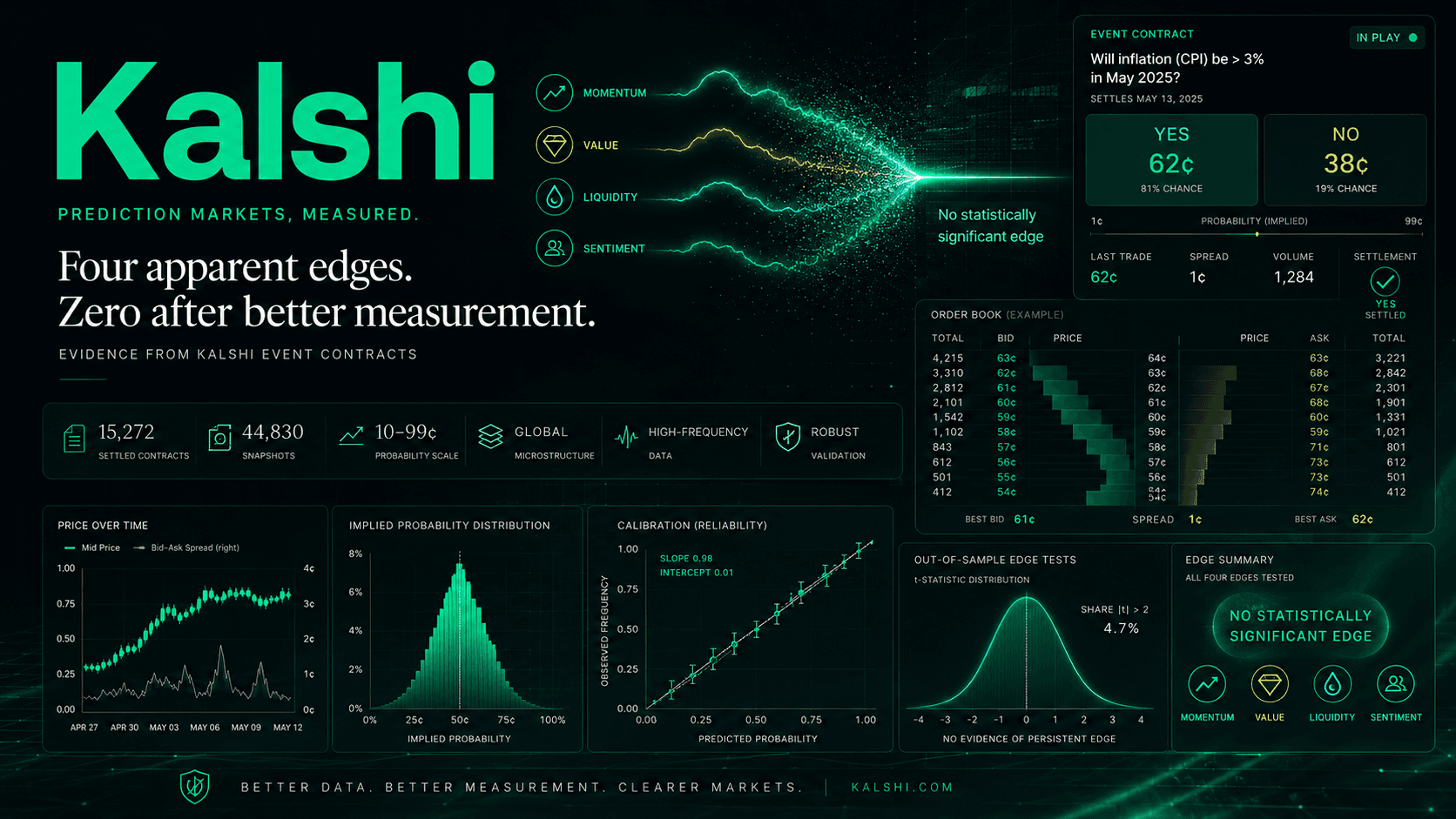
How to Evaluate and Trade Event Contracts
Choose a regulated access route
For U.S. access, verify the exchange is listed by the CFTC as a designated contract market and confirm whether you trade directly or through a registered intermediary. Regulatory status, customer-fund treatment, eligibility, and available products differ by venue.
Read the contract rules before pricing the odds
Identify the exact question, observation window, settlement source, calculation method, cancellation provisions, and challenge process. A correct real-world thesis can still lose if the contract resolves under a narrower definition than expected.
Convert price into payoff and breakeven probability
For a contract that pays $1, buying YES at $0.35 risks $0.35 to earn $0.65 before fees. The quoted 35% is a useful probability signal, but your breakeven probability must also account for transaction costs, spreads, and settlement risk.
Use limit orders and cap event exposure
Inspect order-book depth and bid-ask spreads rather than relying on the displayed midpoint. Size each contract as a speculative or hedging position that can expire worthless, and avoid concentrating multiple positions on the same underlying event.
Prediction Market & Event Contract Risks
Important considerations before investing in prediction markets & event contracts
- Total-loss risk: an incorrect binary position can expire at zero, losing 100% of the premium and fees
- Resolution risk: ambiguous wording, revised data, postponed events, or disputed sources can produce an unexpected settlement
- Liquidity risk: thin order books and wide spreads can make an early exit materially worse than the displayed probability
- Probability misinterpretation: prices embed risk preferences, fees, and market structure and are not guaranteed objective probabilities
- Information asymmetry: participants close to an event may act faster or possess better information than retail traders
- Manipulation and surveillance risk: small markets may be vulnerable to distorted prices or attempted manipulation
- Regulatory and availability risk: product eligibility and state/federal treatment can change, especially for political and sports contracts
- Correlation risk: several apparently different contracts may resolve from the same election, data release, game, or macroeconomic shock
Due Diligence Checklist
- Verify the exchange and any intermediary in the CFTC and NFA registration databases
- Read the complete contract terms, including the settlement source, observation time, rounding rules, and contingency procedures
- Calculate maximum loss, maximum payout, breakeven probability, and all fees before placing an order
- Inspect executable bids and asks, market depth, and recent volume instead of treating the midpoint as an available price
- Check position limits, account eligibility, geographic restrictions, funding rules, and withdrawal procedures
- Understand whether the contract is fully collateralized and how customer funds are held and cleared
- Identify correlated positions and cap total exposure to a single underlying event or information release
- Keep records for tax reporting and consult a tax professional about the treatment of event-contract gains and losses
- Use the contract's formal review or dispute process promptly if a settlement determination appears inconsistent with its rules
Real-World Examples
Binary payoff example: buying a $1-settled YES contract at $0.35 risks $0.35 for a maximum $0.65 pre-fee profit; a NO resolution loses the full $0.35 premium.
Growth example: the CFTC reported that DCMs certified approximately 1,600 event contracts in 2025, compared with an average of roughly five per year from 2006 through 2020.
Hedging example: a business exposed to an adverse weather or economic-data outcome may use a related contract to offset part of the loss, but basis risk remains if the contract's trigger does not match the business exposure.