EquityZen vs UpMarket 2026
Both platforms package the same thing — pre-IPO shares in companies like SpaceX, OpenAI, and Anthropic — into funds you buy into rather than shares you trade. But they package it very differently. EquityZen is a single-layer SPV packager now owned by Morgan Stanley, with a ~2.5% fee and a $5,000 minimum. UpMarket sells two-layer feeder funds through a related-party structure with layered, partly-undisclosed fees. They appear in the same search results; they are not the same product. This guide compares what the primary source data actually shows.
Guide Thesis
Both are packagers, not markets. One is a clean, low-fee, bank-owned SPV. The other is a fee-layered, related-party feeder.
EquityZen: single-layer SPV, ~2.5% fee, $5,000 minimum, Morgan Stanley-owned, no net-capital flag. UpMarket: two-layer 'Access Fund' feeder, layered + undisclosed fees, related-party structure, self-reported broker-dealer net-capital deficiency.
Neither platform is a live market — both sell you a fund that holds the shares. The real comparison is how clean, cheap, and well-backed that fund wrapper is.
EquityZen: one disclosed ~2.5% fee, a single-layer SPV, a $5,000 minimum, and Morgan Stanley ownership. UpMarket: subscription + management + marketing + carry stacked on top of undisclosed underlying-fund fees, placed by an affiliated broker, in a two-layer feeder.
Who each platform is for
EquityZen
- 👤 WhoAccredited investors (some offerings require QP)
- 💵 Entry~$5,000 minimum post-acquisition (industry-lowest)
- 🎯 GoalLow-cost, simple SPV access to a diversified set of pre-IPO names
- 📄 TaxK-1 on SPVs — timing varies, extension filings common
- ⚠️ KnowIlliquid; 'Express' liquidity is conditional; 74% exit return is survivorship-biased
- ✅ Best forCost- and simplicity-focused investors who value Morgan Stanley backing
UpMarket
- 👤 WhoAccredited investors; some offerings require Qualified Purchaser
- 💵 Entry$50,000 stated for marquee funds; $10K–$100K+ across Access Funds
- 🎯 GoalPre-packaged feeder access to a specific named company
- 📄 TaxK-1 — feeder one layer removed from the underlying fund
- ⚠️ KnowRelated-party structure; layered + undisclosed fees; BD net-capital flag
- ✅ Best forInvestors wanting a specific feeder, with the PPM read in full
The Core Decision
Clean low-fee SPV, or layered feeder wrapper.
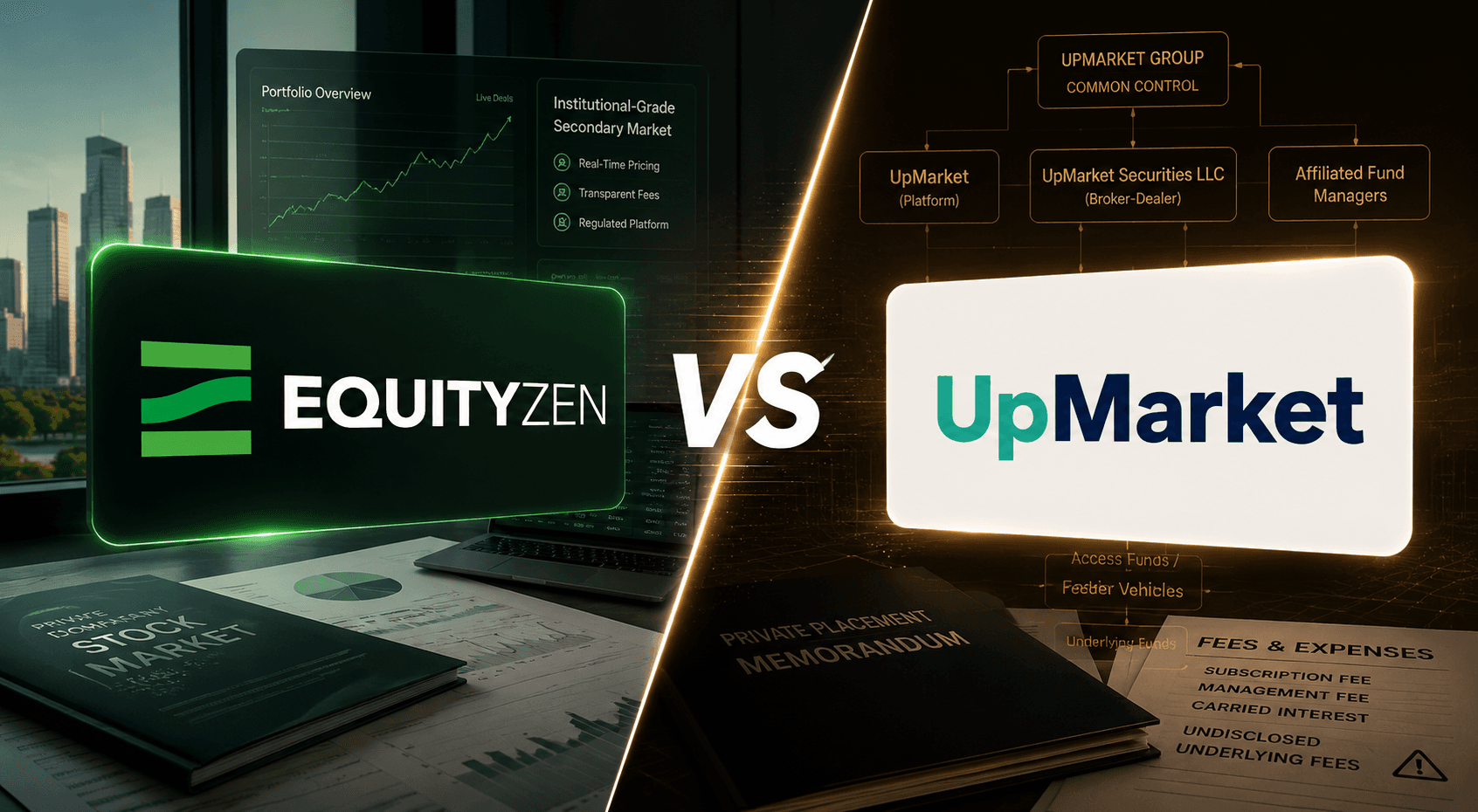
Both platforms reach the same marquee pre-IPO names, and neither lets you trade — you buy a fund that holds the shares. The difference is the wrapper. EquityZen's is single-layer, costs ~2.5%, starts at $5,000, and now sits inside Morgan Stanley. UpMarket's is a two-layer feeder: the platform, the broker placing the deal, and several managers share common control, and the fee stack is layered on top of undisclosed underlying-fund fees. Both require reading the offering documents, not just the homepage.
Structure
Both packaged
EquityZen: single-layer SPV packager (Morgan Stanley-owned). UpMarket: two-layer feeder where platform, broker, and managers share common control.
Fees
EquityZen ~2.5%
EquityZen: ~2.5% buyer fee, single-layer, no underlying-fund fees. UpMarket: ~1.5% subscription + ~1% mgmt + ~1% marketing + 10–20% carry + undisclosed underlying-fund fees.
Regulatory
EquityZen cleaner
EquityZen: SEC-registered BD, now within Morgan Stanley's framework, no net-capital flag. UpMarket: BD self-reported a net-capital deficiency (SEA Rule 17a-11) covering 01/2023–02/2024.
TL;DR
The 30-second version
Both are packagers, not markets. Neither EquityZen nor UpMarket is a live order book. You buy an interest in a fund that holds pre-IPO shares — you do not trade shares directly, and you cannot reliably sell early.
EquityZen is the cleaner, cheaper wrapper. A single-layer SPV, a ~2.5% buyer fee post-Morgan Stanley acquisition (February 2026), a ~$5,000 minimum (industry-lowest), and no second underlying-fund fee layer. AltStreet's complete census documents 1,890 funded EquityZen SPVs across five fund families ($1.484B, 2015–2026).
UpMarket is the layered, related-party wrapper. A two-layer 'Access Fund' feeder where the platform, broker-dealer, and several managers share common control, stacking a subscription fee, management fee, marketing fee, and carry on top of the underlying fund's own — often undisclosed — fees. Its PPMs concede the feeder costs more than going direct.
Regulatory edge: EquityZen. Now within Morgan Stanley's framework with no net-capital flag. UpMarket's broker-dealer self-reported a net-capital deficiency (SEA Rule 17a-11) covering 01/2023–02/2024, originating in related-party expense-sharing.
Both are illiquid and K-1-bearing. Multi-year holds, no guaranteed exit, extension filings common. See the factor-by-factor breakdown below.
Platform fundamentals
Side-by-side at a glance
| Factor | EquityZen | UpMarket |
|---|---|---|
| Model | Single-layer SPV packager (broker-dealer) | Two-layer feeder 'Access Funds' (related-party) |
| Ownership | Acquired by Morgan Stanley (Feb 2026) | Independent; platform, broker, managers share common control |
| Headline fee | ~2.5% buyer fee (post-acquisition) | ~1.5% subscription + ~1% mgmt + ~1% marketing + 10–20% carry |
| Underlying-fund fees | None (single-layer) | Passed through; often undisclosed in PPM |
| Minimum | ~$5,000 (industry-lowest) | $50,000 stated for marquee funds; $10K–$100K+ range |
| What you own | SPV interest holding the shares | Feeder interest one layer from the underlying fund |
| Eligibility | Accredited (some offerings QP) | Accredited (some offerings QP) |
| Regulatory note | No net-capital flag; within Morgan Stanley framework | Self-reported net-capital deficiency (SEA 17a-11), 01/2023–02/2024 |
| Liquidity | Illiquid; 'Express Deals' conditional | Illiquid; feeder held to underlying fund duration |
| Tax | K-1; extension filings common | K-1; feeder structure, extensions common |
| AltStreet data | 1,890 funded SPVs across five fund families — $1.484B, 2015–2026 (complete SEC census) | $35.0M across 31 affiliated Form D offerings (2022–2026) |
Bottom line up front
The Practical Verdict
EquityZen: who should consider it
Accredited investors who want the lowest-cost, simplest, best-backed way into pre-IPO secondaries. The ~2.5% post-acquisition fee and single-layer SPV mean no second underlying-fund fee layer, the $5,000 minimum makes diversifying across several names feasible, and Morgan Stanley ownership adds institutional oversight. Best for cost- and simplicity-focused investors who accept multi-year illiquidity and K-1 complexity, and who treat the 74% aggregate exit return as directional rather than predictive.
UpMarket: who should consider it
UpMarket can still make sense when the investor wants exposure to a specific company or underlying fund not available through EquityZen, accepts the higher minimum, and is comfortable underwriting the full PPM-level fee stack. That means reading the relevant PPM in full — subscription fee, management fee, marketing fee, carry, and the underlying fund's own fees — and sizing the position around the layered cost, two-layer feeder, and disclosed related-party structure.
Head-to-head
EquityZen vs UpMarket, factor by factor
Five decision factors that actually change the outcome — structure, fees, access, regulatory standing, and liquidity. Each section states the summary, the practical verdict, and the specific factors that shift the decision.
Single-layer SPV packager vs related-party feeder distribution
EquityZen vs UpMarket: Platform Structure
Neither platform is a live trading venue — both package pre-IPO exposure into funds — but the packaging is structurally different. EquityZen is an SEC-registered broker-dealer that bundles secondary shares into funds: single-company funds (its Standard and Express Deals) and multi-company funds (Growth Opportunity and Thematic vehicles). The structure is largely single-layer — the fund holds the shares directly, and as of February 2026 the whole operation sits inside Morgan Stanley, which acquired EquityZen's marketplace and technology. UpMarket, by the documents' own description, is a vertically integrated structure: the platform, the placement-agent broker-dealer (UpMarket Securities LLC), and several fund-management entities are described in the PPMs and FINRA records as affiliated or under common control. Its core product is the 'Access Fund' — a feeder that invests substantially all of its assets into a single underlying third-party fund, wrapped at a lower minimum. That feeder is a second layer between the investor and the shares.
Verdict
Both are packagers, but EquityZen's wrapper is simpler and its parent is a major bank, while UpMarket's wrapper adds a layer and a web of disclosed affiliations. On EquityZen you buy a fund that holds the shares; on UpMarket you buy a feeder that buys into another fund that holds the shares. EquityZen asks you to accept an SPV and a low fee; UpMarket asks you to accept a two-layer feeder and a related-party structure the offering documents disclose. Neither is illegitimate — but EquityZen is the structurally cleaner and more institutionally backed of the two.
| Core mechanism | EquityZen: single- and multi-company funds (SPVs) holding secondary shares directly. UpMarket: feeder 'Access Funds' wrapping a single underlying third-party fund/SPV. |
| Layers between you and the shares | EquityZen: one (the SPV). UpMarket: two (the Access Fund feeder, then the underlying fund). |
| Independence / ownership | EquityZen: SEC-registered BD, acquired by Morgan Stanley (Feb 2026). UpMarket: platform, broker-dealer, and several managers share disclosed affiliations or common control. |
| What you receive | EquityZen: an SPV interest (or, in limited cases, a direct share acquisition). UpMarket: a feeder-fund interest one layer removed from the underlying fund. |
Single ~2.5% fee, one layer vs layered, partially-undisclosed stack
EquityZen vs UpMarket: Fees
This is the clearest dimension of the comparison. EquityZen, following the Morgan Stanley acquisition, charges a buyer fee of approximately 2.5% — among the lowest in retail-accessible pre-IPO — on a single-layer SPV, meaning there is no second underlying-fund fee taking another cut. UpMarket's Access Funds stack a ~1.5% subscription fee to the affiliated broker, a ~1% annual management fee, up to ~1% marketing fee, and 10–20% carried interest — and then pass through the underlying fund's own management and performance fees, which several PPMs explicitly decline to disclose. UpMarket's PPMs include a 'Special Note' acknowledging the feeder costs more than investing in the underlying fund directly. EquityZen's cost is a single, disclosed, low number; UpMarket's is a layered, partly-undisclosed stack that compounds over the hold.
Verdict
EquityZen is the decisively cheaper and more transparent fee structure: one disclosed fee (~2.5%), one layer, no second underlying-fund fee layer. UpMarket's cost is the opposite shape — a recurring, layered stack plus undisclosed underlying-fund fees that compound over a multi-year hold, on a product its own PPMs concede costs more than going direct. For fee efficiency, this is not a close call. Read the relevant UpMarket PPM in full before committing; the disclosed product page does not show the complete cost.
| Headline buyer fee | EquityZen: ~2.5% post-Morgan Stanley acquisition. UpMarket: ~1.5% subscription fee to the affiliated broker, plus up to ~1% marketing fee. |
| Management fee | EquityZen: single-layer SPV — no separate ongoing underlying-fund management fee. UpMarket: ~1% annual at the Access Fund level, plus the underlying fund's own management fee (often undisclosed). |
| Carried interest | EquityZen: minimal/none on the standard SPV product. UpMarket: 10–20% at the Access Fund level, plus the underlying fund's own carry. |
| Disclosure | EquityZen: single published fee. UpMarket: full fee layers in the PPM, not on product pages; underlying-fund fees often not disclosed at all. |
$5,000 industry-low minimum vs $50,000+ feeder funds
EquityZen vs UpMarket: Access & Minimums
Both serve accredited investors, with some offerings requiring Qualified Purchaser status, and both list marquee names — but the access mechanics differ. EquityZen's minimum is approximately $5,000 post-acquisition, the lowest in the category, across single-company funds (Standard and the faster Express Deals) and multi-company funds (Growth Opportunity and the now-sunsetting Thematic vehicles). AltStreet's complete SEC Form D census documents 1,890 funded EquityZen SPVs across five fund families — $1.484B raised across 48,614 subscription positions, 2015–2026. The census shows the platform bifurcating rather than shrinking: issuance recovered from a 2023 trough and has grown every year since, while retail median subscriptions fell 44% (2015–2025) and institutional Fund II medians rose to $133,987. UpMarket offers marquee single-name pre-IPO feeders at a stated $50,000 minimum for some products, with Access Funds and feeders running $10,000–$100,000+ depending on the deal — though AltStreet documented marketing-vs-PPM minimum discrepancies (a ByteDance series marketed at $50,000 against a $100,000 PPM minimum).
Verdict
EquityZen offers dramatically lower entry ($5,000 vs UpMarket's $50,000 stated for marquee funds) and a broader, simpler fund catalog. UpMarket can still make sense when the investor wants exposure to a specific company or underlying fund not available through EquityZen, accepts the higher minimum, and is comfortable underwriting the full PPM-level fee stack. Confirm the true minimum and fee terms in the PPM, not the marketing.
| Effective minimum | EquityZen: ~$5,000 post-acquisition (industry-lowest). UpMarket: $50,000 stated for marquee single-name funds; $10,000–$100,000+ across Access Funds (confirm in PPM). |
| Catalog breadth | EquityZen: single- and multi-company funds across many names; 1,890 funded SPVs documented in AltStreet's complete SEC census. UpMarket: curated set of Access Funds and feeders into selected names. |
| Investor eligibility | Both: accredited investors; some offerings require Qualified Purchaser status. |
| Ownership form | EquityZen: SPV interest (single-layer). UpMarket: feeder-fund interest one layer removed from the underlying fund. |
Morgan Stanley-owned BD vs self-reported net-capital deficiency
EquityZen vs UpMarket: Regulatory Standing
Both are FINRA-registered broker-dealers, but their regulatory and ownership profiles differ in a way investors should weigh. EquityZen Securities LLC is an SEC-registered broker-dealer and FINRA member, and as of February 2026 EquityZen's marketplace and technology were acquired by Morgan Stanley — placing it within a global bank's compliance, capital, and oversight framework, with no net-capital flag on record. UpMarket Securities LLC (CRD 295634) self-reported a net-capital deficiency under SEA Rule 17a-11 covering January 31, 2023 to February 1, 2024, disclosed to FINRA and the SEC on April 26, 2024. The deficiency originated in a $28,117 restatement reclassifying related-party expenses; at year-end 2023 the firm was back in compliance ($14,429 net capital vs an $8,749 minimum). The firm also reported a 2023 net loss of about $207,822 and 68% of revenue from two customers.
Verdict
EquityZen carries the cleaner regulatory profile — an SEC-registered broker-dealer now backed by Morgan Stanley, with no net-capital deficiency on record. UpMarket's self-reported deficiency is not evidence of investor harm, and self-reporting is the correct behavior when a breach is found — but it is material context for the entity whose balance sheet backs the placement of illiquid private securities, particularly because the breach flowed from the related-party expense-sharing that defines its integrated structure. For regulatory standing and institutional backing, EquityZen is the stronger counterparty.
| Broker-dealer registration | EquityZen: SEC-registered BD, FINRA member (EquityZen Securities LLC). UpMarket: SEC-registered BD, FINRA member (CRD 295634). |
| Ownership / backing | EquityZen: acquired by Morgan Stanley (Feb 2026) — within a global bank's framework. UpMarket: independent; platform, broker, and managers share common control. |
| Net-capital record | EquityZen: no deficiency on record. UpMarket: self-reported deficiency (SEA Rule 17a-11), 01/2023–02/2024; year-end 2023 net capital $14,429 vs $8,749 minimum. |
| Financial profile | EquityZen: backed by Morgan Stanley balance sheet post-acquisition. UpMarket Securities: 2023 net loss ~$207,822; 68% of revenue from two customers. |
Conditional 'Express' liquidity vs feeder lockup — both illiquid
EquityZen vs UpMarket: Liquidity & Exit
Neither platform offers reliable near-term liquidity — both are fundamentally illiquid, hold-to-exit pre-IPO investments with no live secondary market and no guaranteed exit. EquityZen markets 'Express Deals' as a faster-liquidity option, but AltStreet's analysis is that Express Deals are conditional and most small-ticket investors never qualify, so they should not be treated as a dependable exit; the realistic outcome is holding to the underlying company's IPO or acquisition, which can be years away. EquityZen's platform-stated 74% net aggregate exit return is a useful directional figure but understates survivorship bias — it reflects the deals that exited, not the ones that didn't, and says nothing about timing. UpMarket's Access Funds lock capital into the feeder for the life of the underlying fund, with no live secondary market and the exit governed by the underlying fund's own timeline. Both expose the investor to the core pre-IPO risks: multi-year illiquidity, K-1 tax complexity, and a real probability that an exit never occurs.
Verdict
This is closer to a draw, and the honest answer is that neither is liquid. EquityZen's 'Express' liquidity is conditional and unreliable for most investors; UpMarket's feeder is a multi-year lockup tied to the underlying fund. EquityZen at least publishes an aggregate exit-return figure (74%, survivorship-biased) and offers a lower minimum that makes diversifying across more exits feasible. UpMarket offers no live price discovery and a longer chain to the eventual exit. For either platform, size the position as capital you can leave committed for years with no assured return.
| Secondary market | EquityZen: none reliable — 'Express Deals' are conditional and most small investors don't qualify. UpMarket: none — feeder held to the underlying fund's duration. |
| Realistic exit | EquityZen: underlying company IPO or acquisition (years out, not guaranteed). UpMarket: the underlying fund's exit timeline (years out, not guaranteed). |
| Stated performance | EquityZen: 74% platform-stated net aggregate exit return (survivorship-biased; excludes non-exits and ignores timing). UpMarket: no comparable aggregate figure disclosed. |
| Tax | Both: K-1 reporting, timing varies by vehicle, extension filings common. |
Worked scenario
A $5,000–$50,000 investment, side by side
Illustrative comparison of how the same capital enters each platform. Figures are representative of published EquityZen terms and UpMarket PPM disclosures, not quotes for a specific deal; confirm exact terms on the live offering before investing.
| Metric | EquityZen SPV | UpMarket Access Fund |
|---|---|---|
| Entry minimum | ~$5,000 | $50,000 stated for marquee funds ($10K–$100K+ range) |
| Upfront fee | ~2.5% buyer fee (single, disclosed) | ~1.5% subscription + up to ~1% marketing (to affiliated broker) |
| Ongoing fee | None at SPV level (single-layer) | ~1% annual mgmt + underlying fund's own mgmt fee (often undisclosed) |
| Carried interest | Minimal/none on standard SPV | 10–20% at feeder level + underlying fund's own carry |
| Layers to the shares | One (the SPV) | Two (feeder, then underlying fund) |
| Disclosure of full cost | Single published fee | Full layers in PPM; underlying-fund fees often undisclosed |
| Exit | IPO/acquisition; 'Express' conditional | Underlying fund's exit timeline; no secondary market |
| Tax doc | K-1 | K-1 (feeder) |
Takeaway: at the same capital, EquityZen enters at a fraction of the minimum, charges one disclosed fee on one layer, and carries no undisclosed second-layer drag — while UpMarket requires a larger minimum and stacks multiple fees, some undisclosed, across two layers. The cost gap compounds over a multi-year hold.
Fee detail
Fee structures: what you actually pay
The two platforms charge in opposite shapes — EquityZen levies a single, disclosed buyer fee on a single-layer SPV with no underlying-fund drag; UpMarket layers recurring fees plus the underlying fund's own often-undisclosed fees across a two-layer feeder. The table reflects EquityZen's published post-acquisition terms and UpMarket's PPM disclosures.
| Fee | EquityZen SPV | UpMarket Access Fund |
|---|---|---|
| Buyer / subscription fee | ~2.5% (single, disclosed, post-acquisition) | ~1.5% subscription to the affiliated broker |
| Marketing fee | None | Up to ~1% |
| Management fee | None at SPV level | ~1% annual at feeder + underlying fund's own (often undisclosed) |
| Carried interest | Minimal/none on standard SPV | 10–20% at feeder + underlying fund's own carry |
| Underlying-fund fees | None (single-layer) | Passed through; several PPMs decline to disclose |
| Disclosure location | Published fee | PPM, not product pages; underlying fees often absent |
Methodology
Research methodology
EquityZen sources
- Platform materialsEquityZen fee schedule, fund-type pages, and Morgan Stanley acquisition disclosures (February 2026).
- SPV data layerAltStreet complete SEC Form D census of EquityZen: 1,890 funded SPVs across five fund families, $1.484B raised, 48,614 subscription positions (2015–2026), including the Fund I / Fund II bifurcation in subscription sizes.
- RegulatoryFINRA BrokerCheck — EquityZen Securities LLC verification.
UpMarket sources
- Offering documentsUpMarket Access Fund PPMs, including fee layers, the 'Special Note' on cost vs investing directly, and marketing-vs-PPM discrepancies.
- Form D data layerAltStreet dataset of 31 UpMarket-affiliated Form D offerings (2022–2026), $35.0M total, mapping the related-party structure.
- RegulatoryFINRA/SEC filings — UpMarket Securities LLC (CRD 295634) net-capital deficiency self-report (SEA Rule 17a-11), 01/2023–02/2024.
AltStreet has no financial relationship with EquityZen, UpMarket, or Morgan Stanley. This guide is for informational and educational purposes only and is not investment, legal, or tax advice. Fees, minimums, and terms change — confirm current terms on each platform and read the relevant offering documents in full before investing. Both platforms involve illiquid private securities with risk of total loss and no guaranteed exit.
FAQs
EquityZen vs UpMarket: Common questions
What is the difference between EquityZen and UpMarket?
Both are packaged-product pre-IPO platforms rather than live trading venues — but they package very differently. EquityZen is an SEC-registered broker-dealer that bundles pre-IPO secondary shares into single-company and multi-company funds (SPVs) with a relatively simple, single-layer structure; as of February 2026 it is owned by Morgan Stanley, which acquired its marketplace and technology. UpMarket runs an affiliated feeder model built around 'Access Funds': the platform, the placement-agent broker-dealer (UpMarket Securities LLC, CRD 295634), and several fund managers are described in the offering documents and FINRA records as affiliated or under common control, and a typical deal layers an affiliated-broker subscription fee on top of a management fee, marketing fee, carried interest, and undisclosed underlying-fund fees. EquityZen sells a comparatively clean, low-fee SPV wrapper now backed by a major bank; UpMarket sells a fee-layered feeder wrapper around a single underlying fund through a related-party structure.
Which platform has lower fees — EquityZen or UpMarket?
EquityZen, clearly, on disclosed fees. Following the Morgan Stanley acquisition, EquityZen's buyer fee is approximately 2.5% — among the lowest entry costs in retail-accessible pre-IPO secondaries — and its fund structure is single-layer (the SPV holds the shares; there is no underlying third-party fund taking a second set of fees). UpMarket's Access Funds stack a ~1.5% subscription fee (to the affiliated broker), a ~1% annual management fee, up to ~1% marketing fee, and 10–20% carried interest — then pass through the underlying fund's own management and performance fees, which several PPMs explicitly decline to disclose. UpMarket's own PPMs include a 'Special Note' stating that investing through the fund costs more than investing in the underlying fund directly. EquityZen front-loads a single low fee on a single-layer product; UpMarket layers multiple fees, some undisclosed, on a two-layer feeder. For nearly any holding period, EquityZen's fee structure is the larger advantage.
Is EquityZen or UpMarket more transparent?
EquityZen, on both structure and ownership. EquityZen is a single-layer SPV packager with a published fee (≈2.5% post-acquisition) and is now owned by Morgan Stanley, which adds institutional oversight and disclosure expectations. UpMarket presents as a curated marketplace, but the disclosed structure more closely resembles a related-party distribution model — the platform, broker-dealer, and several managers share common control, and the most economically significant terms (full fee layers, the underlying fund's fees) appear in the PPMs rather than on product pages. AltStreet also documented recurring marketing-vs-PPM gaps in UpMarket's materials: a ByteDance series marketed a $50,000 minimum against a $100,000 PPM minimum, and an EB-5 fund showed a '–' management fee in marketing against 2% in the PPM. Neither finding implies wrongdoing — both platforms operate within disclosure norms — but the disclosure hierarchy is materially clearer at EquityZen.
Does UpMarket have financial problems?
UpMarket's broker-dealer (UpMarket Securities LLC) self-reported a net-capital deficiency under SEA Rule 17a-11 covering January 31, 2023 to February 1, 2024, disclosed to FINRA and the SEC on April 26, 2024. The deficiency originated in a $28,117 restatement — a FINRA cycle exam identified expenses a related party (UpMarket Group, Inc.) had paid on the firm's behalf under an expense-sharing agreement, which had to be reclassified as a liability, pushing net capital below the minimum at various intra-period points. At the December 31, 2023 snapshot the firm was back in compliance ($14,429 net capital against an $8,749 minimum). The firm also reported a 2023 net loss of about $207,822 and 68% of revenue from two customers. None of this implies investor harm, but it is material context for an entity whose financial stability backs the placement of illiquid private securities — and the fact that the breach flowed from related-party expense-sharing ties it to the integrated structure. EquityZen's broker-dealer carries no comparable finding, and post-acquisition it sits within Morgan Stanley's regulatory and capital framework.
What is ROFR and does it affect both platforms?
ROFR (right of first refusal) is a company's contractual right to buy back its shares at the agreed transaction price before they transfer to a third party. Because both EquityZen and UpMarket are fund/SPV packagers rather than direct-transfer marketplaces, neither typically exposes the individual investor to deal-level ROFR the way a direct peer-to-peer transfer does. On EquityZen, you buy an interest in a fund that holds the shares; ROFR (where applicable) is handled at the fund/platform level before your interest is finalized, so you are not personally left waiting on a company approval that could refund your capital after 30–90 days. UpMarket's feeder structure similarly routes you into a fund that holds the underlying interest. The practical consequence is the same for both: you give up the option of direct share ownership in exchange for the packager absorbing the transfer mechanics — and you accept the fund wrapper's fees and illiquidity in return.
Can I sell my EquityZen or UpMarket position early?
Generally no — both are illiquid, hold-to-exit private investments. EquityZen markets 'Express Deals' as a faster-liquidity option, but those are conditional and most small-ticket investors never qualify, so they should not be relied upon as an exit. UpMarket's Access Funds lock capital into the feeder for the life of the underlying fund with no live secondary market. In both cases the realistic exit is the underlying company's IPO or acquisition, which can be years away and is not guaranteed to occur at all. Neither platform offers a live order book or reliable secondary sale, so size any position as capital you can leave committed for a multi-year, uncertain horizon.
Which is better for a first-time pre-IPO investor?
For most first-time accredited investors prioritizing low cost, structural simplicity, and institutional backing, EquityZen is the more straightforward starting point: a single-layer SPV, an industry-low ~2.5% fee, a $5,000 minimum, and Morgan Stanley ownership. UpMarket suits a narrower case — an investor who specifically wants a feeder into a particular named company UpMarket offers, has read the relevant PPM in full (subscription fee, management fee, marketing fee, carry, and the underlying fund's own fees), and accepts both the layered cost and the disclosed related-party structure. Both demand the same baseline discipline every pre-IPO investor needs: accept multi-year illiquidity, K-1 tax complexity, and a real probability that an exit never materializes. Neither is a place for capital you may need back.
Reference terms
Key mechanics behind this comparison
Secondary & Pre-IPO Markets
Reference hub for pre-IPO SPVs, feeder funds, ROFR, Form D, PPMs, and private-market liquidity risk.
Single-Layer SPV
The cleaner wrapper model behind EquityZen's standard pre-IPO fund structure.
Feeder Fund
The two-layer access structure that can add another fee and disclosure layer.
Private Placement Memorandum (PPM)
The controlling document for private-fund fees, conflicts, transfer limits, and risk factors.
Form D Private Placement
The SEC notice filing used to map exempt private offerings and capital raised.
Right of First Refusal (ROFR)
Company repurchase rights that can delay or reroute private-share transfers.
Accredited Investor
The baseline eligibility gate for many Reg D pre-IPO access vehicles.
Illiquidity Discount
Why restricted private-company exposure can clear below reported marks.
Keep researching
Related research
Platform Review
EquityZen Review
Full review of EquityZen's SPV fund families, ~2.5% post-acquisition fee, Morgan Stanley ownership, ROFR handling, and SPV data layer.
Platform Review
UpMarket Review
Full review of UpMarket's Access Fund structure, related-party disclosures, fee layering, and broker-dealer financial context.
Comparison Guide
EquityZen vs Forge vs Hiive
Broader comparison of the major pre-IPO marketplace models across fees, price discovery, ROFR handling, and investor fit.
Comparison Guide
Hiive vs UpMarket
Live-order-book marketplace vs related-party feeder distribution — the structural opposite of EquityZen's packaged-SPV model.
Workflow Guide
How Accredited Investors Buy Pre-IPO Shares
Step-by-step mechanics for accreditation, SPV vs direct purchase choice, ROFR, settlement, K-1s, lockups, and post-IPO exits.
Category Guide
Secondary Pre-IPO Markets
Category-level guide to secondary shares, tender offers, late-stage private-company access, and platform mechanics.
Fund Landscape
Pre-IPO Funds
EDGAR-derived fund landscape for pre-IPO access vehicles, feeder funds, series funds, managers, and Form D capital raised.