
Puro.earth
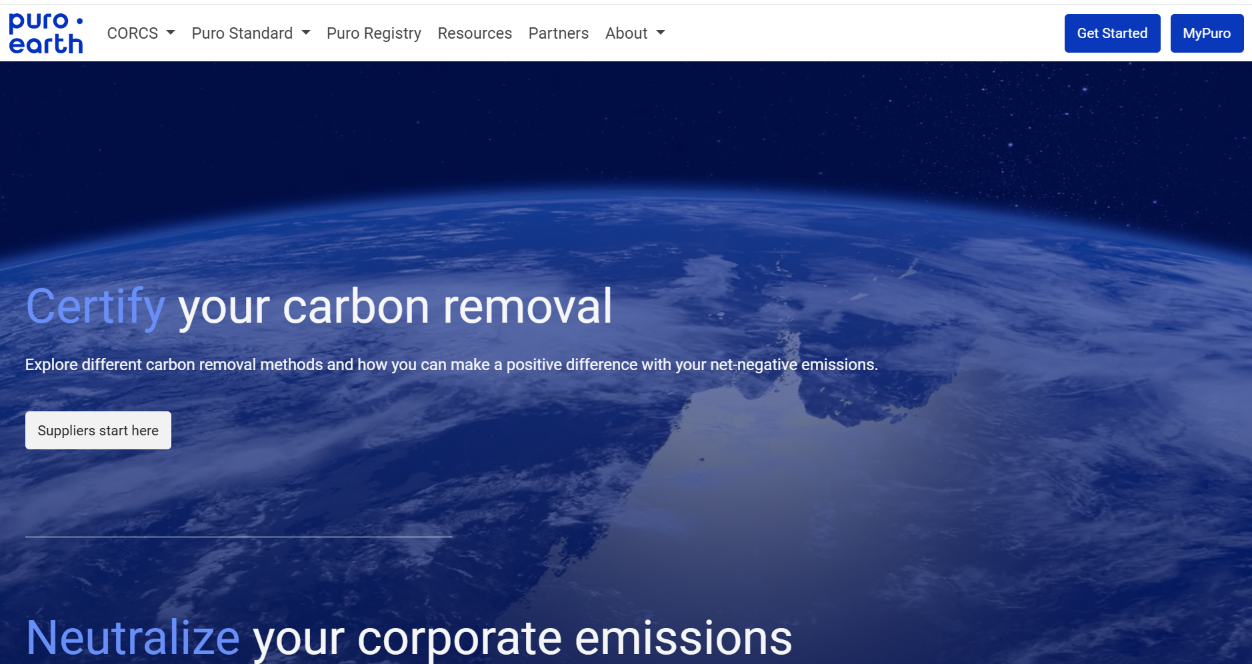
A carbon-removal crediting standard + issuance/registry layer (CORCs) for engineered removals—optimized for supplier onboarding, verification workflows, and buyer procurement, not for retail investing or tradable exposure.
Compare Before Deciding
Where Puro.earth fits against alternatives
Use these hooks to pressure-test whether this is the right platform, or whether a nearby alternative matches the job better.
How this compares to Cloverly
Cloverly
Commerce/API procurement layer for credits vs. Puro’s emphasis on a removal crediting standard and issuance mechanics.
How this compares to Patch
Patch
Buyer-side procurement infrastructure vs. Puro’s programmatic focus on removal methodologies, issuance, and registry workflows.
Overview
Platform Overview
A concise read on what the platform is, how the structure works, and where the practical friction shows up for real investors.
Puro.earth provides a carbon-removal crediting standard (the Puro Standard) and an issuance/registry workflow for CO2 Removal Certificates (CORCs), connecting removal suppliers with corporate buyers through verification, issuance, and retirement mechanics.
It defines program rules (methodologies), governs verification/issuance workflows for CORCs, and provides a registry-like audit trail that supports enterprise procurement and retirement claims. The practical takeaway: this is infrastructure for getting removal supply certified and retired with documentation—rather than a marketplace engineered for speculative trading or retail access.
Primary Role
Removal standard + issuance workflow (CORCs)
Who It Serves
Removal suppliers & corporate buyers
Primary Output
Verified removal credits (issued + retired)
Orientation
Procurement / retirement workflows
ASHow It Works in Practice
- Suppliers onboard into a defined methodology with documentation, monitoring, and verification requirements.
- Once verified under program rules, removal units are issued as certificates/credits that can be procured by buyers and retired for claims workflows.
- The buyer value proposition is operational: a documented audit trail and standardized issuance mechanics that reduce procurement friction for removals.
Key Gaps & Non-Disclosures
- Public materials often understate the commercial layer: fees/spreads can be deal-specific and not easily benchmarked without enterprise documentation.
- Post-issuance remediation is frequently less visible than issuance/verification marketing—buyers should request a written escalation/remediation path.
Investment Structures
Puro.earth is designed for crediting, procurement, and retirement of carbon-removal units—not for investor return generation via tradable exposure. Credits are consumed (retired) for claims rather than held as a financial asset strategy.
- Procurement and retirement workflows, not investment products.
- No retail investor framing in the platform model; primary users are suppliers and enterprises.
- Economic value is tied to compliance with program rules, not price appreciation mechanics.
Risk
Risk Structure
This is where the marketplace pitch gives way to the actual operating reality: delayed exits, limited disclosure, fee drag, and path-dependent outcomes.
AIAltStreet Risk Inferences
- Integrity risk concentrates in methodology boundaries (what qualifies) and MRV execution (how well it’s measured and monitored).
- If commercial terms are negotiated and not public, buyers face benchmarking risk (harder to compare true all-in costs).
- If remediation pathways are not explicit, post-issuance controversies can become reputational liabilities for buyers even when credits are formally “valid” under program rules.
Methodology / Program Risk
The removal certificate’s credibility is downstream of program rules: eligibility criteria, monitoring, verification cadence, and how disputes/reversals are handled.
Supplier Concentration Risk
Supply quality is supplier-dependent; buyer outcomes can vary materially across removal pathways and supplier operational maturity.
Claims & Reputational Risk
Even when credits follow program rules, buyers remain exposed to public/NGO scrutiny and shifting market expectations around “high integrity” removals.
Methodology Misalignment Risk
Risk Summary
A buyer may purchase removals that meet the program’s methodology but fail the buyer’s internal integrity bar (durability, additionality, MRV standards).
Why It Matters
The buyer—not the platform—often bears reputational risk if stakeholders dispute the climate claim.
Mitigation / Verification
Request methodology summaries, MRV requirements, verification cadence, and a buyer-facing checklist for each pathway; align purchases to internal claims policy before procurement.
Post-Issuance Controversy Risk
Risk Summary
A supplier/project can become controversial after issuance due to monitoring concerns, boundary disputes, or shifting market norms.
Why It Matters
Without a clear remediation/replace/refund protocol, the buyer’s only option may be reputational management and internal write-down of claim value.
Mitigation / Verification
Ask for the platform’s written escalation and remediation process (replacement options, dispute handling, and what triggers corrective actions).
Pricing / Commercial Opacity Risk
Risk Summary
If fees/spreads are not transparently published, buyers may overpay relative to comparable removals or alternative procurement rails.
Why It Matters
Opaque commercial terms can dominate outcomes, especially at scale.
Mitigation / Verification
Benchmark all-in pricing across at least 2–3 procurement channels and request a line-item breakdown (issuance, platform fees, verification, and any service charges).
ASRisk signals to watch
- Refusal to share methodology/MRV requirements in buyer-usable language (beyond marketing summaries).
- No written remediation path for post-issuance disputes or monitoring failures.
- Inability to provide transparent all-in pricing components for enterprise procurement.
Biggest Misconceptions & What Actually Happens
- Provide a buyer-facing remediation policy for disputed credits (replacement, refund, or corrective issuance).
- Clarify whether any buffer/insurance mechanisms apply platform-wide vs. pathway-specific or deal-specific protections.
- Publish (or share under NDA) an enterprise fee schedule and typical pricing components to support benchmarking.
Regulatory & Legal Posture
Security Status
Not a Security
The platform facilitates procurement and retirement of carbon-removal units for climate-claim workflows rather than offering an investment contract designed to generate profits from the efforts of others..
Disclosure Quality
Typically strong on program framing and methodology narratives, but variable on standardized commercial disclosure and remediation clarity unless provided in enterprise documentation.
Custody Model
No custody (crediting + registry/retirement workflow)
Regulatory Backing
Governing-law / dispute-resolution specifics depend on the platform’s published legal pages and enterprise agreements; confirm the controlling documents before large procurement commitments..
Tax Treatment
Reporting
Not Applicable
No standard investment tax forms (e.g., 1099/K-1) are expected because procurement of credits for retirement is not an investment vehicle.
Income Character
Procurement / Operating Expense
For most enterprises, carbon-removal procurement used for retirement is treated as a business/ESG procurement expense rather than investment income..
Limitation
Treatment varies by jurisdiction, entity structure, and whether credits are retired for the buyer vs. passed through to end users—consult a qualified tax advisor.
Before You Invest
Get Puro.earth investor insights before you invest
K-1 timing, distribution updates, yield insights, and risk signals for Puro.earth and similar platforms.
- Weekly platform research focused on tax timing and liquidity reality.
- Signals on distributions, risks, and structural tradeoffs before capital is locked up.
- Coverage of adjacent platforms so you can compare better options faster.
Get weekly platform signals
Track fee changes, liquidity updates, risk flags, and adjacent platforms before you invest.
Independent intelligence from AltStreet. No hype. No sponsor spin.
Decision Fit
Investor Fit
Who this works for, who it does not, and what level of patience and complexity tolerance the platform really demands.
Institutional / Enterprise Buyers
Best for enterprises and procurement teams that need repeatable removal sourcing with documentation and retirement evidence, and can run internal integrity screens on methodologies and suppliers..
ESG / Climate SaaS Providers
Strong fit for climate/ESG software platforms embedding removals into customer workflows, where standardized issuance/retirement and auditability matter more than trading features..
Retail / Individual Investors
Retail users typically want simple checkout offsets and minimal diligence overhead; this model is oriented toward supplier programs and enterprise procurement standards..
Investors Seeking Financial Returns
Puro.earth is not built to provide tradable exposure or price speculation pathways; removals are procured and retired for claims, not held for investment returns..
Tradeoffs
Key Tradeoffs
The attraction of pre-IPO access is real, but every benefit comes bundled with a corresponding liquidity, transparency, or pricing cost.
Integrity Rigor vs. Supply Breadth
Tighter methodologies can raise confidence but reduce supply and raise cost; broader eligibility improves access but can weaken perceived integrity if MRV is inconsistent..
Operational Efficiency vs. Buyer Recourse
Streamlined issuance/retirement reduces friction, but buyers must proactively secure remediation clarity for post-issuance disputes..
Documentation Strength vs. Cross-Program Comparability
Program-specific documentation can be strong, but comparing “quality” across different standards/registries still requires independent due diligence..
Avoid
Who This Is Not For
This section should be read as a filter, not an afterthought. If you need income, simplicity, or near-term access to capital, the structure is working against you.
Investors seeking returns
This is crediting/procurement infrastructure for carbon-removal retirement—not a platform designed for holding/trading credits for price appreciation..
Retail offset buyers
The model is optimized for suppliers and enterprise procurement teams with due diligence needs; retail users may find disclosures and workflows oriented toward B2B use cases..
Buyers without due diligence capacity
Methodology and supplier risk require internal standards and verification processes; teams without an integrity framework may be exposed to claims and reputational risks..
Editorial View
AltStreet Perspective
The compressed version of the review: what matters, what marketing tends to obscure, and how we would frame the platform for a serious allocator.
Verdict
Puro.earth is a removal-crediting and procurement rail, not an investment venue.
Positioning
Strongest for enterprises and climate platforms that treat carbon removals as a documented procurement program (with internal integrity screens). The key diligence work is not “does the platform look good,” but “are the methodologies and MRV rules sufficient for our claims policy—and what happens if a credit becomes controversial after issuance?”
The Bottom Line
Methodology and MRV discipline drive outcomes; treat it as procurement infrastructure, not tradable exposure.
Action
Next Steps
If you still want to engage after reading the review, these are the practical next moves that reduce avoidable mistakes.
Map your claims policy (durability, additionality, MRV) to the specific Puro methodologies you intend to use.
Request a buyer-facing remediation protocol for post-issuance disputes (replacement/refund/corrective actions).
Benchmark all-in pricing (including verification, issuance, and any platform/service fees) against 2–3 alternative procurement rails.
If embedding removals in a product, define operational controls: retirement timing, audit trail retention, and customer-facing disclosures.
Appendix
Sources, Disclosures, and Supporting Context
The lower section is structured like a report appendix: relationship context first, adjacent reading second, and evidence last.
Report Appendix
Disclosure
Relationship and compensation context
+
Report Appendix
Disclosure
Relationship and compensation context
Report Appendix
Related Resources
Adjacent platform comparisons, frameworks, and category links
+
Report Appendix
Related Resources
Adjacent platform comparisons, frameworks, and category links
Further Reading
Related Resources
Adjacent frameworks and reviews that help place the platform in a broader allocation or due-diligence context.
Explore Asset Class
Carbon & ClimateReport Appendix
Evidence & Methodology
Sources, scope, and how the review was assembled
+
Report Appendix
Evidence & Methodology
Sources, scope, and how the review was assembled
ASReview Evidence
Methodology
Recursive Domain Dossier + Review Synthesis
Scope
Dossier-derived coverage (core product pages + discovered legal pages)
Key Findings
- *Program framing centers on engineered carbon removals and issuance of CO2 Removal Certificates (CORCs).
- *Dossier coverage shows a supplier-first workflow (methodologies + verification) paired with buyer procurement/retirement positioning.
- *Legal pages are discoverable and should be reviewed alongside enterprise agreements to confirm dispute resolution, limitation language, and buyer/supplier obligations.
Primary Source Pages
FAQ
Frequently Asked Questions
High-intent search questions answered directly, without making users hunt through the full review.
Is Puro.earth an investment platform?
No. It functions as a carbon-removal crediting/issuance and procurement rail (methodologies, verification, issuance, and retirement). It is designed for climate claims workflows, not for investor return generation via tradable exposure.
What diligence matters most for buyers on Puro.earth?
Methodology rules and MRV execution. Buyers should review eligibility criteria, durability assumptions, monitoring cadence, verification processes, and the platform’s documented remediation approach for post-issuance disputes.
What should an enterprise ask for before scaling procurement?
A written remediation protocol (replacement/refund/corrective actions), a transparent all-in pricing breakdown, and confirmation of which contract controls (public terms vs. enterprise MSA/order form).