
How to Invest in Mineral Rights
Mineral rights are ownership of what is under the land and the right to be paid when someone produces it. This guide covers the four interests a buyer can hold, the four routes an individual can buy through, what each costs and pays on AltStreet's record, how buyers price an acre, the due diligence steps, the tax forms, and how the basins differ.
Guide Thesis
Development status can change the value of the same mineral acre dramatically, but location, geology, operator and drilling inventory still matter. The route you buy through decides whether you own the acre or a claim on it.
The same acre runs from $0 to $1,500 unleased to $20,000 to $40,000 or more producing. A trust unit, an auction lot, a direct deed and a fund interest each hold a piece of that ladder with different fees, tax forms and exits.
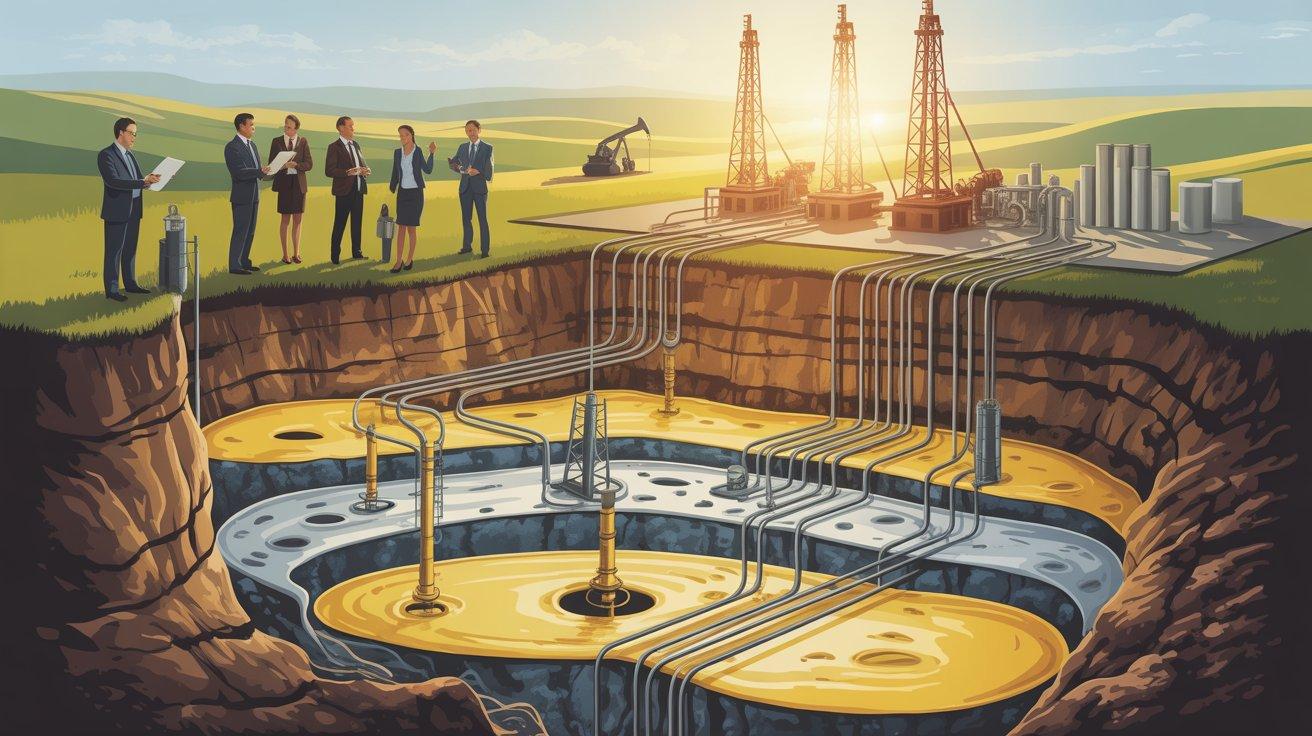
Executive Insight
A royalty owner on a $1,000,000 production month collects $200,000 and pays nothing. The working interest collects $750,000 and pays the $300,000 bill.
That is the arithmetic on a lease with a 20% royalty and a 5% override, from AltStreet's royalty interest vs working interest reference. Both sides are sold to individuals as oil and gas income. One is a cost-free share of gross revenue that shrinks with the well; the other is a share of a business that can owe money in a workover month and carries the plugging bill at the end. Knowing which noun is on the listing is the first step in mineral rights investing.
Producing acre
$20,000 to $40,000+
Per net mineral acre for producing minerals in AltStreet's valuation ladder, against $0 to $1,500 unleased. Development status, not negotiation, sets the price.
First-year decline
60% to 70%
Typical year-one production fall for a new horizontal well, then 25% to 35% in year two and 8% to 15% a year after that. The yield at purchase is a starting point, not a run rate.
Bottom Line Up Front
An individual can invest in mineral rights four ways: through a listed royalty trust or mineral company bought by the share (San Juan Basin Royalty Trust, Permian Basin Royalty Trust, Kimbell, Viper), through an auction marketplace where the interest itself is conveyed (Efficient Markets, formerly EnergyNet, from $1,000 a lot), through a direct purchase from an owner or a listing service (US Mineral Exchange, LandGate), or through a private mineral fund or Reg D syndicate at $25,000 to $250,000.
What the interest pays is set by the lease: a royalty of 12.5% to 25% of production, free of drilling and operating costs. What it yields on purchase price is set by the commodity: AltStreet's category hub puts direct mineral income at 8% to 15% a year at $70 to $100 oil and 3% to 5% below $50, and listed trusts at 6% to 12%. What it is worth is set by development status: $0 to $1,500 per net mineral acre unleased, $2,000 to $8,000 leased, $10,000 to $20,000 permitted and $20,000 to $40,000 or more producing, where a horizontal well trades at 36 to 48 months of trailing royalty income. And what it will pay next year is set by the decline curve: 60% to 70% off in a new well's first year, 5% to 15% a year across a mature property.
What you buy
A mineral interest (the minerals and the right to lease them), a royalty interest (12.5% to 25% of production under the lease), an overriding royalty (1% to 5% carved from the working interest, ending with the lease) or a working interest (the operator's share, which pays the costs).
What it costs
A trust unit under $20 and no fee; an auction lot from $1,000 with an unpublished seller commission; a direct deed plus a $500 to $2,000 title search; a fund interest at illustrative terms of 1.5% to 2.5% a year plus 15% to 20% of the profit.
What many miss
A trust cannot buy new acreage, so its decline is permanent; San Juan Basin paid nothing from March through September 2026. A direct interest can take 6 to 12 months to sell. A PV-10 reserve value overstates what a buyer will pay by 30% to 50%.
The interest decides who pays. A mineral, royalty or overriding royalty owner pays no well costs; a working interest pays all of them and keeps what is left after every royalty.
Development status moves the price most, with location, geology and operator behind it. The same acre is worth $0 to $1,500 unleased and $20,000 to $40,000 or more producing; a producing well trades at 36 to 48 months of trailing royalty income.
The route decides the paperwork. A trust unit is a broker 1099 and a decline that can never be replaced; a direct lot is title, division orders and depletion; a fund is usually a K-1 and a carry.
New to the asset class? Start with the mineral rights and energy royalties hub, then read the royalty interest vs working interest reference for the arithmetic. The per-acre pricing in this guide comes from how to value mineral rights, and the royalty trust and fund figures from the royalty income guide.
Quick Answers
The explicit answers most investors actually need
Each answer is expanded in the sections below and in the FAQ.
What is mineral rights investing?
Mineral rights investing is buying the oil, gas and other minerals under a tract of land, or a share of the revenue they produce, for the income that production pays. An individual can buy four kinds of interest: a mineral interest (the minerals and the right to lease them, collect the lease bonus and receive the royalty), a royalty interest (typically 12.5% to 25% of production revenue under the lease, free of drilling and operating costs), an overriding royalty interest (typically 1% to 5% carved out of the operator's working interest, which usually ends when the lease does) or a working interest (the operator's side, which pays the well costs and keeps what is left after every royalty). The first three are income investments that pay no well costs; the working interest is a share of an operating business. The income follows the commodity price and the decline curve: a new horizontal well typically loses 60% to 70% of its production in its first year.
What kinds of mineral rights investments can an individual buy?
Four, and the route decides the cost and the paperwork. A listed royalty trust or mineral company bought by the share through any brokerage: no accreditation and no title work, with royalty trusts reporting through a broker 1099 rather than a K-1, but a trust cannot buy new acreage, so its decline is permanent. An auction lot on Efficient Markets (formerly EnergyNet), from $1,000, where the interest itself is conveyed to the buyer and buyers certify as sophisticated, qualified and accredited. A direct purchase from an owner or through a listing service such as US Mineral Exchange or LandGate, plus a title search at $500 to $2,000 or an oil and gas attorney at $1,000 to $3,000. Or a private mineral fund or Reg D syndicate, on illustrative terms of $25,000 to $250,000 minimums, 1.5% to 2.5% management fees and 15% to 20% carried interest, usually with a K-1. Phoenix Energy's bonds are sometimes sold alongside these, but they are unsecured corporate debt of one producer, not a mineral interest.
How do you invest in mineral rights?
Four routes exist for an individual. Buy units of a listed royalty trust or shares of a listed mineral company through any brokerage (San Juan Basin Royalty Trust, Permian Basin Royalty Trust, Kimbell Royalty Partners and Viper Energy are the listed mineral companies named on AltStreet's category hub; the hub's third name, Sitio Royalties, was acquired by Viper in August 2025). Bid for a royalty, mineral or overriding royalty lot on an auction marketplace such as Efficient Markets (formerly EnergyNet), where lots start at $1,000 and title passes directly to the buyer. Buy acreage directly from an owner or through a listing service such as US Mineral Exchange or LandGate, with a title search and a production history. Or commit to a private mineral fund or Reg D syndicate, for which AltStreet's royalty income guide uses illustrative terms of $25,000 to $250,000 minimums, 1.5% to 2.5% management fees and 15% to 20% carried interest. A trust or mineral company needs one share. Direct and auction purchases need capital, title and production diligence and the ability to read a decline curve. Private funds delegate that work to the manager but add manager selection, fees and illiquidity.
Are mineral rights a good investment?
The record says they can pay well at the right commodity price and lose most of their value at the wrong one. AltStreet's category hub puts direct mineral income at 8% to 15% a year when oil is $70 to $100 a barrel and 3% to 5% when oil is below $50, with production declining 5% to 15% a year unless new wells are drilled. The listed-trust history shows both sides: the hub's example of $10,000 in San Juan Basin Royalty Trust in 2010 was worth about $6,000 in 2024 after $12,000 of dividends, a 4.3% annual return, and that trust declared no monthly cash distribution from March through September 2026. A new horizontal well typically loses 60% to 70% of its production in its first year. Whether that profile is a good investment depends on the price paid per acre or per unit, which the valuation section covers.
What are the pros and cons of investing in mineral rights?
Pros carried from AltStreet's hub: the owner pays no drilling, operating or plugging costs; income is tied to commodity prices rather than the stock market; percentage depletion (generally 15% of gross income, for eligible owners and subject to statutory limits) shelters part of the income; mineral ownership is perpetual and passes to heirs with a step-up in basis; and a lease royalty of 12.5% to 25% of production comes off the top before the operator sees a dollar. Cons from the same record: wells decline 5% to 15% a year and new ones 60% to 70% in year one; oil has traded as low as $13 and as high as $123 in the last six years and royalty checks move with it; the owner cannot force drilling; title defects are common in inherited and fractional interests; on AltStreet's reference ranges a direct interest can take 6 to 12 months to sell and forced sales clear at 30% to 50% discounts; and the retail vehicles that remove those problems (trusts, funds) add their own, from permanent decline at a trust that cannot buy new acreage to a carry of 15% to 20% on illustrative terms at a fund.
How much does it cost to buy mineral rights?
It depends on what the acre is doing. AltStreet's valuation article lays out a ladder by development status: unleased acreage at $0 to $1,500 per net mineral acre, leased but unpermitted at $2,000 to $8,000, permitted or drilled-but-uncompleted at $10,000 to $20,000, and producing at $20,000 to $40,000 or more, with producing horizontal wells trading at 36 to 48 months of trailing royalty income. The category hub quotes the same spread as $500 an acre for low-production acreage to $50,000 or more in Permian hot spots. On the entry side, a listed trust unit cost under $20 on the hub's figures, Efficient Markets lots start at $1,000 (royalties typically $1,000 to $500,000), US Mineral Exchange parcels run $5,000 to $500,000 or more, and private funds start at $25,000 to $250,000. Add a title search at $500 to $2,000 or an oil and gas attorney at $1,000 to $3,000 for any direct purchase.
What Actually Matters
If you ignore these four things, the rest is noise
A royalty interest and a working interest are different investments
On a lease with a 20% royalty and a 5% override, a month of $1,000,000 in production pays the royalty owner $200,000 and the override holders $50,000 before any cost is counted; the working interest takes $750,000 and pays $300,000 of operating cost in a normal month, or $800,000 in a workover month, when it writes a $50,000 check while the royalty owners still receive $250,000. Platforms sell both under the word royalties.
The price is set per net royalty acre, not per acre
Forty net mineral acres leased at 12.5% are 40 net royalty acres; the same forty leased at 25% are 80. An offer of $5,000 per net mineral acre is $5,000 per NRA on the first lease and $2,500 on the second. Every comparison on the record is made on the NRA basis.
A trust cannot replace what it depletes
Listed royalty trusts hold fixed interests and cannot acquire new properties, so production declines are permanent; the hub puts San Juan Basin's decline at 5% to 10% a year and Permian Basin's at 7% to 12%. Listed mineral companies such as Kimbell and Viper can buy acreage, which is why they carry equity risk and, in Kimbell's case, management fees of about 2% a year.
Title is part of the purchase price
The category hub's cautionary example is a $25,000 Eagle Ford purchase made without a title search that turned out to be one-eighth of the claimed acreage, worth $3,000, with $5,000 of legal fees to unwind: an 88% loss. A title search at $500 to $2,000 or an oil and gas attorney at $1,000 to $3,000 is the cheapest line in any direct purchase.
What are mineral rights and which interests can you buy?
Short answer
Mineral rights are ownership of the oil, gas and other minerals beneath a tract of land, separable from the surface. The owner can lease them to an operator, collect a lease bonus and reserve a royalty, typically one-eighth to one-quarter of production, paid free of drilling and operating costs. Four interests come out of that lease: the mineral interest itself, the royalty interest it reserves, an overriding royalty carved from the operator's side, and the working interest that drills, pays the costs and keeps the rest. Retail offerings use the word royalties for all four. The label on the listing decides who pays when a well costs more than planned.
| Interest | What it is | Share of revenue | Who pays the costs | How long it lasts |
|---|---|---|---|---|
| Mineral interest | Ownership of the minerals under the land, with the right to lease them, collect the bonus and reserve the royalty | Whatever royalty the owner reserves in the lease, plus the bonus; the right to lease again when a lease expires | Nobody on this side; the operator pays | Perpetual unless sold; passes to heirs with a step-up in basis |
| Royalty interest | The share of production revenue the lease pays the mineral owner; can be severed and sold separately from the minerals | Typically 12.5% to 25% of gross production; 12.5% standard in older leases, 18.75% to 25% in newer ones | No drilling or operating costs; may bear post-production deductions (gathering, compression, transport) depending on the lease wording | As long as the minerals are owned and the lease is held by production |
| Overriding royalty interest (ORRI) | A cost-free share carved out of the working interest by assignment, often granted to a landman, geologist, promoter or lender, and sold on to royalty buyers | Typically 1% to 5% of production | No drilling or operating costs; post-production deductions per the assignment | Expires with the lease unless the assignment extends it to renewals; not a mineral interest |
| Working interest | The right to drill and produce, held by the operator and non-operating partners; the subject of participation agreements and farmouts | The net revenue interest: what is left after every royalty. A 100% working interest on a lease with a 20% royalty and a 5% override keeps 75% | Collectively 100% of drilling, completion, operating, workover and plugging costs, each holder bearing its contractual share, including cash calls on a well that never pays out | As long as the lease is held by production; plugging liability at the end |
The royalty interest vs working interest reference works the arithmetic on a real lease: a $1,000,000 production month pays the 20% royalty owner $200,000 and the 5% of override holders $50,000 before costs, leaves the working interest $750,000, and charges it $300,000 of operating cost in a normal month or $800,000 in a workover month, when the working interest writes a $50,000 check while the royalty owners still receive $250,000. A non-operating partner holding 25% of that working interest has an 18.75% net revenue interest, receives $187,500, pays $75,000 and carries 25% of the plugging liability.
The overriding royalty interest reference is the one to read before buying anything described as cost-free: an override burdens the lease, not the minerals, so it can vanish when the lease is released, and the phrase cost-free can still hide post-production deductions that change the net check, especially on gas. The working interest reference lists what that side carries: lease operating expense, severance taxes, capital calls and plugging obligations.
What are the four ways to invest in mineral rights?
Short answer
Listed royalty trusts and mineral companies are bought by the share through any brokerage, with no accreditation and no title work; the trade-off is that a trust cannot replace what it depletes and a mineral company adds equity risk and, at Kimbell, management fees of about 2% a year. Auction marketplaces such as Efficient Markets convey the interest itself from $1,000 a lot to buyers who certify as sophisticated, qualified and accredited, with the seller commission unpublished. Direct purchases through US Mineral Exchange, LandGate or a private negotiation put title, the division order and the depletion deduction in the buyer's name, at the cost of a title search and, on AltStreet's reference ranges, a 6 to 12 month exit. Private mineral funds and Reg D syndicates diversify across basins and operators; no named private mineral fund is on AltStreet's record, and the minimums, fees and carry this guide quotes ($25,000 to $250,000, 1.5% to 2.5% and 15% to 20%) are the illustrative terms its royalty income guide uses.
The table compares the routes on what you own, who can buy and what the record shows. The trust, mineral company and marketplace figures are carried from the mineral rights and energy royalties hub, the Efficient Markets figures from AltStreet's Efficient Markets review, and the fund terms from the royalty income guide.
| Route | What you own | Minimum and eligibility | Costs and terms | What the record shows |
|---|---|---|---|---|
| Listed royalty trusts (SJT, PBT, SBR) | Units of a pass-through trust holding fixed royalty interests; San Juan Basin (1980, gas-weighted) is the oldest, Permian Basin spans 33 Texas counties, Sabine reported $82.6 million of 2024 royalty income | One unit through any brokerage; the hub's figures put a unit at about $5 to $8 (SJT) and $12 to $18 (PBT); no accreditation | No management fee; distributions after trustee fees and expenses; trusts cannot acquire new properties, so decline is permanent (SJT 5% to 10% a year, PBT 7% to 12% on the hub's figures) | 6% to 12% yields on the hub, 8% to 12% in favorable price environments on the royalty income guide; the 2020 crash cut trust dividends 80% to 90% and SJT suspended in Q2 2020; SJT declared no monthly cash distribution from March through September 2026, citing excess production costs; grantor trusts, broker 1099, no K-1 |
| Listed mineral companies (Kimbell, Viper) | Shares or units of a company that buys and holds mineral and royalty acreage across basins and can keep buying | One share; no accreditation; the hub's figures put a share at about $15 to $20 (KRP) and $30 to $40 (VNOM); the hub also lists Sitio (STR), which no longer trades on its own: Viper completed its acquisition of Sitio on August 19, 2025 (Viper Form 8-K) | Company-level costs; Kimbell is quoted on the hub at management fees of about 2% a year; Viper is described there as a Diamondback Energy subsidiary (hub figures as of its last update; corporate structures, yields and prices change) | Hub-quoted yields of 9% to 11% (KRP) and 6% to 9% (VNOM); the hub's example of $10,000 in Kimbell at its 2017 IPO reached $15,000 by 2024 with distributions, a 6.5% annual return; equity risk on top of commodity risk |
| Auction marketplace (Efficient Markets, formerly EnergyNet) | The royalty, mineral, overriding royalty or working interest itself, conveyed by title from seller to buyer; for the direct mineral and royalty lots described in AltStreet's review, the buyer receives a conveyed property interest rather than a platform-issued investment security | Lots from $1,000 to $250 million-plus, royalties typically $1,000 to $500,000; the July 2026 Buyer's Agreement requires registering as a sophisticated, qualified and accredited investor, with the company holding sole discretion over that determination; bank verification for a bid allowance | Seller commission on the gross sales price, charged only on sale, percentage not published; listing fees up to $1,500 on non-producing-only or sub-$25,000 lots; 1.5% buyer premium on government lease sales; 7-day standard auctions, 2 business days to wire, about 35 to 45 days from listing to seller check | Founded 1999; broker-dealer with zero FINRA disclosure events since 2000; audited FY2025 revenue $13.4 million and net income $6.7 million; company-stated 2025 sales of $1.5 billion across 568 winning buyers; lots across the Permian, Eagle Ford, SCOOP/STACK, DJ Basin, Bakken, Appalachia and Haynesville; the review calls it a B2B venue, not a retail platform |
| Direct purchase (US Mineral Exchange, LandGate, private) | The deed to a mineral or royalty interest, recorded in the county; the buyer receives the division order and the operator's checks | US Mineral Exchange parcels $5,000 to $500,000-plus; LandGate offers a free research tier with valuations from production data; the hub suggests $10,000 to $25,000 first purchases in established basins | US Mineral Exchange quoted at 5% to 10% commission; title search $500 to $2,000 or an oil and gas attorney at $1,000 to $3,000; 5-year production data from the state regulator (Texas RRC, New Mexico OCD) | Per-acre prices from $500 (low production) to $50,000-plus (Permian hot spots) on the hub; the hub's example of a $25,000 Eagle Ford purchase without a title search lost 88%; on the hub's reference ranges a direct interest takes 6 to 12 months to sell and forced sales clear at 30% to 50% discounts |
| Private mineral funds and Reg D syndicates | LP or LLC interests in a pooled mineral portfolio spread across basins and operators | $25,000 for smaller syndications to $100,000 to $250,000 for institutional-grade funds; accredited | Illustrative terms from the royalty income guide: 1.5% to 2.5% management fees plus 15% to 20% carried interest, often above an 8% to 12% preferred return; multi-year lockups; K-1s for partnership structures | Diversification in exchange for a fee layer; AltStreet has not reviewed a named private mineral fund, so no fund-level return record is on the site |
| Not mineral rights: operator bonds (Phoenix Energy) | Unsecured debt of an oil producer that buys Williston Basin minerals and drills wells; no interest in the acreage | FlexNotes 6% to 7% at $1,000; Registered Notes 9% to 12% at $5,000; 506(c) bonds 9% to 14% at $25,000 | Fixed coupons; transfers only with issuer consent; puts capped at 10% of principal a year at a discount | Every retail note sits behind a $525 million secured facility; 1099-INT and no depletion; corporate credit of one leveraged producer, which this guide treats as such |
Working interests are sold on the same marketplaces and by platforms such as EnergyFunders. They pay a larger share of revenue and bear drilling, operating and plugging costs, so they are a share of a business rather than a cost-free stream; the Efficient Markets review lists the interest types it conveys (producing working interests, overriding royalties, royalty interests, mineral rights, non-producing leasehold and government leases) and its FAQ puts the minimum economic position for a direct buyer at $10,000 to $100,000 or more with 5 to 15 year holds.
What do mineral rights cost and what do they yield?
Short answer
On AltStreet's category hub, direct mineral income runs 8% to 15% a year at $70 to $100 oil and 3% to 5% below $50; listed royalty trusts pay 6% to 12% (8% to 12% in favorable price environments on the royalty income guide) and can pay nothing; listed mineral companies are quoted at 6% to 11%. Per-acre prices run from $500 for low-production acreage to $50,000 or more in Permian hot spots. A royalty paying $10,000 a month at $80 oil pays about $6,250 at $50 with no change in production, and a new horizontal well loses 60% to 70% of its production in year one, so every yield here is a starting point.
| Figure | What the record says | Source page |
|---|---|---|
| Lease royalty rate | 12.5% to 25% of gross production; 12.5% (one-eighth) standard in older leases, 18.75% to 25% in newer ones; a higher rate means more income per acre but usually a higher price | Royalty vs working interest; category hub |
| Direct mineral income yield | 8% to 15% a year at $70 to $100 oil; 3% to 5% below $50; most mineral rights need oil above $50 a barrel for positive cash flow, and below that many wells shut in | Category hub |
| Listed royalty trust yield | 6% to 12% dividend yield with total returns of negative 30% to positive 50% in a year on the hub; 8% to 12% in favorable price environments on the royalty income guide; PBT 8% to 14% and SJT 8% to 12% historically on the hub, with SJT at zero from March through September 2026 | Category hub; royalty income guide |
| Listed mineral company yield | Kimbell 9% to 11% and Viper 6% to 9%, both hub-quoted (the hub's Sitio figure is retired: Viper acquired Sitio in August 2025); Kimbell management fees about 2% a year | Category hub |
| Producing royalty returns | 10% to 20% for well-positioned producing interests, described on site as the range of outcomes at reasonable prices rather than what any purchase delivers | Royalty income guide |
| Price per acre | $500 (low production) to $50,000-plus (Permian hot spots) on the hub; $0 to $1,500 unleased, $2,000 to $8,000 leased, $10,000 to $20,000 permitted, $20,000 to $40,000-plus producing on the valuation ladder; within one county, $250 to over $30,000 | Category hub; valuing mineral rights |
| Entry minimums | Trust and mineral company units under $40 on the hub's figures; Efficient Markets lots from $1,000, royalties typically $1,000 to $500,000; US Mineral Exchange parcels $5,000 to $500,000-plus; private funds $25,000 to $250,000 | Category hub; Efficient Markets review; royalty income guide |
| Transaction costs | Efficient Markets seller commission unpublished, listing fee up to $1,500 on small or non-producing lots, 1.5% buyer premium on government sales; US Mineral Exchange 5% to 10% commission; title search $500 to $2,000; attorney $1,000 to $3,000; illustrative fund terms of 1.5% to 2.5% plus 15% to 20% carry | Efficient Markets review; category hub; royalty income guide |
| Decline | New horizontal wells fall 60% to 70% in year one, 25% to 35% in year two, then 8% to 15% a year; a mature property declines 5% to 15% a year; wells often produce 50% of lifetime value in their first 24 months | Royalty income guide; category hub; valuing mineral rights |
Two worked figures from the record show what the ranges mean. The category hub's Permian example is $5,000 an acre bought in 2010 that was worth $40,000 an acre by 2020 during the shale boom, with 10% to 15% income at $70-plus oil along the way. Its San Juan Basin example is $10,000 of trust units bought in 2010, worth about $6,000 in 2024 after $12,000 of dividends received: a total return of about 80% over 14 years, a 4.3% annual rate, because production decline offset the commodity. Both are the same asset class. The difference is the acre, the basin and the price paid.
How do you value mineral rights, and how do you calculate net royalty acres?
Short answer
Buyers price minerals as a discounted cash flow stream, not as land. They convert the acreage to net royalty acres, place it on a ladder by development status (unleased $0 to $1,500 per acre, leased $2,000 to $8,000, permitted $10,000 to $20,000, producing $20,000 to $40,000 or more), forecast production with a decline curve and discount it at 12% to 15% for producing wells and 20% to 25% or more for speculative acreage. Producing horizontal wells trade at 36 to 48 months of trailing royalty income, vertical wells at 48 to 60 and premium Permian locations at 48 to 72; leased non-producing acreage at 2 to 3 times the lease bonus. A PV-10 figure at 10% overstates what the private market pays by 30% to 50%.
| Development status | Valuation method | Buyer discount rate | Typical range per net mineral acre |
|---|---|---|---|
| Unleased, no nearby production | Lease bonus comparables and basin activity; no DCF | 20% to 25% or more, or not valued by DCF at all | $0 to $1,500 |
| Leased, no permit | 2 to 3 times the lease bonus received; many leases expire undrilled | 18% to 22% | $2,000 to $8,000 |
| Permitted or drilled, uncompleted | Probabilistic DCF from offset well type curves; production within about 12 months | 15% to 18% | $10,000 to $20,000 |
| Producing | DCF from actual production, or a cash flow multiple: 36 to 48 months of trailing royalty income for horizontal wells, 48 to 60 for vertical, 48 to 72 for premium Permian locations with stacked pay | 12% to 15% | $20,000 to $40,000 or more |
| PV-10 (reserve report standard) | SEC reporting convention at a fixed 10% rate on proved reserves | 10% | Overstates private market value by 30% to 50%; a position worth $1 million at PV-10 trades at $600,000 to $750,000 |
The mineral rights valuation article supplies the three rules behind the table. First, normalize to net royalty acres: NRA equals net mineral acres multiplied by the royalty rate divided by 0.125, so 40 acres leased at 25% are 80 NRA and a $5,000 per acre offer is $2,500 per NRA. Second, time is a valuation input: a two-year drilling delay cuts present value by 25% at a 15% discount rate and 31% at 20%, which is why the operator's drilling schedule, well count and spacing assumptions belong in any offer analysis; the article's 40-acre Permian scenario runs from $5,000 per acre in the bear case (drilling delayed to 2028, two wells, $50 oil) to $60,000 in the bull case (eight wells, $75 oil). Third, comparables are scarce: county records usually show a nominal $10 consideration, and forced pooling orders in states such as Oklahoma and North Dakota are the public floor.
The producing example in the same article is the one to keep: a position earning $50,000 a year of royalty income draws offers of $150,000 to $300,000, which is $20,000 to $40,000 or more per net mineral acre in core locations and a 17% to 33% trailing yield before the decline curve. The royalty income guide carries a second discount-rate convention from on-site valuation work, 8% to 12% for proved developed production and 12% to 18% for undeveloped acreage, with non-producing minerals priced 70% to 90% below producing ones; the two pages agree on the ordering, and the rate a buyer actually uses is one of the questions to ask.
What due diligence does a mineral rights purchase need?
Short answer
For a direct interest: verify title with an oil and gas attorney ($1,000 to $3,000) or a title search ($500 to $2,000), pull five years of production from the state regulator (Texas RRC, New Mexico OCD), read the lease for the royalty rate and whether it is cost-free or net of post-production deductions, check the operator, model a 10% annual decline if no new wells are coming, and confirm the noun on the listing (royalty, override, working interest). For an override, add the lease expiry and renewal language. For a trust or fund, read the 8-Ks or the offering document for the fee layer and the decline. For any route, ask the six questions the valuation article lists: discount rate, drilling schedule, type curve, price deck, well spacing and price per net royalty acre.
1. Title and the chain of ownership
An interest is worth what the recorded chain of title says it is. The hub's due diligence list starts with an oil and gas attorney at $1,000 to $3,000 to confirm clean title, because fractional ownership and heirship tangles are common in inherited rights; its Eagle Ford example lost 88% on a purchase made without one. Division orders state each owner's decimal interest and are where net revenue interest errors surface; check them against the title.
2. Production history and the decline
Request five years of production from the state regulator and model a 10% annual decline if no new wells are planned, per the hub. A high recent check can reflect flush production from a new well that will fall 60% to 70% within a year; the ORRI reference warns against valuing on trailing checks alone and asks for decline curves, reserve reports, operator development plans and shut-in history.
3. The lease and the deductions
Read the royalty rate (12.5% in older leases, 18.75% to 25% in newer ones) and whether the royalty is paid free of cost or net of gathering, compression, processing and transportation. The ORRI reference's point is that cost-free can still hide post-production deductions, especially on gas, and that check stubs should be compared with the governing documents. For an override, read whether it survives lease renewals, extensions, top leases and pooled units.
4. The operator and the basin
Production depends on the leaseholder's drilling; the hub asks whether the operator is investment-grade or a small independent, because the royalty owner cannot force drilling. Compare basin break-evens: the hub puts the Permian at $30 to $40 a barrel and other basins at $50 to $60. Check pooling and unitization documents, since unit production is allocated by acreage contribution.
5. The counterparty on a marketplace
On Efficient Markets, the review's advice is to verify the broker-dealer at FINRA BrokerCheck (CRD 102100, zero disclosure events since 2000), to use its SEC-filed audited financials rather than the homepage counters as the record of scale, and to expect a 7-day auction, two business days to wire and a 35 to 45 day close that compresses diligence; the platform's data rooms carry production history, decline curves, reserve reports, well files and title information.
6. The six valuation questions
Before accepting or making an offer, the valuation article's checklist asks: what discount rate (12% to 25% is the typical range), what drilling timeline and well count, what type curve, what commodity price deck, what well spacing, and what the price is per net royalty acre. A buyer unwilling to disclose these is a flag; sellers should also ask how the buyer is financed, since Phoenix Energy, one of the Williston Basin's most visible buyers, funds purchases with 9% to 14% bonds behind a $525 million secured facility.
The full checklists live on the category hub (eight diligence items), the overriding royalty interest reference (assignment, burden stack, division orders, check history, pooling, depth limits) and the valuation article (the six questions and the pre-offer checklist).
How are mineral rights taxed?
Short answer
Royalty income is generally ordinary income. Eligible independent producers and royalty owners may claim percentage depletion, generally 15% of gross income from the property, subject to statutory limitations that include 65% of taxable income and property-level caps; eligibility depends on the owner's circumstances. Listed royalty trusts are grantor trusts reporting through a broker 1099 and a trustee tax booklet, not a K-1; partnership-structured private funds and syndicates commonly issue K-1s, depending on entity structure; a direct owner reports from the operator's statements. Certain directly held mineral and royalty interests may qualify as real property for Section 1031 purposes, inherited minerals get a step-up in basis, and an outright sale of a qualifying interest can produce capital-gain treatment at 0%, 15% or 20% plus a possible 3.8% net investment income tax, while retained interests and other structures can differ. Working interests deduct 60% to 80% of well cost as intangible drilling costs; royalty owners do not. None of this is tax advice.
| Route | Tax document | Treatment noted on site |
|---|---|---|
| Listed royalty trust (SJT, PBT, SBR) | Broker 1099 plus a trustee tax booklet; no K-1 (grantor trust) | Unit holders report their share of royalty income and may claim depletion per the trustee booklet; possible state filings in the states where the trust holds interests |
| Listed mineral company (Kimbell, Viper) | Depends on the entity: Kimbell is described on the hub as an MLP, a structure that typically reports on a K-1; the hub does not state the form for Viper | Company-level taxation and distributions; the record on site carries no entity-specific tax detail beyond the MLP label |
| Directly owned royalty or mineral interest | Operator or purchaser statements; varies by interest type and state | Percentage depletion, generally 15% of gross income for eligible owners, limited to 65% of taxable income with carryforward of the excess and property-level caps; certain directly held interests may qualify as real property for Section 1031 purposes; step-up in basis at death; an outright sale of a qualifying interest can produce capital-gain treatment at 0%, 15% or 20% plus a possible 3.8% net investment income tax, while retained interests and other structures can differ |
| Private mineral fund or Reg D syndicate | Commonly a K-1 for partnership-structured funds; the form depends on the entity | Pass-through of the fund's royalty income and depletion; the ORRI reference notes a fund holding overrides should disclose tax reporting, withholding and state exposure, and whether its yield is quoted before or after depletion and filing costs |
| Working interest (not a royalty) | K-1 | Intangible drilling costs, 60% to 80% of well cost, deductible in the year incurred; the tax feature that royalty owners do not get, paired with the cost and plugging liability they do not carry |
| Operator bonds (Phoenix Energy) | 1099-INT | Interest income including accrued original issue discount; no depletion, no K-1 |
The depletion and 1031 lines are carried from the royalty income guide and the category hub; the capital gains and inheritance lines from the valuation article. How much depletion is allowable depends on the owner's circumstances, and the Efficient Markets review notes that holding a direct interest in a self-directed IRA is generally impractical because of structure-dependent issues including possible unrelated business taxable income.
How do the basins differ?
Short answer
On AltStreet's category hub the Permian Basin has the best production, the highest per-acre prices ($10,000 to $50,000) and the lowest break-evens ($30 to $40 a barrel against $50 to $60 elsewhere); the Haynesville is cheaper ($1,000 to $5,000 an acre) with active gas drilling; the Marcellus is gas-focused with lower yields at gas prices; the Bakken is oil-focused but declining. Efficient Markets lists lots across all of them plus the Eagle Ford, SCOOP/STACK, DJ Basin and Appalachia. The record carries no Bakken-specific price or yield, and this guide does not estimate one.
| Basin | Commodity | What the record says | Where it appears on site |
|---|---|---|---|
| Permian (Texas, New Mexico) | Oil | Best production and highest prices, $10,000 to $50,000 an acre; break-evens $30 to $40 a barrel; premium locations with stacked pay trade at 48 to 72 months of royalty income; the hub's $5,000 to $40,000 an acre 2010 to 2020 example; gas differentials have gone negative at the Waha hub | Category hub; valuation article; royalty income guide; Permian Basin Royalty Trust and Viper hold Permian interests |
| Haynesville (Louisiana, Texas) | Gas | Lower prices, $1,000 to $5,000 an acre, with active drilling; one of the two established basins the hub names for a first $10,000 to $25,000 purchase | Category hub; Efficient Markets basin list |
| Marcellus and Utica (Appalachia) | Gas | Natural gas focus with lower yields because of gas prices; the ORRI reference's warning about post-production deductions bites hardest on gas-heavy assets | Category hub; Efficient Markets basin list; ORRI reference |
| Bakken and Williston (North Dakota) | Oil | Oil-focused but declining on the hub; Phoenix Energy, the one Williston Basin buyer AltStreet has reviewed, acquires minerals and drills there, funded by 6% to 16.5% bonds behind a $525 million secured facility; North Dakota forced pooling orders are a public pricing floor; no Bakken per-acre price or yield is on the record | Category hub; Phoenix Energy review; valuation article; Efficient Markets basin list |
| Eagle Ford (South Texas) | Oil and gas | The hub's title cautionary example: a $25,000 purchase in 2014 without a title search turned out to be one-eighth of the claimed acreage, an 88% loss; an active market on US Mineral Exchange | Category hub; Efficient Markets basin list |
| San Juan (New Mexico, Colorado) | Gas | The basin behind the oldest listed royalty trust (1980), whose production declines 5% to 10% a year and which paid no monthly distribution from March through September 2026, citing excess production costs | Category hub; royalty income guide |
| SCOOP/STACK (Oklahoma), DJ Basin (Colorado, Wyoming) | Oil and gas | Listed among the basins Efficient Markets conveys lots in; Oklahoma forced pooling orders are a public pricing floor; the record carries no per-acre figures for either | Efficient Markets review; valuation article |
The hub's framing is that the basin is a commodity choice first: an oil basin at $70 to $100 pays 8% to 15%, a gas basin pays on gas prices and differentials, and both pay less or nothing when the price falls through the break-even. WTI traded as low as $13 in 2020 and as high as $123 in 2022, and the 2020 crash cut listed trust dividends 80% to 90%.
What are the pros and cons of mineral rights investing?
Short answer
The case for: no well costs, income that follows the commodity rather than the stock market, a depletion allowance, perpetual ownership with a step-up at death, and a royalty paid before the operator. The case against: production declines 5% to 15% a year and 60% to 70% in a new well's first year, prices that have swung from $13 to $123, no control over drilling, title defects, a 6 to 12 month exit with forced sales at 30% to 50% discounts on AltStreet's reference ranges, and climate and regulatory risk on demand after 2040. The retail wrappers trade those problems for others: a trust's decline is permanent and a fund's carry runs 15% to 20% on the illustrative terms.
Pro: a cost-free share of gross revenue
A royalty or mineral owner pays no drilling, operating, workover or plugging cost. On the reference lease, the royalty owner collects $200,000 of a $1,000,000 month whether the working interest's bill is $300,000 or $800,000. The hub lists the same point as no operational responsibilities, no capex and no labor.
Pro: commodity-linked income and a tax shield
Income rises with oil and gas prices, which the hub describes as an inflation hedge with low correlation to stocks in inflationary periods. Percentage depletion, generally 15% of gross income for eligible owners and subject to statutory limits, shelters part of each year's royalty. Ownership is perpetual, can pass to heirs with a step-up in basis, and certain directly held interests may qualify for a Section 1031 exchange.
Con: decline is the base case
Wells deplete 5% to 15% a year, and a new horizontal well loses 60% to 70% in year one. Revenue only holds if new wells are drilled on the property, which the royalty owner cannot force; a trust cannot buy new acreage at all. The hub's SJT example returned 4.3% a year over 14 years because decline absorbed the commodity gains.
Con: the commodity decides the check
Oil and gas prices swing 50% to 100% over a cycle, and royalty income mirrors them: $10,000 a month at $80 oil is about $6,250 at $50. Below the break-even, wells shut in and pay nothing. The 2020 crash cut listed trust dividends 80% to 90%, and SJT paid nothing from March through September 2026 for a different reason, excess production costs on the royalty interest.
Con: title, liquidity and control
Fractional ownership, conflicting claims and heirship tangles are common and can freeze royalties for years. On the hub's reference ranges a direct interest takes 6 to 12 months to sell to a limited buyer pool, and forced sales clear at 30% to 50% discounts; small interests trade at steep discounts because diligence costs are high relative to cash flow. The owner has no say in drilling timing, technology or investment.
Con: regulation, climate and the wrapper
The hub lists drilling bans, methane rules and carbon taxes as production risks and names stranded-asset risk on demand beyond 2040. Each retail route adds a layer: a trust's trustee expenses and permanent decline, a mineral company's equity risk and Kimbell's roughly 2% management fee, a fund's management fee and carry (1.5% to 2.5% and 15% to 20% on the illustrative terms), an auction's unpublished commission and 35 to 45 day close. Efficient Markets' own FAQ puts asset values at 30% to 50% or more of swing with prices and actual production at 20% to 40% away from projections.
Who should invest in mineral rights?
Short answer
The hub describes the asset class as suited to income-focused investors comfortable with commodity exposure and holds of ten years or more. This guide does not suggest an allocation or a route; the useful discipline from the record is that a single well, basin or price cycle going to zero must be survivable, that a direct purchase is priced with the title search and the decline model included, and that a wrapper is chosen for what it removes (title work, concentration) with its fee and decline profile priced in. Anyone who needs liquidity inside a year, who is buying a headline yield without a decline curve, or who cannot read a division order or an offering document is outside the record's description of who this suits.
A practical sequence drawn from the record: decide whether you want the acre (a direct deed or an auction lot, with title and depletion in your name and a 6 to 12 month exit), a claim on acres (a trust unit or mineral company share, liquid by the share, with equity and permanent-decline risk) or a slice of a portfolio (a fund interest behind a carry). Place any specific acreage on the development ladder and price it per net royalty acre at the discount rate buyers use. Model the decline before the yield. For a direct purchase, add the title search and the state production history before bidding, and confirm on the listing whether the instrument is a royalty, an override or a working interest.
The royalty income guide places oil and gas royalties beside music and media royalties for anyone comparing income streams, the passive income guide places them in a blended portfolio, and the due diligence frameworks cover the offering-document questions that apply to any fund or syndicate.
How does Efficient Markets (EnergyNet) work?
The 26-year incumbent marketplace for US oil and gas asset sales, rebranded from EnergyNet in September 2024, runs continuous online auctions with weekly closes, sealed bids and negotiated sales of working interests, royalties, overrides and minerals from $1,000 to $250 million-plus across the Permian, Eagle Ford, SCOOP/STACK, DJ Basin, Bakken, Appalachia and Haynesville. Its broker-dealer has zero FINRA disclosure events since 2000, and its SEC-filed FY2025 results show $13.4 million of revenue and $6.7 million of net income.
Nothing on it is a retail product: buyers register as sophisticated, qualified and accredited under a standard the company itself adjudicates, title passes directly from seller to buyer, the seller commission is not published, and for the direct mineral and royalty lots the buyer receives a conveyed property interest rather than a platform-issued security. For the fee opacity, the buyer concentration and the government-lease franchise, see the full Efficient Markets review.
How does Phoenix Energy work, and why is it not mineral rights?
Phoenix Energy acquires mineral and royalty interests in the Williston Basin and drills its own wells, funding the program by selling unsecured bonds to individuals: FlexNotes at 6% to 7% from $1,000, Registered Notes at 9% to 12% from $5,000 and 506(c) bonds at 9% to 14% from $25,000, all behind a $525 million secured facility.
A bond holder owns none of the acreage, receives a 1099-INT rather than depletion, and depends on the solvency of one leveraged producer. The company appears in this guide as the counterparty a mineral seller may meet and as the example of what oil and gas income marketing can wrap around corporate credit. For the capital structure and the note terms, see the full Phoenix Energy review.
Final View
Conclusion: are mineral rights worth owning?
Mineral rights are one of the few income streams an individual can own where the check arrives before any cost is paid, and the record shows acreage that went from $5,000 to $40,000 an acre in a decade. The same record shows a trust that returned 4.3% a year for fourteen years because decline ate the commodity, a trust that paid nothing for seven months in 2026, and a $25,000 purchase that was worth $3,000 because nobody read the title.
The disciplined version is unglamorous: know which of the four interests is on the listing, price the acre by what it is doing and per net royalty acre, discount at the rate buyers use rather than PV-10, model the decline before the yield, and treat title work as part of the purchase price. Bought that way, through whichever of the four routes fits the capital and the appetite for paperwork, mineral rights are a commodity-linked income sleeve with a known decay. Bought on a headline yield, they are a slow way to find out what the operator decides.
AltStreet verdict
Own the interest you think you own. The acre's status is the price; the decline is the return.
Related records on AltStreet
Related Resources
Mineral rights and energy royalties hub
Royalty trusts, mineral companies, marketplaces, basin economics, the eight-item diligence list and the worked examples behind this guide.
How to value mineral rights
NPV, discount rates by development status, net royalty acres, the per-acre ladder and the six questions to ask a buyer.
Royalty interest vs working interest
The four oil and gas interests, the NRI arithmetic on a real lease and who pays the costs.
Overriding royalty interest
How an override is carved out, valued, reduced by deductions and lost when the lease expires.
Working interest
The operator's side: net revenue interest, operating expense, capital calls and plugging obligations.
How to invest in royalty income
Oil and gas royalties beside music, film and brand royalties, with the marketplace pricing data and the trust tax treatment.
Efficient Markets (EnergyNet) review
The auction marketplace's audited financials, fee opacity, buyer eligibility standard and basin coverage.
Phoenix Energy review
The Williston Basin mineral buyer that funds itself with retail bonds: structure, coupons and the secured facility ahead of them.
Passive income guide
Where mineral and royalty income sits in a blended income portfolio.
Due diligence frameworks
The offering-document questions that apply to any fund or syndicate.
Frequently Asked Questions
1. What is mineral rights investing?
Mineral rights investing is buying the oil, gas and other minerals under a tract of land, or a share of the revenue they produce, for the income that production pays. An individual can buy four kinds of interest: a mineral interest (the minerals and the right to lease them, collect the lease bonus and receive the royalty), a royalty interest (typically 12.5% to 25% of production revenue under the lease, free of drilling and operating costs), an overriding royalty interest (typically 1% to 5% carved out of the operator's working interest, which usually ends when the lease does) or a working interest (the operator's side, which pays the well costs and keeps what is left after every royalty). The first three are income investments that pay no well costs; the working interest is a share of an operating business. The income follows the commodity price and the decline curve: a new horizontal well typically loses 60% to 70% of its production in its first year.
2. What kinds of mineral rights investments can an individual buy?
Four, and the route decides the cost and the paperwork. A listed royalty trust or mineral company bought by the share through any brokerage: no accreditation and no title work, with royalty trusts reporting through a broker 1099 rather than a K-1, but a trust cannot buy new acreage, so its decline is permanent. An auction lot on Efficient Markets (formerly EnergyNet), from $1,000, where the interest itself is conveyed to the buyer and buyers certify as sophisticated, qualified and accredited. A direct purchase from an owner or through a listing service such as US Mineral Exchange or LandGate, plus a title search at $500 to $2,000 or an oil and gas attorney at $1,000 to $3,000. Or a private mineral fund or Reg D syndicate, on illustrative terms of $25,000 to $250,000 minimums, 1.5% to 2.5% management fees and 15% to 20% carried interest, usually with a K-1. Phoenix Energy's bonds are sometimes sold alongside these, but they are unsecured corporate debt of one producer, not a mineral interest.
3. How do you invest in mineral rights?
Four routes exist for an individual. Buy units of a listed royalty trust or shares of a listed mineral company through any brokerage (San Juan Basin Royalty Trust, Permian Basin Royalty Trust, Kimbell Royalty Partners and Viper Energy are the listed mineral companies named on AltStreet's category hub; the hub's third name, Sitio Royalties, was acquired by Viper in August 2025). Bid for a royalty, mineral or overriding royalty lot on an auction marketplace such as Efficient Markets (formerly EnergyNet), where lots start at $1,000 and title passes directly to the buyer. Buy acreage directly from an owner or through a listing service such as US Mineral Exchange or LandGate, with a title search and a production history. Or commit to a private mineral fund or Reg D syndicate, for which AltStreet's royalty income guide uses illustrative terms of $25,000 to $250,000 minimums, 1.5% to 2.5% management fees and 15% to 20% carried interest. A trust or mineral company needs one share. Direct and auction purchases need capital, title and production diligence and the ability to read a decline curve. Private funds delegate that work to the manager but add manager selection, fees and illiquidity.
4. Are mineral rights a good investment?
The record says they can pay well at the right commodity price and lose most of their value at the wrong one. AltStreet's category hub puts direct mineral income at 8% to 15% a year when oil is $70 to $100 a barrel and 3% to 5% when oil is below $50, with production declining 5% to 15% a year unless new wells are drilled. The listed-trust history shows both sides: the hub's example of $10,000 in San Juan Basin Royalty Trust in 2010 was worth about $6,000 in 2024 after $12,000 of dividends, a 4.3% annual return, and that trust declared no monthly cash distribution from March through September 2026. A new horizontal well typically loses 60% to 70% of its production in its first year. Whether that profile is a good investment depends on the price paid per acre or per unit, which the valuation section covers.
5. What are the pros and cons of investing in mineral rights?
Pros carried from AltStreet's hub: the owner pays no drilling, operating or plugging costs; income is tied to commodity prices rather than the stock market; percentage depletion (generally 15% of gross income, for eligible owners and subject to statutory limits) shelters part of the income; mineral ownership is perpetual and passes to heirs with a step-up in basis; and a lease royalty of 12.5% to 25% of production comes off the top before the operator sees a dollar. Cons from the same record: wells decline 5% to 15% a year and new ones 60% to 70% in year one; oil has traded as low as $13 and as high as $123 in the last six years and royalty checks move with it; the owner cannot force drilling; title defects are common in inherited and fractional interests; on AltStreet's reference ranges a direct interest can take 6 to 12 months to sell and forced sales clear at 30% to 50% discounts; and the retail vehicles that remove those problems (trusts, funds) add their own, from permanent decline at a trust that cannot buy new acreage to a carry of 15% to 20% on illustrative terms at a fund.
6. How much does it cost to buy mineral rights?
It depends on what the acre is doing. AltStreet's valuation article lays out a ladder by development status: unleased acreage at $0 to $1,500 per net mineral acre, leased but unpermitted at $2,000 to $8,000, permitted or drilled-but-uncompleted at $10,000 to $20,000, and producing at $20,000 to $40,000 or more, with producing horizontal wells trading at 36 to 48 months of trailing royalty income. The category hub quotes the same spread as $500 an acre for low-production acreage to $50,000 or more in Permian hot spots. On the entry side, a listed trust unit cost under $20 on the hub's figures, Efficient Markets lots start at $1,000 (royalties typically $1,000 to $500,000), US Mineral Exchange parcels run $5,000 to $500,000 or more, and private funds start at $25,000 to $250,000. Add a title search at $500 to $2,000 or an oil and gas attorney at $1,000 to $3,000 for any direct purchase.
7. What is the difference between mineral rights and royalties?
A mineral interest is ownership of the minerals under the land: the right to lease them, collect the lease bonus and receive the royalty the lease reserves. A royalty interest is the share of production revenue that lease pays the mineral owner, typically one-eighth to one-quarter (12.5% to 25%), free of drilling and operating costs. Someone can own the royalty without owning the minerals if the two have been severed and sold separately. An overriding royalty interest is a third thing: a cost-free share, typically 1% to 5%, carved out of the operator's working interest, which usually expires when the lease does. The working interest is the operator's side: working-interest owners collectively bear 100% of well costs, a fractional holder bears its contractual share, and they keep what is left after every royalty, which on a lease with a 20% royalty and a 5% override is 75% of revenue.
8. How are mineral rights taxed?
Royalty income is generally ordinary income. Eligible independent producers and royalty owners may claim percentage depletion, generally 15% of gross income from the property, subject to statutory limitations that include 65% of taxable income and property-level caps; eligibility depends on the owner's circumstances. The form you receive depends on the route: listed royalty trusts such as Sabine, Permian Basin and San Juan Basin are grantor trusts that report through a broker 1099 plus a trustee tax booklet rather than a K-1; partnership-structured private mineral funds and syndicates commonly issue K-1s, with the form depending on the entity structure; a directly owned interest is reported from the operator's statements. Certain directly held mineral and royalty interests may qualify as real property for Section 1031 purposes, depending on the nature of the interest and the transaction; inherited minerals receive a step-up in basis; and an outright sale of a qualifying capital or real-property interest can produce capital-gain treatment at long-term rates of 0%, 15% or 20% plus a possible 3.8% net investment income tax, while retained economic interests and other structures can produce different results. Working interests, which are not royalties, deduct intangible drilling costs of 60% to 80% of well cost in the year incurred. AltStreet does not give tax advice.
9. Is there a mineral rights investment fund?
Three kinds exist on AltStreet's record. Listed vehicles that own mineral and royalty acreage and trade by the share: Kimbell Royalty Partners (an MLP with management fees of about 2% a year on the hub's figures) and Viper Energy (a Diamondback Energy subsidiary), which acquired Sitio Royalties, the hub's third name, in August 2025. Private mineral funds and Reg D syndicates, for which the royalty income guide uses illustrative terms of $25,000 minimums for smaller syndications and $100,000 to $250,000 for institutional-grade funds, 1.5% to 2.5% management fees and 15% to 20% carried interest, often above an 8% to 12% preferred return, with K-1 reporting for partnership structures; AltStreet has not reviewed a named private mineral fund, so no fund-level return record is on the site. And listed royalty trusts, which are not funds in the managed sense: they hold fixed royalty interests, cannot acquire new properties and charge no management fee. Phoenix Energy's bonds are sometimes marketed alongside these but are unsecured corporate debt of one producer, not a fund.
10. How do you invest in oil and gas royalties?
The most liquid path is a listed royalty trust: Permian Basin Royalty Trust, Sabine Royalty Trust or San Juan Basin Royalty Trust pass production revenue through to unit holders and have historically yielded 8% to 12% in favorable price environments, with distributions that can swing 50% or more year over year or stop, as San Juan Basin's did from March through September 2026. Direct ownership means buying a royalty interest, mineral interest or overriding royalty on a marketplace such as Efficient Markets, where, for the direct mineral and royalty lots in AltStreet's review, the buyer receives a conveyed property interest rather than a platform-issued security, and buyers certify as sophisticated, qualified and accredited. Private mineral funds pool capital at $25,000 to $250,000 minimums. AltStreet's royalty income guide covers oil and gas royalties beside music and media royalties, and this guide covers the mineral side in full.
11. What is a mineral rights investing strategy?
AltStreet does not recommend a strategy, but the record supports a sequence. First decide what you want to own: a trust unit or mineral company share (liquid, no title work, equity and commodity risk), a direct interest (title risk and a 6 to 12 month exit, but the checks and the depletion are yours) or a fund interest (diversified across basins and operators behind a fee layer). Then price the interest the way buyers do: by development status and net royalty acres, with producing wells at 36 to 48 months of trailing royalty income and discount rates of 12% to 15% for producing acreage and 20% to 25% or more for unleased acreage. Then model the decline before the yield: 60% to 70% in year one for a new horizontal well, 5% to 15% a year thereafter. The category hub's framing is that most mineral income needs oil above $50 a barrel to be positive, and that a position should be sized so that a single well, basin or price cycle going against it is survivable.
12. How much do mineral rights pay?
A lease royalty pays the mineral owner 12.5% to 25% of gross production revenue, with 12.5% standard in older leases and 18.75% to 25% in newer ones, before any post-production deductions the lease allows. As a yield on purchase price, the category hub quotes 8% to 15% a year at $70 to $100 oil and 3% to 5% below $50, and listed royalty trusts at 6% to 12%. A royalty paying $10,000 a month at $80 oil pays about $6,250 at $50 with no change in production. The valuation article's producing-acre example is a position earning $50,000 a year that draws offers of $150,000 to $300,000, which is a 17% to 33% trailing yield before the decline curve does its work.
13. How do you value mineral rights before buying?
Convert the offer to net royalty acres (NRA = net mineral acres multiplied by the royalty rate divided by 0.125, so one acre leased at 25% equals two NRA), place the acreage on the development ladder (unleased, leased, permitted, producing), and discount the forecast cash flow at the rate buyers actually use: 12% to 15% for producing wells, 15% to 18% for permitted locations, 18% to 22% for leased but unpermitted acreage and 20% to 25% or more for unleased. A PV-10 figure from a reserve report uses a 10% rate and overstates private market value by 30% to 50%. Producing horizontal wells trade at 36 to 48 months of trailing royalty income, vertical wells at 48 to 60 months and premium Permian locations at 48 to 72 months; leased non-producing acreage at 2 to 3 times the lease bonus. A two-year drilling delay cuts present value by 25% to 35% at those rates, so the operator's drilling schedule is a valuation input, not a detail.
14. How do you calculate net royalty acres from net mineral acres?
Net royalty acres (NRA) normalize acreage for the royalty it actually carries, so that two positions with the same net mineral acres (NMA) but different lease royalties can be compared. The formula on AltStreet's valuation article is NRA equals NMA multiplied by the royalty rate divided by 0.125, the one-eighth royalty that is the industry's unit. Forty net mineral acres leased at 12.5% are 40 NRA; the same forty leased at 25% are 80 NRA; at 18.75% they are 60 NRA. Prices are quoted per NRA for exactly this reason: an offer of $5,000 per net mineral acre is $5,000 per NRA on a one-eighth lease and $2,500 per NRA on a one-quarter lease, so the second seller is being offered half the price for the same cash flow. Convert every offer and every comparable to NRA before comparing them, and ask a buyer to state the price per net royalty acre.
15. Are Bakken mineral rights a good investment?
AltStreet's record on the Bakken is thin and says so. The category hub describes the basin as oil-focused but declining, against the Permian's higher prices and lowest break-evens ($30 to $40 a barrel versus $50 to $60 elsewhere). Efficient Markets lists Bakken lots alongside the Permian, Eagle Ford, SCOOP/STACK, DJ Basin, Appalachia and Haynesville. The one Williston Basin buyer AltStreet has reviewed, Phoenix Energy, funds its mineral acquisitions and drilling with unsecured bonds sold to individuals behind a $525 million secured facility, which is a credit question for anyone selling to it on deferred terms. No Bakken-specific per-acre price or royalty yield is on the site, and this guide does not estimate one.
Important Disclosures
This page is educational and does not constitute investment, tax or legal advice. Mineral rights investing involves commodity price risk, production decline, title risk, illiquidity, limited disclosure and the potential loss of capital.
Per-acre price ranges, discount rates and cash flow multiples are general descriptions carried from AltStreet's mineral rights valuation article and category hub, not quotes for any specific acreage. Royalty trust yields and distribution history come from the trusts' SEC filings as summarized on AltStreet's pages; San Juan Basin Royalty Trust's 2026 distribution record is from its 8-Ks. Efficient Markets figures come from its SEC-filed Form X-17A-5 financial statements, FINRA BrokerCheck and its published agreements as summarized in AltStreet's review, with company-stated scale figures attributed as such. Phoenix Energy figures come from its SEC filings as summarized in AltStreet's review. Listed mineral company yields, share prices and fees are carried from the category hub as of its last update and change daily. Royalty rates, decline curves and tax mechanics are general descriptions; the terms of any specific interest are set by its lease, its assignment and its recorded title.
Platform minimums, fees and eligibility rules change; verify current terms directly with each platform. AltStreet has no affiliate, sponsored or paid relationship with any platform or company referenced in this guide.