
AltStreet Deal Intelligence · Analyst-led, AI-powered private-market deal intelligence
New deal alerts.
Diligence from the marketing, the documents and the filings, led by an analyst.
Find new private-market offerings and understand their terms, sponsor history and unresolved risks before committing time or capital.
AltStreet watches the covered platforms, their launch emails and their listing pages, and the SEC filings, and alerts subscribers the day a new offering appears. The memo that follows reads four sources together: what the platform marketed, what the offering documents say, what the filings report, and what AltStreet's own record holds on the sponsor: its prior offerings, realized outcomes, the performance it has reported in its own filings, its fee history and its enforcement record, with the asset class's base rates across every platform AltStreet covers. The analyst leads the work: obtains and reads the documents, directs what the research covers, resolves every conflict, rewrites what is wrong and decides what is sent. The AI does the compiling and the first draft on that framework, and every line carries the source that verified it.
For RIAs, family offices, allocators and accredited investors
Descriptive research for your own evaluation. Nothing in an alert or a memo is investment advice or a recommendation of any offering, and sponsors cannot pay for coverage. AltStreet does not know your circumstances; every subscriber receives the same memo.
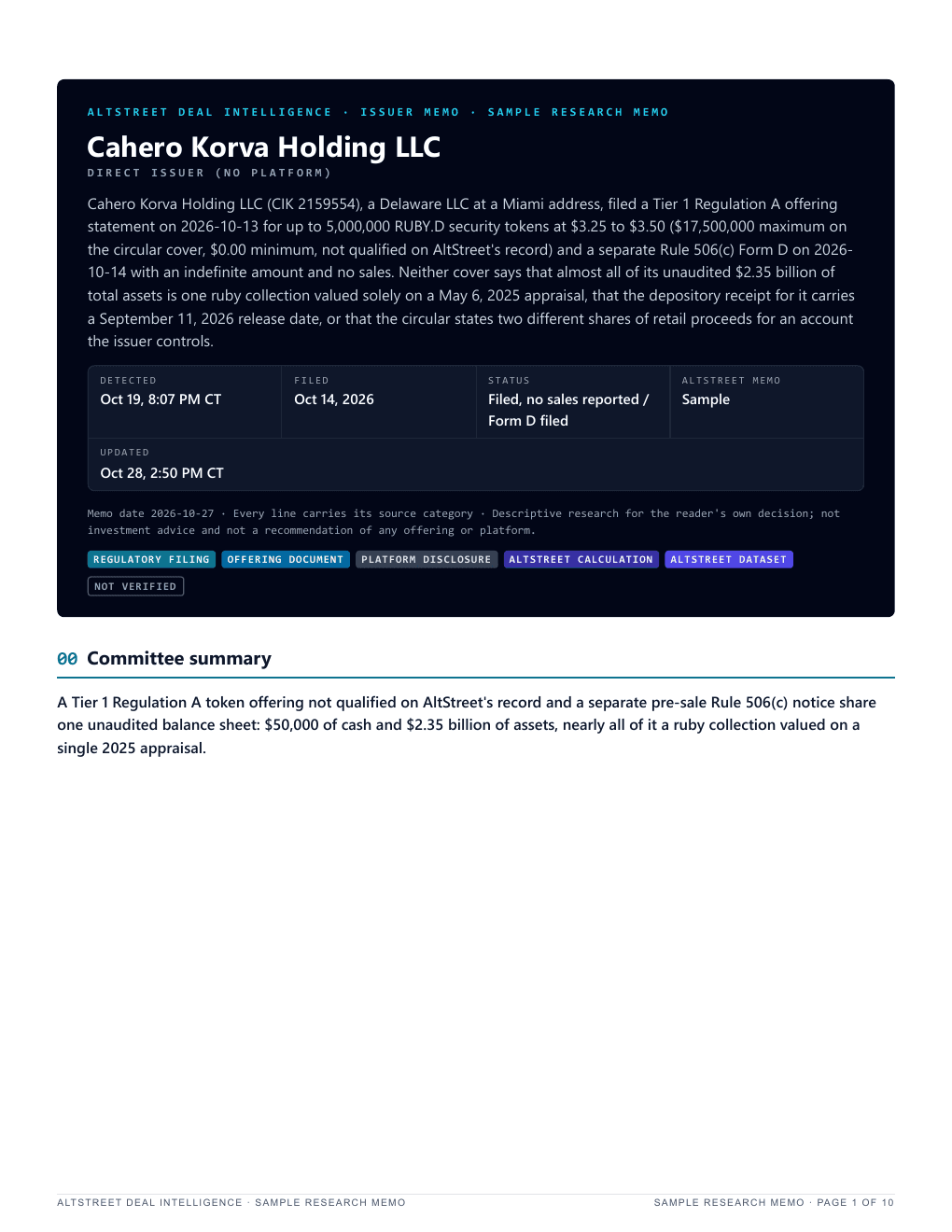
Sample: Cahero Korva Holding LLC (RUBY.D security tokens), 10 pages · Latest data print 2026-11-22 · Subscriber archive
18
In active deal detection
platforms whose new offerings trigger alerts and memos today
675
In the research record
platforms tracked through filings and reviews, 169 reviewed in full; detection is added one adapter at a time
10K
Offerings tracked
3,270 first seen on platforms · 6,959 in filings
2,572
Offering documents
read, extracted and cited by page
72K
Cited excerpts
1500 marketing-to-filing discrepancies flagged
577
Verified exits
realized outcomes behind the base rates
Three deliverables, one subscription
The alert the same day. The filing brief the day it posts. The memo when the analyst is done.
The day a Rule 506(c) notice posts to EDGAR before its first sale: nothing sold, general solicitation permitted, the first public record of the offering. The notice item by item, the related persons with their other issuers, the sales-compensation recipients, the adviser and auditor from Form ADV, the issuer's filing history, the enforcement scan, and a plain statement of what the filing does not carry. No document, so no memo yet; the brief updates when one is obtained.
- Every pre-sale 506(c) notice market-wide, five or six a day, routed by industry, size and state
- Competitor tracking on Adviser and above: every Form D filed by the platforms, issuers and names you watch
- No model-written prose: filed fields and AltStreet's tables, with the source on every line
The day an offering appears on a covered platform. The listing's stated terms, captured and dated, beside what AltStreet already holds on the sponsor: filing history and amounts sold, published exits and their outcomes, the fee pattern of prior offerings, the review score, any enforcement or court record. Machine-assembled within hours, which is why it says so, and why every platform figure in it is marked as the platform's claim.
- When a platform lists a deal before its Form D appears, AltStreet can detect it first
- Sponsor record attached automatically from the data layer
- Routed by platform, asset class or minimum check on Adviser and above
When the analyst has read the offering documents, the platform's marketing and the sponsor's record in full. A one-page decision brief and three to five pages of analysis for the committee: a one-page summary with a decision lens (a reading structure for the committee's own analysis, not a rating), the marketed terms set against the filed and documented ones, return sensitivity, the sponsor's record, conflicts and fees, exit and liquidity, the regulatory and legal record, what cannot be verified yet, and the questions for the sponsor. Every claim carries one of six verification tiers; the verbatim passages travel in a separate evidence book. The analyst directs the research and the AI assembles the first draft on the framework; an automated gate fails any internal inconsistency; the analyst then reads every claim against the documents, rewrites what is wrong, resolves what the gate raised, and decides whether it goes out. Nothing is sent that the analyst has not worked through.
- A standard framework, so memos compare across sponsors and years
- The sponsor's realized outcomes, reported performance history and fee history beside this deal's terms, with the asset class's base rates
- Pre-IPO listings get the Pre-IPO Brief: the offered price against the last round and against other platforms, the share class and its rights, the vehicle's fees on the minimum
- No recommendation, no rating, no price; facts and open questions
The Deal Alert, as it arrives Alert
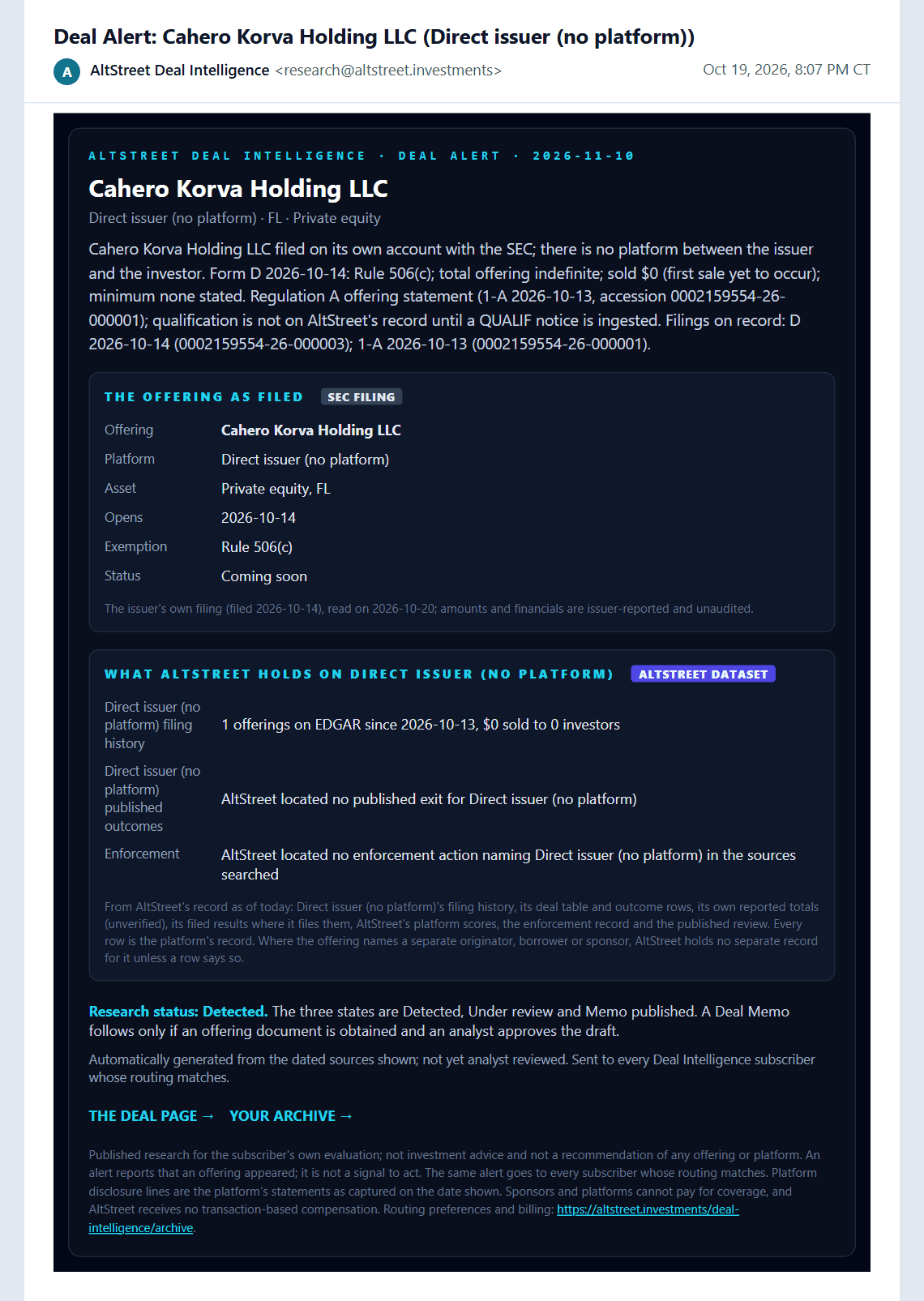
One email the day the offering appears. Two blocks, two tiers.
The first block is the offering as the platform listed it, every line marked platform disclosure with the capture date, because at this point that is what it is. The second block is what AltStreet already holds on the sponsor, marked AltStreet dataset: the Form D history of its entities and what they reported sold, the realized exits with their median IRR and hold and the losses named, the prior deals in the same state, the fee pattern of its recent offerings, the platform score, and whether an enforcement action names the sponsor. The sample beside this is the alert for the deal the sample memo was written on, as it was assembled on the morning of detection.
- Sent within hours of detection, dated, machine-assembled and labeled as such
- The sponsor's filing history, published outcomes, same-state record and fee pattern, attached automatically
- No rating, no recommendation: what was listed and what the record says
- Routed by platform, asset class or minimum check on Adviser and above
The Form D Alert, as it arrives Alert
The notice the day it posts. Four blocks, and an honest fourth.
Most Form Ds confirm a raise that has already begun. The ones this alert reads are different: a Rule 506(c) notice whose Item 7 says the first sale is yet to occur. General solicitation is permitted, nothing has been sold, and the signed notice is the first public record of the offering. The first block is the filing item by item, marked regulatory filing. The second is the people and the firms: each related person with the other Form D issuers that carry the same name, and each sales-compensation recipient with its CRD. The third is what AltStreet holds: the issuer's filing history, its platform if it has one, the adviser and auditor from Form ADV Schedule D, and whether an enforcement release carries any of the names. The fourth says what the filing does not carry, which is the offering document, and that the brief is updated when one is obtained.
- Five or six pre-sale 506(c) notices a day market-wide, routed by industry, stated size and issuer state
- Competitor tracking on Adviser and above: every Form D or amendment filed by the platforms, issuers and names you watch, any exemption
- Assembled from the filing and AltStreet's tables the day the index posts; no generated prose, no verdict
- Updated when an offering document for the issuer is obtained; a memo follows only then
Coverage
Select deals from everything we track
Run a platform or sponsor offerings? Send your deals as they open: registration is free, the alert reaches the allocators who pay to see deal flow, and the memo reads the document.
Deals come from everything AltStreet tracks: platforms whose offerings appear before, or without, a filing (farmland, real estate, private credit, energy, royalty and pre-IPO marketplaces), read from their launch emails, their listings and the filings that open an offering, and every issuer whose Form D, Regulation A or Regulation CF filing the ledger ingests. Pre-IPO marketplaces are followed by company: a new vehicle on one of them opens a lead, and the brief is written on the company and the share class offered, with every platform's price side by side on the company board. Institutional subscribers can ask for a platform or a sponsor to be followed. Sponsors and platforms cannot pay to be covered, and the memo is the same for every subscriber.
From the sample memo
Cahero Korva Holding LLC (RUBY.D security tokens), on EDGAR, filed directly by the issuer
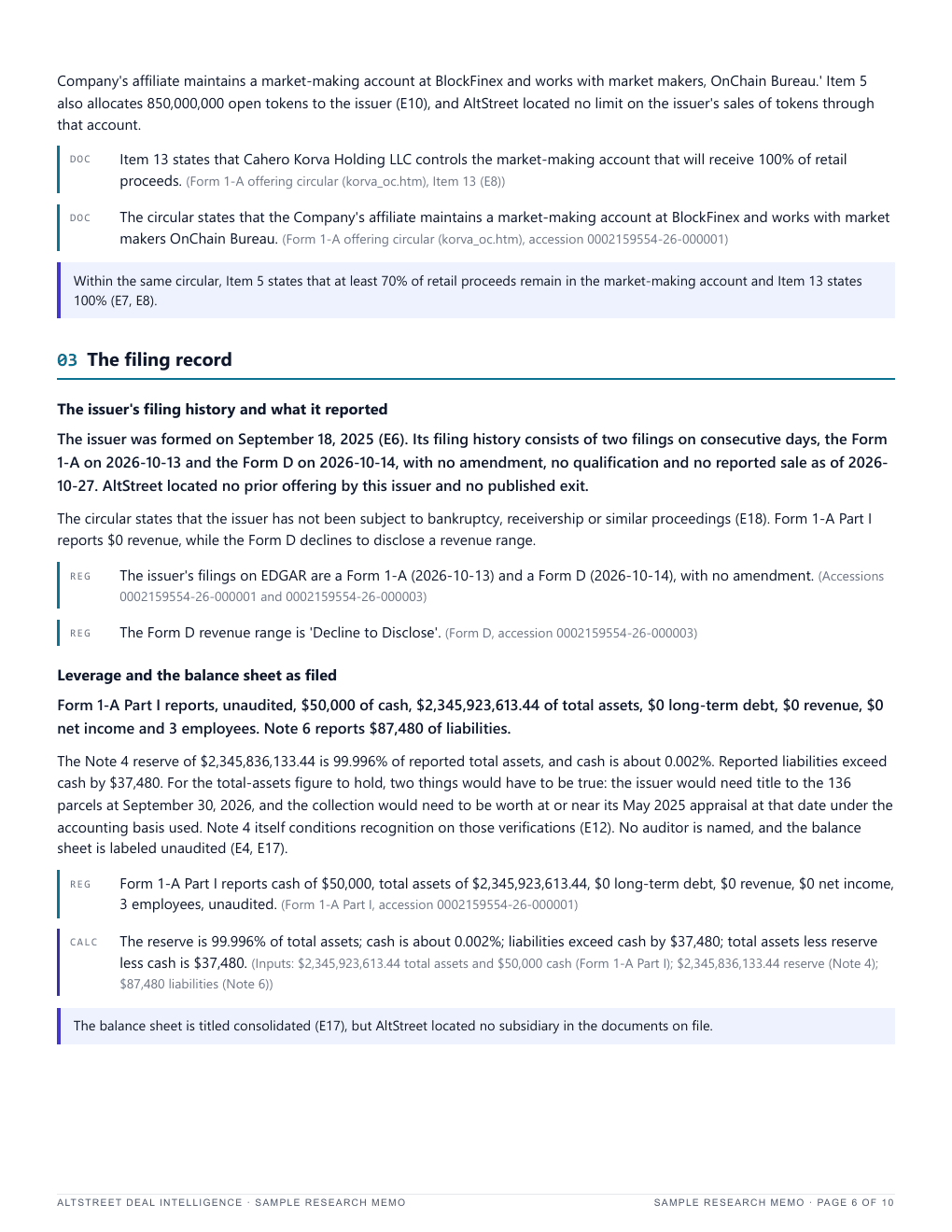
Form 1-A Part I reports, unaudited, $50,000 of cash beside $2,345,923,613.44 of total assets. The ruby collection behind 99.996% of that total is valued solely on appraisal # ID-R004, dated May 6, 2025, four months before the issuer was formed, and the appraisal itself is not on file.
Item 5 of the offering circular says at least 70% of retail purchase proceeds remain in the market-making account; Item 13 says the issuer controls that account and that it will receive 100% of retail proceeds. Item 6 sends the other 30% of the maximum, $5,250,000, to marketing.
The safekeeping receipt filed with the Form 1-A carries a September 11, 2026 release date, before the September 30 balance sheet and the October 13 filing. Whether the collection was released is a question for the issuer and the depository.
The two related persons on the Rule 506(c) Form D appear as related persons on Form D filings for the same 13 other issuers, one of them a near-identical name under a different CIK. AltStreet's ledger shows $0 sold on every one.
Preview the memo here, all 10 pages, without leaving the page
The sample is a demonstration copy published for evaluation: it passed the automated quality gate and is shown as a sample, not as an approved subscriber memo. A subscriber memo is sent only after the reviewer named below has read it against the document and the record and approved it, and the archive attaches the filings that follow. Descriptive research for the reader's own evaluation; not investment advice and not a recommendation of the offering or the platform.
Who this is for
Accredited investors, RIAs, family offices, institutions
IndividualIndividual plan
Accredited investors
You see platform offerings before they close and want the committee read before you commit. Deal Intelligence gives one investor the same alerts and the same memos a family office receives: the sponsor's record beside the listing, the fees in context, the return assumption named, and the questions to ask the sponsor before wiring.
AdviserAdviser plan
RIAs and advisory practices
Clients bring you platform offerings and expect a documented answer. The Adviser plan's client-file license lets the memo sit in the client's file as the record of what was reviewed, when and from which source. Alert routing by platform, asset class or minimum check keeps each adviser in their lane, and a memo request moves an open covered offering a client is holding up the research order; the memo it produces goes to every subscriber at once.
Family OfficeFamily Office plan
Family offices and allocators
An investment committee wants the record, not the pitch: the sponsor's prior raises and realized outcomes, the fee drift, the marketed terms against the filed ones, the conflicts and the exit path. Deal-flow software organizes the deals the office already receives; Deal Intelligence watches the market for the deals it has not seen, and the context pack behind each memo comes as data.
InstitutionalInstitutional plan
Institutions and platforms' own compliance
Fund administrators, due diligence firms, allocators with their own systems, and platforms that want an independent read on the sponsors they list. Memos and alerts by API or webhook, custom coverage of platforms or sponsors, single sign-on and invoicing on your paper.
Plans
One seat, a practice, a committee, or a firm.
Individual
$3,500/yr
one seat · billed annually
Every alert and every memo, for one investor.
An accredited investor who sees platform offerings before they close and wants the committee read before committing.
- Deal Alerts the day an offering appears on a covered platform, with the sponsor's record attached
- Form D Alerts the day a Rule 506(c) notice posts before its first sale, with the filing brief
- Every Deal Memo published during your subscription, as PDF, with the evidence appendix
- The memo archive: every memo published since launch, searchable by platform and sponsor
- Filing watch on every memo: the Form D, the amendment or the annual report attached when it files
- The questions for the sponsor, ready to send
- On every memo: fees and costs in dollars on the minimum, the sponsor's similar offerings in one table, the open questions tracked, and what changed on each re-issue
- Personal use; memos are not for redistribution
Research for your own evaluation, not investment advice. No recommendation, no rating.
Adviser · most practices
$5,000/yr
founding cohort, first year · then $10,000/yr · first 25 subscriptions
The memo in the client file before the client asks.
An RIA or a small advisory practice fielding platform offerings from clients.
- Everything in Individual, for three named seats
- Client-file license: a memo may be placed in a client's file and discussed with that client
- Alert routing by platform, asset class or minimum check so each adviser sees their lane
- Watchlists with material-change alerts: every Form D or amendment filed by the platforms, issuers and sponsor names you watch, an amendment stating what moved since the prior notice
- Memo requests: a request decides which covered open offering is researched next; the memo publishes to every subscriber at once, with no exclusivity or head start for the requester
- Quarterly outcome update on every memo'd deal: what filed, what closed, what changed
- Not for publication, syndication or resale; the memo stays inside the firm
Research for your own evaluation, not investment advice. No recommendation, no rating.
Family Office
$25,000/yr
up to ten seats · billed annually
A diligence desk that already knows the sponsor.
A multi-advisor RIA or a single or multi family office with an investment committee.
- Everything in Adviser, for ten named seats
- Priority sequencing: Family Office requests are researched first among requests; the memo still publishes to every subscriber at once
- The context pack behind each memo: the sponsor's filings, outcomes, fee history and review as data
- A methodology call on any memo, scheduled within two business days: how the memo was sourced and verified, never the caller's holdings, allocation or whether to invest
- Internal redistribution license across the firm's committees and reports
- Memos are research for the firm's own decisions; AltStreet does not advise on any allocation
Research for your own evaluation, not investment advice. No recommendation, no rating.
Institutional
Quoted
annual, invoiced · typically $30,000 to $75,000
The memo feed, the data behind it, on your paper.
Large family offices, allocators, fund administrators, due diligence firms and platforms' own compliance teams.
- Everything in Family Office, for as many seats as the team needs
- Memo and alert delivery by API or webhook into your own system
- Custom coverage: platforms or sponsors added to detection on request
- Single sign-on, security questionnaire, invoicing on your terms
- A named analyst for methodology questions
- Quoted by scope; typically $30,000 to $75,000 a year
Research for your own evaluation, not investment advice. No recommendation, no rating.
Paid pilot
A 30-day paid pilot on the Adviser or Family Office plan: every alert and every memo for a month, the archive, the routing, a call with the reviewer at the end. Priced on the order form and credited against the annual term if you continue. Ask for a pilot.
Other ways to buy
Invoice or purchase order
Annual terms for firms, named seats, vendor onboarding and security questionnaires handled, no card required.
Request an order formResearch Desk: one report on one offering
An offering outside coverage, commissioned by the investor and published to the subscriber archive within 30 days, with no exclusivity. Diligence Check $750 in two business days; Diligence Report $1,495 in three to five; custom engagements quoted.
Commission diligenceAltStreet Terminal: pull, not push
The data layer the memos are built on, as a product you search yourself: platform comparison, deal flow, filings and outcomes, from $149 a month. Deal Intelligence is the push side: AltStreet watches and tells you.
Terminal plansEvery plan receives the same alerts and the same memos. Plans differ in seats, license and service, never in what the memo says. Published research for the subscriber's own evaluation; not investment advice and not a recommendation of any offering or platform. Sponsors and platforms cannot pay for coverage or ratings, and AltStreet receives no transaction-based compensation. A memo request sets what is researched next and never produces a private memo: the memo publishes to every subscriber at once, with no draft or head start for the requester. The methodology call covers how a memo was sourced and verified, never the caller's holdings, allocation or whether to invest.
Why AltStreet is different
Real-time private-market deal alerts with independent due diligence
Against
Deal-flow software for family offices
Organizes the opportunities the office already receives: intake, pipeline, screening.
You do not have to send AltStreet the deal first. AltStreet is already watching the platforms and the filings for it, and the memo arrives with the sponsor's record attached.
Family office due diligenceAgainst
Investment due diligence and DDQ software
A workflow for the diligence your team performs: questionnaires, document rooms, manager research.
The diligence itself, done from primary sources on a standard framework, delivered before the offering closes, with every line marked by what verified it.
What a memo containsAgainst
A commissioned due diligence report
A one-off study of one offering the investor chooses, delivered to that investor.
Continuous coverage: every alert and every memo on the covered platforms during the term, the same for every subscriber. For an offering outside coverage, AltStreet's Research Desk is the one-off product.
Research DeskAgainst
AltStreet Terminal
Pull: you ask the data. Search every platform, offering, adviser, auditor and filing on one schema, screen and export.
Push: AltStreet watches the market for you and tells you what changed before you knew to ask, with the memo behind it. Many firms run both: the Terminal to look, Deal Intelligence to be told.
The TerminalThe sponsor's record, beside the deal Memo
The listing says what the sponsor wants said. The memo says what the sponsor did.
The offering document is a hundred pages the sponsor wrote. What a committee needs beside it is the record: every prior offering the sponsor filed, what each sold and to how many investors, the realized outcome of every exit the sponsor has published, how this offering's fees sit against the sponsor's recent offerings, where the marketing and the filings disagree, the enforcement and court record, and what AltStreet's platform review found. That record already exists in AltStreet's data layer for every covered platform. A memo is the cross-check between it and the deal in front of you, with the questions for the sponsor written out.
- Outcome base rates: the sponsor's realized exits, median IRR and hold, the losses named, and the asset class's realized record across every platform AltStreet covers
- Performance the platform reported itself, period by period, from its 1-K, 1-SA, 10-K or C-AR filings and its own pages: revenue, net income, cash, NAV, distributions, redemptions
- The sponsor's other deals on record: how they filled against target, how long they took to close, the yields and returns stated and realized, the ones in work-out
- Form D history: what each prior offering reported sold, and how long after launch it filed
- Filing watch: the Form D or amendment attached to the memo when it files
Fee drift and conflicts Memo
Every fee line, who receives it, and where it sits in the sponsor's own range.
A fee schedule means little on its own. The memo lines this offering's fees against the sponsor's recent offering documents by name and date, states the dollar difference at the sponsor's median rate, and reads the conflicts the document discloses: who sets the value a management fee is charged on, who decides the sale and earns on it, whether the vehicle is audited and independently administered. Each claim carries its source, and the passages are reproduced verbatim in the evidence book.
- Fee drift: this offering's fees against the sponsor's prior offerings, by name
- Conflicts as the document states them, quoted
- Governance: audit, administrator, valuation authority, sale authority
- Reserves, guaranties and credit support kept distinct
Also on every memo and alert
The five things a committee asks for after reading its first memo
Re-issued memos Memo
What changed since the last version, first.
When a memo is re-issued because an amendment filed, a document arrived or the sponsor answered, it opens with what changed: the figure, the finding or the document, each with its source. Nobody re-reads seven pages to find the one line that moved.
On every memo after its first version.
Subscriber-dollar economics Memo
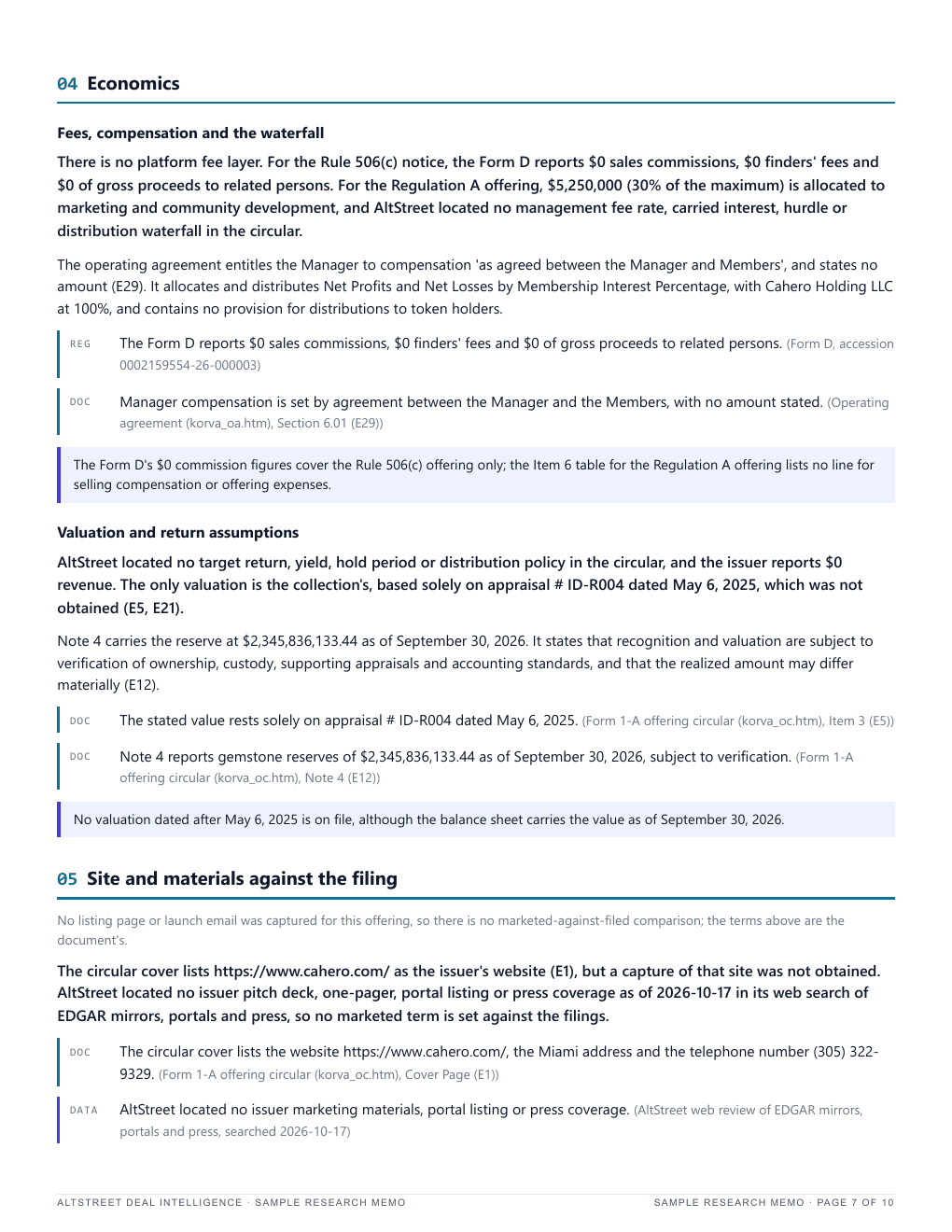
Every fee and cost in dollars, on the minimum ticket.
A table of what the minimum investment pays at entry, each year and at exit, and the total over the document's hold. Fees to the sponsor and its affiliates sit apart from third-party costs and reserves, so a closing cost never hides inside a fee figure.
The conflicts and fees section of every memo.
Consistent comparison Memo
The same table of the sponsor's similar offerings, every time.
Name, date, size, the same fee lines and the realized outcome where there is one, for the sponsor's similar offerings on AltStreet's record. The comparison stays inside the asset class the sponsor sells, never against an index or a different market.
The sponsor record section of every memo.
Unresolved questions Memo
The open questions, tracked across versions.
Every memo closes with the questions it could not answer and the documents that would answer them. When one closes, the next version says so under what changed; what stays open stays listed, so the committee knows what it is still waiting for.
The committee summary and the questions for the sponsor.
Watchlists Alert
Watchlists with material-change alerts.
Name the platforms, issuers, CIKs and sponsor names you watch. Every Form D or amendment they file is alerted the day it posts, and an amendment states what moved since the prior notice: amount sold, investor count and offering size, before and after.
Adviser plan and above; set on the account page.
Questions
The commercial questions, and the ones a buyer searches for
What exactly arrives, and when?
Two things, at two different times. A Deal Alert goes out the day an offering appears on a covered platform: the deal's stated terms beside the sponsor's record in AltStreet's data layer, machine-assembled, within hours, with every platform figure marked as the platform's claim. A Deal Memo follows when the analyst has read the offering documents, the platform's marketing and the sponsor's record: a one-page decision brief and three to five pages of analysis for the committee, with a decision lens, the marketed terms set against the filed and documented ones, every line marked with one of six verification tiers, and the questions to put to the sponsor, plus a separate evidence book of verbatim passages. The analyst directs the research, the AI writes the first draft on AltStreet's data, an automated gate fails any internal inconsistency, and the analyst reads every claim against the sources, rewrites what is wrong and decides what is sent. Most ship within two business days of the document; an offering that closes before a memo is possible still gets its alert. A third thing arrives from the filing lane: a Form D Alert the day a Rule 506(c) notice posts to EDGAR before its first sale, carrying the filing brief (the notice item by item, the related persons and their other issuers, the adviser and auditor from Form ADV, the enforcement scan) and a plain statement that no offering document exists yet. On Adviser plans and above the same lane tracks every Form D filed by the platforms, issuers and names a subscriber watches.
How much does Deal Intelligence cost?
Individual is $3,500 a year for one seat. Adviser is $10,000 a year for up to three seats with a client-file license. Family Office is $25,000 a year for up to ten seats with priority sequencing of requests, the context pack as data and a methodology call on any memo. Institutional is quoted by scope, typically $30,000 to $75,000 a year, with API delivery and custom coverage. The founding cohort, the first 25 Adviser subscriptions, pays $5,000 for the first year. Prices are in US dollars, billed annually.
Is this unlimited due diligence?
No. It is every memo AltStreet publishes during your subscription, on the offerings AltStreet covers, plus the alerts. Coverage is select deals from everything AltStreet tracks, chosen by the analyst, not by subscriber request; Adviser and above can request a memo on an open offering from a covered platform; a request decides which covered offering is researched next, and the memo publishes to every subscriber at the same time, with no draft, head start or exclusivity for the requester. A memo on an offering outside coverage is a commissioned Diligence Report, sold separately, which is itself published to the subscriber archive within 30 days.
Who writes the memo, and can a sponsor pay for a better one?
The analyst obtains the offering documents, captures the platform's marketing and sets what the research must cover. The first draft is generated from those documents and AltStreet's record on the sponsor under house rules enforced in code; the analyst then reads every claim against the documents, the marketing and the filings, rewrites what is wrong, resolves what the quality gate raised and decides what is sent. No memo goes out that the analyst has not worked through. Sponsors and platforms cannot pay for coverage, for a memo, or for a rating, and AltStreet takes no transaction-based compensation from anyone. A memo states facts and open questions and never recommends; the reader's committee decides.
What does a memo know that the offering document does not say?
The sponsor's record. Every prior offering the sponsor filed, what it sold and to how many investors, the realized outcome of every exit it has published, how this offering's fees compare with its recent offerings, what its own marketing claimed against what it filed, whether an enforcement or court record exists, and what AltStreet's platform review found. That is the cross-check a committee pays for; the offering document alone is a hundred pages the sponsor wrote.
Which platforms are covered?
Detection covers the alternative-investment platforms whose offerings appear on the platform, by email or listing, before or without a filing: farmland, real estate, private credit, royalty and pre-IPO marketplaces. The current list is on this page and grows platform by platform; a platform joins coverage when its detection adapter runs and its sponsor record is loaded, never before. Institutional subscribers can ask for a platform or a sponsor to be added.
How do firms and institutions buy?
By invoice or purchase order on an annual term, with as many named seats as the team needs, through the order form at /deal-intelligence/order. Security questionnaires, vendor onboarding and custom terms go through the same form. Card checkout covers Individual, Adviser and Family Office.
Is this investment advice?
No. A memo is published research for the subscriber's own evaluation, the same research for every subscriber. It never recommends an offering, a price or an allocation, and AltStreet does not know your portfolio, your circumstances or your suitability for anything. AltStreet is not a fiduciary to any subscriber and no subscriber relies on it as an adviser; those terms are part of every subscription. The methodology call on the Family Office plan covers how a memo was sourced and verified and never the caller's holdings or whether to invest. Advisers who personalize a memo for a client do so under their own license and compliance.
Due diligence questions, answered
How can I get alerts when new private investment deals launch?
Subscribe to a service that watches the platforms where offerings appear. AltStreet Deal Intelligence reads covered platforms' launch emails and listing pages and the EDGAR filings that open an offering, matches each new deal to the sponsor's existing record, and sends the Deal Alert the same day. Routing by platform, asset class or minimum check is available on Adviser and above.
Read moreIs there a service that monitors new Reg D offerings?
Yes, in two layers. Form D filings on EDGAR are monitored as they arrive. For a marketplace offering that is confirmation, because a Reg D issuer may file up to 15 calendar days after its first sale. For a Rule 506(c) notice filed before the first sale it is the first public record of the offering, and AltStreet sends a Form D Alert with the filing brief the day it posts. Platform listings are monitored for the offerings that appear before any filing. AltStreet runs both, attaches the Form D to the memo when it files, and on Adviser plans and above tracks every Form D filed by the platforms, issuers and sponsors a subscriber watches.
Read moreCan you find a private placement before its Form D is filed?
Often, when the offering is marketed on a platform. Rule 503 gives an issuer until 15 calendar days after the first sale to file Form D, and marketplace offerings are typically listed, and sometimes fully subscribed, before that. When a platform lists a deal before the Form D appears, AltStreet can detect it first; when the filing comes first, the filing lane opens the deal.
Read moreHow do I perform due diligence on a private placement?
Read the offering document against the sponsor's record rather than on its own. Verify the terms and fees in the PPM, compare the fees with the sponsor's prior offerings, check the sponsor's realized outcomes and holding periods against the deal's model, test every return figure for the assumption that produces it, read the conflicts and the exit mechanics, check the enforcement and court record, and write down what cannot be verified. That is the framework an AltStreet Deal Memo follows, with every line marked by what verified it.
Read moreWhat should I look for in a private placement memorandum (PPM)?
The fee lines and who receives them, the waterfall, the sources and uses, the leverage and the authority to borrow later, the return assumptions and whether a target return is stated at all, the manager's discretion over valuation and sale timing, drag-along and transfer restrictions, whether the vehicle is audited and independently administered, and the risk factors the sponsor itself chose to disclose. A memo quotes the passages so a committee can read them rather than trust a summary.
How do I verify a private investment sponsor's track record?
From the filings and the sponsor's own published exits, not the pitch. Every Form D the sponsor's entities filed shows what each offering sold and to how many investors; the sponsor's exits disclosure, where one exists, gives realized IRRs and holds. AltStreet's data layer holds both for covered platforms, so a memo can state the median realized IRR, the median hold, the number of losses and the largest, and compare them with the deal in front of you.
How can I compare a sponsor's fees with its previous offerings?
Line the fee schedule of the new offering document against the schedules of the sponsor's recent offerings, fee by fee and as a percentage of price or equity. AltStreet ingests the offering documents of covered platforms, so the memo reports where a fee sits in the sponsor's range by name and date, as in the sample, where the acquisition fee was the highest of the sponsor's six most recent offerings.
How do family offices evaluate private market deals?
Through an investment committee that wants the record beside the document: the sponsor's prior raises and outcomes, the fee drift, what the marketing claims against what was filed, the conflicts, the exit path, and the open questions. A family office's deal-flow software organizes the deals the office already receives; Deal Intelligence watches the market for the deals it has not yet seen and delivers the memo before the offering closes.
Read moreWhat due diligence should an RIA document for an alternative investment?
A record of what was reviewed, when, from which source, and what remained open. The Adviser plan's client-file license lets a memo sit in the client's file as that record: each claim carries its verification tier and source, the evidence book carries the verbatim passages, and the filing watch attaches the Form D or amendment that later confirms or changes the terms.
What should an investment committee memo include?
The terms and capital stack, the marketed terms against the documented ones, the return sensitivity and the assumption that drives it, the sponsor's record and prior deal outcomes, fees and conflicts, exit and liquidity, the regulatory and legal record, what cannot be verified yet, and the questions for the sponsor, with a one-page summary and a decision lens in front. Read the sample to see the framework on a live offering.
Read moreWhat is the difference between an IC memo and a due diligence report?
Scope and timing. A Deal Memo is written for a committee deciding on an open offering, on a standard framework so memos compare across sponsors and years, and every subscriber receives every memo. A commissioned Diligence Report is a one-off, deeper study of one offering or sponsor the investor chooses, including offerings outside coverage, delivered to the investor who ordered it.
Read moreCan AI review a PPM for investment due diligence?
It can read it, extract the terms, and draft against the record; it cannot be trusted to publish. AltStreet's drafts are generated from the offering document and the data layer under house rules enforced in code, then pass an automated quality gate that fails closed on internal inconsistencies, then the analyst does the work that decides the memo: reads every claim against the documents, the marketing and the filings, rewrites what is wrong, resolves what the gate raised, and decides whether it is sent. A subscriber never sees a draft.
How do you monitor a private investment after the initial diligence?
Through the filings that follow the raise. The Form D or its amendment reports the amount sold and the investor count as of filing; Reg A issuers file semiannual and annual reports; Reg CF issuers file the annual Form C-AR. The memo archive attaches each to the memo it confirms or changes, and Adviser plans and above receive a quarterly outcome update on every memo'd deal.
What does Form D tell investors about a private placement, and what does it not?
Form D names the issuer, its related persons, the exemption claimed, the minimum investment, the total offering amount and the amount sold and investor count as of the filing date, and any sales commissions. It does not carry the offering document, the fee schedule, the pro forma, the sponsor's track record or any audited figure, and the amount sold is a snapshot that an amendment may later revise. A Form D figure is cumulative capital reported sold, never assets under management.
Read moreHow do you evaluate projected IRR in a private real estate or farmland deal?
Find the assumption that produces most of the return and state the IRR without it. In the sample memo the PPM states no target return; the sponsor's pro forma implies a 7.01% IRR, most of it from a 6% annual appreciation assumption realized in the exit-year cash flow, and roughly 1.6% at a flat value. Every AltStreet calculation is marked as AltStreet's arithmetic with its inputs named.
Go deeper
Four pages on how it works
Private market deal alerts
How offerings are detected on platforms and in filings, what an alert carries, and how routing works.
ReadForm D alerts and competitor tracking
The 506(c) notices filed before any sale, the filing brief each alert carries, and the tracking lane for the platforms, issuers and names you watch.
ReadInvestment committee memos
The framework, the six verification tiers, and the full sample memo on a live farmland offering.
ReadFamily office due diligence
How Deal Intelligence differs from deal-flow software, and what a committee receives.
ReadWhat is where
Individual, Adviser, Family Office and Institutional, line by line
| What | Individual | Adviser | Family Office | Institutional |
|---|---|---|---|---|
| Deal Alerts the day an offering appears, with the sponsor's record attached | ||||
| Form D Alerts the day a 506(c) notice posts before its first sale, with the filing brief | ||||
| Competitor tracking: every Form D filed by the platforms, issuers and names you watch | · | |||
| Every Deal Memo published during the subscription, as PDF, with the evidence book | ||||
| The memo archive and the filing watch on every memo | ||||
| Questions for the sponsor on every memo | ||||
| Named seats | 1 | 3 | 10 | 10+ |
| Client-file license: a memo may sit in a client's file and be discussed with that client | · | |||
| Alert routing by platform, asset class or minimum check | · | |||
| Memo requests: a request decides which covered open offering is researched next; the memo publishes to every plan at once | · | |||
| Quarterly outcome update on every memo'd deal | · | |||
| Priority sequencing of requests, the context pack as data, a methodology call on any memo | · | · | ||
| Internal redistribution across the firm's committees and reports | · | · | ||
| API or webhook delivery, custom platform coverage, single sign-on, invoicing | · | · | · |
The alert today. The memo while the offering is open.
Read the sample first: a real offering, the real sponsor record beside it, every line tiered to its source. Then the publishing record above, which is what a subscription has delivered so far.