
Investment committee memos
What an independently researched IC memo on a live offering looks like.
Most pages about investment committee memos explain how to write one. This one shows one: the AltStreet Deal Memo on a token offering filed directly by its issuer, built from the offering circular and exhibits on EDGAR, the issuer's Form D and the record of every other issuer its people appear on, every line marked by what verified it, with the framework and the rules behind it.
Latest data print 2026-11-22
2,572
Offering documents read
extracted and cited by page
72K
Cited excerpts
1,500 discrepancies flagged
577
Verified exits
realized outcomes behind the base rates
10 pages
Sample memo
EDGAR, filed directly by the issuer
The framework
Nine headings, the same on every memo
An investment committee memo earns its keep by being comparable. A committee that reads one memo a quarter can tolerate a different shape each time; a committee that reads one a week cannot. AltStreet's memo follows the same nine headings on every offering, so the fee section of a farmland deal sits where the fee section of a private credit note sits, and a reader who has seen three memos knows where to look in the fourth.
The order is deliberate. Deal terms first, because nothing else means anything until the terms are fixed. Marketed against filed second, because the gap between what the investor was shown and what the document and the filings say is the committee's first question, not an appendix. Return sensitivity third, naming the assumption that produces most of the return and stating the figure without it. Then the sponsor's record, conflicts and fees, exit and liquidity, the regulatory and legal record, what cannot be verified yet, and the questions for the sponsor, written to be sent.
In front of the nine headings sits a one-page committee summary: the headline, the bullets with their tiers, two cards (what supports the deal, what could change the conclusion) and a decision lens strip: four or five factual cells that give the committee a reading structure for its own analysis, never a rating or a verdict. The memo states what a document discloses and what remains open; it does not characterize a sponsor, a fee or a term, and a house rule enforced in code keeps it that way. Behind them, delivered as a second PDF, is the evidence book: every section in full, the marketed-against-filed table, and every verbatim passage cited.
01Deal terms
Terms · Capital stack and use of proceeds
02Marketed against filed
Marketing claims against the documents
03Return sensitivity
Valuation and return assumptions · Leverage
04Sponsor record
Sponsor track record · Prior deal outcomes
05Conflicts and fees
Fees and waterfall · Conflicts of interest
06Exit and liquidity
Exit mechanics and liquidity
07Regulatory and legal record
Regulatory and legal record
08What we cannot verify
What cannot be verified yet
09Questions for the sponsor
Questions for the sponsor
Six verification tiers
The committee reads the tier before the number
Every sentence of substance in the memo carries one of six marks. A regulatory filing, with its accession or file number. The offering document, with its section or page. The platform's or sponsor's own disclosure, with the capture date, printed as the platform's claim. An AltStreet calculation, with the inputs named, so the reader can redo the arithmetic. AltStreet's dataset, naming the table or the review the fact came from. Or not verified, which is a finding in its own right rather than a gap papered over.
The marks are not decoration. They are how a diligence desk already works: a number from a signed filing, a number from the sponsor's own document and a number from a marketing email are three different kinds of fact, and a committee that cannot tell them apart on the page has to tell them apart in its head. The memo does it in advance, and the evidence book reproduces the passages so the reader can check the source rather than trust the summary.
The sample memo
Cahero Korva Holding LLC (RUBY.D security tokens), on EDGAR, filed directly by the issuer
A Tier 1 Regulation A offering of up to 5,000,000 RUBY.D security tokens at $3.25 to $3.50 ($17.5 million maximum), filed in October 2026 beside a Rule 506(c) Form D, by a Delaware LLC whose unaudited balance sheet carries $50,000 of cash and $2.35 billion of rubies valued on a single 2025 appraisal. The memo was built from the Form 1-A, its offering circular, operating agreement and custody receipt, the Form D and AltStreet's record of every issuer the related persons appear on. It is rendered here as a demonstration copy; it passed the same automated quality gate every subscriber memo passes, and subscriber memos additionally carry an analyst's approval before delivery.
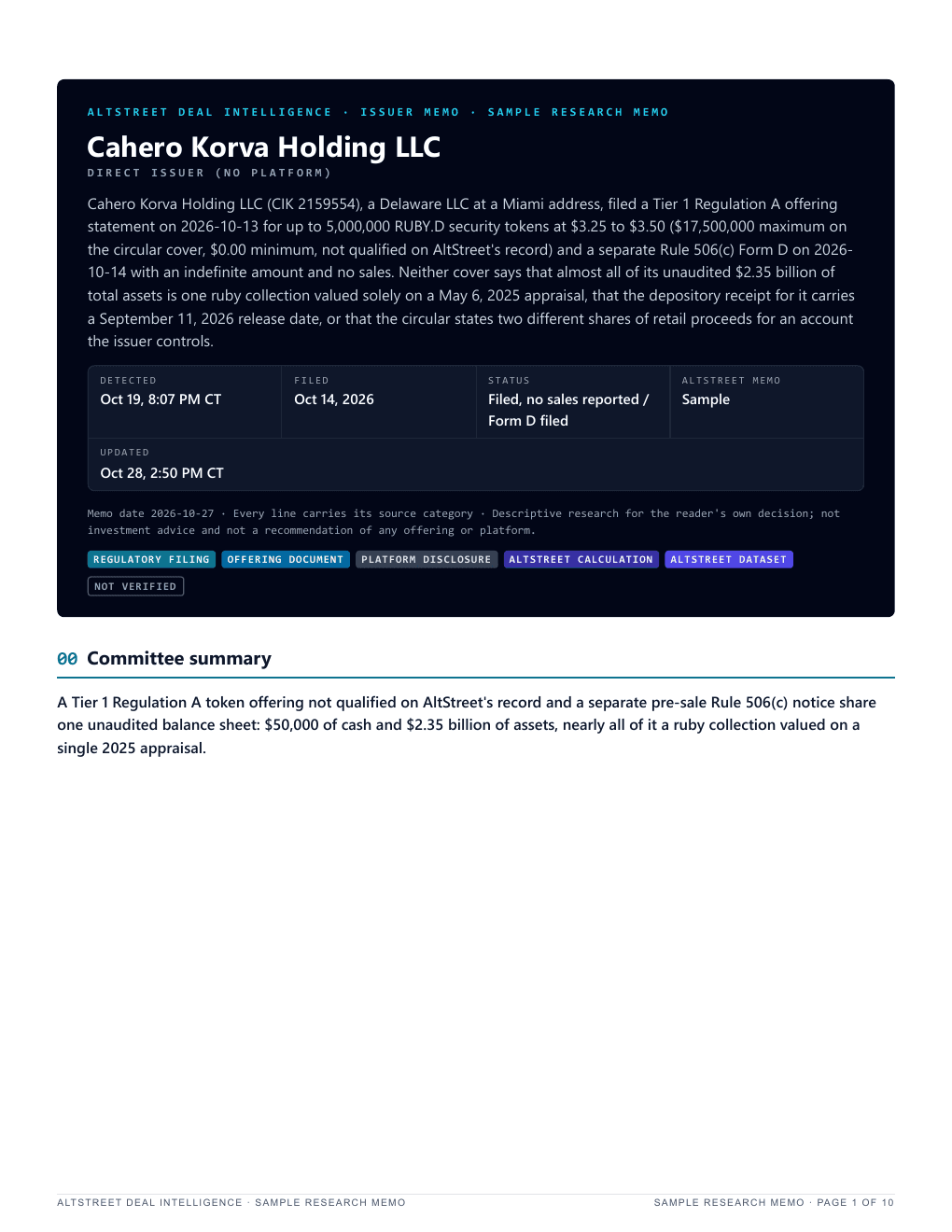
Page 1: timing panel, committee summary, tiers
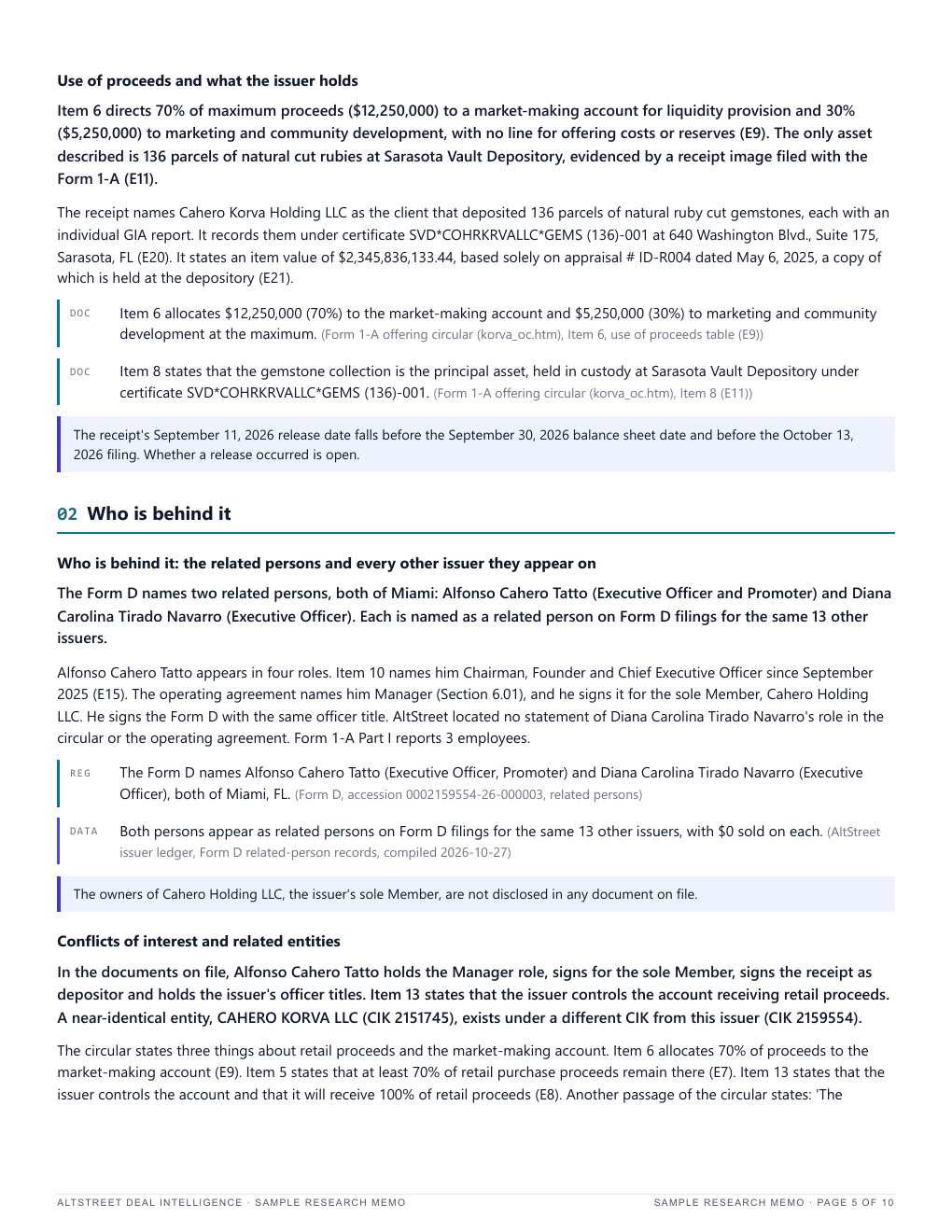
Page 5: who is behind it, conflicts of interest
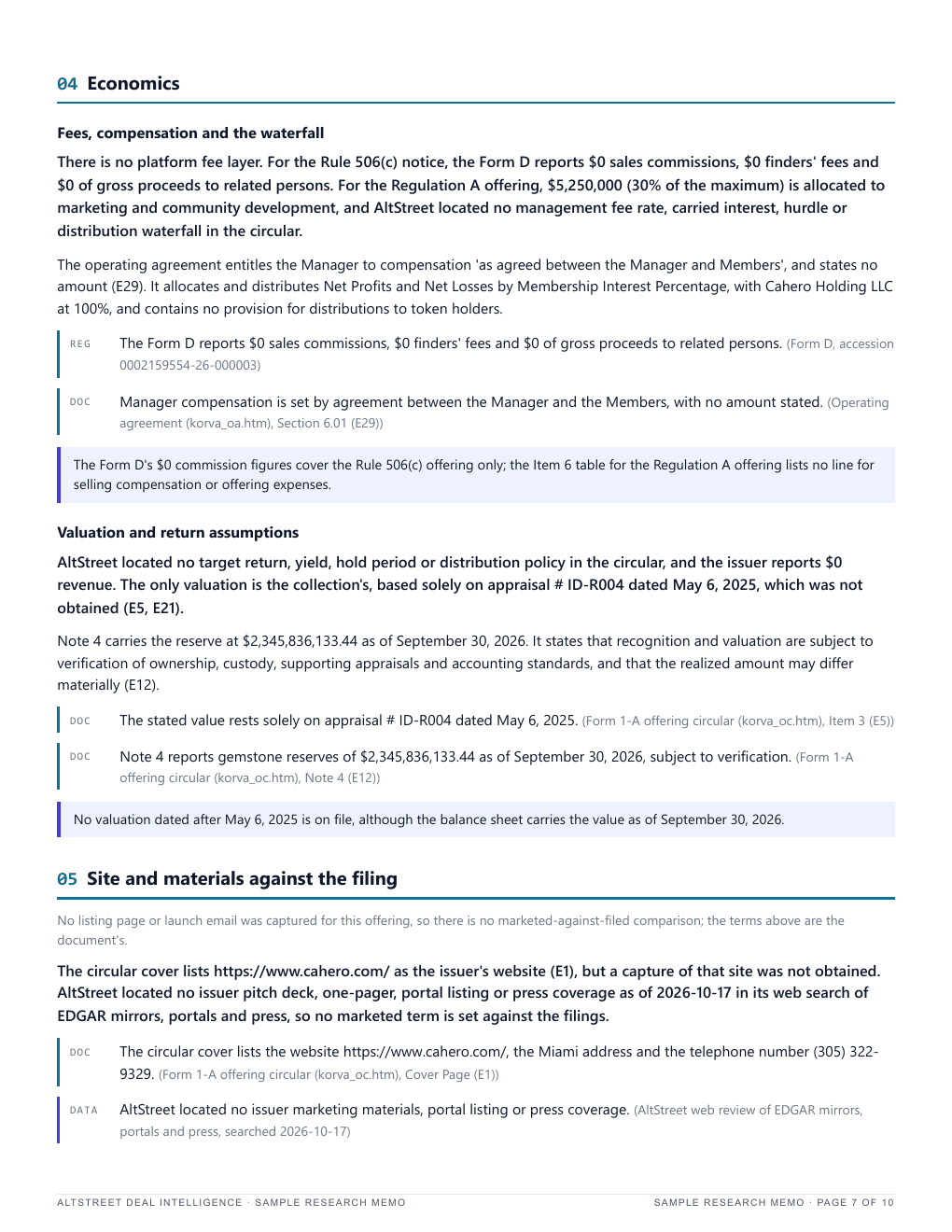
Page 7: fees, compensation and valuation
Descriptive research for the reader's own evaluation; not investment advice and not a recommendation of the offering or the platform. Figures are as the memo states them, with their tiers and sources.
How a memo is made
Led by the analyst, drafted by the AI on the record, gated in code, judged by the analyst
The analyst obtains the offering documents the listing points to, captures the platform's marketing as it stood, and sets what the research must cover for this deal. The AI then reads the documents, extracts the terms and the passages, and assembles everything AltStreet holds on the sponsor: the Form D history of its entities, the published exits, the sibling offerings and their fee terms, the enforcement and court record, the platform review. The memo is drafted from that pack on the standard framework, with each claim tiered and sourced.
Then two gates. The house rules run as code against every sentence. The quality gate checks the draft against itself and against the record, and fails on any inconsistency rather than flagging it for later. Then the analyst's real work: every claim read against the documents, the marketing and the filings, what is wrong rewritten, what the gate raised resolved, and the decision whether it goes out. A draft that cannot be made right is not sent. The subscriber sees conclusions, evidence and uncertainty; the subscriber never sees AltStreet debugging itself.
What the subscriber receives is two PDFs and a monitoring commitment: the committee memo, the evidence book, and the filing the memo expects attached to the archive when it posts. How the filing watch works.
House rules
Enforced before a person reads the draft
Quality gate
Fails closed on internal inconsistency
Coverage
Select deals from everything we track
Launch emails, listing pages and the Form D, Regulation A and Regulation CF filings AltStreet ingests; the platforms shown carry a review. Sponsors and platforms cannot pay to be covered.
Questions
Asked the way people search for it
What should an investment committee memo include?
The terms and capital stack; the marketed terms against the documented and filed ones; the return sensitivity and the assumption that drives it; the sponsor's record and prior deal outcomes; fees and conflicts; exit and liquidity; the regulatory and legal record; what cannot be verified yet; and the questions for the sponsor. In front, a one-page summary and a decision lens; behind, the verbatim evidence. That is the framework every AltStreet Deal Memo follows.
What is the difference between an IC memo and a due diligence report?
Scope and timing. An IC memo is written for a committee deciding on an open offering, on a standard framework so memos compare across sponsors and years, and every Deal Intelligence subscriber receives every memo. A commissioned Diligence Report is a one-off, deeper study of one offering or sponsor the investor chooses, including offerings outside coverage, delivered to that investor first and published to the subscriber archive within 30 days, with no exclusivity.
Read moreHow long is an investment committee memo?
AltStreet's committee memo is a one-page decision brief (the cover, the decision lens and the committee summary) and three to five pages of analysis under the framework headings, compressed to what the committee needs. The evidence book, delivered alongside, carries every section in full, the marketed-against-filed table and every verbatim passage, and runs longer.
Does the memo recommend whether to invest?
No. A memo states facts, marks each by what verified it, names the assumption behind every computed figure, lists what could change the conclusion, and writes out the questions for the sponsor. The committee decides. House rules enforced in code keep out recommendations, ratings, price targets and verdicts on attractiveness.
Can AI write an investment committee memo?
It can draft one from the offering document and the sponsor's record, and that is how AltStreet's drafts begin. It cannot be trusted to publish. Every draft passes house rules enforced in code and an automated quality gate that fails closed on any internal inconsistency, then an analyst reads it against the document and the record, corrects or rejects it, and approves it. Nothing reaches a subscriber without that approval.
What is a verification tier?
The mark on every line of substance saying what verified it: a regulatory filing with its accession, the offering document with its section, the platform's own disclosure with its capture date, an AltStreet calculation with its inputs named, AltStreet's dataset with the table named, or not verified. The committee reads the tier before the number.
Where can I see an example of an IC memo for a private investment?
On this page. The sample is the AltStreet Deal Memo on Cahero Korva Holding LLC, a Tier 1 Regulation A offering of gemstone-backed security tokens filed directly by the issuer, rendered as a demonstration copy with the same framework, tiers and evidence a subscriber memo carries.
Related
Private market deal alerts
How offerings are detected on platforms and in filings, what an alert carries, and how routing works.
ReadForm D alerts and competitor tracking
The 506(c) notices filed before any sale, the filing brief each alert carries, and the tracking lane for the platforms, issuers and names you watch.
ReadFamily office due diligence
How Deal Intelligence differs from deal-flow software, and what a committee receives.
ReadAltStreet Deal Intelligence
The product page: alerts, memos, who it is for, plans and pricing.
Plans and pricingThe memo while the offering is open.
Every Deal Intelligence subscriber receives every memo published during the term, on the same framework, with the same evidence. Plans differ in seats, license and service, never in what the memo says.