
Family office due diligence
You do not have to send AltStreet the deal first. AltStreet is already watching for it.
Family office investment due diligence has two halves: learning of the deal and knowing the sponsor. Deal-flow software organizes the deals the office already received. AltStreet Deal Intelligence detects the offerings the office has not seen, on the platforms and in the filings, and delivers the investment committee memo, the analyst's read of the platform's marketing, the offering documents, the filings and the sponsor's record together, before the offering closes.
Latest data print 2026-11-22
675
Platforms monitored
169 reviewed in full
577
Verified exits
realized outcomes behind the base rates
34K
Enforcement actions
SEC and FINRA, joined to the entity graph
2,572
Offering documents
read, extracted and cited by page
The distinction
Inbound organization against outward detection
A family office's deal flow is bounded by its network. The offerings that reach the committee are the ones a sponsor, a banker, a peer or an adviser chose to send, and the software most offices run exists to organize that inbound stream. It is good at that. It cannot show the committee the farmland raise that opened on a marketplace yesterday, the private credit note that a platform's list received this morning, or the royalty auction that closes on Friday, because none of those were sent to the office.
Deal Intelligence runs in the other direction. AltStreet reads covered platforms' launch emails and listing pages and the EDGAR filings that open an offering, matches each new deal to the sponsor's existing record, and sends the Deal Alert the same day. When the offering document is in hand, the memo follows. The office does not forward anything; the alert is the first the office hears of the deal, and the sponsor's record is already attached. How detection works.
Deal-flow software
Organizes what you already have
Due diligence software
Organizes the work you do
AltStreet Deal Intelligence
Detects the deal and delivers the research
What the committee receives
The record beside the document
The offering document is a hundred pages the sponsor wrote. The committee's question is what sits beside it. For every covered platform AltStreet's data layer holds the sponsor's prior offerings and what each reported sold, the realized outcome of every exit the sponsor has published, the fee terms of the offering documents already read, the enforcement and court record of the sponsor and its principals, and the platform review. The memo is the cross-check between that record and the deal in front of the committee.
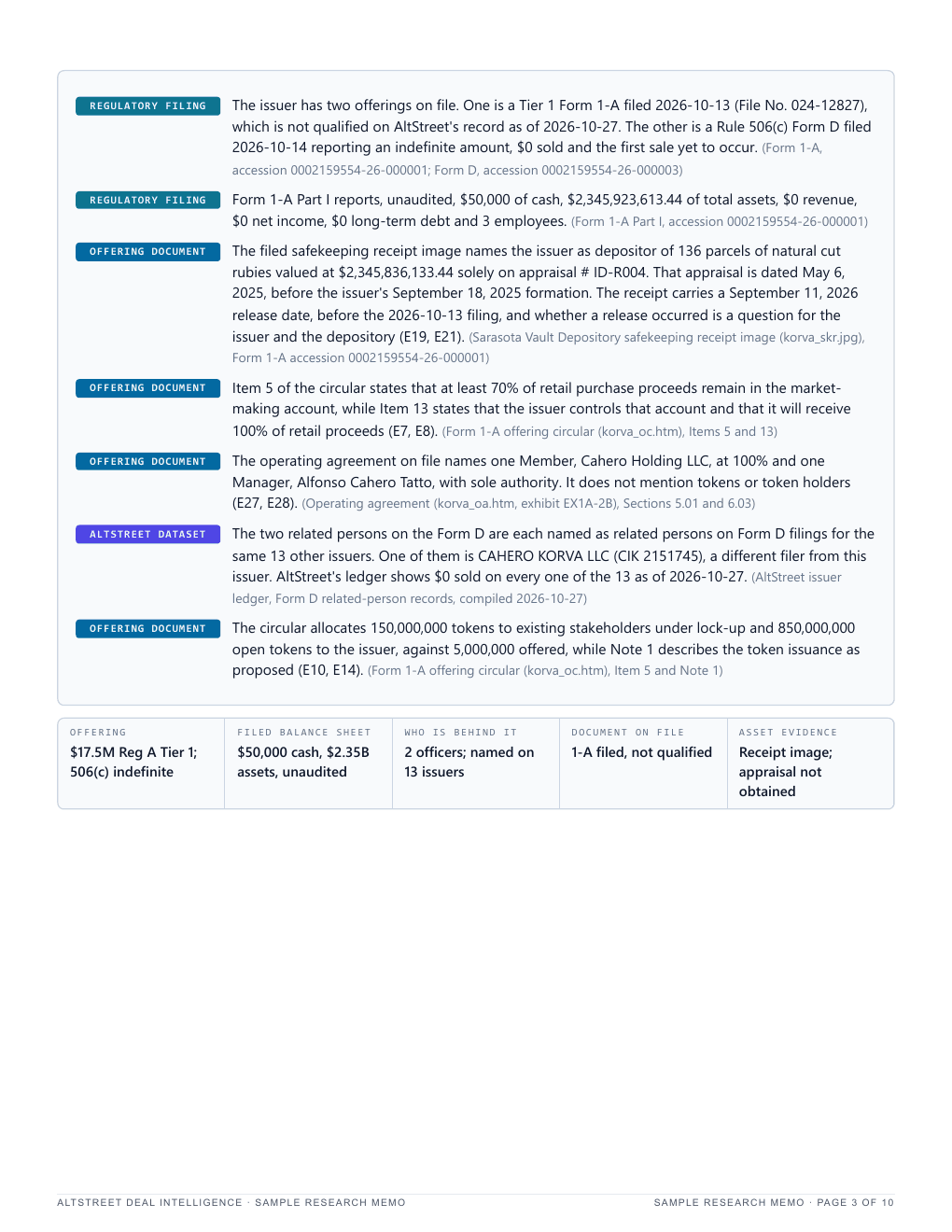
It arrives on a standard framework so memos compare across sponsors and years: deal terms; the marketed terms against the documented and filed ones; return sensitivity with the driving assumption named; the sponsor's record and prior deal outcomes; conflicts and fees, including where this offering's fees sit in the sponsor's own range; exit and liquidity; the regulatory and legal record; what cannot be verified yet; and the questions for the sponsor, written to be sent. Every line carries one of six verification tiers, and the evidence book reproduces the passages verbatim. The framework, and the full sample memo.
It never recommends. A memo states facts and open questions, lists what supports the deal and what could change the conclusion, and leaves the decision where it belongs. Sponsors and platforms cannot pay for a memo, and AltStreet takes no transaction-based compensation.
Licenses and service
Built for how an office and a practice actually use research
An RIA fielding platform offerings from clients needs a documented answer. The Adviser plan's client-file license lets the memo sit in the client's file as the record of what was reviewed, when and from which source, and the quarterly outcome update keeps that record current as the filings post. Alert routing keeps each adviser in their lane.
A family office with an investment committee needs the research to travel inside the firm. The Family Office plan's internal redistribution license covers the committee pack and the firm's own reports, the context pack behind each memo comes as data for the office's own models, priority sequencing puts the office's requests first among requests (the memo still publishes to every subscriber at once), and a methodology call is available on any memo, covering how it was sourced and verified and never the caller's holdings or whether to invest.
Institutions, allocators and platforms' own compliance teams take the same alerts and memos by API or webhook, with coverage extended to the platforms or sponsors they name. Plans and pricing, or the order form for invoice or purchase order.
Adviser
$10,000 a year, up to three seats
Family Office
$25,000 a year, up to ten seats
Institutional
Quoted by scope
Coverage
Select deals from everything we track
Launch emails, listing pages and the Form D, Regulation A and Regulation CF filings AltStreet ingests; the platforms shown carry a review. Sponsors and platforms cannot pay to be covered.
Questions
Asked the way people search for it
How do family offices evaluate private market deals?
Through an investment committee that wants the record beside the document: the sponsor's prior raises and realized outcomes, the fee drift against its earlier offerings, what the marketing claims against what was filed, the conflicts, the exit path and the open questions. The committee's time goes to judgment; the record-gathering is what Deal Intelligence delivers before the meeting.
What is the difference between Deal Intelligence and family office deal-flow software?
Direction. Deal-flow software organizes the opportunities the office already receives: intake, pipeline, screening, notes. Deal Intelligence watches the market outward, detects offerings the office has not seen on the platforms and in the filings, and delivers the diligence memo on them. You do not have to send AltStreet the deal first; AltStreet is already watching for it.
What due diligence should an RIA document for an alternative investment?
A record of what was reviewed, when, from which source, and what remained open. On the Adviser plan the client-file license lets the memo sit in the client's file as that record: each claim carries its verification tier and source, the evidence book carries the verbatim passages, and the filing watch attaches the Form D or amendment that later confirms or changes the terms.
Can the office redistribute a memo internally?
The Family Office plan carries an internal redistribution license across the firm's committees and reports, and the context pack behind each memo comes as data. The Adviser plan's license covers the client file and the conversation with that client. No plan permits publication, syndication or resale.
Can we request a memo on a deal we are already holding?
On Adviser plans and above, yes, for an open offering from a covered platform. A request decides which covered offering is researched next, and Family Office requests are sequenced first. The memo that results is the same general-circulation memo every subscriber receives, published to all seats at the same time, with no draft, head start or exclusivity for the requester. An offering outside coverage is a commissioned Diligence Report, sold separately and itself published to the subscriber archive within 30 days.
Read moreDoes AltStreet take compensation from sponsors or platforms?
No. Sponsors and platforms cannot pay for coverage, for a memo or for a rating, and AltStreet receives no transaction-based compensation from anyone. The memo is the same for every subscriber, and it never recommends.
How does an institution or a large family office buy?
By invoice or purchase order on an annual term through the order form, with as many named seats as the team needs, API or webhook delivery, custom coverage of platforms or sponsors, single sign-on and a security questionnaire handled. Institutional is quoted by scope, typically $30,000 to $75,000 a year.
Related
Private market deal alerts
How offerings are detected on platforms and in filings, what an alert carries, and how routing works.
ReadForm D alerts and competitor tracking
The 506(c) notices filed before any sale, the filing brief each alert carries, and the tracking lane for the platforms, issuers and names you watch.
ReadInvestment committee memos
The framework, the six verification tiers, and the full sample memo on a live farmland offering.
ReadAltStreet Deal Intelligence
The product page: alerts, memos, who it is for, plans and pricing.
Plans and pricingThe deal you have not seen yet, with the record attached.
Read the sample memo first. It is a real offering with the real sponsor record beside it, and it shows what the committee receives: the facts, the tiers, the flags and the questions, and nothing that tells you what to do.