Private market deal alerts
New private investment deals, the day they appear.
AltStreet watches the alternative-investment platforms where offerings are listed, reads their launch emails and listing pages and the EDGAR filings that open an offering, and sends subscribers a Deal Alert the same day with the sponsor's record attached. The alert arrives first. The diligence memo follows once an analyst has approved it.
Latest data print 2026-11-21
675
Platforms monitored
169 reviewed in full
10K
Offerings tracked
3,270 first seen on platforms
6,959
Seen in filings
opened from EDGAR
654K
Form D filings read
the ledger behind the sponsor record
The problem
Marketplace offerings open before the record catches up
A private offering on an alternative-investment platform is announced to the platform's list and posted to its site on launch day. For a Reg D offering the public record arrives later: Rule 503 gives the issuer until 15 calendar days after the first sale to file Form D, and a well-subscribed marketplace deal can be fully reserved inside that window. An investor who learns of a deal from the Form D has learned of it after the people on the list did.
Alternative investment deal alerts solve the first half of the problem, learning of the deal. They do not solve the second, which is knowing anything about the sponsor beyond what the listing says. AltStreet's alerts carry both: the listing's terms as captured, and the sponsor's record from a data layer that already holds its filings, exits and fee history for every covered platform.
Detection
Three lanes, one deal record
Every detection lane writes to the same deal record. A launch email that arrives on Monday opens the deal; the listing page captured on Tuesday attaches to it; the Form C or Form D that posts the following week confirms it rather than duplicating it. Matching runs on the issuer's SEC identifiers where they exist and on the platform's own deal name and terms where they do not yet, so the subscriber sees one deal with its history, not three fragments.
Detection is deliberately platform-scoped. A platform joins coverage when its adapter runs and its sponsor record is loaded: the prior Form D filings of the sponsor's entities, the published exits, the fee terms of the offering documents AltStreet has already read, the platform review. The coverage list below is the live flag, and a platform cannot pay to be on it.
Pre-IPO marketplaces are the exception that proves the rule. They list new special-purpose vehicles almost daily on the same handful of private companies, so alerting on every vehicle would be noise. For those platforms the alert is organized by company, and the memo is written on the company and its share-class terms, not on each vehicle.
Lane one
Platform email
Lane two
Listing pages
Lane three
EDGAR filings
The alert
What a subscriber receives
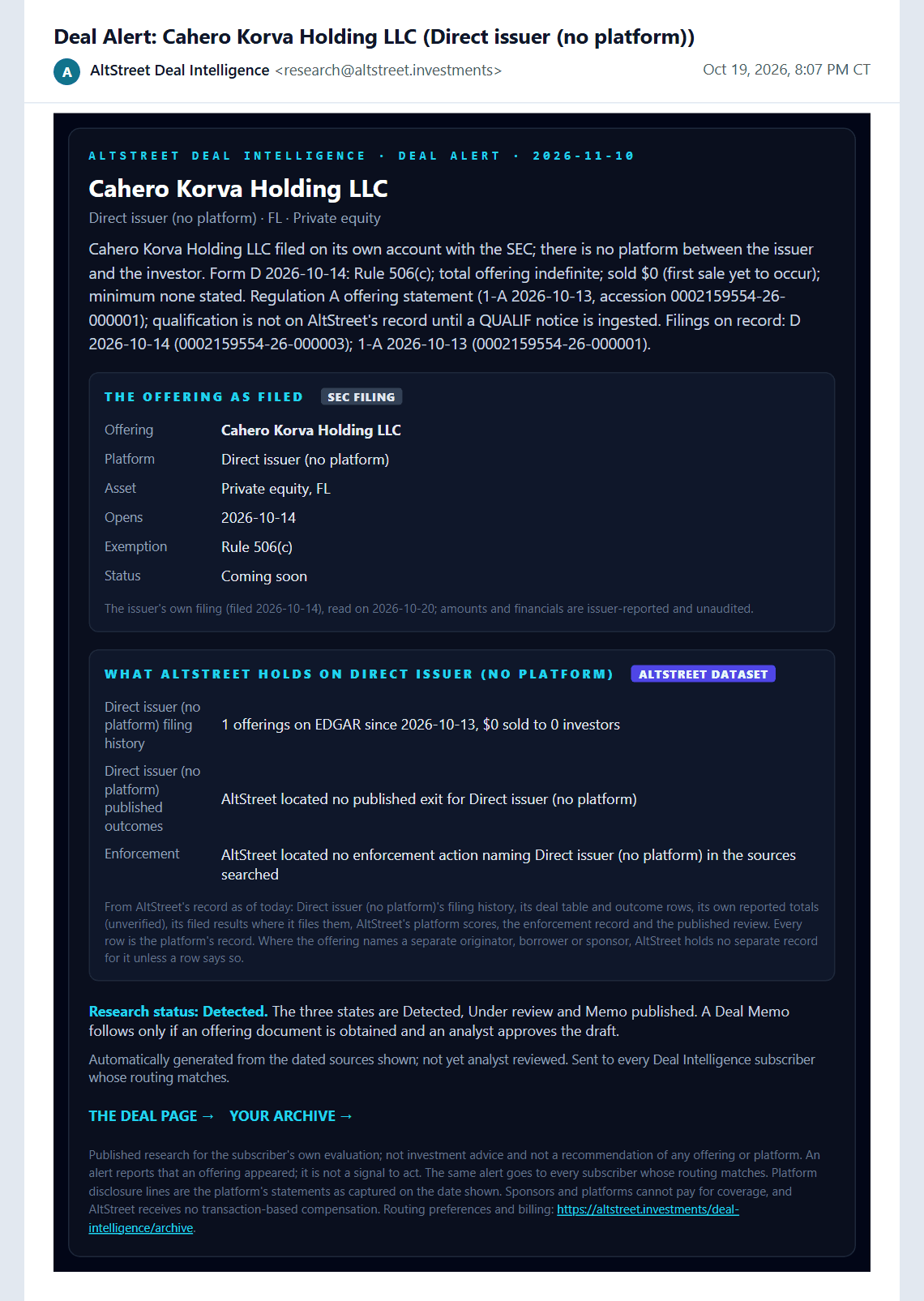
The Deal Alert is one email per deal, sent the day the deal is detected. The top carries the offering as the platform stated it: the name, the asset and location, the target raise, the minimum investment, the structure and the exemption, the launch and close dates where the platform gave them, and the capture time. Each of those lines is marked as the platform's claim, because at this point it is one.
Below it sits the sponsor's record as AltStreet holds it: how many offerings the sponsor's entities have filed and what they reported sold, how long after launch the recent ones filed, the realized exits with their median IRR and hold and the losses named, the fee pattern of the offering documents already on file, the platform review's score and its date, and whether an enforcement action or court record exists for the sponsor or its principals. Each of those lines is marked as AltStreet's dataset, or as a regulatory filing, with the table or the accession named.
The alert does not rate, rank or recommend. It ends with what happens next: whether an offering document is in hand, whether a memo is in production, and which filing AltStreet expects to confirm the raise.
Routing
Each adviser in their lane
Every plan receives every alert. On Adviser plans and above, each seat can set routing preferences by platform, by asset class (farmland, real estate equity, real estate debt, private credit, royalties, pre-IPO) and by minimum check, so an adviser who only fields real estate offerings above $50,000 sees those and nothing else. The archive still holds every alert and every memo for the firm.
Institutional subscribers can take the same alerts by API or webhook into their own pipeline or committee system, and can ask for a platform or a sponsor to be added to detection.
Coverage
Select deals from everything we track
Launch emails, listing pages and the Form D, Regulation A and Regulation CF filings AltStreet ingests; the platforms shown carry a review. Sponsors and platforms cannot pay to be covered.
After the alert
The memo, and the filing that confirms the raise
An alert is the start of coverage, not the end. Once an analyst has the offering document, AltStreet drafts the investment committee memo on its standard framework, runs it through the house rules and the automated quality gate, and an analyst reads, corrects and approves it before it is sent. The memo names the filing it expects, usually the Form D or its amendment; when that filing posts, the archive attaches it to the memo and reports the amount sold and the investor count as of filing. How Form D monitoring works, and what the memo contains.
Questions
Asked the way people search for it
How can I get alerts when new private investment deals launch?
Subscribe to a service that watches the places offerings appear. AltStreet Deal Intelligence reads covered platforms' launch emails and listing pages and the EDGAR filings that open an offering, matches each new deal to the sponsor's existing record, and sends the Deal Alert the same day. Every plan receives every alert; Adviser plans and above can route them by platform, asset class or minimum check.
What is in a private market deal alert?
The offering's stated terms as captured and dated (raise, minimum, structure, exemption, launch and close dates where stated), beside the sponsor's record from AltStreet's data layer: prior Form D filings and amounts sold, published exits and their outcomes, the fee pattern of prior offerings, the platform review score, and any enforcement or court record. Every platform figure is marked as the platform's claim.
How fast does an alert arrive after a deal is listed?
Within hours. Platform email is read on a short cycle through the day, listing scrapers run daily, and the EDGAR lane runs after the SEC's daily index posts. The alert is machine-assembled, which is why it says so; the analyst-approved memo follows separately.
Do alerts cover Reg D, Reg A and Reg CF offerings?
Yes. Reg D offerings on marketplaces are mostly detected from the platform, because the Form D may follow the first sale by up to 15 calendar days. Reg CF offerings are detected from the Form C, which must be filed before the campaign opens, and from the portal. Reg A offerings are detected from the qualified offering statement, the offering circular supplement and the platform listing.
Can I get alerts for only real estate, or only private credit, or only deals above a certain minimum?
On Adviser plans and above, yes. Routing preferences by platform, asset class and minimum check are set on the subscriber's account, and each alert is delivered to the seats whose preferences it matches.
Is a deal alert a recommendation?
No. It is detection and record: what was listed, when, and what AltStreet already holds on the sponsor. It carries no rating, no price and no view on attractiveness. The memo that follows states facts and open questions on a standard framework, and it never recommends either.
Related
Form D alerts and competitor tracking
The 506(c) notices filed before any sale, the filing brief each alert carries, and the tracking lane for the platforms, issuers and names you watch.
ReadInvestment committee memos
The framework, the six verification tiers, and the full sample memo on a live farmland offering.
ReadFamily office due diligence
How Deal Intelligence differs from deal-flow software, and what a committee receives.
ReadAltStreet Deal Intelligence
The product page: alerts, memos, who it is for, plans and pricing.
Plans and pricingThe alert today. The memo while the offering is open.
Read the sample memo to see what follows an alert: a real offering, the real sponsor record, every line marked by what verified it.