
Farmland LP Review 2026: Fund I Preferred Offering, Returns and Risks
Farmland LP is a Bay Area manager of private organic and regenerative farmland funds, and in 2026 it is marketing a 5% preferred offering in its oldest fund to accredited investors at $100,000. The offering is concentrated in two farms, and the public information is not enough to assess how the payments, the conversion and the redemption would be funded.
No platform response on record for this review. Is this your platform? Respond or claim it.
What the data actually shows - TL;DR
A preferred investment concentrated in two farms, from a long-running organic farmland sponsor, whose public information is insufficient to assess payment coverage, conversion economics and redemption funding.
Preferred return: '5.0% simple annual, paid semi-annually (cash or PIK at investor election)' (deck); 'paid in cash every six months until conversion' (website). A stated preferred return, subject to the governing terms and the fund's ability to pay. $100,000 minimum, accredited investors only. Deck: 'Targeting $10M+ by December 31, 2026.'
Redemption date in the deck's term table. The website says 'Hold period of 5-6 years,' which a fixed 2031 date produces for subscriptions in 2026. The deck also calls the offering 'A five-year convertible preferred interest' and gives a '6 Year term'; whether the term runs from subscription, closing or a fixed date needs confirming.
Conversion threshold: '120% of Dec 2025 NAV' (deck). The deck also says 'GP may convert to LP interests when NAV ≥ Conversion Threshold.' Fund I's NAV is not published, and the conversion ratio and treatment of accrued return are not public.
2025 appraisals of Fund I's two farms, against $32.6 million paid (deck): Burns Farm, 4,242 acres, bought December 2012 for $29.5 million, appraised at $87.2 million (about 91%); A2R, 692 acres, bought March 2012 for $3.1 million, appraised at $8.3 million. Fund I's debt is not public, so equity value cannot be derived from these figures.
Fund I's historical net post-tax IRR and multiple for the common equity since 2009, as of December 31, 2025 (deck), partly appraisal-based; calculation and dated cash flows not published. Separately, the deck's target for the preferred is 14% to 16% net IRR over six years, and the sponsor's advisor guide states 12% to 13% for Fund III over ten years.
Fund I farm sales (deck): Fern Road ($0.7 million to $2.1 million), Wattenpaugh ($0.4 million to $1.0 million), Brentwood Creek ($10.6 million to $20.0 million) and Orland (bought in 2018 for $2.8 million, sold for $1.2 million, 0.4x); the deck puts the sold farms at 1.7x in total.
Fund III (Vital Farmland III, LLC): $109,960,527 from 581 investors on its October 2025 Form D/A, sold through Alto Securities, LLC; marketed as a $250 million fund and, per the website, closed in March 2026. Microsoft's Climate Innovation Fund invested in it in 2024.
Sources: farmlandlp.com captured October 16, 2026; the sponsor's Fund I Convertible Preferred Interests deck; SEC EDGAR Form Ds of seven related entities. Fund I's financial statements, debt and fees are not public; appraisal and return figures are the sponsor's.
What's Actually Happening
In plain English, here is what is actually happening.
- 1Farmland LP buys conventional farms, converts them to organic or regenerative farming or to permanent crops like blueberries, and either farms them itself or rents them to farmers.
- 2Its oldest fund, Fund I (2009), owns two farms, most of the value in one large California farm. It wants to raise $10 million or more by the end of 2026 by selling a preferred interest.
- 3You put in at least $100,000 for a stated 5% preferred return, paid twice a year. The deck says you can choose cash or additional interests.
- 4The deck sets the redemption date at December 31, 2031; the website calls that a hold of five to six years.
- 5You can instead convert into the fund's regular units once the fund's value reaches 120% of its December 2025 value; the general partner can also convert at that point. What you would receive depends on terms that are not public.
- 6The fund's debt, fees and financial statements are in the private offering documents, not on the website.
Quick Verdict
Is this platform right for you?
Farmland LP is an established organic farmland sponsor with a working farm operation. The Fund I Preferred Offering offers a stated 5% and a 2031 redemption date on a fund concentrated in two farms, most of the value in Burns Farm.
Read the full assessmentShow less
The fund became EBITDA positive in 2025 by the sponsor's account, and its blueberries are projected to raise cash generation by 2029; its debt, fees and cash position are not public, so payment coverage and redemption funding cannot be assessed from public sources, and the conversion feature cannot be valued without the conversion formula. An accredited investor interested in this sponsor's farms should evaluate the offering on the governing documents and audited statements, which this review does not use.
Best for
- Accredited investors who want exposure to organic and regenerative farmland and to this sponsor specifically
- Investors who can hold to the marketed December 31, 2031 redemption date
- Investors who will review the partnership agreement and audited statements before subscribing
Avoid if
- You need assured income on a fixed schedule
- You may need the money before 2031
- You want public, audited reporting
- You need the target return to be likely rather than possible
Top strengths
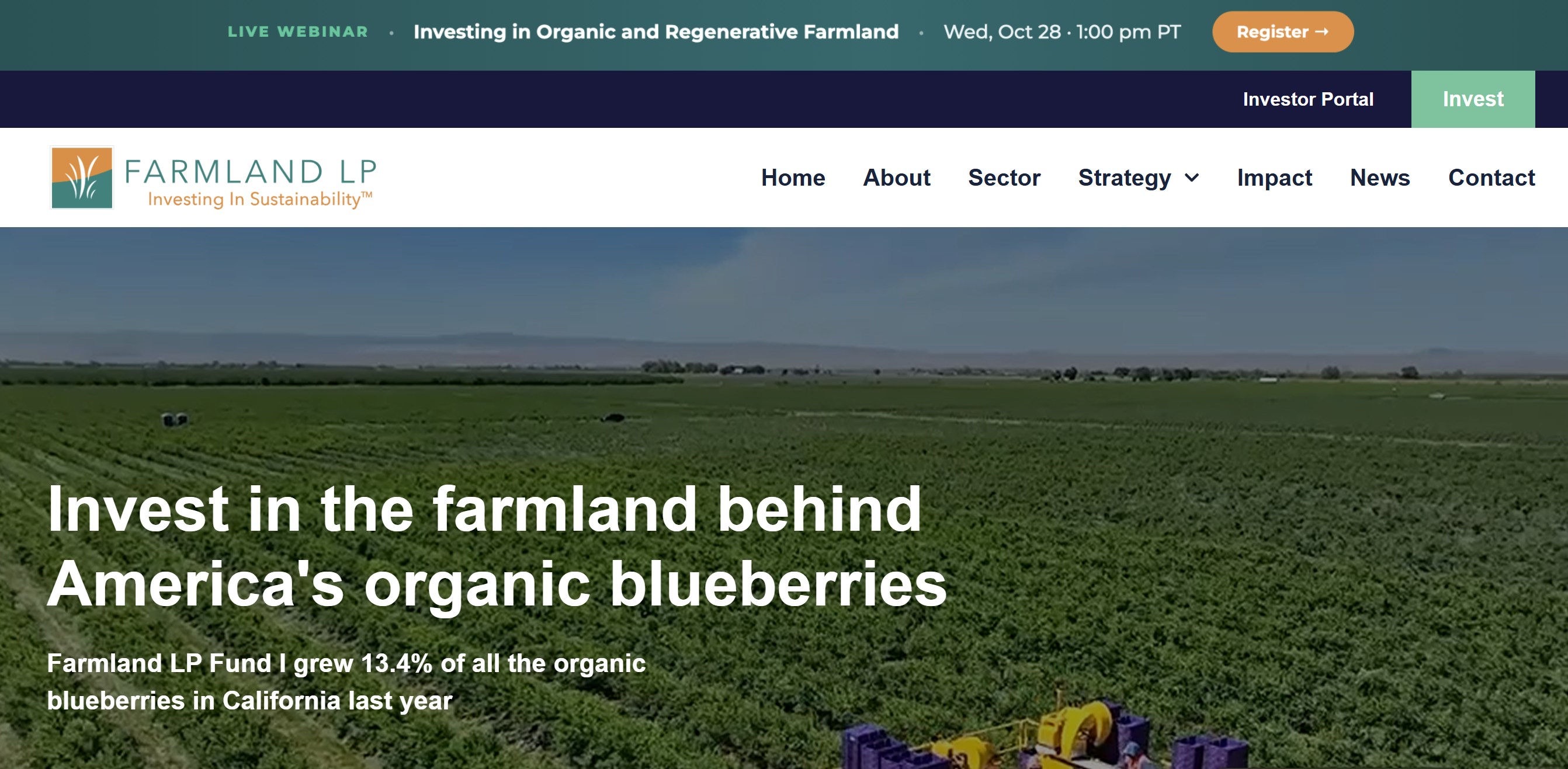
- Seventeen years of operation, three funds and about 19,000 acres; an organic blueberry operation the sponsor says grew 13.4% of California's organic blueberries
- A preferred position with a stated return and a dated redemption, with the cash-or-PIK choice at the investor's election per the deck
- A principal farm the sponsor describes as diversified across 12 crops and 7 tenants
- Institutional investment in Fund III (Microsoft's Climate Innovation Fund), a 2024 Agri Investor Farmland Fund Manager of the Year award, and no SEC, FINRA or state action or federal suit against the sponsor located in AltStreet's scan
Key limitations
- Payment coverage and redemption funding cannot be assessed from public sources
- Value concentrated in one farm, Burns, about 91% of appraisals
- Conversion economics not determinable from the public terms
- Reported fundraising totals not reconciled to the Form D notices AltStreet located
Where It Fits
Where Farmland LP fits relative to the alternatives.
A preferred interest in one manager's existing farmland fund
If you want
A stated 5% with a dated redemption and an option on the fund's appreciation, from a sponsor focused on organic conversion
Use
Farmland LP Fund I Preferred Offering, the instrument this review covers; accredited only, $100,000 minimum, redemption date December 31, 2031
A diversified organic farmland REIT open to everyone
If you want
Many farms, audited public reports and a $10,000 minimum
Use
Amber Farmland Investments, formerly Iroquois Valley (see AltStreet's review): Reg A REIT, board-set price, five-year redemption path
Single-farm investments with an exit at the sale
If you want
To pick one farm and get capital back when it is sold
Use
AcreTrader (see AltStreet's review): accredited investors, one LLC per farm, a published record of realized exits
Listed farmland REITs
If you want
Daily liquidity and public reporting
Use
Gladstone Land (LAND) and Farmland Partners (FPI)
Compare Before Deciding
Where Farmland LP fits against alternatives
Use these hooks to pressure-test whether this is the right platform, or whether a nearby alternative matches the job better.
How this compares to Amber Farmland Investments
Amber Farmland Investments
An organic farmland REIT with audited public reports, open to non-accredited investors at $10,000.
How this compares to AcreTrader
AcreTrader
One LLC per farm for accredited investors, with a published record of realized exits.
How this compares to FarmTogether
FarmTogether
Accredited-only farmland funds and single farms with manager fees.
Overview
Platform Overview
A concise read on what the platform is, how the structure works, and where the practical friction shows up for real investors.
Sponsorship of private farmland funds that acquire conventional farmland in Northern California, Oregon and Washington, convert it to organic, regenerative and permanent-crop production, and farm or lease it; the 2026 offering is a 5% preferred interest in Fund I sold to accredited investors.
Fund I (Vital Farmland LP) bought farms near Corvallis, Oregon from 2010, and in 2012 the 1,114-acre Brentwood Creek Farm in California, the 692-acre A2R farm in Oregon and the 4,200-acre Burns Farm near Tracy, California. A second fund launched in 2014. Fund III (Vital Farmland III, LLC, 2023) bought the 1,186-acre Riverwood Farm in Oregon, three Sacramento Delta ranches for $35.6 million at the 2024 Trinitas bankruptcy auction and, in 2025, a 989-acre orchard joint venture with Stemilt in Washington.
The sponsor reports about $400 million of assets under management and 19,000-plus acres, an investment from Microsoft's Climate Innovation Fund in Fund III, B Corp certification and Agri Investor's 2024 Farmland Fund Manager of the Year award. Mark Chedekel is a related person on the sponsor's Form Ds from 2023.
Platform Model
Fund sponsor and farm operator
Primary Function
Buy conventional farmland, convert it to organic and permanent crops, lease or farm it, and hold for appreciation and cash flow
Target Users
Accredited investors ($100,000 minimum), wealth advisers and RIAs; Fund III also on iCapital's AI Insights and brokerage platforms
Instruments
Fund I Preferred Offering (2026); Fund III LLC interests (closed March 2026 per the website)
Verification Strategy
Rule 506(c) accredited-investor verification (per the Form Ds of the 2014 and later offerings)
Investment Structures
Delaware limited partnership (Fund I) and LLCs (later funds)
ASHow It Works
- The sponsor converts farmland to organic and permanent crops and earns returns from rent, crop income and appreciation
- Preferred holders have a stated 5% paid twice a year, in cash or additional interests at their election, and a redemption date of December 31, 2031 (per the deck)
- Holders may convert into the common class once NAV reaches 120% of December 2025 NAV; the general partner may also convert at that point
- Fund I's NAV, set by the general partner and not published, drives the conversion threshold
Key Gaps & Non-Disclosures
- Fund I's financial statements, debt and fees
- The conversion formula and the treatment of accrued return
- The method behind the return figures
Platform Intelligence
Farmland LP (Vital Farmland) timeline
Key platform events, regulatory turns, liquidity stress points, and product launches that shape how the review should be read.
Farmland LP founded
Craig Wichner launches the first fund; the first Oregon farm near Corvallis follows in 2010.
Fund I's Form D; Brentwood Creek, A2R and Burns
Form D and D/A report $9,847,000 sold to 62 investors under a $100 million Rule 506 offering. Brentwood Creek (February), A2R (March) and the 4,200-acre Burns Farm (December, $29.5 million) are acquired.
Second fund launches
Vital Farmland REIT, LLC files a $250 million Rule 506(c) Form D; $3,224,000 sold to 9 by October. Fast Company names Farmland LP among its most innovative companies.
Blueberry expansion
Fund I begins a 600-acre organic blueberry project at Burns Farm and buys the 87-acre Orland farm (later sold at 0.4x, per the deck).
Fund I adds equity
The deck reports an additional $26 million for Fund I's blueberry expansion; AltStreet did not locate a Form D notice for it.
Fund III launches
Vital Farmland III, LLC files a Rule 506(c) Form D, sold through Alto Securities; Vital Riverwood Farm raises $8,492,000 from 56 investors in March.
Trinitas ranches and Microsoft
Fund III buys three Sacramento Delta ranches (2,625 acres) for $35.6 million at the Trinitas bankruptcy auction; Microsoft's Climate Innovation Fund invests in Fund III.
Fund I EBITDA positive
The deck reports Fund I EBITDA positive in 2025 and a 5.6% net post-tax IRR since inception as of December 31, 2025. Fund III's October Form D/A reports $109,960,527 from 581 investors.
Fund III closes; Fund I preferred marketed
The website says Fund III closed in March 2026 and markets the Fund I Preferred Offering, targeting $10 million or more by December 31, 2026 (deck).
Investment Structures
Fund I Preferred Offering (2026)
Marketed on farmlandlp.com/invest to accredited investors, $100,000 minimum: 'A preferred return paid in cash every six months until conversion,' conversion 'when the value of the fund increases 20% or greater,' 'Hold period of 5-6 years.' The deck adds a 5.0% simple preferred return paid semiannually, cash or PIK at the investor's election, a December 31, 2031 redemption date, a conversion threshold of 120% of the December 2025 NAV, a general-partner right to convert at the threshold and a 14% to 16% target net IRR. No Form D for this offering was located on EDGAR at October 16, 2026.
Fund I existing limited partnership interests
The common class the preferred converts into. The Fund I Form D AltStreet located (2012) reports $9,847,000 sold to 62 investors under a $100,000,000 Rule 506 offering with a $50,000 minimum.
Fund III (Vital Farmland III, LLC) and Vital Riverwood Farm, LLC
Fund III: $109,960,527 sold to 581 investors by its October 2025 Form D/A, $100,000 minimum, sold through Alto Securities; marketed as a $250 million fund with a 12% to 13% net IRR target over ten years; closed in March 2026 per the website. Vital Riverwood Farm, LLC raised $8,492,000 from 56 investors under a March 2023 Rule 506(c) Form D for the 1,186-acre Riverwood farm, which the website lists among Fund III's acquisitions.
Risk
Risk Structure
This is where the marketplace pitch gives way to the actual operating reality: delayed exits, limited disclosure, fee drag, and path-dependent outcomes.
A Portfolio Concentrated in Two Farms
Burns Farm is about 91% of Fund I's appraised value on the deck's figures. The sponsor describes it as spread across 12 crops and 7 tenants; water, location and market exposure remain concentrated.
Payment Coverage Not Publicly Assessable
The fund's debt, fees, cash and audited statements are in confidential documents. The sponsor reports EBITDA turned positive in 2025; that is not a measure of cash available after interest and capital spending.
A General-Partner NAV
The conversion threshold runs off an equity NAV the general partner sets and does not publish.
Terms to Confirm
The deck gives a December 31, 2031 redemption date and describes the offering as both five-year and six-year; the cash election, the conversion formula and any deferral provision are in documents this review does not use.
Payments Not Covered
The 5% is a stated return payable by a fund whose cash generation the sponsor expects to build as blueberries mature by 2029.
Why it matters
If cash generation lags, payment depends on the governing terms, including any deferral provision, and on the fund's other sources of cash.
Mitigation / verification
Confirm whether investors retain an enforceable cash election, and whether any provision permits the fund to defer payment.
Redemption Not Funded on Time
Redeeming the preferred in 2031 requires cash from operations, refinancing or farm sales, and the fund's debt and reserves are not public.
Why it matters
If the fund cannot redeem on time, the holder's remedies are whatever the partnership agreement provides.
Mitigation / verification
Ask what happens if redemption is not paid by the redemption date and how the fund's debt maturities line up with it.
Conversion Outcome Unclear
The public terms give the threshold and a general-partner conversion right, but not the conversion ratio, the treatment of accrued return or the consequences of a general-partner conversion.
Why it matters
Without those terms an investor cannot compare converting with holding to redemption.
Mitigation / verification
Ask for the conversion formula and a worked example at and above the threshold.
Concentration in Burns Farm
Most of Fund I's appraised value is one Northern California farm, and the sponsor's cash-generation plan centers on its blueberries.
Why it matters
Water, crop prices, yields and labor on that property drive the fund.
Mitigation / verification
Ask for Burns Farm's revenue by crop and tenant and its water rights.
Biggest Misconceptions & What Actually Happens
- AltStreet found no SEC, FINRA or state action and no federal suit against Farmland LP, its funds or Mr. Wichner as of October 16, 2026. In the Trinitas Advantaged Agriculture Partners IV Chapter 11 (Bankr. N.D. Cal., 2024) Vital Farmland appears as a winning bidder. State court dockets were not searched directly.
- AltStreet did not locate Form D notices reconciling the sponsor's reported fundraising totals; notices filed under entity names AltStreet did not search would not appear, and state notice filings are separate. A missing Form D does not by itself remove the Rule 506 exemption, though the SEC says a Form D is required, generally within 15 days after the first sale.
- Brentwood Creek is listed among Fund I's sold farms in the deck, and a farm of the same name, with different acreage, appears on the sponsor's impact page. That supports a question, not a conclusion about the buyer.
- The 14% to 16% figure is a target in a marketing deck. Fund I's four farm sales are fund-level transactions, not investor exits.
Regulatory & Legal Posture
Security Status
Unregistered securities sold under Rule 506 of Regulation D to accredited investors
Private placements are exempt from SEC registration and review. Fund I files no periodic reports with the SEC; the Fund I Form D AltStreet located is from 2012, and none for the 2026 preferred offering was located at October 16, 2026.
Disclosure Quality
Public disclosure is a marketing page, a deck and Form D notices. Detailed terms, financial statements, debt and fees are in confidential offering documents, as is usual for private placements; that limits what a public review can assess.
Custody Model
No public information on custody or transfer agency for Fund I interests
Regulatory Backing
Protections are contractual (the partnership agreement); AltStreet found no adviser registration for the sponsor's entities.
Tax Treatment
Reporting
Not stated publicly for this offering
The sponsor's advisor guide says its structure offers '1099 reporting instead of K-1s'; whether that applies to the Fund I preferred is not stated publicly.
Income Character
Preferred return from a farmland partnership; character depends on the instrument's tax treatment
A preferred interest in a partnership can be treated as equity (partnership allocations) or, in some structures, as debt (interest). An investor who elects payment in kind may have taxable income without cash.
Limitation
Confirm the tax treatment and reporting form with the sponsor and a tax adviser.
Special Considerations
- Tax-exempt investors should ask whether fund debt creates unrelated business taxable income
- State filing obligations may follow from farms in California and Oregon
Account Suitability
Taxable
Depends on the reporting form and on whether the investor elects cash or additional interests.
Roth IRA
Possible through a self-directed custodian; confirm UBTI exposure.
Traditional IRA
As for a Roth, with deferral; illiquid until the redemption date.
HSA
Not addressed.
Before You Invest
Get Farmland LP investor insights before you invest
K-1 timing, distribution updates, yield insights, and risk signals for Farmland LP and similar platforms.
- Weekly platform research focused on tax timing and liquidity reality.
- Signals on distributions, risks, and structural tradeoffs before capital is locked up.
- Coverage of adjacent platforms so you can compare better options faster.
Get weekly platform signals
Track fee changes, liquidity updates, risk flags, and adjacent platforms before you invest.
Independent intelligence from AltStreet. No hype. No sponsor spin.
AltStreet Data Layer
What the data actually shows
AltStreet set the sponsor's public materials against each other and against the Form D notices it located.
Concentration in one farm
Burns Farm is $87.2 million of Fund I's $95.5 million in 2025 appraisals, about 91%; the sponsor describes it as 12 crops and 7 tenants.
What this means
The fund's value and cash generation depend chiefly on one property.
Historical record and target are different measures
Fund I: 5.6% net post-tax IRR and 1.5x since 2009 for the common equity (historical, partly appraisal-based). Preferred: 14% to 16% net IRR target over six years. Fund III: 12% to 13% target.
What this means
The historical figure is context for the sponsor's execution, not a test of the preferred's target; the target's cash-flow basis is not public.
Fundraising totals not reconciled to located notices
Reported: $65 million (Fund I) and $135 million (second fund). Located Form D notices: $9.85 million and $3.3 million. Searches by entity name and by related person (Mr. Wichner, Mr. Chedekel) found no fund notices from 2015 to 2022.
What this means
A question for the sponsor; notices under other entity names would not appear in these searches.
Data as of 2026-10-16 . AltStreet review evidence layer . Public-source analysis
Full datasetDecision Fit
Investor Fit
Who this works for, who it does not, and what level of patience and complexity tolerance the platform really demands.
retail
The offering is limited to accredited investors with a $100,000 minimum.
accredited-income
A stated 5% ahead of the common class with an investor cash election, but payment coverage and redemption funding cannot be assessed from public information.
impact-investors
The sponsor's organic and regenerative focus, B Corp status and soil-carbon work fit an impact mandate; the financial terms need the same diligence as any private fund.
institutional
Institutions can negotiate terms and ask for audited statements and the loan agreement before committing.
Tradeoffs
Key Tradeoffs
The attraction of pre-IPO access is real, but every benefit comes bundled with a corresponding liquidity, transparency, or pricing cost.
Preferred Position vs Coverage Unknown
A stated return and dated redemption ahead of the common class; payment coverage not visible publicly.
Diversified Farm vs Concentrated Fund
Burns spans 12 crops and 7 tenants; it is about 91% of the fund's appraised value.
Conversion Upside vs Undisclosed Formula
An option on the fund's appreciation; the ratio and accrued-return treatment are not public.
Established Sponsor vs Unreconciled Totals
Seventeen years and three funds; reported fundraising not reconciled to located Form D notices.
Avoid
Who This Is Not For
This section should be read as a filter, not an afterthought. If you need income, simplicity, or near-term access to capital, the structure is working against you.
Investors Who Need Assured Income
The 5% is a stated return, subject to the governing terms and the fund's ability to pay, which public information does not show.
Investors Who Might Need the Money Before 2031
The deck's redemption date is December 31, 2031, and there is no public market for the interests.
Investors Relying on the 14% to 16% Target
It is a marketing target whose cash-flow basis is not public.
Non-Accredited Investors
The offering is limited to accredited investors.
Editorial View
AltStreet Perspective
The compressed version of the review: what matters, what marketing tends to obscure, and how we would frame the platform for a serious allocator.
Verdict
Farmland LP's farms are real, its team runs them, and its third fund drew institutional money. The Fund I Preferred Offering is a concentrated preferred investment: a stated 5%, a 2031 redemption date and a conversion option on a fund whose value sits mostly in one California farm. From public sources it is not possible to assess whether the fund's cash covers the payments, how the redemption would be funded, or what conversion would deliver. Those answers are in the partnership agreement and the audited statements, which an investor should obtain and read before subscribing.
Positioning
Scores below Amber Farmland (audited public reporting, open to non-accredited investors) and AcreTrader (single-farm LLCs with a long realized exit record), largely because far less of this offering is public.
The Bottom Line
A preferred investment concentrated in two farms, from an established organic sponsor, whose public information is insufficient to assess payment coverage, conversion economics and redemption funding.
Action
Next Steps
If you still want to engage after reading the review, these are the practical next moves that reduce avoidable mistakes.
Request the partnership agreement and confirm the cash election, any deferral provision, when the term runs from, the conversion formula and the general partner's conversion right.
Request Fund I's audited financial statements for 2024 and 2025, its debt terms and maturities, its fee schedule and its December 2025 NAV.
Ask how the preferred's projected cash flows produce 14% to 16%, and for the dated cash flows behind Fund I's 5.6% and 1.5x.
Ask who bought Fund I's Brentwood Creek, when, and how the price was set.
Ask which entities and Form D notices cover the capital raised for Funds I and II.
Final Answer
What this means for your decision.
Finding
Public information is not enough to assess how the 5% and the redemption would be paid
Meaning
The 5% is a stated preferred return, subject to the governing terms and the fund's ability to pay. Fund I's debt, cash position, fees and audited statements are not public. The deck says the fund became 'EBITDA positive in 2025' and that 'blueberry maturity by 2029 will boost cash flow, shifting returns from land appreciation to cash.' EBITDA is earnings before interest, taxes, depreciation and amortization; it does not show the cash left after interest, capital spending and working capital. Whether the fund can fund the semiannual payments and the redemption is the central question, and it cannot be answered from public sources.
Action
Ask for Fund I's audited statements, total debt, lender and maturities, the fees the preferred bears, and the planned sources of cash for the semiannual payments and the redemption.
Finding
The offering is a portfolio concentrated in two farms
Meaning
Fund I owns Burns Farm in California (4,242 acres) and A2R in Oregon (692 acres), bought for $32.6 million and appraised at $95.5 million in 2025, per the deck. Burns is about 91% of that appraised value. The sponsor's website describes Burns as diversified within itself: 2,910 acres certified organic and in permanent crops, 12 crops and 7 farming tenants, with a 600-acre organic blueberry planting begun in 2018. Geographic, water and crop-market exposure still concentrates in one Northern California property.
Action
Ask for Burns Farm's revenue by crop and tenant, its water position and the blueberry yield ramp.
Finding
The conversion feature cannot be valued from the public terms
Meaning
The deck sets the conversion threshold at '120% of Dec 2025 NAV' and says 'GP may convert to LP interests when NAV ≥ Conversion Threshold'; the website says the interest 'converts to partnership interest when the value of the fund increases 20% or greater.' The threshold alone does not establish the payoff. That depends on the conversion ratio, how accrued preferred return is treated, the redemption amount, timing, and what follows a general-partner-triggered conversion. Fund I's NAV is not published, and a 20% rise in the fund's equity value is not the same as a 20% rise in farm values: debt, operating results, distributions and new capital all move equity NAV.
Action
Ask for the conversion formula, the treatment of accrued return on conversion, the consequences of a general-partner conversion, and Fund I's December 2025 NAV.
Finding
The fund's past record and the preferred's target measure different things
Meaning
The deck reports Fund I's historical result since 2009 as '5.6% net post-tax IRR and 1.5x post-tax MOIC as of 12/31/2025' and targets '14-16% target net IRR over a 6-year hold' for the preferred. The first is a historical, post-tax figure for the common equity, partly based on appraised rather than realized values; the second is a prospective target for a new preferred security, with 'net' undefined. The historical figure is context for judging the sponsor's execution, not a test of the target. Interpreting the 5.6% and 1.5x also needs the contribution and distribution dates behind them.
Action
Ask how the preferred's projected cash flows produce 14% to 16%, what 'net' means, and for the dated cash flows behind Fund I's 5.6% and 1.5x.
Finding
AltStreet did not locate Form D notices reconciling the sponsor's reported fundraising totals
Meaning
The website says the first fund 'raised $65 million' and the second 'raised $135 million'; the deck gives Fund I about $35 million from 2009 to 2014 plus $26 million in 2022. The Form Ds AltStreet located show $9,847,000 for Fund I (2012) and, for Vital Farmland REIT, LLC, $3,224,000 (2014) and $100,000 (2025). AltStreet searched EDGAR by entity name and searched its Form D related-persons data, loaded from the SEC's quarterly data sets for 2012 and 2014 to 2026, for filings naming Craig Wichner or Mark Chedekel; for 2015 to 2022 the only hits were two 2016 notices of the sponsor itself. Notices filed under other entity names would not appear in that search. A missing Form D does not by itself make the Rule 506 exemption unavailable, but the SEC says a Form D is required, generally within 15 days after the first sale.
Action
Ask the sponsor which entities and Form D notices cover the capital raised for Funds I and II.
If you read nothing else
Farmland LP has a real operating business: three funds, about 19,000 acres, an organic blueberry operation it says grew 13.4% of California's organic blueberries, institutional money in its third fund and a seventeen-year history. The Fund I Preferred Offering is a concentrated preferred investment, and the public information is insufficient to assess payment coverage, conversion economics and redemption funding. That is a limit of public disclosure, not a finding against the offering. It suits an accredited investor who wants this sponsor's farms, can hold to the marketed 2031 redemption date, and gets the governing terms and audited statements first.
AltStreet Research Desk
About to invest in Farmland LP, or in an offering we haven't covered?
Commission an independent diligence report: the same filing-based analysis behind this review, applied to the specific investment in front of you before you wire the money.
- Built from primary sources: SEC filings, court records, capital structure, and marketing-versus-filings comparison.
- From $750; full reports from $1,495. Fixed price confirmed up front, delivery in 3-5 business days.
- Independent by design: we work for investors and accept no compensation from the companies we cover.
Want this on every new deal, not one? Deal Intelligence sends the alert the day a new offering appears on a covered platform and follows with an analyst-approved investment committee memo.
Deal Intelligence →Appendix
Sources, Disclosures, and Supporting Context
The lower section is structured like a report appendix: relationship context first, adjacent reading second, and evidence last.
Report Appendix
Disclosure
Relationship and compensation context
+
Report Appendix
Disclosure
Relationship and compensation context
Report Appendix
Comparison Guides
Head-to-head guides featuring Farmland LP
+
Report Appendix
Comparison Guides
Head-to-head guides featuring Farmland LP
Report Appendix
Related Resources
Adjacent platform comparisons, frameworks, and category links
+
Report Appendix
Related Resources
Adjacent platform comparisons, frameworks, and category links
Further Reading
Related Resources
Adjacent frameworks and reviews that help place the platform in a broader allocation or due-diligence context.
Fund Landscape
Similar Platform Reviews
- Amber Farmland Investments
An organic farmland REIT with audited public reports, open to non-accredited investors at $10,000.
- AcreTrader
One LLC per farm for accredited investors, with a published record of realized exits.
- FarmTogether
Accredited-only farmland funds and single farms with manager fees.
Report Appendix
Tracked Offerings
6 Farmland LP offerings with disclosed terms in the AltStreet database
+
Report Appendix
Tracked Offerings
6 Farmland LP offerings with disclosed terms in the AltStreet database
- Vital Farmland, L.P. Fund I Preferred Offering (Rule 506(c), 2026)CA, OR
- Vital Farmland REIT, LLC pooled fund interests, 2025 Rule 506(c) notice
- Vital Farmland III, LLC (Fund III), 2023 Rule 506(c) offering
- Vital Riverwood Farm, LLC, 2023 Rule 506(c) offering
- Vital Farmland REIT, LLC equity, 2014 Rule 506(c) offering
- Vital Farmland LP limited partnership interests (Fund I), 2012 Rule 506 offering
Report Appendix
SEC Filers Behind Farmland LP
The largest issuers linked to Farmland LP on EDGAR, by total reported sold; each page carries the filing record and the related persons
+
Report Appendix
SEC Filers Behind Farmland LP
The largest issuers linked to Farmland LP on EDGAR, by total reported sold; each page carries the filing record and the related persons
- Vital Farmland III, LLC2025 · $110M · 581 investors
- Vital Farmland REIT, LLC2014 · $100K · 1 investors
Report Appendix
Evidence & Methodology
1 cited passages on file; sources, scope, and how the review was assembled
+
Report Appendix
Evidence & Methodology
1 cited passages on file; sources, scope, and how the review was assembled
Evidence on file
1 supporting passage on file for Farmland LP and its offerings from 1 source document, 1 verified by an analyst through 2026-10-16, 1 discrepancy flagged. Each passage records the metric it supports, the value read from the document, the page, and the verbatim text where the document has it. Terminal subscribers read the passages; open them in the terminal.
- Cited passages
- 1
- Source documents
- 1
- Analyst verified
- 1
- Discrepancies flagged
- 1
Latest analyst verification 2026-10-16; latest extraction 2026-10-16. A discrepancy is a disagreement between two sources, or between a document and a marketing claim, recorded rather than resolved silently.
ASReview Evidence
Methodology
Four public sources: (1) farmlandlp.com captured October 16, 2026 (124 pages); (2) the sponsor's Fund I Convertible Preferred Interests deck; (3) SEC EDGAR Form D filings of seven related entities and AltStreet's Form D ledger and related-persons data from the SEC's quarterly data sets; (4) a legal scan the same day (CourtListener, SEC IAPD, general searches).
Scope
Public materials and filings only. The offering's private placement memorandum and summary of key terms are confidential and were not used; Fund I's financial statements, partnership agreement and debt terms are not public. Form D searches cover the entities named above and filings naming Mr. Wichner or Mr. Chedekel; notices under other names would not appear. State court dockets were not searched directly.
Key Findings
- *Payout (deck p. 8): '5.0% simple annual, paid semi-annually (cash or PIK at investor election)'; (website): 'A preferred return paid in cash every six months until conversion.'
- *Term (deck p. 8): 'Redemption Date December 31, 2031 (with conversion)'; (deck p. 7): 'A five-year convertible preferred interest in Fund I' and '6 Year term with conversion option'; (website): 'Hold period of 5-6 years.'
- *Conversion (deck p. 8): 'Conversion Threshold 120% of Dec 2025 NAV'; 'GP may convert to LP interests when NAV ≥ Conversion Threshold.'
- *Cash profile (deck p. 3): 'EBITDA positive in 2025 and blueberry maturity by 2029 will boost cash flow, shifting returns from land appreciation to cash.'
- *Fund I capital (deck p. 3): 'Raised ~$35M in equity (2009-2014) and an additional $26M completed in 2022 for organic blueberry expansion'; 'Thirty-year fund (6-year lockup period) ends in 2039.'
- *Brentwood Creek: deck p. 4 sold-farms table 'Brentwood Creek incl. Adobe Addition, CA, 1,566, 3/1/2012, $10.6, $20.0, 1.9'; impact page 'Brentwood Creek California · almonds · 762 acres ... Baseline set in 2025.'
- *IAPD search 2026-10-16: no record for Vital Farmland, Farmland LP or their related entities.
- *Legal scan (2026-10-16): no SEC, FINRA, state action or federal suit naming the sponsor, its funds or Mr. Wichner located; Vital Farmland appears as a buyer in the Trinitas Chapter 11 (Bankr. N.D. Cal. 24-50211).
AltStreet Data Layer
AltStreet read of the sponsor's public materials, seven EDGAR entities and the legal record (2026-10-16)
AltStreet's dataset holds six offering records (the 2026 preferred and five Form D offerings from 2012 to 2025), five filing snapshots and the sponsor's deck and 14 EDGAR filings on the document pipeline. There is no performance history: no Farmland LP entity files annual or semiannual reports with the SEC.
- Preferred: 5% stated, semiannual, cash or PIK at investor election · redemption December 31, 2031 · conversion threshold 120% of December 2025 NAV
- Fund I: 2 farms, 4,934 acres · $95.5M 2025 appraisals on $32.6M cost · Burns about 91%
- Fund I historical: 5.6% net post-tax IRR, 1.5x since 2009 (deck)
- Fund III: $110.0M from 581 investors (Form D, October 2025)
- Form D notices located for Funds I and II: $9.85M and $3.3M, against reported totals of $65M and $135M
Source: farmlandlp.com capture + sponsor deck + SEC EDGAR (7 CIKs) + legal scan, October 16, 2026
Primary Source Pages
Comparable Platforms
- Amber Farmland Investments
Audited public Reg A REIT of organic farms, $10,000 minimum.
- AcreTrader
Single-farm LLCs with a published realized exit record.
- FarmTogether
Accredited farmland funds and farms with manager fees.
FAQ
Frequently Asked Questions
High-intent search questions answered directly, without making users hunt through the full review.
What is Farmland LP?
A Larkspur, California manager of private farmland funds, founded in 2009 by Craig Wichner, that converts conventional farmland to organic, regenerative and permanent-crop production in Northern California, Oregon and Washington. Its funds include Vital Farmland LP (Fund I) and Vital Farmland III, LLC (Fund III).
Is Farmland LP a good investment?
That cannot be judged from public information alone. The Fund I Preferred Offering offers a stated 5% return, a December 31, 2031 redemption date and a conversion option, on a fund concentrated in two farms. Its debt, fees, cash position and the conversion formula are in confidential offering documents, so payment coverage, conversion economics and redemption funding have to be assessed from those documents and the fund's audited statements.
Who can invest in Farmland LP, and what is the minimum?
Only accredited investors. The Fund I Preferred Offering's minimum is $100,000, per the sponsor's website.
How does the Fund I preferred offering work?
Per the sponsor's materials, the preferred carries a stated 5% simple return paid twice a year, in cash or additional interests at the investor's election, and a redemption date of December 31, 2031. Holders may convert into Fund I's regular partnership interests once the fund's value reaches 120% of its December 2025 NAV, and the general partner may also convert at that point. The conversion ratio and the treatment of accrued return are not public.
Is the 5% paid in cash?
The website says 'paid in cash every six months until conversion'; the deck says 'cash or PIK at investor election.' Confirm in the partnership agreement that investors retain an enforceable cash election and whether any provision permits the fund to defer payment.
What returns has Farmland LP produced?
The sponsor's deck reports a 5.6% net post-tax IRR and 1.5x multiple for Fund I's common equity since 2009, as of December 31, 2025, mostly from land appreciation and partly appraisal-based. That is a historical figure for a different instrument from the new preferred, whose deck target is 14% to 16% net IRR; the sponsor's stated target for Fund III is 12% to 13%.
When can I get my money back?
The deck sets a redemption date of December 31, 2031, which the website describes as a five-to-six-year hold. Whether the fund can pay at that date, what happens if it cannot, and whether the term runs from that fixed date or from subscription are set by terms not public. There is no public market for the interests.
Is Farmland LP regulated by the SEC?
Its offerings are exempt private placements under Rule 506; they are not registered or reviewed by the SEC. Fund I files no periodic reports, AltStreet found no adviser registration for the sponsor's entities, and it found no SEC, FINRA or state action against the sponsor as of October 16, 2026.
How does Farmland LP compare with Amber Farmland and AcreTrader?
Amber Farmland (formerly Iroquois Valley) is an organic farmland REIT with audited public reports, open to non-accredited investors at $10,000. AcreTrader sells single-farm LLCs to accredited investors and has a long published record of realized exits. Farmland LP sells private fund interests to accredited investors at $100,000 with no public financial reporting, and its value-add strategy concentrates each fund in a few large farms.