
Mainvest Review 2026: What Happened, and What the SEC Filings Show
Mainvest ceased operations on June 14, 2024, 53 days after its banking partner Synapse filed for Chapter 11. Synapse was the trigger. The vulnerability was already on file: the operator's own Regulation Crowdfunding filing in November 2022 disclosed 2.5 months of runway and a going-concern paragraph, and none of the 779 offerings it hosted carried any arrangement for servicing revenue-sharing notes if the portal stopped. AltStreet reconstructed the full SEC record and the site's own marketing claims to answer the question that outlives the platform: what investors can learn from the first major failure of a revenue-sharing crowdfunding portal, and what its 30,000 note holders still own.
No platform response on record for this review. Is this your platform? Respond or claim it.
What the data actually shows - TL;DR
Mainvest hosted 779 Regulation Crowdfunding offerings under a single portal CIK between October 2018 and early 2024, and the 409 with a progress filing report $33.5 million raised. It charged investors nothing and issuers a fee that started at a flat 6% and ended at 9% on out-of-network money.
Read the full assessmentShow less
It ceased operations on June 14, 2024 after the Synapse bankruptcy froze its wallets, with about $2.4 million of user funds caught in the estate and no servicer for the notes outstanding. The filing record adds what the news coverage lacked: the operator's own going-concern disclosure 18 months earlier, a 47% withdrawal rate, annual reports from 17 issuers, and marketing claims no filing ever supported.
Distinct Reg CF offerings under MainVest, Inc. (CIK 0001746059), by first filing year: 7 (2018), 57, 154, 240 (2021 peak), 148, 137, 36 (2024). Status at last filing: 379 funded, 365 withdrawn, 13 reporting, 9 terminated, 9 in progress, 4 dark.
Reported raised across the 409 offerings with a Form C-U observation (median $57,400, max $1,235,000), against 365 Form C-W withdrawals. Consistent with the company's own '$30 million' claim, and with a listing book roughly twice the funded one.
Issuer fee, read from twelve sampled Form C filings: a flat 6% of the final offering amount in 2019 to 2021; 3% on issuer-introduced investors and 9% on all others from 2022; 4.5% on in-network users and 9% on all others in 2023 to 2024. Investors paid no fee.
Runway the operator disclosed in its own November 2022 Form C on Republic: cash of $205,000 at October 31, 2022, a $2,081,237 fiscal-year loss, and a substantial-doubt going-concern paragraph. The raise closed at about $386,000 from 282 investors.
Mainvest ceased operations 53 days after Synapse's Chapter 11 filing. Roughly $2.4 million of user funds were frozen. The Synapse case was dismissed on November 14, 2025 with up to $95 million in customer shortfalls unresolved.
AltStreet SEC Form C census of the MainVest, Inc. portal CIK (779 offerings, 2018 to 2025), Mainvest Holdings Corp Form D and Republic Form C filings, a twelve-filing compensation-clause sample, Wayback Machine captures of mainvest.com, and contemporaneous wind-down reporting. September 2026.
AltStreet Weekly
Track the issuers still filing after Mainvest
AltStreet reconstructed all 779 Mainvest offerings from the portal's EDGAR record and watches every issuer CIK for new C-AR and C-TR filings. Get notified when a business you lent to files.
Free during beta. Filing-grounded data, no platform marketing.
What's Actually Happening
In plain English, here is what happened.
- 1From 2018 to 2024, Mainvest let anyone lend to a local business, usually a restaurant, bar, brewery or cafe, from $100, in exchange for a share of that business's revenue each quarter until the investor had received a set multiple, typically 1.5x.
- 2Investors paid Mainvest nothing. The business paid Mainvest a percentage of what it raised, a flat 6% at first and later up to 9% on money from Mainvest's own investor base.
- 3Mainvest ran on venture money and, in late 2022, on a crowdfunding raise of its own on Republic. That filing showed the company losing about $2 million a year with a few months of cash left.
- 4In April 2024 Synapse, the fintech between Mainvest and its banks, filed for bankruptcy. Mainvest wallets froze, and the company announced on May 17 that it would shut down. It ceased operations on June 14, 2024.
- 5The notes still exist and each business still owes its investors. But nobody collects or pays on their behalf, and about $2.4 million that sat in Mainvest wallets went into the Synapse estate, whose bankruptcy case was dismissed in November 2025 with up to $95 million of customer money unresolved.
Quick Verdict
Is this platform right for you?
Mainvest is not a platform anyone can invest on today. This review is for two readers: investors still holding its notes, and investors weighing the revenue-sharing and small-business debt portals that replaced it.
Read the full assessmentShow less
On the record, Mainvest was a genuine and large experiment in community lending with real per-deal disclosure and no investor-side fee. It was also a venture-stage servicer of a decade of quarterly payments, dependent on one fintech intermediary, with a going-concern doubt on its own filings from 2022 and no plan for the notes if it stopped. Synapse's failure was the trigger. The structure was the vulnerability.
Best for
- Investors who hold Mainvest notes and need to understand what they still own and who owes it to them
- Investors evaluating revenue-sharing or small-business debt portals and wanting the category's one documented portal failure
- Researchers working from the filing record rather than the company's own statistics
Avoid if
- You are looking for a place to invest: Mainvest accepts no investments or repayments
- You expect a recovery timeline for frozen wallet funds: none has been published
- You want repayment performance data on the notes: none exists, in the filings or anywhere else
Top strengths
- Scale verifiable from primary filings and consistent with the company's claims
- No investor-side fee, a $100 minimum, and per-offering note terms stated plainly in each Form C
- The all-or-nothing Reg CF structure returned commitments on every withdrawn offering
Key limitations
- Ceased operations with no successor servicer; issuers were told to continue repayments themselves
- User funds frozen in the Synapse estate, unresolved after the case's dismissal
- No repayment data ever published, annual reports from almost no issuers, and a going-concern doubt on the operator's own filing
Where It Fits
Where Mainvest sat relative to the alternatives, and what replaced it.
Revenue-sharing notes on Main Street businesses
If you want
Lend to a local restaurant or brewery at $100 and share in its revenue until a set multiple
Use
Mainvest (ceased June 2024). The instrument survives on other Reg CF portals; the venue does not.
Fixed-rate small-business debt, still operating
If you want
The same borrower base with a fixed coupon, amortizing repayment and per-deal collateral disclosure
Use
Honeycomb Credit, a Reg CF portal with 1,109 filed offerings and a published fee schedule
Diversified retail debt with published performance
If you want
Retail notes where the platform originates, services and publishes loan-level repayment history
Use
Groundfloor, short-term real estate notes with a full performance record
Compare Before Deciding
How Mainvest compares
Mainvest is gone; these are the venues an investor drawn to it would weigh now, and the one it raised its own money on. Take the same questions to each.
Same borrowers, fixed notes, still operating
Honeycomb Credit
Reg CF loans to restaurants, breweries and Main Street retail with per-deal collateral disclosure and a published fee schedule, plus an investor-side fee and the same missing repayment data.
Where Mainvest raised its last round
Republic
The portal that hosted Mainvest Holdings Corp's November 2022 Crowd SAFE, whose Form C disclosed the going-concern doubt this review reads as the earliest public warning.
The servicing-continuity benchmark
Groundfloor
Retail debt where the platform originates, services and publishes loan-level performance on its own notes, the model whose absence stranded Mainvest's book.
Quick Answers
What most investors want to know first
The highest-signal facts first: minimums, liquidity reality, K-1 timing, and whether distributions are actually part of the experience.
Minimum
$100
Liquidity
No secondary market, transfer facility or redemption existed while Mainvest operated, and there is no venue for an unserviced revenue-share note on a small private business now.
K-1 Timing
No K-1s. Tax documents were delivered electronically while the platform operated; none have been issued since June 2024.
Distributions
Under the template terms, revenue sharing began on the 365th day after the offering deadline, with the first payment on the last day of the calendar quarter ending not less than 90 days after that, and continued quarterly until the maximum payment multiple was reached or the payment deadline passed.
Overview
Platform Overview
A concise read on what the platform is, how the structure works, and where the practical friction shows up for real investors.
Regulation Crowdfunding funding portal for small-business revenue-sharing notes, operated by MainVest, Inc. (Salem, Massachusetts; SEC file 007-00162; FINRA CRD 298384), a wholly owned subsidiary of Mainvest Holdings Corp. From October 2018 until it ceased operations on June 14, 2024, the portal listed 779 Form C offerings, overwhelmingly from restaurants, bars, breweries, cafes and other brick-and-mortar businesses, open to all investors at a $100 minimum under Section 4(a)(6). The typical security was an unsecured, subordinated revenue-sharing note paying a stated percentage of gross revenue quarterly until a maximum payment multiple was reached. Investors paid no fee; issuers paid Mainvest a percentage of the raise, only on a successful close.
Funds and repayments moved through Mainvest wallets on Synapse's banking-as-a-service rails. No secondary market existed, no repayment ledger was published, and the portal's registration was never withdrawn.
Offerings were Regulation Crowdfunding securities with a Form C behind each one. Funds and repayments moved through a Mainvest wallet on Synapse's rails. There was no secondary market and transfer required the issuer's consent. Since June 14, 2024 the notes remain obligations of each business, but nothing collects or distributes on them.
Operating Status
Ceased operations June 14, 2024; repayments through the portal accepted only until May 22, 2024
Minimum Investment
$100
Investor Eligibility
All investors (Regulation Crowdfunding); non-accredited subject to Reg CF annual limits
Instrument
Revenue-sharing notes: unsecured, subordinated, quarterly payments of a stated share of gross revenue until a maximum payment multiple; a minority of offerings sold equity units
Example Terms (701 Ops, 2021)
Revenue share 1.5% to 6.0% sliding with amount raised · 1.5x maximum multiple · payment deadline 2031-01-01 · sharing from day 365 after the offering deadline · 0.56% accrual rate · subordinated · unsecured
Investor Fees
None
Issuer Fees
6% of the final offering amount (2019 to 2021) · 3% issuer-introduced / 9% other investors (2022) · 4.5% in-network / 9% other investors (2023 to 2024) · paid only on a successful close
Liquidity
None: no secondary market; transfer required issuer consent and was subject to a right of first refusal
Regulatory Status
MainVest, Inc.: SEC-registered funding portal (file 007-00162), FINRA member (CRD 298384); no CFPORTAL-W found; still listed by FINRA August 2026
Operator
Mainvest Holdings Corp (Delaware, formed March 19, 2018; Salem, MA; CEO Nicholas Mathews); Series Seed $3.6M (2019), Series Seed 2 $2.75M (2021), SAFEs $450K (2022), Republic Reg CF ~$386K (closed January 3, 2023)
Visual Summary
Mainvest vs. the Portals That Remain
How Mainvest's structure compared with the small-business debt venues still operating, and with Republic, where Mainvest raised its own last round.
Status
Mainvest
ceased June 14, 2024
Honeycomb
operating
Republic
operating
Groundfloor
operating
What you bought
Mainvest
revenue-sharing notes on local businesses
Honeycomb
fixed-rate amortizing loans to local businesses
Republic
mostly startup Crowd SAFEs
Groundfloor
short-term real estate debt notes
Investor fees
Mainvest
none
Honeycomb
3% ACH capped $75, 5.5% + $2 card
Republic
varies by offering
Groundfloor
none
Issuer fees
Mainvest
6% flat, later 3% to 4.5% in-network / 9% other
Honeycomb
$500 posting + up to 8.5% origination
Republic
~2% cash + 1% securities on Mainvest's own raise
Groundfloor
n/a (platform originates)
Performance disclosure
Mainvest
none
Honeycomb
none at loan level
Republic
none
Groundfloor
full loan-level repayment and default history
Servicing continuity
Mainvest
none; issuers told to pay investors directly
Honeycomb
none disclosed
Republic
none disclosed
Groundfloor
platform is the originator and servicer
ASEconomic Positioning
- Mainvest's median reported raise of $57,400 at a 6% to 9% fee generated roughly $3,000 to $5,000 per funded offering. Across 379 funded offerings over five and a half years, that is on the order of $1.5 million to $2 million of lifetime origination revenue against $2.2 million of operating expenses in fiscal 2022 alone. The unit economics required venture funding to survive, and the filings show exactly that.
- The 2022 fee change was a pricing decision about distribution: charging 9% on money from the platform's own investor base and 3% to 4.5% on money the issuer brought meant the portal was monetizing its investor network rather than its listing service, in the same year its losses were disclosed.
- The revenue-share structure made the platform's servicing role heavier, not lighter, than a fixed note would. Each quarterly payment depended on the issuer reporting revenue and the portal computing, tracking and distributing the share. That operational dependence is why the closure left the notes stranded rather than merely inconvenienced.
Key Gaps & Non-Disclosures
- No repayment ledger at any level of aggregation, before or after closure.
- No substantiation for the default-rate, on-track or closure-rate claims.
- No disposition of the roughly $2.4 million of user funds frozen in May 2024.
- No successor servicer, escrow or collection arrangement for outstanding notes.
Platform Intelligence
Mainvest Milestones (AltStreet filing-tracked)
Key platform events, regulatory turns, liquidity stress points, and product launches that shape how the review should be read.
Portal registered; first offerings
Mainvest Holdings Corp and MainVest, Inc. formed in Delaware (March 19, 2018). Form CFPORTAL filed July 24, 2018. First Form C under the portal CIK filed October 24, 2018.
Series Seed and a 6% fee
Form D reports $3,576,742 sold to 35 investors. Sampled Form C filings disclose a flat 6% of the final offering amount, paid only on a successful close.
Peak year: 240 offerings, $9.4 million reported raised
Series Seed 2 of $2.75 million closes in February. Listings peak at 240, with 110 withdrawn. The operator's later Form C would report a $2,541,662 net loss for the fiscal year ended June 30, 2021.
Fee restructured; operator raises on Republic with a going-concern paragraph
Compensation clauses move to 3% on issuer-introduced investors and 9% on all others. On November 3, Mainvest Holdings Corp files a Reg CF Form C on Republic disclosing a $2,081,237 fiscal 2022 loss, cash of $205,000 described as 2.5 months of runway, and a substantial-doubt paragraph in the reviewer's report. The homepage advertises 10-25% target returns and a 96% on-track repayment rate.
Republic raise closes; last full year of listings
The Crowd SAFE closes January 3, 2023 at about $386,000 from 282 investors against a $1,235,000 maximum. Fee moves to 4.5% in-network / 9% other. The on-track statistic disappears from the homepage. No operator annual report is filed for fiscal 2023.
Synapse files for Chapter 11
Synapse Financial Technologies, the banking-as-a-service intermediary behind Mainvest wallets, files April 22, 2024. Evolve Bank freezes payment processing for Synapse clients in May. Only 36 offerings had been listed in 2024.
Mainvest ceases operations
Closure announced May 17, 2024, citing the Synapse bankruptcy as the catalyst. Repayments accepted through May 22; site dark June 12; operations cease June 14. Roughly $2.4 million of user funds frozen; Lawyers for Civil Rights writes to FINRA and the FDIC on behalf of affected Massachusetts businesses. Issuers told they remain responsible for repayments.
Synapse case dismissed; issuers file their own terminations
Judge Martin Barash dismisses the Synapse Chapter 11 case on November 14, 2025, with up to $95 million in end-user shortfalls unresolved. Eight Mainvest issuers file Form C-TR terminations during 2025; four file annual reports.
AltStreet census
779 offerings reconstructed from the portal CIK. FINRA still lists MainVest, Inc. as a funding portal; no CFPORTAL-W and no enforcement action found.
Mental Model
How Mainvest worked, and where it broke.
A Main Street business filed a Form C through the MainVest, Inc. portal
The issuer set a target and a maximum and offered revenue-sharing notes: unsecured, subordinated, with a revenue percentage that in some offerings slid upward with the amount raised and a maximum payment multiple of 1.5x. Mainvest earned its fee only if the offering closed.
Investors committed from $100 through a Mainvest wallet
Funds moved through Synapse, a banking-as-a-service intermediary, into accounts at partner banks. If the campaign missed its target, commitments were returned. If it closed, the business paid Mainvest and took the proceeds.
The business shared revenue quarterly, through the same wallet
Sharing typically began a year after the offering deadline and continued until the multiple was reached or the payment deadline, a decade out in the offering read, arrived. Mainvest collected from the business, split payments across investors, and issued tax documents.
The rails failed, and the portal had no reserve to outlast them
Synapse filed for Chapter 11 on April 22, 2024. Evolve Bank froze payment processing for Synapse clients, Mainvest wallets locked, and a company that had disclosed 2.5 months of runway announced its closure within weeks. No successor servicer was named.
Investor Operations
The practical questions investors actually care about: when tax documents arrive, how cash distributions work, and whether capital can be exited before the underlying asset is sold.
Tax Documents
K-1 Timing
What to expect
No K-1s. Tax documents were delivered electronically while the platform operated; none have been issued since June 2024.
Confidence: High
Cash Flow
Distributions
Frequency
quarterly revenue-share payments while operating; none serviced since June 2024
Timing
Under the template terms, revenue sharing began on the 365th day after the offering deadline, with the first payment on the last day of the calendar quarter ending not less than 90 days after that, and continued quarterly until the maximum payment multiple was reached or the payment deadline passed.
Consistency
Payments depended on the issuer's revenue and reporting. Mainvest published no data on payment consistency while operating. Since June 14, 2024 no entity collects or distributes.
Liquidity
Exit Reality
Holding period
Full note term while operating (payment deadlines a decade out in the offering read); indefinite now.
Exit options
- None. Transfer required the issuer's consent and was subject to a right of first refusal; no secondary market existed.
- Direct recovery from the issuer under the Revenue Sharing Agreement, through correspondence or individual arbitration in Massachusetts, is the only remaining path to payment.
- Wallet balances frozen in May 2024 are claims in the Synapse matter; the CFPB's September 2025 settlement is the remaining redress route.
Secondary market
No secondary market, transfer facility or redemption existed while Mainvest operated, and there is no venue for an unserviced revenue-share note on a small private business now.
Confidence: High
Investment Structures
Revenue-Sharing Notes on Food, Beverage and Hospitality Businesses
The core of the book: unsecured, subordinated notes from restaurants, bars, breweries, distilleries, cafes and bakeries, paying a share of gross revenue quarterly until a multiple was reached. Sampled issuers span Popover King (2019), Working Man Distillers (2019), Monkey Wrench Brewing (2020), 7th Street Slider Bar and Mushin Bar (2021), Barbacoa and SoulFully Vegan (2023). Many were pre-opening at the time of the raise, with Form C financial tables showing zeros.
Larger Raises and Equity Units
A small number of offerings raised well above the platform's $57,400 median: 5 Mile Brewing (Ann Arbor, $1,235,000 in 2022, common units rather than notes, on $3.48 million of trailing revenue), Tallgrass Pictures ($1,005,500 in 2022 and $539,300 in a 2023 follow-on), Proof Bread ($541,800 in 2022) and Commongrounds Cooperative ($430,900 in 2021). HG Sply 4 reported $768,900 raised in early 2024 and filed a C-TR in April 2025.
The Operator's Own Crowd SAFE (on Republic)
Not a Mainvest product, but the most informative filing in the record. Mainvest Holdings Corp offered a Crowd SAFE on Republic from November 3, 2022 with a $25,000 target, a $1,235,000 maximum and a $15 million post-money cap, closing January 3, 2023 at about $386,000 from 282 investors. The Form C carried the reviewed fiscal 2022 statements, the going-concern paragraph, and use-of-proceeds language stating the company had no other outside sources of capital. Investors in that offering hold a SAFE in a company that ceased operations 17 months later.
Risk
Risk Structure
This is where the marketplace pitch gives way to the actual operating reality: delayed exits, limited disclosure, fee drag, and path-dependent outcomes.
Servicing Dependency With No Continuity Plan
Every quarterly payment on a Mainvest note ran through the portal: the issuer reported revenue, Mainvest computed the share against the multiple, distributed to investors through their wallets, and issued tax documents. None of the Form C filings sampled, and none of the wind-down communications, disclosed a backup servicer, an escrow agent for repayments, or a plan for the notes if the portal ceased. The notes are enforceable contracts under Massachusetts law with arbitration clauses and class-action waivers, which is to say each investor's remedy is an individual arbitration against a small restaurant for a share of its revenue.
An Operator Whose Own Filing Disclosed Going-Concern Doubt
Mainvest Holdings Corp's November 2022 Form C was public 18 months before the shutdown. Its statements were reviewed, not audited, by Tesseract Advisory Group, whose report dated September 21, 2022 carried a substantial-doubt paragraph. The company filed no annual report for fiscal 2023.
Its May 2024 statement cited the Synapse bankruptcy as the catalyst for closure, compounded by pandemic effects and fintech fundraising conditions. Reg CF requires a funding portal to disclose, not to be solvent.
Wallet Funds Inside a Failed Intermediary
Uninvested cash, pending commitments and undistributed repayments sat in Mainvest wallets operated on Synapse's ledger. The trustee's reconciliation found a $65 million to $96 million shortfall across all Synapse programs; the case was dismissed on November 14, 2025, and the CFPB's September 2025 $1 settlement, drawing on its civil penalty fund, became the remaining redress route. The June 2024 Lawyers for Civil Rights letter to FINRA and the FDIC had to ask regulators simply to establish which bank held which user's money.
Post-Raise Reporting That Almost Never Happened
Regulation Crowdfunding requires issuers to file a Form C-AR annual report within 120 days of fiscal year end until their obligation terminates. The 701 Ops memorandum promised exactly this report; the issuer never filed one. For nearly every note, the investor's only filed financial information was the Form C at the time of the raise, often showing a pre-opening business with zero revenue.
Stranded Notes: Enforceable Claims With No Collection Machinery
Investors hold revenue-sharing notes that survived the portal legally but lost their servicer on June 14, 2024.
Why it matters
A revenue-share note has no fixed installment to miss, so there is no clean default event; the investor's claim is to a percentage of revenue the issuer must report. Without Mainvest computing and collecting that share, payment depends on each business's willingness and ability to do the accounting and pay dozens of small investors it may never have met.
Mitigation / verification
Locate your Revenue Sharing Agreement and the transaction history Mainvest emailed in June 2024. Contact the issuer in writing, ask for quarterly revenue statements and the running payment total against the multiple, and keep your own ledger. Check EDGAR for the issuer's C-AR or C-TR: a C-TR terminates SEC reporting, not the note. Consult a securities attorney before assuming any recovery.
Frozen Wallet Funds in the Synapse Estate
About $2.4 million of Mainvest user funds froze in May 2024, and the bankruptcy that held them has been dismissed.
Why it matters
Money in a Mainvest wallet was not a deposit at a bank in the investor's name; it was a ledger entry at Synapse backed by pooled accounts. When the ledger and the banks disagreed, there was no FDIC failure to trigger pass-through insurance and no estate with enough assets to make users whole. As of the last reporting the CFPB had not contacted affected users.
Mitigation / verification
Keep every record of your wallet balance as of May 2024. Monitor the Synapse trustee's and the CFPB's public notices for end-user claim procedures. Mainvest stated it would assist the trustee; there is no public evidence of a Mainvest-specific distribution.
Operator Insolvency as a Credit Event for Every Note
On a revenue-share portal the servicer's failure is a credit event, because the share cannot be computed or collected without it.
Why it matters
Reg CF imposes no capital requirement on funding portals and no obligation to arrange backup servicing. An investor who read Mainvest Holdings Corp's Form C in November 2022 had the information; there was nothing the structure let them do with it except stop investing.
Mitigation / verification
On any surviving portal, read the operator's own EDGAR filings, ask directly about backup servicing and escrow of repayments, and weight the operator's runway as heavily as the issuer's revenue.
Borrower Concentration in the Highest-Closure Sectors
The book was overwhelmingly restaurants, bars, breweries, cafes and bakeries, many pre-opening at the time of the raise, with no repayment data ever published.
Why it matters
Food and beverage businesses close at rates well above the small-business average, and a note that pays from gross revenue pays nothing from a closed door. Mainvest claimed its closure and default rates were far below the norm and never published the ledger behind either claim.
Mitigation / verification
For any note you still hold, establish directly whether the business is operating. For any future revenue-share investment elsewhere, ask the portal for its repayment ledger and read the C-AR filing rate on EDGAR before crediting any success statistic.
Biggest Misconceptions & What Actually Happens
- Mainvest ceased operations June 14, 2024. Nothing on mainvest.com accepts investments or repayments; the site displays a closure notice.
- Your note is an obligation of the business, not of Mainvest. Find the Revenue Sharing Agreement and the June 2024 transaction-history email before contacting the issuer.
- Wallet balances as of May 2024 are Synapse-estate claims. Keep records and watch the trustee's and the CFPB's notices.
- Check EDGAR under the issuer's CIK for a C-AR (still reporting) or C-TR (reporting terminated). Twelve Mainvest issuers have filed since the closure.
- MainVest, Inc. still appears on FINRA's funding-portal list because no withdrawal was filed, not because anyone is supervising the outstanding notes. No enforcement action, receivership or successor exists to fill that role.
Regulatory & Legal Posture
Security Status
Securities Offerings under Regulation Crowdfunding (Section 4(a)(6)) Hosted by a Registered Funding Portal That Ceased Operations in June 2024 Without Withdrawing Its Registration
MainVest, Inc. registered with the SEC as a funding portal on Form CFPORTAL on July 24, 2018 (file 007-00162) and became a FINRA member (CRD 298384). Every Form C in AltStreet's census names it as intermediary under CIK 0001746059. Each offering filed a Form C with issuer disclosure, note terms, use of proceeds, risk factors and financial information tiered by raise size; most Mainvest issuers were small enough that officer-certified statements sufficed.
Investors received the statutory Reg CF protections: committed funds returned when a target was missed, cancellation rights until 48 hours before the deadline, and annual investment limits. Issuers assumed the Form C-AR annual reporting obligation, which few met. The operator is itself a Reg CF issuer through its November 2022 Republic offering and filed one C-AR, in April 2023, before going silent.
No Form CFPORTAL-W appears on EDGAR and FINRA still listed the firm in August 2026. AltStreet found no SEC or FINRA enforcement action, arbitration award or receivership involving either entity. What Reg CF never provided: a capital requirement for the portal, a backup-servicing obligation, SIPC coverage, or any consequence for issuers that stopped filing.
Disclosure Quality
Strong at the offering level while it operated, absent afterwards. Each Form C stated the note's revenue percentage, multiple, payment deadline, seniority, security and accrual rate, and the compensation clause disclosed Mainvest's fee on that deal. The operator's own Republic Form C was candid to a fault: reviewed statements, runway in months, a going-concern paragraph. Against that: no repayment ledger was ever published, the default-rate and on-track claims were never supported, almost no issuers filed annual reports, the operator filed none for fiscal 2023, and the wind-down produced no disclosure of what happened to the notes or the frozen funds.
Custody Model
Wallet Funds on Synapse Banking-as-a-Service Rails (Frozen May 2024) + Direct Issuer Obligations (Unserviced Since June 2024)
Regulatory Backing
While operating, investor commitments and repayments moved through Mainvest wallets administered on Synapse Financial Technologies' ledger, with underlying deposits reportedly at Evolve Bank & Trust, Lineage Bank and AMG National Trust. Pass-through deposit insurance depends on the intermediary's ledger reconciling to the bank's, and the Synapse collapse was precisely a failure of that reconciliation. On a successful close, capital passed to the issuer and the investor held a direct revenue-sharing note; Mainvest serviced it but did not custody it.
Portal failure did not extinguish the note claims, but no backup-servicing arrangement or successor was ever disclosed. There is no SIPC coverage, no trust between investor and issuer, and recovery runs through individual arbitration under each note's Massachusetts-law dispute clause.
Tax Treatment
Reporting
Investor tax documents delivered electronically by Mainvest while operating; none issued after June 2024
The investment agreement authorized Mainvest and the issuer to deliver tax reports electronically. Since June 14, 2024 no provider issues them; any payment an investor receives directly from an issuer must be self-reported, and the issuer's own reporting to the IRS, if any, is outside the investor's control. Mainvest's 2020 FAQ told investors that 'in most cases, you will report your income as interest'.
Income Character
Contingent-Payment Debt (ordinary income on the return portion; allocation between principal and income depends on the instrument and the investor's facts)
Revenue-sharing notes are debt instruments whose payments are contingent on revenue. Investors commonly think of payments as returning principal first and producing income above it, and Mainvest's own FAQ pointed to interest reporting, but the contingent-payment debt instrument rules can require a different allocation of each payment between principal and income, and the notes carried a stated accrual rate (0.56% in the offering read). This review does not establish the correct treatment for any holder; investors should confirm the characterization with a tax adviser for their own notes.
Limitation
For investors whose notes are no longer being paid, the loss question dominates. If a bona fide nonbusiness debt becomes wholly worthless, an individual may generally claim a short-term capital loss, subject to the annual net capital-loss limitation; a payment stoppage by itself does not establish worthlessness, and partial worthlessness is generally not deductible for nonbusiness debts. Establishing worthlessness for a revenue-share note on a business that may or may not still be operating, with no servicer producing statements, is a documentation exercise: gather the note, the June 2024 transaction history, correspondence with the issuer and evidence of the business's status. Frozen wallet balances in the Synapse estate raise a separate question about the timing and character of any loss on cash. All of this requires adviser input.
Special Considerations
- No tax documents have been issued for any period after Mainvest's closure; investors must reconstruct payments from their own records.
- Payments received directly from an issuer after June 2024 should be tracked against principal and the multiple, so an adviser can allocate them.
- A stopped payment stream is not automatically a deductible loss; worthlessness must be established and is generally a short-term capital loss for nonbusiness debts.
- Cash frozen in the Synapse estate is a separate claim with its own timing; do not net it against note losses without advice.
- State treatment depends on the investor's residence and the issuer's; this review establishes no state conclusions.
Account Suitability
Taxable
Where nearly all Mainvest positions sit. The practical task now is record-keeping: principal invested, payments received through May 2024, any direct payments since, and the evidence needed to support a worthlessness claim if one becomes appropriate.
Roth IRA
Rarely relevant; Mainvest accounts were individual taxable accounts and self-directed custodians supporting Reg CF revenue-share notes were uncommon. Any investor who did hold notes through a custodian should ask how the custodian is valuing an unserviced note and whether a revaluation is warranted.
Traditional IRA
Same as above. A custodian still carrying a Mainvest note at its original value may not be reflecting its condition; investors should raise the closure evidence with the custodian and ask about its valuation policy.
HSA
Not applicable in practice.
Before You Invest
Get Mainvest investor insights before you invest
K-1 timing, distribution updates, yield insights, and risk signals for Mainvest and similar platforms.
- Weekly platform research focused on tax timing and liquidity reality.
- Signals on distributions, risks, and structural tradeoffs before capital is locked up.
- Coverage of adjacent platforms so you can compare better options faster.
Get weekly platform signals
Track fee changes, liquidity updates, risk flags, and adjacent platforms before you invest.
Independent intelligence from AltStreet. No hype. No sponsor spin.
AltStreet Data Layer
What the data actually shows
AltStreet reconstructed the MainVest, Inc. portal's complete EDGAR record, read the operator's own Form C and Form D filings, sampled the fee clause across the platform's life, recovered the site's marketing claims from the Wayback Machine, and set the wind-down reporting against all of it. Read together, the findings separate the trigger from the vulnerability.
The operator's own 2022 filing disclosed the failure mode
Mainvest Holdings Corp's Form C, filed on Republic on November 3, 2022, carried reviewed statements for fiscal 2022: revenue $497,978, operating expenses $2,200,827, net loss $2,081,237, cash of $205,000 at October 31, 2022 described as approximately 2.5 months of runway, a $210,280 stockholders' deficit, and a substantial-doubt going-concern paragraph. The company stated it had no outside sources of capital other than the offering, which closed at about $386,000 against a $1,235,000 maximum. No annual report followed for fiscal 2023.
What this means
Every note on the shelf depended on this balance sheet, because a revenue-share note cannot be computed, collected or distributed without a servicer. Reg CF requires a funding portal to disclose, not to be solvent, and the structure gave an investor who read this filing nothing to do with it except stop investing. This is the vulnerability; Synapse, 17 months later, was the trigger.
The notes outlived the portal; nothing services them
Mainvest ceased operations on June 14, 2024, 53 days after Synapse's Chapter 11 filing. Repayments through the portal were accepted only through May 22, 2024. The company's wind-down statement said issuers remained responsible for continuing payments; founders quoted at the time said they had no mechanism to make them. No backup servicer, repayment escrow or successor was disclosed in any of the twelve Form C filings sampled or at closure.
What this means
Note holders must now collect directly from small businesses under individual arbitration clauses that waive class actions. Investors on surviving portals should ask, in writing, what happens to collections if the portal stops, and treat the absence of an answer as a term of the note.
About $2.4 million of user funds went into a bankruptcy that has since been dismissed
Mainvest wallets ran on Synapse's ledger with deposits reportedly at Evolve, Lineage and AMG. When Evolve froze payment processing for Synapse clients in May 2024, roughly $2.4 million of Mainvest investor and business funds froze with it. The trustee estimated a $65 million to $96 million shortfall across all Synapse programs; the Chapter 11 case was dismissed on November 14, 2025 with up to $95 million unresolved, leaving the CFPB's September 2025 $1 settlement as the remaining redress path. No Mainvest-specific recovery has been publicly reported.
What this means
A platform wallet is a ledger entry at a fintech, not a deposit in the investor's name, and pass-through insurance does nothing when the ledger fails. Keep uninvested cash in your own bank, and keep every record of a balance that was frozen.
Nearly half the book was withdrawn, and the funded half reached 56% of its maximum
365 of 779 offerings (47%) ended in a Form C-W withdrawal, at a stable rate across the platform's life (76 in 2020, 110 in 2021, 69 in 2022, 46 in 2023, 46 in 2024). Among the 409 offerings reporting a raise, the median reached 55.96% of its stated maximum, 74 reached it in full, and the median amount was $57,400 against stated maxima totaling $133.1 million across all offerings.
What this means
The platform's listing count roughly doubled its funded count. Reg CF's all-or-nothing rule returned commitments on the withdrawn campaigns, so this is a marketing-versus-reality finding, not a loss finding, but it is the number to check on any portal before crediting its campaign statistics.
Only 17 issuers ever filed the annual report Reg CF requires
Across 379 funded offerings, Form C-AR filings came from 17 issuers: 6 in 2021, 5 in 2022, 4 in 2024, 4 in 2025 and 3 in 2026. The 701 Ops offering memorandum promised an annual report within 120 days of fiscal year end; none was filed. Many Form C financial tables showed zero revenue because the business had not opened.
What this means
The investor in a typical Mainvest note received no filed financial statement from the borrower after the raise, and the revenue on which the quarterly payment depended was never disclosed again. Post-raise reporting compliance is a portal-quality metric, and it is visible on EDGAR for any portal still operating.
The homepage advertised a 96% on-track rate in 2022, then quietly replaced it
Wayback captures show the January 2022 homepage counters as '400+ investment opportunities launched, $12M+ of capital provided, 96%+ of Mainvest businesses are on track with repayments'. By January 2023 the third counter read '50K+ repayments processed to investors', and by January 2024 '100K+'. The '10-25% target returns', '$100' and 'No investor fees' lines ran unchanged from 2022 to 2023, alongside 'only 5% of businesses that sign up for our platform are chosen to raise'. None of these figures appears in any filing with a definition or denominator.
What this means
A count of repayments processed says nothing about how many notes were current, and a target-return range on a revenue-share note describes the multiple, not an expectation. The one repayment-quality statistic Mainvest ever published was withdrawn within a year of appearing. The 2020 FAQ's own answer, 'far from' safe, was the honest version.
The issuer fee rose from a flat 6% to 9% on out-of-network money
Twelve sampled Form C compensation clauses, two per year from 2019 to 2024, show a flat 6.0% of the final offering amount through 2021, a 3% / 9% split from 2022 (3% on investors the issuer introduced, 9% on all others) and a 4.5% / 9% split from 2023 (4.5% on in-network platform users, 9% on all others), always contingent on a successful close. Investors paid no fee at any point.
What this means
Mainvest priced its investor network as a distribution service: a business bringing its own customers paid a third to a half of what a business relying on the platform's investors paid. The full load, plus the revenue share, came from the same cash flow that repaid investors, and the increase coincided with the year the operator's losses were disclosed.
Reported raises are consistent with the company's scale claim
409 offerings carry a Form C-U observation totaling $33,543,241, with 2021 the peak at $9.37 million across 137 offerings and 2022 and 2023 near $8 million each. The company said it had moved more than $30 million into 400 to 450 businesses; the census counts 379 funded offerings.
What this means
The scale was real and filing-verifiable, which is rare. It also frames the ticket size: a median $57,400 raise on which the platform earned roughly $3,000 to $5,000, against $2.2 million of annual operating expenses, an economics problem the venture rounds and the Republic raise were funding.
Twelve issuers have filed on their own since the closure, mostly to terminate
Chains with filings after June 15, 2024: C-ARs from Tallgrass Pictures (June 2024), Nexus Brewery, Star Estate Development Group and Rancho Relaxo (April 2025); C-TRs from Hattie's Coffee House, HG Sply 4, Pistil & Pollen, Soturi Fitness, Atlas ALX, VK Brewing, Beloved's Bakery and KICAZ011 (March to November 2025).
What this means
These are the only filing-visible traces of the book's afterlife. A C-TR ends an issuer's SEC reporting, not its note; it tells investors the issuer has closed its obligations to the SEC, not to them. Note holders should check their issuer's CIK on EDGAR for either form.
Data as of 2026-10-15 . AltStreet review evidence layer . Public-source analysis
Full datasetAltStreet Weekly
Take these questions to the portals still operating
Operator runway, servicing continuity, withdrawal and annual-report rates: the same filing database behind this review covers Honeycomb, Republic, Groundfloor and 100+ other platforms, where the answers can still change a decision.
So What?
What to do differently because of this.
What this means
A revenue-share note is only as collectable as its servicer
What to do
Before investing on any Reg CF debt portal, ask what happens to collections if the portal stops operating, and whether a backup servicer or escrow of repayments exists. Mainvest's answer, when it mattered, was that issuers were on their own.
What this means
The portal operator's filings are part of your diligence
What to do
Most portals have a parent with something on EDGAR: a Form D, a Form C, a public filer's reports. Mainvest Holdings Corp's was unusually candid, and the market did not react. Read it and weight runway as heavily as the issuer's revenue.
What this means
Wallet balances at a fintech are not bank deposits
What to do
The $2.4 million frozen in May 2024 belonged to investors and businesses but sat on Synapse's ledger. Pass-through deposit insurance did nothing when the ledger failed. Keep uninvested cash in your own bank account.
Decision Fit
Investor Fit
Who this works for, who it does not, and what level of patience and complexity tolerance the platform really demands.
Existing Mainvest Note Holders
The note survived the portal; the servicing did not. The work now is documentary: find the Revenue Sharing Agreement and the June 2024 transaction history, establish whether the business is operating, request revenue statements and a running payment total from the issuer, and check EDGAR for a C-AR or C-TR under the issuer's CIK. Treat any payment as a recovery, keep the wallet-balance record for the Synapse and CFPB processes, and take advice before claiming a loss.
Investors Weighing Revenue-Sharing Portals That Replaced Mainvest
Mainvest is the documented failure case for the category, and its lessons are concrete: read the operator's own EDGAR filings for runway and going-concern language, ask for a backup-servicing and repayment-escrow arrangement in writing, read C-W and C-AR counts on EDGAR rather than the platform's success page, and never leave uninvested cash in a platform wallet. A portal that answers those questions well is a different proposition from one that cannot.
Investors Requiring Published Track Records
Mainvest never published repayment, default or recovery data, and its filing claimed default rates without a ledger. There is no track record to evaluate, only a census of what was raised. Groundfloor remains the retail-debt venue with a full loan-level performance record.
Investors Needing Liquidity
There was never a secondary market, and there is no buyer for an unserviced revenue-share note on a small private business. Frozen wallet balances have no liquidity path outside the Synapse and CFPB processes.
Tradeoffs
Key Tradeoffs
The attraction of pre-IPO access is real, but every benefit comes bundled with a corresponding liquidity, transparency, or pricing cost.
Revenue Share vs. Fixed Schedule
Sharing revenue rather than paying a fixed installment gave a struggling restaurant automatic relief in slow quarters and aligned the note with gross sales the investor could see from the sidewalk. It also removed the clean default event a fixed note provides, capped the upside at 1.5x, and made the servicer indispensable. Mainvest was that servicer, and when it stopped, the notes stopped.
No Investor Fee vs. Issuer Fee Load
Investors paid nothing, a real advantage over Honeycomb's 3% ACH fee. Issuers paid up to 9% of the raise on top of the revenue share, from the same cash flow that repaid investors. Fee incidence matters less than fee weight when the borrower is a cafe with zero revenue at the time of the raise.
Operator Candour vs. Operator Capital
Mainvest Holdings Corp's Republic Form C disclosed more about the operator's finances than most portals ever publish. Candour did not substitute for capital. Reg CF requires funding portals to disclose, not to be solvent, and a portal with months of runway is a servicing risk for every note on its shelf regardless of what it says.
Reg CF Protections vs. Reg CF Silences
The framework returned commitments on every withdrawn offering and put the note terms in writing for every investor. It required no backup servicer, no operator capital, no custody arrangement beyond the intermediary's own wallet, and no consequence for issuers that never filed a C-AR. The protections were front-loaded at the offering; the decade of payments that followed was governed by a contract with a small business and a servicer with no reserve.
Avoid
Who This Is Not For
This section should be read as a filter, not an afterthought. If you need income, simplicity, or near-term access to capital, the structure is working against you.
Anyone Looking for a Place to Invest
Mainvest ceased operations on June 14, 2024. The site displays a closure notice and accepts no investments, repayments or withdrawals.
Investors Expecting a Timeline for Frozen Funds
The Synapse Chapter 11 case was dismissed on November 14, 2025 with up to $95 million of end-user shortfalls unresolved. The CFPB's $1 settlement is the remaining redress route and had not contacted affected users at last report.
Investors Seeking Performance Data on Revenue-Share Notes
None was ever published, none is in the filings, and the operator's claims were never substantiated. The census can say what was raised, not what came back.
Editorial View
AltStreet Perspective
The compressed version of the review: what matters, what marketing tends to obscure, and how we would frame the platform for a serious allocator.
Verdict
Synapse was the trigger. Mainvest's financial condition and its lack of servicing continuity were the vulnerability. That distinction is the whole review. A portal that sells revenue-sharing notes is not a passive intermediary, whatever its regulatory label says: it is the only party that can compute, collect and distribute the payment, and its balance sheet is therefore part of every investor's credit exposure. Mainvest's own filing put that balance sheet on the record in November 2022, with months of runway and a going-concern paragraph, and nothing in the Reg CF framework required anyone to price it. When the banking rails failed 18 months later, the portal followed in 53 days, and 30,000 investors were left holding enforceable contracts with no one to enforce them.
Positioning
A conventional review of a closed platform is useless. This one uses Mainvest to answer a larger question: what investors can learn from the first major failure of a revenue-sharing crowdfunding portal. The answers travel. Read the operator's filings, not just the issuers'. Ask what happens to collections if the portal stops. Count withdrawals and annual reports on EDGAR. Keep cash out of platform wallets. Then take those questions to Honeycomb, to Groundfloor, to Republic and to the filing database, where they can still change a decision. For the full diligence framework built from this case, see AltStreet's research piece, The Warning Signs Were Public.
The Bottom Line
The largest revenue-share portal of its era, undone by its own balance sheet when its banking partner failed, and the clearest case that operator risk is investment risk even when the operator is only an intermediary.
Action
Next Steps
If you still want to engage after reading the review, these are the practical next moves that reduce avoidable mistakes.
If you hold a Mainvest note: locate the Revenue Sharing Agreement, the Form C for the offering (EDGAR, under the issuer's name), and the transaction history Mainvest emailed in June 2024.
Establish whether the business is operating, then write to the issuer requesting quarterly revenue statements and the running payment total against the maximum multiple. Keep your own ledger.
Check EDGAR for the issuer's Form C-AR (still reporting) or C-TR (reporting terminated). A C-TR ends SEC reporting, not the note.
Record your Mainvest wallet balance as of May 2024 and monitor the Synapse trustee's and the CFPB's public notices for end-user claim procedures.
File a complaint with FINRA and the SEC about unpaid notes or frozen funds so that a record exists, and consult a securities attorney before pursuing arbitration.
If you are evaluating a surviving revenue-share or small-business debt portal: read the operator's own EDGAR filings, ask in writing about backup servicing and repayment escrow, count C-W and C-AR filings, and keep uninvested cash in your own bank.
Final Answer
What this means for your decision.
Finding
Synapse was the trigger; the operator's balance sheet and the missing servicer were the vulnerability
Meaning
A revenue-sharing note has no fixed installment. Someone must compute and collect the quarterly share, and on Mainvest that someone was a venture-stage company whose own November 2022 Form C disclosed a $2.08 million annual loss, cash described as 2.5 months of runway, and a going-concern paragraph. No backup servicer or repayment escrow was ever disclosed. When Synapse failed, there was nothing to absorb the shock.
Action
On any portal selling servicing-dependent instruments, read the operator's own EDGAR filings and ask in writing what happens to collections if the portal stops. Operator risk is investment risk even when the operator is only an intermediary.
Finding
The notes outlived the portal; the servicing did not
Meaning
Each note is an obligation of the business, not of Mainvest, so it survived the closure legally. But repayments through the portal were accepted only until May 22, 2024, businesses were told they remained responsible for paying investors directly, and founders said publicly they had no mechanism to do so.
Action
If you hold a Mainvest note, find the Revenue Sharing Agreement and the transaction history Mainvest emailed in June 2024, contact the issuer in writing, and treat any payment as a recovery rather than a scheduled distribution.
Finding
Listing volume was twice funded volume, and post-raise reporting almost never happened
Meaning
365 of 779 offerings were withdrawn before closing, and annual reports were filed by 17 issuers out of 379 funded. Reg CF returned commitments on the withdrawn campaigns, so those were not losses, but an investor in a typical Mainvest note received no filed financials from the borrower after the raise.
Action
Read completion and reporting rates from EDGAR (Form C-W and Form C-AR counts), not from a platform's success page.
Finding
The site's return and repayment claims were never supported by a filing
Meaning
From 2022 the homepage advertised 10-25% target returns and, for one year, a 96% on-track repayment rate that was quietly replaced by a count of repayments processed. The operator's Form C claimed default rates 75% below legacy lenders. No ledger, definition or denominator was ever published.
Action
Treat a target return on a revenue-share note as the ceiling set by the multiple, and any success statistic without a denominator as marketing.
If you read nothing else
Mainvest was the largest revenue-sharing-note portal of its era, and the filings confirm its scale, its $100 minimum, its lack of investor fees and its clear per-deal note terms. It was also a company with months of runway servicing a decade of quarterly payments through a single fintech intermediary, with no plan for the notes if either failed. The Synapse bankruptcy exposed that; it did not create it. The lesson travels to every portal still operating.
AltStreet Research Desk
About to invest in Mainvest, or in an offering we haven't covered?
Commission an independent diligence report: the same filing-based analysis behind this review, applied to the specific investment in front of you before you wire the money.
- Built from primary sources: SEC filings, court records, capital structure, and marketing-versus-filings comparison.
- From $750; full reports from $1,495. Fixed price confirmed up front, delivery in 3-5 business days.
- Independent by design: we work for investors and accept no compensation from the companies we cover.
Want this on every new deal, not one? Deal Intelligence sends the alert the day a new offering appears on a covered platform and follows with an analyst-approved investment committee memo.
Deal Intelligence →Appendix
Sources, Disclosures, and Supporting Context
The lower section is structured like a report appendix: relationship context first, adjacent reading second, and evidence last.
Report Appendix
Disclosure
Relationship and compensation context
+
Report Appendix
Disclosure
Relationship and compensation context
Report Appendix
Related Resources
Adjacent platform comparisons, frameworks, and category links
+
Report Appendix
Related Resources
Adjacent platform comparisons, frameworks, and category links
Further Reading
Related Resources
Adjacent frameworks and reviews that help place the platform in a broader allocation or due-diligence context.
Similar Platform Reviews
- Honeycomb Credit
The surviving Main Street debt portal Mainvest named as a competitor: fixed-rate amortizing loans to the same borrower base, an investor-side fee Mainvest never charged, and the same unanswered questions about repayment data and backup servicing.
- Republic
Where Mainvest raised its own last round: the November 2022 Crowd SAFE whose Form C disclosed the going-concern doubt this review reads as the earliest public warning.
- Groundfloor
Retail debt with a full loan-level repayment record and a platform that originates and services its own notes, the servicing-continuity model Mainvest lacked.
Report Appendix
Tracked Offerings
15 Mainvest offerings with disclosed terms in the AltStreet database
+
Report Appendix
Tracked Offerings
15 Mainvest offerings with disclosed terms in the AltStreet database
Report Appendix
Evidence & Methodology
279 cited passages on file; sources, scope, and how the review was assembled
+
Report Appendix
Evidence & Methodology
279 cited passages on file; sources, scope, and how the review was assembled
Evidence on file
279 supporting passages on file for Mainvest and its offerings from 37 source documents, 21 discrepancies flagged. Each passage records the metric it supports, the value read from the document, the page, and the verbatim text where the document has it. Terminal subscribers read the passages; open them in the terminal.
- Cited passages
- 279
- Source documents
- 37
- Analyst verified
- 0
- Discrepancies flagged
- 21
ASReview Evidence
Methodology
Five primary sources. (1) An SEC EDGAR census of every filing under the MainVest, Inc. funding-portal CIK (0001746059): 779 distinct Form C offerings from October 24, 2018 to early 2024, with their amendments, Form C-U progress updates, Form C-AR annual reports, Form C-TR terminations and Form C-W withdrawals through November 7, 2025, chained per offering and assigned a status from the last filing. Amounts raised are the latest Form C-U observation per offering; 409 of 779 have one. (2) Mainvest Holdings Corp (CIK 0001785840): Form D filings of September 2019, October 2022 and July 2023, and the November 3, 2022 Form C filed through OpenDeal Portal LLC (Republic), read in full including the offering memorandum, the reviewed financial statements for the fiscal year ended June 30, 2022, and the January 2023 C-U and April 2023 C-AR. (3) A sample of twelve Mainvest-hosted Form C primary documents, two per year from 2019 to 2024, read for the intermediary-compensation clause and security type, plus the complete 701 Ops, Inc. offering memorandum and Investment Agreement (2021). (4) Contemporaneous reporting on the wind-down and the Synapse bankruptcy: Boston Business Journal (May 17, 2024), Startland News (May 18), Crowdfund Insider (May 20 and 21), Boston Globe (May 31), the Lawyers for Civil Rights letter to FINRA and the FDIC (June 2024), Bloomberg Law (October 2024) and Banking Dive (November 2025). (5) Wayback Machine captures of mainvest.com: the FAQ (October 2020), the homepage (January 2022, January 2023, January 2024), and the for-investors, funded-businesses and investor-education pages (January 2023). FINRA's funding-portal list was checked in August 2026. A legal and enforcement scan of SEC litigation releases, FINRA disciplinary actions and court dockets found no action against either Mainvest entity.
Scope
Offering-level and operator-level data only. Repayment performance was NOT in scope and does not exist publicly. Withdrawn offerings returned investor commitments under Reg CF's all-or-nothing rule and represent listing attrition, not investor losses. The disposition of user funds frozen in the Synapse bankruptcy is drawn from reporting on the estate as a whole; no Mainvest-specific recovery accounting has been published. Company-reported figures are labeled as such.
Key Findings
- *Portal census: 779 distinct Reg CF offerings under CIK 0001746059, first filing October 24, 2018, last filing November 7, 2025. By first filing year: 7 (2018), 57 (2019), 154 (2020), 240 (2021), 148 (2022), 137 (2023), 36 (2024). Status from the last filing in each chain: 379 funded, 365 withdrawn, 13 reporting, 9 terminated, 9 in progress, 4 dark. Last form in chain: C-U 388, C-W 365, C-AR 13, C-TR 9, C 2, C/A 2.
- *Amount reported raised: $33,543,241 across the 409 offerings with a Form C-U observation (minimum $6,200, 25th percentile $30,900, median $57,400, 75th percentile $100,000, maximum $1,235,000). By first filing year: $308,300 (2018, 5 offerings), $1,644,791 (2019, 25), $4,597,850 (2020, 68), $9,365,550 (2021, 137), $8,524,100 (2022, 83), $7,552,050 (2023, 83), $1,550,600 (2024, 8). Stated maxima across all 779 offerings total $133,144,918; the median offering with a raise reached 56% of its maximum and 74 reached it in full.
- *Withdrawals: 365 Form C-W filings, by year 18 (2019), 76 (2020), 110 (2021), 69 (2022), 46 (2023), 46 (2024). Progress updates: 432 Form C-U filings, of which 426 state an amount, 4 state target met, and 2 state the offering closed unsuccessfully.
- *Annual reporting: Form C-AR filings from 17 issuers across 2021 (6), 2022 (5), 2024 (4), 2025 (4) and 2026 (3), against 379 funded offerings. Post-closure filings (after June 15, 2024): 12 chains, comprising C-ARs from Tallgrass Pictures (June 2024), Nexus Brewery, Star Estate Development Group and Rancho Relaxo (April 2025), and C-TRs from Hattie's Coffee House (March 2025), HG Sply 4 (April 2025), Pistil & Pollen (April 2025), Soturi Fitness (May 2025), Atlas ALX (May 2025), VK Brewing (June 2025), Beloved's Bakery (August 2025) and KICAZ011 (November 2025).
- *Fee clause sample (twelve root Form C filings, security type 'Debt' on all twelve): 2019 to 2021 'MainVest will be paid 6.0% of the final offering amount, upon the successful completion of the offering'; 2022 'MainVest will be paid 3% of the amount raised from persons introduced by the Issuer to the Offering, and 9% of the amount raised from all other investors'; 2023 to 2024 'MainVest will be paid Four and one half (4.5) Percent of the amount of the Offering raised by "In-Network Users" of the Platform plus Nine (9) Percent of the amount of the Offering raised by all other investors'. The 2021 701 Ops memorandum shows a variant: 5% on investors who had invested in a previous offering on the site plus 3% on all others. Every version states Mainvest receives nothing if the offering does not succeed.
- *Note terms (701 Ops, Inc., Fargo ND, 2021): revenue percentage 1.5% to 6.0% on a linear scale with the amount raised ($250,000 target to $1,000,000 maximum); maximum payment multiple 1.5x; payment deadline January 1, 2031; sharing start date the 365th day after the offering deadline; first payment the last day of the calendar quarter ending not less than 90 days later; seniority subordinated; unsecured; accrual rate 0.56%; transfer prohibited without company consent and subject to a right of first refusal; terms amendable by holders of 50% of notes outstanding. Financial table showed $0 in every line: the business had not opened.
- *Largest raises in the census: 5 Mile Brewing Co LLC ($1,235,000, 2022, common units, trailing revenue $3,480,774, net loss $243,217, 75 employees), Tallgrass Pictures LLC ($1,005,500 in 2022; $539,300 in a 2023 follow-on; C-AR filed June 2024), HG Sply 4, LLC ($768,900, 2024; C-TR April 2025), Proof Bread 51 LLC ($541,800, 2022), Commongrounds Cooperative ($430,900, 2021), Verdant Reparative Inc. ($406,500, 2023), 701 Ops, Inc. ($372,700, 2021), Mantis Management Group ($368,500, 2021), KICAZ011 LLC ($312,700, 2023; C-TR November 2025).
- *Operator financials (Mainvest Holdings Corp Form C, Republic, November 3, 2022; statements reviewed by Tesseract Advisory Group, report dated September 21, 2022, with a substantial-doubt going-concern paragraph): fiscal year ended June 30, 2022 revenue $497,978 (2021: $367,805); cost of revenues $381,185; operating expenses $2,200,827; net loss $2,081,237 (2021: $2,541,662); cash $353,205 (from $1,789,235); total assets $419,782; total liabilities $630,062 including $450,000 of SAFEs; stockholders' deficit $210,280; founder promissory note $92,797 at 2.42% due December 31, 2024; 8 to 10 employees; cash $205,000 at October 31, 2022, 'approximately 2.5 months of runway'.
- *Operator capital history: Form D September 5, 2019, $3,576,742 sold to 35 investors (Series Seed); Series Seed 2 $2.75 million, February 2021; SAFE 1 $450,000 ($18.5 million cap, 20% discount) May 2022; SAFE 2 $150,000 ($15 million cap), Form D October 2022 amended July 2023 to $350,000; Republic Crowd SAFE ($15 million post-money cap, $500 minimum, $25,000 target, $1,235,000 maximum, deadline January 2, 2023; Republic compensation 2% cash plus 1% in securities), closed January 3, 2023, $385,795 from 282 investors per the campaign page and $386,795 per the progress filing. Ownership per the Form C: Nicholas Mathews 26% of voting power.
- *Marketing record (Wayback Machine captures of mainvest.com): the October 2020 FAQ described the site as 'a website where you can browse opportunities to lend money to small businesses', open to anyone 18 or older with a US bank account, with minimums 'usually $100', no investor fees, a 'Funding Securement Fee' charged to issuers only on a successful close, a side-by-side Rule 506(c) channel for accredited investors run through MainVest Funding Solutions, LLC, escrow of committed funds until an offering was fully subscribed, and the plain statement that the investments were 'far from' safe. From January 2022 the homepage advertised '10-25% target returns', 'No investor fees', a 5% acceptance rate and a '96%+ on track with repayments' statistic; by January 2023 the on-track figure was gone and the counters read 450+ opportunities, $15M+ provided and 50K+ repayments processed, rising to 500+, $30M+ and 100K+ by January 2024. The 2023 for-investors page explained that a revenue-sharing note carries 'an investment multiple ... the amount owed to investors, no later than the maturity date' and that listing required $10,000 from 10 people the founder knew personally.
- *Wind-down chronology: Synapse Financial Technologies Chapter 11 filed April 22, 2024 (trustee Jelena McWilliams; estate shortfall estimated at $65 million to $96 million); Evolve Bank froze payment processing for Synapse clients in May; Mainvest closure announced May 17, 2024; repayments through the portal accepted through May 22; site dark June 12; operations ceased June 14, 2024; approximately $2.4 million of Mainvest user funds frozen (Boston Globe, May 31, 2024); Lawyers for Civil Rights letter to FINRA and the FDIC, June 2024, citing 30,000 investors, $30 million and 450+ businesses; trustee statement October 23, 2024 that frozen funds should be returned by year end; Chapter 11 case dismissed November 14, 2025 by Judge Martin Barash with up to $95 million of end-user funds unresolved; CFPB $1 settlement approved September 2025 to fund redress from its civil penalty fund.
- *Regulatory status: Form CFPORTAL filed July 24, 2018 (file 007-00162), amended October 15, 2018, March 6, 2020 and September 1, 2022; FINRA CRD 298384; no Form CFPORTAL-W on EDGAR; FINRA's funding-portal list still included MainVest, Inc. on August 3, 2026. No SEC litigation release, FINRA disciplinary action, receivership or class action involving MainVest, Inc. or Mainvest Holdings Corp found as of September 2026. Mainvest Holdings Corp filed no Form C-AR for fiscal 2023 and no Form C-TR.
AltStreet Data Layer
AltStreet Form C census + operator filings + marketing and wind-down record (portal CIK 0001746059, 2026-09-07)
AltStreet's Mainvest dataset is a complete origination and status census of the portal's EDGAR record, not a repayment ledger: 779 Reg CF offering chains under CIK 0001746059 with status, amount reported raised (latest Form C-U observation, present on 409), withdrawal dates and post-closure filings, plus the operator's own Form D and Form C filings. Repayment outcomes on the notes were never disclosed by the platform, do not appear in any filing, and are not covered.
- Offerings tracked: 779 distinct · October 24, 2018 to early 2024 · last chain filing November 7, 2025
- By first filing year: 7 · 57 · 154 · 240 (2021) · 148 · 137 · 36 (2024)
- Status: 379 funded · 365 withdrawn (47%) · 13 reporting · 9 terminated · 9 in progress · 4 dark
- Amount reported raised: $33,543,241 across 409 offerings with a C-U · median $57,400 · p25 $30,900 · p75 $100,000 · max $1,235,000
- Raised by year: $0.31M (2018) · $1.64M · $4.60M · $9.37M (2021) · $8.52M · $7.55M · $1.55M (2024)
- Withdrawals by year: 18 · 76 · 110 (2021) · 69 · 46 · 46 (2024) · median funded offering reached 56% of its maximum · 74 reached it in full
- Annual reporting: C-AR filings from 17 issuers (2021: 6 · 2022: 5 · 2024: 4 · 2025: 4 · 2026: 3) against 379 funded offerings
- Post-closure filings (after June 15, 2024): 12 chains · 4 C-AR · 8 C-TR (last November 7, 2025)
- Issuer fee (12-filing sample, all 'Debt'): 6.0% flat (2019 to 2021) · 3% / 9% (2022) · 4.5% / 9% (2023 to 2024) · investors: none
- Note template (701 Ops, 2021): revenue share 1.5% to 6.0% · 1.5x multiple · payment deadline 2031-01-01 · subordinated · unsecured · 0.56% accrual
- Operator (FY June 30, 2022, reviewed): revenue $497,978 · opex $2,200,827 · net loss $2,081,237 · cash $205,000 at October 31, 2022 (2.5 months) · going-concern paragraph
- Operator capital: $3.58M Form D (2019) · $2.75M (2021) · $450K SAFEs (2022) · ~$386K Republic Reg CF from 282 investors (closed January 3, 2023)
- Site claims (Wayback): 10-25% target returns · $100 minimum · no investor fees · 5% of applicants accepted · '96%+ on track with repayments' (Jan 2022, dropped by Jan 2023) · counters 400+/$12M+ (2022) → 450+/$15M+ (2023) → 500+/$30M+ (2024)
- Wind-down: Synapse Chapter 11 April 22, 2024 · closure announced May 17 · repayments through May 22 · ceased June 14, 2024 · ~$2.4M user funds frozen · Synapse case dismissed November 14, 2025
- Regulatory: CFPORTAL file 007-00162 · FINRA CRD 298384 · no CFPORTAL-W · still listed by FINRA August 2026 · no enforcement action found
- Repayment data: NONE published or filed at any level; the operator's default-rate and on-track claims were never substantiated
Source: SEC EDGAR (MainVest, Inc. CIK 0001746059; Mainvest Holdings Corp CIK 0001785840) + Form C exhibit reads + Wayback Machine captures + wind-down reporting + FINRA funding-portal list, September 2026
Primary Source Pages
Comparable Platforms
- Honeycomb Credit
Same borrower base, fixed-rate amortizing notes instead of revenue shares, an investor-side fee Mainvest never charged, and the same unanswered questions about repayment data and servicing continuity.
- Republic
The portal Mainvest raised on in 2022; its Form C is the operator's only filed financial disclosure and the earliest public warning of the 2024 closure.
- Groundfloor
Retail debt where the platform originates, services and publishes loan-level performance, the continuity and transparency model Mainvest's structure lacked.
FAQ
Frequently Asked Questions
High-intent search questions answered directly, without making users hunt through the full review.
What is Mainvest, and how did it work?
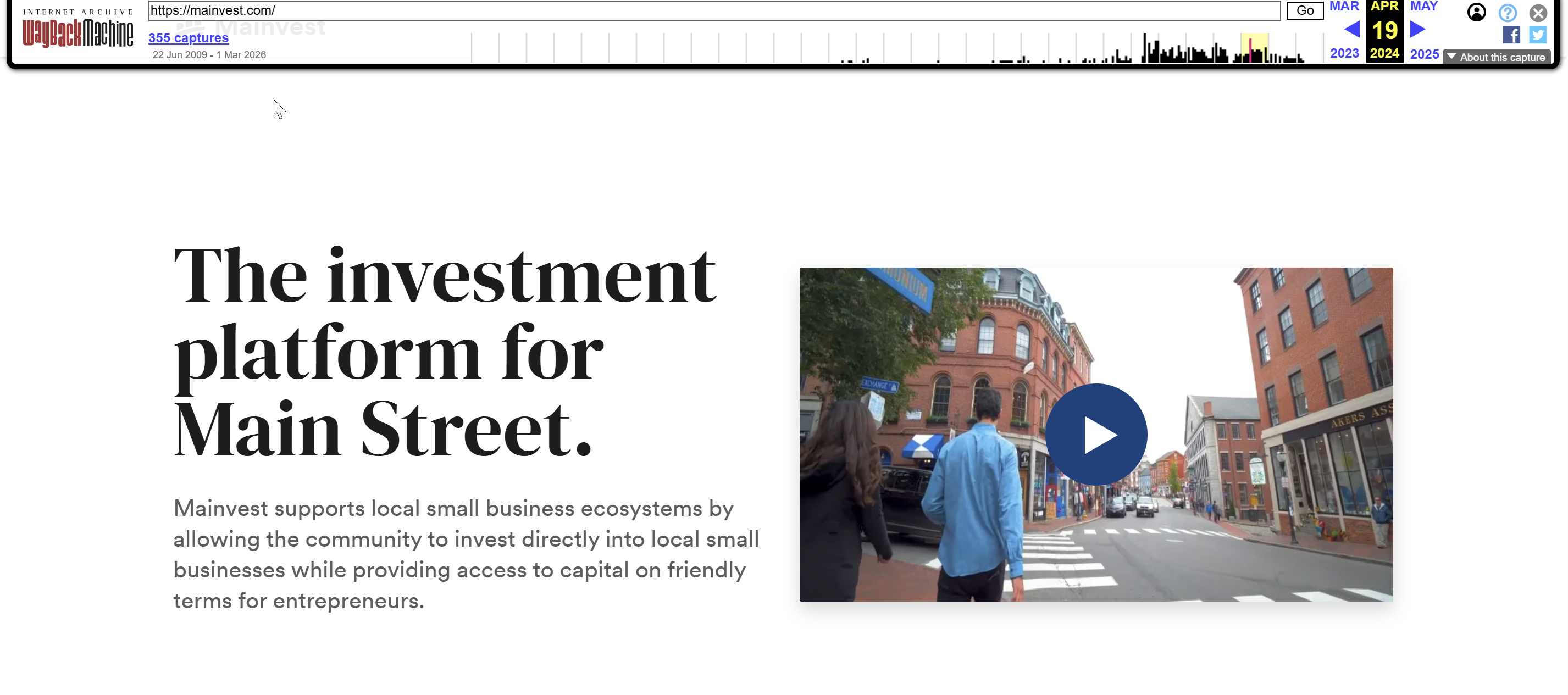
Mainvest described itself as 'the investment platform for Main Street': a Regulation Crowdfunding funding portal, operated by MainVest, Inc. of Salem, Massachusetts, where anyone 18 or older with a US bank account could invest from $100 in local brick-and-mortar businesses, mostly restaurants, bars, breweries, cafes and bakeries. The typical security was a revenue-sharing note: the business paid investors a stated share of its gross revenue each quarter until they had received a maximum multiple, usually 1.5x, or a maturity date passed. Investors paid no fees; the business paid Mainvest a percentage of the raise on a successful close. The site advertised 10-25% target returns and a vetting process that accepted about 5% of applicants. Mainvest hosted 779 offerings between October 2018 and early 2024 and ceased operations on June 14, 2024.
What happened to Mainvest?
Its banking partner, Synapse Financial Technologies, filed for Chapter 11 on April 22, 2024, and Evolve Bank then froze payment processing for Synapse clients, which locked Mainvest's investor and business wallets. On May 17, 2024 Mainvest announced it would wind down, citing the uncertainty around the Synapse bankruptcy as the catalyst. Repayments through the portal were accepted through May 22, investors were emailed their portfolio and transaction histories, and operations ceased June 14. Roughly $2.4 million of user funds were frozen in the Synapse estate. Synapse was the trigger; the vulnerability was already on file. The company's own Form C, filed on Republic in November 2022, had disclosed a $2.08 million annual loss, about 2.5 months of runway and a going-concern paragraph, and no arrangement existed for servicing the notes if the portal stopped.
I hold a Mainvest revenue-sharing note. Do I still own anything?
Yes. The note is an obligation of the business you invested in, not of Mainvest, and it survived the portal's closure. What ended was the servicing: Mainvest collected each business's revenue share, computed it against your multiple, distributed it to your wallet and issued tax documents, and no successor took over any of that. In practice you need the Revenue Sharing Agreement and the June 2024 transaction history, a direct relationship with the issuer, and your own ledger. The notes' dispute clauses provide for individual arbitration in Massachusetts and waive class actions. Consult a securities attorney before assuming any recovery, and check EDGAR under the issuer's name for a Form C-AR (still reporting) or C-TR (reporting terminated).
Will I get back the money that was in my Mainvest wallet?
There is no public answer. About $2.4 million of Mainvest user funds froze in May 2024 inside Synapse's ledger. The court-appointed trustee said in October 2024 that frozen funds should be returned by year end, but the reconciliation found a shortfall of $65 million to $96 million across all Synapse programs, and the Chapter 11 case was dismissed on November 14, 2025 with up to $95 million of end-user funds unresolved. The CFPB's $1 settlement, approved in September 2025, allows redress from the agency's civil penalty fund, but at last report affected users had not been contacted. AltStreet found no public accounting of Mainvest-specific recoveries. Keep records of your balance as of May 2024 and monitor the trustee's and the CFPB's notices.
How did Mainvest revenue-sharing notes work, and what fees did Mainvest charge?
A business issued unsecured, subordinated notes under Regulation Crowdfunding and agreed to pay investors a stated percentage of its gross revenue each quarter until they had received a maximum payment multiple, or a payment deadline passed. In the 701 Ops offering AltStreet read in full, the revenue percentage slid from 1.5% at the $250,000 target to 6.0% at the $1,000,000 maximum, the multiple was 1.5x, sharing began 365 days after the offering deadline, and the payment deadline was January 1, 2031. Transfer required the company's consent. Investors paid Mainvest nothing. Issuers paid a percentage of the raise, only if the offering succeeded: a flat 6% through 2021, then 3% on investors the issuer introduced and 9% on all others from 2022, then 4.5% on in-network users and 9% on all others from 2023.
What returns did Mainvest advertise, and were they real?
From at least January 2022 the homepage read 'Join a community of investors accessing 10-25% target returns with as little as $100', with 'Quarterly repayments' and 'No investor fees' beneath it. On a revenue-sharing note the ceiling is the multiple: a 1.5x note returns at most 50% over its life, however long that takes, and the stated range was a target, not a realized figure. The only repayment-quality statistic Mainvest ever published, '96%+ of Mainvest businesses are on track with repayments', appeared on the January 2022 homepage and was gone by January 2023, replaced by a count of repayments processed. Its own 2020 FAQ answered 'Are these safe investments?' with 'Far from it!' No filing carries a repayment ledger, and AltStreet cannot compute a realized return for any Mainvest note from public data.
Is Mainvest legit? Was it a scam, and was there any regulatory action?
No evidence supports calling it a scam. MainVest, Inc. was an SEC-registered funding portal (file 007-00162) and FINRA member (CRD 298384), every offering filed a Form C, and the operator's own Regulation Crowdfunding filing on Republic disclosed its losses, its runway and a going-concern paragraph in November 2022. AltStreet's legal and enforcement scan found no SEC litigation release, FINRA disciplinary action, receivership or class action involving MainVest, Inc. or Mainvest Holdings Corp as of September 2026. What the record shows is a venture-stage company that never published repayment data, enforced almost no post-raise reporting by its issuers, made unsubstantiated claims about default rates, and had no plan for its notes when its banking intermediary failed. The registration was never withdrawn, so FINRA still lists the firm, which reflects an unfiled form, not ongoing supervision.
Did Mainvest raise money on Republic?
Yes. Mainvest Holdings Corp, the portal's parent, filed a Regulation Crowdfunding Form C through OpenDeal Portal LLC (Republic) on November 3, 2022, offering a Crowd SAFE with a $15 million post-money valuation cap, a $500 minimum, a $25,000 target and a $1,235,000 maximum. The offering closed on January 3, 2023 at $385,795 from 282 investors per the campaign page. The Form C is the most informative document in the record: reviewed financial statements for fiscal 2022 showing $497,978 of revenue, a $2,081,237 net loss, $205,000 of cash described as 2.5 months of runway, and a substantial-doubt going-concern paragraph. The company filed one annual report, in April 2023, and nothing since. Investors in that SAFE hold an instrument in a company that ceased operations 17 months after the close.
Can I still log in to Mainvest?
No. Mainvest took its site dark on June 12, 2024 and ceased operations on June 14; mainvest.com now shows only a closure notice, and the login, investor dashboard and support center are gone. Before closing, Mainvest emailed each investor their portfolio and transaction history. If you did not keep that email, your remaining records are the Form C for each offering on EDGAR, the Revenue Sharing Agreement you signed, and your bank statements showing transfers to and from your Mainvest wallet. For wallet balances frozen in May 2024, keep any statement showing the balance; those are claims in the Synapse matter, not something Mainvest can release.
Mainvest vs Wefunder vs Honeycomb: what is the difference?
All three are Regulation Crowdfunding portals open to non-accredited investors at about $100, and Mainvest's own filing named Honeycomb Credit and SMBX as its competitors. The instruments differ. Wefunder sells mostly startup equity and SAFEs, where the return depends on a future exit, and charges investors a roughly 2% transaction fee. Honeycomb sells fixed-rate amortizing loans to the same Main Street borrower base as Mainvest, often with a lien and a personal guaranty, and charges investors a 3% ACH fee. Mainvest sold unsecured, subordinated revenue-sharing notes with no investor fee and an issuer fee that rose to 9%. Wefunder and Honeycomb are operating; Mainvest ceased in June 2024. What all three share is what none publishes: repayment data and any disclosed arrangement for servicing the notes if the portal ceases. Mainvest is the case study in why that second silence matters.
What are the lessons for investing on revenue-sharing or small-business debt portals now?
Four, each drawn from a specific Mainvest fact. First, read the operator's own EDGAR filings: Mainvest Holdings Corp disclosed a going-concern doubt and 2.5 months of runway 18 months before it closed. Second, ask in writing what happens to collections if the portal stops, and whether a backup servicer or repayment escrow exists: Mainvest's answer was that issuers were responsible for themselves. Third, count filings on EDGAR rather than trusting a success page: 47% of Mainvest's listings were withdrawn and 17 of 379 funded issuers ever filed an annual report. Fourth, keep uninvested cash in your own bank: the $2.4 million frozen in May 2024 was in platform wallets on a fintech intermediary's ledger. Operator risk is investment risk even when the operator is only an intermediary.
Update History
What's changed in this Mainvest review
New data, new findings, corrections, and confirmations as they emerge. Most recent updates appear first.
- New data
Rancho Relaxo Form C-AR 2025-04-30 (fiscal 2024): revenue $239,117, net loss $9,621, cash $71, total assets $458,593, issuer-reported and unaudited; now attached to its tracked 2022 campaign. A C-U for its separate 2021 campaign (file 020-28997), which was never tracked, is closed out. Risks
- Confirmed
SIGNAL WINDOW (2026-09-07 to 2026-10-15): 26 signals (10 closes, 10 amendments, 5 withdrawals, 1 annual report), all with filing dates before the review's evidence; no figure in the review changes. Risks