
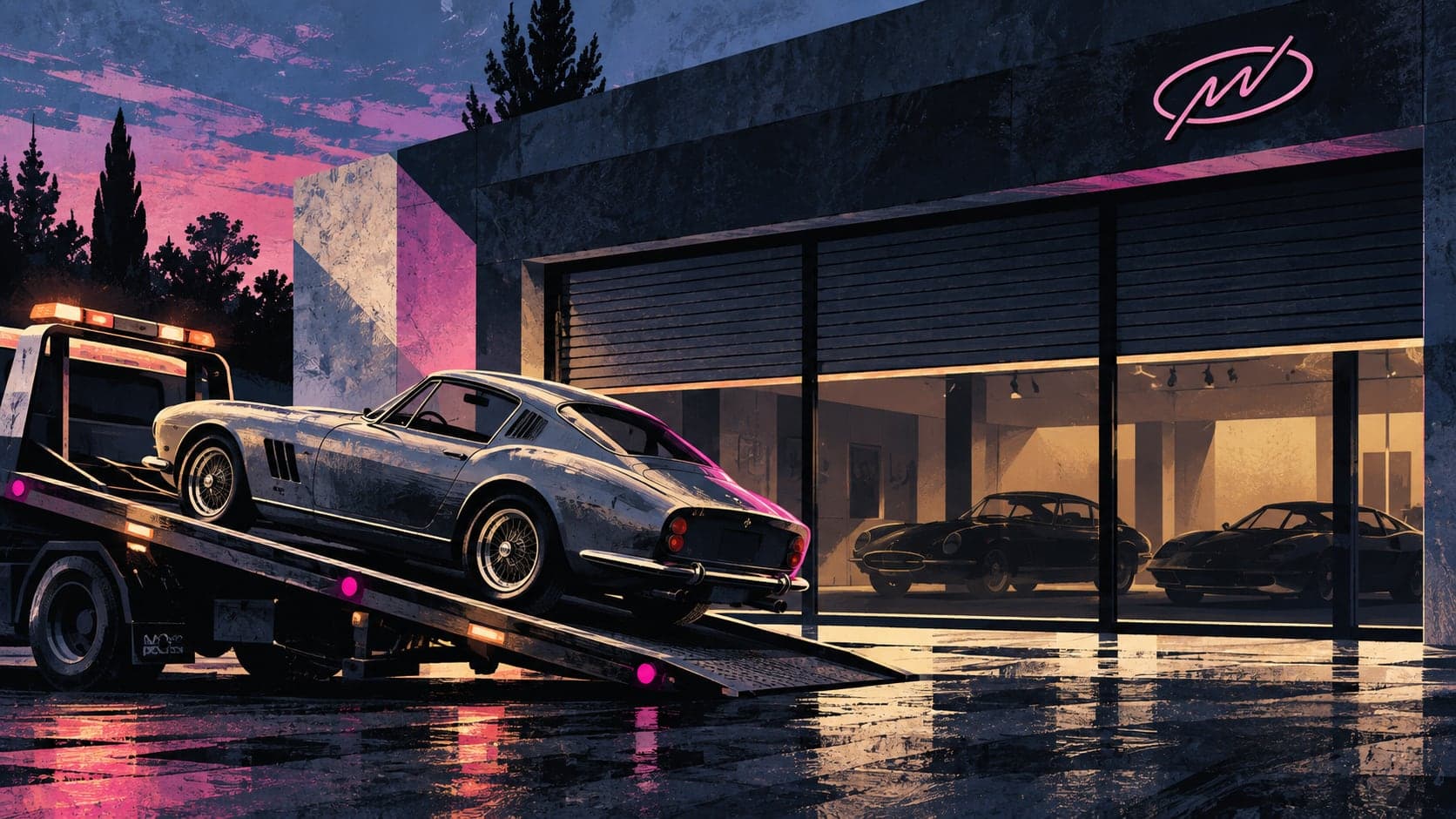
MCQ Markets promised something simple: a $20 share of a Lamborghini. From October 2024 the platform, run by McQueen Labs Inc. of Fort Lauderdale and its Miami showroom, sold Class A Units in five collector cars through a Delaware series LLC under Regulation A, one car per series, each with its own offering circular on EDGAR. Two years later the record is complete enough to read as a case study: three of the five cars have been sold and the cash returned to unit holders, one offering was terminated with its escrowed subscriptions to be refunded without interest, one car sits unsold, the issuer's accountant has twice flagged going-concern doubt, and on September 23, 2026 the company withdrew the amendment that would have kept the program open, telling the SEC that all offers ended on July 15.
AltStreet tracks both entities on EDGAR: the issuer, McQueen Labs Series, LLC, and its manager and administrator, McQueen Labs Inc., which does business as MCQ Markets. AltStreet has not published a review of MCQ Markets as a live platform, and this is not one. It is a reading of what the filings show a fractional collector-car investment to be, from where each car came from to what each unit holder got back, written for anyone weighing a platform of this kind.
How a fractional car offering is built
The structure is the same one used across fractional collectibles. A series limited liability company creates a numbered series for each car, files an offering circular describing the car, its purchase price and its history, and sells $20.00 Class A Units to the public once the SEC qualifies the statement. The series buys the car from its seller with the proceeds. Rialto Markets LLC, a FINRA member, acts as broker-dealer for the offerings and as transfer agent and registrar. There is no market for the units; the circular says none is expected to develop, and the exit is the sale of the car, after which the proceeds, less costs, are distributed and the series wound up.
The economics sit in the definitions. The manager earns an Acquisition Fee of 11% of each car's purchase price, payable in cash from the offering or, if cash is short, in units of the series. It is entitled to an Administrative Fee, also payable in units, which it has waived to date. It holds a Class X unit in each series that takes 20% of distributions once Class A holders have received 100% of their purchase price back. Sellers are paid partly in units of the series that buys their car; when a seller takes more than 25% of the units it also receives a Class B unit that carries the right to name one of the series' managers. And each car arrived with a lien, called a Third-Party Amount in the filings, that was repaid out of investors' proceeds before anything else.
Five cars, five related-party sellers
The annual report's risk factors say certain cars "may be acquired from related parties of the Company, which creates conflicts of interest and other risks." The word "may" understates it. Per the Forms 1-K, 1-SA and 1-U, this is where each car came from and what became of it.
- Series 001, 1986 Lamborghini Countach. Bought from Devlin DeFrancesco, a shareholder of the manager through an entity he owns, for consideration the semiannual report describes as units valued at $306,000 and cash of $294,000, with a $75,350 Third-Party Amount repaid from the offering. All 17,193 units sold for $343,860. Agreed for sale on September 2, 2025 to Ultimate Motors Inc. dba Ft. Lauderdale Collection for $735,000; cash received March 6, 2026, title passed March 16; about $21.83 per unit distributed March 9, 2026.
- Series 002, 1984 Ferrari 512 BBi. Bought from Lachlan DeFrancesco, an officer and director of the manager, who took 47% of the series' Class A Units and its Class B unit; consideration of units valued at $229,500 and cash of $220,500, with a $135,000 Third-Party Amount. The offering closed April 24, 2026. The car has no reported sale and remains the one series still holding an asset.
- Series 003, 2012 Lexus LFA. Bought from Delavaco Holdings Inc., owned by Catherine DeFrancesco, a shareholder of the manager through an entity she owns and Lachlan DeFrancesco's mother, for units valued at $450,000 and cash of $350,000, with a $373,493 Third-Party Amount. The offering closed June 25, 2026 with 19,911 of 22,242 units sold for $398,220, and Delavaco received 22,500 units. On July 31, 2026 the car was sold to GoFaster 1730 LLC, owned by Lachlan DeFrancesco, for a stated $1,473,000, paid through a settlement and mutual release among GoFaster, Delavaco, Ms. DeFrancesco, McQueen Labs Inc. and the series that netted the series $614,406.90 after the distributions that would otherwise have gone to Delavaco ($633,388.35) and Ms. DeFrancesco ($225,204.75); about $28.15 per unit was distributed on August 26, 2026.
- Series 004, 2014 Mercedes SLS AMG Black Series. Bought from MQ Solarbeam AMG, LLC, a wholly owned subsidiary of the manager, which received 8,493 units at closing; 28,575 units sold to the public for $571,500; a $612,000 Third-Party Amount. Sold to Sourced AG LLC for $1,020,000, closed March 23, 2026; about $22.72 per unit distributed.
- Series 005, 2001 Lamborghini Diablo 6.0 VT GT. Held through a Montana subsidiary bought from Mushman Collectibles and Investments LLC, wholly owned by the manager, against a $1,015,000 promissory note that the audited 2025 balance sheet carries as the series' only liability; the Montana entity had bought the car in January 2025 from Ft. Lauderdale Collection, the same dealer that later bought the Countach. Qualified April 23, 2025 for up to $1,138,760; terminated at the company's discretion on July 15, 2026, with escrowed subscriptions to be refunded without interest; the filings reviewed do not establish that every refund has completed.
Related parties on the acquisition side of every series
Set the five acquisitions side by side and the pattern is the finding. The people who sold the cars to the series were the manager's shareholders, an officer and director, his mother's company, and the manager's own subsidiaries. Those were related-party purchase prices on which the manager's 11% Acquisition Fee was calculated. The sellers were paid partly in units, so they held a share of each series' outcome, and in the Ferrari's case 47% of the series and its Class B unit, which carries the right to name one of the series' managers. The governing structure gives the manager control over the sale process, with that seller-named board seat the one outside voice in it. Two of the three completed exits went to unrelated buyers, Ultimate Motors and Sourced AG. The third, the one that produced the largest distribution, went to a company owned by the same officer and director who had sold the Ferrari, with the price to the series settled among his family's entities.
The offering circular discloses all of this and warns of it in its own words: acquiring assets from related parties "introduces a risk of conflicts of interest and potentially less favorable transaction terms," and valuing them "can be particularly challenging." Disclosure is what makes the pattern visible; it does not make it disappear. An investor in a series like these was relying on one group on the buying side of every car: the related party that sold it, the manager that charged its fee on that price and held a block of the units, and the manager that controls the sale process. Whether any of those prices was fair to unit holders is not something the filings can show, because no independent valuation is filed at either end of any transaction. AltStreet makes no finding of wrongdoing; the record contains no complaint, enforcement action or lawsuit. The record does contain a structure in which an arm's-length seller and a filed independent valuation were absent from every series, and one of the three completed exits was also to a related-party buyer.
What unit holders received
Three series paid out, and each paid more than the $20.00 unit price before any withholding tax: approximately $21.83 on the Countach, $22.72 on the Mercedes and $28.15 on the Lexus LFA. Those are the filed distribution figures; the filings do not state annualized returns, and AltStreet does not compute them, because the holding periods differ (the Countach opened October 23, 2024 and paid in March 2026; the LFA series closed its offering on June 25, 2026 and sold the car five weeks later) and because the sums a series distributes depend on the acquisition structure as much as on the car's price. Two of the three sale prices were above the cars' stated acquisition consideration. The LFA demonstrates why a headline sale price is not the same thing as series proceeds: a stated $1.473 million related-party sale translated into $614,406.90 of proceeds to the series after the settlement among related parties.
The fourth series is returning capital by refund rather than by sale: Diablo subscribers, whose money had stayed in escrow, were to be repaid without interest, and the filings reviewed do not establish that every refund has completed. The fifth, the Ferrari, has produced nothing yet, and 47% of its units belong to the officer who sold it the car.
The manager's own numbers
The company running the platform has filed its own record. McQueen Labs Inc., formed June 21, 2023, reported $160,000 from two investors on a March 2024 Form D, then raised $168,345 at $5.40 a share in a Regulation Crowdfunding round through Jumpstart Micro that closed in March 2025. Its Form C-AR for the year ended March 31, 2025 reports no revenue, operating expenses of $6,907,420 (consulting fees $2,555,601, professional fees $742,237, lease expense $570,915, depreciation and amortization $452,330, research and development $261,844) and a net loss of $6,668,282, against $665,004 the year before; total assets were $4,926,627, of which $1,770,847 were equity securities, and cash was $206,997.
Those equity securities are explained by a May 9, 2025 announcement from SOL Global Investments Corp., a Canadian-listed company, of US$1,000,000 in convertible debentures to MCQ Markets paid in about 11.5 million SOL Global shares at C$0.12, for "digital tokenization and fractional ownership of investment-grade collector cars." The selected unaudited balance sheet the manager supplies to the series issuer shows the direction since: at September 30, 2025 total assets of $6,412,646 against total liabilities of $7,649,257 and $157,203 of mezzanine equity, leaving member's equity of negative $1,393,814. A Form D filed March 3, 2026 reports $5,325,000 of debt securities sold to 12 investors of an $8,000,000 offering. The manager has no employees at the series level, has launched an Ontario subsidiary, McQueen Garage Inc., to trade exotic cars, and announced a Dogecoin-based car-trading venture in June 2025.
The series issuer's own audited statements for 2025, signed by Smart Solutions CPA Inc. of Chicago on April 16, 2026, show total assets of $1,630,790 (the Countach at its $600,000 cost, $15,785 of cash and the Diablo's Montana subsidiary at $1,015,000), a $34,075 net loss consisting entirely of a management fee, and substantial doubt about the issuer's ability to continue as a going concern. The September 14, 2026 semiannual report repeats the going-concern language.
September 2026: the amendment withdrawn, the site still open
On September 11, 2026 the company filed Post-Effective Amendment No. 6, and on September 23 it withdrew it, stating that "all offers were effectively terminated as of July 15, 2026" and that it "may offer additional series offerings in the future through a separate offering statement." The same day it filed Supplement No. 1 recording the LFA closing, the Diablo termination with its refunds in progress, and a series table in which every series is marked closed. The May 1, 2026 offering circular remains on file; nothing is being offered under it. AltStreet's news report covers the filings in detail.
On September 25, 2026, mcqmarkets.com is live. Its investment page says: "All our offerings have been fully allocated or ended. Please register your details here to join our waitlist." Its home page still says "Start Investing in Collector Cars for Just $20 per Share," and the Diablo, whose offering was terminated ten weeks earlier with subscriptions to be refunded, still carries a "Buy Shares" button beside a "Sold Out" label. The site's "Curation Experience" section illustrates returns with cars the platform never offered, such as a 1990 Ferrari F40 bought in 2017 at $1,525,000 and valued at $4,000,000, figures that describe a market, not this program.
What a due-diligence read would flag
Everything below is in the filings on EDGAR, most of it in the annual report's own risk factors and notes.
- Where the car comes from, and what the fee is charged on. All five cars were bought from the manager's shareholders, officers, their family or the manager's own subsidiaries, at related-party prices with no independent valuation filed. The 11% Acquisition Fee is charged on that purchase price, so the fee grows with the related-party price.
- Who owns the units. Sellers take units, sometimes with a board seat: 47% of the Ferrari series belongs to the officer who sold it the car. That gives the seller substantial economic exposure and governance influence over the series.
- Who buys the car back. Two exits went to unrelated buyers. The LFA went to a company owned by an officer and director, and it demonstrates why a headline sale price is not the same thing as series proceeds: a stated $1.473 million related-party sale translated into $614,406.90 of proceeds to the series after the settlement among related parties. The distribution was still the best of the three. The chain is disclosed; it is still a chain.
- The liens. Each car carried a Third-Party Amount, from $75,350 to $612,000, repaid from investors' money at closing; the offering size covers the lien, the fee and the seller's cash before it covers anything else.
- The manager's balance sheet. The company that decides when to sell each car had negative equity of $1.39 million at September 30, 2025, a $6.67 million loss in its last fiscal year, and $5.3 million of new debt in March 2026, while the series issuer carries going-concern doubt in two consecutive reports.
- The exit works, at this scale. Three cars sold, three distributions above par, one termination with refunds under way. The record does not yet show a realized loss in a completed series; the Ferrari is unresolved and the Diablo is a refund, not an investment exit. It also does not show a repeatable business: one car left, no offers since July, and a site inviting a waitlist.
- Marketing versus filings. 'Start Investing for $20' on a site whose issuer told the SEC that all offers ended two months earlier is the gap to check first on any platform: read the newest filing before the home page.
Where this sits, and what to watch
AltStreet's only full review in collectibles is Rally, whose series structure, sale-and-distribute exits and related-party disclosures are the closest comparison to what MCQ Markets built; the collectibles category collects the rest of the coverage. The difference here is scale and concentration: five cars, one family and one manager, and a two-year record that has now paused.
What comes next is filed, if it comes. A Form 1-U on the Ferrari 512, a new offering statement, a Form 1-Z exiting Regulation A, a further Form D from the manager or a change in the going-concern language would each appear on the two entity pages the day they are filed. Subscribers to AltStreet Terminal can set an alert on CIK 2025795 or CIK 2004478 and see the next filing before the waitlist email arrives.
What this article does not know
The filings give stated acquisition consideration and sale prices but not the arm's-length value of any car; AltStreet has not appraised them and does not know whether any related-party price was above or below market.
The filings do not say why all offers ended on July 15, 2026 or why the Diablo offering was closed; no cause should be inferred. Whether the Series 005 refunds are complete, what the Ferrari 512 is worth, and whether a new offering statement will be filed are not on the record.
The distribution figures are per-unit amounts before withholding tax as stated in the Forms 1-U; investor counts per series are not disclosed. The manager's September 30, 2025 balance sheet is unaudited and supplied by the manager. The reading of mcqmarkets.com is as of September 25, 2026 and the site can change.
Sources
- Form 1-K annual report for 2025, McQueen Labs Series, LLC (filed April 22, 2026; audited by Smart Solutions CPA Inc.) — SEC EDGAR
- Form 1-SA for the six months ended June 30, 2026, McQueen Labs Series, LLC (September 14, 2026) — SEC EDGAR
- Supplement No. 1 to the Offering Circular dated May 1, 2026 (September 23, 2026) — SEC EDGAR
- Form 1-A-W, McQueen Labs Series, LLC (September 23, 2026) — SEC EDGAR
- Form 1-U (September 24, 2026): sale of the 2012 Lexus LFA and settlement — SEC EDGAR
- Form 1-U (March 31, 2026): sale of the 2014 Mercedes SLS AMG Black Series — SEC EDGAR
- Form 1-U/A (March 19, 2026): sale of the 1986 Lamborghini Countach — SEC EDGAR
- Offering circular (Form 253G2), McQueen Labs Series, LLC, File No. 024-12450 (2025) — SEC EDGAR
- Form C-AR for the year ended March 31, 2025, McQueen Labs Inc. (August 28, 2025) — SEC EDGAR
- Form C-U, McQueen Labs Inc. (March 6, 2025): $168,345 closed — SEC EDGAR
- Forms D, McQueen Labs Inc. (March 5, 2024 and March 3, 2026) — SEC EDGAR
- Sol Global Announces $1M USD Strategic Investment into McQueen Labs Inc. (May 9, 2025) — Newsfile
- MCQ Markets Launches McQueen Garage Inc (June 10, 2025) — GlobeNewswire
- MCQ Markets investment page and home page, read September 25, 2026 — MCQ Markets
- McQueen Labs Withdraws Its Latest Reg A Amendment After Selling Three Collector Cars (AltStreet, September 2026) — AltStreet
- McQueen Labs Series, LLC filing history on EDGAR (CIK 2025795) — SEC EDGAR
- McQueen Labs Series, LLC entity profile — AltStreet