
The Oak Companies (Red Oak Capital) Review 2026: The 9% Series R Preferred, the $353M of Fund Bonds Behind It, and What the Filings Show
The Oak Companies is the renamed Red Oak Capital Holdings, a Charlotte bridge lender that raised about $353 million of retail Reg A bonds through eight fund vehicles and is now selling a 9% perpetual preferred in the parent to retire some of them. The consolidated group lost $31.4 million in 2025; one bond fund is in liquidation, one carries a going-concern opinion, and the District of Columbia is suing the lender over its own loans.
No platform response on record for this review. Is this your platform? Respond or claim it.
What the data actually shows - TL;DR
A real, vertically integrated small-balance lender with seven audited Reg A fund vehicles plus the parent issuer and a candid MD&A, whose record on that MD&A is two years of $30 million losses, a fund in liquidation, a cured default, a going-concern series and a government suit the circular omits, now asking retail investors for $35 million of perpetual preferred to repay the bondholders ahead of them.
Series R Convertible Preferred: cumulative 9% on a $10 stated value, accruing from acceptance, payable when the board authorizes it from legally available funds; converts into Class A common at 75% of the listing price if Oak lists (intended NYSE American symbol OKRE, no application made); callable by Oak at $10 plus accrued after the third anniversary; no vote, no maturity, no collateral; up to 3,500,000 shares ($35 million), $1,000 minimum, best efforts with no minimum, qualified September 22, 2026.
The circular's figure for capital raised by the sponsored funds since 2018 against about $492 million deployed. Bonds payable at December 31, 2025: $300.6 million gross, $294.1 million net, maturing $89.6 million in 2026, $106.9 million in 2027, $97.0 million in 2028. The Cross River Bank revolver shared by the funds had $16.4 million drawn of $50 million.
Consolidated net loss for 2025 (2024: about $30.1 million): total interest income $17,452,274 against interest expense $30,757,012, a net interest spread of $(13.3) million; mortgage interest income fell from $20.8 million to $16.7 million as loans went on non-accrual; realized losses of about $10.0 million on 2025 sales of foreclosed real estate; provision for loan losses $1,979,679. Management's non-GAAP 'adjusted' loss is $(20.9) million. Total assets $271.8 million.
Loans on non-accrual at December 31, 2025, with $59.2 million of loans 90 or more days past due and $67.6 million of real estate owned on a $180.0 million loan portfolio (28 loans, 11.24% weighted average rate per the deck). The circular attributes the impaired loans to 'the legacy management team that was in place prior to the 2022 buyout' and says all of ROCF II Series' legacy investments have been realized.
Fund III: interest stopped February 3, 2025, trustee default notice March 10, 2025, forbearance with UMB Bank November 21, 2025, liquidation basis from December 1, 2025, $45.6 million of Series B bonds extended to October 31, 2027; net liabilities in liquidation of about $50.0 million at December 31, 2025 (estimated assets about $21.4 million, estimated liabilities about $71.4 million) and about $49.2 million at June 30, 2026. ROCF II Series: Series B not redeemed at the February 1, 2025 extended maturity, UMB event-of-default notice March 13, 2025, paid August 21, 2025 after $39.1 million was exchanged into 9.5% Series C due 2028. ROCF IV Series: $44.5 million of Series B and Rb bonds extended to December 31, 2026 with a going-concern paragraph; Series R proceeds are the stated focus of the repayment plan.
Sources: SEC EDGAR filings of CIK 2147706 and the eight Red Oak vehicles (figures as filed; the parent's consolidated statements consolidate the funds as variable interest entities whose bonds are non-recourse to the parent); theoakcompanies.com and redoakcapitalholdings.com captured October 11, 2026; the Series R deck and executive summary; the District of Columbia complaint of February 20, 2026; CourtListener, FINRA and BrokerCheck records retrieved October 11, 2026.
What's Actually Happening
In plain English, here is what is actually happening.
- 1Red Oak Capital raised money from ordinary investors by selling bonds in a series of funds (Fund II through Fund VII and a few siblings) through brokers, paying 8% to 9.5%, and lent that money as one-to-three-year bridge loans on apartment buildings, hotels, offices and warehouses at SOFR plus 5 to 7 points. The fund keeps the spread after fees to Red Oak's own origination, servicing and management companies.
- 2The loans made before the current team bought the business in 2022 went badly. The company's own history page says the 2018 book was originated 'under a high-risk, loan-to-own model.' Fund III, whose loans were all from that era, ran out of cash in February 2025, stopped paying interest and is selling off foreclosed properties under a deal with its bond trustee that runs to October 2027. Fund II's bondholders were asked to swap into longer 9.5% bonds, and the ones who did not were paid seven months late after the trustee declared a default.
- 3Across the whole group, 2025 interest income was $17.5 million and interest owed to bondholders and the bank was $30.8 million. The group lost $31.4 million for the year after losing $30.1 million the year before. Nine loans are not paying, $59.2 million of loans are more than 90 days late, and $67.6 million of the balance sheet is foreclosed real estate the funds now own.
- 4On September 10, 2026 Red Oak Capital Holdings merged into a new Delaware corporation, The Oak Companies, Inc., and on September 22 the SEC qualified an offering of up to $35 million of 9% Series R preferred stock in that parent at $10 a share, $1,000 minimum, sold through Digital Offering for a 7.5% commission. After roughly 10% in offering costs, the money is available for retiring selected fund bonds, operations and working capital, with particular focus on the $44.5 million of Fund IV bonds due December 31, 2026, which the fund's auditor doubts it can meet on its own.
- 5Series R is preferred stock, not a bond: it has no maturity, no collateral, no vote, and its dividend is paid only when the board declares it from legally available funds and accumulates if not. It converts into common stock at a 25% discount if Oak lists on NYSE American, which it says it intends to apply for and has not. If Oak never lists, you hold a perpetual preferred the company can buy back after three years at $10 plus accrued dividends.
- 6In February 2026 the District of Columbia sued Red Oak Capital Holdings in DC Superior Court, alleging its loans on seven rent-controlled buildings were underwritten on the premise that only voucher holders would be housed, which the District says violates its Human Rights Act. The company has not said anything about the case in its offering documents. The allegations are contested and no court has ruled.
Quick Verdict
Is this platform right for you?
Oak is not a shell and not a mystery: it originates, underwrites and services real loans, files audited reports on every vehicle and says hard things in its MD&A. The question is whether a 9% perpetual preferred in the parent is adequate compensation for sitting behind $300 million of fund bonds that the group's interest income does not cover, with a liquidating fund, a going-concern fund, directors and officers who collectively control 97% of the votes and a pending government suit about the lending itself. On the filed record the preferred is a bet that the current team's loans perform, that the legacy book liquidates near carrying value, and that a listing happens; none of the three is evidenced yet.
Best for
- Investors who already understand small-balance CRE credit, have read the September 25, 2026 circular's MD&A and consolidated statements, and want operator equity rather than another fund bond
- Existing Red Oak bondholders deciding whether the Series R raise improves their own repayment odds (for ROCF IV Series, it is the stated plan)
- Nobody who needs income on a schedule, a maturity date, or an exit
Avoid if
- You read '9% cumulative' as a coupon; it is a dividend the board may decline to pay, from a parent whose group lost $31.4 million last year
- You read 'senior secured' in the loan descriptions as a description of your security; Series R is unsecured and structurally behind every bond of every fund
- You expect the conversion; Oak has not applied to list and says a listing may never occur
- You are not prepared to hold a security that cannot be sold, through litigation and fund liquidations that run to at least 2027
Top strengths
- Seven audited Reg A fund issuers and the parent, semiannual reports, 1-Us on every extension and default, a loan schedule by borrower and a series-by-series bond table: the deepest disclosure of any direct retail bond issuer AltStreet has reviewed
- A real lending platform: in-house origination, underwriting, servicing and workout, 49 transactions and $386 million on the transactions page, Fund VI (the current team's 2023 vintage) profitable in FY2025 and the first half of 2026
- The 2022 change of control is documented, the legacy-versus-current split is quantified in the MD&A, and the one trustee-declared default on the record (ROCF II Series B) was cured in cash within six months
- Two national mid-tier audit firms (CohnReznick LLP, UHY LLP), an indenture trustee that has acted (UMB Bank), and an escrow agent (Wilmington Trust) for the Series R proceeds
Key limitations
- Consolidated losses of about $30.1 million (2024) and $31.4 million (2025), interest income covering 57% of interest expense, $130.1 million of cumulative losses in the fund vehicles, and a management going-concern assessment at the predecessor, 'alleviated' on the basis of expected operations, asset sales, maturity extensions and the planned holding-company raise this review covers (distinct from the auditor's going-concern paragraph on ROCF IV Series)
- Fund III in trustee-supervised liquidation with interest unpaid since February 2025 and its own statements showing about $21.4 million of estimated assets against $71.4 million of liabilities; ROCF IV Series under a going-concern opinion with $44.5 million due December 31, 2026; ROCF V and ROIOF bonds renewed or extended; Fund VI's 2024 post-qualification amendments deemed abandoned by SEC staff, its previously qualified offerings having already issued securities and now closed; Fund VII at $2.4 million of a $75 million target
- District of Columbia v. Red Oak Capital Holdings (filed February 20, 2026, Human Rights Act, injunction and civil penalties sought) absent from the circular, amendments and deck; a 2022 to 2023 whistleblower suit by a former employee over underwriting controls reported by the Washington City Paper; plaintiff firms soliciting Fund III and Fund IV claims
- Three insiders on every board seat with 97% of the vote held by directors and officers collectively, a selling-agent conflict through Kennedy and Crescent, a planned acquisition of White Oak from the same insiders, about 10% of gross proceeds to offering costs, and five affiliated fee recipients across the structure
Where It Fits
Where The Oak Companies fits relative to the alternatives.
Operator equity in a retail-funded bridge lender
If you want
A 9% preferred dividend plus a possible listing conversion, from the company that originates, services and sponsors the funds
Use
The Oak Companies Series R, the instrument this review covers; the closest listed analogue is a preferred of a small mortgage REIT, which trades daily and files 10-Ks
Direct-issuer corporate bonds with Exchange Act reporting
If you want
A dated note from a retail bond issuer that files 10-Ks and 10-Qs and has not missed a payment on the record
Use
Phoenix Capital Group (see AltStreet's review), with its own leverage and governance findings
Per-loan real estate notes with a published loan record
If you want
To pick the loan, see its lien and maturity, and read the platform's repayment and default history
Use
Groundfloor (see AltStreet's review): $10 per-loan notes with thousands of filed loan cards; or Sharestates, whose unsecured notes AltStreet reviewed as a cautionary case
A demand bond from a single-purpose lender
If you want
Daily access at a fixed rate from a small issuer, accepting a going-concern paragraph
Use
Compound Real Estate Bonds (see AltStreet's review): every redemption paid so far, coupon never covered by loan income
Compare Before Deciding
Where The Oak Companies (Red Oak Capital) fits against alternatives
Use these hooks to pressure-test whether this is the right platform, or whether a nearby alternative matches the job better.
How this compares to Phoenix Capital Group
Phoenix Capital Group
A direct retail bond issuer with Exchange Act reporting, dated notes and no missed payment located; the disclosure Oak matches and the payment record Oak's funds do not.
How this compares to Compound Real Estate Bonds
Compound Real Estate Bonds
A going-concern demand-bond issuer that has paid every redemption; smaller, thinner and so far intact.
How this compares to Sharestates
Sharestates
Unsecured notes on a real estate lending book whose statistics froze and whose loss is still to be announced; the outcome Fund III's bondholders are now living through.
Overview
Platform Overview
A concise read on what the platform is, how the structure works, and where the practical friction shows up for real investors.
Origination, underwriting, funding and servicing of $1 million to $20 million senior first-lien bridge loans on commercial real estate, financed by selling Regulation A bonds and preferred units of sponsored fund vehicles to retail investors through broker-dealers, and since September 2026 by selling 9% convertible preferred stock of the operating parent, The Oak Companies, Inc., under Regulation A Tier 2.
is a Delaware corporation formed in 2026 into which Red Oak Capital Holdings, LLC merged on September 10, 2026. The business began in Grand Rapids in 2015 as Red Oak Capital Group, 'a small-balance hard money lender,' qualified its first two Regulation A bond funds in 2017, put Gary Bechtel in as chief executive in 2020, and was bought out by management with White Oak Capital Holdings' backing in 2022. Through Red Oak Capital GP (managing member of the funds) and Red Oak Financial (originator and servicer), it has sponsored eight Regulation A vehicles (Funds II through VII, the Fund Series LLC that now houses Funds II, IV, V and the Income Opportunity Fund as series, and the Intermediate Income Fund) and one Regulation D fund, raising about $353 million.
The loans are $1 million to $20 million senior first liens at SOFR plus 500 to 700 basis points for one to three years on multifamily, industrial, retail, office, hospitality and other income property. The parent now sells its own 9% Series R convertible preferred under Regulation A to retire fund bonds, intends to acquire its affiliate White Oak Capital Holdings (an FHA/HUD lender) and to list on NYSE American as OKRE.
Platform Model
Direct originator and sponsor; capital raised by selling fund bonds through broker-dealers and RIAs (Crescent Securities Group, Digital Offering); no marketplace
Primary Function
Originate, underwrite, fund, service and work out senior secured small-balance CRE bridge loans
Target Users
Retail and accredited investors through broker-dealers; Series R open to non-accredited investors up to 10% of the greater of income or net worth, $1,000 minimum
Instruments
Fund bonds (8.00% to 9.50%, three to five years, $1,000 denominations, $10,000 minimums); Fund VI Series A Preferred Units; Series R 9% convertible preferred of the parent ($10, perpetual)
Verification Strategy
Regulation A Tier 2 on every vehicle: audited 1-K (CohnReznick LLP, UHY LLP), 1-SA, 1-U; UMB Bank as indenture trustee; Wilmington Trust escrow for Series R
Investment Structures
Nine vehicles: Series R (open); Funds II, IV, V and ROIOF as series of the Fund Series LLC (closed); Fund III (liquidating); Fund VI (closed; 2024 amendments deemed abandoned); Fund VII (open, $2.4M sold); Intermediate Income (Reg A withdrawn; Reg D series)
ASHow It Works
- A fund sells bonds through brokers (commissions paid from proceeds) and lends to a sponsor; the borrower pays Red Oak Financial an origination fee of about 1% to 2% and servicing fees; the fund pays Red Oak Capital GP an asset management fee of 1% to 1.75% of invested capital plus disposition fees; the bondholder receives the coupon, paid quarterly in arrears, and the fund keeps or loses the rest
- Funds hold participation interests in each other's loans (Fund IV, Fund V and ROIOF Series share positions) and six fund SPVs share a $50 million Cross River Bank revolver secured by loans sold into the SPVs; a loan can be originated by one series and participated to another, to an affiliate (Oak Institutional Credit Solutions) or to a third party, as the February 2026 Valley Forge loan was
- When a borrower defaults the fund forecloses and becomes a landlord or hotelier; foreclosed properties held for sale produced about $2.3 million of income against $5.7 million of expenses in 2025 and about $10.0 million of realized loss on the two sold
- Series R sits at the parent: its dividend comes from the fees and spread the parent earns, after the funds' bonds and the revolver; part of its proceeds may go down into a fund to repay bondholders
- Bond interest is reported on Form 1099-INT; Series R dividends are dividends of a C corporation; the Fund VI preferred units are equity of an LLC
Key Gaps & Non-Disclosures
- The DC attorney general's suit and the former employee's suit, and their status
- A consolidated loan-by-loan status schedule tied to series and bonds
- Series R sales to date and the White Oak acquisition terms
Platform Intelligence
The Oak Companies (Red Oak Capital) timeline
Key platform events, regulatory turns, liquidity stress points, and product launches that shape how the review should be read.
Red Oak Capital Group founded
Founded in Grand Rapids, Michigan as 'a small-balance hard money lender' (company history page).
Funds II and III qualify under Reg A
Both 'fully subscribed within 9 months'; Ray Davis joins and shifts the strategy to bridge lending. Fund II: file 024-10865; Fund III: 024-11046 ($4,386,000 Series A and $45,614,000 Series B eventually sold).
'High-risk, loan-to-own model'
Per the company's own history: 'Assets are originated under a high-risk, loan-to-own model' under prior leadership. The circular later attributes every loan now in workout or foreclosure to this team.
Gary Bechtel appointed CEO; first Razjooyan loan
The founding CEO departs; Bechtel begins a restructuring. Red Oak makes its first loan to DC developer Sam Razjooyan ($2.8 million, 4400 Hunt Pl NE) per the Washington City Paper; Fund IV, Fund V and the Income Opportunity Fund ($150 million Form D) launch.
Staff disagrees with the Intermediate Income Fund's aggregation analysis, qualifies it anyway
Reviewing the Intermediate Income Fund's Form 1-A, the staff asks on August 18 and October 16, 2020 whether an offering whose proceeds buy participations in loans led by sibling Regulation A issuers should be aggregated with those issuers' offerings against the Regulation A ceiling. On December 17, 2020 the staff writes: 'we disagree with your analysis as to whether funds from this offering should be aggregated with the Sponsored Funds that are Regulation A issuers; however, we have no further comments at this time.' The offering is qualified. Earlier letters had asked Fund II (2018) for its Investment Company Act analysis, referred to the Division of Investment Management, and Fund III (2019) why a fund with no operations or assets carried 'Fixed Income' in its name; it was renamed.
Change of control: Red Oak Capital Holdings takes the manager
Form 1-U of April 27, 2021 (Item 6): on April 21, 2021 Red Oak Capital Holdings, LLC acquired all of the equity in the funds' manager, Red Oak Capital GP, LLC, from Red Oak Capital Group (90%, owned by Kevin Kennedy and Joseph Elias) and Raymond Davis (10%), paying in non-voting interests; voting control sits with Red Oak Holdings Management, whose board is Kennedy, Elias, Davis, Jason Anderson and Gary Bechtel. 'Messrs. Kennedy and Elias no longer have sole control.' In February 2021 Fund IV had sold a 68.4% participation in its $21,928,571 M&M Iconic Venture loan to AI 200 Walker Funding LLC for $15,000,000.
Income Opportunity Fund reports $22.9 million from 250 investors
Form D/A August 10, 2021; the Intermediate Income Fund qualifies ($75 million Reg A plus $150 million Reg D).
Management buyout backed by White Oak
Bechtel and Davis, with White Oak Capital Holdings, take control; 'remaining founders exit the business'; Cleary (March) and McGovern (April) join. In December a former employee, Giovanni James, sues Red Oak Capital Holdings in the Central District of California (closed January 2023); the City Paper reports a February 2023 whistleblower suit over underwriting controls.
Founders Anderson and Elias resign; McGovern named CFO
Forms 1-U of March 16, 2022 across the funds: Jason Anderson (chief financial officer) and Joseph Elias (chief operating officer) resign from the boards and all officer positions on March 14, 2022 under transition services agreements; Tom McGovern is appointed CFO of Red Oak Capital Holdings on April 21, 2022. The loan-by-loan current reports the funds had filed since 2019 stop after March 2022.
Fund VI qualifies; Red Oak FHA Capital launched
Fund VI's bond and preferred-unit offerings qualify January 23 and 26, 2023 ($28.7 million, $0.5 million and $19.3 million eventually issued); the FHA lender is formed through the acquisition of Johnson Capital Multifamily under White Oak.
Funds II and IV merge into the Fund Series LLC
1-U filings October 5, 2023; the Income Opportunity Fund had merged in September. Funds II, IV, V and ROIOF become series of Red Oak Capital Fund Series, LLC.
ROCF II Series extends and exchanges its Series B bonds
Maturity extended from August 1, 2024 to February 1, 2025; holders offered 9.5% Series C bonds due December 2, 2028; $36.8 million (80%) tendered by December 2, 2024 and $2.3 million more in March 2025 (T-3 November 18, 2024; SEC staff letter November 25).
Fund III stops paying; Cross River revolver; ROCF II default notice
February 3: Fund III tells bondholders it lacks cash for interest. January 7: six fund SPVs sign a $50 million Cross River Bank revolver. March 3: SEC staff deem Fund VI's amendments abandoned. March 10: UMB serves Fund III a Notice of Events of Default. March 13: UMB serves ROCF II Series an event-of-default notice over the unredeemed Series B; paid August 21, 2025.
Cleary steps down as president; Davis adds the title
Forms 1-U of March 6, 2025 across the vehicles: Paul Cleary resigns as president of Red Oak Capital Holdings effective March 1, 2025 and stays chief operating officer; Raymond T. Davis, chief strategy officer, becomes president. The filings say the resignation 'was not due to any disagreements related to the operations, policies or practices.' Fund Series reminds investors it has 'no separate board of managers or executive officers' of its own.
Fund VII circular; Fund III liquidation plan
Fund VII post-qualification circular for $75 million of 9% bonds (July 31); Fund III presents its Plan of Liquidation to bondholders (June 30). Fund VII sells $2,372,000 in 2025.
Fund III forbearance with UMB Bank
Forbearance Agreement of November 21, 2025: orderly liquidation of three foreclosed properties over about two years, Series B maturity to October 31, 2027, liquidation basis of accounting from December 1.
District of Columbia sues Red Oak Capital Holdings
Complaint filed February 20, 2026 in DC Superior Court under the Human Rights Act over seven rent-controlled buildings (300+ units); injunction and $10,000 per violation sought. Contested; no ruling located.
ROCF IV Series extends $44.5 million of bonds to December 31, 2026
Notice of March 5, 2026 on the 8.25% Series B and 9.00% Series Rb bonds; the FY2025 audit (April 30) carries a going-concern paragraph on ROCF IV Series. Consolidated FY2025 net loss $31,373,338.
Reorganization, Series R qualified, review
Red Oak Capital Holdings merges into The Oak Companies, Inc. (September 10); Form 1-A/A September 15; qualified September 22; final circular September 25 ($35 million of 9% Series R at $10; Digital Offering 7.5%); press release September 23. AltStreet review built October 11, 2026.
Investment Structures
The Oak Companies Series R Convertible Preferred Stock (on sale)
Up to 2,500,000 shares, increasable to 3,500,000 ($35,000,000) at Oak's discretion, at $10.00; 9% cumulative dividend on stated value accruing annually from acceptance of the subscription; automatic conversion into Class A common on a Listing Event at 75% of the price to the public, accrued dividends converting on the same basis, with up to a 90-day lock-up; optional redemption by Oak after the third anniversary of commencement at stated value plus accrued; senior to common, junior to all debt of Oak and its subsidiaries including the sponsored funds' bonds; no voting rights except as required by law; monthly closings, Wilmington Trust escrow, credit card purchases permitted. Qualified September 22, 2026 under file 024-12814.
Red Oak Capital Fund VII, LLC 9.00% Series A Bonds (on sale)
Up to $75 million, $1,000 per bond, $10,000 minimum, quarterly coupons on the 25th of January, April, July and October, maturity December 31, 2029, 1% management fee on invested capital, borrower-paid servicing, credit facility up to 70% of asset value, sold through Crescent Securities Group as managing broker-dealer. Offering costs at the maximum: 5.00% selling commissions, a managing broker-dealer fee of up to 1.00%, a wholesaling fee of up to 1.00%, a 1.25% nonaccountable expense reimbursement and a 2.00% 'O&O Fee' to the Manager (which keeps any excess over actual organization and offering costs), leaving net proceeds of 89.75%; Kevin Kennedy and Raymond Davis 'are registered as associated persons of our managing broker-dealer' and 'may be paid all or a part of any selling commission resulting from Bonds sold directly by them.' Post-qualification circular July 31, 2025; supplement October 28, 2025. $2,372,000 sold by December 31, 2025, of which $1,250,000 was deployed in one participation; management fees paid in 2025 were $13,188 (1% on deployed capital, quarterly, with a 0.5% disposition fee); total assets $4.3 million at June 30, 2026.
Red Oak Capital Fund Series, LLC (ROCF II, ROCF IV, ROCF V and ROIOF Series; closed)
The Delaware series LLC formed from Fund V (024-11289) into which Funds II and IV merged on October 5, 2023 and the Income Opportunity Fund in September 2023. At December 31, 2025: ROCF II Series $37.8 million of long-term bonds (9.5% Series C due December 2, 2028, issued in exchange for 8.5% Series B); ROCF IV Series $44.2 million of short-term bonds (8.25% Series B, 9.00% Series Rb, extended to December 31, 2026; going-concern paragraph); ROCF V Series $37.1 million short-term (Series A and A R, to be renewed five years or extended to June 30, 2027) and $32.3 million long-term; ROIOF Series $7.5 million short-term (CORE and CORE R, extended to December 31, 2026) and $56.6 million long-term. Consolidated FY2025: total assets $175.5 million, net loss $21.3 million; first half 2026: revenue $6.5 million against $17.5 million of expenses (interest $11.3 million, property expenses $2.1 million, management fees $1.6 million), net loss $11.1 million, total assets $164.1 million, 16 senior loans of $99.9 million. The report states: 'We estimate our cost of capital across the Series at approximately 11.5% to 12.3%, which includes interest expense on the bonds as well as management fees and initial selling costs,' against a portfolio weighted average rate of 11.24% to 11.34%.
Red Oak Capital Fund III, LLC (in liquidation)
Sold $4,386,000 of 6.5% Series A bonds (redeemed September 15, 2022) and $45,614,000 of 8.5% Series B bonds under file 024-11046. Interest payments ceased February 3, 2025; UMB Bank, as indenture trustee, served a Notice of Events of Default on March 10, 2025; a Plan of Liquidation was presented June 30, 2025; a Forbearance Agreement of November 21, 2025 provides for an orderly liquidation of three foreclosed properties over about two years, with the Series B maturity extended to October 31, 2027; the forbearance was conditioned on a Trust Instruction Proceeding in the Hennepin County District Court, Minnesota, which entered an order approving the trustee's execution of it, and the forbearance period ends on the earlier of October 1, 2027 and a Termination Event. Liquidation basis of accounting from December 1, 2025.
Bondholders will be repaid from the sales, not at par on a schedule: net liabilities in liquidation were about $50.0 million at December 31, 2025 (estimated assets about $21.4 million, liabilities about $71.4 million) and $49.2 million at June 30, 2026 after the Pembroke sale (about $2.65 million). An affiliate, Red Oak Capital Properties (now the parent), holds about $6.7 million of 8% preferred interests and 14% protective advances in the two Natchez hotel subsidiaries, and Red Oak Income Opportunity Fund II holds a $1,650,000 senior secured note on the Pembroke subsidiary; management fees of $705,513 were paid to Red Oak Capital GP in the eleven months to November 30, 2025. Total assets $19.1 million at June 30, 2026.
Red Oak Capital Fund VI, LLC (closed; 2024 amendments deemed abandoned)
Two 2023 Reg A offerings (bonds up to $35 million, 024-12095; preferred units up to $40 million, 024-12102) that issued $28.7 million of 8.00% Series A bonds, $0.5 million of 8.65% Series Ra bonds and $19.3 million of Series A Preferred Units. SEC staff deemed the January 2024 post-qualification amendments abandoned on March 3, 2025; nothing was issued after. The bonds mature December 31, 2028; the preferred units carry an 8% hurdle with a 1% quarterly management fee and 0.5% acquisition and disposition fees to the manager (offering circular).
Sold six loans ($43 million) in March 2025 and paid down the revolver; twelve loans totaling $55.3 million at a 10.27% weighted average rate at December 31, 2025; net income $912,142 in FY2025 and $296,801 in the first half of 2026 (revenue $3.1 million against $2.8 million of costs including $0.2 million of management fees). On March 11, 2026 the fund served a default notice on McKinney Capital Hermosa Partners LLC (Avalon, CA, $5.7 million at 15.63%), placed the loan on non-accrual on March 18, and reports the property 'in receivership' with the receiver marketing it; the $8.43 million 140 Holiday Owner note was severed into A and B notes on March 25, 2026 with the $7.2 million A note sold to an unaffiliated party. The sponsor has committed up to $1.5 million of common units.
Red Oak Capital Intermediate Income Fund, LLC (Reg A withdrawn; Reg D series)
Offered $75 million of Series A to E bonds under Reg A (024-11291) at $10,000 minimums and $150 million of Series F to H under Reg D at $50,000 minimums. Raised $3.5 million of A, $5.9 million of B, $7.8 million of C, $1.3 million of D, $2.7 million of E and $5.3 million of F; $11.8 million outstanding at December 31, 2025. Reg A offering withdrawn July 29, 2024.
Borrower defaults May 2 and October 13, 2025; a JV SBAM SB participation in default since September 2024. Net loss $1,730,061 in FY2025. In the first half of 2026 the fund booked $11,688 of revenue against $380,922 of bond interest and a $482,951 loss; its $4.1 million participation in an $8.3 million ROCF V Series loan is in receivership with a $1.6 million loss reserve, and the Templecliff property taken by ROCF II Series in August 2025 was sold for $1.1 million on September 16, 2026. The management fee is 0.25% a year of gross bond principal outstanding.
Red Oak Income Opportunity Fund, LLC (Reg D 506(b); now ROIOF Series)
Accredited-investor bond fund: Form D July 17, 2020 for $150 million at a $50,000 minimum; $22,863,000 sold to 250 investors by August 10, 2021; a new $2.2 million notice July 5, 2022. As ROIOF Series it held $64.1 million of bonds at December 31, 2025 and received a bankruptcy cash-collateral order paying it $30,000 a month on one foreclosed loan. Its successor, Red Oak Capital Income Opportunity Fund II, was marketed as a $300 million 506(c) bond at 9.0% with a 1.75% management fee.
Risk
Risk Structure
This is where the marketplace pitch gives way to the actual operating reality: delayed exits, limited disclosure, fee drag, and path-dependent outcomes.
Perpetual Preferred Behind $300 Million of Fund Bonds
Series R ranks junior to all indebtedness of Oak and its subsidiaries, including the sponsored funds' bonds, has no maturity, no collateral, no vote and no holder put. The fund bonds are obligations of the subsidiary funds, consolidated as variable interest entities and non-recourse to the parent; Series R is therefore structurally subordinate to those fund-level liabilities rather than a junior tranche of the same issuer's debt. Its dividend is paid when the board authorizes it from legally available funds and otherwise accumulates.
The board is Bechtel, Kennedy and Davis. The circular's risk factors state that Oak cannot assure timely or any dividends, that it may be unable to redeem or convert, and that the board may issue preferred stock senior to Series R without a Series R vote.
A Group Whose Interest Income Does Not Cover Its Interest Expense
Total interest income of $17,452,274 against interest expense of $30,757,012 in 2025; mortgage interest income down from $20.8 million to $16.7 million as loans went on non-accrual; net loss $31,373,338 after $30.1 million in 2024. Management presents an 'adjusted' loss of $(20.9) million and an 'adjusted' spread of $(6.1) million by adding back real estate owned losses, foreclosed-property operating losses, the loan loss provision, non-cash amortization and an estimated $2.5 million of recoverable non-accrual interest; these are non-GAAP and labeled as such.
Bond Maturities Managed by Extension, Exchange and Renewal
$89.6 million of bonds mature in 2026, $106.9 million in 2027 and $97.0 million in 2028. On the record: ROCF II Series extended, exchanged 80% into longer bonds, then defaulted on the balance before paying; ROCF IV Series extended to December 31, 2026 under a going-concern opinion; ROCF V Series plans a five-year renewal subject to bondholder consent or an extension to June 30, 2027 'to ensure orderly liquidation'; ROIOF Series extended its CORE bonds; Fund III's Series B runs to October 31, 2027 under forbearance. Management 'intends to address near-term maturities through a combination of asset sales, refinancings and extensions, and the application of net proceeds from this Offering.'
Control, Conflicts and Related Parties
Three insiders hold all three board seats, and directors and officers collectively hold 97.0% of the votes (their individual stakes overlap through White Oak and cannot be added); White Oak Capital Holdings (39.21%) is controlled by two of them and is the planned acquisition target; Kennedy is paid on the sale through Crescent; the parent owns the funds' manager, originator and servicer; funds participate in each other's loans and share a revolver; Series R proceeds repay a fund the same people manage. The circular discloses each of these.
Litigation the Circular Does Not Name
District of Columbia v. Red Oak Capital Holdings, LLC (D.C. Superior Court, filed February 20, 2026): two counts under the Human Rights Act alleging that Red Oak appraised seven rent-controlled buildings (more than 300 units, including Hawaii Avenue Apartments and the Minnesota Avenue building ROCF IV Series later foreclosed) on the premise that only voucher tenants would be housed, and underwrote the loans on the resulting rents; the District seeks a declaration, a permanent injunction against those practices, $10,000 per violation and fees.
The allegations are contested and unproven; AltStreet located no answer, ruling or settlement as of October 11, 2026. The circular's contingencies note does not identify the case.
Dividend Suspension or Non-Payment on Series R
The dividend is discretionary, from a parent whose group reported losses in both of the last two years and whose own going-concern assessment counts this raise among its sources; accrual without payment is the designed outcome when cash is short.
Why it matters
A cumulative dividend that accrues is not income; it is a growing claim on a company that must first service $294.1 million of bonds and a bank revolver. Fund III's bondholders have had an accruing, unpaid claim since February 2025.
Mitigation / verification
Read 'Risk Factors' and 'Description of Securities' in the September 25, 2026 circular (EDGAR, CIK 2147706). Watch the first 1-SA of The Oak Companies for the period ending December 31, 2026 for Series R sold, dividends declared and the ROCF IV Series repayment.
Fund Bond Default or Loss on Liquidation
Fund III is repaying bondholders from property sales through 2027 and its own liquidation-basis statement shows estimated assets of about $21.4 million against $71.4 million of liabilities, with an affiliate's preferred capital ahead of the fund inside the hotel subsidiaries; ROCF IV Series must repay $44.5 million by December 31, 2026 with $9.8 million of cash at year-end 2025 and eight loans of $38.9 million, some non-performing; ROCF II Series' default was cured only after most holders accepted longer paper.
Why it matters
The 2025 sales of foreclosed assets produced a realized loss of about $10.0 million; the remaining $67.6 million of real estate owned is carried at management's estimates. A shortfall at a fund is absorbed by its bondholders, and the parent's fee income shrinks with the fund.
Mitigation / verification
Bondholders: read your series' latest 1-U and the June 30, 2026 1-SA (CIK 1817069 for the Fund Series; 1780633 for Fund III) for the maturity, cash and loan status in force. Series R buyers: ask how much of ROCF IV Series' maturity the raise is expected to cover and what fills the rest.
Adverse Outcome in District of Columbia v. Red Oak Capital Holdings
A permanent injunction against appraising or lending on the challenged premise, civil penalties of $10,000 per violation across more than 300 units, and fees, in a case the offering documents do not mention; the complaint names Red Oak Capital Holdings, LLC, which has since merged into The Oak Companies, Inc.
Why it matters
The suit goes to the underwriting of multifamily loans in a market Oak has lent in since 2020, and to the credibility of a circular that omitted it. Any penalty is a parent-level cost that ranks ahead of Series R.
Mitigation / verification
Ask Oak in writing for the case number, its answer, and its assessment of exposure; check the DC Superior Court docket. Treat silence as a disclosure fact, not a finding on the merits.
No Listing, No Conversion, No Exit
The conversion requires a Listing Event; Oak 'intends to apply' to NYSE American and 'has yet to make an application.' Without a listing the security is a perpetual preferred of a private company with an issuer call after year three and no market.
Why it matters
The 25% discount is the equity case for Series R. A company with $31.4 million of consolidated losses, a going-concern series and pending government litigation faces listing standards it has not yet been tested against.
Mitigation / verification
Value Series R assuming no listing and ask whether the 9% accruing dividend, paid at the board's discretion, is enough on its own.
Biggest Misconceptions & What Actually Happens
- No securities regulator has acted against The Oak Companies, Red Oak Capital Holdings or any officer on the public record as of October 11, 2026, and AltStreet's scan found no SEC or FINRA proceeding naming them. The District of Columbia's suit is a civil-rights action over lending practices, and its allegations are contested.
- The fund bonds are obligations of the funds, not of the parent; a Series R holder has no claim on fund assets, and a bondholder has no claim on the parent.
- 'Senior secured' describes the funds' loans. Neither the bonds (secured by the fund's loan pool through the indenture) nor Series R (unsecured) is a claim on a specific property.
- The impaired loans are, by the company's account, legacy originations from before the 2022 buyout; the DC loans at issue were made from 2020 under the current chief executive, and the funds that hold the legacy loans are consolidated in the group's results today.
- The Series R issuer has filed no financial statements of its own yet; the consolidated figures in this review are those of Red Oak Capital Holdings, LLC as predecessor, audited by CohnReznick LLP.
Regulatory & Legal Posture
Security Status
Securities (Regulation A Tier 2 preferred stock of the parent; Regulation A Tier 2 bonds and preferred units of the funds; Regulation D 506(b) and 506(c) bonds); issuer relies on the Investment Company Act Section 3(c)(5)(C) real estate exclusion
The Series R offering statement was qualified by the SEC on September 22, 2026 (file 024-12814); each fund's offering statement was qualified in its year. Qualification is not approval, and the circular says so: 'There is no regulatory review of the Series R Preferred Stock.' Tier 2 requires audited annual and semiannual reports, which every vehicle has filed, and caps non-accredited purchases at 10% of the greater of income or net worth. SEC staff deemed Fund VI's 2024 amendments abandoned in March 2025 and issued a letter on the Fund Series' T-3 in November 2024.
Disclosure Quality
Deep on the financial record: audited statements on every vehicle, series-by-series bond tables, a loan schedule by borrower, candid MD&A on losses, non-accruals and the legacy split, 1-Us within days of extensions and defaults. Incomplete on litigation: the DC attorney general's suit is not named anywhere in the Series R materials. Marketing figures on the site exclude the distressed portfolios and combine Oak with an affiliate it does not own.
Custody Model
Fund bonds under indentures with UMB Bank, N.A. as trustee; Series R subscriptions held by Wilmington Trust, N.A. in escrow until monthly closings; investor records at Phoenix American and Vistra
Regulatory Backing
The trustee has acted on the record (Fund III default notice and forbearance; ROCF II Series event-of-default notice). Digital Offering, LLC (CRD 166401) is broker of record for Series R with no BrokerCheck disclosures; Crescent Securities Group, Inc. (CRD 114993) sold the fund bonds and participates in Series R, with a 2022 FINRA censure and $30,000 fine for supervision of fair pricing on inverse floating-rate CMOs sold to institutions, an unrelated product.
Tax Treatment
Reporting
Form 1099-INT for fund bonds; Form 1099-DIV for Series R dividends
Bond interest is ordinary interest income reported on Form 1099-INT; the fund pages state 1099-INT reporting. Series R is preferred stock of a Delaware C corporation; dividends, when paid, are reported on Form 1099-DIV and their character (qualified or not, return of capital or not) depends on Oak's current and accumulated earnings and profits, which the circular discusses in its tax section; GAAP net losses do not by themselves determine tax earnings and profits.
Income Character
Ordinary interest income (bonds); corporate dividends of uncertain character (Series R)
Fund bonds pay quarterly interest that is ordinary income. Series R dividends accrue cumulatively but are taxable to the holder when paid; a distribution from a corporation without current or accumulated earnings and profits is treated as a return of capital to the extent of basis and then as gain; whether that applies depends on Oak's tax earnings and profits, which its GAAP losses in 2024 and 2025 do not by themselves determine. Conversion into common stock on a listing is generally not a taxable event, per the circular's description; consult the circular's 'Material U.S. Federal Income Tax Considerations.'
Limitation
No state tax guidance is given beyond the standard legend. The character of Series R distributions cannot be determined in advance; Oak will report it after each year. Consult a tax adviser on accrued-but-unpaid dividends and on the redemption or conversion of preferred stock.
Special Considerations
- Fund bond interest is ordinary income at the holder's marginal rate; for a cash-method holder, unpaid interest on Fund III's bonds since February 2025 is a claim, not income, until paid
- Series R dividends may be partly or wholly return of capital depending on earnings and profits; keep basis records
- The 1-SA and 1-K of each fund are filed on EDGAR; the funds state their tax reporting is 1099-INT, with no K-1
Account Suitability
Taxable
Bond interest is fully taxable as it is paid; Series R dividends are taxable when paid with character reported after year-end.
Roth IRA
The fund pages say the bonds are 'open to qualified account investments.' Series R's eligibility in a self-directed IRA depends on the custodian; a perpetual preferred of a private issuer with a discretionary dividend is a concentrated, illiquid position for a retirement account.
Traditional IRA
Same as Roth; interest and dividends would be tax-deferred, and the liquidity and credit considerations are the same.
HSA
Not mentioned by the platform.
Before You Invest
Get The Oak Companies (Red Oak Capital) investor insights before you invest
K-1 timing, distribution updates, yield insights, and risk signals for The Oak Companies (Red Oak Capital) and similar platforms.
- Weekly platform research focused on tax timing and liquidity reality.
- Signals on distributions, risks, and structural tradeoffs before capital is locked up.
- Coverage of adjacent platforms so you can compare better options faster.
Get weekly platform signals
Track fee changes, liquidity updates, risk flags, and adjacent platforms before you invest.
Independent intelligence from AltStreet. No hype. No sponsor spin.
AltStreet Data Layer
What the data actually shows
AltStreet read the Series R circular and every current report of the nine vehicles, set the deck against the filings, and ran the litigation record. Read together, the filings describe a lender that discloses its losses, its non-accruals and its extensions in detail, that attributes the damage to the team it replaced, and that is now selling perpetual preferred stock in itself to retail investors to repay one fund's bondholders, without telling them that the District of Columbia is suing it over the way it lends.
The group's interest income did not cover its interest expense
Total interest income of $17,452,274 against interest expense of $30,757,012 in 2025, a GAAP net interest spread of $(13,304,738). Mortgage interest income fell $4.1 million from 2024 because nine loans went on non-accrual and defaulted loans became real estate owned. Management's adjusted spread, after removing $4.7 million of non-cash amortization and adding an estimated $2.5 million of recoverable non-accrual interest, is still $(6.1) million.
The Fund Series' own June 2026 estimate puts its cost of capital at 11.5% to 12.3% against a loan book yielding about 11.2% to 11.3%. Consolidated Oak also earns fee and other revenue; this is a negative interest spread, not a statement that the group had no revenue.
What this means
Interest income alone did not cover interest expense in 2025, so the group depended on other sources of liquidity, including existing cash, principal collections, asset sales and borrowing, to meet its cash requirements; the spread the deck describes is not yet visible in the consolidated results. That is the condition the Series R raise is meant to change by retiring bond capital; it is also why the dividend on Series R has no operating coverage yet.
Two trustee default notices, and extensions across the rest
Fund III stopped paying on February 3, 2025 and is liquidating under forbearance to October 31, 2027 with net liabilities in liquidation of about $50.0 million (estimated assets $21.4 million against liabilities of $71.4 million). ROCF II Series could not redeem its untendered Series B at the February 1, 2025 extended maturity, received a trustee event-of-default notice on March 13, 2025, and paid on August 21, 2025. ROCF IV Series extended $44.5 million to December 31, 2026 and carries a going-concern paragraph. ROCF V Series intends a five-year renewal subject to consent; ROIOF Series extended its CORE bonds.
What this means
Extension is the group's working tool for maturities, and the indenture trustee has had to act twice. For a bondholder the practical maturity is the one in the latest 1-U; for a Series R holder, every extension keeps a senior claim in place for longer.
Fund III's liquidation estimate shows a $50 million deficit, with related-party claims ahead of the fund inside its hotels
On the liquidation basis Fund III reports net liabilities in liquidation of about $50.0 million at December 31, 2025 and $49.2 million at June 30, 2026: estimated assets of $21.4 million against estimated liabilities of $71.4 million that include $45.6 million of Series B bonds, accrued interest, a preferred membership liability and about $2.2 million of estimated liquidation costs. Inside the two Natchez hotel subsidiaries, an affiliate (Red Oak Capital Properties, whose rights passed to Red Oak Capital Holdings in June 2025) holds about $6.7 million of 8% preferred interests and 14% protective advances that must be repaid first; another affiliate holds a $1,650,000 senior secured note on the Pembroke subsidiary; and the fund paid $705,513 of management fees to the sponsor's GP in the eleven months to November 30, 2025.
What this means
The forbearance is orderly; the outcome it is ordering is, on the fund's own numbers, a deficit against the recorded claims, with related-party interests ahead of the fund's equity in the properties and the sponsor's GP still collecting fees from the fund. Series R proceeds are not earmarked for Fund III; Fund III's bondholders are not the ones being refinanced.
The circular is silent on a government suit filed seven months before qualification
District of Columbia v. Red Oak Capital Holdings, LLC was filed February 20, 2026, seeking a permanent injunction against the company's appraisal and lending practices on seven rent-controlled buildings and $10,000 per violation. The Form 1-A (August 18), the amendment (September 15), the final circular (September 25), the deck, the executive summary and the Fund Series June 2026 semiannual report do not name it; the contingencies note refers to 'various legal proceedings' not expected to be material.
What this means
Whether the suit is material is management's judgment and the allegations are contested; that an investor reading 4,000 words of risk factors would not learn it exists is a fact about the offering. Two of the seven buildings appear on Oak's own transaction pages and one was foreclosed by ROCF IV Series in 2025.
Retail is being asked to refinance retail
Oak estimates about 10% of gross proceeds for offering costs; the remainder is available for retiring selected sponsored-fund bonds, operations and working capital, 'with a particular focus on the ROCF IV Series B and Rb Bonds maturing in 2026.' If all 3,500,000 shares sell, about $31 million remains after costs, less than the $44.5 million ROCF IV Series owes on December 31, 2026 even if every dollar went to the fund, which held $9.8 million of cash at year-end 2025 against eight loans of $38.9 million, some non-performing.
What this means
The raise is the repayment plan the fund's going-concern note depends on, and it moves the claim from a secured bond with a trustee at the fund to an unsecured, perpetual, non-voting preferred at the parent. The bondholders' position improves; the new holders take the parent's residual.
The legacy label is accurate and incomplete
The circular says every loan in workout or foreclosure was 'originated under the Predecessor's legacy underwriting framework' and sourced by the team in place before the 2022 buyout; the history page calls the 2018 book 'high-risk, loan-to-own.' Fund VI, the current team's 2023 vintage, is profitable. The DC loans in the attorney general's complaint were made from 2020 under the current chief executive, and the City Paper's whistleblower account concerns 2021 underwriting.
What this means
The current team's record is real and short, and the parent's results consolidate the legacy book either way. 'Concentrated in legacy funds' explains the loss; it does not remove $294.1 million of bonds or $67.6 million of foreclosed property from the balance sheet Series R sits beneath.
Everything is disclosed and nothing is independent
Three directors own 97.0% of the votes with the other officers; White Oak Capital Holdings (39.21%), the planned acquisition, is controlled by two of them; the funds' manager, originator and servicer are the parent's; Kennedy is paid through Crescent on the raise; funds participate in each other's loans and share a revolver; Bechtel is paid $325,000 by Red Oak and $250,000 by White Oak.
What this means
A Series R holder has no vote on the dividend, the acquisition price, a senior preferred issue or a listing decision. The disclosure is thorough; the governance is a disclosure, not a check.
The marketing counts what performed; the filings count everything
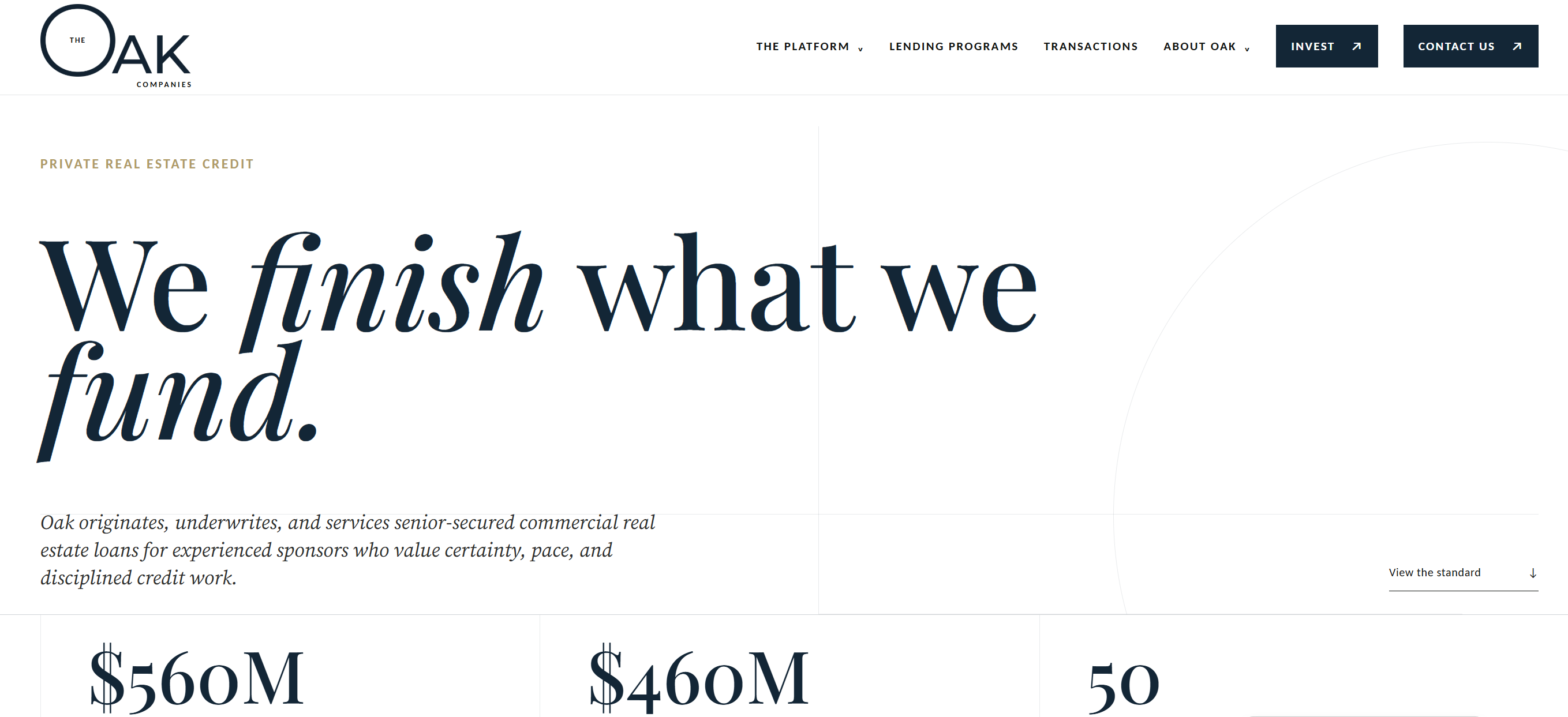
'$560M cumulative originations' excludes 'legacy portfolios acquired in default or distress'; '$460M AUM' adds White Oak's assets to Oak's; '33 full-cycle loans ~$200M' excludes the impaired book; the home page's 'We finish what we fund' sits above a transactions page whose loans include two of the DC buildings. The 1-Ks report the losses, the non-accruals and the foreclosures.
What this means
Neither set of numbers is false. An investor who reads the site and the deck will form a view of the platform that the filings do not support; the filings are the ones to read.
No securities regulator has acted, and the record on file is deep
AltStreet's scan found no SEC or FINRA proceeding naming any Oak or Red Oak entity or officer as of October 11, 2026. Every vehicle files audited annual and semiannual reports; the circular prints a loan schedule, a maturity table and a GAAP-to-adjusted reconciliation; the trustee's notices and the forbearances are on EDGAR within days.
What this means
Regulation A's compliance model is disclosure, and on the financial record Oak has complied beyond the norm. The absence of an action is not a finding on the structure; the omission of the DC suit is the gap in an otherwise complete record.
Data as of 2026-10-11 . AltStreet review evidence layer . Public-source analysis
Full datasetDecision Fit
Investor Fit
Who this works for, who it does not, and what level of patience and complexity tolerance the platform really demands.
retail
Series R is designed for retail ($10 shares, $1,000 minimum, credit cards accepted, a 30-minute webinar) and sits at the bottom of a capital structure that lost $31.4 million last year, behind $300 million of bonds whose own holders have been extended, exchanged and, in one fund, left unpaid. A retail investor cannot sell it, cannot vote, and cannot compel the dividend. The fit is poor not because the business is fictional (it is not) but because the instrument carries the group's risk without a maturity, a security interest or a say.
institutional
An institution lends to Oak as a senior participant or SMA counterparty, as the circular describes four insurers doing, with the A-note and the underwriting on its own terms; it does not buy a non-voting perpetual preferred of the sponsor through a retail broker at a 7.5% load.
Investors Seeking Financial Returns
The 9% is the entire stated return and it is not an obligation; the conversion upside requires a listing that has not been applied for. On the filed numbers the group's loan income does not cover its bond interest, so the parent's capacity to pay a preferred dividend depends on fee income from funds that are shrinking and liquidating.
ESG / Climate SaaS Providers
Not an ESG product; the pending District of Columbia suit alleges source-of-income discrimination in the lender's own underwriting, which is contested and unproven, and would be a screen for any mandate with fair-housing criteria.
Tradeoffs
Key Tradeoffs
The attraction of pre-IPO access is real, but every benefit comes bundled with a corresponding liquidity, transparency, or pricing cost.
9% Preferred vs Dividend Discretion
The highest stated yield in the Oak structure, cumulative and accruing from day one; paid only when a three-person board whose members, with the other officers, control 97% of the votes authorizes it from legally available funds, at a parent whose consolidated group lost $31.4 million in 2025.
Operator Equity vs Junior Claim
A share of every origination, servicing, management and disposition fee the platform earns, and of the loan yield on bonds retired with the proceeds; behind $294.1 million of fund bonds, a $50 million revolver and any future senior preferred.
Listing Conversion vs No Listing
Automatic conversion at 75% of the listing price with accrued dividends converting too; no application filed, 'a Listing Event may never occur,' and without one the preferred is perpetual with an issuer call after year three.
Deep Reg A Disclosure vs the Unidentified DC Case
Audited statements on nine vehicles, a loan schedule, a series-by-series bond table and an MD&A that prints the negative spread; a government complaint filed seven months before qualification that none of the offering materials names.
Refinancing ROCF IV Series vs Funding It
The raise is the stated plan for $44.5 million of bonds due December 31, 2026 at a fund under a going-concern opinion; a Series R buyer is providing that plan's capital and takes the parent's residual risk in return.
Avoid
Who This Is Not For
This section should be read as a filter, not an afterthought. If you need income, simplicity, or near-term access to capital, the structure is working against you.
Income Investors Who Need Payments on a Schedule
The dividend is discretionary and cumulative; Fund III's bondholders, with a contractual coupon and a trustee, have been unpaid since February 2025. A preferred without a trustee is weaker, not stronger.
Anyone Counting on the OKRE Listing
No application has been made; the circular says no assurance can be given that one will be, that it would be approved, or that a market would develop. The conversion is the only path to common stock.
Investors Who Want an Independent Check in the Structure
The board is the three largest shareholders; the selling agent pays one of them; the acquisition target belongs to two of them; the funds' manager, originator and servicer are theirs. Everything is disclosed and nothing is independent.
Holders Who Would Be Troubled by Unnamed Litigation
If a government suit seeking to enjoin the company's lending practices is something you expect to read in the offering document, this offering document does not meet that expectation.
Editorial View
AltStreet Perspective
The compressed version of the review: what matters, what marketing tends to obscure, and how we would frame the platform for a serious allocator.
Verdict
Oak discloses more than almost any retail bond issuer AltStreet has reviewed, and what it discloses is a lender that has lost $61 million over two years at the consolidated level, is liquidating one fund whose own statement shows assets of $21.4 million against $71.4 million of liabilities, extending the others and asking retail shareholders to refinance a fund its auditor doubts. The current team may well be better than the one it bought out in 2022; Fund VI suggests so. But Series R asks the buyer to underwrite that improvement, the legacy book's recovery, a listing and a lawsuit, for a dividend the board can defer, in a security that cannot be sold.
Positioning
Best understood beside Phoenix Capital Group and Compound Real Estate Bonds, the other direct retail issuers AltStreet has reviewed: deeper disclosure than either, a real operating platform like Phoenix, and an outcome record worse than both, with a fund in liquidation, a cured default, a going-concern series and a pending government suit that neither of those issuers carries. Red Oak bondholders will find their series' current terms in this review's structures section; Series R buyers should start with the risk section.
The Bottom Line
A fully disclosed bridge lender whose own filings show losses, a liquidating fund and extended bonds, now selling a 9% perpetual preferred to retail to repay the bondholders ahead of it, while a government suit over its lending is not identified in the offering materials.
Action
Next Steps
If you still want to engage after reading the review, these are the practical next moves that reduce avoidable mistakes.
Read the September 25, 2026 offering circular on EDGAR (CIK 2147706): 'Risk Factors,' 'Use of Proceeds,' 'Description of Securities,' the MD&A reconciliation of GAAP to management-adjusted loss, Note 2 on going concern and Note 11 on contingencies.
Ask Oak investor relations in writing for the case number and status of District of Columbia v. Red Oak Capital Holdings, LLC, its answer and its estimate of exposure, and why the circular does not name it.
If you hold Red Oak bonds, pull your series' latest Form 1-U and the June 30, 2026 Form 1-SA (Fund Series CIK 1817069; Fund III 1780633; Fund VI 1957571; Fund VII 2023066; Intermediate Income 1817413) and note the maturity, cash and loan status now in force.
Ask for Series R sales to date, the amount expected to reach ROCF IV Series, and the source of the remainder of the $44.5 million due December 31, 2026.
Ask for the terms, price and timing of the planned White Oak Capital Holdings acquisition and who will approve it on Oak's side.
Value Series R assuming no listing: a 9% accruing dividend at the board's discretion on a perpetual, unsecured, non-voting instrument with an issuer call after year three.
Final Answer
What this means for your decision.
Finding
Series R is equity in the operator, structurally behind $300.6 million of fund bonds
Meaning
The 9% is a cumulative preferred dividend 'payable only when authorized out of legally available funds' by a parent whose consolidated group lost $31.4 million in 2025 and whose funds owe $89.6 million of bonds in 2026 and $106.9 million in 2027. Oak estimates roughly 10% of gross proceeds will go to offering costs; the remaining proceeds are available for retiring selected sponsored-fund bonds, operations and working capital, with particular focus on ROCF IV's 2026 maturity.
Action
Price it as a perpetual, non-voting, non-secured claim structurally behind every bond the funds have issued (the bonds are the funds' obligations, non-recourse to the parent), with a conversion that only happens if Oak lists on NYSE American, which it has not applied to do.
Finding
Two programs received trustee default notices; several others have required maturity extensions, exchanges or planned renewals
Meaning
Fund III stopped paying interest on February 3, 2025 and is liquidating under a trustee forbearance to October 2027; its own liquidation-basis statement puts estimated assets at about $21.4 million against about $71.4 million of liabilities. ROCF II Series received a trustee event-of-default notice on March 13, 2025 and paid in August. ROCF IV Series extended its $44.5 million of bonds to December 31, 2026 under a going-concern opinion. ROCF V and ROIOF bonds are being renewed or extended rather than repaid.
Action
If you hold Red Oak bonds, read your series' latest 1-U and 1-SA on EDGAR for the maturity now in force; if you are considering Series R, understand that its proceeds are the stated focus of the plan for the ROCF IV maturity.
Finding
The District of Columbia is suing the lender, and the circular does not say so
Meaning
On February 20, 2026 the DC attorney general filed a two-count Human Rights Act complaint alleging Red Oak appraised and underwrote seven rent-controlled buildings on the premise that only voucher tenants would be housed, seeking an injunction and $10,000 per violation. The September 2026 offering circular, its amendments and the investor deck do not mention it; the contingencies note says management expects no material effect from 'various legal proceedings.'
Action
Treat the allegations as contested and unproven, and the omission as a fact about the disclosure. Ask Oak in writing for the status of the case and its view of exposure before investing.
Finding
Three insiders comprise the entire board; directors and officers collectively control 97% of the vote, and one of them sells the deal
Meaning
Bechtel, Davis and Kennedy own 57.8%, 51.6% and 26.8% of the common (overlapping through White Oak Capital Holdings, which they control and which Oak plans to buy from them). Kennedy runs Oak's distribution and is also a registered representative of Crescent Securities, earning up to 1% on Series R sales.
Action
There is no independent director, audit committee or holder vote between you and management decisions, including the related-party acquisition. Decide whether you are comfortable with that before reading the yield.
Finding
The disclosure is unusually complete; the record it discloses is the finding
Meaning
Seven audited Reg A fund filers plus the parent issuer, semiannual reports, a loan schedule by borrower, series-by-series bond balances, and an MD&A that prints the negative interest spread and the legacy-versus-current split. Few retail bond issuers file this much. What it shows is interest income of $17.5 million against $30.8 million of interest expense.
Action
Use the filings, not the deck. The deck's '$560M originated' and '33 full-cycle loans' exclude the impaired book; the 1-Ks include it.
If you read nothing else
The Oak Companies is a real, well-documented bridge lender whose own filings show two years of $30 million consolidated losses, a fund in liquidation, a cured default, a going-concern series and a pending government suit the circular does not name, now selling a 9% perpetual, non-voting preferred in the parent to retail investors to repay the bondholders ahead of it. The disclosure earns respect. The filings show how much risk the 9% has to compensate for.
AltStreet Research Desk
About to invest in The Oak Companies, or in an offering we haven't covered?
Commission an independent diligence report: the same filing-based analysis behind this review, applied to the specific investment in front of you before you wire the money.
- Built from primary sources: SEC filings, court records, capital structure, and marketing-versus-filings comparison.
- From $750; full reports from $1,495. Fixed price confirmed up front, delivery in 3-5 business days.
- Independent by design: we work for investors and accept no compensation from the companies we cover.
Want this on every new deal, not one? Deal Intelligence sends the alert the day a new offering appears on a covered platform and follows with an analyst-approved investment committee memo.
Deal Intelligence →Appendix
Sources, Disclosures, and Supporting Context
The lower section is structured like a report appendix: relationship context first, adjacent reading second, and evidence last.
Report Appendix
Disclosure
Relationship and compensation context
+
Report Appendix
Disclosure
Relationship and compensation context
Report Appendix
Related Resources
Adjacent platform comparisons, frameworks, and category links
+
Report Appendix
Related Resources
Adjacent platform comparisons, frameworks, and category links
Further Reading
Related Resources
Adjacent frameworks and reviews that help place the platform in a broader allocation or due-diligence context.
Fund Landscape
Frameworks
Similar Platform Reviews
- Phoenix Capital Group
A direct retail bond issuer with Exchange Act reporting, dated notes and no missed payment located; the disclosure Oak matches and the payment record Oak's funds do not.
- Compound Real Estate Bonds
A going-concern demand-bond issuer that has paid every redemption; smaller, thinner and so far intact.
- Sharestates
Unsecured notes on a real estate lending book whose statistics froze and whose loss is still to be announced; the outcome Fund III's bondholders are now living through.
Report Appendix
Evidence & Methodology
21,591 cited passages on file; sources, scope, and how the review was assembled
+
Report Appendix
Evidence & Methodology
21,591 cited passages on file; sources, scope, and how the review was assembled
Evidence on file
21,591 supporting passages on file for The Oak Companies (Red Oak Capital) and its offerings from 282 source documents, 282 discrepancies flagged. Each passage records the metric it supports, the value read from the document, the page, and the verbatim text where the document has it. Terminal subscribers read the passages; open them in the terminal.
- Cited passages
- 21,591
- Source documents
- 282
- Analyst verified
- 0
- Discrepancies flagged
- 282
ASReview Evidence
Methodology
Four primary sources. (1) SEC EDGAR: The Oak Companies, Inc. (CIK 2147706; 1-A 2026-08-18, 1-A/A 2026-09-15, 253G1 2026-09-22 and 2026-09-25, exhibits 1.1, 2.5, 6.7, 8.1, 12.1) and the eight Red Oak vehicles: every FY2025 1-K and June 2026 1-SA, the Fund VII 1-A POS (2025-07-31) and 253G2 (2025-10-28), the Fund VI 1-A POS (2024-05-22), 1-A-Ws and SEC staff letters (2025-03-03), the Fund Series T-3 (2024-11-18), staff letter (2024-11-25) and 1-Us (2024-09-25, 2024-10-31, 2024-12-10, 2025-12-16), the Fund III 1-U (2025-12-16), the Fund II and Fund IV merger 1-Us (2023-10-05), the Income Opportunity Fund's three Form Ds; 72 extracted Reg A statements in AltStreet's ledger. (2) theoakcompanies.com (15 pages) and redoakcapitalholdings.com (120 pages) captured 2026-10-11; the Series R investor deck (18 pages) and executive summary (4 pages). (3) Legal scan 2026-10-11: the DC complaint and OAG release, CourtListener RECAP search on every entity name, FINRA Disciplinary Actions (November 2022), BrokerCheck for CRDs 114993 and 166401, Sonn Law Group and The White Law Group notices, Washington City Paper (2025-04-01), Connect CRE and Business Wire (2026-09-23). (4) The extraction of 43 documents on AltStreet's pipeline.
Scope
Issuer- and fund-level filings, the operator's own statements and the public litigation record. Loan-level performance is disclosed as a schedule by borrower in the circular and as narrative in each fund's reports, not as a consolidated status table; investor counts are disclosed only for the Income Opportunity Fund (250 at August 2021); Series R sales are not yet reported; the DC Superior Court docket and any state-court whistleblower docket were not accessible to AltStreet's search.
Key Findings
- *Series R terms (253G1 2026-09-25): up to 2,500,000 shares increasable to 3,500,000 at $10.00; 9.0% cumulative preferential cash dividends 'when and as authorized by the Board'; conversion into Class A common at 75% of the price to the public in a Qualified IPO; optional redemption after the third anniversary at stated value plus accrued; junior to all indebtedness of Oak and its subsidiaries; no voting rights; Digital Offering 7.5% selling commission ('a fee of 7.5% of the aggregate amount raised in the Offering') plus warrants for 0.70% of shares sold exercisable at 125% of the offering price and $25,000 of accountable due diligence expenses; 'If sales are made through Crescent, 6% of the aggregate proceeds of such sales will be retained by Digital Offering' and 1.5% paid to Crescent, with up to 1% to Kevin Kennedy (Rule 5121 conflict); Wilmington Trust escrow; intended NYSE American symbol OKRE, 'has yet to make an application'
- *Consolidated FY2025 (circular, CohnReznick LLP, report dated July 10, 2026): net loss $(31,373,338); add-backs of $5,174,909 (REO losses), $3,362,357 (foreclosed-property operating loss) and $1,979,679 (loan loss provision) to a management-adjusted $(20,856,393); total interest income $17,452,274, interest expense $(30,757,012), net interest spread $(13,304,738), DIC amortization $4,718,054; mortgage interest income about $16.7 million (2024: $20.8 million); bonds payable about $300.6 million gross, $294.1 million net; maturities $89.6 million 2026, $106.9 million 2027, $97.0 million 2028, $3.8 million 2029, $3.3 million 2030; Cross River $16.4 million outstanding net; loan portfolio total $180,009,297
- *Going concern (circular MD&A): 'the consolidated group, including the funds, had current obligations due within one year that exceeded current assets as of December 31, 2025'; 'the substantial majority of those obligations are bonds payable that are non-recourse to Red Oak Capital Holdings, LLC'; 'management concluded that substantial doubt about the Predecessor's ability to continue as a going concern has been alleviated' based on operations, asset sales, extensions 'and the planned capital raise at the holding-company level'
- *ROCF IV Series (Fund Series 1-K FY2025, auditor's report): 'has suffered recurring losses from operations, has a net capital deficiency, and has bonds payable coming due, which raise substantial doubt about ROCF IV Series ability to continue as a going concern'; $44.2 million of short-term bonds payable, net, cash $9.8 million; March 5, 2026 extension of the 8.25% Series B and 9.00% Series Rb bonds to December 31, 2026 to 'fully repay the remaining $44.5 million'; at June 30, 2026 eight loans of $38.9 million at 11.34%, H1 revenue $2.3 million, costs $4.0 million, net loss $1.7 million
- *ROCF II Series (Fund Series 1-K and 1-SA): Series B extended to February 1, 2025; $36.8 million (about 80%) exchanged into 9.5% Series C due December 2, 2028 by December 2, 2024 and $2.3 million more by March 24, 2025 under Section 3(a)(9); 'Due to liquidity constraints of ROCF II Series, the Series B Bonds were not redeemed on the maturity date of February 1, 2025'; UMB 'Notice of an Event of Default and Reservation of Rights' March 13, 2025; full payment delivered August 21, 2025; $37.8 million of long-term bonds and $1.1 million of cash at year-end, $38.1 million and $2.2 million at June 30, 2026
- *Fund III (1-K FY2025, UHY LLP): 'On February 3, 2025, the Company announced that it would no longer make regular quarterly payments of interest'; Indenture Trustee's Notice of Events of Default March 10, 2025; Plan of Liquidation June 30, 2025; Forbearance Agreement November 21, 2025 'which provides for an orderly liquidation of the Company's remaining real estate assets over an approximately two-year period'; Series B 8.50% about $44.0 million extended to October 31, 2027 (circular); sold $4,386,000 Series A and $45,614,000 Series B; liquidation basis from December 1, 2025; 'net liabilities in liquidation were approximately $50.0 million, reflecting total estimated assets of approximately $21.4 million and total estimated liabilities of approximately $71.4 million' (December 31, 2025; $50.4 million at December 1; $49.2 million at June 30, 2026 per the 1-SA); 'estimated costs in excess of estimated receipts through liquidation of approximately $2.2 million'; Pembroke property sold for about $2.65 million in 2026; Red Oak Capital Properties, LLC ('a related party,' rights 'assumed by Red Oak Capital Holdings, LLC as successor-by-merger effective June 13, 2025') holds preferred membership interests in ROCFIII Vue Hotel, LLC and ROCFIII 10 Grand Soleil, LLC (up to $3.3 million and $2.1 million at 8%, maturing September 1, 2027), about $6.7 million invested through November 30, 2025 including about $1.3 million of protective advances at 14%; ROIOF II $1,650,000 senior secured note to ROCFIII Pembroke (July 25, 2025); eleven months to November 30, 2025: bond interest $4,040,928, preferred-liability interest $991,276, management fees $705,513; total assets $17.7 million (November 30, 2025), $19.1 million (June 30, 2026)
- *ROCF V and ROIOF Series (1-K FY2025): ROCF V $37.1 million short-term (Series A and A R) and $32.3 million long-term bonds, cash $3.3 million, 'plans to exercise its right to automatically renew these Bonds for an additional five years at the same interest rate, subject to Bondholder consent,' and may extend to June 30, 2027 'to ensure orderly liquidation'; fifteen amended forbearances with Princeton Development LLC through May 4, 2026; ROIOF $7.5 million CORE and CORE R bonds extended from June 30 to December 31, 2026 'to facilitate redemption' and $56.6 million long-term; 'all offerings for the Series are closed'
- *Fund VI (1-K FY2025, UHY LLP): issued $28.7 million of Series A, $0.5 million of Series Ra and $19.3 million of Series A Preferred Units; 'Both amendments were deemed abandoned as of March 3, 2025'; March 2025 sale of six loans with $43 million aggregate principal; twelve loans, $55.3 million, 10.27% weighted average rate at December 31, 2025; net income $912,142 (FY2025), $296,801 (H1 2026); sponsor commitment up to $1.5 million for 6,000 common units
- *Fund VII and Intermediate Income (1-Ks FY2025): Fund VII 'has raised $2,372,000 of Series A Bonds' of $75 million; Intermediate Income raised $26.5 million across Series A to F with $11.8 million outstanding, Reg A withdrawn July 29, 2024, borrower defaults May 2 and October 13, 2025
- *Second extraction pass (33 further documents, 2026-10-11): Fund VII 1-A POS fee table at the $75 million maximum: selling commissions $3,750,000 (5.00%), managing broker-dealer fee $750,000 (1.00%), wholesaling fee $750,000 (1.00%), expense reimbursement $937,500 (1.25%), O&O Fee $1,500,000 (2.00%), net proceeds $67,312,500 (89.75%); Fund VI 1-SA June 2026: McKinney Capital Hermosa Partners LLC $5,700,000 at 15.63%, default notice March 11, 2026, non-accrual March 18, 'the property is in receivership and the receiver has listed the property for sale'; H1 2026 revenue $3.1 million, management fees $0.2 million, net income $0.3 million; Intermediate Income 1-SA June 2026: revenue $11,688, bond interest $380,922, net loss $482,951, management fee 0.25% of gross bond principal, $4.1 million participation in receivership with a $1.6 million reserve, Templecliff sold for $1.1 million September 16, 2026; Fund Series 1-SA June 2026: revenue $6.5 million, expenses $17.5 million (interest $11.3 million, property $2.1 million, management fees $1.6 million), net loss $11.1 million, 16 loans $99.9 million, 'cost of capital across the Series at approximately 11.5% to 12.3%'; Fund III 1-U December 16, 2025: forbearance contingent on a Trust Instruction Proceeding order in Hennepin County District Court (entered per the June 2026 1-SA), forbearance period to October 1, 2027 or a Termination Event; Paul Cleary employment agreement (exhibit 6.7): $275,000 base salary
- *SEC staff review history (UPLOAD and CORRESP letters 2018 to 2024, third extraction pass 2026-10-12): Fund II, July 2, 2018: provide 'a supplemental detailed analysis' of the Investment Company Act exemption ('We will refer your response to the Division of Investment Management'), whether the Manager will register as an investment adviser, how monthly closings comply with Rule 251(d)(3)(i)(F), and how the bonds payable and contingent interest will be accounted for. Fund III, July 22, 2019, to 'Red Oak Capital Fixed Income III, LLC': 'you were formed in June 2019... but have not yet commenced operations and have no assets. Please tell us your basis for including "fixed income" in your name'; a risk factor said the indenture limits debt to 25% of assets while the next said it does not; the use-of-proceeds table omitted selling commissions. Fund IV, December 16, 2019: whether automatic bond renewals count toward the Rule 251(a)(2) offering limit, Northwind's role ('your website refers to Northwind as a lender'), the sponsor's public track-record data and loan data in future 1-Ks and 1-SAs. Fund V, July 24, 2020: the renewal question again. Intermediate Income Fund, August 18 to December 17, 2020: the aggregation disagreement quoted in the timeline. Fund VII, June 13, 2024: 'It appears that you are conducting a blind pool offering'; provide Industry Guide 5 prior-performance disclosure and fix the volume of 8% Series A and 8.65% Series Ra bonds separately. Every later amendment drew 'we do not intend to review'.
- *Current reports 2019 to 2025 (75 Forms 1-U, third pass): from March 2019 to March 2022 Funds II, III, IV and V filed a 1-U with the loan agreement and note for each origination, 33 named borrowers in all (Nakaddu, LLC $2,831,250 on March 25, 2019; Burooj Holdings, LLC $3,800,000 at 11.0% on March 18, 2020, filed late under the SEC's COVID-19 relief; M&M Iconic Venture LLC $21,928,571 on October 29, 2020, 68.4% of it sold to AI 200 Walker Funding LLC for $15,000,000 on February 24, 2021; 4400 Hunt Pl NE, LLC on June 26, 2020; 11 Waterview Blvd. LLC on March 2, 2022). The practice ends after March 2022; later 1-Us report officer changes (August 2020, April 2021, March and April 2022, March 2025), the September 2023 merger into the Fund Series, the ROCF II Series exchange offer (April to July 2024) and the Fund VII Patio Theatre participation (June 10, 2025). One March 2022 1-U was filed under the wrong CIK and refiled.
- *Ownership and board (circular, 'Security Ownership'): 13,279,164 shares outstanding after the September 10, 2026 reorganization; Bechtel 5,478,258 (57.8%), Davis 4,890,711 (51.6%), Kennedy 2,542,361 (26.8%), all directors and officers 9,194,792 (97.0%); White Oak Capital Holdings 3,716,535 (39.21%), of which Bechtel and Davis are managers and control persons; the board 'comprises Gary Bechtel, Kevin P. Kennedy and Raymond T. Davis'; 2025 compensation Bechtel $465,000, Davis $432,000, Kaplan $460,000 (chief legal officer March 2023 to May 2026)
- *Legacy attribution (circular): loans in workout or foreclosure 'were originated under the Predecessor's legacy underwriting framework' and 'were 100% sourced by the legacy management team that was in place prior to the 2022 buyout led by Gary Bechtel and Ray Davis'; 'All of the Series II legacy investments, however, have been realized'; the company's history page: 2018 'Assets are originated under a high-risk, loan-to-own model'
- *District of Columbia v. Red Oak Capital Holdings, LLC (complaint 2026-02-20): Count One, appraising real property based on source of income (D.C. Code 2-1402.21(a)(3)); Count Two, policies with the effect of discriminating based on source of income (2-1402.68); seven buildings (1413-1415 Tuckerman St NW 65 units; 1017 17th Pl NE 8; 819 E Capitol St SE 17; 89-93 Hawaii Ave NE 22; 4069-4089 Minnesota Ave NE 123; 1525 19th St SE 26; 102-108 Wilmington Pl SE 48); relief: declaration, permanent injunction, $10,000 per violation, fees; jury demanded. Not named in the 1-A, 1-A/A, 253G1, deck, executive summary or the Fund Series June 2026 1-SA (grep of each)
- *Legal and enforcement scan (2026-10-11): no SEC litigation release, administrative proceeding or FINRA action naming any Oak or Red Oak entity or officer; Giovanni James v. Red Oak Capital Holdings, LLC (C.D. Cal. 8:22-cv-02202, filed 2022-12-07, terminated 2023-01-27, 'Other Statutory Actions'); borrower bankruptcies listing Red Oak entities (4069-4089 Minnesota Ave NE, LLC 2025-02-27; Scripps Two, LLC 2025-11-12; Nacre Group LLC 2025-09-05; Discount Warehouses, LP 2026-06-26); Crescent Securities Group AWC 2022-09-26 ($30,000, FINRA Rule 2121 supervision); Digital Offering no disclosures; Sonn Law Group and The White Law Group soliciting Fund III and Fund IV claims
AltStreet Data Layer
AltStreet EDGAR read of nine vehicles, the two sites, the deck and the litigation record (2026-10-11)
AltStreet's dataset for this platform is the EDGAR record of the parent and the eight vehicles (2018 to September 2026) with every annual and semiannual period of the seven Reg A filers in the performance history (64 periods), 72 extracted Reg A statements, nine deal rows, six filing snapshots, and 286 documents extracted on AltStreet's pipeline (312 filings and captures held, every filing of the nine CIKs; 26 superseded amendments held as text only). No bond program has completed with a stated recovery, so no realized exit record exists; Fund III's liquidation is in progress.
- Programs: 8 Reg A (2017 to 2026) + 1 Reg D · ~$353M raised · ~$492M deployed · $300.6M bonds outstanding (2025-12-31) · Series R $35M max, sold: not yet reported
- Consolidated FY2025: net loss $31.4M (2024: $30.1M) · interest income $17.5M vs interest expense $30.8M · assets $271.8M · 9 non-accrual loans · $59.2M 90+ days past due · REO $67.6M · cumulative VIE losses $130.1M
- Fund Series FY2025: assets $175.5M, net loss $21.3M; H1 2026: $164.1M, $(11.1M) · Fund III: liquidation basis · Fund VI: +$912K · Fund VII: $2.4M raised · Intermediate: $(1.7M)
- Bond events on the record: Fund III interest stopped 2025-02-03, default notice 2025-03-10, forbearance 2025-11-21 → 2027-10-31, net liabilities in liquidation $50.0M (assets $21.4M vs liabilities $71.4M) at 2025-12-31, $49.2M at 2026-06-30, affiliate preferred capital $6.7M inside the hotel SPEs · ROCF II Series B default notice 2025-03-13, paid 2025-08-21 · ROCF IV Series extended → 2026-12-31, going concern · ROCF V renew/extend → 2027-06-30 · ROIOF CORE → 2026-12-31
- Control: Bechtel 57.8% · Davis 51.6% · Kennedy 26.8% · officers and directors 97.0% · White Oak 39.21% · board of three · no independent director
- Fees: Series R 7.5% + 0.70% warrants + $25,000 due diligence (Digital Offering; on Crescent-sold shares 6% to Digital Offering and 1.5% to Crescent, up to 1% to Kennedy) · ~10% of gross to costs · fund management 0.25% (Intermediate) to 1.75% · fund offering loads up to 10.25% (Fund VII: 5% + 1% + 1% + 1.25% + 2% O&O to the Manager) · origination 1% to 2% borrower-paid · servicing and disposition fees to affiliates · Fund Series cost of capital 11.5% to 12.3% vs loan yield 11.24%
- Legal (2026-10-11): DC v. Red Oak Capital Holdings (filed 2026-02-20, HRA, contested, status not located, NOT in the circular) · James v. Red Oak (C.D. Cal. 2022-2023) · Crescent AWC 2022 ($30K) · no SEC/FINRA action against Oak · plaintiff-firm notices
- SEC staff review (2018 to 2024): Fund II ICA analysis referred to Investment Management · Fund III 'Fixed Income' name questioned, renamed · Fund IV renewals vs the Reg A limit, Northwind, track record · Intermediate Income: staff 'disagree[d]' with the aggregation analysis 2020-12-17, qualified anyway · Fund VII blind pool, Guide 5 · amendments since 2021 not reviewed
- Auditors: CohnReznick LLP (parent since 2025, Fund Series, Fund VII) · UHY LLP (Funds III, VI, Intermediate) · trustee UMB Bank · escrow Wilmington Trust
- Site (2026-10-11): '$560M cumulative originations' (legacy excluded) · '$460M AUM' (with White Oak) · '49 transactions $386M+' · deck '33 full-cycle loans ~$200M'
Source: SEC EDGAR (CIKs 2147706, 1742521, 1780633, 1794418, 1817069, 1957571, 2023066, 1817413, 1818417) + site and deck captures + legal scan, October 11, 2026
Primary Source Pages
Comparable Platforms
- Phoenix Capital Group
Direct retail bond issuer with Exchange Act reporting and no missed payment located; Oak's disclosure is as deep, its fund outcomes are worse.
- Compound Real Estate Bonds
Going-concern demand bonds that have paid every redemption; a smaller book, no liquidation, no government suit.
- Sharestates
Unsecured notes on a lending book whose loss is still to be announced; the end state Fund III's forbearance is designed to manage.
FAQ
Frequently Asked Questions
High-intent search questions answered directly, without making users hunt through the full review.
Is The Oak Companies the same as Red Oak Capital?
Yes. Red Oak Capital Holdings, LLC merged into The Oak Companies, Inc., a Delaware corporation, on September 10, 2026. The fund vehicles (Red Oak Capital Fund II through VII, the Fund Series LLC, the Intermediate Income Fund and the Income Opportunity Fund) keep their names and their own SEC filings; Red Oak Capital GP and Red Oak Financial remain the funds' manager and servicer.
What is Oak Circle Series R?
A Regulation A Tier 2 offering of up to $35 million of 9% cumulative convertible preferred stock in The Oak Companies, Inc. at $10 a share with a $1,000 minimum, qualified September 22, 2026 and sold through Digital Offering, LLC. The dividend is paid when the board authorizes it from legally available funds and otherwise accrues. The shares convert into common stock at a 25% discount to the listing price if Oak lists on NYSE American, which it has not applied to do; otherwise they are perpetual, and Oak may redeem them after three years at $10 plus accrued dividends.
Is Series R secured by the real estate loans?
No. Series R is preferred stock of the parent, 'junior to all indebtedness of Oak and its subsidiaries, including the Sponsored Funds' bonds.' The loans belong to the funds and secure the funds' bonds through their indentures. The deck's own words: 'Own the platform. Not the loans.'
What happens to the money raised?
Oak estimates roughly 10% of gross proceeds will go to commissions and offering costs. The remainder is available for retiring selected fund bonds, operations and working capital, 'with a particular focus on the ROCF IV Series B and Rb Bonds maturing in 2026,' $44.5 million due December 31, 2026 at a fund whose auditor has raised substantial doubt about its ability to continue. Management has broad discretion over the use.
Did Red Oak Capital lose money?
On a consolidated basis the predecessor reported a net loss of $31,373,338 for 2025 and about $30.1 million for 2024, with interest income of $17.5 million against interest expense of $30.8 million in 2025. Management presents a non-GAAP 'adjusted' loss of $20.9 million after adding back real estate owned losses and the loan loss provision. The parent on a standalone basis reported a 2025 net loss of about $1.3 million and says the funds' bonds are non-recourse to it.
What happened to Red Oak Capital Fund III?
Fund III sold $45.6 million of 8.5% Series B bonds. On February 3, 2025 it told bondholders it did not have the cash to keep paying interest; its trustee, UMB Bank, served a Notice of Events of Default on March 10, 2025; a liquidation plan followed in June and a forbearance agreement on November 21, 2025 provides for selling its three foreclosed properties over about two years, with the bonds extended to October 31, 2027. Bondholders will be repaid from the sales, and the fund now reports on a liquidation basis: at December 31, 2025 it estimated $21.4 million of assets against $71.4 million of liabilities, a $50.0 million deficit ($49.2 million at June 30, 2026). An affiliate of the sponsor holds about $6.7 million of preferred interests and advances in the fund's two hotels that rank ahead of the fund's equity in those hotels, reducing what can flow back to the fund for its bondholders.
Are the other Red Oak bonds being repaid?
ROCF II Series extended its Series B bonds, exchanged about 80% into 9.5% Series C bonds due 2028, could not redeem the rest at the February 1, 2025 maturity, received a trustee event-of-default notice and paid in full on August 21, 2025. ROCF IV Series extended $44.5 million of bonds from June 30 to December 31, 2026 and carries a going-concern paragraph. ROCF V Series plans to renew $37.1 million of bonds for five years subject to bondholder consent, or extend to June 30, 2027. ROIOF Series extended its CORE bonds to December 31, 2026. Fund VI and Fund VII bonds are not yet due.
Is Red Oak Capital being sued?
Yes. On February 20, 2026 the District of Columbia attorney general sued Red Oak Capital Holdings, LLC in DC Superior Court under the Human Rights Act, alleging it appraised and underwrote loans on seven rent-controlled buildings on the premise that only voucher-holding tenants would be housed, and seeking an injunction, civil penalties of $10,000 per violation and fees. The allegations are contested and no court has ruled; AltStreet located no answer or settlement as of October 11, 2026. The Series R offering circular does not mention the case. A former employee also sued the company in federal court in December 2022 (closed January 2023), and the Washington City Paper has reported on a 2023 whistleblower suit about underwriting controls.
Who owns and runs The Oak Companies?
Gary R. Bechtel (CEO, 57.8% of the common on a beneficial basis), Raymond T. Davis (president, 51.6%) and Kevin P. Kennedy (chief sales and distribution officer, 26.8%) are the entire board and, with the other officers, hold 97.0% of the voting stock. Bechtel and Davis control White Oak Capital Holdings, which owns 39.21% and which Oak intends to acquire. Paul Cleary (COO and general counsel), Thomas McGovern (CFO) and Matthew Webster (chief credit officer) hold no shares.
What are the fees?
On Series R, Digital Offering earns a 7.5% commission plus warrants for 0.70% of shares sold at $12.50 and $25,000 of due diligence expenses; on shares sold through Crescent Securities, 6% of that goes to Digital Offering and 1.5% to Crescent, of which up to 1% may go to Oak's own Kevin Kennedy; about 10% of gross proceeds goes to offering costs. At the funds, Red Oak Capital GP earns asset management fees of 0.25% (Intermediate Income) to 1.75% (Income Opportunity Fund II) plus disposition fees, and Red Oak Financial earns borrower-paid origination (about 1% to 2%) and servicing fees; a fund bond offering also carries up to 10.25% of offering costs (Fund VII: 5% commissions, 1% managing broker-dealer, 1% wholesaling, 1.25% expense reimbursement, 2% to the Manager). No fee is charged to an investor directly.
How is Series R taxed?
As dividends of a C corporation, reported on Form 1099-DIV when paid. Whether a distribution is a taxable dividend or a return of capital depends on Oak's current and accumulated tax earnings and profits, which its GAAP losses do not by themselves determine; Oak reports the character after each year. Fund bond interest is ordinary income on Form 1099-INT. Consult the circular's tax section and a tax adviser.
Can I sell Series R or the bonds?
There is no market for either. Series R converts only on a listing and may be redeemed by Oak after three years; the circular says to be prepared to hold indefinitely. The bonds mature on their series' dates, which on the record have been extended, exchanged or placed in forbearance; transfers require the issuer's consent and a buyer you find yourself.
What does the company say about its track record?
About $560 million originated since inception as successor to the predecessor, 33 full-cycle loans of about $200 million, $178 million across 28 loans outstanding at December 31, 2025 at an 11.24% weighted average rate, and $492 million deployed by the funds on $353 million raised. The deck states these exclude 'legacy distressed portfolios,' and the circular attributes every loan in workout or foreclosure to the team replaced in the 2022 buyout.
Will Oak list on NYSE American?
Oak says it intends to apply to list its common shares as OKRE and 'has yet to make an application with the exchange.' The circular states that no assurance can be given that the application will be made, approved, or that a market will develop, and that if no listing occurs the Series R shares will not convert.
What should I check before investing?
Read the September 25, 2026 circular on EDGAR (CIK 2147706), in particular 'Use of Proceeds,' 'Risk Factors,' the MD&A's net interest spread table and the going-concern note. Ask Oak in writing about the District of Columbia suit, Series R sales to date, the ROCF IV Series repayment plan and the White Oak acquisition terms. If you hold fund bonds, read your series' latest 1-U and 1-SA. Then value the preferred assuming no listing and a dividend the board may defer.