
Compound Real Estate Bonds Review 2026: The 8.5% Demand Bond, the Going-Concern Filings, and What Is Actually Secured
Compound Real Estate Bonds sells $10 demand bonds at a fixed 8.5% APY, compounded daily, redeemable within five business days, through an app that calls them senior secured and fee free. The offering circular calls them unsecured general obligations of a two-year-old Florida corporation. Every audit of the original issuer since FY2021 and the second issuer's first audit carry a going-concern paragraph, bond interest has exceeded total income in every year, and 56% of the first issuer's loan book sits in one industrial property in Ontario. Every redemption request has been honored so far, and the semiannual report filed September 28, 2026 shows how: the first issuer liquidated its entire $4,980,679 Treasury bill position to zero, and an affiliate paid $1,547,663 of redemptions on its behalf. AltStreet read all 70 filings of both issuers to set the marketing against the record.
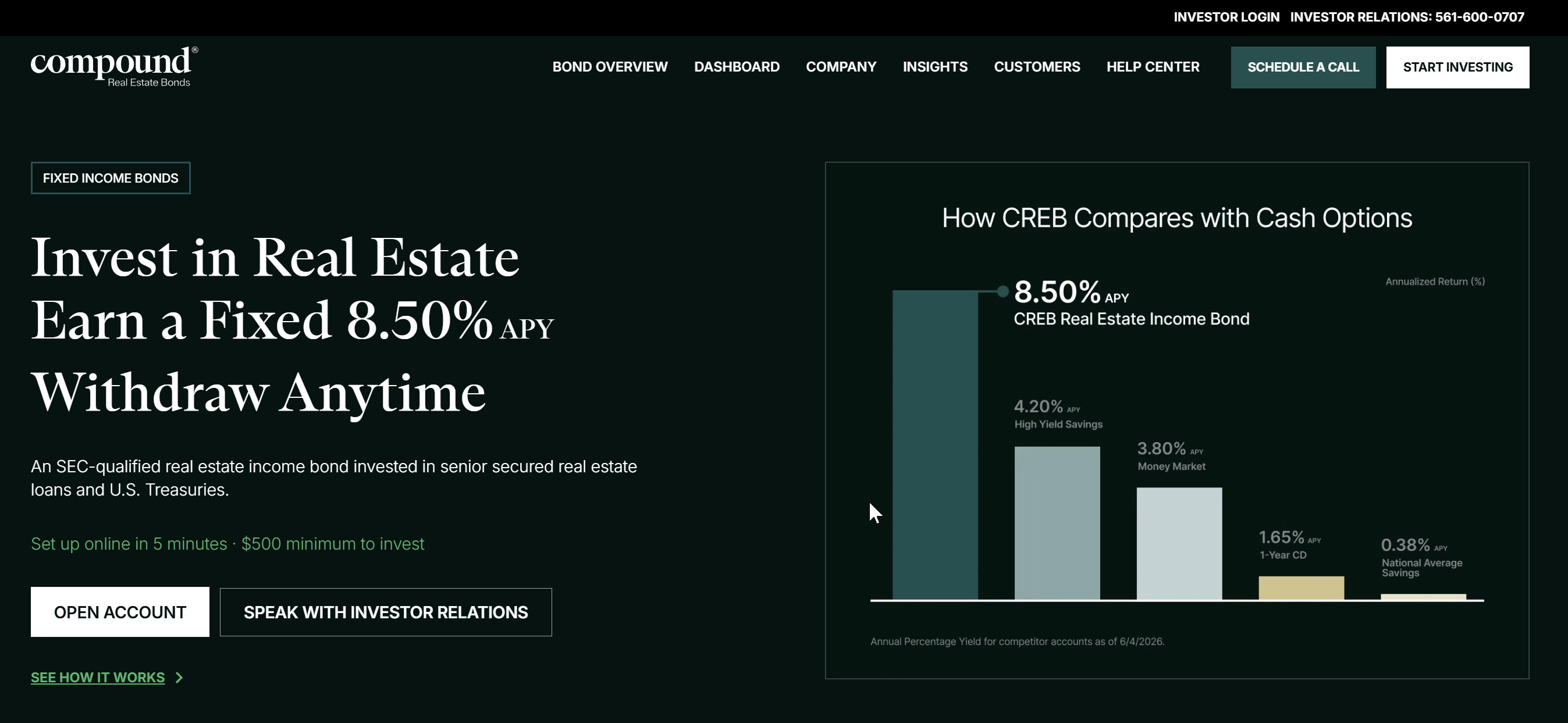
No platform response on record for this review. Is this your platform? Respond or claim it.
What the data actually shows - TL;DR
An 8.5% fixed-rate demand bond that has paid every redemption request, sold by a going-concern issuer whose loan income has never covered the coupon, whose bond is unsecured despite the marketing, and whose ownership and management sit with one owner and a small overlapping group. The numbers below are the filings as of September 2026, including the first issuer's semiannual report for the period ended June 30, 2026, filed September 28.
Fixed, compounded daily, on $10 unsecured demand bonds; 7% until April 3, 2024. Payable on request within 5 business days, or 30 business days if more than $50,000 is requested in 30 days. No maturity, no transfer without consent, issuer may prepay. The rate is credited by the issuer, not earned: bond interest exceeded total income at both issuers in every year.
Compound Real Estate Bonds, Inc. sold $40,042,080 to 5,811 investors from September 2022 until its offering terminated September 19, 2025; Compound Real Estate Bonds II, Inc. sold $27,121,100 from its qualification on September 18, 2025 to July 31, 2026. Redeemed: $25,844,330 (first issuer, to June 30, 2026) and $5,980,210 (second, to July 31, 2026). Outstanding with interest: $14,396,506 and $21,870,885.
Combined net loss of the two issuers in their latest fiscal years: $1,422,572 (first issuer, 2025) and $1,376,417 (second, year to June 30, 2026), on total income of $1,625,212 and $91,964 against bond interest of $1,766,965 and $693,190. Shareholders' deficits of $3,047,892 and $1,376,417. Going-concern paragraph in every audit report since 2021.
Share of the first issuer's $9.7 million loan book in one $5,466,612 first-lien loan on an industrial property in Ontario at June 30, 2026 (64.2% of the year-end 2025 book, at $7,466,612). The second issuer's $3.5 million book at July 31, 2026 was 36% one Ontario loan and 27% one Florida loan; 70% of it was originated by an affiliate. No defaults, issuer-stated. The first issuer's book shrank through repayment rather than new lending: origination and other fees earned fell from $191,547 in the first half of 2025 to $1,074 in the first half of 2026.
Minimum first purchase per the current circular versus the site's headline. The site also says 'Senior Secured First-Liens' (the bond is unsecured); '10,000+ investors' (not reconcilable to the filings, which count 5,811 for the first issuer and give no figure for the second); and '$150M Bond Offerings to Date' (the aggregate maximum size of the two offerings; approximately $67.2 million reported sold per the September 2026 circular).
Sources: SEC EDGAR filings of CIKs 0001919204, 0002078250 and 0002084856 (all figures as filed, whole dollars; where the two issuers' filings disagree both are given); compoundrealestatebonds.com captured September 25, 2026; BBB, Trustpilot and Google Play the same day. Company-stated figures attributed as such throughout.
What's Actually Happening
In plain English, here is what is actually happening.
- 1You lend $10 a bond to a small single-purpose Florida corporation, run from its administrator's leased Manhattan office, at 8.5% a year, credited daily, and you can ask for it back any time. If you ask for under $50,000, the company promises to pay within five business days; over that, within thirty.
- 2The company lends your money out as short-term mortgages on commercial and residential property, mostly in Ontario and Florida, at 10% to 13%, and keeps some of it in Treasury bills. So far the mortgages have not earned enough to pay your 8.5%; the company has necessarily relied on the cash it holds, its affiliates and continuing bond sales to cover the difference.
- 3Your bond is not secured by those mortgages or by anything else. If the company fails, you are a general creditor of a corporation with negative net worth. The site's 'senior secured' label describes the company's loans, not your bond.
- 4Every audit of the original issuer since FY2021 has carried substantial-doubt language, and the second issuer's first audit did too. The company's own explanation is that if too many people withdraw at once it would need its parent to put money in, and the parent has not promised to.
- 5No realized principal loss is disclosed on any completed redemption; every withdrawal on the record has been paid. Worthy sold a similar demand-bond structure, paid withdrawals for four years and then stopped.
- 6There is no broker, custodian, independent director or trustee. The founder owns the whole group, her son is on both issuer boards, and the same three officers run every entity. The fees are zero to you because the parent keeps everything the loans earn above 8.5%, which so far has been less than nothing.
Quick Verdict
Is this platform right for you?
Compound Real Estate Bonds does what it says at the counter: a fixed 8.5%, credited daily, paid on request, no fee, $10 a bond, through a working app. What it does not say at the counter is on EDGAR: the bond is an unsecured obligation of a corporation with negative equity, the loans have not earned the coupon in any year, every audit of the original issuer since FY2021 and the second issuer's first audit have carried substantial-doubt language, the book is concentrated in one Canadian industrial property, and the owner of the parent, with the same small management group, controls every entity the money passes through.
Read the full assessmentShow less
The marketing overstates the security and the minimum, and quotes an investor count and an offering volume the filings cannot confirm. The record to date is clean: no missed redemption, no loan default disclosed, no regulator, no lawsuit. The structure is similar to the one that failed at Worthy; the difference so far is that this operator's sales have kept up with its withdrawals.
Best for
- Investors who understand they are lending unsecured to a small, single-owner lender and want a fixed rate with daily access, in an amount they could tolerate having paused
- Holders who will read the issuer's 1-K and 1-SA on EDGAR twice a year and test a redemption before adding
- Nobody who needs the money on a date certain
Avoid if
- You read 'senior secured' or 'backed by real estate' as a description of your bond; it is a description of the company's loans, and the bond is unsecured
- You are comparing it to a savings account; the terms of service state it is 'not a deposit account' and the filings state the parent has no obligation to fund redemptions
- You need the issuer to have earned its coupon before you rely on it; on the filed income statements it never has
- You want an independent party (custodian, trustee, broker-dealer, independent director) anywhere in the structure; there is none
Top strengths
- Every redemption request on the record has been honored, at five business days or better by the company's account, across $31.8 million of redemptions since 2022; no realized principal loss is disclosed on any completed redemption
- Audited annual and semiannual filings on both issuers that disclose the going-concern doubt, the interest coverage gap, the loan concentration and the affiliate balances
- No investor-side fee of any kind; the coupon is the whole of the investor's economics and it has been credited at 7% and then 8.5% since 2022
- No enforcement action, lawsuit or regulator finding located; one BBB complaint in three years; Google Play 4.3 on 212 ratings
Key limitations
- Unsecured demand notes marketed as senior secured; a $1,000 minimum marketed as $500; a 10,000+ investor claim the filings cannot confirm (5,811 disclosed for the first issuer, none for the second)
- Going-concern paragraph in every audit since inception at both issuers; interest expense above total income in every year; combined deficits of $4.4 million on $96,249 of paid-in capital
- Single-loan concentration of 56% to 64% of the first issuer's book and 36% and 27% of the second's, in Ontario and Florida, with 70% of the second issuer's loans originated by an affiliate
- One owner, one overlapping management group, no employees, no custodian, three auditors in four years at the first issuer, and a parent that may charge a 2% platform fee at its discretion and keeps all profit above the coupon
Where It Fits
Where Compound Real Estate Bonds fits relative to the alternatives.
Fee-free demand bond from a single-purpose lender
If you want
A fixed rate, daily access, $10 increments, an app
Use
Compound Real Estate Bonds, the model this review covers; and Worthy Property Bonds, a similar demand-bond structure at 6.5% from an operator whose earlier programs stopped paying
Dated, secured real estate notes with a loan-level record
If you want
To know which loan you hold, its lien, its maturity and how the platform's book has performed
Use
Groundfloor (see AltStreet's review): $10 per-loan notes with 4,357 filed loan cards and a published default and repayment history
Direct-issuer corporate bonds with Exchange Act reporting
If you want
A retail bond from an issuer that files 10-Ks and 10-Qs and has never missed a payment on the record
Use
Phoenix Capital Group (see AltStreet's review), with its own leverage and governance findings
A deposit account
If you want
Principal that cannot be lost and access that cannot be paused
Use
An FDIC-insured high-yield savings account or a Treasury bill ladder; the bonds are explicitly 'not a deposit account' and 'not FDIC insured' in the company's own terms
Compare Before Deciding
Where Compound Real Estate Bonds fits against alternatives
Use these hooks to pressure-test whether this is the right platform, or whether a nearby alternative matches the job better.
How this compares to Worthy
Worthy
A similar $10 demand-bond structure from an operator whose earlier programs stopped redeeming and were dissolved; the failure mode Compound has not shown.
How this compares to Phoenix Capital Group
Phoenix Capital Group
A direct retail bond issuer with Exchange Act reporting and no missed payment located; the disclosure standard Compound's Regulation A filings do not reach.
How this compares to Groundfloor
Groundfloor
Per-loan, dated, first-lien notes with a filed loan-level record of 4,357 series; the transparency and maturity discipline a pooled demand bond lacks.
Overview
Platform Overview
A concise read on what the platform is, how the structure works, and where the practical friction shows up for real investors.
Direct retail sale of $10 unsecured demand bonds at a fixed 8.5% APY by wholly owned Regulation A Tier 2 issuers of Compound Real Estate Holdings, Inc., through the parent's website and app, with proceeds lent as short-term first-lien real estate bridge loans in Ontario, Florida and other states and held in Treasury bills. Bonds are repayable on request within five business days (thirty above $50,000 in a 30-day window), carry no maturity and are not transferable without consent. Two issuers: Compound Real Estate Bonds, Inc. (sold 2022 to September 2025, bonds outstanding) and Compound Real Estate Bonds II, Inc. (selling since September 2025).
(Delaware; file 024-11848; qualified September 19, 2022; sales ended September 19, 2025; bonds still outstanding) and Compound Real Estate Bonds II, Inc. (Florida; file 024-12644; qualified September 18, 2025; selling). Each issuer lends its proceeds as short-term first-lien bridge loans through a wholly owned lending LLC (Compound Lending, LLC and Compound Lending II, LLC) and holds the balance in Treasury bills and cash, relying on the Investment Company Act's mortgage exclusion. Bonds are $10, pay 8.5% compounded daily, have no maturity, are repayable on request within five business days (thirty above $50,000 in a 30-day window), are not transferable without the issuer's consent and are unsecured.
The parent supplies the website and app, the administrator that employs all staff, and the officers; the bonds are sold without a broker-dealer. The brand was Compound Banc until a rename; the app's package name still carries it.
Platform Model
Direct issuer of retail demand bonds (no marketplace, no broker-dealer); parent-owned app and administrator
Primary Function
Raise unsecured debt from retail investors and lend it as short-term first-lien real estate bridge loans
Target Users
U.S. residents 18 and over; non-accredited investors limited to 10% of the greater of income or net worth; IRA accounts through Equity Trust
Instrument
$10 unsecured demand bonds, 8.5% compounded daily, no maturity, 5 or 30 business day repayment, non-transferable, amendable by a majority of principal
Verification Strategy
Regulation A Tier 2: audited annual (1-K) and unaudited semiannual (1-SA) reports on each issuer; single-practitioner auditors; going-concern paragraphs
Investment Structures
Two Reg A bond programs (2022 and 2025); an affiliate Rule 506(c) gold-bond offering not sold on the platform
ASHow It Works
- Investors buy bonds in $10 increments through the app after Plaid identity and bank verification; interest accrues from the day the subscription is accepted and is credited daily to the account balance, where it compounds
- The issuer lends the proceeds through its lending LLC as one-year interest-only bridge loans at 10% to 13%, first lien, target 50% to 60% loan-to-value, in Ontario, Florida and other states; the balance sits in Treasury bills and bank accounts
- The investor's return is the coupon; the issuer's return is the spread; the parent takes any profit above the coupon and may charge a 2% license fee; the administrator is reimbursed at cost. On the filed statements the spread has been negative every year
- Redemption is a promise to pay within five business days from whatever cash the issuer holds; there is no reserve requirement, no trustee and no parent guarantee
- Interest is reported on Form 1099-INT; the issuers are C corporations that have paid no income tax
Key Gaps & Non-Disclosures
- Investor count for the current issuer and the basis for the site's '10,000+', which only the second issuer's undisclosed count could reconcile
- Loan-level performance, borrower identity and the affiliate originator's terms
- Redemption timing data and the parent's financial capacity to fund shortfalls
Platform Intelligence
Compound Real Estate Bonds timeline
Key platform events, regulatory turns, liquidity stress points, and product launches that shape how the review should be read.
Parent formed
Compound Real Estate Holdings, Inc. incorporated in Florida on September 28, 2021, owned 100% by Inderjit Tuli; the first issuer incorporated in Delaware on November 2, 2021 and renamed Compound Real Estate Bonds, Inc. on March 11, 2022.
Administrator and lender formed
Compound Administrative Services LLC (March 15) and Compound Lending, LLC (March 16) formed; the Administrative Services Agreement signed March 17, 2022, not at arm's length by the filings' own account.
First offering qualified at 7%
Form 1-A qualified September 19, 2022 (file 024-11848) for $75 million of $10 bonds at 7%; first offering circular September 20, 2022; minimum $10; sold as Compound Banc.
First auditor dismissed
Integritat Audit, Accounting & Advisory dismissed February 1, 2024 after going-concern reports on FY2021 and FY2022; Ernest L. Tomkiewicz CPA PLLC engaged (1-U April 1, 2024).
Rate raised to 8.5%
Interest increased from 7% to 8.5% APY effective April 3, 2024 (1-U April 1, 2024); bonds outstanding rose from $1.4 million at year-end 2023 to $12.2 million at year-end 2024.
First loans made
Compound Lending, LLC commenced operations October 26, 2024, two years after bond sales began; $2.2 million of mortgages at year-end 2024, $12.4 million a year later.
Second issuer formed
Compound Real Estate Bonds II, Inc. incorporated in Florida June 18, 2025; Compound Lending II, LLC July 11, 2025; Form 1-A filed July 23, 2025.
Second offering qualified; first terminated; gold affiliate files
Compound Real Estate Bonds II qualified September 18, 2025 (file 024-12644, $75 million, $1,000 minimum); the first issuer's offering terminated September 19, 2025 at the end of its three-year term; Compound Gold Bonds Corp filed a Form D on September 8, 2025 for a 506(c) debt offering ($763,000 from 25 investors).
Second auditor dismissed
Ernest L. Tomkiewicz CPA PLLC dismissed January 1, 2026; Umair AK CPA LLC of Sugar Land, Texas engaged February 19, 2026. No disagreements reported.
FY2025 annual report: going concern, coverage gap, concentration
First issuer's 1-K filed April 30, 2026: income $1,625,212, bond interest $1,766,965, net loss $1,422,572, deficit $3,047,892, one Ontario loan 64.2% of the book, $4.1 million owed to affiliates; 'substantial doubt about the Company's ability to continue as a going concern.'
Second issuer's first audit and amended circular
1-K for the year to June 30, 2026 filed September 3 (net loss $1,376,417, bonds $20.5 million, loans $3.2 million, going concern); amended offering circular September 21, 2026 reporting $27.1 million sold and $5.98 million redeemed by July 31.
First issuer semiannual report: the reserve is gone
1-SA filed September 28, 2026 for the six months to June 30, 2026: Treasury bills $4,980,679 to zero, cash $1,673,563 against $14,325,182 of demand bonds, net bond flow $(4,682,603) against $7,721,639 a year earlier, liabilities exceeding assets by $3,267,516, advertising zero, origination fees $1,074, and $1,547,663 of redemptions paid by an affiliate on the company's behalf.
AltStreet review
All 70 filings of both issuers read; site captured; legal scan run: no enforcement, no lawsuit, every redemption honored, bond unsecured, coupon uncovered, going concern since inception.
Investment Structures
Compound Real Estate Bonds II, Inc. bonds (on sale)
$10 unsecured demand bonds at 8.5% compounded daily, qualified September 18, 2025 under file 024-12644 for up to $75,000,000 ($74,800,000 for cash and $200,000 as referral rewards; none issued as of September 21, 2026), offering ends September 18, 2028 unless extended. Minimum first purchase $1,000, any amount after. Repayable within 5 business days of request, or 30 business days if more than $50,000 has been requested in 30 days; issuer may prepay at any time; no transfer without consent.
Sold $27,121,100 by July 31, 2026, redeemed $5,980,210, outstanding $21,870,885 with interest. Lending began April 1, 2026 through Compound Lending II, LLC: $3.5 million of loans at July 31, 2026, 36% in one $2,000,000 Ontario industrial loan (LTV 50%) and 27% in one $1,500,000 Florida residential loan (LTV 38%), 70% originated by an affiliate at 12% to 13%. First fiscal year to June 30, 2026: income $91,964, bond interest $693,190, net loss $1,376,417, total assets $19,761,427, bonds $20,496,129, shareholders' deficit $1,376,417, going-concern paragraph.
Compound Real Estate Bonds, Inc. bonds (closed to new sales; outstanding)
The original program: $10 bonds at 7% from September 20, 2022, raised to 8.5% APY effective April 3, 2024, minimum $10, file 024-11848, qualified September 19, 2022 and amended thirteen times. Sold $40,042,080 to 5,811 investors; the FY2025 annual report states the offering terminated September 19, 2025 and no new capital is being raised, while the second issuer's September 2026 circular describes it as still ongoing. Redeemed $25,844,330 (2,584,433 bonds from 3,433 investors) by June 30, 2026; 1,419,775 bonds outstanding, $14,396,506 with interest, still repayable on demand.
Lending began October 26, 2024 through Compound Lending, LLC and two SPVs: $12,396,287 of mortgages at December 31, 2025 with 64.2% of the loan book in one $7,466,612 Ontario industrial loan (LTV 50%); $9,726,287 at June 30, 2026 with 56% in that loan at $5,466,612; average LTV 55%, loans at 10% to 13%, collateral in Ontario, Florida, New York, Pennsylvania and Georgia; no defaults, issuer-stated. FY2025: income $1,625,212, bond interest $1,766,965, net loss $1,422,572, total assets $20,404,504, bonds $19,007,784, due to related parties $4,065,072, deficit $3,047,892, going-concern paragraph; the same paragraph has appeared in every audit since FY2021.
Compound Gold Bonds Corp (affiliate; not offered on the platform)
A Florida corporation under common ownership, named as a related party in both issuers' financial statements (the first issuer owed it $413,980 at December 31, 2025). It filed a Form D on September 8, 2025 for a Rule 506(c) offering of debt securities of indefinite size: $763,000 sold to 25 investors at a $1,000 minimum, with 'Harminder Tuli' listed as executive officer. What it sells and how it relates to the bond issuers is not disclosed in any filing read; the site does not mention it.
Risk
Risk Structure
This is where the marketplace pitch gives way to the actual operating reality: delayed exits, limited disclosure, fee drag, and path-dependent outcomes.
Demand Liabilities Funding Term Loans, With No Reserve and No Guarantee
Both issuers borrow on demand and lend for a year. The circular's own words: 'This planned pairing of assets and liabilities creates the possibility of more investors requesting withdrawals than we have readily available in liquid assets, which could force us to borrow money or seek to liquidate Real Estate assets on disadvantageous terms.' There is no reserve requirement; the parent 'is under no contractual obligation to advance any such funds.' The five-business-day covenant has been kept on every request to date.
Going-Concern Paragraphs in Every Audit Since Inception
Three different audit firms have written the same explanatory paragraph on the first issuer for FY2021 through FY2025, and a fourth on the second issuer for FY June 2026. Management's note: 'The Company has not yet generated sufficient revenues to fully cover all principal and interest obligations on its outstanding bonds from operating cash flow alone.' The first issuer has $96,249 of paid-in capital against $3,144,141 of accumulated losses; the second has none against $1,376,417.
One Owner, One Management Group, Every Entity
Inderjit Tuli owns 100% of the parent and is president, chief executive and director of the parent, both issuers, the administrator and both lending LLCs; Harminder Singh Burmi is chief financial officer and director of all of them; John Tuli, her son, is a director of both issuers. The Administrative Services Agreement 'was not negotiated on an arms-length basis'; the issuers may trade assets with each other on non-arm's-length terms; the chief executive's separate firm, Junzi Capital Group, advises real estate firms that may compete with the issuers. The circular discloses that the officers have 'limited direct experience making real estate investments.'
Marketing That Overstates the Bond
The September 2026 site describes the bond's security as 'Senior Secured First-Liens' and the minimum as $500, while the circular says unsecured and $1,000. Its 10,000+ investor count cannot be reconciled to the filings, which disclose 5,811 for the first issuer and none for the second, and its '$150M Bond Offerings to Date' is the aggregate maximum size of the two offerings against approximately $67.2 million reported sold. The site's disclosures box and the terms of service ('not a deposit account', 'not FDIC insured') are accurate; the headlines above them are not.
Redemption Suspension
The design is a demand note on an illiquid book with cash, new sales and the parent's discretion as the only sources of repayment; the first issuer held $6.8 million of liquid assets against $19.3 million of bonds at year-end 2025.
Why it matters
Worthy sold a similar demand-bond structure, paid every request for four years, then suspended three of five programs and dissolved two with $12.66 million unpaid. Compound's filings describe the same exposure and the same absence of a fix.
Mitigation / verification
Test a redemption of a meaningful amount and record the settlement time before adding. Read each 1-K and 1-SA on EDGAR (CIKs 0001919204 and 0002078250) for liquid assets against bonds outstanding. Hold no more than you could have paused indefinitely.
Loss on an Unsecured Claim
If either issuer cannot pay, the holder is a general unsecured creditor of a corporation with negative equity, behind any secured lender the issuer chooses to add, with no guarantee from the parent or any affiliate.
Why it matters
The site's 'senior secured' framing invites investors to price the bond as collateralized. The circular says the loans belong to the company and the bond is a claim on the company; in an insolvency 'we cannot assure you that you will recover any remaining funds.'
Mitigation / verification
Read 'Securities Being Offered' in the circular. Ask the company in writing whether any secured debt has been issued and what the lending SPVs owe to anyone else.
Single-Loan Concentration and Cross-Border Collateral
One Ontario industrial loan was 64.2% of the first issuer's book at year-end 2025 and 56% at mid-2026; the second issuer's first two loans were 63% of its book. Enforcement on Canadian collateral runs under Ontario law, which the filings note is unfamiliar to the officers.
Why it matters
A bond marketed as 'diversified' rests, at the first issuer, on one borrower's ability to refinance or sell one property. A default there would consume more than half the loan income that already fails to cover the coupon.
Mitigation / verification
Ask for the loan schedule with maturities and current status. Watch the next 1-SA for the Ontario loan's balance and any allowance; the allowance at year-end 2025 was $9,960 on $12.4 million.
Affiliate Dependence
Every function sits with the parent or an affiliate: the app, the staff, the origination of most loans, the allocation of loans between issuers, and the decision whether to charge a 2% platform fee or to fund a shortfall.
Why it matters
If the parent withdrew the platform, 'investors who purchase Compound Bonds in this offering would have difficulty purchasing additional Compound Bonds and/or redeeming their existing Compound Bonds.' The parent's finances are not disclosed anywhere.
Mitigation / verification
Treat the parent's capacity as unknown. Track the related-party payable in each 1-K ($4,065,072 at December 31, 2025; about $6,897,095 at March 31, 2026) as the measure of how much the issuer already owes the group.
Biggest Misconceptions & What Actually Happens
- No regulator has acted against any Compound entity or officer on the public record as of September 25, 2026, and no lawsuit was located. The going-concern doubts, the coverage gap and the affiliate dealings are disclosed in the issuers' own filings; the marketing gaps are between the site and those filings.
- Every redemption request on the record has been paid; the review's concern is what the payments are funded with, not whether they have been made.
- The two issuers are separate corporations. A holder of the first issuer's bonds has a claim on the first issuer only; the second issuer's cash is not available to the first, except through the affiliate balances the parent controls.
- The 'senior secured first-lien' language describes the mortgages the issuer holds. The bond is unsecured. Both statements are in the company's own materials.
- The first issuer's June 30, 2026 semiannual report had not been filed when this review was written; the figures for that date come from the second issuer's September 21, 2026 circular.
Regulatory & Legal Posture
Security Status
Security (Regulation A Tier 2 debt); issuer relies on the Investment Company Act Section 3(c)(5)(C) mortgage exclusion
Each issuer's Form 1-A offering statement was qualified by the SEC (September 19, 2022 and September 18, 2025). Qualification is not approval; Tier 2 requires audited annual and semiannual reports, which both issuers file, and caps non-accredited purchases at 10% of the greater of income or net worth. No broker-dealer, funding portal or investment adviser is registered; officers sell under Rule 3a4-1. The circular warns that if the mortgage exclusion were lost the issuer would be an unregistered investment company and 'could result in a large number of investors demanding repayment in a short period of time.'
Disclosure Quality
The filings are candid: going concern, coverage gap, concentration, affiliate terms and management's inexperience are all stated. The site is not: the security and the minimum are overstated, and the investor count and offering volume are stated in terms the filings cannot confirm. Read the circular, not the app.
Custody Model
No custodian; investor cash in the issuer's own bank accounts; bonds as book entries on the parent's platform
Regulatory Backing
Funds move by ACH through Plaid into the issuer's operational accounts and are 'either awaiting deployment into mortgage investments or represent liquidity held to honour redemptions'; balances above the FDIC limit are uninsured ($1,597,385 over at the first issuer at year-end 2025). There is no transfer agent, trustee or escrow. The Bond Purchase Agreement contains an arbitration clause and class-action waiver with a 30-day opt-out; the site's terms designate Palm Beach County, Florida.
Tax Treatment
Reporting
Form 1099-INT
Interest credited daily is ordinary interest income; the issuers state that investors with more than $10 of realized interest receive a Form 1099-INT after year-end. The issuers are C corporations with no income tax expense to date.
Income Character
Ordinary interest income
Daily compounding on a demand note means interest is credited to the account each day; whether it is taxable as credited or as paid depends on the holder's method and the issuer's reporting, which the filings do not detail beyond the 1099-INT statement.
Limitation
No state tax guidance is given. Canadian collateral does not change the U.S. tax character of the bond's interest. Consult a tax adviser on the timing of accrued-but-unpaid interest.
Special Considerations
- Interest is ordinary income at the holder's marginal rate; there is no capital-gain component and no depreciation pass-through
- Accrued interest on a demand bond that is later not paid is a loss question, not an income question; keep statements showing credited balances
- The referral program pays cash ($25 to $250) after 90 days; the circular's Bond Rewards Program issues bonds; either is likely reportable
Account Suitability
Taxable
Ordinary interest income; the daily-compounding statement makes the accrual visible and reportable.
Roth IRA
Offered through Equity Trust per the site. The bond is a debt security, not a collectible, so it is eligible in principle; the custodian's fees and the issuer's going-concern status are the considerations.
Traditional IRA
Same as Roth; interest would be tax-deferred, and an unsecured demand note with a going-concern issuer is a concentrated credit position for a retirement account.
HSA
Not mentioned by the platform.
Before You Invest
Get Compound Real Estate Bonds investor insights before you invest
K-1 timing, distribution updates, yield insights, and risk signals for Compound Real Estate Bonds and similar platforms.
- Weekly platform research focused on tax timing and liquidity reality.
- Signals on distributions, risks, and structural tradeoffs before capital is locked up.
- Coverage of adjacent platforms so you can compare better options faster.
Get weekly platform signals
Track fee changes, liquidity updates, risk flags, and adjacent platforms before you invest.
Independent intelligence from AltStreet. No hype. No sponsor spin.
AltStreet Data Layer
What the data actually shows
AltStreet read every filing of both issuers, the current circular and annual report in full, the site on the day of review and the affiliate's Form D, and set the marketing against the record. Read together, the filings describe a demand bond that has paid every request while loan income fell short of the coupon, so that existing liquidity, affiliate balances and continuing inflows necessarily carried the difference; issuers whose every audit has carried substantial-doubt language; and a site that describes a safer instrument than the one being sold.
The coupon has never been earned
Bond interest expense exceeded total income at the first issuer in 2024 ($360,065 against $77,550) and 2025 ($1,766,965 against $1,625,212) and at the second in its first year ($693,190 against $91,964). Cumulative losses are $3,144,141 at the first issuer on $96,249 of paid-in capital and $1,376,417 at the second on none. Both have negative equity.
What this means
The 8.5% is a liability the issuer has chosen to incur; with loan income short of it, the payments have necessarily rested on existing liquidity, affiliate balances and continuing capital inflows. That is not a fraud finding; it is what a start-up lender's income statement looks like, and it is what a bondholder is lending into.
Every redemption has been paid, from a liquidity position the filings call insufficient for a run
$31.8 million redeemed across both issuers since 2022 with no missed or delayed payment on the record. What paid for it is now visible. At December 31, 2025 the first issuer held $6,828,064 of cash and Treasury bills against $19,345,217 of bonds and interest; at June 30, 2026 it holds $1,673,563 of cash and no Treasury bills against $14,396,506, having liquidated the reserve and taken $1,547,663 of redemption funding from an affiliate.
The second issuer held $16,767,293 against $21,870,885 at July 31, 2026, with $3.5 million already lent and the rest to follow, which is the same sequence one stage earlier. The circular: 'we would not be able to satisfy investor redemption requests if all our investors were to simultaneously seek to redeem their bonds.'
What this means
The promise is a cash position, not a right. It has held while sales exceeded withdrawals; the first issuer's bonds outstanding fell from $19.0 million to $14.4 million in the six months after its offering closed, which is the direction a closed program runs.
The website describes a secured bond; the circular describes an unsecured one
Home page: 'Security: Senior Secured First-Liens.' About page: 'every bond is collateralized by senior-secured loans on real U.S. real estate.' Circular: 'The Bonds are unsecured general obligations of the Company...
We may issue secured debt in our sole discretion without notice to or consent from the holders of Bonds.' The site's disclosures box: 'Unsecured bonds: Not backed by specific pledged assets.'
What this means
An investor who reads the app and not EDGAR prices a collateralized note. The collateral belongs to the issuer, and the issuer may pledge it to someone else. The minimum ($500 versus $1,000) is overstated in the same direction; the investor count (10,000+ against 5,811 disclosed for one issuer and none for the other) cannot be reconciled to the filings, and the '$150M' headline is offering capacity, not the approximately $67.2 million sold.
Most of the book is one property in Ontario
A single first-lien loan on an industrial property in Ontario was 72.6% of the first issuer's loan portfolio at March 31, 2025 (June 2025 circular), 64.2% at December 31, 2025 ($7,466,612) and 56% at June 30, 2026 ($5,466,612). The second issuer's first two loans, one Ontario industrial and one Florida residential, were 63% of its book at July 31, 2026. Enforcement on the Ontario collateral runs under Canadian law; the filings say the officers have limited experience with it.
What this means
A product marketed as 'diversified' across 'North America' is, at the issuer that has been lending longest, one borrower and one building for more than half its income. The allowance for credit losses at year-end 2025 was $9,960.
Going concern in every audit since inception, from four different auditors
Integritat (FY2021, FY2022), Tomkiewicz (FY2023, FY2024), Umair AK CPA LLC (FY2025) and, on the second issuer, Joseph Komolafe, CPA LLC (FY June 2026) each included an explanatory paragraph on substantial doubt. Two auditor changes in two years, with no disagreements reported.
What this means
Four auditors reaching the same conclusion across five fiscal years is stronger evidence than one; the changes of auditor are a fact to watch, not a finding, and the filings give no reason for them.
One owner, one management group in every seat, and a parent with no obligation
The chief executive owns the parent outright and, with the chief financial officer and her son, the same three people hold every officer and director seat at the parent, both issuers, the administrator and both lending LLCs. The administrator is reimbursed under a contract 'not negotiated on an arms-length basis' and was owed $3,325,004 at year-end 2025; 70% of the second issuer's loans came from an affiliate; the parent may charge 2% of sales and keeps all profit above the coupon; the parent 'is under no contractual obligation' to fund redemptions.
What this means
There is no independent check anywhere in the chain from deposit to loan, and the one entity that could fund a shortfall has neither promised to nor disclosed whether it could.
The two issuers' filings do not agree with each other
The first issuer's 1-K (April 30, 2026) says its offering terminated September 19, 2025 and reports 4,134,718 bonds sold to March 31, 2026. The second issuer's circular (September 21, 2026) says the first offering 'is still ongoing' and reports 4,004,208 bonds sold by the first issuer to June 30, 2026, 130,510 fewer than the earlier date.
What this means
Either a cumulative count was restated without explanation or the two documents were prepared from different ledgers. The review uses each figure with its source and treats the gap as a reporting-quality finding.
No regulator has acted, and the record is on file
AltStreet's scan of SEC, FINRA, state and court records reachable by search found no action involving any Compound entity or officer as of September 25, 2026. Both issuers file audited annual and semiannual reports that disclose the going-concern doubt, the coverage gap, the concentration and the affiliate terms.
What this means
Regulation A's compliance model is disclosure, and the issuers have complied. The absence of an action is not a finding that the structure is sound; the presence of a complete filing record is what allowed this review to be written.
Data as of 2026-09-25 . AltStreet review evidence layer . Public-source analysis
Full datasetDecision Fit
Investor Fit
Who this works for, who it does not, and what level of patience and complexity tolerance the platform really demands.
retail
The product is built for retail: $10 bonds, an app, daily interest, a $1,000 first purchase and no fee. The fit is neutral rather than poor because the record is clean and the filings are candid; it is neutral rather than good because the bond is unsecured, the issuer has never earned the coupon and a similar structure has failed elsewhere. Size it as a speculative fixed-income position, not a savings account.
institutional
No custodian, trustee, independent director, loan-level reporting or negotiated terms; a $36 million book concentrated in a handful of loans; a parent whose finances are not disclosed. Nothing here meets an institutional credit process.
Investors Seeking Financial Returns
8.5% fixed with daily access is the entire return; there is no upside and the downside is an unsecured claim. The rate is one the issuer chose to credit, not a yield the loan portfolio has produced; on the filed income statements it never has.
ESG / Climate SaaS Providers
Not an ESG or embedded product; a direct retail bond.
Tradeoffs
Key Tradeoffs
The attraction of pre-IPO access is real, but every benefit comes bundled with a corresponding liquidity, transparency, or pricing cost.
8.5% Fixed vs Coverage
The coupon is fixed, credited daily and above every bank rate; the issuers' total income has covered 92% of it (first issuer, 2025: $1,625,212 against $1,766,965) and 13% of it (second issuer, FY2026: $91,964 against $693,190), with the rest necessarily met from existing liquidity, affiliate balances and continuing inflows.
Daily Access vs Demand Structure
Five-business-day repayment on request has been honored on every request; the same structure gives the issuer no maturity to plan around and no reserve to draw on when requests exceed cash.
No Fees vs Affiliate Economics
Zero investor fees and zero commissions; the issuer reimburses the parent's administrator at cost, may pay the parent 2% of sales, and cedes all profit above the coupon, so 'we earn when you earn' means the parent earns only if the loans outperform the coupon, which they have not.
Real Estate Collateral vs Unsecured Bond
The loans are first liens at 38% to 70% loan-to-value; the bondholder's claim is on the issuer, ranks with all its other unsecured debt and behind any secured debt it later issues.
Regulation A Disclosure vs Regulation A Protection
Audited reports twice a year that state the going-concern doubt and the concentration; no capital requirement, trustee, reserve or obligation to redeem behind them.
Avoid
Who This Is Not For
This section should be read as a filter, not an afterthought. If you need income, simplicity, or near-term access to capital, the structure is working against you.
Savers Replacing a Bank Account
The terms of service say it: 'Compound is not a bank or depository institution... not insured by the Federal Deposit Insurance Corporation.' An 8.5% demand note from a going-concern issuer is a credit position, not a deposit.
Investors Who Need a Date
There is no maturity. Repayment is at the issuer's cash position on the day you ask, with a promise of five business days that the issuer can keep only while it has the cash.
Anyone Relying on 'Senior Secured'
The bond is unsecured. If the collateral matters to your decision, this is not the instrument that gives it to you.
Retirement Accounts Seeking Preservation
Eligible through Equity Trust, and an unsecured note from an issuer with negative equity and a going-concern paragraph is a speculative allocation for capital that cannot be replaced.
Editorial View
AltStreet Perspective
The compressed version of the review: what matters, what marketing tends to obscure, and how we would frame the platform for a serious allocator.
Verdict
A working product with a clean payment record, built on issuers that have never earned their coupon, disclosed in filings that say so, and sold by a site that says something else. The promise has held for four years; the filings describe exactly how it would stop.
Positioning
Best understood alongside Worthy, with the record still intact: a similar $10 demand-bond structure, the same direct sale without a broker, the same going-concern paragraphs, the same concentration of every function in one management team. The differences are a higher coupon, a smaller and younger loan book, a single-owner structure and marketing that overstates the security of the bond. The right comparison for a buyer is not a savings account but an unsecured note from a small, thinly capitalized lender with a parent that has not promised to stand behind it.
The Bottom Line
An 8.5% demand bond that has paid everyone so far, from an issuer whose own auditors doubt it can keep going; unsecured, concentrated and controlled by one owner, whatever the app says.
Action
Next Steps
If you still want to engage after reading the review, these are the practical next moves that reduce avoidable mistakes.
Read 'Securities Being Offered' and 'Risk Factors' in the September 21, 2026 circular (EDGAR, CIK 0002078250) and confirm for yourself that the bond is unsecured and that the parent has no obligation to fund redemptions.
Read the first issuer's Form 1-SA for the period ended June 30, 2026 (CIK 0001919204, filed September 28, 2026) before anything else: the balance sheet, the cash flow statement's 'Net Receipts from issuing bonds' line and Note 9 on related parties. Then read its FY2025 annual report (filed April 30, 2026) for the going-concern note, the interest coverage line and the Ontario loan concentration.
Before adding, test a redemption of an amount that matters to you and record the days from request to cash in your bank.
Ask investor relations in writing for: the current number of bondholders in the second issuer, the loan schedule with maturities, the identity of the affiliate originator and the pricing of loans bought from it, and whether any secured debt has been issued.
Compare the terms to Worthy Property Bonds (similar demand-bond structure, 6.5%, going concern, three sister programs stopped paying) and to Groundfloor's dated, per-loan notes before choosing the structure.
Size the position to what you could tolerate having paused indefinitely; that is the failure mode a similar structure has shown elsewhere.
Final Answer
What this means for your decision.
Finding
The bond is unsecured; the site says senior secured
Meaning
The home page lists 'Security: Senior Secured First-Liens' and the about page says every bond is 'collateralized by senior-secured loans.' The offering circular says the opposite about the bond itself: 'The Bonds are unsecured general obligations of the Company... We may issue secured debt in our sole discretion without notice to or consent from the holders of Bonds.' The first-lien language describes the loans the issuer makes, not the claim the bondholder holds. The site's own disclosures box, lower on the same page, says 'Unsecured bonds: Not backed by specific pledged assets.'
Action
Price this as what it is: an unsecured demand note of a single-purpose corporation with negative equity, whose loans are the collateral for nobody but the corporation.
Finding
The coupon has never been covered by the loan book
Meaning
In 2025 the first issuer earned $1,428,665 of interest and owed $1,766,965 to bondholders; in its first year the second issuer reported $91,964 of total income, of which only $19,047 was mortgage interest, against $693,190 of bond interest. Both lost money and both have negative equity; every audit of the first issuer since FY2021 has carried substantial-doubt language, and the second issuer's first audit did too. Because operating income has not covered bond interest, the issuers have necessarily depended on existing liquidity, affiliate balances and continuing capital inflows beyond current loan income to meet all obligations, which is the exposure the going-concern notes describe.
Action
Treat the 8.5% as a rate the issuer has chosen to credit, not a rate the assets have produced. Ask how it will be paid in a year when sales slow.
Finding
Every redemption has been honored, on the record, so far
Meaning
The first issuer had redeemed 2,584,433 bonds ($25.8 million) from 3,433 investors by June 30, 2026 and the second 598,021 by July 31, 2026, and both state every request has been met within the five or thirty business days the bond allows. The same filings state that neither could meet simultaneous requests: the first held $6.8 million of liquid assets against $19.3 million of bonds at year-end 2025, the second $16.8 million against $21.9 million at July 31, 2026, with the gap set to widen as cash becomes loans.
Action
The five-day promise is real while the cash lasts and is a policy, not a reserve. Size any position to what you could afford to have paused, as happened at Worthy on a similar demand-bond structure.
Finding
One owner and a small overlapping management group control every entity on both sides
Meaning
The chief executive owns 100% of the parent, her son sits on both issuer boards, and the same three officers run the parent, both issuers, the administrator that employs every worker, both lending subsidiaries and an affiliate gold-bond company. The circular states that the two issuers may buy and sell assets from each other on non-arm's-length terms, that 70% of the second issuer's loans were originated by an affiliate, and that the officers have 'limited direct experience making real estate investments.'
Action
There is no independent director, custodian, trustee or broker-dealer between your money and the operator. The disclosure is candid; the structure is the risk.
If you read nothing else
Compound Real Estate Bonds has a demand-bond structure similar to Worthy's, with the record still intact: a fee-free 8.5% demand note that has paid everyone who asked, issued by companies that lose money, carry going-concern paragraphs and hold a concentrated, affiliate-originated loan book. The site says senior secured and a $500 minimum; the filings say unsecured and $1,000. The site's 10,000+ investors cannot be reconciled to the public record, which counts 5,811 for the first issuer and nothing for the second. Whether the promise keeps being kept depends on new sales and the parent's willingness to fund shortfalls, and the parent has no obligation to.
AltStreet Research Desk
About to invest in Compound Real Estate Bonds, or in an offering we haven't covered?
Commission an independent diligence report: the same filing-based analysis behind this review, applied to the specific investment in front of you before you wire the money.
- Built from primary sources: SEC filings, court records, capital structure, and marketing-versus-filings comparison.
- From $750; full reports from $1,495. Fixed price confirmed up front, delivery in 3-5 business days.
- Independent by design: we work for investors and accept no compensation from the companies we cover.
Want this on every new deal, not one? Deal Intelligence sends the alert the day a new offering appears on a covered platform and follows with an analyst-approved investment committee memo.
Deal Intelligence →Appendix
Sources, Disclosures, and Supporting Context
The lower section is structured like a report appendix: relationship context first, adjacent reading second, and evidence last.
Report Appendix
Disclosure
Relationship and compensation context
+
Report Appendix
Disclosure
Relationship and compensation context
Report Appendix
Comparison Guides
Head-to-head guides featuring Compound Real Estate Bonds
+
Report Appendix
Comparison Guides
Head-to-head guides featuring Compound Real Estate Bonds
Report Appendix
Related Resources
Adjacent platform comparisons, frameworks, and category links
+
Report Appendix
Related Resources
Adjacent platform comparisons, frameworks, and category links
Further Reading
Related Resources
Adjacent frameworks and reviews that help place the platform in a broader allocation or due-diligence context.
Fund Landscape
Similar Platform Reviews
- Worthy
A similar $10 demand-bond structure from an operator whose earlier programs stopped redeeming and were dissolved; the failure mode Compound has not shown.
- Phoenix Capital Group
A direct retail bond issuer with Exchange Act reporting and no missed payment located; the disclosure standard Compound's Regulation A filings do not reach.
- Groundfloor
Per-loan, dated, first-lien notes with a filed loan-level record of 4,357 series; the transparency and maturity discipline a pooled demand bond lacks.
Report Appendix
Related Coverage
AltStreet newsroom articles on Compound Real Estate Bonds filings and disclosures
+
Report Appendix
Related Coverage
AltStreet newsroom articles on Compound Real Estate Bonds filings and disclosures
- Compound Real Estate Bonds Sold Its Entire Treasury Reserve to Pay Redemptions, and an Affiliate Covered $1.5 Million MoreSep 29, 2026
The 8.5% demand-bond issuer's semiannual report shows Treasury bills at zero, down from $4.98 million, cash of $1.67 million against $14.3 million of bonds repayable on five days' notice, and a related party that paid bondholder redemptions on the company's behalf.
Report Appendix
Tracked Offerings
1 Compound Real Estate Bonds offerings with disclosed terms in the AltStreet database
+
Report Appendix
Tracked Offerings
1 Compound Real Estate Bonds offerings with disclosed terms in the AltStreet database
Report Appendix
SEC Filers Behind Compound Real Estate Bonds
The largest issuers linked to Compound Real Estate Bonds on EDGAR, by total reported sold; each page carries the filing record and the related persons
+
Report Appendix
SEC Filers Behind Compound Real Estate Bonds
The largest issuers linked to Compound Real Estate Bonds on EDGAR, by total reported sold; each page carries the filing record and the related persons
- Compound Gold Bonds Corp2025 · $763K · 25 investors
- COMPOUND REAL ESTATE BONDS INC2022
- Compound Real Estate Bonds II Inc.2025
Report Appendix
Evidence & Methodology
24 cited passages on file; sources, scope, and how the review was assembled
+
Report Appendix
Evidence & Methodology
24 cited passages on file; sources, scope, and how the review was assembled
Evidence on file
24 supporting passages on file for Compound Real Estate Bonds and its offerings from 3 source documents, 1 discrepancy flagged. Each passage records the metric it supports, the value read from the document, the page, and the verbatim text where the document has it. Terminal subscribers read the passages; open them in the terminal.
- Cited passages
- 24
- Source documents
- 3
- Analyst verified
- 0
- Discrepancies flagged
- 1
ASReview Evidence
Methodology
Three primary sources. (1) SEC EDGAR: every filing by Compound Real Estate Bonds, Inc. (CIK 0001919204; 54 filings, April 2022 to April 2026) and Compound Real Estate Bonds II, Inc. (CIK 0002078250; 15 filings, July 2025 to September 2026), 69 filings and 146 documents pulled as text on September 25, 2026; the FY2025 1-K (accession 0001829126-26-004272) and the amended circular of September 21, 2026 (0001829126-26-010260, with audited statements to June 30, 2026) read in full; the 253G2s of September 20, 2022 and June 27, 2025, the 1-U of April 1, 2024, every 1-SA and the FY2022 to FY2024 1-Ks read for the figures cited; the Compound Gold Bonds Corp Form D (0002084856-25-000001). (2) compoundrealestatebonds.com, 19 pages captured September 25, 2026 (Firecrawl), with the Google Play listing, BBB profile and Trustpilot page read the same day. (3) Legal and enforcement scan September 25, 2026 (SEC, FINRA, state and court records reachable by search; PACER and state dockets not searched directly). Ten performance periods (every 1-K and 1-SA of both issuers) are in AltStreet's data layer; one semiannual row mis-scaled by the extractor was corrected by hand against the filing.
Scope
Issuer-level filings and the operator's own statements. Loan-level performance is NOT disclosed by either issuer beyond concentration percentages, rate ranges and the statement that no loan has defaulted; investor counts are disclosed for the first issuer only; the parent's financial condition is not disclosed anywhere. Redemption fulfillment is issuer-stated. Where the two issuers' filings disagree (status of the first offering; cumulative bonds sold) both figures are reported with their source.
Key Findings
- *Programs and sales (as filed): Compound Real Estate Bonds, Inc. sold 4,004,208 $10 bonds ($40,042,080) to 5,811 investors by June 30, 2026 (CREB II circular) after 237,128 by December 31, 2023, 2,766,724 by March 31, 2025 and 4,134,718 by March 31, 2026 (1-Ks); redeemed 2,584,433 bonds ($25,844,330) from 3,433 investors; 1,419,775 outstanding, $14,396,506 with interest. Compound Real Estate Bonds II, Inc. sold 2,712,110 ($27,121,100) by July 31, 2026, redeemed 598,021, 2,114,089 outstanding, $21,870,885 with interest.
- *Bond terms (253G2 2026-09-21): $10 unsecured demand bonds, 8.5% compounded daily, minimum first purchase $1,000; 'payable within 30 Business Days from demand by holder (if repayment of Bonds in the aggregate principal amount greater than $50,000 has been requested over the last 30 days), or 5 Business Days from demand by the holder (if not)'; prepayable by the issuer; not transferable without consent; amendable by a majority of outstanding principal; arbitration with 30-day opt-out.
- *First issuer FY2025 (1-K 2026-04-30): total income $1,625,212 (interest $1,428,665, origination and other fees $196,547); expenses $3,047,794 (bond interest $1,766,965, advertising $426,223, legal and professional $373,600); net loss $1,422,572 (2024: $1,329,604); cash $1,847,385; Treasury bills $4,980,679; mortgages $12,396,287 (SPV 1 $8,105,042, SPV 2 $3,000,000, Compound Lending $1,301,205, allowance $9,960); total assets $20,404,504; bonds $19,007,784; accrued interest $337,433; due to related parties $4,065,072 (administrator $3,325,004, CREB II $315,353, Compound Gold Bonds $413,980); total liabilities $23,452,396; shareholders' deficit $3,047,892; accumulated losses $3,144,141; paid-in capital $96,249.
- *First issuer history (1-Ks and 1-SAs): total assets $39,065 (2022), $1,313,442 (2023), $11,165,901 (2024), $20,404,504 (2025), $13,128,921 (June 30, 2026); bonds outstanding $1,392,773 (2023), $12,239,873 (2024), $19,007,784 (2025), $14,325,182 (June 30, 2026); net loss $70,420 (2022), $291,018 (2023), $1,329,604 (2024), $1,422,572 (2025), $219,622 (half to June 30, 2026); total income $0, $0, $77,550, $1,625,212, $740,269. Liquid assets at December 31, 2025 $6,828,064 against $19,345,217 of bonds and interest; at March 31, 2026 cash $7,770,502, mortgages $12,661,947, bonds $16,766,719, related-party payable about $6,897,095; at June 30, 2026 cash $1,673,563 and no Treasury bills against $14,396,506 of bonds and interest, mortgages $9,726,287, related-party payable $1,970,893, shareholders' deficit $3,267,516.
- *First issuer H1 2026 (1-SA 2026-09-28, unaudited): total other income $740,269 (mortgage interest $682,269, Treasury interest $56,925, origination and other fees $1,074, against $191,547 of such fees a year earlier); operating expenses $959,891 (bond interest $746,448 against $180,698 a year earlier, other professional $177,744, general and administrative $35,699, advertising and marketing zero against $308,682); net loss $219,622. Cash flows: operating $(3,141,899); investing $7,650,679, being the full $4,980,679 Treasury liquidation plus $2,670,000 of mortgage repayments; financing $(4,682,603), the net bond redemption. Related-party balance reduced $2,094,254 in the same period.
- *Second issuer FY June 2026 (1-K 2026-09-03; 253G2 2026-09-21): income $91,964 (bank interest about $42,000, Treasury bills about $25,000, mortgages $19,047); expenses $1,468,381 (bond interest $693,190, general and administrative $583,064 including marketing and advertising $519,113, compensation $192,127); net loss $1,376,417; cash $14,034,406; mortgages $3,205,000; Treasury bills $2,421,510; total assets $19,761,427; bonds $20,496,129; accrued interest $641,715; shareholders' deficit $1,376,417; no paid-in capital. Half-year to December 31, 2025: total assets $7,619,202, bonds $7,840,311, net loss $319,835.
- *Loan book: first issuer 'as of March 31, 2025, approximately 72.6% of our loan portfolio is concentrated in a single loan secured by an industrial property located in the Province of Ontario, Canada' (253G2 2025-06-27); at December 31, 2025, 'one single mortgage investment of $7,466,612 accounts for 60% of the total investments' and '64.2% of the Company's outstanding loan portfolio was concentrated in a single loan of $7,466,612 secured by an industrial property with a LTV of 50% in the Canadian Province of Ontario'; loans at 10% to 12% averaging 11.8%, collateral in Ontario, Florida, New York, Pennsylvania and Georgia; at June 30, 2026 $9,726,287 of loans, average LTV 55% (40% to 70%), 56% in the Ontario loan at $5,466,612, 'no defaults.' Second issuer at July 31, 2026: 36% in a $2,000,000 Ontario industrial loan (LTV 50%), 27% in a $1,500,000 Florida residential loan (LTV 38%), 70% originated by an affiliate at 12% to 13%, 30% purchased at 11% to 13%.
- *Going concern (every audit report FY2021 to FY June 2026; management's note 2): 'The Company has not yet generated sufficient revenues to fully cover all principal and interest obligations on its outstanding bonds from operating cash flow alone... These conditions raise substantial doubt about the Company's ability to continue as a going concern... In the event that bondholder redemption requests exceed the Company's available liquidity reserves, the Company would be dependent on its parent, Compound Real Estate Holdings, Inc., to provide capital... CH is under no contractual obligation to advance any such funds.'
- *Affiliates and control (253G2 2026-09-21; 1-K FY2025): parent owned 100% by Inderjit Tuli (5 shares); officers Inderjit Tuli (78, president, CEO, director), Harminder Singh Burmi (54, SVP, CFO, director), John Tuli (53, director, son of the CEO); no employees; Administrative Services Agreement 'not negotiated on an arms-length basis'; 2% platform license fee to the parent 'does not become due or payable unless CH elects the fee', deferred until at least 2027; 'the two affiliated funds could buy and sell assets from each other, the terms of which transactions will not be the result of arms' length transactions'; 'Inderjit Tuli & Michael Burmi have limited direct experience making real estate investments.'
- *Auditor changes: Integritat dismissed 2024-02-01 (1-U 2024-04-01); Tomkiewicz dismissed 2026-01-01 and Umair AK CPA LLC engaged 2026-02-19 (1-K FY2025 Item 6); Joseph Komolafe, CPA LLC on the second issuer (report 2026-08-07). No disagreements reported in either change.
- *Investor record: Google Play 4.3 on 212 ratings with 10K+ downloads; Trustpilot 3.5 on five reviews, one alleging offshore control (unsubstantiated), four citing daily interest and five-business-day withdrawals; BBB one complaint in three years, rating A, not accredited; site testimonials include one attributed to the company's own Director of Corporate Relations.
- *Legal and enforcement scan (September 25, 2026): no SEC litigation release or administrative proceeding, FINRA disciplinary action, state securities action or lawsuit found naming Compound Real Estate Holdings, Inc., either issuer, either lending LLC, the administrator, Compound Gold Bonds Corp, Inderjit Tuli, Harminder Singh Burmi or John Tuli. Both issuers state no pending or threatened litigation. Name collisions (Compound DAO, Compound Property Management) excluded.
AltStreet Data Layer
AltStreet EDGAR read of two Reg A bond issuers and one affiliate, and the site capture (2026-09-25)
AltStreet's dataset for this platform is the complete EDGAR record of both issuers and the affiliate's Form D (2022 to September 2026), with every annual and semiannual period in the performance history and the two current offering circulars, five annual reports, six semiannual reports and one current report ingested as documents. No loan-level data exists to ingest; no exit or IRR data exists because the bonds are demand notes redeemed at par.
- Programs: 2 qualified (2022, 2025) · ~$67.2M sold (September 2026 circular figures) · 5,811 investors in the first (second not filed) · $31.8M redeemed · $36.3M outstanding with interest
- Coupon as filed: 7% (2022-09-20) → 8.5% (2024-04-03); credited daily; every redemption honored (issuer-stated)
- First issuer FY2025: income $1.63M · bond interest $1.77M · net loss $1.42M · assets $20.4M · bonds $19.0M · deficit $3.05M · going concern
- Second issuer FY June 2026: income $92K · bond interest $693K · net loss $1.38M · assets $19.8M · bonds $20.5M · loans $3.2M · deficit $1.38M · going concern
- Concentration: one Ontario industrial loan 64.2% of the first issuer's book (2025-12-31), 56% (2026-06-30); two loans 63% of the second's (2026-07-31); 70% affiliate-originated
- Affiliates: administrator owed $3.33M (2025-12-31); all related parties about $6.90M (2026-03-31); 2% parent license fee deferred; Compound Gold Bonds Corp 506(c) $763K from 25 investors
- Auditors: Integritat → Tomkiewicz → Umair AK CPA LLC (first issuer); Joseph Komolafe, CPA LLC (second); going-concern paragraph in every report since 2021
- Distribution: direct, no broker-dealer, no commissions, no investor fees, Rule 3a4-1 · no custodian, trustee or transfer agent
- Site (2026-09-25): 'Senior Secured First-Liens' · '$500 minimum' · '10,000+ investors' · '$150M Bond Offerings to Date' · '$0 Principal Lost' · 'Withdraw Anytime'
- Regulatory: two Reg A Tier 2 qualified issuers · no enforcement action found · BBB A (1 complaint) · Trustpilot 3.5 (5) · Google Play 4.3 (212)
Source: SEC EDGAR (CIKs 0001919204, 0002078250, 0002084856) + compoundrealestatebonds.com capture + investor record captures, September 25, 2026
Primary Source Pages
Comparable Platforms
- Worthy
A similar $10 demand-bond structure and the same going-concern paragraphs, with the failure Compound has not had: three programs stopped redeeming and two were dissolved with $12.66 million unpaid.
- Phoenix Capital Group
Direct retail bond issuer with Exchange Act reporting, dated notes and no missed payment located; deeper disclosure, its own leverage findings.
- Groundfloor
Per-loan, dated, first-lien notes with a filed loan-level census, against a pooled unsecured demand bond with no loan schedule.
FAQ
Frequently Asked Questions
High-intent search questions answered directly, without making users hunt through the full review.
Is Compound Real Estate Bonds legit?
It is a real SEC-qualified Regulation A issuer that files audited annual and semiannual reports, has sold approximately $67.2 million of bonds since 2022 (using the September 2026 circular's figures) and has paid every redemption request on the record. No enforcement action or lawsuit was located. The same filings show an issuer with negative equity, a going-concern paragraph in every audit since 2021, loan income below its bond interest in every year and a book concentrated in one Ontario property. Real and risky are both true.
Are Compound Real Estate Bonds secured by real estate?
No. The offering circular states the bonds are 'unsecured general obligations of the Company' and that the company may issue secured debt without bondholders' consent. The 'senior secured first-lien' language on the site describes the loans the company makes with your money, which belong to the company. If it fails, you are a general creditor.
Is Compound Real Estate Bonds FDIC insured?
No. The company's own terms state that it 'is not a bank or depository institution' and that its securities 'are not insured by the Federal Deposit Insurance Corporation.' The bond is a corporate debt security.
How do withdrawals work and how long do they take?
You request repayment in the app. The bond requires the issuer to pay principal and interest within five business days, or within thirty business days if you have requested more than $50,000 in the past 30 days. Both issuers state that every request to date has been honored; the site quotes five to six business days. The issuer may also prepay your bonds at any time, and you cannot sell them to anyone else without its consent.
What does the going-concern warning mean?
The auditor's report and the company's own note say there is substantial doubt the issuer can continue for the next twelve months, because its loan income does not cover its bond interest and because it would need money from its parent if too many investors withdrew at once, and the parent has not committed to provide any. This paragraph has appeared in every audit of the first issuer since 2021 and in the second issuer's first audit.
Where does the 8.5% come from?
The company lends bond proceeds as short-term first-lien mortgages at 10% to 13% and holds some in Treasury bills. In 2025 the first issuer earned $1.43 million of interest and owed bondholders $1.77 million; in its first year the second issuer earned $92,000 and owed $693,000. Loan income did not cover the difference; existing liquidity, affiliate balances and continuing bond sales necessarily did.
What is the minimum investment?
The current offering circular sets a $1,000 minimum for an investor's first purchase, with any amount after. The website advertises $500 and, on one page, transfers from $10. Bonds are $10 each. The original 2022 program had a $10 minimum.
Who owns and runs Compound Real Estate Bonds?
Compound Real Estate Holdings, Inc., a private Florida corporation owned 100% by Inderjit Tuli, who is president, chief executive and director of the parent, both bond issuers, the administrator and both lending subsidiaries. Harminder Singh (Michael) Burmi is chief financial officer and director of each; John Tuli, her son, is a director of both issuers. The issuers have no employees.
Are there fees?
None to the investor. The issuer reimburses the parent's administrator for all staff and office costs, may pay the parent a 2% annual license fee on bonds sold (not yet charged; deferred until at least 2027), and pays the parent all profit above the coupon. Borrowers pay 1% to 2% origination fees to the lending subsidiary.
How is the interest taxed?
As ordinary interest income. The issuer reports on Form 1099-INT to investors with more than $10 of realized interest. IRA accounts are offered through Equity Trust, which the site says supports self-directed IRA investments in the bonds.
Can too many withdrawals stop payments?
Yes, and the filings say so: 'we would not be able to satisfy investor redemption requests if all our investors were to simultaneously seek to redeem their bonds.' At year-end 2025 the first issuer held $6.8 million of cash and Treasury bills against $19.3 million of bonds. Worthy, which sold a similar demand-bond structure, paid every request for four years and then suspended three programs.
How does Compound Real Estate Bonds compare to Worthy?
A similar demand-bond structure: $10 unsecured demand bonds sold directly under Regulation A with going-concern audit paragraphs. Compound pays 8.5% against Worthy's 6.5%, has a smaller and younger loan book, and has not missed a redemption; Worthy's Peer Capital and Community Bonds programs stopped paying and two were dissolved with $12.66 million unpaid. See AltStreet's Worthy review.
What happened to the first Compound bond program?
Compound Real Estate Bonds, Inc. sold $40.0 million from September 2022 and, per its FY2025 annual report, stopped selling when its three-year qualification ended on September 19, 2025. Its bonds remain outstanding ($14.4 million with interest at June 30, 2026) and redeemable on demand; new sales moved to Compound Real Estate Bonds II, Inc. The second issuer's September 2026 circular describes the first offering as still ongoing, which the first issuer's own report contradicts.
Is Compound Real Estate Bonds the same as Compound Banc?
Yes. Compound Banc was the earlier brand; the app's package name and the terms of service still reference compoundbanc.com. The legal entities have not changed.
What should I check before investing?
Read 'Securities Being Offered' and the going-concern note in the latest filings on EDGAR (CIKs 0001919204 and 0002078250), test a redemption before adding, ask for the loan schedule and the current investor count in writing, and size the position to what you could tolerate having paused.
Update History
What's changed in this Compound Real Estate Bonds review
New data, new findings, corrections, and confirmations as they emerge. Most recent updates appear first.
- New data
H1 2026 added to the performance history from the 1-SA: total assets $13,128,921, total liabilities $16,396,437, equity $(3,267,516), cash $1,673,563, total other income $740,269, operating expenses $959,891, net loss $219,622. Treasury bills $4,980,679 to zero; mortgage investments $12,396,287 to $9,726,287; bonds payable $19,007,784 to $14,325,182; due to related parties $4,065,147 to $1,970,893. Liquidity
- New finding
An affiliate paid $1,547,663 of bondholder redemptions on the issuer's behalf and $415,250 of investor funds were transferred to an affiliated portfolio, per Note 9. The related-party debt is due on demand and bears no interest, and the filings elsewhere say the affiliate group is under no obligation to advance funds. Related parties
- New finding
Origination has stopped: advertising and marketing $308,682 to zero, origination and other fees $191,547 to $1,074, and the MD&A states the company 'is no longer deploying new investor capital into illiquid real estate assets'. Bond interest expense of $746,448 for the half now exceeds total other income of $740,269. Coverage
- New finding
Bonds outstanding rise from $14,396,506 at June 30 to $15,839,877 at August 31, about $1.44 million in two months at an issuer that says it terminated its offering in September 2025 and has no plans to raise capital. Interest at 8.5% accounts for roughly $204,000. The filing does not explain the remainder. Marketing vs Filings