Upright Review 2026 (Formerly Fund That Flip): What Happened to the Pre-Fund and Horizon, the Fees, and What the Site Still Says
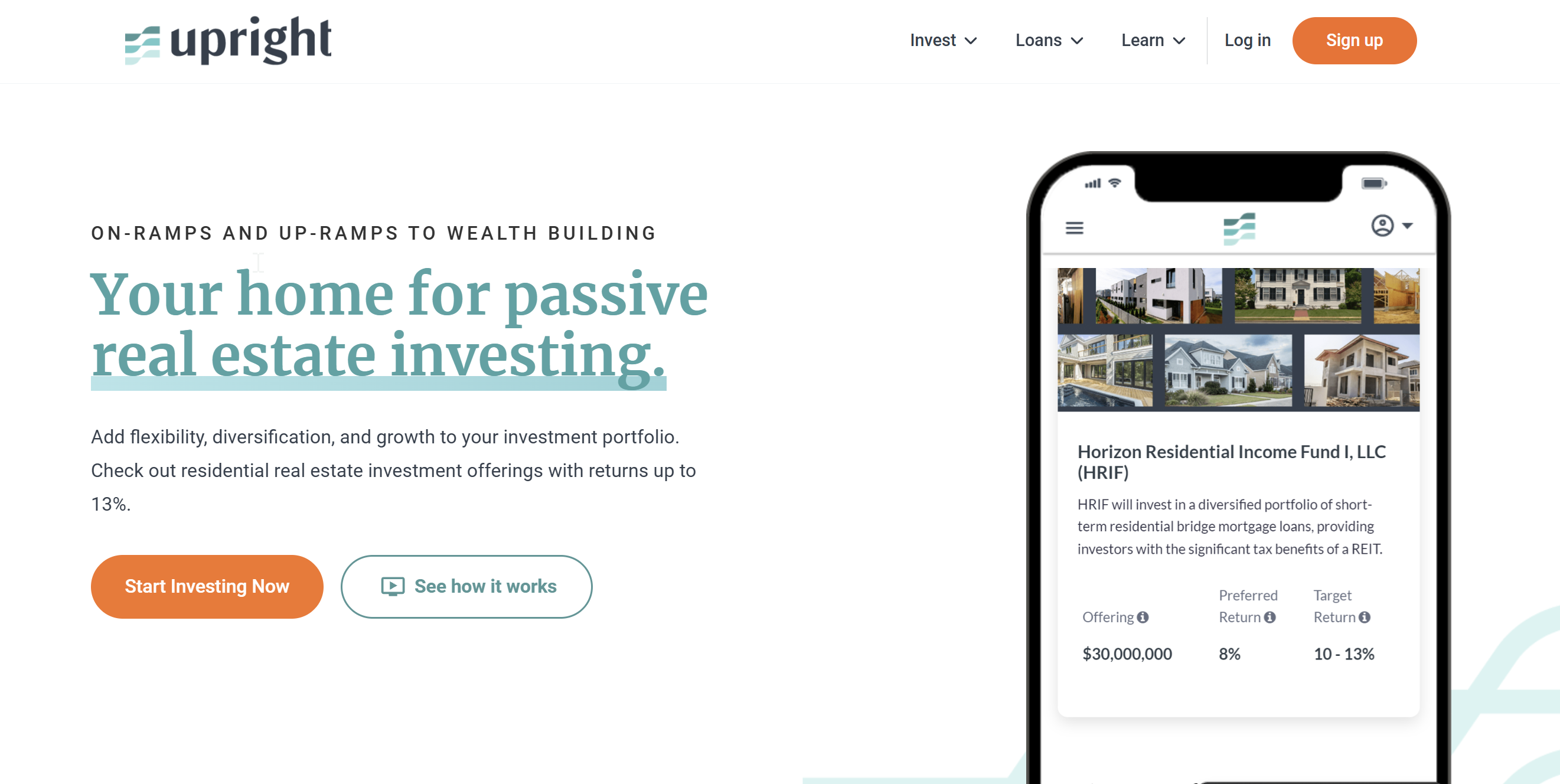
Upright, called Fund That Flip until 2023, lends to house flippers and builders and has funded those loans with accredited investors' money through single-loan notes, two note funds and the Horizon fund. Its loans were already slipping before its payment provider Synapse failed in May 2024 (13.51% of loans by count 31 or more days late that April). Upright halted new investments, announced in August 2024 that it was resuming them starting with Horizon, and admitted Horizon investors into mid-2025. By its own account the Pre-Fund note fund has been returning capital since June 2024 with interest deferred and loan-level losses reported in 2026, and Horizon has been winding down since mid-2025. The website still shows those products with 'Invest Today' buttons, '100% principal repaid' badges and 'Low fees - only 1%'.
No platform response on record for this review. Is this your platform? Respond or claim it.
What the data actually shows - TL;DR
Upright originates short-term loans to residential real estate investors and, from 2014 to 2025, funded them with accredited investors' money: borrower payment dependent notes on single loans from $5,000, the Pre-Funding Note Fund and Residential Bridge Note Fund from $1,000, and from 2023 the Horizon Residential Income Fund I from $15,000. Three questions frame it.
Read the full assessmentShow less
What happened: delinquency had risen from about 4% to 7% of the book (2019 to 2022) to 13.51% of loans by count in April 2024, the last monthly report. Then Upright's payment and wallet provider, Synapse, failed in May 2024: Upright halted new investments, $13.7 million of Upright-related cash including $5.1 million of investor wallet balances was frozen for about five weeks, and 292 performing loans were sold. Upright announced in August 2024 that it was resuming investments starting with Horizon, which admitted investors monthly into mid-2025.
Product by product: the $70.3 million Pre-Fund has been returning capital pro rata since June 2024 with interest deferred, and had returned 90.25% of principal by October 19, 2026, with losses reported on some resolved loans and gains on others; the Residential Bridge Note Fund's last $1.1 million is 'largely REO or late stage foreclosure'; Horizon reported 46% delinquency in April 2025 and, from July 2025, a 'Fund wind-down process'. What the site still says: '100% interest paid / 100% principal repaid' for the Pre-Fund, 'Invest Today' and a July 1, 2025 admittance date for Horizon, '99.7% of principal returned' and 'Low fees - only 1%'. What investors pay: in Horizon, a 1% management fee on net asset value and a 20% manager share of profits above an 8% preferred return that does not carry forward if missed. Separately, Upright's lending arm keeps all origination points borrowers pay (an average of 1% to 10% of each loan) and half of extension and default fees; those are not deducted from investor balances, but the PPM notes they can lower the rate borrowers will pay the fund.
Upright halted new investments when its payment and wallet provider, Synapse, failed; $13.7 million of Upright-related cash, including $5.1 million in investor wallets, was inaccessible until mid-June 2024. Credit stress came first: 13.51% of loans by count were 31 or more days late on April 1, 2024. Upright announced a reopening in August 2024, starting with Horizon.
Share of Pre-Funding Note Fund principal returned by October 19, 2026, from $70,254,000 of notes at May 31, 2024. The other 9.75% is unreturned, not a final loss: Upright reports losses on some resolved loans and gains on others, and the final recovery is unresolved. Interest is deferred until principal is returned.
Horizon fund delinquency on April 16, 2025, per Upright (basis not stated; Upright attributed part of the rise to a shrinking loan count). By March 31, 2026, in a 'wind-down process', loans in foreclosure or REO were about 48% of the book by unpaid principal balance.
'100% interest paid / 100% principal repaid' badges still shown for the Pre-Fund and Residential Bridge Note Fund on October 31, 2026; Wayback captures show the homepage badges unchanged since April 2024.
Horizon's fund-level fees: 1% of net asset value and 20% of profits above a non-cumulative 8% preferred return. Upright's lending arm also keeps 100% of borrower points and fees, which the PPM says average 1% to 10% of each loan.
Audits located for any Upright fund or note vehicle; the reviewed 2025 PPM promises none. No enforcement action against Upright or its officers was located in the federal and AltStreet sources searched; state regulators and courts not yet searched.
Balances, delinquency, losses and distributions are Upright's own figures from its update thread, help center, Horizon updates and quarterly report, none of them audited. Fees and terms are from the June 12, 2025 Horizon PPM (page numbers are the PPM's). Delinquency bases differ: platform figures to 2024 are by loan count or book share as Upright stated them, the April 2025 Horizon figure has no stated basis, and the 2026 Horizon figures are shares of unpaid principal balance, so they are not one series. Form D figures are as filed. Wayback dates are capture dates.
Quick Verdict
Is this platform right for you?
Upright has a long record of lending to real estate investors, but its legacy investor products are returning capital or winding down by its own account. Delinquency was rising before its payment provider failed in May 2024; Upright then halted new investments, reopened Horizon from August 2024 to mid-2025, and has since put it into wind-down.
Read the full assessmentShow less
The Pre-Fund has returned 90.25% of principal with interest deferred and both losses and gains on resolved loans, its final recovery unresolved, and the Residential Bridge Note Fund is largely in REO. Upright publishes candid monthly updates, yet its product pages still show '100% principal repaid' badges, open invest buttons and 'only 1%' fees, and no audit of any vehicle was located.
Best for
- Existing Upright investors following their recoveries through the update thread.
Avoid if
- You are considering a new investment based on the product pages.
- You need audited reporting.
- You need liquidity.
Top strengths
- Origination since 2014 and a dated public update thread with balances, losses and distributions.
- First-lien loans, with an indenture trustee on single-loan notes.
- Offering documents linked openly; Horizon management fees waived for 26Q1.
Key limitations
- Pre-Fund loan-level losses and deferred interest; RBNF largely REO; Horizon in wind-down.
- Product pages and badges contradict the company's own updates.
- A 20% profit share and borrower points of 1% to 10% kept by an affiliate, outside the 'only 1%' headline.
- No audit located; Form D notices that lag the offerings; sponsor financial pressure disclosed.
Compare Before Deciding
Where Upright fits against alternatives
Use these hooks to pressure-test whether this is the right platform, or whether a nearby alternative matches the job better.
How this compares to Worthy Review
Worthy Review
Retail bonds whose programs stopped paying.
How this compares to Groundfloor Review
Groundfloor Review
Loan-by-loan real estate notes under Regulation A.
How this compares to Compound Real Estate Bonds Review
Compound Real Estate Bonds Review
Fixed-rate real estate bonds with audited reporting.
Quick Answers
What most investors want to know first
The highest-signal facts first: minimums, liquidity reality, K-1 timing, and whether distributions are actually part of the experience.
Minimum
$5,000 (single-loan notes), $1,000 (note funds), $15,000 (Horizon; $25,000 on some pages).
Liquidity
None.
K-1 Timing
Not stated publicly.
Distributions
Monthly to quarterly, per Upright's updates.
Overview
Platform Overview
A concise read on what the platform is, how the structure works, and where the practical friction shows up for real investors.
Fund That Flip, Inc., doing business as Upright since September 2023, was founded in 2014 by Matt Rodak and is based in Cleveland. Its lending arm makes short-term first-lien loans to residential real estate investors for fix-and-flip, construction and rental projects. Accredited investors funded those loans through four products: borrower payment dependent notes issued by FTF Lending, LLC on a single loan ($5,000 minimum, repaid only from that loan); the Pre-Funding Note Fund and Residential Bridge Note Fund, series notes on pools of loans ($1,000 minimum, managed by FTF Fund Management, LLC); and the Horizon Residential Income Fund I, an equity fund with notes and a sub-REIT ($15,000 minimum, managed by FTF Capital Management, LLC).
A second fund, Blueprint, is advertised but reports no sales. All offerings are Rule 506 private placements; Upright states it is not a registered broker-dealer, funding portal or investment adviser.
By its own count it has originated more than $3 billion of loans and repaid more than 8,000. After the May 2024 failure of its payment provider, Upright says it returned 'just over $60M' to investors in 90 days, reopened Horizon to new investors from August 2024 to mid-2025, resumed origination with institutional capital through a separate lending site, and now manages its legacy investor products toward repayment.
What you buy
Single-loan notes (FTF Lending), series notes in two note funds, or membership interests and notes in the Horizon fund; Rule 506(c), accredited investors only.
Minimum
$5,000 (single-loan notes), $1,000 (note funds), $15,000 (Horizon; $25,000 on some pages).
Underlying loans
First-lien loans to residential real estate investors, 6 to 24 months, target loan-to-value 60% to 65% (maximum 75%) on after-repair or as-completed value in the Horizon PPM.
Status (Upright's updates)
New investment halted May 2024 and reopened for Horizon from August 2024; Pre-Fund in capital return since June 2024 (90.25% of principal returned); RBNF largely REO; Horizon in wind-down since July 2025.
Fees
Horizon: 1% of NAV management fee and a 20% manager profit share above a non-cumulative 8% preferred return; borrower-paid points (average 1% to 10%) kept by Upright's lending arm. Notes: no investor fee stated; Upright keeps the loan spread.
Audit
None located for any vehicle; none promised in the reviewed 2025 PPM.
Company
Fund That Flip, Inc. dba Upright, Cleveland; founder and CEO Matt Rodak; not a registered broker-dealer or investment adviser.
Visual Summary
Upright's investor products, as of October 2026
Status from Upright's own updates and reports; Form D figures as filed.
Individual project notes (FTF Lending)
Minimum
$5,000
Latest Form D sold
$309,640,000 (1,115 investors, 2024)
Status per Upright
292 performing loans sold 2024; remaining loans repaid as borrowers pay
Site still shows
'99%+ principal repaid'
Pre-Fund (PFNF)
Minimum
$1,000
Latest Form D sold
$78,626,000 (951 investors, 2024)
Status per Upright
Capital return since June 2024; interest deferred; losses and gains on resolved loans
Site still shows
'100% interest paid / 100% principal repaid'
Residential Bridge Note Fund
Minimum
$1,000
Latest Form D sold
$0 (never amended)
Status per Upright
'Largely REO or late stage foreclosure'
Site still shows
'100% principal repaid'
Horizon fund
Minimum
$15,000
Latest Form D sold
$0 (2023 notice, never amended)
Status per Upright
Reopened Aug 2024; wind-down since July 2025; equity $12.0M at 3/31/2026
Site still shows
'Invest Today', admittance July 1, 2025
Blueprint fund
Minimum
$15,000
Latest Form D sold
$0
Status per Upright
Not described
Site still shows
Advertised; detail page 404
Investor Operations
The practical questions investors actually care about: when tax documents arrive, how cash distributions work, and whether capital can be exited before the underlying asset is sold.
Tax Documents
K-1 Timing
What to expect
Not stated publicly.
Cash Flow
Distributions
Frequency
As liquidity allows during the wind-downs.
Timing
Monthly to quarterly, per Upright's updates.
Consistency
Pre-Fund interest deferred since mid-2024; no Pre-Fund distribution in August 2025; Horizon returns of capital in 2025 and 2026.
Liquidity
Exit Reality
Holding period
Until loans resolve.
Exit options
- Wait for pro-rata distributions.
Secondary market
None.
Investment Structures
Borrower payment dependent notes
One note series per loan, $5,000 minimum, 3 to 24 month terms, repaid only from that loan's payments; the first lien is held by an indenture trustee; interest is paid only when the borrower pays. No new single-loan note offering evidenced since May 2024.
Pre-Funding Note Fund
Series notes, $1,000 minimum, 6 to 12 month terms, funding every loan Upright originated; in pro-rata principal return since June 2024.
Residential Bridge Note Fund
Series notes on a pool of whole and fractional loans, $1,000 minimum; remaining $1.1 million largely REO or late-stage foreclosure.
Horizon Residential Income Fund I
Evergreen fund of bridge loans with a sub-REIT; membership interests and unsecured Horizon Notes from $15,000; 1% of NAV and 20% above a non-cumulative 8% preferred return; 12-month lockup and annual gate; reopened August 2024; in wind-down since July 2025.
Risk
Risk Structure
This is where the marketplace pitch gives way to the actual operating reality: delayed exits, limited disclosure, fee drag, and path-dependent outcomes.
Claim
Notes repaid from loans or fund liquidity; Horizon interests behind a credit facility and Horizon Notes; Horizon Notes unsecured and non-recourse.
Control
Upright originates, services or appoints the servicer, sets NAV and reserves, and decides distributions and withdrawals.
Related parties
Affiliates keep borrower points, half of extension and default fees and REO fees, and may sell loans to the funds without independent price review.
Liquidity
None beyond loan repayments; Pre-Fund and Horizon now return capital pro rata as loans resolve.
Reporting
Company updates and quarterly reports with no audit located; Form D notices that lag the offerings.
Losses in products still marketed as whole
Pre-Fund loan-level losses in 2026 and deferred interest, RBNF largely in REO, Horizon in wind-down, while the site shows 100% badges and invest buttons.
Why it matters
Investors relying on the product pages would not learn the current status.
Mitigation / verification
Read Upright's update thread and the latest Horizon quarterly report, and ask for the current balance, losses to date and expected recovery of any product before relying on a page badge.
Sponsor under financial pressure
The PPM discloses 'significant operating and profitability challenges'; staff fell from 43 to 22 in nine months.
Why it matters
The same company services the loans, runs foreclosures and manages the wind-downs.
Mitigation / verification
Ask who would service the loans and administer the funds if Upright could not, and whether a backup servicer is in place.
Economics beyond the 1%
A 20% manager profit share, and borrower-paid points of 1% to 10% per loan kept by Upright's lending arm, sit outside the 'only 1%' headline.
Why it matters
The profit share comes out of fund returns; the borrower points are not deducted from balances but can lower the rate the fund earns.
Mitigation / verification
Read pages 26 to 28 of the PPM and ask for points and fees earned on loans held by the fund.
No audit located
No audit was located for any vehicle, the reviewed PPM promises none, and the manager sets NAV and loss reserves.
Why it matters
Without an audit there is less independent assurance over reported values, returns and recoveries.
Mitigation / verification
Ask for the most recent financial statements, which the PPM says are available on request.
ASRisk signals to watch
- Further principal losses or a final recovery figure for the Pre-Fund.
- Horizon distributions, foreclosure and REO share in the next quarterly report.
- Any update to the product pages, badges or Form D notices.
- Any litigation or regulatory action naming Upright entities.
Regulatory & Legal Posture
Security Status
Private placements under Rule 506(c) (some 506(b)) by Upright subsidiaries and funds; Form D notices only.
Upright's terms state it 'is not a registered broker-dealer, funding portal, or investment advisor'; IAPD and BrokerCheck show no Upright firm or officer. The Horizon PPM relies on Investment Company Act exemptions and says the manager and fund 'are not supervised or regulated by any federal or state authority' except for lending and brokerage activities. No Form ADV filing was found for either fund manager.
- Enforcement: AltStreet located no SEC, FINRA or CFPB action against Fund That Flip, Inc., its subsidiaries, its funds or its officers in the sources searched; state securities regulators have not yet been searched.
- Courts: not yet searched; this review will be updated once federal and Ohio court records are checked.
- Form D: Horizon's only notice ($20 million, no sale) never amended; sub-REIT notice 27 days late; two 2016 notices 185 and 295 days late; no annual amendments for several continuing offerings.
- Licensing: Upright says it lends in 39 jurisdictions; NMLS could not be read and the PPM says only that the manager 'believes' licenses are held or exemptions apply.
Disclosure Quality
Offering documents linked openly and a detailed public update thread; product pages, statistics and Form D notices that have not been updated to match.
Custody Model
Investor cash moved through Upright wallets held with Synapse until May 2024; loans are held by the issuing vehicles, with an indenture trustee for single-loan notes.
Regulatory Backing
Rule 506 exemptions and state notice filings; state lender licensing not verified.
Tax Treatment
Reporting
Form 1099-INT for notes; Schedule K-1 for Horizon membership interests.
Annually.
Income Character
Questions to put to the firm and a tax adviser
Note interest is ordinary income. Horizon pitches the Section 199A deduction for qualified REIT dividends through its sub-REIT. The June 2025 PPM describes that deduction for tax years before January 1, 2026, but later legislation made Section 199A permanent, so the PPM's wording is out of date rather than evidence that the benefit ended; whether a given distribution qualifies depends on the distribution and the taxpayer. How losses on notes and fund interests in wind-down can be deducted is a question for a tax adviser.
Limitation
AltStreet is not a tax adviser.
Special Considerations
- Timing and character of principal losses on notes and fund interests.
- Whether Horizon distributions, including returns of capital in the wind-down, qualify as REIT dividends for Section 199A.
- Unrelated business taxable income from fund leverage in IRAs.
Account Suitability
Taxable
The default.
Roth IRA
Possible through a self-directed IRA; leverage may raise unrelated business income questions.
Traditional IRA
Same as Roth.
HSA
Not applicable.
Before You Invest
Get Upright investor insights before you invest
K-1 timing, distribution updates, yield insights, and risk signals for Upright and similar platforms.
- Weekly platform research focused on tax timing and liquidity reality.
- Signals on distributions, risks, and structural tradeoffs before capital is locked up.
- Coverage of adjacent platforms so you can compare better options faster.
Get weekly platform signals
Track fee changes, liquidity updates, risk flags, and adjacent platforms before you invest.
Independent intelligence from AltStreet. No hype. No sponsor spin.
AltStreet Data Layer
What the data actually shows
Upright's own updates against its product pages.
Pre-Fund recovery
90.25% of $70.25 million of principal returned by October 2026; interest deferred and collected interest paid out as principal; losses reported on some resolved loans and gains on others.
What this means
Loan-level losses are reported; the final aggregate recovery is unresolved.
Horizon trajectory
Late loans 3 of 174 (end of 2023), about 26% (September 2024) and 46% (April 2025, basis not stated); wind-down from July 2025; 48% of unpaid balance in foreclosure or REO (March 2026).
What this means
The fund's outcome now depends on foreclosure and REO sales.
Stale badges
Homepage badges unchanged in Wayback captures from April 2024 to July 2026.
What this means
Product pages do not reflect Upright's own disclosures.
Fees outside the headline
A 20% manager profit share above the preferred return; borrower-paid points averaging 1% to 10% per loan kept by the originator.
What this means
'Only 1%' describes the management fee rate, not the full economics; the borrower points act through the loan rates the fund can earn.
Data as of 2026-11-01 . AltStreet review evidence layer . Public-source analysis
Full datasetDecision Fit
Investor Fit
Who this works for, who it does not, and what level of patience and complexity tolerance the platform really demands.
Existing investors tracking a recovery
Upright publishes monthly updates with balances and distributions; outcomes depend on foreclosures and REO sales.
New investors attracted by the product pages
The products shown as open and fully repaid are in principal return or wind-down by Upright's own account.
Investors who need audited reporting
No audit was located for any vehicle.
Tradeoffs
Key Tradeoffs
The attraction of pre-IPO access is real, but every benefit comes bundled with a corresponding liquidity, transparency, or pricing cost.
Transparency
Product pages, badges and statistics contradict those updates.
Security
Horizon Notes unsecured and liquidity-dependent; no audit located.
Fees
20% manager profit share; borrower points kept by Upright's lending arm can lower the fund's loan rates.
Avoid
Who This Is Not For
This section should be read as a filter, not an afterthought. If you need income, simplicity, or near-term access to capital, the structure is working against you.
Non-accredited investors
All offerings are under Rule 506.
Anyone relying on the website's performance badges
They have not been updated since before the 2024 disruption.
Editorial View
AltStreet Perspective
The compressed version of the review: what matters, what marketing tends to obscure, and how we would frame the platform for a serious allocator.
Verdict
Upright's investor business did not survive rising delinquency and the May 2024 payment-provider failure in its original form; a reopening through Horizon lasted about a year. What remains is a set of wind-downs that the company reports on in detail, alongside a website that still sells them as open and fully performing. The open questions are how much principal each product will finally return, what Upright's lending arm earned on loans its funds held, and when the product pages and filings will reflect where the products stand.
Positioning
On payment status, Upright's pooled products sit closer to Worthy, where three of five bond programs stopped honoring redemptions, than to Groundfloor or Percent: the Pre-Fund pays no interest and returns capital as loans resolve. On security, Upright's single-loan notes are backed by first liens held by a trustee, where Worthy's bonds are unsecured obligations of single-purpose issuers. On reporting, Worthy, Groundfloor, Compound Real Estate Bonds and CNote file audited annual reports with the SEC under Regulation A; no audit of an Upright vehicle was located.
The Bottom Line
A real estate lender whose investor products are in principal return or wind-down by its own account, while its website still markets them as fully repaid.
Action
Next Steps
If you still want to engage after reading the review, these are the practical next moves that reduce avoidable mistakes.
Read Upright's update thread and the latest Horizon quarterly report, not the product pages.
Ask Upright for total principal losses to date and the expected final recovery of each product you hold.
Ask for the most recent fund financial statements, which the PPM says are available on request.
Ask what points and fees Upright's lending arm earned on loans held by Horizon and the Pre-Fund.
Ask who would service the loans if Upright could not.
AltStreet Research Desk
About to invest in Upright, or in an offering we haven't covered?
Commission an independent diligence report: the same filing-based analysis behind this review, applied to the specific investment in front of you before you wire the money.
- Built from primary sources: SEC filings, court records, capital structure, and marketing-versus-filings comparison.
- From $750; full reports from $1,495. Fixed price confirmed up front, delivery in 3-5 business days.
- Independent by design: we work for investors and accept no compensation from the companies we cover.
Want this on every new deal, not one? Deal Intelligence sends the alert the day a new offering appears on a covered platform and follows with an analyst-approved investment committee memo.
Deal Intelligence →Appendix
Sources, Disclosures, and Supporting Context
The lower section is structured like a report appendix: relationship context first, adjacent reading second, and evidence last.
Report Appendix
Disclosure
Relationship and compensation context
+
Report Appendix
Disclosure
Relationship and compensation context
Report Appendix
Related Resources
Adjacent platform comparisons, frameworks, and category links
+
Report Appendix
Related Resources
Adjacent platform comparisons, frameworks, and category links
Further Reading
Related Resources
Adjacent frameworks and reviews that help place the platform in a broader allocation or due-diligence context.
Fund Landscape
Similar Platform Reviews
- Worthy Review
Retail bonds whose programs stopped paying.
- Groundfloor Review
Loan-by-loan real estate notes under Regulation A.
- Compound Real Estate Bonds Review
Fixed-rate real estate bonds with audited reporting.
- Iron Bridge Mortgage Fund Review
An audited first-lien mortgage fund.
Report Appendix
Evidence & Methodology
17 cited passages on file; sources, scope, and how the review was assembled
+
Report Appendix
Evidence & Methodology
17 cited passages on file; sources, scope, and how the review was assembled
Evidence on file
17 supporting passages on file for Upright and its offerings from 9 source documents, 6 discrepancies flagged. Each passage records the metric it supports, the value read from the document, the page, and the verbatim text where the document has it. Terminal subscribers read the passages; open them in the terminal.
- Cited passages
- 17
- Source documents
- 9
- Analyst verified
- 0
- Discrepancies flagged
- 6
ASReview Evidence
Methodology
15 Form D filings across nine vehicles; the 2025 Horizon PPM and linked fund documents; the 2016 note PPM; the live site, lending site, help center and 97 Wayback captures; Upright's update thread and Horizon reports; Saluda Grade ABS-15G reports; registers and enforcement tables.
Scope
Upright's investor products. Court records, NMLS, Ohio and Delaware entity records and state securities regulators have not yet been searched.
Key Findings
- *PPM: 'Upright has experienced significant operating and profitability challenges'.
- *PPM: 'One Hundred Percent (100%) of such fees described in the foregoing paragraph shall be payable to the Originator.'
- *PPM: 'There will be no independent review of the value of such loans'.
- *Update thread: 'We unfortunately experienced some principal loss on the grouping of repaid loans this period.'
- *26Q1 report: 'Fund wind-down process'.
Primary Source Pages
Comparable Platforms
- Worthy
Retail bonds that stopped paying, with audited Regulation A reporting.
- Groundfloor
Loan-by-loan notes with Regulation A reporting.
FAQ
Frequently Asked Questions
High-intent search questions answered directly, without making users hunt through the full review.
Is Upright (Fund That Flip) legit?
Upright is a real lender that has originated loans since 2014 and files Form D notices for its offerings, and no enforcement action against it was located in the sources AltStreet searched. Its investor products are in trouble by its own account: delinquency was rising before its payment provider Synapse failed in May 2024; it then halted new investments, reopened Horizon from August 2024 to mid-2025, and since then the Pre-Fund has been returning capital with interest deferred and loan-level losses reported, and the Horizon fund has been winding down. Its product pages have not been updated to reflect this.
What happened to the Upright Pre-Fund (PFNF)?
Upright put the Pre-Funding Note Fund, which had $70,254,000 of notes at May 31, 2024, into a pro-rata principal-return plan in June 2024. Interest borrowers pay is collected and distributed with principal; Upright plans to pay noteholders interest only after all principal is returned. On October 19, 2026 it reported 90.25% of principal returned. It has reported losses on some resolved loans and gains on others, so the 9.75% still unreturned is not yet a final loss.
Is the Upright Horizon fund still open?
Upright's 26Q1 quarterly report describes a 'Fund wind-down process', with $12.75 million returned to investors from July 2025 to April 2026 and loans in foreclosure or REO at about 48% of the book. Horizon had reopened to new investors in August 2024 and admitted them until at least July 1, 2025; the deal card still shows 'Invest Today' and that July 1, 2025 admittance date.
What fees does Upright charge?
In the Horizon fund, a management fee of 1% of net asset value a year and a 20% manager share of profits above an 8% preferred return that does not carry forward if missed. Separately, Upright's lending arm keeps the origination fees and points borrowers pay, which the PPM says average 1% to 10% of each loan, and half of extension and default fees; these are not taken from investor balances but can lower the rates the fund earns. For its note products Upright states no investor fee and earns the spread between loan and note rates.
Did Upright investors lose money in the Synapse collapse?
Upright reported that $13.7 million of Upright-related cash, including $5.1 million in investor wallets, was inaccessible after Synapse failed and was released around June 17, 2024. The losses Upright has since reported are on loans in the Pre-Fund and other products, not on the frozen cash.