
Wahed Review 2026: Halal Robo Portfolio Costs, HLAL, UMMA and KWIN, the SEC Orders and Wahed Real Estate
Wahed is a Shariah-screened robo-adviser: from $100, Wahed Invest LLC places US clients in portfolios built mostly from ETFs it advises or sub-advises, for 0.49% a year plus a $60 annual fee below $100,000, which makes small accounts expensive. The SEC sanctioned the adviser in 2022 and 2024 over marketing and an undisclosed conflict in seeding its own ETF with client money, and a small Regulation A real estate line sits alongside.
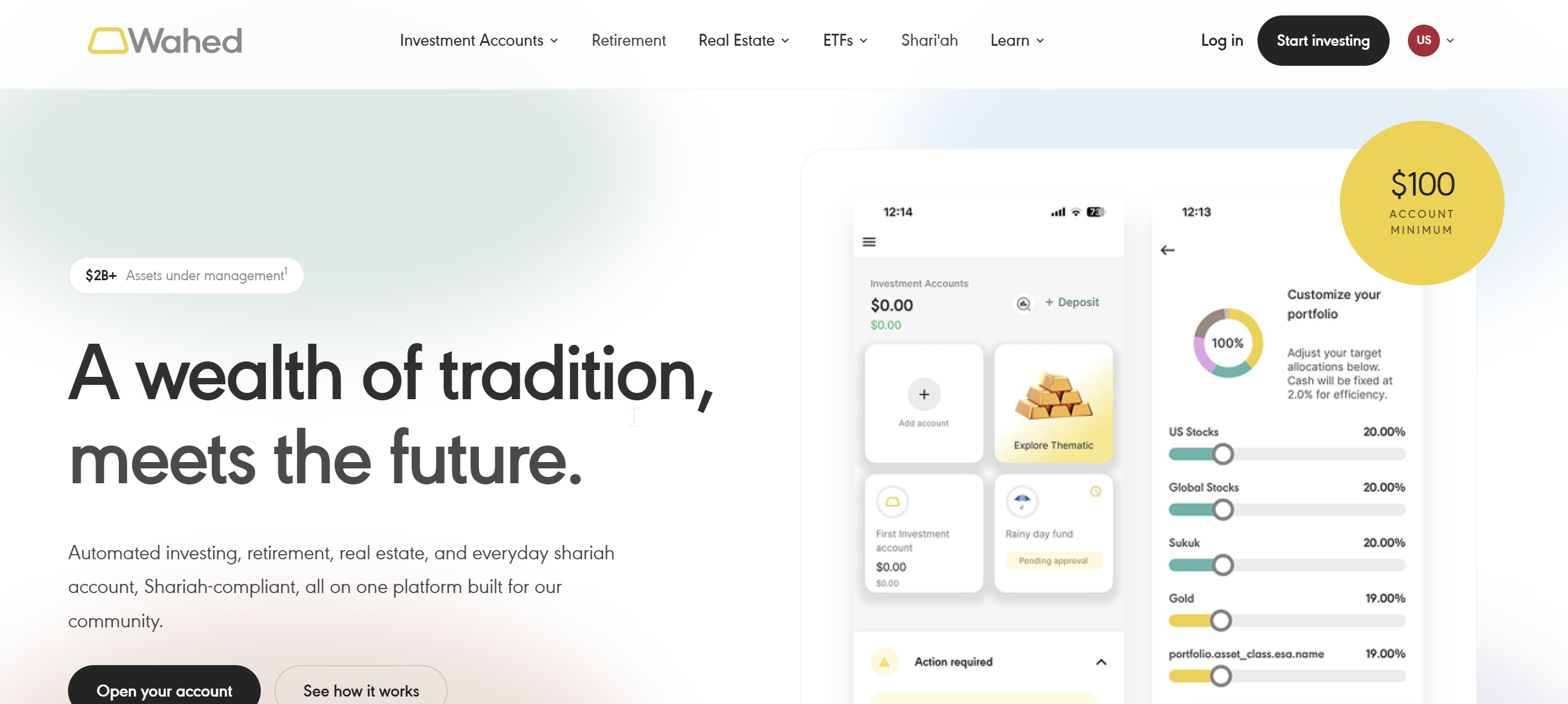
No platform response on record for this review. Is this your platform? Respond or claim it.
What the data actually shows - TL;DR
Wahed, founded in New York in 2015, sells Shariah-screened investing worldwide; its US business is Wahed Invest LLC, an SEC-registered adviser with $1.29 billion of regulatory assets, 30,683 accounts and nine employees (Form ADV, October 2026). Clients open an app account from $100 and are placed in one of six portfolios, most of which sits in ETFs Wahed advises (HLAL, UMMA) or sub-advises (KWIN); Wahed waives its 0.49% wrap fee on those funds and is paid through them instead.
Read the full assessmentShow less
Below $100,000 a $60 annual fee also applies, so on $1,000 the estimated yearly cost of a Moderate portfolio is about 6.5% before sukuk and gold fund expenses, and about 1.1% on $10,000. The SEC sanctioned the adviser in 2022 ($300,000) for misleading marketing and for using more than $13 million of client assets to seed HLAL without disclosing the conflict, and in 2024 ($250,000) for undisclosed paid endorsements and hypothetical performance shown without required policies. Today's site again shows hypothetical, backtested results, which the rule allows with adequate policies; public disclosures do not show whether current controls meet it.
A Shariah process document still linked from the site says Wahed cannot use options in its portfolios, while five of six portfolios now hold KWIN, a separately certified fund that pairs stocks with options to lock in a forward sale price. A small real estate line, about $5.2 million across four homes and a pooled fund, buys homes from Wahed's manager at cost; both vehicles carry going-concern paragraphs.
Client assets Wahed Invest used to seed its own HLAL ETF at launch in 2019 without first disclosing the conflict, one of the findings in the SEC's 2022 order, settled for $300,000 without admitting or denying.
Estimated yearly cost of a $1,000 Moderate portfolio before sukuk and gold fund expenses; the $60 fee alone is 6%. About 1.1% on $10,000 and 0.52% on $100,000.
KWIN's share of five of the six US portfolios. KWIN holds stocks and sells them forward through paired options, so the share measures exposure to that hedged strategy, not to the stock market.
Assets in Wahed Invest's US wrap program at September 30, 2026. The home page's '$2B+ AUM' is footnoted as a worldwide group figure; the site does not reconcile the two.
Adviser figures from Form ADV (October 12, 2026) and the wrap fee brochure (October 10, 2026); fund figures from the Listed Funds Trust annual report (May 31, 2026) and KWIN's summary prospectus (July 31, 2026); real estate figures from the Reg A filings. Cost illustrations assume a constant balance, the Moderate portfolio's published mix and a full year of standard fees, and exclude sukuk and gold fund expenses, IRA trustee fees and withdrawal fees.
Quick Verdict
Is this platform right for you?
Wahed offers a simple, Shariah-screened multi-asset portfolio and IRA from $100, built on listed, audited funds at a third-party custodian, which few US competitors do. The trade-offs are cost at small balances, because the $60 annual fee applies until $100,000; concentration in funds Wahed is paid to run, from an adviser the SEC sanctioned in 2022 for not disclosing that conflict and in 2024 over marketing; and website documents that lag the filings, including an outdated client agreement and a Shariah policy written before KWIN.
Read the full assessmentShow less
KWIN itself is a hedged forward-sale strategy rather than open stock exposure, and investors using the Everyday Shariah Account for short-term money should understand that it is uninsured. The real estate line is small, priced at the manager's cost, and carries going-concern paragraphs.
Best for
- Muslim investors with $10,000 or more who want an automated screened portfolio or IRA and accept concentration in Wahed-linked funds.
Avoid if
- Your balance will stay under a few thousand dollars.
- You need principal that cannot fall.
- You need to get real estate money back on demand.
Top strengths
- Screened multi-asset portfolios and IRAs from $100 with a third-party custodian.
- HLAL and UMMA are listed, independently administered and audited.
- The current fee schedule is plainly stated in the brochure and Form CRS, and the wrap fee is waived on the Wahed-linked sleeve.
- Real estate homes passed to investors at the manager's cost, with interest-free bridging.
Key limitations
- Two settled SEC orders (2022, 2024) on marketing and on the HLAL seeding conflict.
- A $60 annual fee that is 6% of a $1,000 account.
- Website documents that lag the filings: the client agreement's fee schedule and a pre-KWIN Shariah policy.
- Small real estate vehicles with going-concern paragraphs and limited or no liquidity.
Compare Before Deciding
Where Wahed fits against alternatives
Use these hooks to pressure-test whether this is the right platform, or whether a nearby alternative matches the job better.
How this compares to Alto IRA Review
Alto IRA Review
Self-directed IRAs for alternative assets.
How this compares to Fundrise Review
Fundrise Review
App-based Regulation A real estate funds for retail investors.
How this compares to Arrived Review
Arrived Review
Shares of single-family rental homes under Regulation A.
Quick Answers
What most investors want to know first
The highest-signal facts first: minimums, liquidity reality, K-1 timing, and whether distributions are actually part of the experience.
Liquidity
The ETFs trade on exchanges; the real estate interests have no secondary market.
K-1 Timing
No K-1.
Distributions
Fund I targets mid-January, April, July and October payments after a full quarter of rent.
Overview
Platform Overview
A concise read on what the platform is, how the structure works, and where the practical friction shows up for real investors.
Wahed Inc. runs an investing app in the US, UK, Malaysia, the UAE and other markets. In the US, Wahed Invest LLC manages wrap-fee accounts (taxable, Traditional, Roth and SEP IRAs) custodied at Apex Clearing: after a questionnaire, money goes into one of six model portfolios of Shariah-screened equity ETFs, sukuk, gold, cash and, in five of them, KWIN; the Everyday Shariah Account is held almost entirely in KWIN. Wahed Invest advises HLAL and UMMA (Listed Funds Trust) and sub-advises KWIN (Krane Shares Trust). Separately, Wahed Financial LLC sells interests in single homes through series of Wahed Real Estate Series 1 LLC and shares of Wahed Real Estate Fund I LLC under Regulation A. The Shariyah Review Bureau advises on Wahed's own products; KWIN is certified by Abrahamic Finance.
Mohsin Siddiqui succeeded Wahedna as group CEO in March 2024. HLAL launched in 2019, which Wahed describes as Nasdaq's first halal equity ETF; UMMA followed in 2022 and KWIN, with KraneShares, in November 2025. The real estate line began with Series 1 in 2024 and Fund I in 2025.
What it is
A Shariah-screened robo-adviser and ETF sponsor, with Regulation A real estate offerings.
Investor eligibility
US residents; $100 minimum for portfolios, IRAs and Fund I; $500 for real estate series; Reg A investment limits apply to non-accredited investors.
Adviser
Wahed Invest LLC (SEC-registered since 2015, CRD 242793): $1.29B regulatory assets, 30,683 accounts, 9 employees (Form ADV, October 2026); custodian Apex Clearing.
Fees
0.49% a year plus $60 under $100,000, waived on the Wahed-linked fund sleeve; fund expense ratios 0.50% (HLAL), 0.65% (UMMA), 0.51% (KWIN).
Funds
HLAL $917.7M and UMMA $280.5M at May 31, 2026 (audited by Cohen & Co); KWIN sub-advised for KraneShares.
Real estate
Series 1: four homes funded, $1,706,100 issued; Fund I: $3,474,750 raised, six homes. Both with going-concern paragraphs (Artesian CPA).
Regulatory record
SEC orders 2022 ($300,000) and 2024 ($250,000), both settled with cease-and-desist orders.
Visual Summary
Estimated yearly cost of a Moderate portfolio, by account size
AltStreet's estimate on Wahed's published schedule and the Moderate portfolio's published mix (27% HLAL, 13% UMMA, 37.8% KWIN, 16.2% sukuk, 5% gold, 1% cash), assuming a constant balance and a full year of standard fees. Wrap fee 0.49% on the 22.2% not in Wahed-linked funds; fund expenses on the Wahed-linked sleeves only. Excludes sukuk and gold fund expenses, IRA trustee fees and withdrawal fees, so actual costs are somewhat higher.
$100
$60 annual fee
$60
Wrap fee and Wahed-linked fund expenses
$0.52
Estimated total
$60.52 (60.5%)
$1,000
$60 annual fee
$60
Wrap fee and Wahed-linked fund expenses
$5.21
Estimated total
$65.21 (6.5%)
$10,000
$60 annual fee
$60
Wrap fee and Wahed-linked fund expenses
$52.11
Estimated total
$112.11 (1.1%)
$100,000
$60 annual fee
none
Wrap fee and Wahed-linked fund expenses
$521.10
Estimated total
$521.10 (0.52%)
Investor Operations
The practical questions investors actually care about: when tax documents arrive, how cash distributions work, and whether capital can be exited before the underlying asset is sold.
Tax Documents
K-1 Timing
What to expect
No K-1.
Cash Flow
Distributions
Frequency
Portfolios: fund distributions; Fund I: quarterly when declared.
Timing
Fund I targets mid-January, April, July and October payments after a full quarter of rent.
Consistency
Fund I is new; no distribution record yet in the filings reviewed.
Liquidity
Exit Reality
Holding period
None for advisory accounts; 6 months for Fund I; series held until sale.
Exit options
- Withdraw advisory accounts at any time.
- Fund I January and July windows, 10% of unlocked shares each.
- Series: none until the home is sold.
Secondary market
The ETFs trade on exchanges; the real estate interests have no secondary market.
Investment Structures
Robo portfolios and IRAs
Six model portfolios of HLAL, UMMA, KWIN, sukuk, gold and cash; 0.49% plus $60 under $100,000; withdrawable at any time.
Everyday Shariah Account
Substantially all in KWIN; 0.0% wrap fee; an investment account, not FDIC insured.
Wahed Real Estate Series 1
One series per home, $500 minimum, no redemption; four funded ($1.7M).
Wahed Real Estate Fund I
Pooled single-family rental fund, $100 minimum, semi-annual 10% redemption windows after six months; $3.5M raised.
Risk
Risk Structure
This is where the marketplace pitch gives way to the actual operating reality: delayed exits, limited disclosure, fee drag, and path-dependent outcomes.
Conflicts
Portfolios concentrated in funds the adviser is paid to run; the 2022 order found client money used to seed HLAL without disclosure.
Fees
A $60 annual fee to $100,000 that makes small accounts expensive; the posted client agreement states an older schedule.
Product risk
KWIN, a hedged forward-sale strategy, is up to 79.2% of a portfolio and nearly all of the ESA; its risk is execution and concentration more than market direction.
Marketing controls
Two SEC orders on marketing; hypothetical performance is shown again, and public material does not show the controls behind it.
Real estate
Small, new vehicles with going-concern paragraphs; no redemption (Series) or capped semi-annual windows (Fund I).
Small accounts pay a high share in fees
$60 a year under $100,000 on top of 0.49% and fund expenses.
Why it matters
The $60 alone is 6% of a $1,000 account.
Mitigation / verification
Estimate your yearly cost at your balance before funding; above about $10,000 it falls near 1%.
Affiliated fund selection
Portfolios lean on HLAL, UMMA and KWIN, from which Wahed is paid.
Why it matters
The SEC has found that Wahed once failed to disclose this kind of conflict; how much it earns on each allocation is not public.
Mitigation / verification
Read the brochure's conflicts section and compare the funds' costs and records with alternatives.
A hedged strategy used for short-term money
The ESA and the conservative portfolios hold KWIN.
Why it matters
Its value can fall through execution, liquidity or counterparty problems, and it is not insured like a deposit.
Mitigation / verification
Read KWIN's prospectus and Shariah letter; keep emergency money where principal is insured if that matters to you.
Illiquid, early-stage real estate
Going-concern paragraphs on both vehicles; series cannot be redeemed.
Why it matters
Money may be tied up until homes are sold, and costs above the price reached 20.6% on one series.
Mitigation / verification
Read the series' cost table and the fund's redemption terms before investing.
Regulatory & Legal Posture
Security Status
Wahed Invest LLC is an SEC-registered investment adviser (since August 7, 2015) running a wrap-fee program; HLAL, UMMA and KWIN are registered ETFs; the real estate interests are offered under Regulation A Tier 2 by Wahed Real Estate Series 1 LLC (qualified December 2, 2024) and Wahed Real Estate Fund I LLC (qualified December 19, 2025).
Advisory clients are owed a fiduciary duty, which the 2022 order found Wahed breached in seeding HLAL. Regulation A qualification is not an SEC approval of the offerings.
- SEC order IA-5959, February 10, 2022: misleading advertising (September 2018 to July 2019), rebalancing not performed as represented, undisclosed conflicts in seeding HLAL with more than $13 million of client assets, and inadequate policies including for the Shariah advisory business; $300,000, cease and desist, compliance consultant; settled without admitting or denying.
- SEC order IA-6763, November 1, 2024: paid athlete endorsements without required disclosures (November 2022 to May 2024) and hypothetical performance without required policies; $250,000, cease and desist; settled without admitting or denying.
- UK: the Advertising Standards Authority banned Wahed Invest Ltd's 'burning banknotes' posters on January 8, 2025 as likely to cause serious offence.
- Civil: Khurana v. Wahed Invest (S.D.N.Y. 1:18-cv-00233), a 2018 contract suit, ended with a notice of voluntary dismissal on January 29, 2021, after a settlement conference. Chadha v. Wahedna, a former chief operating officer's suit over the repurchase of his shares: in 2022 the Appellate Division (2022 NY Slip Op 04089) upheld the dismissal of his fraud and shareholder claims and reinstated four individual claims totaling about $205,000 plus a bonus share; their later course was not located.
- No action located against named executives in the SEC action lookup, BrokerCheck or IAPD, and no New York DFS or Attorney General action located in site searches; CFPB and BBB returned nothing relevant. Some CourtListener searches for named executives were pending its daily quota.
Disclosure Quality
The brochure, Form CRS, fund documents and Reg A filings are clear; the website's client agreement, Shariah policy and Fund I liquidity statements lag them.
Custody Model
Advisory accounts custodied and cleared at Apex Clearing Corporation; HLAL and UMMA assets at U.S. Bank; real estate subscriptions through Dalmore Group.
Regulatory Backing
SEC adviser registration; SIPC coverage at Apex for advisory account securities; neither the ESA nor the real estate interests are FDIC insured.
Tax Treatment
Reporting
Taxable accounts: Form 1099-DIV and 1099-B. IRAs: Form 5498 for contributions and 1099-R for distributions; no annual 1099-DIV or 1099-B. Real estate vehicles: 1099-DIV.
Annual, through Apex for advisory accounts.
Income Character
Capital gains and dividends in taxable accounts; tax-deferred or tax-free inside IRAs
In a taxable account, fund distributions and sales are reported annually; inside a Traditional or Roth IRA they are not taxed as they occur, and tax depends on the IRA type when money is withdrawn. Wahed calculates an annual 'purification' amount of non-compliant income for clients to donate. Fund I intends to be taxed as a REIT. Consult a tax adviser.
Limitation
AltStreet is not a tax adviser.
Special Considerations
- IRAs: Traditional, Roth and SEP; cash transfers only; trustee fees sit outside the wrap fee.
- Purification is a religious calculation; a donation is deductible only under the usual charitable-deduction rules.
Account Suitability
Taxable
Yes.
Roth IRA
Yes.
Traditional IRA
Yes.
HSA
Not offered.
Before You Invest
Get Wahed investor insights before you invest
K-1 timing, distribution updates, yield insights, and risk signals for Wahed and similar platforms.
- Weekly platform research focused on tax timing and liquidity reality.
- Signals on distributions, risks, and structural tradeoffs before capital is locked up.
- Coverage of adjacent platforms so you can compare better options faster.
Get weekly platform signals
Track fee changes, liquidity updates, risk flags, and adjacent platforms before you invest.
Independent intelligence from AltStreet. No hype. No sponsor spin.
AltStreet Data Layer
What the data actually shows
The US filings describe a mid-sized adviser with two established ETFs and a small real estate line; the marketing describes a worldwide group.
US wrap program $255.6M
At September 30, 2026; the '$2B+' headline is a disclosed worldwide group figure; HLAL $917.7M and UMMA $280.5M at May 31, 2026.
What this means
Read the headline as the group, not the US advisory business.
Real estate at the manager's cost
Paign Drive $260,000 to $263,960; Lake Overlook $374,900 to $377,282; Fund I homes bought from the manager at cost plus acquisition costs.
What this means
No markup on transfers, but sourcing and offering costs ran 9.5% to 20.6% above the price.
Going-concern paragraphs on both vehicles
Fund I: $54,390 cash against $318,135 current liabilities (June 30, 2026); Series 1: $632,245 against $729,179 (December 31, 2025).
What this means
Both depend on the manager and new subscriptions.
Data as of 2026-10-28 . AltStreet review evidence layer . Public-source analysis
Full datasetDecision Fit
Investor Fit
Who this works for, who it does not, and what level of patience and complexity tolerance the platform really demands.
Muslim investors with $10,000 or more who want a hands-off screened multi-asset portfolio or IRA
Estimated costs fall near 1% a year at that size and the funds are listed and audited, but portfolios concentrate in funds Wahed is paid to run.
Investors who only want screened equity
HLAL or SPUS in a brokerage account avoids the wrap fee and the $60.
Small savers starting with $100 to a few thousand dollars
The $60 fee alone is 6% a year of a $1,000 account.
Investors seeking liquid real estate
Series have no redemption; Fund I allows 10% a window twice a year after six months.
Tradeoffs
Key Tradeoffs
The attraction of pre-IPO access is real, but every benefit comes bundled with a corresponding liquidity, transparency, or pricing cost.
Access
A $60 annual fee to $100,000; Betterment's similar fee lifts at $24,000 or with regular deposits.
Products
Concentration in Wahed-linked funds, including a hedged options strategy at up to 79.2%.
Record
Two settled SEC orders on marketing and conflicts.
Avoid
Who This Is Not For
This section should be read as a filter, not an afterthought. If you need income, simplicity, or near-term access to capital, the structure is working against you.
Small accounts
The $60 fee alone is 6% a year on $1,000.
Emergency money that must not lose value
The ESA is an uninsured investment in KWIN.
Investors needing quick access to real estate money
No redemption on series; capped semi-annual windows on Fund I.
Editorial View
AltStreet Perspective
The compressed version of the review: what matters, what marketing tends to obscure, and how we would frame the platform for a serious allocator.
Verdict
Wahed built a real product for an underserved market and a halal ETF family with $1.2 billion in HLAL and UMMA. Its regulatory record shows marketing and conflict controls that have fallen short twice, and its website still trails its filings in places. The product suits investors large enough that the $60 fee stops mattering and willing to read the brochure and KWIN's prospectus rather than the app's summaries.
Positioning
Against general robo-advisers (Betterment, Wealthfront, Schwab Intelligent Portfolios), Wahed costs more on small and mid-sized accounts and concentrates in its own funds; its distinction is Shariah screening across stocks, sukuk and gold. Investors who want screened equity only can hold HLAL or SPUS directly. Its real estate line is far smaller than Fundrise or Arrived.
The Bottom Line
A halal robo-adviser with a real product, two settled SEC orders and a $60 annual fee that makes small accounts expensive.
Action
Next Steps
If you still want to engage after reading the review, these are the practical next moves that reduce avoidable mistakes.
Estimate your yearly cost at your balance: $60 below $100,000, plus 0.49% on the non-Wahed sleeve, plus fund expenses.
Read the wrap fee brochure's conflicts section and the 2022 and 2024 SEC orders.
Before using the Everyday Shariah Account or a conservative portfolio, read KWIN's prospectus and Shariah letter.
Ask Wahed which client agreement governs your fees and whether its Shariah process document has been updated for KWIN.
For real estate, read the series' cost table and Fund I's redemption terms, and plan to hold for years.
AltStreet Research Desk
About to invest in Wahed, or in an offering we haven't covered?
Commission an independent diligence report: the same filing-based analysis behind this review, applied to the specific investment in front of you before you wire the money.
- Built from primary sources: SEC filings, court records, capital structure, and marketing-versus-filings comparison.
- From $750; full reports from $1,495. Fixed price confirmed up front, delivery in 3-5 business days.
- Independent by design: we work for investors and accept no compensation from the companies we cover.
Want this on every new deal, not one? Deal Intelligence sends the alert the day a new offering appears on a covered platform and follows with an analyst-approved investment committee memo.
Deal Intelligence →Appendix
Sources, Disclosures, and Supporting Context
The lower section is structured like a report appendix: relationship context first, adjacent reading second, and evidence last.
Report Appendix
Disclosure
Relationship and compensation context
+
Report Appendix
Disclosure
Relationship and compensation context
Report Appendix
Related Resources
Adjacent platform comparisons, frameworks, and category links
+
Report Appendix
Related Resources
Adjacent platform comparisons, frameworks, and category links
Further Reading
Related Resources
Adjacent frameworks and reviews that help place the platform in a broader allocation or due-diligence context.
Fund Landscape
Frameworks
Similar Platform Reviews
- Alto IRA Review
Self-directed IRAs for alternative assets.
- Fundrise Review
App-based Regulation A real estate funds for retail investors.
- Arrived Review
Shares of single-family rental homes under Regulation A.
Report Appendix
Evidence & Methodology
9 cited passages on file; sources, scope, and how the review was assembled
+
Report Appendix
Evidence & Methodology
9 cited passages on file; sources, scope, and how the review was assembled
Evidence on file
9 supporting passages on file for Wahed and its offerings from 6 source documents, 5 discrepancies flagged. Each passage records the metric it supports, the value read from the document, the page, and the verbatim text where the document has it. Terminal subscribers read the passages; open them in the terminal.
- Cited passages
- 9
- Source documents
- 6
- Analyst verified
- 0
- Discrepancies flagged
- 5
ASReview Evidence
Methodology
Form ADV and brochure; the two SEC orders; the Wahed ETFs' annual report; KWIN's summary prospectus and Wahed's KWIN documents; every Reg A filing; 224 wahed.com pages and PDFs with Wayback history; peer pricing pages; app-store data; legal searches.
Scope
Wahed's US platform: advisory accounts, IRAs, the Everyday Shariah Account, the funds it advises or sub-advises, and its two real estate vehicles. Non-US affiliates are described from public pages only.
Key Findings
- *SEC 2022: 'used those clients' advisory assets, amounting to more than $13 million, as the initial equity capital for the Wahed ETF'.
- *Brochure: 'As of September 30, 2026, Wahed had $255,642,321 assets under management in its Wrap Fee program.'
- *KWIN prospectus: 'synthetic short positions in those same long positions in approximately a 1:1 to ratio through the use of options'.
- *Shariah process document: 'we cannot use any derivatives or options contracts in any of our portfolios'.
- *Fund I circular: 'we pay 6.0% of the gross proceeds from such sale of such investments to the Manager as a disposition fee'.
Primary Source Pages
FAQ
Frequently Asked Questions
High-intent search questions answered directly, without making users hunt through the full review.
Is Wahed legit?
Yes. Wahed Invest LLC is an SEC-registered adviser, client accounts are held at Apex Clearing, and its ETFs are registered, audited funds. It has also settled two SEC orders: in 2022 for misleading marketing and for seeding its own ETF with more than $13 million of client assets without disclosing the conflict ($300,000), and in 2024 for undisclosed paid endorsements and hypothetical performance shown without required policies ($250,000).
How much does Wahed cost?
0.49% a year plus $60 a year below $100,000, with no wrap fee on the part held in Wahed-linked funds, which charge 0.50% to 0.65%. AltStreet estimates a Moderate portfolio costs about $65 a year on $1,000, $112 on $10,000 and $521 on $100,000, before sukuk and gold fund expenses.
Is the Everyday Shariah Account a savings account?
No. It is an investment account held almost entirely in KWIN, which owns stocks and locks in a forward sale price for them with paired options. The design aims at a steady, cash-like return, but it is not FDIC insured and its value can fall.
Does Wahed use options?
Not directly in client accounts, but five of its six US portfolios hold KWIN, a fund Wahed sub-advises that uses a sold call and a bought put on each stock. KWIN is certified by Abrahamic Finance; an older Wahed Shariah document still on the site says Wahed cannot use options in its portfolios.
How does Wahed Real Estate work?
Wahed Financial buys a home and resells it at cost to a series (from $500) or to Fund I (from $100), lending any gap interest-free. Investors pay sourcing, offering and asset management fees. Series cannot be redeemed; Fund I allows redemptions twice a year after six months, up to 10% of unlocked shares each time. Both vehicles carry going-concern paragraphs.
How much does Wahed manage?
The site's '$2B+' is a worldwide group figure. In the US, the wrap program held $255.6 million at September 30, 2026, HLAL and UMMA held $1.2 billion at May 31, 2026, and Wahed Invest reported $1.29 billion of regulatory assets; these measure different things and partly overlap.