Re Protocol Review 2026: What Backs reUSD and reUSDe, What the Chain Shows, and Who Controls It
Re's reUSD and reUSDe tokens are offered only to non-U.S. persons after KYC, so US investors cannot buy them from Re. The tokens turn stablecoin deposits into reinsurance capital: the money buys notes of Cover Re, a Cayman reinsurer, and the tokens accrue a set spread over SOFR or the sUSDe rate. On chain, the 337.6 million reUSD and 21.0 million reUSDe outstanding match the deposits Re reports. The $799 million TVL Re headlines also counts $318.9 million of premium receivable that has not changed since June 20, 2026. And the reinsurer Re's docs call unaffiliated is owned by the company that built the protocol.
No platform response on record for this review. Is this your platform? Respond or claim it.
What the data actually shows - TL;DR
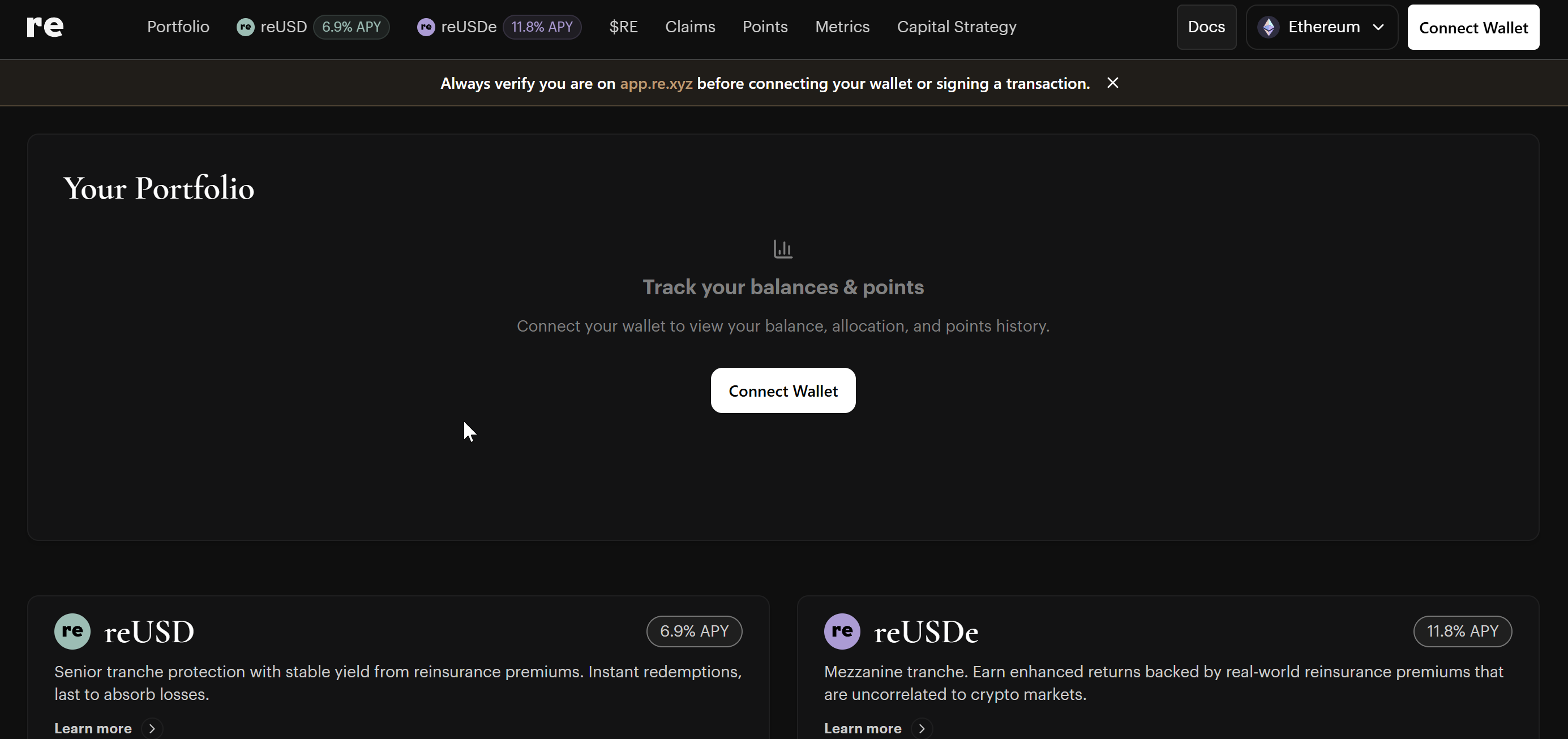
Re sells two tokens to non-U.S. persons. reUSD is a senior tranche that accrues SOFR (or the sUSDe rate on capital held on chain) plus 250 basis points and redeems instantly within caps. reUSDe is a mezzanine tranche that accrues the risk-free rate plus 850 basis points and redeems in quarterly windows. Behind both sit Principal-at-Risk Notes of Cover Reinsurance SPC Ltd's Segregated Portfolio 1, which reinsures US insurers and MGAs on a quota-share basis.
Read the full assessmentShow less
Three questions frame it. What backs the tokens: the token side reconciles. AltStreet's chain reads ($405.18 million at NAV on November 1, 2026) match the per-token values in Re's API to within $134 and Re's October 31 month-end deposits to within 0.07%; on-chain capital matched Re's September 30 report to within 0.4%.
That checks token counts and on-chain balances; the reserves held with the reinsurer rest on Re's reports, one agreed-upon-procedures snapshot and the reinsurer's audit. Re's headline TVL ($799 million) adds $318.9 million of premium receivable that has not changed to the cent since June 20, 2026. What a holder can get out: reUSD paid 2,008 instant redemptions (202 million reUSD) in a year. reUSDe's July 2026 window filled 28% of requests and the October window 100%.
The PPM allows the issuer to hold back up to 100% of redemptions for 18 months. Who controls it: token upgrades and roles sit behind a 48-hour timelock, but a 3-of-5 Safe can move redemption-vault reserves, mark down NAV within limits, and pause or unpause redemptions with no delay. The reinsurer is wholly owned by Cover Re Inc., the protocol's developer and licensor, though Re's docs call it 'unaffiliated'. reUSD redemptions pay out in sUSDe, so a holder who wants dollars has to convert again.
reUSD (337,563,141 on 13 chains at NAV 1.110712) plus reUSDe (21,014,286 at 1.439200) on November 1, 2026, from AltStreet's chain reads; within $134 of the per-token values in Re's API and 0.07% below Re's October 31 month-end deposits ($405.46M).
Premium receivable counted in Re's TVL ($799M), identical to the cent from June 20 to October 31, 2026, and 44.8% of TVL in Re's September update; The Network Firm's only public report excluded its collectability.
Fill rate of reUSDe's July 2026 redemption window (3.84M requested, $1.5M pool), read from the window contract; the October window filled 100% of 0.53M.
Signers needed on the governance Safe that can withdraw redemption-vault reserves (17.5M sUSDe on Ethereum), mark NAV within limits, and pause or unpause redemptions, all with no delay.
Shareholder's equity of Cover Re SP1 at December 31, 2025 (audited), plus a $15.9M note; Re's docs describe a '$77M' first-loss layer, dated June to October 2026, and no published figures bridge the two.
What an instant reUSD redemption pays out: Ethena's staked USDe, not dollars or USDC, so a holder who wants another asset has to convert the payout on sUSDe's own terms.
Chain figures are AltStreet's read-only RPC reads at the pinned blocks; holder labels are from Blockscout (an indexer). TVL, deposits, premium receivable, combined ratios and treaty data are Re's own figures from its API, app and updates, none audited. Cover Re SP1 figures are from its audited FY2025 statements, which cover the reinsurer's segregated portfolio, not the token issuer. A chain reconciliation checks token counts and on-chain balances, not off-chain reserves.
Quick Verdict
Is this platform right for you?
Re offers non-U.S. holders a reinsurance-linked spread through two tokens whose supply and NAV reconcile on chain to the deposits it reports. The rest rests on Re and a reinsurer owned by the protocol's developer: a TVL headline that adds a receivable unchanged since June, a $77 million first-loss layer that cannot be reconciled to the published audit, and a 3-of-5 Safe that can move vault reserves and lift a pause with no delay.
Best for
- Non-U.S. holders who can verify positions on chain, accept a formula NAV and limited redemption, and follow the treaty book.
Avoid if
- You are a US person.
- You need audited issuer statements.
- You need guaranteed redemption at NAV.
Top strengths
- Token supply, NAV, redemptions and on-chain reserves can be checked, and they match Re's reported deposits.
- A treaty-level table with premiums, booked loss ratios and collateral.
- Audited reinsurer statements and 48-hour timelock on token upgrades.
Key limitations
- TVL includes a static premium receivable; the first-loss layer is not reconciled to the audit.
- reUSDe windows partly filled; reUSD caps and an 18-month holdback right.
- No-delay Safe powers over vault reserves and pausing.
- Reinsurer owned by the protocol's developer; issuer and note holder not audited.
Compare Before Deciding
Where Re fits against alternatives
Use these hooks to pressure-test whether this is the right platform, or whether a nearby alternative matches the job better.
How this compares to Paxos Review
Paxos Review
Dollar and gold tokens with attested reserves.
How this compares to Figure Markets Review
Figure Markets Review
On-chain lending pools reconciled on chain.
How this compares to Superstate Review
Superstate Review
Tokenized Treasury and basis funds.
Quick Answers
What most investors want to know first
The highest-signal facts first: minimums, liquidity reality, K-1 timing, and whether distributions are actually part of the experience.
Liquidity
Active: 80% of Ethereum reUSD sits in Pendle; Fluid, Morpho, Curve and Euler hold most of the rest.
K-1 Timing
Not applicable.
Distributions
Realized on redemption or sale.
Overview
Platform Overview
A concise read on what the platform is, how the structure works, and where the practical friction shows up for real investors.
Re is operated by Resilience Foundation Company, an ownerless Cayman foundation formed in October 2024, with Resilience (BVI) Ltd as token issuer and Resilience Inv SPC (Cayman) as the holder of the reinsurer's notes; the RE governance token is issued by Resilience Core Ltd (BVI). Depositors who pass KYC exchange USDC, USDT, USDe or sUSDe for reUSD, or USDe and sUSDe for reUSDe. Part of the money stays on chain for redemptions; the rest buys Principal-at-Risk Notes of Cover Reinsurance SPC Ltd's Segregated Portfolio 1, a Cayman Class B(iii) reinsurer that posts collateral in trusts for US cedents.
Cover Re SPC is wholly owned by Cover Re Inc. (Delaware), which Re describes as the protocol's principal initial technology developer. CEO and co-founder Karn Saroya previously co-founded the insurance startup Cover (Y Combinator, 2016).
Instant reUSD redemptions began in the fourth quarter of 2025; the RE governance token launched on June 18, 2026. On October 31, 2026, Re reported $405 million of deposits and $799 million of TVL, with reinsurance bound since 2022 of $510.5 million across 71 treaties.
Who can buy
Non-U.S. persons under Regulation S, after KYC; excludes US, Canadian, BVI and Swiss persons.
reUSD
Senior tranche; SOFR or 7-day sUSDe rate plus 250 bps; instant redemption within 20% daily and 10% per-wallet caps, 0.06% fee, paid in sUSDe.
reUSDe
Mezzanine tranche; risk-free rate plus 850 bps; quarterly windows with a fixed pool, pro rata; 6 bps window fee.
Behind the tokens
Principal-at-Risk Notes of Cover Reinsurance SPC Ltd SP1 (SOFR plus 500 and 950 bps, annual, deferrable), which collateralizes quota-share reinsurance of US insurers.
Outstanding (Nov 1, 2026)
337,563,141 reUSD on 13 chains; 21,014,286 reUSDe; $405.2 million at NAV (chain reads).
Audits
Reinsurer's segregated portfolio audited by Grant Thornton Cayman (FY2025); token issuer and note holder not audited; contracts reviewed by Sherlock, Certora and Hacken.
Control
48-hour timelock on token roles and upgrades; 3-of-5 Safe with no-delay powers over vault reserves, NAV markdowns, fees and pausing.
Visual Summary
Re's capital, as reported and as read on chain
Re API month-end figures in $ millions; deposits at NAV; chain column is AltStreet's reconstruction where read.
Dec 31, 2025
Re TVL
244.39
Premium receivable
80.11
On + off chain capital
164.28
Token value (deposits)
104.71
Chain read
n/a
Mar 31, 2026
Re TVL
490.48
Premium receivable
215.14
On + off chain capital
275.34
Token value (deposits)
203.58
Chain read
n/a
Jun 30, 2026
Re TVL
567.26
Premium receivable
318.93
On + off chain capital
248.33
Token value (deposits)
176.53
Chain read
n/a
Sep 30, 2026
Re TVL
712.64
Premium receivable
318.93
On + off chain capital
393.71
Token value (deposits)
319.16
Chain read
209.3 on chain; 319.2 deposits
Oct 31, 2026
Re TVL
799.32
Premium receivable
318.93
On + off chain capital
480.39
Token value (deposits)
405.46
Chain read
405.2 deposits
Investor Operations
The practical questions investors actually care about: when tax documents arrive, how cash distributions work, and whether capital can be exited before the underlying asset is sold.
Tax Documents
K-1 Timing
What to expect
Not applicable.
Cash Flow
Distributions
Frequency
None; value accrues in NAV daily.
Timing
Realized on redemption or sale.
Consistency
reUSD NAV has risen every day since May 2025; reUSDe fell once (July 1, 2025) and was restored in two hours.
Liquidity
Exit Reality
Holding period
None for reUSD within caps; reUSDe quarterly windows.
Exit options
- Instant reUSD redemption within caps.
- reUSDe quarterly windows.
- Sale on DeFi venues.
Secondary market
Active: 80% of Ethereum reUSD sits in Pendle; Fluid, Morpho, Curve and Euler hold most of the rest.
Investment Structures
reUSD (senior tranche)
Accrues SOFR or the sUSDe rate plus 250 bps; last to absorb reinsurance losses; instant redemption within caps; deposits in USDC, USDT, USDe or sUSDe.
reUSDe (mezzanine tranche)
Accrues the risk-free rate plus 850 bps; absorbs losses after the first-loss layer and before reUSD; quarterly redemption windows with a fixed pool; deposits in USDe or sUSDe.
RE governance token
Not a claim on reinsurance returns ('does not represent equity, debt, profit-sharing, dividend or fee-distribution rights'); distributed through points and listed on exchanges.
Risk
Risk Structure
This is where the marketplace pitch gives way to the actual operating reality: delayed exits, limited disclosure, fee drag, and path-dependent outcomes.
Claim
Tokens of Resilience (BVI) Ltd; economic exposure through unsecured, limited-recourse notes of Cover Re SP1, subordinated to cedents; 'no direct legal claim' on the trust assets.
Loss order
Premiums, then a first-loss layer Re puts at $77 million, then reUSDe, then reUSD; audited SP1 equity $11.27 million at end-2025, with no published bridge between the two.
Valuation
Formula NAV set by protocol-operated oracles within guardrails; reUSDe target NAV struck quarterly by an unnamed actuary.
Control
48-hour timelock on token roles; 3-of-5 Safe with no-delay powers over vault reserves, NAV markdowns, fees and pausing.
Reporting
Company updates and API; reinsurer audited; issuer and note holder not audited; one AUP snapshot.
Reinsurance losses
A combined ratio above about 105% to 110% would draw on the first-loss layer and then reUSDe, per Re's own chart.
Why it matters
63% of bound premium is 2026 and 2027 treaties still booked at their pricing loss ratios, so much of the book is immature and estimated.
Mitigation / verification
Follow booked loss ratios in the app's treaty table as treaties develop, and ask Re how the first-loss layer is measured.
Redemption limits
reUSDe windows have a fixed pool (28% filled in July 2026); reUSD caps apply daily; the issuer may hold back redemptions for up to 18 months.
Why it matters
Exit may depend on selling in DeFi markets rather than redeeming at NAV.
Mitigation / verification
Check the window contract and current reserves before relying on redemption.
Key-holder powers
A 3-of-5 Safe can withdraw the full redemption-vault balance to any address and pause or unpause with no delay; the October 2026 pause was lifted after 19 hours where the docs describe 48.
Why it matters
Holders depend on the signers' conduct for the reserves held on chain.
Mitigation / verification
Ask Re who the Safe signers are and why the unpause delay differs from the docs.
Affiliated reinsurer
The reinsurer is owned by the protocol's developer and licensor; conflicts are disclosed in the PPM.
Why it matters
Pricing of the notes, the spread and the first-loss layer are set between related parties.
Mitigation / verification
Read the PPM's conflicts section and ask who receives the note-versus-token spread.
ASRisk signals to watch
- Any change in the premium receivable figure, or a write-down of it.
- Booked loss ratios moving above pricing on 2026 treaties.
- Fill rates of future reUSDe windows.
- Any change to the Safe's signers or powers.
- A published bridge from the audited equity to the $77 million first-loss layer.
Regulatory & Legal Posture
Security Status
Unregistered tokens offered under Regulation S to non-U.S. persons; Cayman-licensed reinsurer; RE governance token notified under MiCA.
The PPM states the tokens are not registered under the Securities Act and that the issuer is not registered under the Investment Company Act; none of the Foundation, the issuer or Resilience Inv SPC is registered under the Advisers Act. Cover Re SPC holds an Unrestricted Class B(iii) license per its audited statements; the CIMA entity search could not be reached to confirm it. Cayman is not an NAIC qualified or reciprocal jurisdiction, so cedents rely on collateral trusts.
- Enforcement: AltStreet located no SEC, FINRA or CFPB action and no OSC or CIMA warning naming Re, Cover Re or their named people in the sources searched; the CIMA entity search, FCA, NAIC, AM Best and IOSCO could not be reached.
- Courts: not yet searched; this review will be updated once court records are checked.
- MiCA: white paper for the RE governance token only (Central Bank of Ireland, offeror Resilience Core Ltd); reUSD and reUSDe are in no ESMA register.
- US: one Form D, Re Member Fund A LP (Rule 506(c), filed October 4, 2024, $0 sold).
Disclosure Quality
Extensive public docs, API data, a treaty-level table and verified contracts; several statements in them differ from the contracts and the audited figures.
Custody Model
On-chain reserves in redemption vaults and custodian addresses (sUSDe and USDC); off-chain capital in Cover Re's trust and bank accounts (Computershare, Truist, Wells Fargo per the audited statements); Fireblocks MPC custody per the docs.
Regulatory Backing
CIMA supervision of the reinsurer; no regulator over the token issuer or the Foundation named.
Tax Treatment
Reporting
Not stated publicly.
Not stated.
Income Character
Questions to put to the firm and a tax adviser
The tokens accrue value in their NAV rather than paying distributions. How that accrual is taxed in a holder's country, and how DeFi wrappers such as Pendle's change it, are questions for a tax adviser.
Limitation
AltStreet is not a tax adviser; US persons are excluded from the offering.
Special Considerations
- Character and timing of NAV accrual.
- Treatment of points and RE token rewards.
- Holding through DeFi wrappers.
Account Suitability
Taxable
Not applicable to US investors.
Roth IRA
Not applicable.
Traditional IRA
Not applicable.
HSA
Not applicable.
Before You Invest
Get Re investor insights before you invest
K-1 timing, distribution updates, yield insights, and risk signals for Re and similar platforms.
- Weekly platform research focused on tax timing and liquidity reality.
- Signals on distributions, risks, and structural tradeoffs before capital is locked up.
- Coverage of adjacent platforms so you can compare better options faster.
Get weekly platform signals
Track fee changes, liquidity updates, risk flags, and adjacent platforms before you invest.
Independent intelligence from AltStreet. No hype. No sponsor spin.
AltStreet Data Layer
What the data actually shows
Re's reported figures against AltStreet's chain reads and the reinsurer's audit.
Deposits reconcile
Chain reads give $405.18M of token value on November 1, within $134 of Re's API per-token values and 0.07% below its October 31 month-end deposits; $209.3M on chain at September 30 against $210.14M reported.
What this means
Token counts and on-chain balances match; off-chain reserves rest on Re's reports.
Static receivable
$318,925,958.48 of premium receivable on every date from June 20 to October 31, 2026, 40% of TVL.
What this means
The TVL headline is not a measure of holders' capital.
Window fills
July 2026 reUSDe window: 28.12% of 3.84M requested; October: 100% of 0.53M.
What this means
Mezzanine exit depends on a fixed pool.
First-loss layer
Docs: $77M (June to October 2026); audited SP1 equity $11.27M plus a $15.94M note at end-2025.
What this means
Different dates and possibly different entities; no published bridge.
Data as of 2026-11-01 . AltStreet review evidence layer . Public-source analysis
Full datasetDecision Fit
Investor Fit
Who this works for, who it does not, and what level of patience and complexity tolerance the platform really demands.
Non-U.S. stablecoin holders seeking a reinsurance-linked spread
Token counts and NAV can be checked on chain; the capital stack, receivable and affiliation questions remain open.
US investors
Excluded from the offering under Regulation S.
Holders who need to exit at NAV on demand
reUSDe windows have filled partially, reUSD redemptions are capped, and the issuer can hold back redemptions.
Tradeoffs
Key Tradeoffs
The attraction of pre-IPO access is real, but every benefit comes bundled with a corresponding liquidity, transparency, or pricing cost.
Transparency
TVL includes a static receivable; several documented controls differ from the contracts.
Yield
Formula accrual ahead of annual, deferrable coupons; spread kept by the protocol not disclosed.
Control
No-delay Safe powers over vault reserves, markdowns and pausing.
Avoid
Who This Is Not For
This section should be read as a filter, not an afterthought. If you need income, simplicity, or near-term access to capital, the structure is working against you.
US persons
The tokens are offered only to non-U.S. persons.
Investors who need audited issuer financial statements
Only the reinsurer's segregated portfolio is audited.
Editorial View
AltStreet Perspective
The compressed version of the review: what matters, what marketing tends to obscure, and how we would frame the platform for a serious allocator.
Verdict
Re's token side can be checked from the chain, and the check holds: supply, NAV and on-chain reserves match what Re reports. The questions sit off chain and in the keys. The receivable, the first-loss layer and the affiliation are questions only Re can answer.
Positioning
On reserve evidence, Re sits between Paxos, whose dollar tokens are backed by reserves a Big Four firm examines twice a month, and Figure Markets, whose lending pools AltStreet reconciled on chain but whose borrower is an affiliate. On redemption, reUSD resembles a tokenized fund with daily caps, while reUSDe behaves like an interval vehicle with a fixed quarterly pool.
The Bottom Line
A reinsurance yield token whose on-chain side reconciles, with its capital stack, receivable and controls resting on an affiliated reinsurer and a small set of keys.
Action
Next Steps
If you still want to engage after reading the review, these are the practical next moves that reduce avoidable mistakes.
Check your token balance, the NAV oracle and redemption reserves on chain before relying on the app's figures.
Ask Re how the $77 million first-loss layer is measured and why premium receivable has not changed since June 20, 2026.
Ask who receives the difference between the note coupons and the token accrual.
Ask who the Safe signers are and why the unpause delay and timelock executors differ from the docs.
Read the PPM's sections on conflicts, redemption holdbacks and fees before depositing.
AltStreet Research Desk
About to invest in Re, or in an offering we haven't covered?
Commission an independent diligence report: the same filing-based analysis behind this review, applied to the specific investment in front of you before you wire the money.
- Built from primary sources: SEC filings, court records, capital structure, and marketing-versus-filings comparison.
- From $750; full reports from $1,495. Fixed price confirmed up front, delivery in 3-5 business days.
- Independent by design: we work for investors and accept no compensation from the companies we cover.
Want this on every new deal, not one? Deal Intelligence sends the alert the day a new offering appears on a covered platform and follows with an analyst-approved investment committee memo.
Deal Intelligence →Appendix
Sources, Disclosures, and Supporting Context
The lower section is structured like a report appendix: relationship context first, adjacent reading second, and evidence last.
Report Appendix
Disclosure
Relationship and compensation context
+
Report Appendix
Disclosure
Relationship and compensation context
Report Appendix
Related Resources
Adjacent platform comparisons, frameworks, and category links
+
Report Appendix
Related Resources
Adjacent platform comparisons, frameworks, and category links
Further Reading
Related Resources
Adjacent frameworks and reviews that help place the platform in a broader allocation or due-diligence context.
Similar Platform Reviews
- Paxos Review
Dollar and gold tokens with attested reserves.
- Figure Markets Review
On-chain lending pools reconciled on chain.
- Superstate Review
Tokenized Treasury and basis funds.
- Maple Finance Review
On-chain credit pools.
Report Appendix
Evidence & Methodology
21 cited passages on file; sources, scope, and how the review was assembled
+
Report Appendix
Evidence & Methodology
21 cited passages on file; sources, scope, and how the review was assembled
Evidence on file
21 supporting passages on file for Re and its offerings from 15 source documents, 5 discrepancies flagged. Each passage records the metric it supports, the value read from the document, the page, and the verbatim text where the document has it. Terminal subscribers read the passages; open them in the terminal.
- Cited passages
- 21
- Source documents
- 15
- Analyst verified
- 0
- Discrepancies flagged
- 5
ASReview Evidence
Methodology
All docs and site pages, Re's API and treaty table; the PPM, token and platform agreements; Cover Re SP1 audited statements; The Network Firm AUP; Certora and Sherlock reports; MiCA and ESMA; one Form D; read-only chain reads across 14 EVM chains and Solana; registers and enforcement tables.
Scope
reUSD and reUSDe and the structures behind them. Courts not yet searched; CIMA, FCA, NAIC, AM Best and IOSCO searches unreachable; Solana holder list not captured.
Key Findings
- *Docs: 'Cover Re SPC is unaffiliated with Resilience Foundation.' Audited statements: 'wholly owned by Cover Re Inc.'
- *AUP: 'We did not perform procedures over specific aspects of the Re Protocol, including but not limited to the reUSD and reUSDe tokens, 1:1 backing of reserves to the tokens'.
- *PPM: Resilience Inv SPC 'does not expect to engage an independent auditor'.
- *Docs: an unpause takes effect after a 48-hour delay; on chain the October 29, 2026 pause was lifted 18 hours 57 minutes later, with no delay on the role.
Primary Source Pages
Comparable Platforms
- Paxos
Reserves examined twice a month by KPMG.
- Figure Markets
On-chain lending with an affiliated borrower.
FAQ
Frequently Asked Questions
High-intent search questions answered directly, without making users hunt through the full review.
Is Re (re.xyz) legit?
Re is a real protocol whose reUSD and reUSDe supply, NAV and on-chain reserves AltStreet could check on chain, and they match the deposits Re reports; AltStreet located no enforcement action against it in the sources searched. Several points rest on Re's word: TVL includes a premium receivable that has not changed since June 2026, the $77 million first-loss layer cannot be reconciled to the reinsurer's published audit, and the reinsurer Re calls unaffiliated is owned by the protocol's developer.
Can US investors buy reUSD or reUSDe?
No. Re offers the tokens only to non-U.S. persons under Regulation S after KYC, and its terms also exclude Canadian, BVI and Swiss persons.
What backs reUSD?
Stablecoins held on chain for redemptions and Principal-at-Risk Notes of Cover Reinsurance SPC Ltd's Segregated Portfolio 1, a Cayman reinsurer that collateralizes reinsurance of US insurers. reUSD sits last in the loss order, behind premiums, a first-loss layer and reUSDe. Holders have no direct claim on the reinsurer's trust assets.
What do I receive when I redeem reUSD?
sUSDe, Ethena's staked USDe, at the day's NAV less a 0.06% fee, within daily and per-wallet caps. A holder who wants USDC or dollars has to convert the sUSDe again.
How do reUSDe redemptions work?
In quarterly windows with a fixed pool, filled pro rata. In July 2026, 3.84 million reUSDe was requested against a $1.5 million pool and 28% was filled; in October a smaller request was filled in full. The PPM also allows the issuer to hold back up to 100% of redemptions for 18 months.
Is Cover Re affiliated with Re?
Re's docs say Cover Re SPC is unaffiliated with Resilience Foundation. Cover Re SPC is wholly owned by Cover Re Inc., which Re describes as the protocol's principal initial technology developer; the PPM discloses conflicts of interest from common founders, and The Network Firm lists Cover Re among Re's affiliated operating entities. Re does not explain its use of 'unaffiliated'.