DealMaker vs Republic 2026: Curated Marketplace or Your Own Funnel?
Republic built the most product-diverse curated marketplace in US crowdfunding; DealMaker built the machine that skips marketplaces entirely. This guide compares them for founders and investors on primary sources: SEC Form C fee disclosures, AltStreet's censuses of both books (2,151 Republic-era filings; DealMaker's complete 195-offering census), FINRA BrokerCheck, audited broker-dealer reports, and Republic's own funded book reconciled against EDGAR.
Guide Thesis
Audience you rent vs audience you own.
Republic sells curation and a storefront whose numbers check out — on a US deal flow that has contracted sharply. DealMaker sells the funnel and the data — at a price, with a marketing engine under attributed challenge.
Republic's published funded-book figures agree with SEC filings roughly 92% of the time — and its 2024 US Reg CF volume was $15.6M. Both facts matter equally.
Republic's published funded-book history checks out unusually well against SEC filings. The question founders must ask is how much active capital the storefront currently delivers to issuers — and whether DealMaker's six-figure funnel is the better rental.
The Core Decision
Whose storefront is your raise standing in — theirs, or yours?
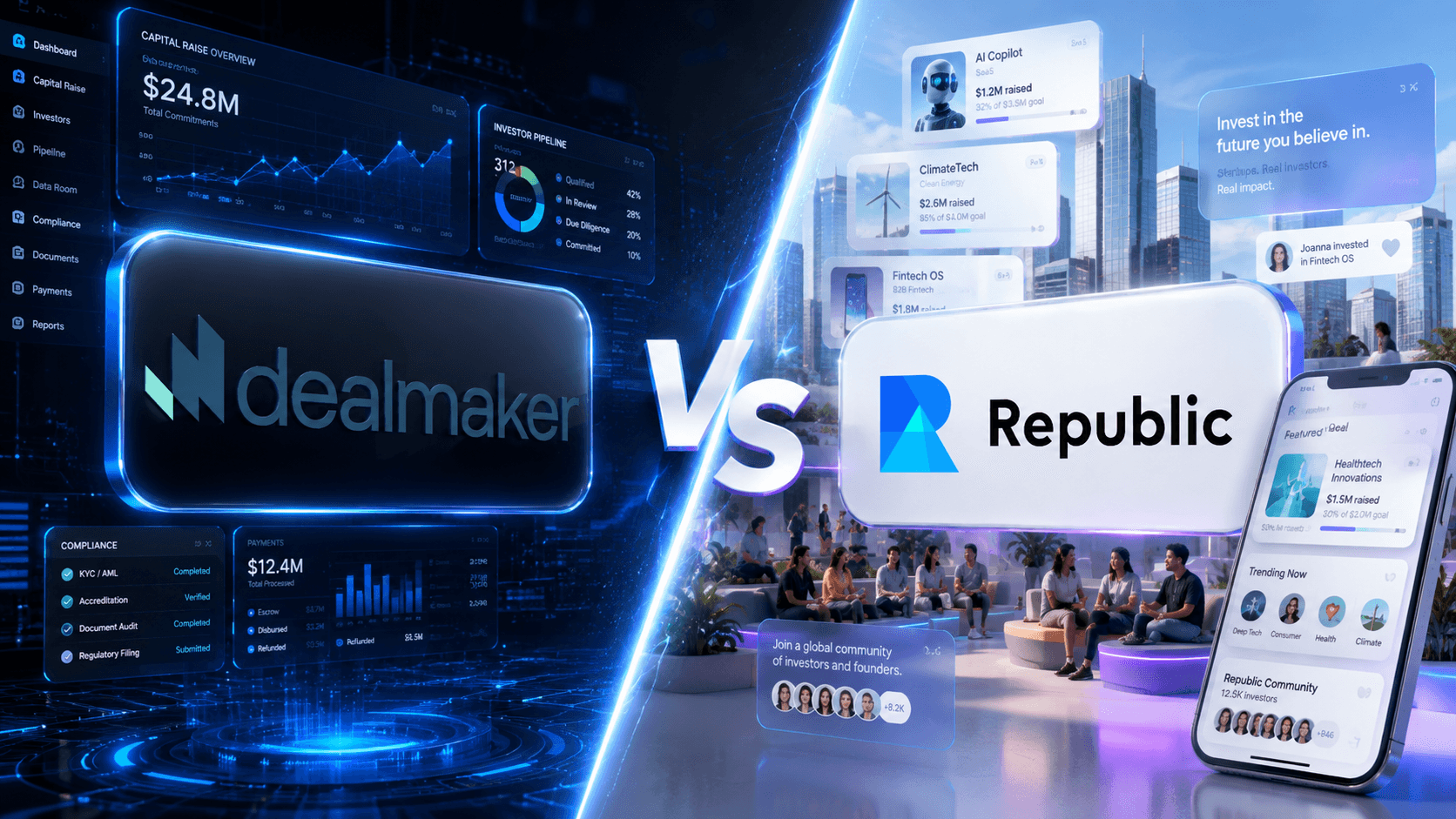
Republic curates a marketplace and intermediates the relationships: apply, get accepted, and your offering stands on a shelf beside others, in front of a claimed multi-million-member audience, mostly on Republic's Crowd SAFE paper. DealMaker hands you the shelf: your domain, your investor data, your ad budget — 8.5% plus fixed fees for the machinery, with no crowd included. The twist 2026 adds: the marketplace's US deal flow has contracted to a fraction of its peers', while the self-hosted machine carried roughly $358M last year. Both facts are attributed, both are checkable, and both should shape which architecture you rent.
Located Enforcement Record
Republic
AltStreet located zero enforcement actions across all Republic registered entities — alone among major US venues it has reviewed. DealMaker's BD is also disclosure-free, but its marketing arm has been under attributed journalistic challenge since March 2026.
Raise Volume Momentum
DealMaker
~$358M raised through DealMaker in 2025 per Kingscrowd vs Republic's $15.6M of 2024 US Reg CF volume per Kingscrowd-derived data — different years and lanes, so directional only, but the current large-raise machine is self-hosted.
Investor Storefront
Republic
A curated, browsable marketplace at $50-$150 minimums whose published funded-book figures agree with SEC filings ~92% of the time. DealMaker raises reach you through paid funnels with no shelf beside them.
TL;DR
The structural difference in two sentences
Republic is a curated multi-exemption marketplace — $256.7M in SEC-verified lifetime Reg CF raises at a $165,939 median, a ~63% Crowd SAFE book, zero located enforcement actions across its registered entities, US deal flow of $15.6M in 2024 (Kingscrowd-derived, attributed), and house tokens from non-intermediary affiliates that deserve entirely separate diligence. DealMaker is self-hosted infrastructure — 8.5% + $17.5K-$29.5K + $4,000/month in every Form C, roughly $358M of 2025 volume per Kingscrowd, a zero-disclosure broker-dealer whose assets are 92-97% affiliate receivables, and a marketing funnel under attributed journalistic challenge since March 2026.
If you read nothing else: scroll to the head-to-head comparison sections →
Republic is better for
- → Early-stage raises that fit its curation and want a trusted storefront audience
- → Founders in Republic's strong verticals — consumer, web3, gaming, real estate
- → Raises where a ~7%-plus-securities schedule beats six-figure fixed costs
- → Investors who want a browsable shelf, $50-$150 minimums, and a verified track record
DealMaker is better for
- → Brands that own an audience and want direct access to the investor data too
- → Raises above Reg CF's $5M ceiling — its Reg A record is its strongest evidence
- → Founders who would rather fund their own traffic than rent a contracting marketplace
- → Campaign volume: ~$358M through the stack in 2025 per Kingscrowd
92%
Republic's funded-book agreement with AltStreet's SEC census
802 offering pages captured and reconciled against 2,151 drained filings — company-level amounts agree where both report. Rare marketing-vs-filings hygiene in this category.
$15.6M vs $358M
Directional volume comparison — not like-for-like: Republic US Reg CF 2024 vs DealMaker Reg CF + Reg A 2025
Kingscrowd-derived figures via Angel Investors Network (Republic) and Kingscrowd 2025 tracking (DealMaker). Different years and different regulatory lanes — read it as direction, not a same-basis ranking.
$165,939
Median verified realized raise on Republic (606 SEC-confirmed offerings)
10.1% of the verified subset reached $1M+. ~63% of the funded book used the Crowd SAFE — no maturity date, version-specific conversion.
0 located
Enforcement actions across Republic's registered entities
AltStreet's legal scan located none — alone among major US venues it has reviewed. Its house tokens, issued by non-intermediary affiliates, carry a separate record: read the Republic review.
Comparison hub
Head-to-head decision map
This is a curation-versus-control decision wearing a fee comparison's clothes.
Founders usually arrive asking about fees; investors arrive asking whether either venue's numbers can be trusted. These sections isolate each dimension so both audiences can read only what they came for.
An audience you apply for vs a funnel you pay for
DealMaker vs Republic: Curated Marketplace vs Self-Hosted Machine
Republic is the most product-diverse marketplace among the major US venues: a FINRA-registered funding portal (Reg CF), a broker-dealer lane (Reg A/Reg D, dba Capital R), adviser-run SPVs, and — separately — house digital products issued by its own affiliates. Founders apply; Republic's materials describe accepting only a small fraction of applicants (a platform-marketed claim), and accepted offerings join a browsable storefront dominated by Republic's Crowd SAFE instrument. DealMaker inverts all of it: no storefront, no curation in the marketplace sense, no house products — each raise lives on the issuer's own domain with DealMaker's checkout, its broker-dealer as broker of record, and traffic the issuer buys, often through DealMaker's own marketing arm. AltStreet's censuses put numbers on both: Republic's lifetime verified Reg CF book is $256.7M across 606 confirmed raises (median $165,939), while DealMaker's 195-offering Reg CF book since 2022 sits beside a Reg A record including $62M-$75M raises — and Kingscrowd's 2025 tracking ($358M through DealMaker) against Republic's $15.6M of 2024 US Reg CF volume (Kingscrowd-derived, attributed) shows where the current volume actually flows.
Practical answer
Founders: Republic sells an audience and a trusted venue; DealMaker sells ownership of the funnel and the data. Check what each is worth today — Republic's US deal flow has contracted, and DealMaker's traffic is only as good as your ad budget. Investors: Republic at least shows you a shelf with comparable offerings; a DealMaker raise reaches you alone, through an ad — supply the comparison context yourself.
| Decision factor | What changes |
|---|---|
| Who investors meet | Republic: a curated, browsable marketplace with $50-$150 minimums. DealMaker: the issuer's own raise page, usually reached through a paid ad. |
| Investor data access | Republic: intermediated through the platform's marketplace and portal. DealMaker: the issuer has direct access — its core pitch. |
| Regulatory lanes | Republic: Reg CF portal + Reg A/D broker-dealer + SPV advisers under one brand (plus house tokens from non-intermediary affiliates). DealMaker: Reg CF and Reg A+ through one self-hosted stack. |
| Scale of book | Republic: 739 distinct SEC-census issuers, $256.7M verified realized, ~63% Crowd SAFE. DealMaker: 195 Reg CF offerings since 2022 + the Reg A mega-raise book. |
A narrower gap than you'd guess — and it isn't the real decision
DealMaker vs Republic: Fees for Founders
Republic's issuer schedule (layered sources): a representative 2026 Form C discloses 7% of funds raised (0% on the first $1M from certain pre-identified investors) plus a $25,000 onboarding fee; Republic's help center adds ~$3,000 of baseline compliance pass-throughs and notes commission applies only on success; third-party reviews report the commonly used 7% cash + 2% securities schedule (attributed). DealMaker's schedule, verbatim in every issuer's Form C: 8.5% cash + $17,500-$29,500 setup + $4,000/month, marketing extra. On an illustrative $1.2M raise that is roughly $112K cash + ~$24K securities at Republic versus $167K-$180K all-cash at DealMaker — a real but not decisive gap, and far narrower than Wefunder's near-zero founder-direct schedule undercuts both (see AltStreet's DealMaker vs Wefunder guide). The honest framing: at Reg CF scale you are not choosing on price between these two — you are choosing between Republic's storefront audience plus curation signal and DealMaker's funnel ownership plus data access.
Practical answer
Under the schedules modeled here, Republic is meaningfully cheaper on cash and adds a securities component; DealMaker costs more and hands you the funnel. If the fee delta decides your raise, neither may be right — Wefunder's founder-direct pricing exists. Choose between these two on architecture: audience you rent vs audience you own.
| Decision factor | What changes |
|---|---|
| Setup / onboarding | Republic: $25,000 onboarding (representative 2026 Form C) + ~$3,000 compliance pass-throughs per its help center. DealMaker: $17,500-$29,500 + $4,000/month ongoing. |
| Percentage fee | Republic: 7% cash per representative Form C (deal-specific; 0% on first $1M from pre-identified investors in that filing) + 2% securities per attributed third-party schedule. DealMaker: 8.5% cash on everything raised. |
| Equity/securities component | Republic: ~2% of securities (attributed schedule). DealMaker: none — all cash. |
| Marketing | Republic: storefront discovery included; promotion optional but recommended by the platform. DealMaker: issuer-funded, often via DealMaker's own agency — the subject of the March 2026 investigation. |
| $1.2M raise, illustrative all-in | Republic: ~$112K cash + ~$24K securities. DealMaker: ~$167.5K-$179.5K all cash — before marketing. |
Two clean formal records, two very different asterisks
DealMaker vs Republic: Regulatory Records & Structures
Republic's registered entities show the cleanest located-enforcement record among major US venues AltStreet has reviewed: zero disclosure events on both broker-dealer CRDs, no portal AWC located, zero RIA disclosures, and no SEC, FINRA, or state actions located in AltStreet's August 2026 legal scan. Its asterisk is structural, not disciplinary: at least ten entities operate under the brand, and the house products — the Republic Note and Mirror Tokens — are issued by non-intermediary affiliates that are not registered as broker-dealers, funding portals, or investment advisers. The Note's issuer documents, in its own final annual report, a distribution mechanism that never produced a holder payout, a $15.2M parent claim with liquidation priority over holders, and a lawful termination of SEC reporting in May 2026. DealMaker Securities also shows zero FINRA disclosures — against a balance sheet that is 92-97% receivables from its own affiliates in every audited year, $203,886 of net capital entering a $250,000-minimum carrying transition, confidential income statements throughout, and a March 2026 Hunterbrook investigation of its marketing arm's ad-disclosure practices (attributed; no regulatory action public as of this guide).
Practical answer
Neither record contains a regulator's sanction; both contain things worth reading. Republic's caution is entity architecture — know which of its ten-plus entities you face, and treat its house tokens as a separate product with a separate record. DealMaker's caution is financial opacity plus a live journalistic challenge to its growth engine. Founders inherit the association either way.
| Decision factor | What changes |
|---|---|
| Located enforcement | Republic: none located across any registered entity (AltStreet legal scan, August 2026). DealMaker Securities: zero BrokerCheck disclosures (CRD 315324). |
| The structural finding | Republic: house tokens from non-intermediary affiliates; the Note's issuer never paid a distribution and exited SEC reporting May 2026. DealMaker: 92-97% affiliate-receivable assets; $203,886 net capital vs a $250K incoming minimum. |
| Financial transparency | Republic: broker-dealer financials confidential since FY2022 (last public audit FY2021 showed a large net-capital cushion); parent private. DealMaker: BD balance sheets audited but income statements confidential all four years; parent private. |
| Live controversies | Republic: none located; the Note's record is disclosure, not enforcement. DealMaker: March 2026 Hunterbrook investigation of ad-compensation disclosure — attributed, unresolved, no action public. |
A shelf that checks out vs a funnel you must check yourself
DealMaker vs Republic: The Investor Lens
Republic gives investors something rare in this category: published track-record figures that survive independent verification. AltStreet captured all 802 offerings in Republic's public funded book and reconciled them against its SEC census — roughly 92% of company-level amounts agree where both report, with most divergences explained by multi-campaign aggregation or Reg A/D money alongside Reg CF rounds. The underlying distribution is still seed-stage venture: $165,939 median verified raise, 10.1% of verified raises at $1M+, no secondary market for the Crowd SAFE positions that dominate the book, and raise outcomes are not investor returns — AltStreet has verified no pattern of realized investor returns on either platform. DealMaker's investor-side reality is the funnel: offerings reach you through paid placements (the compensation disclosure practices of which are under attributed challenge), comparable deals are never shown beside them, and verified raise outcomes are weak where observable. And on Republic specifically, keep the marketplace separate from the house products: the Republic Note and Mirror Tokens are Republic's own issuances through non-intermediary affiliates, with the Note's zero-distribution history documented in its issuer's final annual report.
Practical answer
Same discipline, different venues: assume venture-grade loss rates, size positions for total loss, and read the Form C before the pitch. Republic's shelf, minimums, and verified book make it the friendlier browsing venue; its house tokens are a separate product deserving separate diligence. A DealMaker-powered raise arrives with zero context — supply it yourself from EDGAR before wiring anything.
| Decision factor | What changes |
|---|---|
| Discovery | Republic: curated browsable shelf, $50-$150 minimums, public deal pages. DealMaker: paid placements and issuer funnels — treat promotional mentions as potentially compensated unless disclosure shows otherwise. |
| Evidence depth | Republic: 606 verified raises, $165,939 median, funded book ~92% consistent with SEC filings. DealMaker: young book; weak observable raise outcomes; -40% to -99.6% listed-alumni tally (attributed to Hunterbrook). |
| Structural trap | Republic: the Crowd SAFE (no maturity; version-specific conversion) — and house tokens that are not marketplace offerings. DealMaker: 8.5% + fixed fees paid regardless of your eventual investment outcome, in a Form C the funnel never shows you. |
| Exit | Neither offers secondary liquidity for typical Reg CF positions. Republic's family owns the INX ATS, but it currently serves its house token lane, not the Crowd SAFE book. |
Primary-data deep dives
The Republic figures come from AltStreet's complete two-era SEC census (2,151 Form C-family filings; 606 verified realized raises), its full capture of Republic's public funded book (802 offering pages, reconciled against the census), Republic Core LLC's own annual reports, and FINRA BrokerCheck — documented in the AltStreet Republic review. The DealMaker figures come from its complete Form C intermediary census, four audited X-17A-5 filings, and FINRA BrokerCheck — documented in the AltStreet DealMaker review. The March 2026 investigation of DealMaker's marketing practices is at Hunterbrook Media and is cited throughout as attributed reporting; volume comparisons are Kingscrowd-derived and attributed as such.
Scenario Analysis
What a 12-month, $1.2M Reg CF raise costs on each platform
Illustrative, under the disclosed and attributed schedules modeled here — before marketing spend on either platform. Republic's fees are deal-specific; the representative Form C and its help-center pass-throughs anchor the model.
Republic (representative Form C + help-center pass-throughs)
- Commission: 7% × $1.2M = $84,000 (representative 2026 Form C; that filing waives fees on the first $1M from certain pre-identified investors)
- Securities component: ~2% per the commonly reported schedule (attributed) ≈ $24,000 of securities
- Onboarding: $25,000 (same Form C)
- Compliance pass-throughs: ~$3,000 baseline (Form C prep + escrow, per Republic's help center; commission on success only)
- Illustrative total: ~$112,000 cash + ~$24,000 in securities (≈9-11%)
DealMaker (Form C-disclosed schedule)
- Commission: 8.5% × $1.2M = $102,000
- Setup fee: $17,500-$29,500
- Account management: $4,000 × 12 = $48,000
- Illustrative total: ~$167,500-$179,500 (≈14-15%), all cash — plus marketing, since there is no marketplace crowd
Under the schedules modeled here, Republic is roughly $50,000-$65,000 cheaper in cash on this raise and includes a storefront audience — but adds a securities component and requires passing its curation. The honest founder question is not the fee delta: it is whether Republic's current US deal flow ($15.6M across all of 2024, Kingscrowd-derived, attributed) still delivers the fundraising value the storefront implies, or whether that budget is better spent buying your own traffic on infrastructure you control. The model assumes the full $1.2M is commission-bearing; the cited Rentberry filing would produce a lower fee if qualifying pre-identified investors supplied part of the raise. Actual costs depend on negotiated terms, sourcing mix, and campaign length.
DealMaker vs Republic: every question we could find searchers asking
Short answer
Fits Republic's curation and needs an audience: Republic — a cheaper disclosed schedule, a browsable storefront whose published numbers survive SEC cross-checking, and the cleanest located-enforcement record among major venues AltStreet has reviewed, weighed against sharply contracted US deal flow and a multi-entity structure whose house tokens deserve separate diligence. Owns an audience, or raising past $5M: DealMaker — funnel and data ownership with a strong Reg A execution record, weighed against six-figure all-cash fees, an affiliate-paper balance sheet, and a marketing arm under attributed journalistic challenge. Investors: on either venue, read the Form C before the pitch.
Is DealMaker better than Republic for raising capital?+
They sell opposite architectures. Republic is a curated marketplace: you apply, and if accepted (Republic's own materials describe accepting only a small fraction of applicants — a platform-marketed claim), your offering joins a browsable storefront in front of Republic's claimed multi-million-member community, intermediated by its FINRA-registered funding portal for Reg CF or its broker-dealer for Reg A. DealMaker is self-hosted infrastructure: no marketplace, no application curation in the marketplace sense — your raise runs on your own website with DealMaker's checkout and broker-dealer, and you (often with DealMaker's marketing arm) buy the traffic. The current momentum split is stark: Kingscrowd tracked roughly $358M raised through DealMaker across Reg CF and Reg A in 2025, while Republic's 2024 US Reg CF volume was $15.6M per Kingscrowd-derived data reported by Angel Investors Network. Republic supplies an audience but its US deal flow has contracted sharply; DealMaker supplies no audience but its machine is currently where large self-hosted raises happen. Founders with their own crowd and budget lean DealMaker; founders who need a venue's audience and trust lean Republic — after checking how much fundraising value that audience still delivers.
What fees does Republic charge founders and investors?+
Republic's issuer-side fees are deal-specific and disclosed in each offering's Form C intermediary-compensation block. A representative 2026 Form C (Rentberry) discloses 7% of funds raised (0% on the first $1M from certain pre-identified investors) plus a $25,000 onboarding fee. Republic's own help center adds the compliance pass-throughs — roughly $1,500 for Form C preparation and $1,500 for escrow, about $3,000 baseline, with financials review and attorney costs on top where needed — and states Republic takes commission only on successful campaigns. Third-party reviews (Angel Investors Network, 2026) report a commonly used schedule of 7% cash plus 2% of securities, plus an investor-side transaction fee of roughly 2.5% capped around $250 — attributed figures; the filings are the authority per deal. Investor side: the transaction fee plus whatever the security itself costs you in structure — on Republic that usually means a Crowd SAFE, which is a convertible claim rather than stock.
What does it cost to raise on DealMaker compared to Republic?+
Modeled illustratively on a 12-month $1.2M Reg CF raise under the disclosed schedules: Republic runs roughly $84,000 at 7% cash, plus about 2% in securities (per the commonly reported schedule, attributed), plus a $25,000 onboarding fee and ~$3,000 of compliance pass-throughs — call it roughly $112,000 cash plus a ~$24,000 securities component. DealMaker's Form C-disclosed schedule — 8.5% cash commission plus $17,500-$29,500 setup plus $4,000 per month — comes to roughly $167,500-$179,500, all cash, before marketing spend, which is extra and often substantial because there is no marketplace crowd. The schedule gap is real but narrower than DealMaker vs Wefunder: what you are actually choosing is whether ~$50,000-$65,000 of schedule savings plus Republic's storefront audience beats owning your funnel and your investor data outright. Actual costs depend on negotiated terms, sourcing mix, and campaign length — read the specific Form C either way.
Is Republic legit and safe?+
Republic's registered entities have the cleanest located-enforcement record among the major US crowdfunding venues AltStreet has reviewed: its legal scan located no SEC, FINRA, or state enforcement actions against the funding portal, either broker-dealer registration, or the RIA across ten years — versus FINRA settlements at Wefunder ($1.4M) and StartEngine ($350K). Two cautions keep that from being the whole story. First, 'Republic' is a brand covering at least ten entities — its own terms of service call the name a collective label — and its house digital products (the Republic Note, Mirror Tokens) are issued by non-intermediary affiliates that are not registered as broker-dealers, funding portals, or investment advisers; the Note has never paid a holder distribution and its issuer lawfully terminated SEC reporting in May 2026. Second, a clean located-enforcement record describes compliance, not investment quality: the marketplace's Reg CF book behaves like seed-stage venture everywhere behaves. AltStreet's full Republic review documents both sides.
Is DealMaker legit?+
Yes, with structural caveats its own filings document. DealMaker Securities LLC is a FINRA member broker-dealer (CRD 315324) with zero disclosure events on BrokerCheck as of August 2026. The caveats: in all four audited years, 92-97% of the broker-dealer's assets are receivables from DealMaker's own affiliates, leaving $203,886 of regulatory net capital as it enters a FINRA-approved transition to carrying customer accounts with a $250,000 minimum — additional qualifying net capital would be needed before operating under that requirement — and its income statements have been filed confidentially in every year. A March 2026 Hunterbrook Media investigation also reported that DealMaker's marketing arm placed offering ads across mainstream newsletters without disclosing the specific compensation received — disclosure the investigation argues securities rules require — with no regulatory action public as of this guide. AltStreet treats those allegations as attributed reporting alongside the clean formal record.
What do raises on each platform actually look like?+
AltStreet ran full SEC censuses on both. Republic: 2,151 Form C-family filings drained across both of its intermediary registration eras, resolving 739 distinct issuers — 606 with verified realized raises totaling $256.7M, at a median of $165,939, with 10.1% of the verified subset reaching $1M+ and roughly 63% of the platform's public funded book using the Crowd SAFE. Notably, Republic's own published funded-book figures agree with the SEC census on roughly 92% of company-level amounts where both report — unusually good marketing-vs-filings hygiene. DealMaker: 195 Reg CF offerings involving 206 issuing and co-issuing legal entities since April 2022 (about 86% ordinary operating companies), beside the Reg A book where its marquee raises live (EnergyX $75M, Pacaso $72.5M). The shapes match the models: Republic hosts many small curated community raises whose US pace has slowed; DealMaker powers fewer, larger, marketing-driven raises — Kingscrowd put its 2025 combined volume around $358M.
Can investors sell shares bought on Republic or through DealMaker raises?+
For typical positions on either: realistically no. Reg CF securities carry Regulation Crowdfunding's one-year resale restriction as the floor, and neither venue operates a secondary market for ordinary Reg CF positions — Republic's dominant Crowd SAFE additionally has no maturity date, so a position in a surviving-but-not-exiting company remains outstanding indefinitely. One nuance separates them on paper: Republic's corporate family owns a registered alternative trading system through its April 2025 INX acquisition, where its house Republic Note trades and where tokenized products are intended to trade — real infrastructure, but it does not currently serve the Crowd SAFE positions that dominate the funded book. Across DealMaker's 195-offering census, no offering discloses an ATS arrangement. Plan for exit only through issuer events on venture timelines, on both.
What securities do you actually buy on each platform?+
On Republic, roughly 63% of the captured funded book used the Crowd SAFE — Republic's signature convertible instrument. Its conversion depends on defined triggering events and the specific version's terms (some variants convert at the issuer's election), it has no maturity date or interest, and it generally provides limited holder rights before conversion; the rest of the book spans common stock, token purchase agreements, and revenue-share notes. DealMaker-powered raises are set by each issuer and lean toward direct common or preferred shares, especially in the Reg A book — conventional equity, but bought through an issuer-controlled funnel where comparable offerings are never presented alongside. Separate both from Republic's house products: the Republic Note and Mirror Tokens are issued by Republic's own non-intermediary affiliates and are a different proposition from the marketplace entirely — AltStreet's Republic review covers why they deserve their own diligence.
Who should raise on Republic, and who should raise on DealMaker?+
Republic: earlier-stage companies that fit its curation (its materials emphasize tech, consumer, web3, and gaming verticals), want a trusted storefront and a $50-$150-minimum retail audience, and are raising at a scale where a ~7%-plus-securities schedule beats six-figure fixed costs — accepting that the platform's US Reg CF deal flow, per Kingscrowd-derived data, was $15.6M across all of 2024, so the audience subsidy is thinner than the member counts suggest. DealMaker: brands raising $1M-$75M+ that own an audience and an ad budget, want direct access to investor data and communications in their own database, and need execution above Reg CF's $5M ceiling, where DealMaker's Reg A record is its strongest documented evidence — while Republic also hosts Reg A through its broker-dealer, DealMaker's recent large-raise execution is where the filings put the weight. Investors: on either venue, the Form C or offering circular is the only unpaid voice — read it before the pitch.
Final read
Final Verdict
For founders, this comparison is about what you are actually renting. Republic rents you a curated storefront, a retail audience at $50-$150 minimums, a multi-exemption stack under one roof, and an association with the cleanest located-enforcement record among the major venues AltStreet has reviewed — at a schedule roughly $50,000-$65,000 lighter in cash than DealMaker's on a $1.2M raise, plus a securities component. The caution is momentum: $15.6M of 2024 US Reg CF volume (Kingscrowd-derived, attributed) is a fraction of what the member counts imply, and a storefront is only worth its foot traffic. DealMaker rents you the opposite: no audience at all, but total ownership of your funnel and your investor data, and the strongest recent execution record in large self-hosted raises — read against an affiliate-paper balance sheet, a confidential group P&L, and a marketing engine under attributed journalistic challenge since March 2026.
For investors, Republic is the friendlier venue by construction — a browsable shelf, small minimums, and published track-record figures that agree with SEC filings roughly 92% of the time, which is more verification than platform marketing usually survives. Its two disciplines: know the Crowd SAFE's mechanics (no maturity; conversion depends on defined triggering events and the specific version), and keep the marketplace strictly separate from Republic's house tokens, which are issued by non-intermediary affiliates and carry a documented record of their own. On any DealMaker-powered funnel, the discipline is simpler and harder: every mention of the offering you encountered was likely paid for, so open the Form C on EDGAR — the fee table, the valuation math, and the issuer's real financials — before wiring anything. On either venue, raise outcomes are not investor returns, and no pattern of realized investor returns is verifiable on either book.
Republic wins on
Schedule cost at Reg CF scale, storefront discovery and curation signal, verified track-record hygiene (~92% filing agreement), the located-enforcement record, and product breadth across Reg CF, Reg A, and SPV lanes.
DealMaker wins on
Current raise volume (~$358M in 2025 per Kingscrowd), direct investor-data access, funnel and brand control, and Reg A execution at $20M-$75M scale where its record is strongest.
The Primary Sources Behind This Guide
Both records, documented from filings — no marketing language, no affiliate framing.
DealMaker Full Review
The 195-offering census, four audited broker-dealer balance sheets, the verbatim fee schedule, the carrying-firm transition, and the March 2026 investigation — treated as attributed reporting.
Republic Full Review
The two-era census (2,151 filings), the 802-offering funded-book reconciliation, the Crowd SAFE analysis, the entity map, and the Republic Note's documented record — read from its issuer's own filings.