DealMaker vs Wefunder 2026
Wefunder pioneered the community round; DealMaker built the machine that competes with it. This guide compares them for founders and investors on primary sources: SEC Form C fee disclosures, 4,738 Wefunder-associated filings, FINRA's $1.4M settlement, audited broker-dealer reports, and AltStreet's censuses of both books.
Guide Thesis
Cheapest venue vs biggest ceiling.
Under $5M with a community, Wefunder wins on arithmetic. Above $5M, Reg CF ends and so does the comparison — DealMaker's Reg A machine is playing a different game.
DealMaker's own comparison page concedes Wefunder for raises "under $500K." The filings say the concession runs much further.
On a $1.2M community-sourced round, the schedule difference is roughly $10K versus $170K. What you are really buying at DealMaker is the data — and the ceiling.
The Core Decision
Whose crowd is it — and how big does the raise need to get?
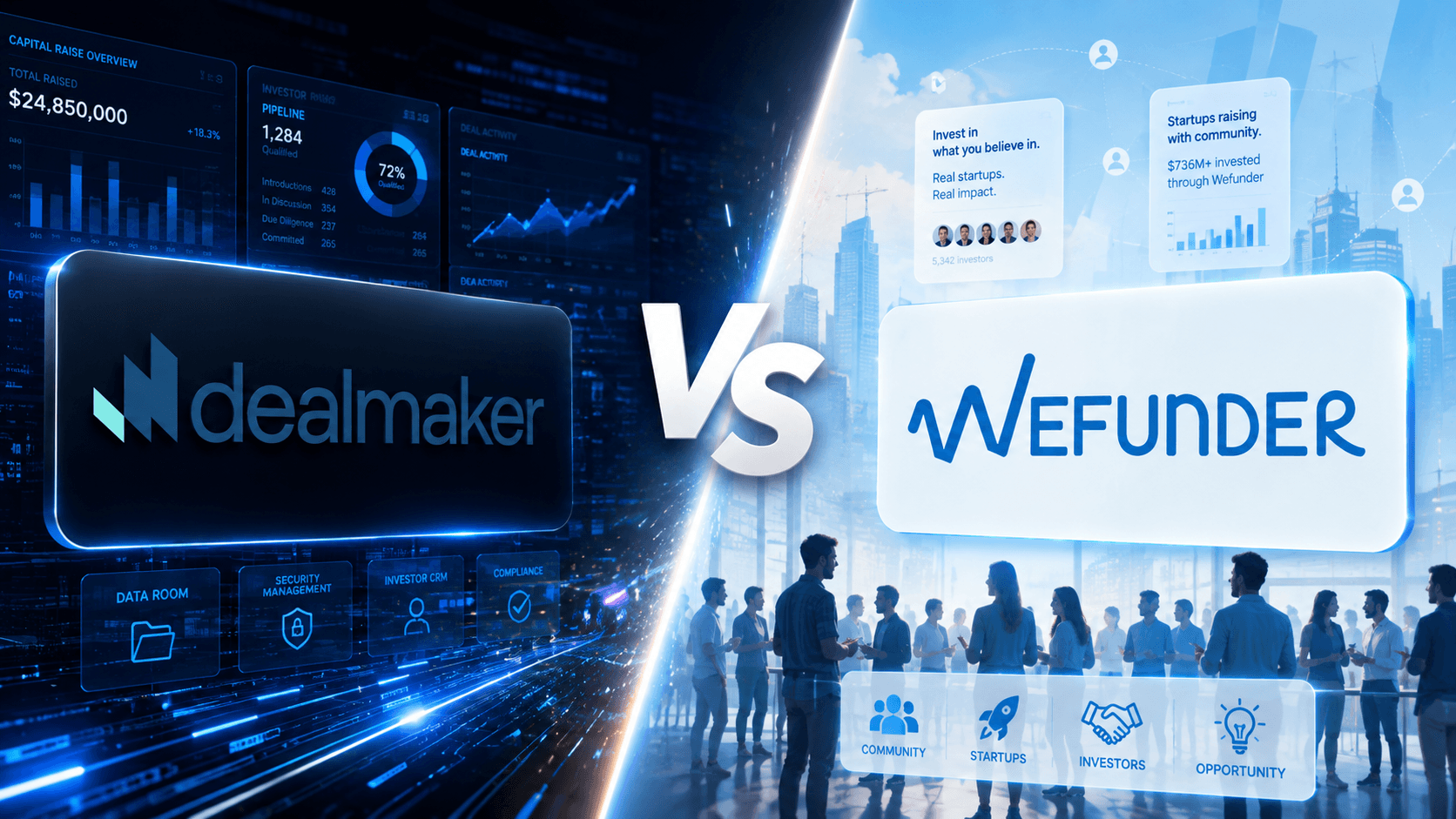
Wefunder monetizes its network: bring your own investors and it charges you almost nothing; use its crowd and SPV rails and it takes its share. DealMaker monetizes the raise itself: 8.5% plus fixed fees on everything, in exchange for your own storefront, direct access to your investor data, and a stack that keeps working past Reg CF's $5M ceiling into $60M-$75M Reg A territory. Two honest machines, priced for different founders — with records on both sides worth reading before either sales call.
Lowest Schedule
Wefunder
$10K setup, 0% on founder-brought investors, ~7.5% marketed on network capital — the lowest disclosed schedule AltStreet has reviewed among major venues.
Above $5M
DealMaker
Reg CF stops at $5M/year — and so does Wefunder. DealMaker's Reg A stack executed several of the largest self-hosted raises AltStreet identified.
Formal Disciplinary Record
DealMaker
Zero BrokerCheck disclosures at DealMaker Securities (a broker-dealer) vs Wefunder Portal's resolved $1.4M AWC (a funding portal) — different intermediary categories, weighed against DealMaker's affiliate-paper balance sheet.
TL;DR
The structural difference in two sentences
Wefunder is the original Reg CF marketplace — ~3,000 lifetime offerings at a $283K verified median, near-zero disclosed fees on founder-brought investors, a $5M annual ceiling, and a resolved $1.4M FINRA fine covering its first five years. DealMaker is self-hosted infrastructure — 8.5% + $17.5K-$29.5K + $4,000/month in every Form C, a zero-disclosure broker-dealer whose assets are 92-97% affiliate receivables, Reg A execution to $75M, and a marketing funnel under attributed journalistic challenge since March 2026.
If you read nothing else: scroll to the head-to-head comparison sections →
Wefunder is better for
- → Community rounds under $1M-$5M — the lowest disclosed schedule among venues AltStreet has reviewed
- → Founders whose customers ARE the investor base (0% founder-direct)
- → First raises that need a trusted marketplace and lead-investor signal
- → Investors who want a shelf, negotiated terms, and public Q&A
DealMaker is better for
- → Raises above Reg CF's $5M ceiling — Wefunder is not an option there
- → Brands that own an audience and want direct access to the investor data too
- → Reg A+ campaigns at $20M-$75M, its strongest documented lane
- → Founders allergic to a marketplace brand between them and backers
$10K vs ~$170K
Schedule cost of a founder-sourced $1.2M raise: Wefunder vs DealMaker
Wefunder: $10K setup + 0% on founder-direct investors. DealMaker: 8.5% + $17.5K-$29.5K setup + $4K/month, per its Form C disclosures — before marketing.
$1.4M
FINRA fine against Wefunder Portal — AWC settled May 2022, resolved
Five violation categories, 2016-2021: 39 offerings circumventing Reg CF maxima via Reg D redirection (~$20M), ~$290K dormant escrow, supervisory and solicitation failures.
$283K
Median verified closed raise on Wefunder (254 offerings with parseable C-U totals)
About 21% of that verified subset cleared $1M. 55% of top-200 analyzed capital shows distressed signals at latest filing; one third-party estimate attributes ≈55% of historical aggregate gains to Zenefits.
$5M ceiling
Where the comparison ends: Reg CF's annual cap is Wefunder's ceiling
DealMaker's Reg A book runs to $75M (EnergyX, Pacaso, Monogram — several of the largest self-hosted raises AltStreet identified). Above $5M there is no Wefunder option to compare.
Comparison hub
Head-to-head decision map
Below $5M this is a price-versus-control decision. Above $5M it stops being a decision at all.
Founders usually arrive asking about fees; investors arrive asking what the outcome data shows. These sections isolate each dimension so both audiences can read only what they came for.
The two poles of Reg CF architecture
DealMaker vs Wefunder: Community Marketplace vs Self-Hosted Machine
These are the purest opposites among the major venues. Wefunder is the original marketplace: the first SEC-registered Reg CF funding portal (May 2016), founded by Y Combinator alumni who lobbied for the JOBS Act itself, hosting roughly 3,000 lifetime offerings on a browsable shelf with community discussion and a lead-investor model that puts negotiated terms in front of the crowd. FINRA's own 2022 settlement described it as the largest participant in the crowdfunding space. DealMaker has no shelf at all: each raise runs on the issuer's own website with DealMaker's checkout, its broker-dealer as broker of record, and — since its Ridge Growth Agency acquisition — its own marketing arm supplying the traffic. AltStreet's censuses show what each machine produces: Wefunder's verified closed raises have a $283K median across thousands of community rounds; DealMaker's 195-offering Reg CF book (86% ordinary operating companies) sits beside a Reg A record that includes $62M-$75M raises no Reg CF venue can touch.
Practical answer
Founders: pick the architecture your raise actually needs. If the crowd must be found, the marketplace finds it; if the crowd is yours, the marketplace is a toll. Investors: Wefunder at least shows you a shelf, a lead investor's terms, and a public Q&A; a DealMaker offering reaches you outside any marketplace, so comparable offerings are not presented alongside it.
| Decision factor | What changes |
|---|---|
| Who investors meet | Wefunder: a browsable marketplace with lead-investor terms and public Q&A. DealMaker: the issuer's own raise page, usually reached through a paid ad. |
| Investor data access | Wefunder: intermediated through the platform's network. DealMaker: the issuer has direct access — its core pitch. |
| Regulatory ceiling | Wefunder: Reg CF's $5M per issuer per year (plus Reg D side-cars). DealMaker: Reg CF and Reg A+ to $75M — where its record is strongest. |
| Scale of book | Wefunder: ~3,000 lifetime offerings, 4,738 associated filings, median closed raise $283K. DealMaker: 195 Reg CF offerings since 2022 + the Reg A mega-raise book. |
The widest fee gap in the category — until $5M, where it inverts
DealMaker vs Wefunder: Fees for Founders
At Reg CF scale the arithmetic is one-sided. Wefunder's disclosed schedule (per AltStreet's review): $10,000 per-offering setup; 0% on founder-direct invitee investors; 5% management + 10% carry on Wefunds SPV money sourced from Wefunder's network; marketed headline pricing around 7.5% on network-raised capital — no equity component, no monthly retainer, with actual terms negotiated per offering. DealMaker's schedule, verbatim in every issuer's Form C: 8.5% cash commission + $17,500-$29,500 setup + $4,000/month, with marketing extra — its own ads were credited (by DealMaker, per Hunterbrook's reporting) with over $50M of one issuer's raise. On a $1.2M community-sourced round the difference is roughly $10K versus $170K. What inverts the comparison is not price but ceiling: Reg CF stops at $5M, and Wefunder with it. Above that line DealMaker is not competing with Wefunder at all — it is competing with Reg A platforms and underwriters, on a fee schedule whose fixed costs have shrunk to noise at $20M-$75M raise sizes.
Practical answer
Under $5M with any real community: under the schedules modeled here, Wefunder wins the fee comparison decisively — the money you save is money that reaches your actual use of proceeds, which your investors can verify in the Form C. Choose DealMaker at Reg CF scale only if the whole self-hosted architecture — direct data access, brand control, and a stack that extends into Reg A — is genuinely worth six figures to you; choose it above $5M because Wefunder is no longer on the menu.
| Decision factor | What changes |
|---|---|
| Setup | Wefunder: $10,000 per offering. DealMaker: $17,500-$29,500 + $4,000/month ongoing. |
| Percentage fee | Wefunder: 0% founder-direct · ~7.5% marketed on network capital · 5% + 10% carry on the SPV track. DealMaker: 8.5% cash on everything raised. |
| Equity component | Neither charges equity or warrants — unlike StartEngine's ~2%. |
| Marketing | Wefunder: marketplace discovery included; promotion optional. DealMaker: issuer-funded, often through DealMaker's own agency — the subject of the March 2026 investigation. |
| $1.2M raise, all-in schedule | Wefunder: ~$10K (founder-sourced) to ~$100K (network-sourced). DealMaker: ~$167K-$180K before marketing. |
A $1.4M resolved fine vs a clean record on an unusual balance sheet
DealMaker vs Wefunder: Regulatory Records & Structures
Wefunder's record contains the largest FINRA fine among the major Reg CF venues: AWC No. 2021071940801, settled May 2022, $1.4 million, covering five categories of violations across the platform's first five years — most seriously, 39 offerings that circumvented Reg CF's maximum-raise limits by redirecting capital into Reg D vehicles (~$20M aggregate), plus ~$290K of dormant escrow not transmitted, supervisory failures, and solicitation violations. It is resolved, the conduct period ended in 2021, and the dual Reg CF/Reg D structure involved in those violations still exists, now with the two tracks disclosed in current offering materials — and still worth understanding deal by deal. DealMaker Securities shows the opposite profile: zero FINRA disclosures in four years — against a balance sheet that is 92-97% receivables from its own affiliates in every audited year, $203,886 of regulatory net capital entering a $250,000-minimum carrying transition (additional qualifying capital would be needed), income statements confidential throughout, and a March 2026 Hunterbrook investigation of its marketing arm's ad-disclosure practices (attributed allegations; SEC/FINRA referrals filed by the contributor; no regulatory action public as of this guide).
Practical answer
Read both records as what they are: Wefunder's is a documented, resolved compliance failure at a marketplace with an unusually deep public filing record; DealMaker's is a formally spotless record at a structurally opaque group under live journalistic challenge. Founders inherit the association either way; investors should weight resolved-and-disclosed differently from clean-but-untested — and read the Wefunds SPV terms and the Form C compensation sections regardless of venue.
| Decision factor | What changes |
|---|---|
| FINRA record | Wefunder Portal: $1.4M AWC settled May 2022 (2016-2021 conduct), resolved. DealMaker Securities: zero disclosures (CRD 315324). |
| The structural finding | Wefunder: Reg CF maxima circumvented via Reg D redirection across 39 offerings — the dual-track structure persists, now disclosed. DealMaker: 92-97% affiliate-receivable assets; $203,886 net capital vs a $250K incoming minimum. |
| Financial transparency | Wefunder: private company; platform metrics marketed, not audited publicly. DealMaker: BD balance sheets audited but income statements confidential all four years; parent private. |
| Live controversies | Wefunder: none documented post-2022 in AltStreet's review. DealMaker: March 2026 Hunterbrook investigation of ad-compensation disclosure — attributed, unresolved, no action public. |
What the outcome data says when you are the one buying
DealMaker vs Wefunder: The Investor Lens
Wefunder gives AltStreet the deepest filing-based dataset it has assembled for any Reg CF venue — verified closed-raise totals plus a post-raise issuer-condition analysis — and it is sobering: a $283K median across 254 verified closed raises, with about 21% of that subset clearing $1M; 55% of top-200 analyzed capital sitting in issuers with distressed structural signals at their latest SEC filing (another 15% declining); and a third-party analysis attributing roughly 55% of historical aggregate investor gains to a single non-replicable outlier (Zenefits). None of that is hidden — it is what a fully filing-transparent marketplace looks like when someone reads all 4,738 filings. DealMaker's book is younger and its observable record thinner: verified raise outcomes are weak where they exist (2.2%-of-target; zero-sold), its promoted cohort carried 25x-67x book-value markups per the March 2026 reporting, and its listed alumni traded down 40-99.6% from debut per the same tally — with the standing caveat that raise and business outcomes are not investor returns, which are largely unobservable on both venues.
Practical answer
Same discipline, different venues: assume venture-grade loss rates, size positions for total loss, and read the Form C before the pitch. Wefunder adds two things worth using — the lead investor's negotiated terms and the public Q&A — and one trap worth checking: whether you are in the Reg CF direct security or the Wefunds SPV, which differ in fees, rights and tax paperwork. A DealMaker-powered raise reaches you without that context — supply it yourself from EDGAR before wiring anything.
| Decision factor | What changes |
|---|---|
| Discovery | Wefunder: browsable shelf, lead-investor terms, public Q&A. DealMaker: paid placements and issuer funnels — assume every mention is bought. |
| Evidence depth | Wefunder: deep filing record — $283K median closed raise (21% of the verified subset above $1M), 55% of top-200 capital showing distressed signals, and a third-party estimate attributing ≈55% of historical aggregate gains to Zenefits. DealMaker: young book; weak observable raise outcomes; -40% to -99.6% listed-alumni tally (attributed). |
| Structural trap | Wefunder: Reg CF direct vs Wefunds SPV — different fees, securities, K-1s; not shown side by side. DealMaker: 8.5% + fixed fees paid regardless of your eventual investment outcome, in a Form C the funnel never shows you. |
| Exit | Neither operates a secondary market. Issuer events only, on venture timelines — 'indefinite' is the documented typical outcome. |
Primary-data deep dives
The Wefunder figures come from AltStreet's analysis of 4,738 Wefunder-associated SEC filings, its outcome classification of the 200 highest-capitalized offerings, and the FINRA AWC read at source — documented in the AltStreet Wefunder review. The DealMaker figures come from its complete Form C intermediary census, four audited X-17A-5 filings, and FINRA BrokerCheck — documented in the AltStreet DealMaker review. The March 2026 investigation of DealMaker's marketing practices is at Hunterbrook Media and is cited throughout as attributed reporting; the Zenefits concentration figure is a third-party estimate (CrowdWise) and is attributed as such.
Scenario Analysis
What a 12-month, $1.2M Reg CF raise costs on each platform
Disclosed schedules only — before marketing spend on either platform. The Wefunder figure depends heavily on who sources the investors, which is the entire point of its model.
Wefunder (disclosed schedule, per AltStreet's review)
- Setup fee: $10,000
- Founder-direct investors: 0% — a fully community-sourced round pays only the setup fee
- Network-sourced capital: ~7.5% marketed → up to ~$90,000 if Wefunder's crowd fills the whole round
- Wefunds SPV track (accredited, network-sourced): 5% management + 10% carry, per its terms
- Schedule total: ~$10,000-$100,000 depending on sourcing — no equity, no monthly retainer
DealMaker (Form C-disclosed schedule)
- Commission: 8.5% × $1.2M = $102,000
- Setup fee: $17,500-$29,500
- Account management: $4,000 × 12 = $48,000
- Schedule total: ~$167,500-$179,500 (≈14-15%), all cash — plus marketing, since there is no marketplace crowd
The asymmetry founders should sit with: under the disclosed schedules modeled here, DealMaker's Reg CF pricing does not compare favorably with Wefunder's at any raise size — its case is direct data access and funnel control, and actual costs depend on sourcing mix, campaign length, and negotiated terms. The comparison genuinely flips only at the $5M Reg CF ceiling, above which Wefunder does not operate and DealMaker's Reg A stack — at $20M-$75M raise sizes where its fixed costs become noise — is its strongest documented lane.
DealMaker vs Wefunder: every question we could find searchers asking
Short answer
Under $5M with an engaged community: Wefunder — the lowest disclosed schedule among the venues AltStreet has reviewed (0% on investors you bring), a trusted marketplace, and a lead-investor model, with a resolved $1.4M FINRA fine as the record to read. Above $5M, or when owning the investor data is worth six figures: DealMaker — Reg A execution to $75M and total funnel control, with an affiliate-paper balance sheet and a journalistically challenged marketing arm as the record to read. Investors: on either venue, read the Form C before the pitch.
Is DealMaker better than Wefunder for raising capital?+
They barely compete on the same raises. Wefunder is a Reg CF marketplace — the first SEC-registered funding portal, described by FINRA in its 2022 settlement as the largest participant in the crowdfunding space — built around 'community rounds' up to Reg CF's $5M annual ceiling, with pricing that rewards founders who bring their own crowd (per AltStreet's review of its disclosed schedule: a $10,000 per-offering setup fee, 0% on investors the founder brings directly, 5% management plus 10% carry on SPV money sourced from Wefunder's network, and platform-marketed headline pricing around 7.5% for network-raised capital). DealMaker is self-hosted infrastructure priced for scale — 8.5% cash commission plus $17,500-$29,500 setup and $4,000 per month, disclosed verbatim in issuers' SEC Form C filings — and its distinguishing record is Regulation A+ execution far above Wefunder's ceiling: EnergyX at $75M, Pacaso at $72.5M, Monogram at $62M, several of the largest self-hosted Reg A raises AltStreet identified. Under $5M with a community: Wefunder is structurally cheaper and supplies the venue. Above $5M, Wefunder is not an option and the comparison ends — DealMaker's real rivals there are other Reg A platforms and investment banks.
What fees does Wefunder charge founders and investors?+
Wefunder's model is the most founder-tilted of the major venues, with a structure that rewards bringing your own investors. Per AltStreet's review of the disclosed schedule: a $10,000 per-offering setup fee; 0% on founder-direct invitee investors (people the founder brings rather than Wefunder's network); and on the Wefunds LLC Reg D side-car — the SPV track for accredited investors arriving through Wefunder's network — a 5% management fee plus 10% carry. The platform's marketed headline rate for network-raised Reg CF capital runs around 7.5% (published terms). Investor side: roughly a 2% transaction fee. Two structural cautions from AltStreet's review: the Reg CF direct track and the Wefunds SPV track are different securities with different fees, voting rights and tax documents (Common Stock or SAFEs with no K-1 versus LLC membership interests with one), and the platform does not present the two side by side — read the specific deal page and PPM to know which you are buying.
What does it cost to raise on DealMaker compared to Wefunder?+
At Reg CF scale, it is not close. DealMaker's schedule — disclosed verbatim in its issuers' Form C filings — is 8.5% cash commission plus a $17,500-$29,500 setup fee and $4,000 per month: roughly $150,000-$180,000 on a 12-month $1.2M raise before any marketing spend, which is extra and often substantial. The same raise on Wefunder runs about $10,000 plus roughly 7.5% on network-sourced capital — and materially less if the founder's own community supplies the round, since founder-direct investors carry no percentage fee at all. What DealMaker sells for the difference: your raise on your own website, direct access to 100% of the investor data, no marketplace brand between you and your backers, and a stack that continues working above $5M where Reg CF — and therefore Wefunder — stops.
Is Wefunder legit and safe?+
Wefunder is a real, decade-old regulated institution — founded by Y Combinator alumni who personally lobbied for the JOBS Act, first to register as a Reg CF funding portal, and the venue behind roughly 3,000 lifetime offerings. Its record requires reading one document: FINRA AWC No. 2021071940801, settled May 2022 with a $1.4 million fine — the largest FINRA fine among the major Reg CF venues — covering five categories of violations across the platform's first five years (2016-2021), including 39 offerings that circumvented Reg CF's maximum-raise limits via redirection into Reg D vehicles (roughly $20M aggregate), about $290K of dormant escrow funds not transmitted, supervisory failures, and solicitation rule violations. It is resolved, and the conduct period ended in 2021; AltStreet's review treats it as a serious but bounded historical finding. Separately, investors should understand what the marketplace does not do: Wefunder performs compliance review, not investment underwriting — it does not vet offerings for quality, and its own materials say so.
Is DealMaker legit?+
Yes, with structural caveats its own filings document. DealMaker Securities LLC is a FINRA member broker-dealer (CRD 315324) with zero disclosure events on BrokerCheck as of August 2026 — formally cleaner than both Wefunder's portal ($1.4M AWC, 2022) and StartEngine's ($350K AWC, 2022). The caveats: in all four audited years, 92-97% of the broker-dealer's assets are receivables from DealMaker's own affiliates, leaving $203,886 of regulatory net capital under $20.6M of book equity as it enters a FINRA-approved transition to carrying customer accounts with a $250,000 minimum — additional qualifying net capital would be needed before operating under that requirement — and its income statements have been filed confidentially in every year. A March 2026 Hunterbrook Media investigation also reported that DealMaker's marketing arm placed offering ads across eight mainstream newsletters without disclosing the specific compensation received — disclosure the investigation argues securities rules require — with no regulatory action public as of this guide. AltStreet's DealMaker review treats those allegations as attributed reporting alongside the clean formal record.
What do raises on each platform actually look like?+
AltStreet's filing datasets give a grounded answer marketing pages do not. Wefunder: across 254 successfully closed offerings where Form C-U progress filings allowed final totals to be parsed, the median raise was $283K, and about 21% of that verified subset cleared $1M. The far larger universe of roughly 3,000 lifetime listings mostly lacks parseable final totals, and offerings that never filed a final progress update cannot be assumed to have done better — so the verified 254-offering subset is the dataset this guide relies on. DealMaker: 195 Reg CF offerings involving 206 issuing and co-issuing legal entities since April 2022 — roughly 86% ordinary operating companies — plus the Reg A book where its marquee raises live (EnergyX $75M, Pacaso $72.5M). The shapes match the models: Wefunder hosts thousands of small community rounds; DealMaker powers fewer, larger, marketing-driven raises. Kingscrowd's 2025 tracking put DealMaker's combined Reg CF and Reg A volume around $358M — driven by raise size, not raise count.
Can investors sell shares from either platform?+
Realistically, no — on both. Neither Wefunder nor DealMaker operates a secondary market: Wefunder's review confirms no platform-operated resale venue exists after the statutory 12-month Reg CF restriction lifts, and across DealMaker's 195-offering census no offering discloses an ATS arrangement. (Of the major venues, only StartEngine runs its own secondary ATS — see AltStreet's DealMaker vs StartEngine guide.) On either platform, plan for exit only through issuer events — an acquisition, a dissolution, or a listing — on a venture timeline of five to ten-plus years, with 'indefinite' as the typical outcome AltStreet's Wefunder review documents.
What is a community round, and when does it beat a self-hosted raise?+
A community round is Wefunder's framing of Reg CF: your customers, users and fans invest small checks alongside a lead investor who negotiates terms, on a marketplace where the offering is publicly browsable. It beats self-hosting when the raise is under roughly $1M-$5M and the company's crowd needs a trusted, familiar venue more than the company needs to own the funnel — the platform brand, the lead-investor signal, and the browsing traffic all substitute for marketing spend a small raise cannot afford. Self-hosting wins when those subsidies stop mattering: a consumer brand with millions of customers does not need Wefunder's shelf, does not want its investor records living in someone else's database, and — above $5M — cannot use Reg CF at all. DealMaker's own comparison page concedes the split, recommending Wefunder for 'early-stage, mission-driven companies raising under $500K.' On the numbers, that concession runs well past $500K.
Do investors on Wefunder or DealMaker actually make money?+
Neither platform publishes investor returns, and the observable evidence counsels caution on both. For Wefunder, AltStreet's post-raise issuer-condition analysis of the 200 highest-capitalized offerings found 55% of analyzed capital in issuers showing distressed structural signals at their most recent SEC filing (debt exceeding assets, sub-six-month runway, or revenue collapse), with another 15% declining; and a third-party analysis (CrowdWise, via Angel Investors Network) suggests a single non-replicable outlier — Zenefits — accounts for roughly 55% of the platform's historical aggregate investor gains. For DealMaker, verified raise outcomes are weak where observable (one closed offering reached 2.2% of target; another sold zero securities — which also means it harmed no investors), and the DealMaker-raised companies that later listed traded down 40-99.6% from their debuts per Hunterbrook's tally. These are offering and business outcomes, not realized investor returns, which are largely unobservable on both platforms — the honest planning assumption on either venue is venture-grade loss rates with rare outliers driving any aggregate gains.
Who should raise on Wefunder, and who should raise on DealMaker?+
Wefunder: first-time and early-stage founders raising under $1M-$5M, especially with an engaged customer community — the lowest disclosed schedule among the venues AltStreet has reviewed (0% on the investors you bring), the marketplace supplies discovery, and the community-round format is native to the platform's culture. Its history argues for one discipline: understand the Reg CF versus Wefunds SPV distinction before signing, since the dual structure is exactly where the platform's 2016-2021 compliance failures concentrated. DealMaker: brands raising $1M-$75M+ that own an audience and an ad budget, want direct access to investor data and communications in their own database, and — above $5M — need Reg A+, where Wefunder does not play and DealMaker's execution record is its strongest evidence. Investors: on either platform, the SEC filing is the only unpaid voice — the valuation math, the intermediary compensation, and the issuer's real financials live in the Form C or offering circular, not on the raise page.
Final read
Final Verdict
For founders, the filings support a cleaner split than either platform's marketing admits. Below Reg CF's $5M ceiling, Wefunder is the price-performance answer: the lowest disclosed schedule among the venues AltStreet has reviewed, a marketplace that supplies discovery a small raise cannot buy, and a community-round culture that is genuinely native rather than bolted on — read against a resolved $1.4M FINRA settlement covering its first five years and a dual Reg CF/SPV structure that still demands per-deal attention. DealMaker's case begins where the price comparison becomes irrelevant: raises that outgrow $5M entirely, and brands for whom direct access to every investor record justifies a six-figure premium — read against an affiliate-paper balance sheet, a confidential group P&L, and a marketing arm under attributed journalistic challenge.
For investors, the deepest fact in this comparison is the Wefunder dataset — verified closed-raise totals plus AltStreet's issuer-condition analysis: a $283K median closed raise with only about a fifth of the verified subset clearing $1M, most analyzed top-200 capital in stressed issuers, and a third-party estimate attributing most historical aggregate gains to one outlier — because it is the closest thing to ground truth AltStreet has assembled for retail crowdfunding outcomes, and there is no reason to believe self-hosted raises escape the same distribution. Assume venture-grade loss rates on both venues, use Wefunder's lead-investor terms and public Q&A when they are offered, and on any DealMaker-powered funnel, supply the context the funnel omits: open the Form C first.
Wefunder wins on
The disclosed fee schedules across the Reg CF sizes modeled here, marketplace discovery, lead-investor signal, community-round culture, and among the deepest public filing records AltStreet has reviewed in the category.
DealMaker wins on
Everything above $5M, direct investor-data access, Reg A execution at $20M-$75M scale, and a broker-dealer record with zero FINRA disclosures.
The Primary Sources Behind This Guide
Both records, documented from filings — no marketing language, no affiliate framing.
DealMaker Full Review
The 195-offering census, four audited broker-dealer balance sheets, the verbatim fee schedule, the carrying-firm transition, and the March 2026 investigation — treated as attributed reporting.
Wefunder Full Review
4,738 filings analyzed, the $283K median closed raise, the top-200 outcome classification, the Wefunds SPV structure, and the $1.4M FINRA AWC read at source.