
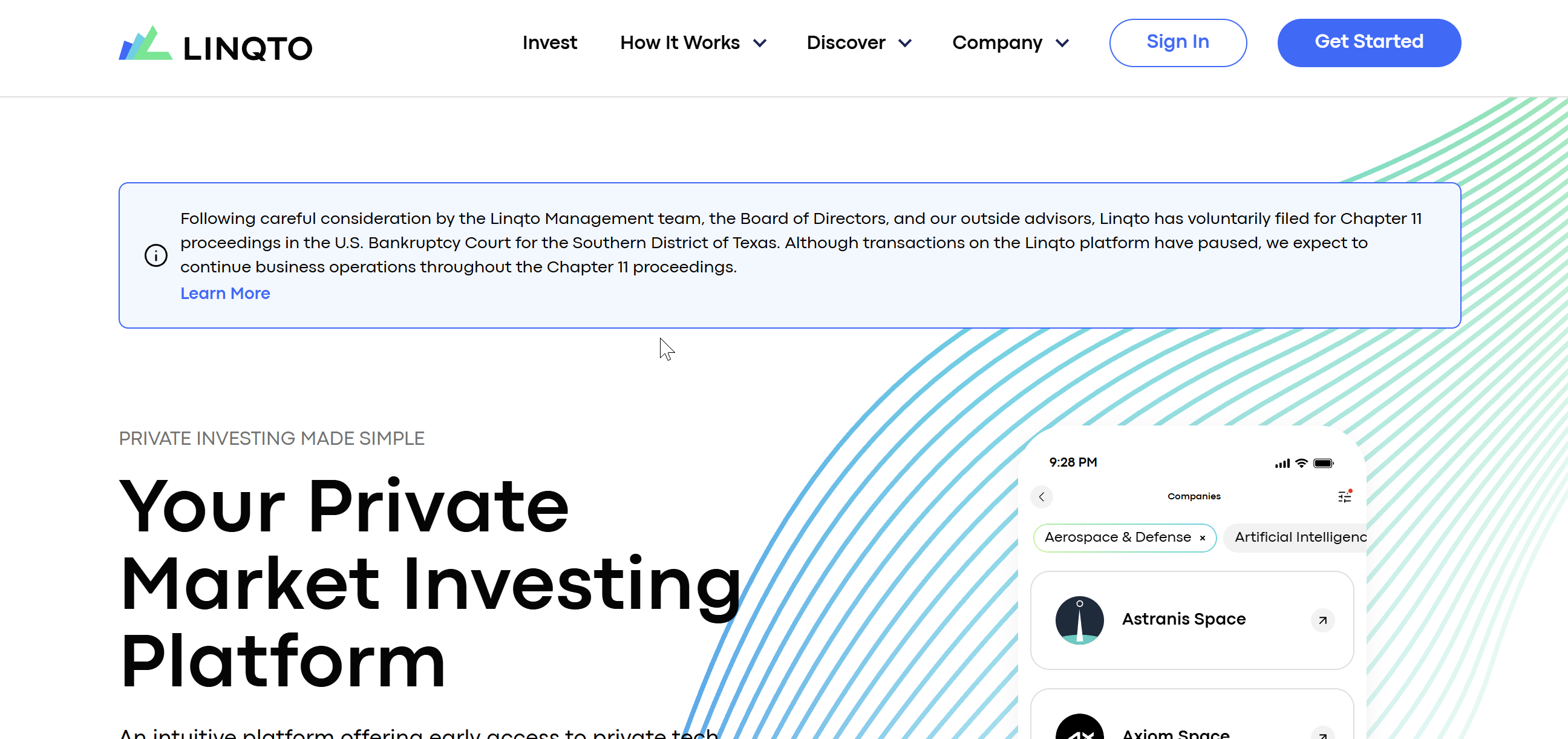
Linqto (in Chapter 11; transactions paused)
Linqto sold retail investors units in single-company vehicles holding pre-IPO shares, paused transactions in 2025, and filed for Chapter 11 in the Southern District of Texas on July 7, 2025. AltStreet rebuilt its Regulation D record: 1,231 Form D filings resolving to 546 offerings, $486,124,079 reported sold and 22,222 investor positions, and not one offering in the entire book ever reported 100 investors or more.
No platform response on record for this review. Is this your platform? Respond or claim it.
What the data actually shows - TL;DR
Linqto sold $486,124,079 of units in 546 single-company vehicles to 22,222 investor positions, then froze redemptions and filed for Chapter 11. The filings record a structure the marketing never described: a reported-investor ceiling that stops at 99 in every one of 546 offerings, a registered broker-dealer whose own audited accounts say it did not provide services to the offering business, and 157 offerings that had an Investment Company Act exclusion added retroactively in the last five months of the business.
Form D filings that ever reported 100 or more investors in a vehicle. The maximum recorded anywhere in the book is 99, across 546 offerings, without an exception.
Reported sold across 546 offerings, which independently corroborates the "over $450 million" figure in the indictment from the filed record alone.
Commission revenue the registered broker-dealer restated away, on the stated ground that it had not engaged in broker-dealer activities during 2023.
Offerings that had the Section 3(c)(1) exclusion added by amendment between August 2024 and January 2025. None had one removed.
Sales commissions and finders' fees reported across all 546 offerings. In a principal model there is no commission to report, because the cost is in the price.
Consecutive fiscal years in which the registered broker-dealer reported a net capital deficit, both disclosed on July 10, 2025, three days after the parent's bankruptcy petition.
Figures computed by AltStreet from the 1,231 Form D and D/A filings of Linqto Liquidshares LLC (CIK 1841356) in its EDGAR ledger, from the four X-17A-5 annual reports of Linqto Capital, LLC (CIK 1878121), from FINRA BrokerCheck CRD 314557, and from a 100-page crawl of linqto.com on September 18, 2026.
AltStreet Weekly
Run this test on the platform you are actually considering.
For any Regulation D vehicle with a Form D on file, the investor count, the claimed exemptions and the amendment history are public. AltStreet's terminal holds those filings for every platform in its coverage, reconciled against EDGAR.
Free tier includes filing counts and coverage by platform.
What's Actually Happening
In plain English, here is what is actually happening.
- 1Linqto sold ordinary investors a way into private tech companies like Ripple, Stripe and Shield AI before they went public. You did not buy the shares. You bought units in a vehicle that held an economic interest in those shares.
- 2Linqto bought the shares first, with its own money, and then sold you units at a higher price. The difference was its revenue. The site calls that difference a "Purchase Premium" and never says how large it is.
- 3Every vehicle stopped at 99 reported investors. AltStreet checked all 1,231 filings: the number 100 never appears in the investor field, not once, and 158 vehicles sit in the 90 to 99 band. The filings show the ceiling. They do not show why 99 was chosen, or what happened when another buyer arrived.
- 4The group owns a registered broker-dealer, Linqto Capital. Its own audited accounts say it was never engaged to provide services to the entity that sold you the units, or to anyone else, and it gave back the only commission income it had ever recorded.
- 5In March 2025 the company froze redemptions. In July 2025 the parent filed for Chapter 11 in Texas. A plan was confirmed in February 2026 and customers chose between a liquidating trust and a closed-end fund intended to be publicly listed.
- 6In September 2026 the founder was indicted on six counts in New York. He has not been convicted of anything. The former second-in-command pled guilty in August 2026 and is cooperating with the government.
- 7The website is still up. It still says "All-In Pricing", still lists dozens of companies to invest in, and still says "With a $1,000 initial minimum, we're one of the industry's lowest". No Form D offering reports a minimum below $2,500. The two may be measuring different things, an account-level initial minimum against a per-offering one, and AltStreet could not reconcile them.
Quick Verdict
Is this platform right for you?
Linqto is a closed platform with an open public record, and the record is the reason to read it. Between December 2021 and January 2025 it filed 546 Regulation D offerings reporting $486,124,079 sold to 22,222 investor positions, and not one of those offerings ever reported a hundredth investor.
Read the full assessmentShow less
Its registered broker-dealer, a member firm in 52 states and territories, restated away the only commission revenue it had ever booked, on the stated ground that it had not engaged in broker-dealer activities, and its audited notes say it was never engaged to serve the offering entity or any other party. Its website today still headlines "All-In Pricing" and names the whole basis of its compensation as a "Purchase Premium" of unstated size. Customers are now creditors under a plan confirmed on February 6, 2026.
Best for
- Investors trying to understand what a principal-model pre-IPO platform looks like from the outside, before committing money to one that is still open
- Former Linqto customers who want the filed record of the entity they bought from, separate from the litigation coverage
- Anyone building a checklist for single-company special purpose vehicles: the tests in this review are all runnable on EDGAR and BrokerCheck
Avoid if
- You are looking for a platform to invest through. Transactions are paused and the parent is reorganizing.
- You want a verdict on the criminal case. This review takes no position on guilt and neither should any reader of it.
- You need a recovery estimate. The plan targets a share of fair market value, but AltStreet located no public filing carrying the marks on the underlying private shares.
Top strengths
- The estate does hold private-company positions, and the confirmed plan routes their value to customers through a trust or a fund. The offerings were represented as backed by shares in named private companies; AltStreet cannot certify from the public record that every one of the 546 had a fully matched block behind it, and the broker-dealer's own audited note uses the word "purported" of the allocation step.
- The Regulation D record is unusually complete for a retail platform. 304 of 546 offerings were amended at least once, so the filings track sales over time rather than freezing at the first notice.
- The company's post-2024 management filed the broker-dealer's overdue annual reports, restated the prior year, and disclosed the regulatory investigations in the audited notes rather than leaving them out.
Key limitations
- The price basis was never published. No acquisition cost, no premium percentage, and no range appears on the site or in any filing AltStreet located.
- The registered broker-dealer was structurally beside the business rather than in it, and reported a net capital deficit in each of its first two full fiscal years.
- No realized outcome is published for any offering, so there is no return series to evaluate even for the offerings that predate the collapse.
- The marketing is still live and still in the present tense, including a stated $1,000 initial minimum that AltStreet could not reconcile with any offering minimum in the book.
Where It Fits
What you were actually choosing between.
Buy units from a principal that sets the price
If you want
The lowest friction and the smallest check into a named pre-IPO company
Use
This is the Linqto model. It closed in 2025. The comparable question on any platform still running it is what the price is set against and whether that basis is published.
Buy through a matched marketplace with a visible order book
If you want
A price formed by two parties rather than one, and a stated commission
Use
Hiive publishes live bids and asks and a disclosed maximum fee. The trade-off is execution uncertainty: a matched market can fail to fill.
Buy a fund interest in a vehicle whose fees are disclosed as rates
If you want
A stated entry and exit percentage rather than a spread of unknown size
Use
EquityZen discloses a fee schedule as a percentage. You still hold a vehicle interest rather than shares, and the vehicle register is still kept by the manager.
Buy the institutional venue rather than the retail wrapper
If you want
Block liquidity, custody and a regulated intermediary of scale
Use
Forge Global operates as a broker-dealer with registered affiliates. It is also, under the confirmed plan, the liquidating trustee for Linqto's own estate.
Compare Before Deciding
Where the same structure is still being sold
Single-company vehicles for pre-IPO shares are a live product. These platforms run variations of it, and the review of each says how the price is formed and what the fee schedule discloses.
Fees as a percentage rather than a spread
EquityZen
Same vehicle structure, but the fee is published as a rate rather than embedded in the entry price, and an Investment Company Act exclusion is claimed on every vehicle in the book.
A price with two sources
Hiive
A visible order book with live bids and asks and a disclosed maximum fee, so the price is formed by two parties rather than set by the seller.
The institutional venue, and Linqto's liquidating trustee
Forge Global
A registered broker-dealer venue for private-share blocks, and the party selected under the confirmed plan to serve as liquidating trustee for Linqto's estate.
Quick Answers
What most investors want to know first
The highest-signal facts first: minimums, liquidity reality, K-1 timing, and whether distributions are actually part of the experience.
Minimum
$2,500 on 338 offerings, $5,000 on 190; the site separately advertises $1,000, unreconciled
Liquidity
None for the units. The group's broker-dealer registered an intention to operate an alternative trading system for private placement securities and, on its own audited statement, never provided those services.
K-1 Timing
Not disclosed.
Distributions
Proceeds only on a liquidity event in the underlying company.
Overview
Platform Overview
A concise read on what the platform is, how the structure works, and where the practical friction shows up for real investors.
Linqto sold retail accredited investors units in series of a single Delaware LLC, each series holding an indirect economic interest in the shares of one named private company that Linqto had bought as principal and resold at a price it set. The platform paused transactions in 2025 and its parent is reorganizing under a Chapter 11 plan confirmed on February 6, 2026.
was founded in 2010 as a software company and became a pre-IPO investment platform around 2020. Its mechanism was straightforward and, for a retail platform, unusual: rather than match a buyer to a seller, Linqto bought private-company shares on the secondary market through Linqto Liquidshares LLC and then sold retail accredited investors units in a series of that LLC holding an economic interest in the block. Between December 6, 2021 and January 28, 2025 Liquidshares filed 1,231 Form D and Form D/A documents covering 546 distinct offerings, reporting $486,124,079 sold across 22,222 investor positions.
The median offering reported $202,537 and 23 investors; the largest reported $70,509,036. 425 of the 546 offerings claimed Rule 506(c), which permits general solicitation where accreditation is verified, and 121 claimed Rule 506(b). Every offering reported a minimum investment of $2,500 or more, and every offering reported $0 of sales commissions and $0 of finders' fees, which is what a principal model looks like on a Form D: there is no commission to disclose because the compensation is inside the price.
The group also owns Linqto Capital, LLC, a FINRA member since November 22, 2022 and registered in 52 states and territories, which restated its first year's accounts to remove the only commission revenue it had ever recorded and whose audited notes say it was never engaged to provide services to Liquidshares or any other party. Redemptions froze in March 2025. On July 7, 2025 the parent and three subsidiaries, not including the broker-dealer, filed Chapter 11 petitions in the Southern District of Texas.
A plan was confirmed on February 6, 2026 with more than 95 percent approval from voting creditors, giving customers a choice between a liquidating trust and a closed-end fund intended to be publicly listed, with VanEck selected as fund manager and Forge Global as liquidating trustee. On September 2, 2026 an indictment was unsealed in the Southern District of New York charging the founder with six counts including securities fraud and conspiracy to conduct unregistered investment company transactions; those charges are accusations and he is presumed innocent. The former second-in-command pled guilty on August 27, 2026 and is cooperating.
Status
Transactions paused; parent in Chapter 11, plan confirmed February 6, 2026
What you bought
Units in a series of Linqto Liquidshares LLC, not shares of the underlying company
Offerings on file
546, from 1,231 Form D and D/A filings, December 2021 to January 2025
Reported sold
$486,124,079 across 22,222 investor positions
Investors per offering
Median 23, maximum 99, never 100 or more in any filing
Pricing
Principal sale at a price Linqto set; the site names it a "Purchase Premium" and states no amount
Stated fees
"No Other Fees": no carry, no profit fee, no legal fee, no administrative fee
Minimum on file
$2,500 on 338 offerings, $5,000 on 190; the site separately advertises $1,000, unreconciled
Registered broker-dealer
Linqto Capital, LLC (CRD 314557), FINRA member since November 22, 2022; its audited notes say it never served the offering business
Regulatory matters disclosed
FINRA Enforcement investigation and an SEC document request, both disclosed in the broker-dealer's audited FY2025 notes
Visual Summary
What the marketing says against what the filings say
Left column quoted verbatim from linqto.com as crawled on September 18, 2026. Right column computed by AltStreet from the filings named in the evidence section. These are different kinds of statement and are not always in conflict; where they can be reconciled, this review says so.
"All-In Pricing" and "Clear Pricing for Your Investments"
No acquisition cost, premium percentage or range appears anywhere on the site or in any Linqto filing AltStreet located.
"Purchase Premium. We apply a premium to the share cost, which varies based on market conditions, risk factors, and operating costs."
The premium is how the platform monetized the spread between its acquisition cost and the investor's price. Gross premium is not the same as net revenue, since it can also absorb acquisition costs, operating costs and reserves. The indictment alleges a median markup of approximately 60 percent, over a quarter of sales above approximately 80 percent, and some above 200 percent. Those figures are allegations and are not established.
"No Other Fees", "No Carry Fees", "No Profit Fees", "No Administrative Fees"
Consistent with the filings: $0 of sales commissions and $0 of finders' fees on all 546 offerings. A model with no fee line items can still carry a large embedded cost.
"Segregation of Assets. Your investment is held separately from Linqto's corporate assets."
Two counts of the indictment allege that shares already allocated to customer vehicles were tendered back to the issuing company in January 2025 without customer knowledge or consent, for over $18 million. Allegations, not findings.
"When you invest on our platform, you buy directly from Linqto. Other platforms act as a marketplace that matches buyers with sellers, which adds uncertainty."
Accurate as a description of the model. It is also the reason the price had a single source, which the site does not draw out.
"With a $1,000 initial minimum, we're one of the industry's lowest."
338 offerings report a $2,500 minimum, 190 report $5,000, 18 report $10,000 or more, and none reports $1,000 or less. Form D states the minimum accepted from any outside investor in that offering, which is not necessarily the same measure as an account-level initial minimum. AltStreet could not reconcile the two.
"Instant Ownership. Your purchase means immediate ownership in the fund, avoiding delays of a matched sale."
The affiliated broker-dealer's audited notes state that Liquidshares "purported to allocate an economic interest in the Securities to a special purpose vehicle". The allocation step is described in the filings as following the purchase.
62 company pages still live, each with an invest call to action
The last Form D filed by Liquidshares is dated January 28, 2025. The homepage carries a Chapter 11 notice above the same marketing.
ASWhat the filings add that the coverage does not
- $486,124,079 reported sold is computed from the filings alone and sits above the "over $450 million" in the indictment. The two are consistent: the indictment describes money drawn in by the alleged scheme, the filings record what the issuer told the SEC it sold.
- 22,222 investor positions against the more than 13,000 customers alleged in the indictment works out to roughly 1.7 positions per customer on average. That is arithmetic, not a distribution: the filings do not show how positions were spread across holders.
- The 2024 cohort is the second largest in the book: 167 offerings opened that year against 209 in 2022 and 153 in 2023. The business was not winding down before it stopped.
Key Gaps & Non-Disclosures
- No Form D field records the underlying company, so the filings cannot show how many distinct companies the 546 offerings covered or how many vehicles any one company attracted.
- Neither Linqto, Inc. nor Linqto Liquidshares LLC files audited financial statements with the SEC. The group's only audited accounts belong to the broker-dealer that reported no revenue.
- AltStreet located no published outcome for any offering: no exit, distribution or write-off record for any of the 546 in the sources searched.
Platform Intelligence
Linqto: the filed record
Key platform events, regulatory turns, liquidity stress points, and product launches that shape how the review should be read.
Linqto founded
Incorporated as a technology and software development company.
Platform launches
The Linqto investment platform goes live on web and mobile, selling units in single-company vehicles.
Broker-dealer entity formed
Linqto Capital, LLC formed in Delaware on January 2, 2021.
First Form D
Linqto Liquidshares LLC files its first Form D on December 6, 2021. Ten offerings open before year end.
Peak filing year
209 offerings opened, the most in any year. 89 of them in March alone.
FINRA membership granted
Linqto Capital, LLC becomes a FINRA member on November 22, 2022; SEC and FINRA registration effective December 1.
153 offerings opened
The book keeps growing. The broker-dealer's later-filed accounts state it did not engage in broker-dealer activities during 2023.
Exclusion posture changes
From August 2024 every newly opened offering claims the Investment Company Act Section 3(c)(1) exclusion. Across April, May and June 2024, none of the 41 offerings opened did.
54 offerings amended
Fifty-four already-filed offerings have the 3(c)(1) exclusion added by amendment in a single month.
68 more amended, and a change at the top
Sixty-eight further offerings amended to add the exclusion. Sean Bowden becomes CEO and CCO of the broker-dealer in December 2024.
Filings stop
Twenty-nine final exclusion amendments, seven new offerings, and the last Form D on January 28, 2025.
Redemptions frozen
The company suspends customer redemptions amid an internal review of historical regulatory compliance.
Chapter 11
The parent and three subsidiaries file Chapter 11 petitions in the Southern District of Texas on July 7, 2025. The broker-dealer is not a debtor. DIP financing is approved on July 8.
Two years of accounts filed at once
On July 10, 2025 the broker-dealer files a restated FY2023 report and its FY2024 report. Both disclose net capital deficits; the FY2023 restatement reverses $1,669 thousand of commissions revenue.
Recovery managers selected
VanEck selected to manage the closed-end fund, Forge Global selected as liquidating trustee, announced January 13, 2026.
Plan confirmed
The court rules on confirmation on February 6, 2026 with approximately 95 percent of the three customer classes voting to accept. The confirmation order is entered on February 13, 2026 as Docket 1598, and the fourteen-day stay is waived so it takes effect on entry.
FY2025 accounts
The broker-dealer files its FY2025 report on March 27, 2026 with a new sole-practitioner auditor, a going-concern paragraph, no revenue, and disclosure of a FINRA Enforcement investigation and an SEC document request.
The trustee refuses to serve
On July 15, 2026, five days before the anticipated effective date of July 20, Forge Global tells the estate it will not act as liquidating trustee. Forge admits the communication and denies the allegation that it acted on orders from its new parent, The Charles Schwab Corporation.
The estate sues its own trustee
The debtors and the creditors' committee file an adversary complaint against Forge Global Holdings, Inc. and Does 1 through 10 on July 19, 2026, opening adversary proceeding 26-03265. Five counts, seeking both an order compelling performance and damages.
Guilty plea
Joseph Endoso, the former second-in-command, pleads guilty on August 27, 2026 before Judge Denise L. Cote and cooperates with the Government.
The claim to compel is set aside
A stipulation and agreed order entered August 19, 2026 relieves Forge of responding to Count I, the section 1142(b) enforcement claim, and to every request for injunctive and equitable relief. Forge's answer states those claims have been withdrawn. AltStreet has not obtained the stipulation itself, so that is Forge's characterization of it.
Indictment unsealed
A six-count indictment against founder William Sarris is unsealed in the Southern District of New York on September 2, 2026. The charges are accusations; he is presumed innocent.
Forge answers and demands a jury
On September 1, 2026 Forge denies liability on all four remaining counts, pleads six affirmative defenses including that a backup bidder was available throughout, and demands a jury trial it says the bankruptcy court may not conduct.
Pre-dispute burn rate reported
The June monthly operating report, filed September 18, 2026, shows $2,068,758 of restructuring costs in that single month against $976,534 of operating cash flow, with consolidated cash falling $1,092,223 to $12,296,379. The period ends June 30 and so predates Forge's July 15 refusal: this is the rate the estate was running at going into the dispute, not a measure of its cost.
Mental Model
How the Linqto structure actually worked, simplified.
One company, one vehicle, and a ceiling at 99
Linqto Liquidshares LLC, a Delaware LLC operating from San Jose, bought private-company shares on the secondary market with its own balance sheet. It then created a series of itself to hold an economic interest in a block of those shares, filed a Form D for that series, and sold units in it. Most series stayed small: across 546 offerings the median reported 23 investors. A large minority ran to the high nineties, and none ever reported a hundredth.
You bought units, not shares, and the register was not yours
What you held was a unit in the series. The underlying shares stood in the name of the Linqto entity. The broker-dealer's own audited accounts describe the step in unusually careful language: Liquidshares "purported to allocate an economic interest in the Securities to a special purpose vehicle in the form of a series of Liquidshares". That is the affiliated broker-dealer's auditor-reviewed description of its own group's mechanics, and the word "purported" is the filing's, not AltStreet's.
The price you paid was set by the seller
Linqto was the principal on the other side of your trade, which the site presents as a benefit: "When you invest on our platform, you buy directly from Linqto. Other platforms act as a marketplace that matches buyers with sellers, which adds uncertainty." A matched marketplace produces a price from two parties. A principal sale produces a price from one. The site never published the acquisition cost, the premium percentage, or a range.
Nothing paid out until the underlying company did
There was no redemption right and no secondary market for the units. The site describes the exit as an IPO or acquisition followed by a 90 to 180 day lock-up and then shares or cash. 528 of the 546 offerings declared an indefinite duration and stated no total offering amount at all. Only 18 stated one, and 15 of those reported selling it in full. Money went in at a price nobody outside the company could check, and came back only when a third party created a liquidity event.
When the company stopped, the units stopped with it
Redemptions froze in March 2025, the parent filed Chapter 11 on July 7, 2025, and unit holders became creditors in a bankruptcy case rather than holders of a tradable asset. Their recovery now runs through a plan confirmed on February 6, 2026, not through anything on the platform.
Investor Operations
The practical questions investors actually care about: when tax documents arrive, how cash distributions work, and whether capital can be exited before the underlying asset is sold.
Tax Documents
K-1 Timing
What to expect
Not disclosed.
Delay signals
- No tax page, K-1 timing statement or delivery commitment located on the site.
Extension risk
Not disclosed.
Cash Flow
Distributions
Frequency
None. The vehicles held equity and made no current distributions.
Timing
Proceeds only on a liquidity event in the underlying company.
Consistency
Not applicable; no distribution history is published for any offering.
Liquidity
Exit Reality
Holding period
No redemption right at any point. After an IPO or acquisition the site describes a 90 to 180 day lock-up on the underlying shares before proceeds reach the investor.
Exit options
- IPO or acquisition of the underlying company, then delivery of shares or cash after the lock-up
- Since 2025, the Chapter 11 plan elections: a liquidating trust interest, or an interest in a closed-end fund intended to be publicly listed
Secondary market
None for the units. The group's broker-dealer registered an intention to operate an alternative trading system for private placement securities and, on its own audited statement, never provided those services.
Confidence: High
Investment Structures
Units in a series of Linqto Liquidshares LLC
The investor's holding. Each series held an indirect economic interest in shares of one named private company that Liquidshares had bought on the secondary market. There was no redemption right, no secondary market for the units, and no maturity.
The site described the exit as an IPO or acquisition, followed by a 90 to 180 day lock-up, followed by shares in a brokerage account or cash proceeds, and promised that "Once a company goes public or experiences a liquidity event, your fund is redeemable for one-to-one public shares." 546 such offerings are on file, reporting $486,124,079 sold to 22,222 investor positions, with a median of 23 investors and a maximum of 99.
Linqto Liquidshares LLC, the filing entity
CIK 1841356, a Delaware LLC filing from 101 Metro Drive, Suite 335, San Jose, California. It is the issuer on every one of the 546 offerings and the only Linqto entity that has ever filed a Form D. It is not a registered broker-dealer and files no audited financial statements. The broker-dealer's audited notes describe it as "an indirect, wholly owned subsidiary of the Parent" which, "acting as the primary investor, purchased shares of private company securities ... primarily in the secondary market".
Linqto Capital, LLC, the registered broker-dealer that did not serve the offering business
CIK 1878121, CRD 314557, SEC file number 8-70775, formed in Delaware on January 2, 2021, a FINRA member since November 22, 2022 with SEC and FINRA registration effective December 1, 2022 and approvals in 52 states and territories, the last of them Illinois on March 11, 2025. BrokerCheck records two lines of business: private placements of securities, and an intended alternative trading system for secondary trading in private placement securities. Those are statements of permitted and intended business.
Its FY2025 audited notes state it "was not ever engaged to provide such services to Linqto Liquidshares LLC ... or any other parties, during the period covered by these financial statements", and its FY2023 accounts were restated to reverse $1,669 thousand of commissions revenue on the stated ground that "as a matter of regulatory law, the Company did not engage in broker-dealer activities during 2023". It is not a debtor in the Chapter 11.
The post-confirmation recovery vehicles
Under the plan confirmed on February 6, 2026, customers elected between a liquidating trust retaining indirect private-company interests and a closed-end fund intended to be publicly listed and to hold private shares. VanEck was selected as the fund's manager and Forge Global as liquidating trustee, both announced on January 13, 2026. As of September 19, 2026 AltStreet did not locate a registration statement it could tie to the planned fund, so its fee schedule, governance and the valuation marks on the underlying private shares are not yet readable in a public filing. That search would not surface a fund organized under a name that does not mention Linqto.
Risk
Risk Structure
This is where the marketplace pitch gives way to the actual operating reality: delayed exits, limited disclosure, fee drag, and path-dependent outcomes.
AIAltStreet Risk Inferences
- The retroactive exclusion amendments date a change in compliance posture to the month, and their direction is uniform: 157 added, none removed.
- The August 2024 cutover is visible in new filings too. Every offering opened from August 2024 onward claims the exclusion; across April, May and June 2024, none of the 41 offerings opened did.
- $205,079,894 of reported sales sits on offerings that, as of the last filing for each, claim no Investment Company Act exclusion at all.
- The broker-dealer's restatement removed the group's only recorded broker-dealer revenue and reassigned it to Liquidshares as redemption revenue, which places the economics in the unregistered entity by the group's own accounting.
The price had one source
Linqto was the counterparty, the pricing authority and the only party that knew the acquisition cost. The site presents the first fact as a benefit and never addresses the third. On a matched marketplace a bad price fails to clear; on a principal platform it clears immediately.
The ceiling at 99 reported investors
The ceiling at 99 is one of the most distinctive structural patterns in the record: it holds across 546 offerings without a single exception. Opening repeated vehicles for the same underlying company would be one way to accommodate further investors, but the Form D record does not identify the underlying company and does not establish why any new series was opened, so the book's size cannot be attributed to that mechanism from the filings alone. Why the counts stop at 99 is likewise not something the filings answer, and Form D's investor count is not a beneficial-owner determination under the Investment Company Act. The part an investor inherits is real either way: these vehicles depend on an exclusion, and if the exclusion is unavailable the consequence lands on the vehicle they hold.
The register was kept by the seller
Unit holders held a claim on a series; the underlying shares stood in the Linqto entity's name. Counts Five and Six of the indictment allege that shares allocated to customer vehicles were tendered back to their issuer without customer knowledge. Those are allegations. The structural point stands regardless: when the manager holds the register, the investor's protection is contractual and operational, not possessory.
The regulated entity was beside the business, not in it
By its own audited account, the FINRA member firm was never engaged to provide services to Liquidshares or any other party, and it recorded no revenue in any audited year. A firm that is not party to a transaction does not supervise it. The marketing names "Linqto Capital" on the leadership page; the entity on the other side of an investor's purchase was Liquidshares.
Two consecutive net capital deficits at the broker-dealer
At December 31, 2023 the firm reported a net capital deficit of $(794) thousand against a $323 thousand requirement, $1,117 thousand short, with an aggregate indebtedness ratio of (326 percent). At December 31, 2024 the deficit was $(922) thousand against a $192 thousand requirement, $1,114 thousand short, ratio (311.6). Both reports were filed on July 10, 2025, three days after the parent's bankruptcy petition. The FY2025 report shows the position restored: net capital $318 thousand against an $11 thousand minimum.
No outcome data exists
Across 546 offerings and nearly half a billion dollars of reported sales, AltStreet located no published exit, distribution or write-off record for any offering, in the filings, on the site or in the BrokerCheck record. AltStreet located no realized-return evidence in the platform's current site or in the filed record; whether anything was published and later removed is not something a 2026 crawl can establish.
Recovery risk for former customers
Unit holders are creditors in a Chapter 11 case, and their recovery depends on the value realized from private-company positions over time.
Why it matters
The plan was confirmed on February 6, 2026 and gives a choice between a liquidating trust and a closed-end fund intended to be publicly listed. Both are claims on illiquid private shares whose marks are not in any public filing AltStreet located. Reporting has described a target of roughly 95 percent of fair market value, which is a target against a mark, not a return of what was paid.
Mitigation / verification
Read the confirmed plan and the disclosure statement through the claims agent rather than relying on press coverage, and watch for a registration statement that would put the fund's fees and marks on the public record.
Pricing risk on any principal pre-IPO platform
Where the platform is the seller and the acquisition cost is unpublished, the investor cannot compute what they paid over the platform's basis.
Why it matters
This is the structural feature the indictment is built around, and it is not unique to Linqto. Several platforms still operating sell single-company vehicles as principal or with an affiliate on the other side.
Mitigation / verification
Ask for the acquisition price and date in writing before investing. Compare against platforms that disclose a fee as a percentage or publish a live order book, where the cost is at least measurable.
Entity substitution risk
The regulated name in the marketing may not be the entity on the other side of your transaction.
Why it matters
Linqto Capital, LLC held a broker-dealer registration throughout the period in which Liquidshares sold 546 offerings, and its own audited accounts say it was never engaged to serve that business. An investor who took comfort from the group holding a license was not thereby protected on their trade.
Mitigation / verification
Match three records before investing: the entity named in the marketing, the issuer on the Form D, and the firm in BrokerCheck. Then read the broker-dealer's most recent X-17A-5.
Investment Company Act structure risk
Running many vehicles for the same underlying stock raises a counting question that the filings cannot answer.
Why it matters
Count Four of the indictment charges conspiracy to conduct unregistered investment company transactions, alleging that the related vehicles should have been counted together. Whether or not that is proved, the general point holds for any such platform: an investor in a vehicle that depends on an exclusion bears the consequence if the exclusion turns out to be unavailable.
Mitigation / verification
Read Item 6 and Item 14 of the Form D together. Ask the operator directly how it counts beneficial owners when it runs several vehicles for the same underlying company, and on what advice.
Stale marketing risk
The site presents an operating platform in the present tense while the business is paused.
Why it matters
A reader arriving from a search result sees "Get Started", 62 investable company pages and a $1,000 initial minimum. The Chapter 11 notice is one paragraph above them and the last offering was filed in January 2025.
Mitigation / verification
Check the issuer's EDGAR filing history for a date of last activity before trusting any platform's marketing tense.
ASRisk signals to watch
- A registration statement for the planned closed-end fund appearing on EDGAR, which would first disclose its fees and its private-company marks.
- Any FINRA or SEC action against Linqto Capital, LLC, or a first disclosure event appearing on CRD 314557.
- The broker-dealer's FY2026 X-17A-5, due in 2027, and whether the going-concern paragraph persists.
- Sentencing in United States v. Endoso and the docket in United States v. Sarris.
- Whether the liquidating trust publishes realized proceeds, which would be the first outcome data ever available for these positions.
Regulatory & Legal Posture
Security Status
Units in a series of a Delaware LLC, sold under Regulation D. 425 of 546 offerings claimed Rule 506(c) and 121 claimed Rule 506(b). All 546 reported that the issuer is not registered under the Investment Company Act.
Each series was offered as a private placement to accredited investors, with accreditation verified during online sign-up. 246 offerings claim the Section 3(c)(1) exclusion from Investment Company Act registration and 300 claim no exclusion at all. The Form D exemption field records what an issuer claims; it is not a determination by the SEC, and nothing in the filings shows whether any given vehicle qualified.
- Linqto Capital, LLC became a FINRA member on November 22, 2022, with SEC and FINRA registration effective December 1, 2022. It is approved in 52 states and territories, the earliest California on December 21, 2022 and the latest Illinois on March 11, 2025.
- BrokerCheck records two business lines for the firm: private placements of securities, and "Other - LINQTO CAPITAL, LLC WILL ACT AS AN ALTERNATIVE TRADING SYSTEM PLATFORM ACTING A SECONDARY MARKET FOR TRADING PRIVATE PLACEMENT SECURITIES". The second is a statement of intended business. The firm's audited notes state it never provided those services.
- As of September 18, 2026 the BrokerCheck report for CRD 314557 records no disclosure events and no regulator suspension.
- The broker-dealer's audited FY2025 notes disclose "an ongoing investigation by FINRA Enforcement, as well as potential involvement in a broader SEC investigation focused on the Company's Parent and its affiliated fund, Liquidshares", and state that "The SEC has requested documents related to the Company's ATS." The firm says it is fully cooperating.
- The same notes disclose a FINRA customer arbitration claim of approximately $138 thousand, addressed through the parent's bankruptcy plan, with a motion to dismiss filed and the arbitration not commenced.
- The auditor's report on the FY2025 accounts contains a going-concern paragraph: the firm "has incurred operating losses and no revenue and will require additional capital". The FY2023 and FY2024 reports carry the same paragraph.
- The FY2023 and FY2024 reports were audited by RBSM LLP, which states it has "served as the Company's auditor since 2025". The FY2025 report was audited by Ferrara CPA, a sole practitioner in Hamilton, New Jersey.
- Neither Linqto, Inc. nor Linqto Liquidshares LLC is an SEC reporting company, and neither files audited financial statements.
- LEGAL AND ENFORCEMENT SCAN, as of September 18, 2026. An indictment was unsealed in the Southern District of New York on September 2, 2026 charging William Sarris, 75, with two counts of securities fraud, one of broker-dealer fraud, one of wire fraud, and two conspiracy counts, one of which is conspiracy to defraud the United States and to conduct unregistered investment company transactions. The charges are accusations and the defendant is presumed innocent. Joseph Endoso, 66, pled guilty on August 27, 2026 before United States District Judge Denise L. Cote and is cooperating with the Government. A securities class action against the founder is before Judge Lewis A. Kaplan in the same district, with Scott+Scott appointed co-lead counsel; AltStreet has not read that docket and reports it from published accounts. No SEC or FINRA enforcement action against any Linqto entity was located. PACER and state securities regulators were not searched.
Disclosure Quality
Complete at the filing level and absent at the price level. Every offering discloses its amount sold, investor count, minimum, exemption and duration, and 304 offerings were amended to update those figures. Nothing in any filing discloses what Linqto paid for the underlying shares, which is the only number that would let an investor evaluate the price they were offered.
Custody Model
Linqto Liquidshares LLC held the underlying shares and allocated economic interests to each series. Unit holders held claims on the series rather than shares in their own name. The broker-dealer's audited notes state that it "does not carry or clear customer accounts".
Regulatory Backing
None applicable to the units. The group's registered broker-dealer was not party to the transactions and is exempt from the SEC customer protection rule on the ground that its business activities met the relevant conditions. There was no qualified custodian, no SIPC coverage on the vehicle interests, and no transfer agent in the chain that AltStreet located.
Tax Treatment
Reporting
Not disclosed by the platform
The site publishes no tax guidance. If a series were treated as a partnership for federal tax purposes it would generally issue a Schedule K-1 to its members, but Linqto's public materials do not establish the classification, the reporting form or the timing.
Income Character
Capital gain or loss on disposition of the underlying position, if and when one occurs
The vehicles held equity and made no current distributions, so there was ordinarily nothing to characterize until a liquidity event. What the bankruptcy plan elections do to a holder's basis and holding period is a matter for the plan documents and a tax adviser, not for this review.
- No tax guidance page was found in a 100-page crawl of linqto.com on September 18, 2026.
- A series treated as a partnership for federal tax purposes would generally issue a Schedule K-1, but the platform never published its classification, the form it issued or when.
- The choice between a liquidating trust interest and a closed-end fund interest under the confirmed plan has its own tax consequences, which the plan documents address and which a personal adviser should read against the holder's basis.
- Any loss recognition on these positions depends on facts a holder can only establish from their own records and the plan, not from anything AltStreet can compute.
Limitation
No tax page, no K-1 timing statement and no guidance of any kind appeared in AltStreet's 100-page crawl of the site on September 18, 2026.
Before You Invest
Get Linqto investor insights before you invest
K-1 timing, distribution updates, yield insights, and risk signals for Linqto and similar platforms.
- Weekly platform research focused on tax timing and liquidity reality.
- Signals on distributions, risks, and structural tradeoffs before capital is locked up.
- Coverage of adjacent platforms so you can compare better options faster.
Get weekly platform signals
Track fee changes, liquidity updates, risk flags, and adjacent platforms before you invest.
Independent intelligence from AltStreet. No hype. No sponsor spin.
AltStreet Data Layer
What the data actually shows
Four findings computed from the filed record, each stated with its unit and its limit. None depends on the criminal case, and each can be reproduced from public sources. AltStreet's case study on auditing a pre-IPO SPV, linked in the resources below, walks through how to run these same checks on a platform that is still open.
The book stops dead at 99 reported investors
Across all 1,231 Form D filings the highest investor count ever reported is 99, and no filing reports 100 or more. 157 offerings sit in the 90 to 98 band and only 35 in the far wider 50 to 89 band.
What this means
Section 3(c)(1) excludes a fund with not more than 100 beneficial owners, and Form D Item 14 reports investors in the offering rather than beneficial owners, so the clustering is a structural signal and not proof that these vehicles qualified for the exclusion or were built to evade it. The indictment alleges the related vehicles should have been counted together; that theory is the Government's. Read Item 6 and Item 14 together on any platform selling single-company vehicles.
The registered broker-dealer says it never served the offering business
Linqto Capital, LLC's audited FY2025 notes state it was never engaged to provide services to Liquidshares or any other party during the period covered, and its FY2023 accounts were restated to reverse $1,669 thousand of commissions revenue because, as the filing puts it, the firm "did not engage in broker-dealer activities during 2023". It recorded no revenue in any audited year.
What this means
A group-level license does not put a regulated intermediary on your transaction. BrokerCheck shows what a firm is permitted to do; the X-17A-5 annual report is where it describes what it actually did and whether it met its net capital requirement. Read the second before you treat a registration as protection.
157 offerings had an exclusion added after the fact
246 offerings now claim the 3(c)(1) exclusion but only 89 did on their opening filing. The other 157 were amended to add it, 6 in August 2024, 54 in October, 68 in December and 29 in January 2025. None was amended to remove one.
What this means
Amending a Form D to add an omitted claim is not a violation, and the field records a claim rather than a determination. What it does establish is the month a filer's posture changed, which is information the latest filing alone will not give you.
Zero commissions reported on half a billion dollars of sales
All 546 offerings report $0 of sales commissions and $0 of finders' fees against $486,124,079 reported sold.
What this means
This is exactly what a principal model looks like on a Form D and is not evidence of low cost. Where compensation is the spread, no fee field can capture it, and the Form D will look clean no matter how large the spread is.
No published outcome was located for any offering
Across 546 offerings, 22,222 investor positions and $486,124,079 of reported sales, AltStreet located no exit record, distribution history or write-off for any offering in the sources named in the methodology: the EDGAR filings, a 100-page crawl of the site, and the BrokerCheck record.
What this means
An investor evaluating this platform at any point in its life had no realized-return evidence to work from. Treat the absence of outcome data as a finding about the platform, not as a neutral gap.
Data as of 2026-09-18 . AltStreet review evidence layer . Public-source analysis
Full datasetAltStreet Weekly
Get told when the next one files.
AltStreet tracks Form D, Form C and Regulation A filings across every platform in its coverage and flags structural changes: a wave of amendments, an exclusion claim that moves, a filer that stops filing.
So What?
So what should you actually do with this?
What this means
A principal platform monetizes the spread, and the spread is invisible unless the platform publishes its acquisition cost.
What to do
Before buying a pre-IPO vehicle interest, ask in writing what the platform paid for the underlying shares and on what date. If the answer is a description rather than a number, treat the price as unverified.
What this means
Form D will not tell you a vehicle's beneficial-owner count, but it will show you the shape of what an operator reports.
What to do
Pull the platform's Form D filings on EDGAR and read Item 6 and Item 14 together. For a Regulation D vehicle with a Form D on file, the investor count, the claimed exemptions and the amendment history are all public. Treat an unexplained ceiling as a question to put to the operator, not as an answer.
What this means
A group can hold a broker-dealer license that its actual business never touches.
What to do
Registration tells you what a firm may do. Its X-17A-5 annual report tells you what it did, and whether it met its net capital requirement. Read the report, not just the BrokerCheck summary.
What this means
"No other fees" is a statement about line items, not about cost.
What to do
A platform with no management fee, no carry and no administrative fee can still be the most expensive way to buy an asset, if the entire cost is embedded in the purchase price. Separate the fee schedule question from the price question and ask both.
What this means
Marketing outlives operations. The Linqto site still reads as an open platform seven months after its plan was confirmed.
What to do
Check the SEC filing record for a date of last activity before you trust a website's present tense. Liquidshares' last Form D is dated January 28, 2025.
Decision Fit
Investor Fit
Who this works for, who it does not, and what level of patience and complexity tolerance the platform really demands.
Any investor looking for a platform to use today
Transactions are paused and the parent is reorganizing. There is nothing to buy.
Former Linqto customers
Your position is now an election under a confirmed plan. This review gives you the filed record of what you bought and from which entity; the plan documents govern what you receive.
Investors evaluating other pre-IPO platforms
Every structural test in this review runs on public sources: the Form D investor counts, the exclusion claims and their amendment history, and the broker-dealer's own X-17A-5 annual report.
Researchers and journalists covering the case
The filings-based findings here are computed from primary sources and stated with their units and their limits, separately from the allegations.
Tradeoffs
Key Tradeoffs
The attraction of pre-IPO access is real, but every benefit comes bundled with a corresponding liquidity, transparency, or pricing cost.
Principal execution
The price came from the party selling to you, and its basis was never published
Single-company vehicles
A unit rather than a share, a register kept by the manager, and a structure that depends on an Investment Company Act exclusion
No management fee and no carry
Fully compatible with a much higher total cost, because the entire cost sits in the entry price
A group holding a broker-dealer registration
By its own audited account that affiliate never served the offering business and recorded no revenue; it was not on the other side of any investor's trade
Avoid
Who This Is Not For
This section should be read as a filter, not an afterthought. If you need income, simplicity, or near-term access to capital, the structure is working against you.
Anyone seeking a current investment
The platform is closed to transactions and its parent is in Chapter 11.
Investors who need to know their entry price against a basis
No acquisition cost, premium percentage or range is published anywhere in the public record AltStreet located.
Investors who need liquidity before a company-level event
The units carried no redemption right and had no secondary market.
Investors relying on a track record
No exit, distribution or write-off is published for any of the 546 offerings.
Editorial View
AltStreet Perspective
The compressed version of the review: what matters, what marketing tends to obscure, and how we would frame the platform for a serious allocator.
Verdict
Linqto is a closed platform, and the reason to read its record is that the record is unusually complete. Between December 2021 and January 2025 it put 546 single-company offerings on file, reported $486,124,079 sold to 22,222 investor positions, and never once recorded a hundredth investor in any vehicle. It held a broker-dealer registration in 52 states and territories whose own audited accounts say the firm was never engaged to serve that business, earned no revenue in any audited year, and had its first year restated to remove commissions on the stated ground that it had not engaged in broker-dealer activities. In the last five months before the filings stopped, 157 offerings had an Investment Company Act exclusion added by amendment, all in the same direction. None of those are allegations. They are what the filings say, and they were public the entire time.
Positioning
The marketing is the other half of the story, and it is still on the internet. A reader arriving today finds "All-In Pricing" over a paragraph naming the whole basis of its compensation as a "Purchase Premium" that "varies based on market conditions, risk factors, and operating costs". That sentence discloses that a markup exists and nothing else about it. Below it sits "Segregation of Assets. Your investment is held separately from Linqto's corporate assets", and two counts of the indictment allege the opposite happened in January 2025. Those are accusations and the founder is presumed innocent. But the gap between a page that says "Clear Pricing" and a page that publishes no price basis did not require a prosecutor to notice, and neither did a book of 546 vehicles that stopped dead at 99.
The Bottom Line
A platform that told investors its pricing was clear, published no price, and built a book of 546 vehicles that never once reported a hundredth investor.
Action
Next Steps
If you still want to engage after reading the review, these are the practical next moves that reduce avoidable mistakes.
If you held Linqto units, work from the confirmed plan and the case's claims agent rather than from linqto.com, which still describes an operating platform.
If you are considering another pre-IPO platform, pull its Form D filings on EDGAR and read Item 6 and Item 14 together: what exclusion is claimed, and what shape the reported investor counts take across the book.
Identify the issuer on the Form D, find the group's broker-dealer in BrokerCheck, and then read that firm's most recent X-17A-5 annual report, which is where it describes the business it actually did.
Ask any principal-model platform, in writing, what it paid for the underlying shares and on what date. Treat a description without a number as an undisclosed price.
Compare the structure against a disclosed-fee alternative and a live order book before deciding that a no-fee platform is a low-cost one.
For a step-by-step version of the checks behind this review, written to be run on a platform that is still open, see AltStreet's case study on auditing a pre-IPO SPV using SEC filings.
Final Answer
What this means for your decision.
Finding
You cannot invest here, and the recovery vehicles are not yet public documents
Meaning
The homepage carries a Chapter 11 notice: transactions on the platform have paused. The plan was confirmed on February 6, 2026 with more than 95 percent approval from voting creditors, and customers chose between a liquidating trust and a closed-end fund intended to be publicly listed. VanEck was selected to manage the fund and Forge Global to serve as liquidating trustee. As of September 19, 2026 AltStreet did not locate a registration statement it could tie to the planned fund, so its fees, terms and the marks placed on the underlying private shares are not yet readable in a public filing. A fund organized under a name that does not mention Linqto would not surface in that search.
Action
If you are a former customer, your entitlement runs through the bankruptcy case and its claims agent, not through the website. Read the plan and the election documents rather than the marketing pages, which are still live and still describe an operating platform.
Finding
Every offering stopped at 99 reported investors, with no exceptions
Meaning
Across all 1,231 Form D filings, the highest investor count ever reported is 99. Not one filing reports 100 or more. The distribution is not shaped like demand: 353 offerings report 1 to 49 investors, only 35 report 50 to 89, and then 157 report 90 to 98 with one at exactly 99. That is a nine-wide band holding four and a half times as many offerings as the forty-wide band beneath it. Read it as a structural signal and not as a legal finding: Form D Item 14 reports investors in the offering, which is not the same measurement as beneficial ownership under the Investment Company Act.
Action
Whenever a platform sells you an interest in a single-company vehicle, ask what caps the vehicle and what happens when the cap is reached. Section 3(c)(1) of the Investment Company Act excludes a fund with not more than 100 beneficial owners, so a hundredth owner is not itself disqualifying, and Form D does not record beneficial ownership at all. What you can check on EDGAR before you invest is the shape of the reported counts and whether an exclusion is claimed.
Finding
The registered broker-dealer says in its own audited accounts that it did not serve the offering business
Meaning
Linqto Capital, LLC (CRD 314557) became a FINRA member on November 22, 2022 and is registered in 52 states and territories. Liquidshares was the issuer on all 546 offerings, which by itself is ordinary: an issuer files its own Form D and a broker-dealer normally does not. The consequential evidence is the broker-dealer's own audited accounts. Its FY2025 annual report states that it "was not ever engaged to provide such services to Linqto Liquidshares LLC ... or any other parties, during the period covered by these financial statements", and its FY2023 accounts were restated to reverse $1,669 thousand of commissions revenue because, in the filing's words, "as a matter of regulatory law, the Company did not engage in broker-dealer activities during 2023".
Action
A group can hold a broker-dealer license whose registration says nothing about what the licensed firm actually did. The Form D tells you who the issuer was, which is a separate question. The annual X-17A-5 report is where a broker-dealer describes its own business and its net capital, and it is the document to read.
Finding
The Investment Company Act exclusion was added to 157 offerings after the fact, all in one direction
Meaning
246 of the 546 offerings now claim the Section 3(c)(1) exclusion, but only 89 claimed it on their opening Form D. The other 157 had it added by amendment, and every one of those amendments moved the same way: none of them removed a claim. They cluster in four months, 6 in August 2024, 54 in October 2024, 68 in December 2024 and 29 in January 2025. From August 2024 onward, every newly opened offering claims the exclusion. 300 offerings, carrying $205,079,894 of reported sales, still claim no Investment Company Act exclusion at all.
Action
Form D records what an issuer claims, not what a regulator has decided, and adding an omitted checkbox by amendment is not itself misconduct. What it does show is when a filer's posture changed. Read the amendment history, not just the latest filing.
If you read nothing else
Linqto is the clearest case AltStreet has reviewed of a platform whose public filings recorded the structure its marketing never described. The site said "All-In Pricing" and "Clear Pricing" while naming the markup only as a "Purchase Premium" that "varies based on market conditions, risk factors, and operating costs", with no number and no range anywhere on the site. The filings, meanwhile, show 546 single-company offerings that never once reported a hundredth investor, a registered broker-dealer whose own audited accounts say it did not serve that business and which twice reported a net capital deficit, and a wave of retroactive amendments adding an Investment Company Act exclusion in the closing months of the business. The founder has been indicted and nothing has been proven against him; the former second-in-command has pled guilty and is cooperating. The platform itself is closed, so the useful question is no longer whether to invest here. It is what to check on the platforms that are still open.
AltStreet Research Desk
About to invest in Linqto, or in an offering we haven't covered?
Commission an independent diligence report: the same filing-based analysis behind this review, applied to the specific investment in front of you before you wire the money.
- Built from primary sources: SEC filings, court records, capital structure, and marketing-versus-filings comparison.
- From $750; full reports from $1,495. Fixed price confirmed up front, delivery in 3-5 business days.
- Independent by design: we work for investors and accept no compensation from the companies we cover.
Want this on every new deal, not one? Deal Intelligence sends the alert the day a new offering appears on a covered platform and follows with an analyst-approved investment committee memo.
Deal Intelligence →Appendix
Sources, Disclosures, and Supporting Context
The lower section is structured like a report appendix: relationship context first, adjacent reading second, and evidence last.
Report Appendix
Disclosure
Relationship and compensation context
+
Report Appendix
Disclosure
Relationship and compensation context
Report Appendix
Related Resources
Adjacent platform comparisons, frameworks, and category links
+
Report Appendix
Related Resources
Adjacent platform comparisons, frameworks, and category links
Further Reading
Related Resources
Adjacent frameworks and reviews that help place the platform in a broader allocation or due-diligence context.
Fund Landscape
Frameworks
- ->How AltStreet scores platforms
- ->How to audit a pre-IPO SPV using SEC filings
- ->The 99-investor pattern in Form D filings
- ->How to spot platform risk before you invest
- ->The Linqto Forge trustee dispute
- ->Form D and the private placement notice
- ->3(c)(1) funds and the 100-owner line
- ->The Investment Company Act of 1940
- ->Alternative trading systems
Similar Platform Reviews
- EquityZen
Same single-company vehicle structure, fees disclosed as percentages rather than embedded in the price; claims an Investment Company Act exclusion on every vehicle
- Forge Global
Institutional private-share venue with registered affiliates; selected as liquidating trustee for Linqto's estate
- Hiive
Live order book with visible bids and asks and a disclosed maximum fee, so the price has two sources
- MicroVentures
Broker-dealer running single-purpose Regulation D vehicles alongside a Regulation Crowdfunding book; fees disclosed in every Form C
- Mainvest
AltStreet's other review of a platform that ceased operations, evaluated entirely from the filed record
Report Appendix
SEC Filers Behind Linqto
The largest issuers linked to Linqto on EDGAR, by total reported sold; each page carries the filing record and the related persons
+
Report Appendix
SEC Filers Behind Linqto
The largest issuers linked to Linqto on EDGAR, by total reported sold; each page carries the filing record and the related persons
- Linqto Liquidshares LLC2025 · $7.3M · 97 investors
Report Appendix
Evidence & Methodology
Sources, scope, and how the review was assembled
+
Report Appendix
Evidence & Methodology
Sources, scope, and how the review was assembled
ASReview Evidence
Methodology
Three record types, kept separate throughout. (1) FILINGS. AltStreet pulled all 1,231 Form D and Form D/A documents filed by Linqto Liquidshares LLC (CIK 1841356) from its EDGAR ledger and reconciled the count against EDGAR's own submissions index, which returns the same 1,231. Offerings were reconstructed by SEC file number, which is a column on the ledger and not a field inside the filing facts: 546 file numbers, one initial Form D each, 685 amendments. Because a Form D/A restates its offering, every per-offering figure takes the latest filing for that file number and every opening date takes the earliest. All four X-17A-5 annual reports of Linqto Capital, LLC (CIK 1878121) were downloaded and read in full. (2) REGISTRATION AND MARKETING. The FINRA BrokerCheck firm report for CRD 314557 was downloaded as a PDF and read. linqto.com was crawled to 100 pages on September 18, 2026 and every quoted sentence comes from that crawl. (3) LITIGATION. The redacted indictment in United States v. Sarris was downloaded from the Department of Justice and read in full; every statement drawn from it is written as an allegation. Where a fact about the bankruptcy case rests on law firm or newswire accounts rather than the docket, this review says so.
Scope
Covers the Regulation D offering record from the first filing on December 6, 2021 to the last on January 28, 2025, the broker-dealer's financial condition for fiscal years 2023 through 2025, the live marketing as at September 18, 2026, and the procedural posture of the bankruptcy and criminal matters as at the same date. Does not cover: the bankruptcy docket itself, which AltStreet has not read; the class action docket; PACER; state securities regulators; the identity of the underlying companies behind any offering, which no Form D field records; or any valuation of the estate's positions.
Key Findings
- *1,231 Form D filings resolving to 546 offerings, reporting $486,124,079 sold across 22,222 investor positions between December 6, 2021 and January 28, 2025.
- *Maximum investor count reported anywhere in the book: 99. Offerings reporting 100 or more: zero. Bands: 353 at 1 to 49, 35 at 50 to 89, 157 at 90 to 98, one at exactly 99.
- *Linqto Capital, LLC has filed four X-17A-5 annual reports and nothing else. Its FY2025 notes state it "was not ever engaged to provide such services to Linqto Liquidshares LLC ... or any other parties".
- *FY2023 restated to reverse $1,669 thousand of commissions revenue, because "as a matter of regulatory law, the Company did not engage in broker-dealer activities during 2023".
- *Net capital deficit of $(794) thousand at December 31, 2023 and $(922) thousand at December 31, 2024, restored to $318 thousand of net capital at December 31, 2025.
- *246 offerings claim the Section 3(c)(1) exclusion; only 89 claimed it on the opening filing. 157 had it added by amendment between August 2024 and January 2025, and none had it removed.
- *$0 of sales commissions and $0 of finders' fees reported on all 546 offerings.
- *No offering reports a minimum investment below $2,500. The site separately advertises "a $1,000 initial minimum"; the two measures could not be reconciled.
AltStreet Data Layer
546 offerings, $486,124,079 reported sold, and not one hundredth investor
AltStreet holds all 1,231 Linqto Liquidshares Form D filings in its EDGAR ledger, reconciled against EDGAR's own submissions index, plus the four X-17A-5 annual reports and the BrokerCheck firm report. No realized-outcome data exists for any of the 546 offerings, because none has ever been published.
- The investor-count distribution stops at 99 with no exceptions across 1,231 filings, and the nine-wide 90 to 98 band holds 157 offerings against 35 in the forty-wide band beneath it.
- Every dollar in the book was raised by Liquidshares, while the group's registered broker-dealer recorded no revenue in any audited year and states in its own notes that it was never engaged to serve that business.
- 157 retroactive Investment Company Act exclusion amendments, all in one direction, inside the final five months of filing activity.
- $205,079,894 of reported sales sits on offerings that still claim no Investment Company Act exclusion at all.
Source: AltStreet EDGAR ledger and primary filings, computed September 18, 2026
Primary Source Pages
Comparable Platforms
- EquityZen
Single-company vehicles with a disclosed percentage fee and an Investment Company Act exclusion claimed on every vehicle
- Forge Global
Registered broker-dealer venue for institutional private-share blocks; liquidating trustee for Linqto's estate
- Hiive
Visible order book and published maximum fees
- MicroVentures
Broker-dealer that does file its own offerings, with fees disclosed on every Form C
FAQ
Frequently Asked Questions
High-intent search questions answered directly, without making users hunt through the full review.
Can I still invest on Linqto?
No. The homepage carries a Chapter 11 notice stating that transactions on the platform have paused. The parent and three subsidiaries filed Chapter 11 petitions in the Southern District of Texas on July 7, 2025, and a plan of reorganization was confirmed on February 6, 2026. The last Regulation D offering the company filed is dated January 28, 2025.
What happened to Linqto?
Redemptions were frozen in March 2025 after an internal review of historical regulatory compliance, and the parent filed for Chapter 11 in July 2025. A plan was confirmed on February 6, 2026 with more than 95 percent approval from voting creditors, giving customers a choice between a liquidating trust and a closed-end fund intended to be publicly listed, with VanEck selected to manage the fund and Forge Global as liquidating trustee. Separately, an indictment charging the founder with securities fraud and related offenses was unsealed on September 2, 2026; those charges are accusations and he is presumed innocent. The former second-in-command pled guilty on August 27, 2026 and is cooperating with the Government.
What did I actually own when I invested through Linqto?
Units in a series of Linqto Liquidshares LLC, a Delaware limited liability company, which held an indirect economic interest in shares of one named private company. You did not own the shares themselves and your name was not on the company's register. The group's own broker-dealer describes the mechanic in its audited notes: Liquidshares "purported to allocate an economic interest in the Securities to a special purpose vehicle in the form of a series of Liquidshares".
How much did Linqto charge?
The site publishes no number. Under a heading reading "All-In Pricing" it states: "Purchase Premium. We apply a premium to the share cost, which varies based on market conditions, risk factors, and operating costs", followed by "No Other Fees" and explicit disclaimers of carry, profit, legal and administrative fees. All 546 Form D filings report $0 of sales commissions and $0 of finders' fees, which is what a principal model looks like on a Form D: the compensation is inside the price rather than in a fee line. The indictment alleges a median markup of approximately 60 percent, with over a quarter of sales above approximately 80 percent and some above 200 percent. Those figures are allegations and have not been established.
Why did every Linqto vehicle stop at 99 reported investors?
AltStreet checked all 1,231 Form D filings and the highest investor count ever reported is 99; none reports 100 or more. Section 3(c)(1) of the Investment Company Act excludes from registration a fund with not more than 100 beneficial owners that does not publicly offer its securities, so a hundredth owner is not itself disqualifying, and Form D Item 14 reports investors in the offering rather than making any beneficial-owner determination. The indictment alleges that the vehicles were capped at 99 deliberately and that the related vehicles should have been counted together, which would have defeated the structure. That is the Government's allegation and it has not been proved. What the filings independently show is the ceiling itself, holding across 546 offerings without an exception, which is a structural signal rather than a legal conclusion either way.
Was Linqto a registered broker-dealer?
The group owned one. Linqto Capital, LLC (CRD 314557) became a FINRA member on November 22, 2022 and is approved in 52 states and territories. Whether it was involved in the offerings is a different question from who filed the Form D, because an issuer files its own. The firm's audited FY2025 notes answer it directly: it "was not ever engaged to provide such services to Linqto Liquidshares LLC ... or any other parties, during the period covered by these financial statements", and its FY2023 accounts were restated to reverse the only commission revenue it had recorded. Liquidshares, the issuer on all 546 offerings, is not a registered broker-dealer. As of September 18, 2026 BrokerCheck records no disclosure events for the firm, though its own audited notes disclose an ongoing FINRA Enforcement investigation and an SEC document request.
Will Linqto customers get their money back?
That depends on what the estate's private-company positions realize, and on which election a customer made. The confirmed plan offers a liquidating trust interest or an interest in a closed-end fund intended to be publicly listed; published accounts describe a target of roughly 95 percent of fair market value, which is a target measured against a mark rather than a return of the amount paid. As of September 19, 2026 AltStreet did not locate a registration statement it could tie to the planned fund, so it could not read the fund's fees or the marks placed on those private shares from a public filing; a fund organized under an unrelated name would not have surfaced. Read the plan documents through the case's claims agent rather than relying on the website or on press coverage.
What should I check on a pre-IPO platform that is still open?
Four things, all public. First, the entity: identify the issuer on the Form D, find the group's broker-dealer in BrokerCheck, then read that firm's most recent X-17A-5 annual report, which is where it says what business it actually did and whether it met its net capital requirement. Second, the price basis: ask in writing what the platform paid for the underlying shares and on what date, and treat a description without a number as an undisclosed price. Third, the structure: read Item 6 and Item 14 of the Form D together to see what Investment Company Act exclusion is claimed and how the investor counts sit against 100, and check the amendment history rather than only the latest filing. Fourth, the outcomes: ask what realized exits, distributions or write-offs the platform has published, and treat silence as a finding.
Update History
What's changed in this Linqto review
New data, new findings, corrections, and confirmations as they emerge. Most recent updates appear first.
- New finding
THE PLAN IS CONFIRMED BUT NOT EFFECTIVE, AND A DISPUTE WITH ITS SELECTED TRUSTEE IS UNRESOLVED. This review previously described the trust-versus-fund election as the route by which customers would recover, without recording that it has not opened. The complaint alleges that the liquidating trustee's execution and delivery of documents is a condition precedent to the effective date, so on the estate's account neither election can pay out until the trustee question is resolved: customers who chose the liquidating trust cannot receive distributions of their interests, and closed-end fund assets cannot be transferred to the fund on the exchange date. Forge denies that its withdrawal is what prevented the effective date. No new effective date appears in anything AltStreet has read. Recovery routes under the plan
- New finding
THE CLAIM THAT SOUGHT TO COMPEL PERFORMANCE IS, ON FORGE'S ACCOUNT, NO LONGER BEING PRESSED. A stipulation and agreed order entered August 19, 2026 provides that Forge is not required to respond to Count I, enforcement of the confirmed plan under 11 U.S.C. section 1142(b), or to the assertions regarding injunctive and equitable relief. Forge's answer states those claims have been withdrawn and that plaintiffs have withdrawn Count I. That leaves breach of fiduciary duty, breach of contract, breach of the covenant of good faith and fair dealing, and promissory estoppel: four claims for money. A customer reading this review to find out when they will be paid should understand the distinction. A damages award against Forge compensates the estate; it does not by itself install a trustee or start distributions. AltStreet has not obtained the stipulation itself and takes its operative sentence from the answer, which quotes it verbatim. Recovery routes under the plan
- New finding
WHAT FORGE ADMITS. Forge admits that its representatives told the estate on July 15, 2026 that it would not serve; that its bid was the winning bid for the trustee role and that it was not selected as fund manager; that its proposal stated its chief financial officer was empowered to execute a binding proposal; and that it negotiated the $2,000,000 service fee payable to the liquidating trustee. It denies the estate's allegation that it first demanded $3,000,000 to $4,000,000, says it lacks knowledge whether its bid was the most economical received, and denies the paragraph containing the allegation that Schwab ordered the refusal. Its first affirmative defense is that the estate failed to mitigate by never invoking the backup bid, which under the court-approved selection procedures remained open until the effective date and could be consummated without further approval by the court. If that is right, the delay is contested rather than an agreed consequence. AltStreet has not read the selection procedures and takes no view. The adversary proceeding
- New data
THE ESTATE'S BURN RATE GOING INTO THE DISPUTE. The June 2026 monthly operating report, filed September 18, covers a period ending June 30 and therefore predates Forge's July 15 refusal entirely. It does not measure what this dispute is costing, and must not be read that way. What it does show is the rate the estate was already running at. It reports $2,068,758 of restructuring costs in that single month against $976,534 of operating cash flow, with consolidated cash falling $1,092,223 to $12,296,379 and $23,030,487 of debtor-in-possession financing outstanding. Total assets are reported at $678,637,726, of which $555,912,760 is the private company positions. Two cautions the report states itself: those positions are carried at petition-date marks and are deliberately not revalued monthly, so the figure is a July 7, 2025 valuation rather than a current one, and the consolidated totals do not tie because Liquidshares reports its prepetition unsecured debt and equity as unknown. A separate trap for anyone reading the source: the exhibits are headed as thousands but carry actual dollars. Estate financial condition
- Correction
CONFIRMATION DATE MADE PRECISE. This review stated that the plan was confirmed on February 6, 2026. That is the date the court made its ruling, after a confirmation hearing that ran February 2 to 4. The confirmation order itself was entered on February 13, 2026 as Docket 1598, with the fourteen-day stay under Bankruptcy Rule 3020(e) waived so that it took effect on entry. Both dates are admitted by Forge in its answer. The distinction matters in this case because the order, not the ruling, is the instrument the estate says binds Forge. Timeline