
Securitize vs iCapital 2026
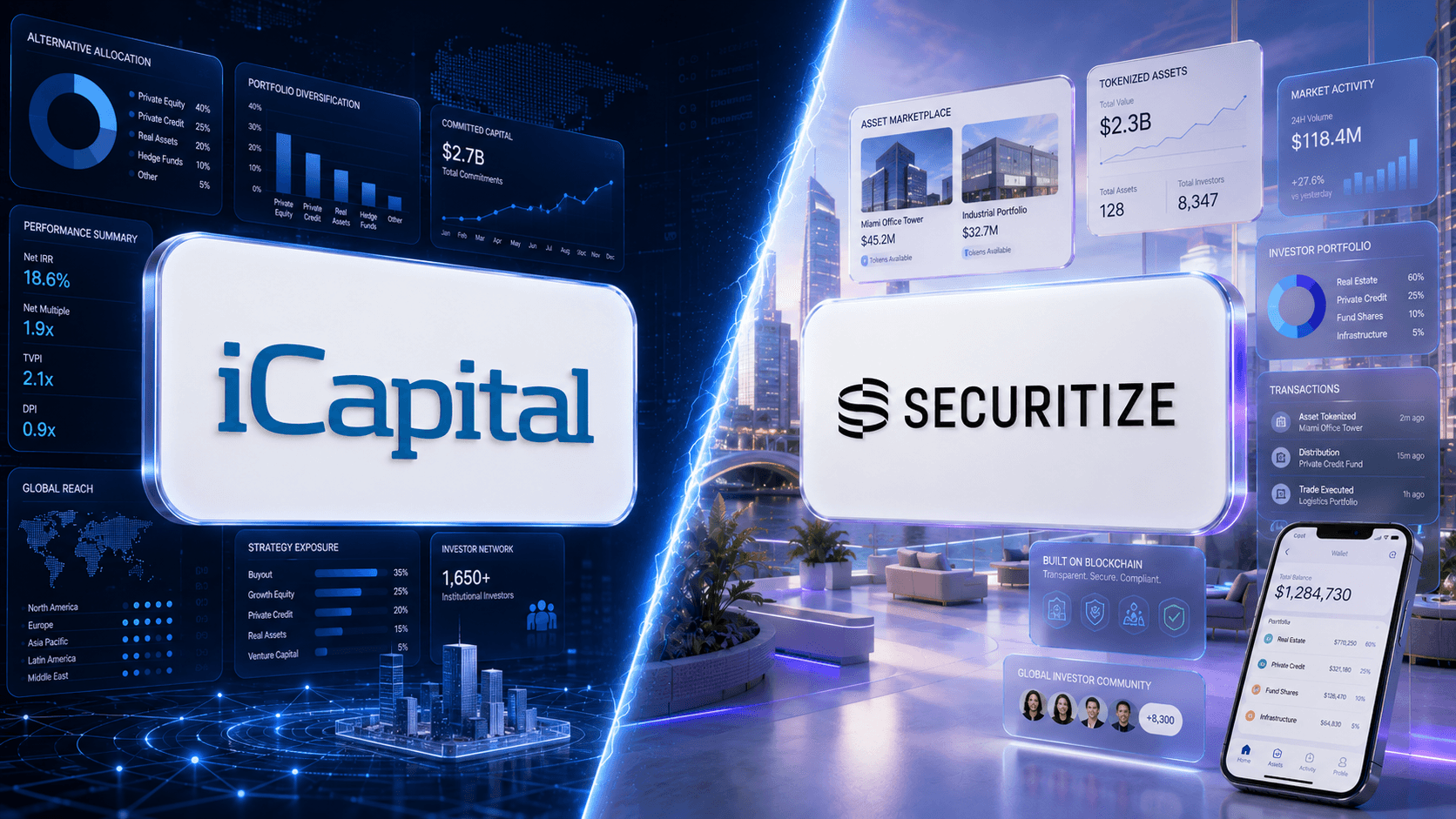
At the private-markets feeder layer, both run the same basic machine — feeder funds that turn $5M+ institutional minimums into five- and six-figure checks. The difference is everything around the machine: who can walk in the door, what the wrapper costs, and who is standing between you and the offering document.
Guide Thesis
Same trade, two doors: buy the feeder yourself at $10K-$50K, or reach a far wider shelf through an advisor at $100K+.
Securitize: self-directed, tokenized, NYSE-listed operator — with feeder terms that vary sharply per vehicle and no personal financial adviser to catch them for you. iCapital: 747 filed feeder entities and $106.6B of reported sales behind an advisor gate, a registered adviser on every feeder — and a fee stack that is never published platform-wide.
Most comparisons stop at "both offer private markets access." The access model, the location of the fee opacity, and the wrapper terms are what actually change the decision.
Securitize: self-directed tokenized feeders, $1K-$50K entry, terms set vehicle-by-vehicle. iCapital: advisor-only Private Access Funds, $100K median filed minimum, fees disclosed only per offering document.
The Core Decision
Answer one question first: do you invest through an advisor?
iCapital has no direct investor door — every subscription, capital call, and report runs through a financial advisor using its platform. If that describes how you invest, iCapital's shelf (747 filed feeders, 1,144 currently advised private funds), due-diligence reports, and consolidated reporting are the deeper toolkit, and the questions become fee extraction and advisor dependency. If you are self-directed, Securitize is the only one of the two you can use — at genuinely lower minimums ($10K-$50K feeders, $1K retail) — and the burden iCapital assigns to an advisor lands entirely on your reading of the PPM. AltStreet's document review of the Securitize shelf found that burden is real: terms range from a registered fund with an independent board to feeders with non-voting shares and no voluntary redemption.
Access Model
Self-directed vs advisor-only
Securitize: onboard and subscribe yourself, $1K-$50K entry points. iCapital: no direct investor access — every transaction runs through a financial advisor.
Filed Feeder Footprint
747 vs ~10 tracked
iCapital: 747 selling feeder entities identified across AltStreet's historical Form D census (Aug 2026), reporting $106.6B sold-at-filing; 1,144 private funds currently advised per Form ADV. Securitize: approximately ten currently tracked platform vehicles, ~$4B+ platform AUM.
Operator Transparency
Inverted
Securitize: NYSE-listed operator (SECZ), exempt-reporting feeder advisor. iCapital: private operator, SEC-registered feeder adviser ($149.9B RAUM) — with outside reference points now in public filings: BlackRock carries its ~21% stake at $0.7B (equity method), against a $7.5B 2025 round.
TL;DR
The situation in two sentences
iCapital operates at dramatically greater scale in advisor-mediated private markets — 747 filed feeder entities reporting $106.6B sold, 1,144 currently advised private funds, and $149.9B of adviser regulatory AUM (AltStreet Form D census and Form ADV, August 2026) — but it is structurally closed to anyone without a financial advisor, its feeder fees are disclosed only per offering document, and its advisor pricing and manager distribution fees are not disclosed at all. Securitize is the self-directed challenger: $10K-$50K tokenized feeders into Apollo, Hamilton Lane, and KKR strategies plus retail and institutional cash products, a NYSE-listed operator — and wrapper terms that AltStreet's review of seven offering documents found vary from investor-friendly to manager-absolute, with no advisor in the loop to flag the difference.
If you read nothing else: jump to the head-to-head sections →
Securitize is the self-directed, lower-minimum option
- → Direct access: $10K-$50K feeders, $1K retail ArCoin, tokenized stocks
- → Feeder layer quantified (~0.5%); NYSE-listed operator (SECZ)
- → Unique products: daily-liquidity tokenized cash (BUIDL, VBILL)
- → Trade-off: per-vehicle term variance, exempt-reporting advisor, and you read the PPM alone
iCapital is the advisor-channel, wide-shelf option
- → 747 filed feeder entities / 1,144 advised private funds across PE, credit, hedge funds, real estate
- → SEC-registered feeder adviser; due-diligence reports; consolidated reporting
- → Capital-call automation and advisor-managed workflow
- → Trade-off: no direct access, unpublished fee stack, advisor + platform dependency
Quick decision
If you are self-directed
Securitize
The only one of the two with a direct investor door: $10K-$50K feeders into brand-name managers, $1K retail Treasury fund, tokenized stocks — provided you read the specific vehicle's PPM, because terms vary sharply.
If you invest through an advisor
iCapital
The purpose-built channel: 747 filed feeders and 1,144 advised private funds, registered feeder adviser, due-diligence reports, capital-call automation — with fee layers you must extract from each offering document, because none are published platform-wide.
If you want tokenized cash management
Securitize
BUIDL and VBILL (daily liquidity at a target $1.00 NAV) have no iCapital equivalent — iCapital's shelf is private-market and structured vehicles, not onchain cash.
0 direct
Individual investor accounts on iCapital — access is advisor-only
Every subscription runs through a financial advisor, RIA, or private bank using iCapital's platform. Securitize onboards investors directly.
747 vs ~10 tracked
Filed feeder footprint — iCapital's breadth vs Securitize's depth
iCapital: 747 selling feeder entities identified across AltStreet's historical Form D census (Aug 2026), reporting $106.6B sold-at-filing; 1,144 private funds currently advised per Form ADV. Securitize: approximately ten currently tracked platform vehicles — but with seven offering documents AltStreet has read line-by-line.
$10K vs $100K
Typical feeder minimums — Securitize vs iCapital Private Access Funds
Securitize: $10K-$50K (Hamilton Lane, Apollo ACRED), self-directed. iCapital: $100,000 median across 266 feeders disclosing a minimum on Form D, through an advisor.
2 fee stacks
Both platforms layer fees — the opacity just sits in different places
Securitize: feeder ~0.5% stated, underlying unquantified. iCapital: nothing published platform-wide — feeder fees, advisor pricing, and manager distribution fees all require per-document extraction.
Comparison hub
Head-to-head decision map
The same feeder-fund trade, distributed through opposite channels — self-directed tokens vs the advisor stack.
These sections isolate the access-model, feeder-economics, and liquidity dimensions where the platforms differ most sharply. Securitize data comes from AltStreet's ingested offering documents and EDGAR sweep (August 2026); iCapital data from AltStreet's Form D census of 747 feeder entities, Form ADV, a 104-page platform capture, and third-party Exchange Act filings (all August 2026) — labeled accordingly.
Related diligence
Direct-to-investor tokenized shelf vs B2B advisor infrastructure
Securitize vs iCapital: Access Model & Who the Customer Is
This is the gate that decides everything. iCapital (founded 2013) is B2B: its customers are the 100,000+ financial professionals and 3,000+ wealth firms who transacted on the platform (company-reported) — individual investors cannot access it independently, and changing advisors can complicate access to existing feeder holdings. The scale of what sits behind that gate is now measurable rather than asserted: 747 feeder entities reporting $106.6B of cumulative amount sold, and a further $386.6B of aggregate reported sales across 106 third-party funds that name iCapital Securities as a compensated sales agent — the observable distribution footprint, which measures the size of funds iCapital touches, not capital attributable to iCapital. Securitize (founded 2017, NYSE: SECZ since July 2026) is direct: investors onboard through KYC and wallet whitelisting and subscribe themselves, from $1,000 retail products up to $5M institutional cash funds. The business models follow: iCapital monetizes advisor platform fees, manager distribution fees, and feeder management (none published); Securitize monetizes advisory, placement, transfer agency, administration, ATS commissions, and payment rails across its affiliate stack. One consequence worth naming plainly: iCapital's structure puts a professional between the investor and a complex product; Securitize's structure puts the offering document there and nothing else.
Practical answer
If you work with an advisor and want the widest institutional menu, iCapital is the purpose-built channel — with advisor dependency and unpublished economics as the cost. If you are self-directed, Securitize is the only one of the two you can actually use — with the caveat that AltStreet's document review found its feeder terms vary sharply per vehicle, and no advisor stands between you and the PPM. Neither model is 'safer' in the abstract; they relocate the diligence burden.
| Decision factor | What changes |
|---|---|
| Who can invest | Securitize: self-directed — retail ($1K ArCoin, tokenized stocks), accredited ($50K ACRED), accredited + QP ($10K-$20K Hamilton Lane feeders), QP ($100K-$5M cash funds). iCapital: advisor-mediated only; accredited minimum, many funds require QP; no direct investor accounts. |
| What the company is | Securitize: tokenization rails + fund marketplace + sponsored feeders; NYSE-listed operator (SECZ, July 2026). iCapital: B2B fintech serving advisors — technology modules (Learn/Invest/Manage), feeder funds, due diligence; private company. Corporate family per its own legal disclosures: iCapital Advisors LLC (RIA), three broker-dealers (iCapital Securities, Axio Financial, SIMON Markets), plus AltExchange, Mirador and Insurance Technologies. |
| Scale (AltStreet-verified) | Securitize: ~$4B+ platform AUM, 575K+ accounts (platform-reported, Aug 2026), ~10 tracked vehicles. iCapital: 747 Reg D feeder entities reporting $106.6B sold-at-filing and 220,449 aggregate investor positions (AltStreet Form D census, Aug 2026); 1,144 private funds and $149.9B RAUM per Form ADV. Company-reported separately: ~$1.2T assets serviced, of which $312B alternative platform assets. |
| The footprint you cannot see by name | Securitize: every vehicle carries the brand or a named manager. iCapital: 404 of its 747 filed feeders (54%) carry no iCapital branding — code-named vehicles ('Premier Tango II Access Fund') or manager-branded access funds identifiable only through Form D related-persons data. An investor can hold an iCapital feeder without the name ever appearing. |
| Dependency created | Securitize: none beyond the vehicle itself — but no personal financial adviser vets suitability either. iCapital: advisor + platform lock-in; changing advisors or platforms complicates access to existing feeder holdings, capital calls, and reporting. |
Tokenized BVI/Delaware feeders vs conventional Private Access Funds
Securitize vs iCapital: The Feeder Stack Head-to-Head
Both platforms run the same basic machine: aggregate smaller checks in a feeder vehicle that commits to an institutional fund the investor could not reach directly. The differences are in the wrapper. Securitize's sponsored feeders (Apollo ACRED, Hamilton Lane x3, KKR) are tokenized vehicles — some BVI companies, some Delaware LPs — advised by Securitize Capital (an exempt reporting adviser), typically charging a quantified 0.5% feeder fee over underlying fund fees the PPMs mostly do not quantify; AltStreet's document review found non-voting shares in two vehicles, written no-due-diligence clauses in two PPMs, and governance from conventional to manager-absolute. iCapital's Private Access Funds are conventional Delaware feeders managed by iCapital Advisors LLC (an SEC-registered adviser with $149.9B of regulatory AUM), offered under Rule 506(b) in 97.6% of the 723 census feeders that state an exemption; their feeder-level terms are disclosed only in individual offering documents — never published platform-wide — with advisor platform fees and manager distribution fees as additional undisclosed layers. Fee opacity is the shared defect; its location differs.
Practical answer
On verifiable economics, Securitize's feeder layer is more visible (a stated 0.5%) but its underlying layer is not; iCapital's entire fee stack requires PPM-by-PPM extraction, and AltStreet declines to publish a platform-wide estimate because nothing in the public record supports one. On governance, iCapital's registered-adviser Delaware structure is the more conventional wrapper; Securitize's shelf contains both stronger and materially weaker configurations. On both platforms, price the feeder against the direct alternative — an interval-fund share class or, for larger checks, a direct LP commitment — before accepting any second layer.
| Decision factor | What changes |
|---|---|
| Feeder structure | Securitize: tokenized feeders — BVI companies (ACRED, SF6) and Delaware LPs (SCOPE, EOV); non-voting shares documented in ACRED and SF6. iCapital: Delaware LPs/LLCs (Private Access Funds), conventional LP interests, managed by iCapital Advisors LLC. |
| Adviser status | Securitize Capital: exempt reporting adviser (not SEC-registered) — stated in the ACRED PPM. iCapital Advisors LLC: SEC-registered investment adviser, CRD 177513, $149.9B regulatory AUM across 1,144 private funds (Form ADV, Aug 2026); iCapital Securities LLC, Axio Financial LLC and SIMON Markets LLC: FINRA/SIPC broker-dealers. |
| Fee visibility | Securitize: feeder layer quantified (~0.5%); underlying fund fees mostly unquantified in the PPM; ACRED combined stack recorded at ~3.5% by AltStreet. iCapital: no platform-wide fee schedule — the feeder adds a vehicle layer whose management fee, expenses and any performance compensation appear only in that offering's documents, on top of the underlying fund's own terms; advisor platform fees and manager distribution fees undisclosed. AltStreet publishes no all-in estimate for iCapital because none is verifiable from public sources. |
| Exemption & solicitation (verified) | Securitize: Rule 506(c) with Reg S sleeves — general solicitation permitted, which is why the deal pages are public. iCapital: 706 of the 723 census feeders that state an exemption filed under Rule 506(b) — 97.6%, with only 17 under 506(c). The 'no general solicitation' posture is not a generalization here; it is the filed record, and it is why the offerings are invisible outside the advisor channel. |
| Underlying diligence | Securitize: two PPMs (ACRED, AAA CLO) state the advisor will not conduct due diligence on the underlying fund. iCapital: research team produces due diligence reports for advisors — but selection criteria and manager distribution-fee conflicts are not fully disclosed. |
Does the token change your exit? Mostly no — with two real exceptions
Securitize vs iCapital: Liquidity, Tax & What Tokenization Actually Adds
The honest answer on liquidity: both platforms' private-market feeders are as illiquid as their underlying funds. iCapital's Private Access Funds match underlying terms — 10-12 year private equity commitments with capital calls, 3-7 years for credit, hedge-fund gates where applicable — with no secondary market or early redemption through the platform. Securitize's tokenized feeders are not meaningfully different at the locked end: SF6's shares are contractually non-redeemable until an April 2034 maturity, EOV and the KKR vehicle are locked, and every feeder document AltStreet reviewed describes potential ATS listing without guaranteeing it. In the current Securitize shelf AltStreet reviewed, tokenization adds its clearest practical value in two situations: where the underlying is liquid (BUIDL/VBILL redeem daily at a target $1.00 NAV — a product class with no direct iCapital equivalent), and where the underlying has an interval mechanism the token passes through (ACRED's quarterly windows, SCOPE's monthly NAV redemption with a 5% gate). On tax, both feeder models produce multi-layer partnership complexity with expected extensions; Securitize adds PFIC/Form 8621 exposure on two vehicles, which has no iCapital equivalent.
Practical answer
Do not choose Securitize over iCapital because tokens sound liquid — at the private-equity end of both shelves, capital is locked for years either way, and Securitize's ATS currently trades one fund (ArCoin). Choose based on which liquidity profile you actually need: tokenized cash management and interval-fund passthrough exist only on Securitize; the broad menu of conventional institutional strategies, with an advisor managing capital calls and consolidated reporting, exists only on iCapital. And on either platform, confirm the specific vehicle's tax regime before an IRA or tax-sensitive account touches it.
| Decision factor | What changes |
|---|---|
| Private-market liquidity | Securitize: SCOPE monthly at NAV (5% gate); ACRED quarterly via underlying interval fund's ≥5% offers; EOV/SF6/KKR locked (SF6 non-redeemable to April 2034). iCapital: matches underlying — PE 10-12 years with capital calls, credit 3-7 years, hedge-fund gates; no platform secondary market. |
| Liquid products | Securitize: BUIDL/VBILL daily at target $1.00 NAV; ArCoin monthly repurchases + the only operating ATS secondary market. iCapital: no direct equivalent to BUIDL/VBILL's tokenized daily-liquidity cash products; registered iCapital products may provide periodic liquidity depending on their prospectus. |
| Capital mechanics | Securitize: mostly fully-funded subscriptions (one-time or on-demand); ACRED contributions not capped at subscription per its PPM. iCapital: PE-style capital calls over 3-5 years, automated through the platform — advisor manages the cash-flow calendar. |
| Tax | Securitize: K-1 (ACRED, Hamilton Lane LPs — extensions expected), PFIC/8621 (AAA CLO, Index Four), 1099-DIV (ArCoin) — three regimes, verify per vehicle. iCapital: one investor-facing K-1 from the feeder incorporating the underlying fund's items (multi-layer partnership complexity, not two K-1s to the investor), Feb-March or later delivery, multi-state filing, UBTI risk in IRAs above $1,000 of gross UBTI. |
| Reporting | Securitize: deal-page dashboards (with display defects AltStreet verified against governing documents) + transfer-agent records. iCapital: consolidated cross-holding reporting and analytics via the platform — but data portability if the advisor relationship ends is unclear. |
Scenario Analysis
$250,000 · Private-credit allocation · Three routes
The same accredited investor, the same asset class, three access routes (August 2026): a Securitize tokenized feeder, an iCapital Private Access Fund, and the benchmark both should be priced against — a direct interval-fund share class through a brokerage.
| Metric | Securitize · Apollo ACRED | iCapital · Private Access Fund (credit) | Direct interval-fund share class |
|---|---|---|---|
| How you get in | Self-directed — KYC, wallet whitelisting, USDC or wire | Through your advisor only — no direct subscription | Brokerage or RIA; ticketed like a fund purchase |
| Minimum | $50,000 (accredited) | $100,000 median filed minimum (266 feeders disclosing; middle half all at $100K, range $10K-$1M); $25K on registered products (accredited; many funds QP) | Varies by fund and share class; use the prospectus for the directly accessible registered-fund alternative being compared |
| Wrapper layers | Tokenized BVI feeder → registered interval fund (Apollo) | Delaware feeder (iCapital Advisors) → institutional fund | None — you hold the registered fund directly |
| Fee knowability | Feeder 0.5% stated; underlying unquantified in PPM; ~3.5% combined (AltStreet-recorded) | Per-PPM only — no platform-wide schedule; plus undisclosed advisor/distribution layers | Published expense ratio, plus any sales load or acquired-fund fees, disclosed in the prospectus |
| Liquidity | Quarterly, derivative of the underlying fund's ≥5% repurchase offers; suspension powers at the feeder | Matches underlying fund terms; no platform secondary market | Quarterly repurchase offers directly from the fund, per its prospectus |
| Governance over your position | Non-voting feeder shares; two-director board (both Securitize employees per the PPM) | Conventional LP interest; SEC-registered feeder adviser; financial professional in the transaction | '40 Act protections, independent board, shareholder rights |
| Tax document | K-1 (extensions expected per PPM) | One feeder K-1 incorporating underlying items (multi-layer partnership); multi-state; UBTI risk in IRAs above $1,000 gross | 1099 (registered fund) |
The third column is the discipline check both platforms deserve: where the same manager offers a registered share class an investor can reach directly, the feeder — tokenized or advisor-mediated — must justify its extra layer on access, minimums, or service, because it will rarely win on fees, governance, or tax simplicity. Where no direct route exists (most closed-end institutional PE and credit funds), the choice collapses back to the first question: self-directed at Securitize's minimums, or advisor-channel at iCapital's breadth.
Who can actually invest on each platform?
Short answer
Only Securitize offers direct investor access — retail from $1,000 (ArCoin, tokenized stocks), accredited from $10,000-$50,000 (Hamilton Lane, Apollo ACRED feeders), Qualified Purchaser from $100K-$5M (VBILL, BUIDL). iCapital has no individual investor door: access requires a financial advisor, RIA, family office, or private bank using its platform, with accredited status as the floor and QP required by many funds. The table below maps both ladders.
⚠ Access is a structural fact, not a preference
A self-directed investor cannot "choose" iCapital — there is no account to open. An advisor-channel investor can reach Securitize products, but the advisor's platform integrations and compliance stack usually determine what actually gets recommended. Start from how you invest, then compare shelves.
| Route | Self-directed? | Requirement | Typical minimum |
|---|---|---|---|
| Securitize · Arca ArCoin / tokenized stocks | Yes — retail | Verified US investor; KYC + whitelisting | $1,000 (ArCoin); per-share (stocks) |
| Securitize · Hamilton Lane feeders | Yes | Accredited + Qualified Purchaser | $10,000-$20,000 |
| Securitize · Apollo ACRED | Yes | Accredited | $50,000 |
| Securitize · BUIDL / VBILL | Yes | Qualified Purchasers | $100K-$1M (VBILL, by chain); $5M (BUIDL) |
| iCapital · Private Access Funds | No — advisor only | Accredited minimum; many funds require QP; advisor determines suitability | $100,000 median filed minimum (Form D, 266 feeders disclosing) |
| iCapital · Direct platform account | Does not exist | B2B infrastructure — advisors, RIAs, family offices, private banks are the customers | — |
Where does each fee stack hide its numbers?
Short answer
Both stack a feeder layer on top of institutional fund fees, and neither publishes an all-in number — the difference is which layer you can see. Securitize states the feeder fee (~0.5%) but mostly leaves the underlying fund's fees unquantified in its PPMs; AltStreet records ACRED's combined stack at roughly 3.5%. iCapital publishes no platform-wide feeder schedule at all: each Private Access Fund's management fee and carry live in its own offering document, on top of whatever the underlying fund charges, with advisor platform pricing and manager distribution fees undisclosed entirely. On either platform, the only defensible fee analysis is built from the specific PPM — details in the table below.
| Fee layer | Securitize feeders | iCapital Private Access Funds |
|---|---|---|
| Feeder management fee | Stated: typically 0.5% (basis varies; SF6's basis ambiguity spans 1.5% vs 3.0% annualized combined) | Per offering document only — no published schedule; varies by fund |
| Feeder carry | Varies: 0% (ACRED feeder level) to 12.5%/8% (SF6, plus a second undisclosed layer) | Charged on some funds per PPM; rates not published platform-wide |
| Underlying fund fees | Mostly unquantified in the feeder PPM — incorporated by reference | Underlying institutional-fund economics vary by strategy, manager and share class; disclosed in the underlying fund documents and incorporated into the feeder economics |
| Channel fees | Zero Hash rails ($18 wire, 0.1% USDC/USD); 1% ATS commission on secondary trades; 2% GP-waivable liquidity-pool fee (AAA CLO, SCOPE PPMs) | Advisor platform fees and manager distribution fees — both undisclosed; your advisor's own fee sits on top |
| All-in estimate | ACRED recorded at ~3.5% combined (AltStreet database); most feeders not computable from their own documents | Not publicly determinable: feeder-level terms live in each offering document and no platform-wide schedule exists — illustrative, confirm per PPM |
The symmetry is the finding: neither platform lets an investor compute total cost from public materials. Securitize's opacity sits in the underlying layer; iCapital's sits everywhere except the underlying layer. The practical consequence is identical — demand the combined feeder-plus-underlying figure in writing before subscribing, and on iCapital, additionally ask your advisor what they pay the platform and whether managers pay for distribution, because those economics shape what gets recommended.
Whose structure protects the investor more?
Short answer
iCapital's wrapper is the more conventional one: Delaware feeders under an SEC-registered adviser (Form ADV on file), a FINRA/SIPC broker-dealer processing transactions, and a financial professional sitting between the investor and the product, subject to the standards applicable to that advisory or brokerage relationship. Securitize's wrapper quality varies by vehicle — from a registered '40 Act fund with an independent board (ArCoin) to feeders with non-voting shares, two-employee boards, and written no-due-diligence clauses — under an exempt reporting adviser, with no personal financial adviser required in the self-directed investment decision. The operator-level transparency runs the other way: Securitize Corp. is NYSE-listed and files publicly; iCapital is private with undisclosed financials.
| Dimension | Securitize | iCapital |
|---|---|---|
| Feeder adviser | Securitize Capital — exempt reporting adviser (not SEC-registered), per the ACRED PPM | iCapital Advisors LLC — SEC-registered investment adviser, Form ADV public |
| Broker-dealer | Securitize Markets — SEC-registered, FINRA/SIPC, operates the ATS | iCapital Securities LLC, Axio Financial LLC, SIMON Markets LLC — SEC-registered, FINRA/SIPC |
| Operator disclosure | NYSE-listed (SECZ, July 2026) — Exchange Act reporting, public financials | Private; BlackRock carries ~21% at $0.7B (equity method, Q2 2026 10-Q), $7.5B 2025 round — no public revenues or profitability |
| Feeder governance | Varies per vehicle: independent board (ArCoin) to non-voting shares and unremovable managers (ACRED, SF6) — verified in ingested PPMs | Conventional Delaware LP/LLC interests; SEC-registered feeder adviser; advisor suitability layer |
| Diligence intermediary | No personal financial adviser is required; the self-directed investor bears the primary document-review burden | A financial professional is in the transaction and may use iCapital due-diligence materials; the investor still receives and should review the vehicle's offering documents — selection criteria and distribution-fee conflicts are not fully disclosed |
| If the platform fails | Transfer-agent dependency is explicit — the Arca prospectus states repurchases and dividends could become difficult to execute | Fund holdings continue at underlying administrators, but capital calls, reporting, and access become problematic; no disclosed contingency plans |
Neither column dominates. iCapital wins on adviser registration and on having a financial professional in the transaction, subject to the standards applicable to that advisory or brokerage relationship; Securitize wins on operator transparency and on having one genuinely registered retail product on its shelf. The failure modes also differ: Securitize's risk concentrates in per-vehicle wrapper terms the investor must catch alone, iCapital's in undisclosed economics and dependency on an advisor relationship that may not outlive a ten-year fund commitment.
Which platform is right for which investor?
Short answer
Securitize suits self-directed accredited investors who want brand-name feeder access at $10K-$50K and will read the PPM themselves, plus anyone wanting tokenized cash management or the retail doors — no iCapital equivalent exists for any of those. iCapital suits HNW investors ($500K-$5M liquid, per AltStreet's review) already working with advisors, who want a wide institutional menu with suitability, capital-call automation, and consolidated reporting handled. Ultra-HNW investors able to meet direct institutional minimums should question both feeder layers. IRA investors need vehicle-specific review — UBTI, PFIC treatment, custodian support and tax reporting vary by feeder — and neither platform suits anyone unwilling to extract fees from offering documents.
Choose Securitize if
- → You are self-directed and accredited — iCapital has no door for you
- → You want brand-name feeder access at $10K-$50K minimums
- → You want tokenized cash management (BUIDL, VBILL) or the $1K retail fund
- → You value a listed, reporting operator you can underwrite publicly
- → You will read the specific vehicle's PPM — non-negotiable on this shelf
Avoid if:
You want an intermediary vetting suitability, you need the widest possible fund menu, or you assume the platform brand standardizes wrapper terms (it does not).
Choose iCapital if
- → You already invest through an advisor, RIA, or private bank on the platform
- → You want breadth: 747 filed feeders and 1,144 advised private funds across PE, credit, hedge funds, real estate
- → You want capital calls, K-1 aggregation, and reporting handled for you
- → You value an SEC-registered feeder adviser and a financial professional in the transaction, subject to the standards applicable to that advisory or brokerage relationship
- → You can commit $100K+ per position for 5-12 years
Avoid if:
You are self-directed (no access), you require published fee schedules before committing, or your advisory relationship may not outlive a 10-12 year fund term.
Neither is a fit if
- → You can meet direct institutional minimums ($5M-$25M+) — both feeder layers are avoidable costs at that scale
- → IRA investors need vehicle-specific review — UBTI, PFIC treatment, custodian support and tax reporting can make certain feeders materially less attractive in retirement accounts
- → You need capital back within five years — both shelves' private-market vehicles are locked or gate-dependent
- → A registered interval-fund share class of the same strategy is directly available to you at a published expense ratio
Benchmark note:
Price every feeder — on either platform — against the most direct route to the same exposure. The feeder must earn its layer on access or service; it will rarely earn it on fees.
AltStreet Take
What the documents actually say
- →
The access model is the comparison — everything else is downstream.
These platforms rarely compete for the same investor on the same day. iCapital's customer is the advisor; the investor arrives mediated, at $100K+ minimums, with suitability and capital calls handled. Securitize's customer is the investor directly, at $10K-$50K, with nothing between them and the PPM. The genuine overlap — an advised HNW investor whose advisor could route either way — is narrower than the category framing suggests, and in that overlap the advisor's platform integration usually decides.
- →
Both fee stacks are opaque; they are opaque in mirror image.
Securitize states its feeder layer (~0.5%) and incorporates the underlying fund's economics by reference without quantifying them; AltStreet could not compute a defensible all-in ratio for most of its feeders from their own documents. iCapital publishes no feeder schedule at all, and adds two layers Securitize doesn't have — advisor platform pricing and manager distribution fees, both undisclosed. Whichever door you use, the all-in number exists only in the specific offering documents, and the discipline is the same: get it in writing, then compare it to the most direct route to the same exposure.
- →
The protection profiles are inverted, not ranked.
iCapital offers the conventional safeguards: an SEC-registered feeder adviser, a financial professional in the transaction subject to the standards applicable to that advisory or brokerage relationship, Delaware LP interests. Securitize offers operator-level transparency iCapital cannot match — a NYSE-listed parent with public financials — while its feeder advisor is exempt-reporting and its wrapper terms vary from a registered fund with an independent board to vehicles with non-voting shares and written no-due-diligence clauses. Pick which failure mode you'd rather manage: undisclosed economics inside a conventional structure, or fully-documented terms you must read and catch yourself.
- →
On this comparison, tokenization adds its clearest practical value in two situations — and private equity is not one of them.
Where the underlying is liquid (BUIDL and VBILL's daily-liquidity cash funds) or has an interval mechanism the token passes through (ACRED quarterly, SCOPE monthly with a 5% gate), Securitize offers something iCapital structurally does not. At the private-equity end, the token changes nothing that matters: SF6 is non-redeemable until 2034, the ATS trades one fund today, and every feeder document reviewed describes potential listing without guaranteeing it — functionally the same multi-year lock as an iCapital Private Access Fund, minus the advisor managing the calendar.
Primary sources reviewed
Forensic source layer
Securitize data comes from ingested offering documents and SEC filings; iCapital data now comes primarily from primary filings rather than company claims — AltStreet reconstructed its Form D footprint in August 2026 (2,611 filings swept, 1,423 entities classified by related-persons data, 747 confirmed feeders), cross-checked against Form ADV and third parties' Exchange Act filings. Company-reported metrics that remain are labeled and dated, and are drawn from an August 2026 capture of iCapital's own materials.
Data through
August 10, 2026
Securitize documents: Aug. 5 · iCapital census/ADV: Aug. 10
Securitize sources
- ›Offering documents — Seven ingested and forensically extracted: Apollo ACRED PPM, AAA CLO PPM, Hamilton Lane SCOPE/EOV/SF6 PPMs, Arca prospectus, Index Four PPM — with verbatim verification of contested fields.
- ›SEC EDGAR — 31-entity sweep resolving 13 confirmed platform CIKs incl. Securitize Corp. (2094496), ACRED (2056038), and the Hamilton Lane feeders. Source ↗
- ›Exchange Act filings — Securitize Corp. post-listing filings; NYSE listing July 2, 2026 (~$1.25B Cantor Equity Partners II combination).
- ›Deal pages — All ten tracked vehicles captured Aug 2026; platform-reported figures recorded with basis warnings.
- ›BrokerCheck — Securitize Markets, LLC — SEC-registered broker-dealer, FINRA/SIPC, ATS operator (CRD 283256). Source ↗
iCapital sources
- ›Platform materials — icapital.com — product structure, Learn/Invest/Manage modules, partnership announcements (Schwab, Fidelity, Pershing, Envestnet, Morningstar).
- ›AltStreet Form D census (iCapital) — 747 selling feeder entities identified across AltStreet's historical Form D census, reporting $106.6B sold-at-filing and 220,449 aggregate investor positions; 54% unbranded; 97.6% filed under Rule 506(b); median disclosed minimum $100,000. Separately, 106 third-party funds with $386.6B of aggregate reported sales name iCapital Securities as a compensated sales agent (August 2026). Reconstructed from EDGAR full-text search across Form D filings. Source ↗
- ›SEC Form ADV (iCapital) — iCapital Advisors, LLC — CRD 177513, SEC# 801-106690: the SEC-registered investment adviser managing the Private Access Funds, reporting $149.86B discretionary regulatory AUM across 1,144 private funds and 1,314 accounts (August 2026 SEC IA firm roster; figures verified against the FOIA roster download). Business model, conflicts and disciplinary history via IAPD. Source ↗
- ›BlackRock Q2 2026 Form 10-Q — ~21% interest in iCapital carried at $0.7B under the equity method, with BlackRock stating the carrying amount may not represent fair value. Filed 2026-08-06 for the period ended 2026-06-30 (BlackRock, Inc., CIK 2012383). Source ↗
- ›Ares Capital Q2 2026 Form 10-Q — 71,430 iCapital shares held at $1.0M cost (April 2025) and $1.1M fair value. Filed 2026-07-29 for the period ended 2026-06-30 (Ares Capital Corp., CIK 1287750). Source ↗
- ›Company-reported metrics — ~$1.2T assets serviced including $312B alternative platform assets, 100,000+ professionals, 3,000+ wealth firms — August 2026 platform capture; $7.5B valuation per the 2025 financing round.
- ›Third-party coverage — InvestmentNews (advisor-only access), Wealthmanagement.com (adoption metrics), Sacra (competitive positioning, fee transparency).
- ›Regulatory records — iCapital Securities LLC, Axio Financial LLC, SIMON Markets LLC — SEC-registered broker-dealer, FINRA/SIPC member; sample feeder Form D filings on EDGAR.
FAQs
Securitize vs iCapital: Common questions
Can I invest through Securitize or iCapital directly, without an advisor?+
Only through Securitize. iCapital is B2B infrastructure: individual investors cannot open an account or subscribe independently — every transaction runs through a financial advisor, RIA, family office, or private bank using iCapital's platform. Securitize is self-directed: an accredited investor (or, for two products, a retail investor) can onboard, verify, and subscribe without an intermediary — Apollo ACRED at $50,000, Hamilton Lane feeders at $10,000-$20,000, the Arca U.S. Treasury Fund at $1,000, and tokenized stocks for verified US investors. This is the single most decision-relevant difference: if you do not have (or want) an advisor relationship, iCapital is structurally closed to you, whatever its shelf contains.
Are Securitize and iCapital competitors?+
They compete for the same underlying trade — routing accredited capital into brand-name private-market funds through feeder vehicles at reduced minimums — but through different channels, and at wildly different scale. AltStreet's reconstruction of iCapital's SEC Form D record found 747 feeder entities reporting $106.6B of cumulative amount sold across 220,449 aggregate reported investor positions, alongside 1,144 private funds currently advised per its Form ADV — Delaware Private Access Funds distributed through advisors, with Form D-disclosed minimums clustering at exactly $100,000. Securitize distributes direct to investors: a shelf of roughly ten tokenized vehicles including feeders into Apollo, Hamilton Lane, and KKR strategies at $10K-$50K minimums, plus issuer-led cash funds (BlackRock BUIDL, VanEck VBILL). The manager rosters overlap in kind — mega-cap PE and credit sponsors — but fund-by-fund availability differs, and the specific vehicles are never the same: an iCapital Apollo feeder and Securitize's ACRED are separate funds with separate terms even where the underlying manager is the same.
How do the fees compare between Securitize and iCapital feeders?+
Both are multi-layer, and neither gives you the full picture upfront — but the gaps sit in different places. Securitize quantifies the feeder layer (typically 0.5%) but the underlying fund's fees and carry are mostly not quantified in the feeder PPM; AltStreet records ACRED's combined stack at roughly 3.5%. iCapital publishes no standardized feeder fee schedule at all — a feeder introduces an additional vehicle layer that may include management fees, administrative expenses and, depending on the vehicle, performance-based compensation, all of which exist only in the individual offering documents and sit on top of whatever the underlying fund charges. AltStreet's review deliberately publishes no platform-wide estimate, because none can be verified from public sources. There is also an invisible layer on iCapital: platform fees charged to advisors and distribution fees paid by asset managers, neither disclosed — treat those as a conflict-of-interest consideration rather than automatically as a line in your own expense ratio. On both platforms, the only reliable fee source is the specific offering document.
What are the minimum investments on Securitize vs iCapital?+
Securitize runs materially lower: Hamilton Lane SCOPE at $10,000, the other Hamilton Lane feeders and the KKR vehicle at $20,000, Apollo ACRED at $50,000 — plus retail doors (ArCoin $1,000, tokenized stocks) that have no iCapital equivalent. iCapital's minimums are now measurable rather than estimated: across the 266 feeders in AltStreet's census that disclose a minimum on their Form D, the median is exactly $100,000 — and so are the 25th and 75th percentiles, meaning the entire middle half of the book sits at that one number. The full range runs $10,000 to $1,000,000, but only 3 of 266 exceed $250,000, so the commonly cited '$100K-$250K typical' overstates the top of the range. Company materials separately advertise $25,000 minimums on registered ('40 Act) products for accredited investors. Accredited status is the floor; many funds require Qualified Purchaser status. Both are far below direct institutional LP commitments ($5M-$25M+), which is the point of the feeder model on either platform.
What tax documents do Securitize and iCapital investments issue?+
Both feeder models produce multi-layer partnership tax complexity, with one extra hazard on the Securitize side. iCapital's Private Access Funds issue a single Schedule K-1 to the investor that incorporates the underlying fund's tax items — expect February-March delivery or later, extension filings, multi-state obligations, and UBTI exposure in IRAs (an IRA must file Form 990-T once gross UBTI exceeds $1,000, taxed at compressed trust rates). Securitize's feeders are similar where they are partnerships (ACRED and the Hamilton Lane LPs issue K-1s, with PPMs explicitly warning investors to expect extensions) — but the shelf also contains PFIC vehicles (the AAA CLO fund and Index Four elect corporate treatment, requiring Form 8621 with QEF information not assured) and a 1099-DIV RIC (ArCoin). For the Reg D Private Access Funds compared here, the investor generally receives a feeder-level K-1; iCapital's registered products can have different tax reporting and should be checked separately. On Securitize the regime must be verified per vehicle because three coexist on one shelf.
Which platform is more transparent about its own business?+
Inverted from what the branding suggests. Securitize Corp. has been a NYSE-listed Exchange Act reporting company since July 2, 2026 (SECZ) — public financial statements, board committees, and periodic filings — while its feeder advisor, Securitize Capital, is an exempt reporting adviser rather than SEC-registered. iCapital is the mirror image: its feeder manager, iCapital Advisors LLC (CRD 177513), is an SEC-registered investment adviser reporting $149.9B of regulatory AUM across 1,144 private funds on its August 2026 Form ADV, and iCapital Securities LLC, Axio Financial LLC and SIMON Markets LLC are FINRA/SIPC broker-dealers — but the parent company is private, publishing no revenues, profitability, or sustainability metrics, and disclosing neither its advisor pricing nor its manager distribution-fee arrangements. That last gap has narrowed slightly: other companies' filings now carry outside reference points. BlackRock's Q2 2026 10-Q discloses a ~21% interest carried at $0.7B under the equity method — an accounting carrying amount BlackRock explicitly says may not represent fair value — and Ares Capital marks a small common-stock position at $1.1M against a $1.0M April 2025 cost. Neither is a valuation of iCapital, and both measure something different from the $7.5B 2025 financing round. Each platform is transparent at exactly the layer where the other is opaque: Securitize at the operator level, iCapital at the adviser-registration level.
Which is better for private markets access: Securitize or iCapital?+
It resolves on three questions, not a ranking. First, do you work with an advisor? If yes, iCapital's current advised-fund universe is dramatically broader: its Form ADV reports 1,144 private funds, while AltStreet separately identified 747 selling feeder entities across its historical Form D census; Securitize currently has roughly ten tracked vehicles. That breadth comes with advisor-mediated suitability, due diligence reports, and consolidated reporting; if no, Securitize is the only door. Second, what check size? Securitize's $10K-$50K feeder minimums undercut iCapital's Form D-disclosed median of exactly $100,000. Third, how much wrapper risk will you underwrite yourself? AltStreet's document review found Securitize's self-directed feeders carry manager-favorable terms (non-voting shares, written no-due-diligence clauses, locked liquidity in several vehicles) that an investor must catch alone, while iCapital's conventional Delaware feeders sit behind a registered adviser and an advisor relationship — at the cost of fee layers that are never published platform-wide. On either path, the specific offering document is the investment.
Full Platform Analysis: Securitize and iCapital
Both reviews are sourced from primary materials — ingested offering documents, SEC filings, Form ADV, and company disclosures labeled as such. No marketing language, no affiliate framing.
Securitize Full Review
Seven offering documents ingested, ten vehicles mapped, 31-entity EDGAR sweep, post-NYSE-listing corporate record — including the best-vs-worst wrapper table and per-vehicle tax classifications.
iCapital Full Review
B2B advisor infrastructure analysis: Private Access Fund structure, fee opacity findings, advisor dependency risks, multi-layer partnership tax complexity, and the direct-access alternatives comparison.