Every tokenization platform sells the same promise: the asset becomes liquid. Regulators require the venues where that liquidity is supposed to happen to report what they actually trade, every week, to FINRA. Almost nobody looks, because the reports are filed under legacy four-letter identifiers that do not match any platform's brand name. AltStreet pulled all of them, back to 2021.
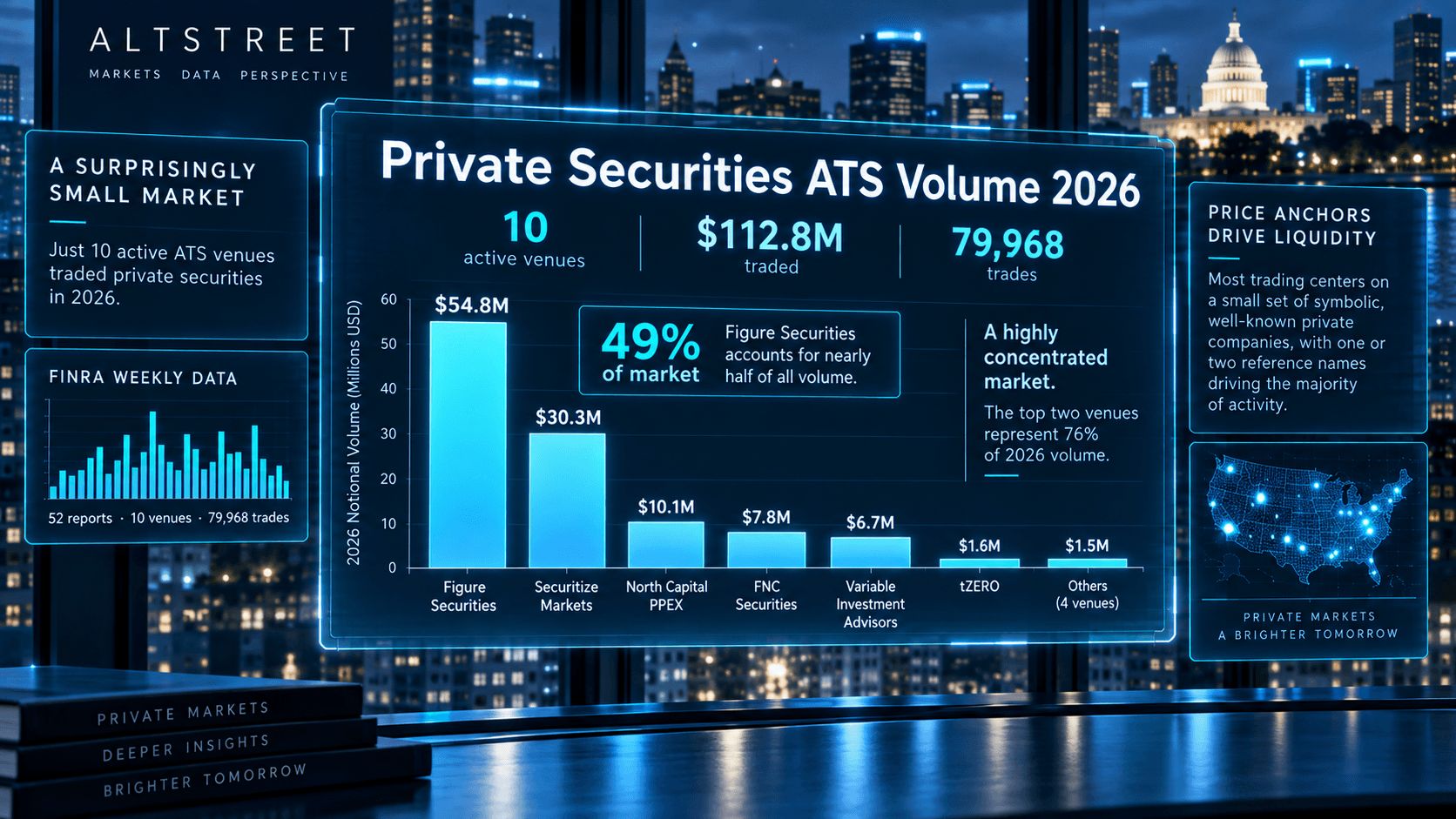
Here is the finding. In 2026 through the week of August 3, the ten US alternative trading systems that reported trades in private placements, Regulation A shares, fractional real-asset interests and tokenized securities traded a combined $112,754,609 across 79,968 transactions. Ten venues, thirty-one weeks, roughly the annual revenue of a single large car dealership.
Just under half of it, $54.8 million, came from one venue that did not exist in January and trades exactly one security: Figure Securities' ATS, trading Figure's own blockchain-native stock. The venue with the most actual transactions sells fractional houses, paintings and trading cards at an average of $149 a trade. Two tokenized venues emptied out almost completely. And two of the steadiest venues in the dataset trade ownership units of farmer-owned ethanol plants, for reasons that have nothing to do with technology and everything to do with a Treasury regulation.
What This Data Is, and Why It Is Not Published Anywhere Else
FINRA's OTC Transparency program requires every alternative trading system to report weekly share volume, trade counts and notional value, both firm-wide and symbol by symbol. The data is public and free. It is also effectively hidden, because venues report under market participant identifiers assigned years ago and never rebranded. The tZERO ATS reports as PROS, a holdover from PRO Securities, the broker-dealer Overstock.com bought in 2014. Securitize Markets is SMKT. North Capital's PPEX is PPEX. INX is SWCL, inherited from OpenFinance Securities. An investor trying to find out whether a token trades would have to know all of this in advance.
Some operators publish headline figures of their own, such as cumulative volume since launch or aggregate transaction counts. None publishes a comparable weekly, symbol-by-symbol ATS series. FINRA does. The marketing language across the category runs to "continuous liquidity," "secondary trading since 2019" and "a leading regulated ATS," and every one of those claims is measurable against a public file that the companies making them do not cite.
Two scope notes before the numbers. First, this covers ATSs reporting in FINRA's OTC Equity tier. Dark pools that trade listed shares are a separate and vastly larger universe, and are excluded. Second, and importantly, private-company share transfers arranged bilaterally by broker-dealers rather than executed on an ATS do not appear here. The pre-IPO secondary market that platforms like Forge, Hiive and EquityZen operate in is largely negotiated rather than ATS-matched, so this census is not a measure of the private securities secondary market as a whole, which is considerably larger. It is a complete measure of one specific thing: securities changing hands on regulated electronic venues that report to this program. The SEC's broader list of registered ATSs includes venues for private company stock that do not appear in the OTC Equity tier at all.
Private Securities ATS List: 10 Active Venues Ranked by 2026 Volume
Every venue that reported a trade in 2026, in order of dollar volume. Figures are FINRA weekly totals summed by AltStreet, January 1 through the week beginning August 3, 2026.
| Venue (FINRA identifier) | 2026 notional | Trades | Avg trade | What trades there |
|---|---|---|---|---|
| Figure Securities (FIGS) | $54,791,792 | 7,799 | $7,025 | One symbol: Figure's own Series A Blockchain Common Stock. First reported week February 16, 2026. |
| Securitize Markets (SMKT) | $30,311,718 | 466 | $65,047 | VanEck VBILL $19.4M in 22 trades, BlackRock BUIDL $4.2M in 8, a Singapore-issued Blockchain Capital token $6.7M in 428. Arca's retail ArCoin traded $60. |
| North Capital PPEX (PPEX) | $10,116,928 | 67,971 | $149 | 1,259 symbols. Arrived homes 56.9%, Masterworks art 24.1%, Rally and RSE collectibles 9.1%, Ark7 homes 8.6%. |
| FNC Securities (FNCA) | $7,787,260 | 75 | $103,830 | Farmer-owned cooperative units: Cardinal Ethanol, Southwest Iowa Renewable Energy, Granite Falls Energy, Ace Ethanol. |
| Variable Investment Advisors (VIAT) | $6,690,790 | 188 | $35,589 | Glacial Lakes Corn Processors, South Dakota Soybean Processors, Homeland Energy Solutions, Lake Area Corn Processors. |
| tZERO Securities (PROS) | $1,605,480 | 2,605 | $616 | TZROP, its own preferred token, was $1.5M of it and last traded the week of May 4. Then Aspen Digital, Curzio, EnergyFunders, the Overstock brand token. |
| Lodas Securities (ALTS) | $982,469 | 93 | $10,564 | Non-traded REITs and BDCs: Starwood REIT, Franklin BSP Capital, CIM Real Estate Finance Trust, Lightstone REIT IV. |
| INX Securities (SWCL) | $421,103 | 386 | $1,091 | The INX token only. No reported trading week since February 16, 2026. |
| Gigastar Securities (GIGA) | $38,934 | 330 | $118 | YouTube channel revenue-sharing units. First reported week July 6, 2026. |
| StartEngine Secondary (STEN) | $8,134 | 55 | $148 | Ten microcap symbols. Down from $829,953 in 2025. |
| Category total | $112,754,609 | 79,968 | $1,410 | Ten venues, 31 weeks. |
The category's history, on the same basis: $54.1 million in 2022, $40.8 million in 2023, $39.6 million in 2024, $53.9 million in 2025, and $112.8 million in 2026 through August. Four flat years, then a doubling that is almost entirely one new venue trading one security. Strip Figure out and 2026 annualizes to roughly $97 million, which is growth, but of a different order than the headline suggests.
Transaction counts tell the opposite story. The category ran 148,303 trades in 2022 and 154,857 in 2023, against 79,968 in thirty-one weeks of 2026. Average trade size went from $263 in 2023 to $1,410 in 2026. More dollars, fewer trades, larger tickets. The increase in dollar volume is not being driven by retail-sized transactions.
Nearly Half of It Is One Company Trading Its Own Stock
Figure Securities began reporting on February 16, 2026 and by August 3 had traded $54.8 million across 7,799 transactions. FINRA's symbol-level data shows one ticker, FGRS, described as "Figure Technology Solutions Inc Blockchain Com Ser A." One hundred percent of the venue's volume is the operating company's own equity.
Stated that way it sounds like a red flag, and in a different context it would be. What makes Figure's case different is the security itself. The Series A Blockchain Common Stock is SEC-registered, not an exempt offering: Figure filed a Form S-1 and a 424B4 prospectus, and registered the class on Form 8-A. In February 2026 it priced an upsized secondary offering of 4,375,000 shares at $32.00. Most importantly, the blockchain shares convert one-for-one into Figure's Class A common stock, which trades on Nasdaq under FIGR.
That conversion is a price anchor. A buyer can mark the blockchain share against a live Nasdaq quote, and the one-for-one conversion right creates a direct economic link between the two prices. The venue settles to self-custody wallets, runs continuously and clears without DTCC, which is the technology story that gets written about. The reason it trades is the boring part: there is a listed security on the other side of a one-for-one exchange.
The Same Structure, the Opposite Outcome
Two venues in the dataset were also dominated by their operator's own security, and both emptied.
The tZERO ATS, the oldest regulated venue for security tokens in the country, traded $28.9 million in 2022. It has fallen every year since: $9.5 million in 2023, $6.0 million in 2024, $5.9 million in 2025, $1.6 million in 2026 through August 3. That is a 94% decline from the peak. In 2025, 96% of the notional and 5,907 of the 6,891 trades were TZROP, tZERO's own Series A preferred token, sold to 920 investors for $75.9 million in 2017 and 2018.
TZROP carried a contingent dividend of 10% of adjusted gross revenue, conditioned on a profitability test the company never met, and a redemption right at not less than $10.00 per token. No dividend was ever declared in eight years. In April 2026 holders approved converting each token into three Series B preferred shares plus eight common shares, surrendering the redemption floor and continuous trading in the process. TZROP last traded the week of May 4. The following week the entire venue reported 32 shares, 7 trades and $20.40 of notional. Weeks since have run between 63 and 3,917 shares across the five remaining listings.
The token had no conversion into a listed security, no net asset value struck by an administrator, and a redemption floor that was never tested. It had a venue and a price screen, and when the issuer restructured it, the venue had almost nothing left to trade.
INX Securities followed a similar arc faster. Its ATS traded $1.8 million in 2024 and $3.85 million in 2025 across 3,813 trades, almost all of it the INX token. It has not reported a trading week since February 16, 2026. The corporate backdrop: Republic acquired all outstanding shares of The INX Digital Company on November 10, 2025, the common shares were delisted from Cboe Canada, and INX token holders were cashed out of a pool of roughly $34.3 million. The closing announcement said nothing about INX Securities LLC or its ATS, and AltStreet located no public statement that the venue has shut. The weekly file simply stops.
The Busiest Venue Sells Houses, Paintings and Trading Cards
Rank the venues by transactions instead of dollars and the table turns over. North Capital's PPEX did 67,971 of the category's 79,968 trades in 2026, or 85% of the transactions in this ATS census, at an average of $149 each. Securitize Markets, second by dollars, did 466.
What trades on PPEX is not tokenized anything. Across 1,259 symbols, four platforms account for 98.7% of the dollar volume:
- Arrived fractional rental homes: 474 symbols, 37,825 trades, $5,756,870, averaging $152
- Masterworks fine art: 405 symbols, 8,111 trades, $2,442,058, averaging $301
- Rally and RSE Archive collectibles: 343 symbols, 16,510 trades, $915,888, averaging $55
- Ark7 fractional rental homes: 25 symbols, 5,100 trades, $874,099, averaging $171
A single Arrived series, a short-term rental called Byers, was the most traded symbol on PPEX by dollar volume: 807 trades worth $156,027. The second was another Arrived rental, Pickler, at $99,753. Third was an Ark7 house. Fourth was a share in an original copy of the Declaration of Independence held by RSE Archive.
This is the part of the dataset that most resembles a retail market: tens of thousands of small-ticket transactions across hundreds of securities. It is also shallow in a way the aggregate hides. Divide 67,971 trades across 1,259 symbols and thirty-one weeks and the typical symbol trades about twice a week. A price exists; depth at that price generally does not.
One quarter of that volume is already scheduled to leave. Masterworks, which accounted for 24.1% of PPEX notional in this census, delivered written notice to North Capital on June 17, 2026 terminating the agreements under which its Class A shares trade on the venue, effective on or about December 14, 2026. The Form 1-U filings say that after that date holders "will not be able to buy or sell Shares through that venue," that the company intends to arrange an alternative such as a bulletin board or matching service, and that no assurance can be given that any alternative will be implemented or will provide "liquidity comparable to that historically available through the PPEX ATS, or any liquidity at all." AltStreet covered the filings when they landed.
That sharpens the point rather than complicating it. PPEX is the busiest venue in this census and it did not build the volume itself: four platforms routed their investors there, and one of them can withdraw a quarter of it on six months' notice. An ATS listing is infrastructure supplied by a commercial relationship between two companies, not a market that exists independently of them.
Two of the Steadiest Venues Trade Ethanol, and Exist Because of a Tax Rule
Two venues almost nobody in alternative investing has heard of have been running quietly since before tokenization had a marketing budget. FNC Securities traded $7.79 million in 2026 across 75 transactions. Variable Investment Advisors traded $6.69 million across 188. Their combined $14.5 million is nine times tZERO's volume for the same period, at an average trade size around $55,000.
The symbols are farmer-owned processing cooperatives: Cardinal Ethanol, Southwest Iowa Renewable Energy, Granite Falls Energy, Ace Ethanol, Glacial Lakes Corn Processors, South Dakota Soybean Processors, Homeland Energy Solutions, Lake Area Corn Processors, Golden Growers, American Crystal Sugar.
These venues exist for a tax reason. An LLC or partnership whose interests become "readily tradable on a secondary market or the substantial equivalent" can be taxed as a publicly traded partnership, at corporate rates, which would be ruinous for a member-owned processor distributing profits to farmers. Treasury regulations under Section 1.7704-1 provide a safe harbor for transfers through a "qualified matching service," a set of behavioral conditions on how a matching venue may operate. The rule does not itself require an ATS, but it produced specialized matching venues, including ATSs expressly designed to operate within the safe harbor. The cooperatives need a venue precisely so that their units do not become too freely tradable.
It is worth sitting with that. Two of the most durable electronic markets for private securities in America were built to satisfy a tax safe harbor for corn and soybean processors, and they out-trade tZERO and INX by a wide margin while existing for a tax reason rather than a tokenization thesis. The same safe harbor turns up in tokenization documents: the offering memorandum for a revenue-participation token being placed through tZERO this year states that the issuer intends transfers through tZERO's matching service to qualify as a qualified matching service, while noting that no ruling will be sought from the IRS.
The Venues That Stopped
A census of a small category has to count the exits, and there are more of them than of entrants.
- LEX Markets (LEXA), fractional commercial real estate, traded $418,914 in 2022 and $18,449 across four weeks of January 2023. Nothing since.
- OpenFinance Securities reported one week in December 2021 before the identifier passed to INX.
- Realto Securities traded $1.5 million in 2022 and $1.1 million through March 2023 before the identifier moved to Lodas.
- Lodas Securities itself peaked at $13.2 million in 2024 and has fallen to $982,469 in 2026, down 93%.
- StartEngine Secondary went from $829,953 and 1,324 trades in 2025 to $8,134 and 55 trades in 2026, a 99% decline. Its largest symbol this year traded $5,336.
- Texture ATS reported exactly one trade, for $29,869, in August 2025.
- INX Securities, as above, stopped reporting in February 2026.
Seven of the venues above have gone quiet, changed hands or collapsed since 2021. Two have launched and are still reporting: Figure in February 2026 and Gigastar, which began reporting in July 2026 and trades revenue-sharing units in YouTube channels including ClearValue Tax, at an average of $118 a trade.
The Pattern: Price Anchors, Not Blockchains
Sort the 2026 table by volume and the venues that work have one thing in common, and it is not their technology.
Figure trades a share convertible one-for-one into a Nasdaq listing. Securitize Markets moves institutional blocks of BUIDL and VBILL, funds that redeem at a target $1.00 net asset value struck by a fund administrator. The cooperative venues trade units of operating businesses with audited financial statements, annual distributions and appraisable assets. PPEX trades series interests whose sponsors publish share prices and, on the pooled products, operate redemption programs. In every case, a participant can answer the question "what is this worth" from a source other than the last print on the venue itself.
The venues that emptied traded securities where the answer to that question was the venue. TZROP's dividend was contingent on profits the issuer never earned and its redemption floor was never exercised. The INX token was an exempt security with no conversion into anything listed. StartEngine Secondary's microcaps have no published marks at all. When the only price is the last trade, the bid thins, then the trades stop, then the venue does.
This is the opposite of how the category markets itself. The pitch is that putting a security on a blockchain makes it liquid. The data says liquidity arrives when a security has a credible external valuation, and the blockchain is orthogonal to that. Figure's venue proves the point twice over: it is the most technologically aggressive design in the dataset, self-custodied and continuous, and the reason it trades is a conversion right into an ordinary listed share.
How to Check ATS Volume Yourself
All of this is public, free, and takes a few minutes per security. FINRA publishes the weekly files under OTC Transparency on finra.org and serves the same data from an API at api.finra.org.
The reports come at two levels. A firm-level summary gives a venue's total shares, trades and notional for the week. A symbol-level summary breaks the same week down security by security. The firm total tells you whether the venue is busy. Only the symbol row tells you whether the thing you own trades.
The obstacle is naming: venues report under market participant identifiers rather than brands, and most were assigned long before the current businesses existed.
- PROS is the tZERO ATS, inherited from PRO Securities
- SMKT is Securitize Markets
- PPEX is North Capital Private Securities
- FIGS is Figure Securities
- SWCL is INX Securities, inherited from OpenFinance
- STEN is StartEngine Secondary, filed under StartEngine Primary LLC
- ALTS is Lodas Securities
- FNCA and VIAT are the two cooperative venues
- GIGA is Gigastar Securities
One caution on reading a quiet week. A venue that reports nothing has reported nothing, which is not the same as having closed: venues file late, and a symbol with no trades in a week simply had no trades.
What to Do With This Before You Buy
Three checks, all free, all from the same public file.
Look up the symbol, not the venue. FINRA publishes symbol-level weekly data. A venue reporting a healthy firm total tells you nothing about the security you hold. Securitize Markets traded $30.3 million in 2026, and its retail Treasury fund accounted for $60 of it across one trade.
Ask what the price is anchored to. Conversion into a listed security, a fund administrator's net asset value, an audited operating business, a sponsor-published share price with a redemption alternative. If the answer is "the last trade on this venue," you are holding the risk that the venue is the market and the market is a handful of people.
Read the listing language as conditional. Offering documents across this category say an issuer "may" seek a listing, subject to the venue's onboarding and with no guarantee. That language is doing real work. The tZERO ATS reported six symbols in 2026 and the Securitize Markets ATS nine, against offering shelves and fund rosters several times that size.
AltStreet tracks this data alongside the filings, fee structures, redemption terms and broker-dealer capital behind more than 100 alternative investment platforms. The venue census above updates weekly from the same source. See what the Terminal tracks, or read the platform reviews behind this analysis: tZERO, Securitize, North Capital and the tZERO vs Securitize comparison.
Method and Limits
Source: FINRA OTC Transparency, ATS weekly summary files, OTC Equity tier, retrieved September 12, 2026. AltStreet summed firm-level and symbol-level weekly rows by venue and year from 2021 to the week beginning August 3, 2026, which is the most recent published week. Symbol-level pulls were paginated to avoid response truncation.
Limits worth stating. FINRA began publishing OTC Equity tier ATS data in December 2021, so 2021 is a partial year and is excluded from comparisons. Several venues changed legal names within the same identifier and are combined here: tZERO ATS LLC became tZERO Securities LLC in May 2024, FNC Ag Stock became FNC Securities in December 2025, and Realto and Lodas Securities LLC both reported under the identifier now used by Lodas Securities ATS. FINRA lists the firm behind StartEngine Secondary as StartEngine Primary LLC and the firm behind MPID FIGS as Figure Securities, Inc. Volume reported for a week reflects that week's reporting, and venues occasionally report late. Absence of a reported week is not proof a venue has closed, and this article does not claim any venue has closed except where the operator has said so.
Nothing here is investment advice. Trading volume is one input into whether a security can be sold, and a thin venue is not evidence of a bad investment any more than a busy one is evidence of a good one. It is evidence about exit, which the marketing in this category routinely overstates and which is measurable, for free, before you commit capital.