Secondary Startup & Pre-IPO Markets
Accessing late-stage private companies before IPO through secondary marketplaces, funds, and tender offers.
EDGAR Fund Landscapes
Move from the asset-class guide to AltStreet's fund-level data: managers, vehicles, capital raised, investor counts, and links down to EDGAR entity profiles.
Largest SEC filers in pre ipo
Ranked by the total reported sold on the latest Form D or Regulation A notice. Each page carries the filing record, the related persons and what to check; AltStreet gives no verdict on an issuer.
- Fund FG-BLU, a series of Forge Investments LLC2026 · $397M · 148 investors · Forge Global
- Fund FG-LRN, a series of Forge Investments, LLC2026 · $380M · 85 investors · Forge Global
- ASP (Feeder) Global Secondary Fund 8 LP2025 · $258M · 28 investors
- Fund FG-ANO, a series of Forge Investments LLC2026 · $222M · 102 investors · Forge Global
- Fund FG-LHU, a series of Forge Investments, LLC2026 · $140M · 53 investors · Forge Global
- Fund FG-MBW, a series of Forge Investments LLC2026 · $139M · 99 investors · Forge Global
- Felicitas Liquidity Solutions Fund (Offshore), LP2026 · $108M · 10 investors
- Star Mountain U.S. Lower Middle-Market Secondary Fund III (Offshore), LP2026 · $96.9M · 8 investors
- Fund FG-ONJ, a series of Forge Investments, LLC2020 · $92.6M · 118 investors · Forge Global
- Fund FG-SMP, a series of Forge Investments LLC2026 · $66.4M · 53 investors · Forge Global
- Fund EQ-DGO, a series of Forge Investments LLC2026 · $66.3M · 81 investors · Forge Global
- Fund FG-NAS, a series of Forge Investments LLC2026 · $66.1M · 72 investors · Forge Global
- EquityZen Growth Technology Fund LLC - Series 23002026 · $66.0M · 402 investors · EquityZen
- Felicitas Liquidity Solutions Fund, LP2026 · $57.4M · 35 investors
- Hiive SpaceX Opp Fund-02, LLC2026 · $54.5M · 541 investors · Clarity
- Fund FG-UBW, a series of Forge Investments LLC2026 · $45.9M · 48 investors · Forge Global
- Adams Street (HNW Onshore) Global Secondary Fund 8 LP2025 · $33.7M · 53 investors
- Fund FG-MXY, a series of Forge Investments LLC2026 · $31.5M · 29 investors · Forge Global
- Fund FG-DOG a series of Forge Investments2026 · $31.0M · 43 investors · Forge Global
- Fund FG-KLT, a series of Forge Investments LLC2021 · $28.6M · 42 investors · Forge Global
Overview
Secondary startup and pre-IPO markets provide access to late-stage private companies before public listing through secondary share marketplaces, tender offers, and growth equity vehicles. Market size: $50B+ secondary market transactions annually (2024). Investment access via: (1) Secondary marketplaces (EquityZen, Forge, Carta), (2) Pre-IPO funds (SharesPost, Linqto), (3) SPVs and syndicates (AngelList, Republic), (4) Employee liquidity programs. Typical companies: Stripe, SpaceX, Databricks, Discord (pre-IPO unicorns). Returns: -50% to +500% depending on entry valuation and exit timing. Minimums: $10K-$100K depending on platform. Key advantages: Access to high-growth companies pre-IPO, earlier exit than VC funds (2-3 years vs. 10 years). Risks: Illiquidity (1-3 year lockups), valuation uncertainty, and IPO timing/market conditions.
Key Benefits
- Pre-IPO access: Invest in unicorns (Stripe, SpaceX, Databricks) years before public listing; capture late-stage appreciation
- Shorter duration: 2-3 year holds until IPO/acquisition vs. 10-year VC fund lockups; faster liquidity
- Lower risk than early-stage: Late-stage companies have proven business models, revenues, customers; 80%+ survival rates vs. 10% for seed
- Portfolio diversification: Access to private markets uncorrelated with public equities; venture returns without VC fund commitment
- Transparent pricing: Secondary markets provide price discovery vs. opaque VC valuations; see bid/ask spreads
- Fractional ownership: $10K-$100K minimums vs. $1M+ direct VC investments; democratizes private markets
- Employee liquidity: Many shares from employees seeking cash; motivated sellers create opportunities
Platform Reviews
In-depth analysis using our three-pillar evaluation framework
EquityZen
EquityZen is not a pre-IPO trading platform — it's a packaged private equity product with retail access. Morgan Stanley-owned, 2.5% transaction fees (post-2026), $5K-$50K minimums, K-1 tax reporting, multi-year illiquidity. AltStreet has enumerated the platform's complete funded-SPV census from SEC Form D: 1,933 SPVs, $1.565B, 2015-2026.
Republic
Republic is a multi-entity private-investment marketplace built around a FINRA-registered Reg CF funding portal and broker-dealer, with no located enforcement actions across its registered entities, $308.0M in SEC-verified realized Reg CF raises, and a house token (the Republic Note) whose issuer never paid a distribution, disclosed one month of cash runway, and lawfully terminated its SEC reporting in May 2026.
Clarity
Clarity, the pre-IPO marketplace known as Hiive until September 22, 2026, is a live-order-book secondary market for direct share transfers and SPV-wrapped fund access: up to 4.85% buyer fees, up to 5.75% seller fees, an 18% ROFR exercise rate in 2024, a $25,000 standard minimum, and no recurring management fee on most fund products.
Forge Global
Forge gives you institutional-grade data, but requires institutional-style engagement to actually transact. It is one of the strongest platforms for private market intelligence, fund access, and custody, but execution remains specialist-driven, fee visibility is incomplete before engagement, and Forge Price is not a tradeable price.
UpMarket
UpMarket is a vertically integrated offering structure: the platform, the broker-dealer placing the deals, and several fund managers share disclosed affiliations or common control. Access Funds layer affiliated-broker fees on top of management fees, carry, and undisclosed underlying-fund fees, and the broker-dealer self-reported a net-capital deficiency to regulators.
Augment
Augment sells units of pre-IPO positions it has already bought, from $10,000, through series it calls 0-and-0: no management fee and no carry. All 107 of their Form D filings report sales commissions to Augment's own broker-dealer: $22.6M against $309.0M sold at filing, a 7.0% median on the 2026 series, and up to 10% under the adviser's brochure. Who bears each commission is set in the transaction documents, not by Form D.
Equifund
Equifund is a direct-response crowdfunding platform: a FINRA funding portal for Regulation Crowdfunding raises and a marketing company that hosts Regulation A deals, aimed at mining, biotech and space companies that plan to list. Ten Reg CF issuers reported $31.6M raised since 2019 at a 7 to 8 percent cash fee plus up to 7 percent in stock. Three of its Reg A issuers reached a public quote (two exchange listings and one OTC-quoted issuer), and on October 9, 2026 all three were quoted below their original Equifund offering price, a current mark rather than a realized return.
Moonfare
Moonfare offers accredited US investors access to institutional private equity funds at $75K minimums, including KKR, Carlyle, EQT, Apax, Warburg Pincus, Vista, Hg, and Lexington. But AltStreet's 61-record catalog analysis found recurring disclosure-quality problems, the data room did not unlock in a verified KYC test, and the captive US broker-dealer's FY2025 revenue was mostly affiliate debt forgiveness rather than placement fees.
StartEngine
StartEngine is a multi-exemption capital-formation platform with a principal-traded Reg D Series product line: Reg CF for non-accredited investors, Reg A+ for direct startup offerings, and accredited-only Reg D 506(c) Series where affiliate-acquired shares are resold through Series LLC structures at disclosed markups of 29% to 194% over the affiliate's purchase cost.
Wefunder
Wefunder is one of the largest US Reg CF funding portals by capital volume — described by FINRA in the 2022 AWC as the largest participant in the crowdfunding space — a regulated marketplace hosting third-party startup offerings at $100+ minimums, no secondary market, and a documented but resolved 2022 FINRA settlement that covered the platform's first five years of operation.
Equitybee
Equitybee is an accredited-only platform that funds startup employees' stock-option exercise costs in exchange for repayment of principal plus 2-4% annual interest plus a 17-42% equity share at the eventual liquidity event. Investors do not buy shares; they buy interests in single-purpose Section 3(c)(1) Series LLCs whose disclosure document is a templated private placement memorandum identical across the series, with deal-specific economics surfaced only on an authenticated dashboard and in each series' SEC Form D.
Highlander (formerly PicMii Crowdfunding)
AltStreet reconstructed the SEC Form C record of PicMii Crowdfunding, the Lancaster, Pennsylvania funding portal that renamed itself Highlander on March 15, 2026: 113 Regulation Crowdfunding offerings by 107 issuers since 2021, 22 of them with a filed raise totaling $12.8 million, and 15 raises live on the platform's own public API with $754,036 committed between them. Three things the site does not put together for you: the portal's flagship success, Arrive AI, trades about 98 percent below the split-adjusted price its crowd investors paid and faces a Nasdaq compliance deadline on September 28, 2026; the largest raise in the portal's history was a $4.87 million real estate vehicle that later reported $0 revenue for fiscal 2024 and stopped filing; and the old PicMii website has been taken down, so the platform's PicMii-era offering history now exists only on EDGAR.
MicroVentures
MicroVentures markets itself as equity crowdfunding, and AltStreet's reconstruction of its SEC record shows that channel is now close to dormant: 195 Regulation Crowdfunding offerings by 182 issuers, peaking at 38 initial filings in 2020 and down to 4 in 2025, with no offering open on the platform's own public feed on September 18, 2026. The business still filing steadily is accredited-only, a series of single-purpose Regulation D vehicles numbered in Roman numerals that had reached MVP LS FUND 685. The company publishes 'over $550M' raised on one of its sites and 'over $700+ million' on the other, with no reconciliation between them; AltStreet could verify $289,281,413 of capital sold through the platform's own offerings, and explains below why that is a floor rather than a refutation.
Linqto
Linqto sold retail investors units in single-company vehicles holding pre-IPO shares, paused transactions in 2025, and filed for Chapter 11 in the Southern District of Texas on July 7, 2025. AltStreet rebuilt its Regulation D record: 1,231 Form D filings resolving to 546 offerings, $486,124,079 reported sold and 22,222 investor positions, and not one offering in the entire book ever reported 100 investors or more.
The Private Shares Fund
The Private Shares Fund (PRIVX) is a registered interval fund that gives investors with $2,500 and no accreditation a portfolio of late-stage venture-backed companies. Class A returned 7.91% a year at NAV over the ten years to September 30, 2026, against 9.84% for the Russell 2000 it reports against, and the fund costs 2.46% to 2.74% a year plus sales charges of up to 5.75%. At June 30, 2026, SpaceX was 23.7% of its $1.54 billion of net assets. Holders can sell only in quarterly repurchase offers for 5% of shares; they tendered 8% to 12% of the fund in each 2025 offer and 8.54% in June 2026, and requests were prorated.
Netcapital
Two days before this review, the SEC filed a civil securities-fraud action against Netcapital Inc., its CFO and other defendants, alleging the company materially overstated revenue — nearly $14 million, per the complaint — through purported consulting agreements, some allegedly forged. Those are contested litigation claims, not adjudicated findings, and they land on top of what AltStreet's own data already showed: a Form C census of 473 offerings since 2016 in which the median offering raised $48,580 against a median $1 million displayed maximum; a custodial structure in which investors do not hold their shares directly; and a parent whose filings carry a going-concern warning, $19.9 million of portfolio-company impairments — including stakes in companies that had raised on Netcapital — and a secondary-trading feature 'paused' after years of being marketed as the liquidity answer.
AngelList
AngelList, the administrator behind roughly 25,000 venture SPVs and funds for accredited investors, now sells any US investor a $500 share of USVC Venture Capital Access Fund, a registered closed-end fund advised by its own AngelList Asset Management that buys third-party SPVs and venture funds holding names like xAI, Anthropic and OpenAI. The filings show a fund that was 92% the adviser's own $8.1 million seed at its first audit, raised $29.5 million in the three months after its April 22, 2026 launch and stood at about $55.8 million of capital on September 25, charges 4.55% gross and 2.50% net under a waiver that runs to November 2027, held 39% of net assets in a government money-market fund and one position at 19% on June 30, and offers liquidity only through tender offers its board may decline to make.
Destiny Tech100
Destiny Tech100 (NYSE: DXYZ) is a registered closed-end fund that any brokerage account can buy, holding late-stage private technology companies such as Anthropic, SpaceX and OpenAI mostly through special purpose vehicles. Its net asset value per share went from $6.44 at the end of 2024 to $34.30 at June 30, 2026, and the fund's own financial highlights attribute most of that to selling new shares above net asset value: $9.95 of the $13.49 rise in 2025 and $7.10 of the $14.37 rise in the first half of 2026 came from the at-the-market program, not the portfolio. That accretion raised net asset value for every holder already in the fund, but it did not translate into comparable shareholder returns: a shareholder who held at the market price lost 47.96% in 2025 and 15.90% in the first half of 2026, because the market premium compressed faster than net asset value rose. Management named the shelf behind that program as its principal plan for a going-concern warning at December 31, 2024, and the proceeds, together with portfolio dispositions, also remediated a breach of the fund's tax diversification test; at June 30, 2026 the program had left 57.5% of net assets in a money market fund, on which the adviser charges 2.50%.
Robinhood Ventures
Robinhood Ventures Fund I (NYSE: RVI) is a registered closed-end fund that Robinhood Markets seeded with $350 million, took public at $25.00 a share on March 6, 2026 in an offering underwritten by Goldman Sachs, with its brokerage affiliate Robinhood Financial distributing an undisclosed portion through IPO Access, and now advises through a wholly owned subsidiary for 2.00% of net assets with no performance fee. At June 30, 2026 it held thirteen private companies bought directly on their cap tables, led by Databricks, OpenAI, Mercor and Revolut, with 32% of net assets still in a money market fund, and a net asset value of $25.02 against a $24.05 audited NAV at March 31. The market did the rest: the shares closed at $73.71 on May 13, 2026, about 206% above the last published NAV, and at $24.81 on July 31, below it. Between June 3 and August 31, Robinhood Markets, the adviser's parent and the fund's largest disclosed holder, sold 1,233,062 shares for $38.5 million at an average of $31.23, against a seed cost of $24.62, and filed notice to sell more. Robinhood Ventures Fund II (NYSE: RVII), a business development company holding SAFEs in 79 Y Combinator companies with a 2.00% fee and a 20% incentive fee on realized gains, listed on August 13, 2026 at $25.00 and closed at $21.55 on October 2.
Latest Research & Analysis
View All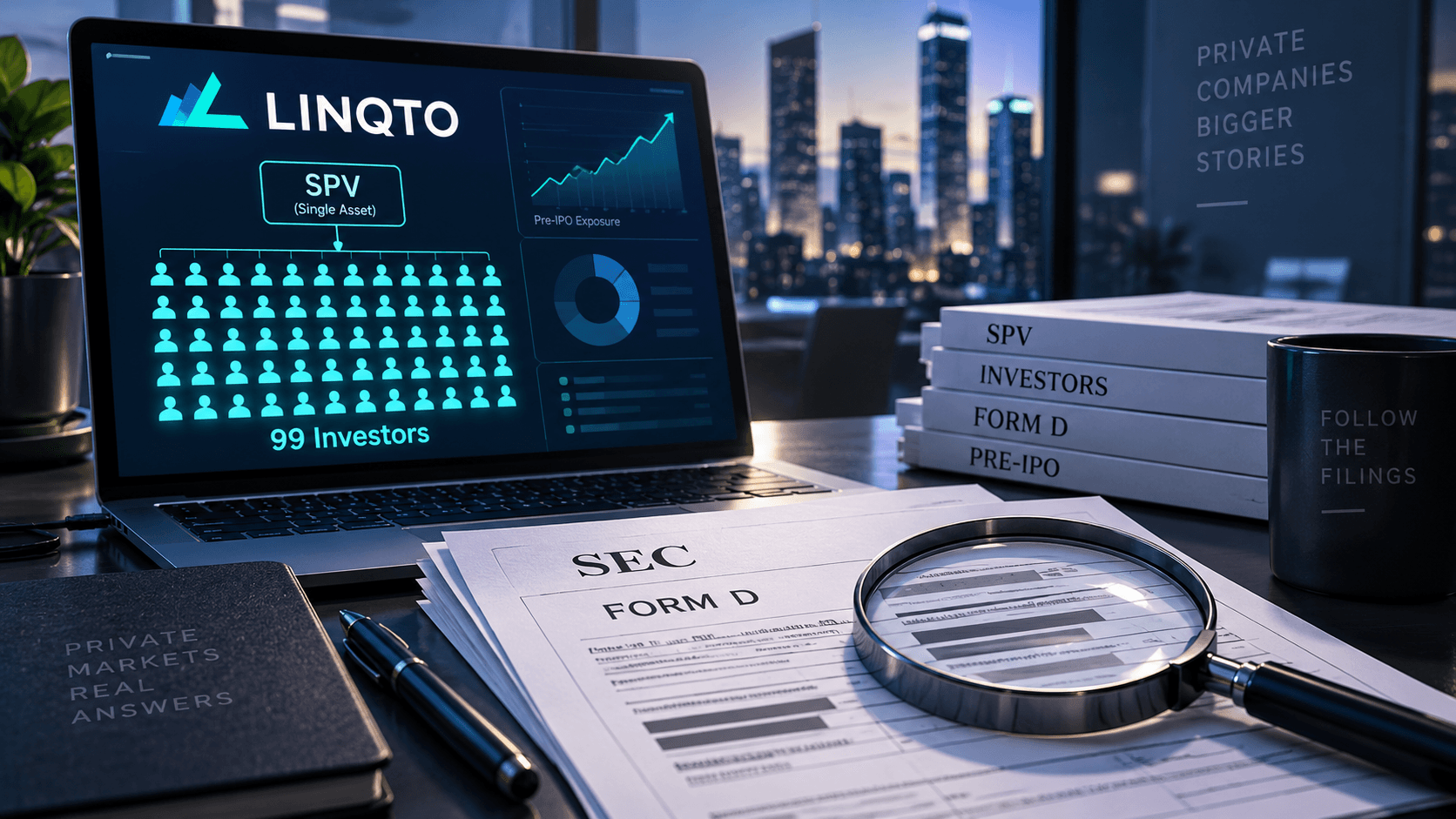
The 99-Investor Pattern: What 1,231 Linqto Filings Show
Across 1,231 Linqto Form D filings covering 546 SPVs, no offering ever reported 100 investors. What the 99-investor pattern does, and does not, show.

How to Audit a Pre-IPO SPV Using SEC Filings: The Linqto Case Study
Five structural signals you can check on EDGAR before buying a pre-IPO SPV, worked through 1,231 Linqto Form D filings: investor-count patterns, amendment histories, which entity actually transacts, embedded pricing, and filing recency.

The Insider's Guide to the Secondary Market: Accessing Pre-IPO Innovation
Get into unicorns before IPO. Learn how secondary marketplaces, employee liquidity, and late-stage equity open access to the $100B private markets.
The Innovation Premium: Why Public Markets Now Miss the Growth Phase
The real growth now happens before IPO. See how $26T in private capital and secondary markets shift returns to early private investors.

How Accredited Investors Actually Buy Pre-IPO Shares: The Complete Technical Workflow from Sourcing to Settlement
Learn how to source, structure, price, and close pre-IPO share deals—SPVs vs direct purchases, ROFR navigation, 409A valuation analysis, and post-IPO exit strategy.
Start with the guide
Accessing Secondary & Pre-IPO Markets
Start with Established Marketplaces
EquityZen and Forge offer secondary shares in 300+ private companies (Stripe, SpaceX, Databricks, Discord). Minimums $10K-$100K. Due diligence: Revenue growth, burn rate, competitive position. Transactions take 3-6 months (legal, compliance). Accredited investors only. Diversify across 3-5 companies.
Explore Pre-IPO Funds
SharesPost funds offer diversified pre-IPO portfolios (20-30 companies). Minimum $2,500 (SharesPost) to $25K (others). Target 15-25% IRR. 3-5 year fund life. Professional selection reduces single-company risk. Some quarterly liquidity via secondary sales. Lower minimums than direct purchases.
Understand Valuation Risk
Secondary shares trade at 10-40% discount to last primary round (409A valuation). But if company down-rounds or IPO below valuation, losses significant. Stripe $95B valuation (2021), $50B (2023) = -47%. Assess valuation relative to public comparables (revenue multiples, growth rates).
Assess IPO Timing and Lock-Ups
Average time to liquidity: 2-3 years. IPO lock-ups add 6 months. If IPO delayed (market conditions, company readiness), capital tied up longer. Secondary shares often have 12-month transfer restrictions. Factor illiquidity into allocation; recommend <5-10% of portfolio.
Secondary & Pre-IPO Market Risks
Important considerations before investing in secondary startup & pre-ipo markets
- Valuation risk: Companies often overvalued at late-stage; Stripe $95B (2021) → $50B (2023). Down-rounds wipe out returns
- Illiquidity: 1-3 year holds until IPO; no guaranteed exit; if IPO delayed/cancelled, capital tied up indefinitely
- IPO market timing: 2022-2023 IPO window closed; companies delayed listings; secondary buyers faced extended holds
- Information asymmetry: Limited financials available; rely on company presentations (often optimistic); insiders know more
- Lock-up periods: Post-IPO, shares locked 6 months; can't sell even if stock crashes (Rivian IPO: $170 → $15 in 6 months)
- Regulatory risk: SEC scrutiny on secondary markets; changing rules on who can participate and disclosure requirements
- Platform risk: If EquityZen, Forge shuts down, share ownership may be unclear; escrow arrangements critical
- Concentration: Single company = binary outcome; successful companies (Uber, Airbnb) coexist with failures (WeWork)
Due Diligence Checklist
- Verify valuation vs. public comps: Compare revenue multiples to public companies; Stripe 30x revenue vs. public SaaS 8x = overvalued
- Check revenue growth trajectory: Is growth accelerating or decelerating? Late-stage companies slowing <30% growth face down-rounds
- Assess burn rate and runway: How long until profitability or next funding? <18 months runway = dilution risk
- Understand liquidity terms: How long until likely IPO? 2-3 years typical but check market conditions, company readiness
- Review share class: Common shares (employees) vs. preferred (VCs). Common have no liquidation preference; get paid last
- Check transfer restrictions: Most shares have 12-month restrictions; verify you can sell after lock-up expires
- Diversify across 3-5 companies: Single pre-IPO bet = lottery ticket; portfolio approach captures winners, limits individual failures
- Compare to IPO pop: Average IPO pops 20-40% on Day 1; if buying at last private valuation, may be better to wait for IPO
Real-World Examples
Uber secondary (2015): Bought at $50B valuation, IPO 2019 at $75B (+50%), but stock fell to $30B in months. Early secondary buyers: breakeven to slight loss.
Stripe secondary (2021): Bought at $95B valuation. Valuation cut to $50B (2023). Current holders: -47% unrealized loss. Illustrates late-stage valuation risk.
SpaceX secondary (2019): Bought at $46B valuation. Now $180B (2024) = +291%. No liquidity yet (still private) but strong paper gains for patient investors.
EquityZen portfolio study: 50 companies (2015-2023). Median return: +35% over 3 years (10% IRR). Top quartile: +150% (35% IRR). Bottom quartile: -60% (down-rounds/failures).
WeWork secondary (2019): Bought at $47B valuation (pre-IPO). IPO canceled, valuation fell to $2.9B (2020) = -94%. Total loss for late-stage buyers. Extreme failure case.
Advanced Guides
Equitybee vs EquityZen
Compare option-exercise funding claims with SPV-backed secondary share access, including ownership, fees, upside, governance, taxes, and liquidity.
EquityZen vs Forge vs Clarity (formerly Hiive)
Compare the major pre-IPO secondary marketplaces across pricing, minimums, ROFR handling, and investor fit.
StartEngine vs EquityZen
Compare principal-traded Reg D Series with agency-intermediated SPV access, including fees, conflicts, tax timing, and liquidity.
Explore Subcategories
Secondary Share Marketplaces
Platforms like EquityZen, Forge, and Carta that match sellers and buyers of private company shares.
Employee Liquidity & Tender Offers
How employees and early investors get liquidity through tender offers and secondary sales.
Late-Stage Growth Equity Vehicles
Funds and syndicates that specialize in pre-IPO and late-stage growth rounds.
Pre-IPO Pricing & Risk
Valuation, liquidity, and governance risks when investing pre-IPO.