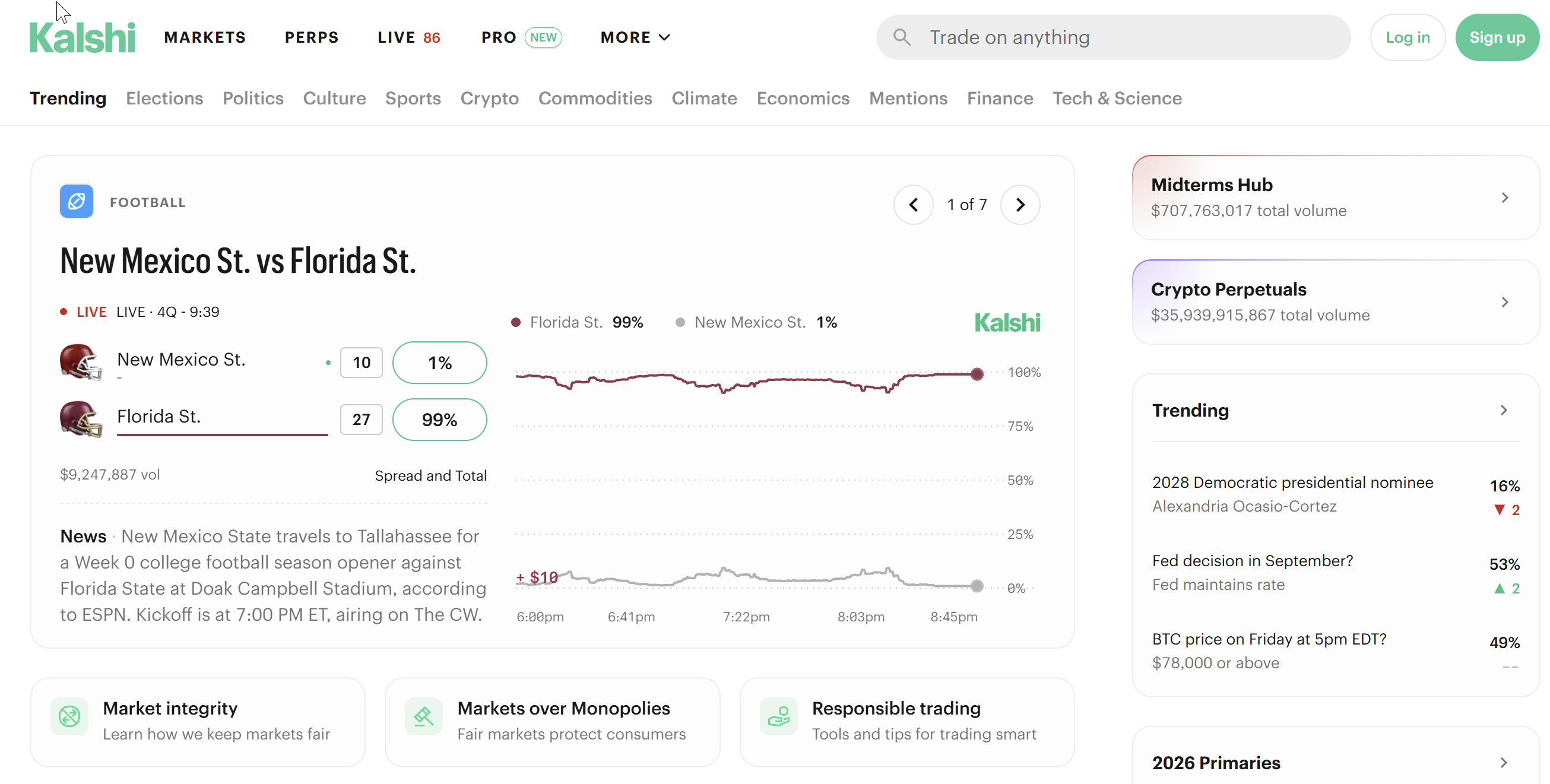
Kalshi
Kalshi is the CFTC-regulated exchange where anyone 18+ can trade binary event contracts on elections, economics, weather, and — controversially — sports, plus leveraged crypto perpetuals since mid-2026. It is a trading venue, not an investment: AltStreet's own 15,685-market study found no exploitable edge after fees, the genuine use case for alternative investors is precision hedging, and the venue itself now sits at the center of the widest unresolved legal fight in retail markets. AltStreet's census of the federal docket record finds 80 matters naming a Kalshi entity across 41 courts and 8 circuits, 55 of them open, and 25 brought by Kalshi itself against state officials.
No platform response on record for this review. Is this your platform? Respond or claim it.
What the data actually shows - TL;DR
Kalshi is the most transparent trading venue in AltStreet's coverage and simultaneously the most legally contested. The plumbing is genuinely excellent: published rulebook and member agreements, fees disclosed to the cent per series, monthly FCM financial statements, a full public data API, and prompt cash settlement.
Read the full assessmentShow less
The economics for traders are exactly what a fee-charging zero-sum market implies — AltStreet's own study of 15,685 markets found every apparent edge dissolved under better data. The honest uses for an alternative-asset investor are narrow and real: precision hedging of rate, inflation, commodity, and event exposure. Around that core sit three things a user must price: a sports-dominated product surface being litigated as unlicensed gambling across 41 federal courts and 8 circuits, with 55 matters open at September 29, 2026 (a federal circuit split formed August 28, 2026); disclosed structural conflicts, including an affiliate that trades on its own exchange and member cash Kalshi may invest without paying interest; and custody that is regulated but explicitly not FDIC-guaranteed to you.
AltStreet tracked 15,685 Kalshi markets against the exchange's public endpoints and analyzed 195 settled contracts: four apparent trading edges all proved to be sampling artifacts. Combined with the fee formula (0.07 × contracts × price × (1 − price), peaking near 1.75 cents at 50-cent prices), the realistic base case for traders is the zero-sum market minus costs.
The Third Circuit ruled for Kalshi in April 2026 (New Jersey); the Ninth Circuit ruled for the states on August 28, 2026 (Nevada, potentially reviving Arizona's criminal charges against KalshiEX). New York's Attorney General sued July 31 seeking statutory penalties. Nothing is finally adjudicated, the CFTC actively backs Kalshi with emergency orders, and a Supreme Court test is now the likeliest resolution path.
Disclosed venture capital sold across Kalshi Inc.'s five Form D filings from October 2025 through the August 25, 2026 filing ($1.12 billion sold of $1.5 billion offered to 71 investors) — after raising just $36 million in 2020-2021. The company publishes no financial statements; the Form Ds are the entire public record of its capitalization.
Maximum leverage on Kalshi's crypto perpetual futures, launched June 2026 through affiliate FCM Kalshi Prime — BTC and ETH perps showed over $100 million each in 24-hour volume at capture. Customer funds at the FCM went from zero (May) to $20.0 million (July 31) per its filed monthly statements. A leveraged derivatives product is a different risk class from binary event contracts, on the same login.
Kalshi's own FAQ advertises an 18+ minimum age (versus sportsbooks' 21+) as a feature of the federal regime — while New York's suit alleges failures to keep out bettors under 21. Both positions are documented; which body of law controls is precisely what the courts are deciding.
Financial data: Kalshi Prime's six monthly 1-FR-FCM statements (Feb-Jul 2026) and Kalshi Inc.'s seven Form D filings are ingested into AltStreet's data layer; market-quality figures come from AltStreet's published microstructure study (its own collection, not Kalshi's marketing). Notional-volume totals ($23.8 billion processed) are platform-reported. Legal matters are pending unless stated otherwise; status as of August 30, 2026.
Quick Verdict
Is this platform right for you?
Kalshi runs the most transparent venue plumbing AltStreet has reviewed — published rulebook, per-series fees, monthly FCM financials, full API, clean settlement record — wrapped around products whose legality is the most contested question in US retail markets, with a federal circuit split as of August 28, 2026. It is not an investment: AltStreet's own 15,685-market study found no exploitable trading edge, and the disclosed structure (affiliate market maker, uncompensated float, capped liability) prices the venue in the house's favor beyond the stated fee.
Read the full assessmentShow less
The defensible use for this site's audience is narrow and real — precision hedging of rate, inflation, commodity, and weather exposure with defined maximum loss. The sports surface, the parlays, and the new 6.1x perps are a different proposition: speculation on a venue whose right to offer them is being decided across 41 federal courts at once, in a record where Kalshi is the plaintiff in 25 of 80 matters.
Best for
- Hedgers offsetting specific rate, CPI, commodity, or weather exposures with defined-risk contracts
- Researchers and data users — the API is open and the market data is genuinely excellent
- Traders who want US-regulated, KYC'd, segregated infrastructure instead of offshore books, and who price the trade as entertainment
- Readers of terms: the member agreements disclose nearly everything this review flags
Avoid if
- You are looking for an investment, yield, or a durable trading edge
- You live in a state actively litigating or prosecuting event contracts and cannot tolerate mid-position disruption
- You need deposit-insurance certainty on cash balances
- You would trade sports or parlays at stakes that matter, or perps with money you cannot lose entirely
Top strengths
- Venue transparency without peer in this coverage: rulebook, member agreements, per-series fee schedule, product certifications, monthly FCM financials, open API
- Real federal regulation: DCM/DCO/FCM registrations, segregation rules, surveillance obligations — and a clean located settlement record
- Fully collateralized event contracts: maximum loss defined at entry, no margin calls on the core product
- Genuine hedging utility in the economics, rates, commodity, and weather markets
- Independently verifiable: AltStreet ran its own 15,685-market collection against the public endpoints
Key limitations
- Legality unresolved: 80 federal dockets, 55 open, across 41 courts and 8 circuits; circuit split (Aug 28, 2026), state criminal charges, AG suits, tribal claims, and 25 matters Kalshi brought itself
- Zero-sum economics with no located edge; absent one, directional trading carries a negative expected return after fees and execution costs
- Structural conflicts: affiliate trading member, undisclosed market-maker economics, member float invested without compensation
- Custody is omnibus with FDIC pass-through explicitly 'not guaranteed to you'; no SIPC
- No corporate financial disclosure despite ~$2.4B raised; product mix migrating toward its most contested segments
Quick Answers
What most investors want to know first
The highest-signal facts first: minimums, liquidity reality, K-1 timing, and whether distributions are actually part of the experience.
Liquidity
Kalshi IS the secondary market — a continuous central limit order book, which is more genuine liquidity than nearly anything else AltStreet covers. The honest caveats: the bid-ask spread is the real cost and AltStreet measured it wide outside headline markets; volume concentrates heavily in a small share of markets; and hedges needing mid-stream unwinds depend on depth being there when needed.
K-1 Timing
No K-1s. Kalshi provides year-end tax documentation for trading results; the ordinary-versus-1256 character question is unsettled (see Tax Treatment) and worth resolving with an adviser before active trading.
Distributions
No distributions exist. Contracts settle in cash at resolution — typically promptly after the outcome source publishes — and proceeds land in the member account for withdrawal or reuse.
Overview
Platform Overview
A concise read on what the platform is, how the structure works, and where the practical friction shows up for real investors.
Kalshi Inc. (Delaware, CIK 0001806928; founded 2018 by MIT graduates Tarek Mansour and Luana Lopes Lara) operates a family of CFTC-registered entities: KalshiEX LLC, a designated contract market since 2020; Kalshi Klear LLC, its affiliated clearinghouse (DCO registration August 28, 2024); Kalshi Prime LLC, an FCM (NFA ID 0574784) that intermediates its margined products; and Kalshi Trading LLC, an affiliate approved by Kalshi's own board to trade on the exchange. The core product is the binary event contract: a yes/no position priced between $0.01 and $0.99 that settles at $1 or $0 when an outcome resolves — across elections, economics (CPI, Fed decisions, recession), weather, culture, crypto prices, 'mention' markets, and, since January 2025, sports, which now dominates the visible product surface along with parlay-style combos. In June 2026 Kalshi added leveraged crypto perpetual futures (BTC to 6.1x, ETH 4.7x, SOL, XRP, HYPE) with 8-hour funding and 3.25% interest on perps margin cash.
Anyone in the US aged 18+ can trade after KYC; event contracts are restricted in roughly fifty foreign jurisdictions including Canada, the UK, France, and Australia. Fees follow a published per-series schedule (taker fee 0.07 × C × P × (1 − P)); member cash sits in Klear's omnibus settlement account at Silicon Valley Bank, a division of First Citizens Bank, with an insured cash sweep whose limits Kalshi's own agreement discloses — including that FDIC insurance 'is not guaranteed to you.' Distribution runs far beyond kalshi.com: Robinhood, Webull, and Coinbase route event-contract order flow to KalshiEX. Kalshi is a venue, not an investment: nothing here pays yield, accrues value, or represents a claim on anything — every position is a priced bet against another trader, minus fees.
The history since is three escalations. First, products: from cautious economics and weather markets to elections (won in court in 2024 after the CFTC's 2023 disapproval was overturned, with the agency dropping its appeal in May 2025), then sports event contracts nationally from January 2025 via self-certification, parlay-style combos, and in June 2026 leveraged crypto perpetuals through affiliate FCM Kalshi Prime — whose filed monthly statements show customer funds going from zero (May 2026) to $20.0 million (July 31). Second, capital: after raising $36 million total in 2020-2021, Kalshi's Form Ds disclose roughly $2.4 billion sold from October 2025 through the August 25, 2026 filing ($1.12 billion of a $1.5 billion offering, 71 investors) — while an ecosystem of pre-IPO SPVs (six Hiive series among them) resells its equity at $50,000 minimums.
Third, law: sports contracts triggered cease-and-desists, then suits, in a dozen-plus states; Arizona filed criminal charges in March 2026; New York's Attorney General sued July 31, 2026; three tribal coalitions sued under IGRA including a civil RICO count; the Third Circuit ruled for Kalshi in April 2026 and the Ninth Circuit ruled for the states on August 28, 2026; and the CFTC has twice used emergency authority on Kalshi's behalf — ordering Michigan-voided trades honored (July 14) and directing the exchange to keep operating against New York (August 11). Distribution now runs through Robinhood, Webull, and Coinbase. The venue's plumbing — published rulebook, per-series fees, monthly FCM financials, full API, prompt settlement — is the most transparent in AltStreet's coverage. What it sells, and where, is the least settled question in US retail markets.
Founded & Structure
Founded 2018; Kalshi Inc. (Delaware, CIK 0001806928) parent. Regulated entities: KalshiEX LLC (CFTC-designated contract market, 2020), Kalshi Klear LLC (derivatives clearing organization, registered August 28, 2024), Kalshi Prime LLC (FCM, NFA 0574784). Kalshi Trading LLC is a board-approved affiliate member of the exchange. Founders Tarek Mansour (CEO) and Luana Lopes Lara; Y Combinator W19; HQ New York.
Platform Scale
Platform-reported: $23.8 billion in notional volume processed (per Kalshi figures cited in AltStreet's study); roughly 8,000 open event 'series' with tens of thousands of auto-generated market shards. Filed: Kalshi Prime customer segregated funds $19.98M at July 31, 2026 (perps side, from $0 in May); adjusted net capital $48.2M. Venture record: ~$2.46B disclosed sold across seven Form Ds (2020-2026).
Products
Binary event contracts ($0.01-$0.99, settle at $0/$1): elections, politics, economics (CPI, Fed, recession), weather, crypto prices, culture, 'mentions,' and sports (the dominant visible surface). Parlay-style combos. Crypto perpetual futures since June 2026: BTC (6.1x max leverage), ETH (4.7x), SOL, XRP, HYPE, with 8-hour funding. Kalshi Pro tier, institutional arm, and a public trading API.
Eligibility
US individuals 18+ after KYC (identity, SSN, address); no accreditation requirement and no pattern-day-trading rules. Event contracts are restricted in ~50 foreign jurisdictions including Canada, the UK, France, Italy, Australia, India, China, and Singapore — effectively a US-market product. The 18+ minimum (vs sportsbooks' 21+) is advertised by Kalshi as a feature and attacked in New York's suit.
Fees
Published per-series schedule. Standard taker fee: 0.07 × contracts × price × (1 − price), rounded up to the cent — peaking near 1.75 cents per contract at 50-cent prices, with a one-cent-per-order floor that penalizes small low-price orders. Maker fees on 156 non-standard series ($0.02-$0.44 per 100); combos charge makers half the taker rate; some promotional series are fee-free. Perps: 8-hour funding paid between traders; margin cash earns 3.25% (with $250 average balance). The real trading cost — bid-ask spread — is structural and often larger than the fee.
Custody & Clearing
Self-cleared: KalshiEX clears through affiliated DCO Kalshi Klear. Member funds sit in Klear's omnibus settlement account at Silicon Valley Bank, a division of First Citizens Bank, with an IntraFi Insured Cash Sweep. Disclosed limits, verbatim: the account is not in your name, so 'FDIC insurance is not guaranteed to you'; sweep eligibility may lag two business days; FCM customers' funds may not be sweep-eligible. No SIPC. Event-contract positions are fully collateralized (no leverage); perps margin runs through Kalshi Prime.
Member Terms Worth Knowing
Kalshi may invest member cash without notice under CFTC Reg 1.25 (members earn nothing on event-side balances); liability is capped at the lesser of the disputed purchase or total deposits; Klear amendments are automatically effective within 10 days unless you stop trading and close accounts; ACH deposits are withdrawable only to the source account for 90 days; members grant a perpetual license to their trading data; disputes go to arbitration.
Market Quality (AltStreet-measured)
From AltStreet's published study — its own collection against Kalshi's public endpoints, not platform marketing: 15,685 markets tracked; 195 settled contracts analyzed; four apparent trading edges all proved to be sampling artifacts; sample prices were consistent with reasonable calibration; spreads are wide outside headline markets and volume is heavily concentrated. Independent academic work on 300,000+ contracts (Burgi, Deng, Whelan) reports low-price contracts underperform after fees — a favorite-longshot pattern our smaller sample lacked power to confirm or refute.
Tax Treatment
Event-contract gains are taxable; Kalshi provides year-end tax documents, and the correct character of event-contract gains (ordinary income versus Section 1256 60/40 futures treatment) is unsettled among practitioners — the contracts are CFTC-regulated but their 1256 status has not been definitively resolved. Consult a tax adviser, particularly before large or perps positions.
Should You Use Kalshi?
Consider it if||you have a specific exposure the economics, rates, commodity, or weather markets can hedge with defined maximum loss; you treat any directional trading as entertainment priced at spread-plus-fees; you understand the money sits in an omnibus account without guaranteed FDIC pass-through; and you accept that your state may contest the product's legality mid-position.||Avoid it if||you are looking for an investment, income, or an 'edge' (AltStreet's own data found none); you would trade the sports or parlay products in a state actively litigating them; you cannot tolerate funds or positions being frozen or disputed during jurisdictional fights; or you would use 6x leveraged perps as anything but high-risk speculation.
Regulatory Snapshot (August 30, 2026 — changes quickly)
For Kalshi: CFTC designation and active support (emergency orders July 14 and August 11, 2026; affirmative suits against states); Third Circuit ruling in its favor (April 2026); trial-level wins in New Jersey, Tennessee, Minnesota. Against: Ninth Circuit ruled for the states August 28, 2026; Arizona criminal charges (March 2026); New York AG suit (July 31, 2026); adverse trial-level outcomes in Maryland, Nevada, Ohio, Wisconsin; tribal suits including civil RICO; private gambling-loss recovery actions. Nothing finally adjudicated; a Supreme Court test is the likely endgame.
The Pre-IPO Ecosystem
Kalshi equity is among the most active pre-IPO names in AltStreet's tracked universe: six Hiive institutional SPVs in 2026 alone (roughly $33M offered at $50K minimums), plus SPVs from SC, Soma Capital, Latitude Ventures, and Team Ignite. Buying those is investing in Kalshi the company — a venture bet on the venue's growth and legal survival — and is an entirely different decision from trading on the venue, evaluated under AltStreet's pre-IPO coverage, not this review.
Investor Operations
The practical questions investors actually care about: when tax documents arrive, how cash distributions work, and whether capital can be exited before the underlying asset is sold.
Tax Documents
K-1 Timing
What to expect
No K-1s. Kalshi provides year-end tax documentation for trading results; the ordinary-versus-1256 character question is unsettled (see Tax Treatment) and worth resolving with an adviser before active trading.
Delay signals
- Not applicable — no partnership reporting exists.
- Active traders should maintain their own trade log; the API makes complete records exportable.
Extension risk
Not applicable.
Confidence: High
Cash Flow
Distributions
Timing
No distributions exist. Contracts settle in cash at resolution — typically promptly after the outcome source publishes — and proceeds land in the member account for withdrawal or reuse.
Consistency
Settlement reliability is the venue's genuine strength: AltStreet located no missed or failed settlement across its own 15,685-market collection or the public record. The Michigan episode (trades ordered voided by a state court, ordered honored by the CFTC) is the one located case of settlement caught in a legal crossfire — resolved, for now, in members' favor.
Confidence: High
Liquidity
Exit Reality
Holding period
None. Positions can be closed at market any time the order book is open (early close costs the spread); withdrawals via ACH, with deposits locked to withdrawal-to-source for their first 90 days.
Exit options
- Sell any position back into the order book at the prevailing bid — venue liquidity is continuous but varies enormously by market; headline markets are deep, the long tail is thin.
- Hold to settlement: cash at $1 or $0, promptly after resolution.
- Withdraw cash by ACH (90-day source-account rule on fresh deposits).
- Perps: close at market or be closed by liquidation — a materially different exit profile than binary contracts.
Secondary market
Kalshi IS the secondary market — a continuous central limit order book, which is more genuine liquidity than nearly anything else AltStreet covers. The honest caveats: the bid-ask spread is the real cost and AltStreet measured it wide outside headline markets; volume concentrates heavily in a small share of markets; and hedges needing mid-stream unwinds depend on depth being there when needed.
Confidence: High
Investment Structures
Kalshi offers no investments. Its products are trading instruments: binary event contracts (yes/no positions priced $0.01-$0.99, settling at $1 or $0, fully collateralized so maximum loss is defined at entry) across economics, weather, elections, culture, crypto, and — dominantly — sports; parlay-style combos; and, since June 2026, leveraged crypto perpetual futures (BTC to 6.1x, ETH 4.7x, SOL, XRP, HYPE) with 8-hour funding, margined through affiliate FCM Kalshi Prime. Nothing pays yield, accrues value, or represents a claim on an asset: every contract is a priced position against another trader, minus published fees, and AltStreet's own 15,685-market study found no exploitable edge after those fees. The defensible use for this site's audience is precision hedging in the economics, rates, commodity, and weather markets; everything else on the venue is speculation and should be priced as entertainment.
- Event contracts: defined-risk yes/no positions, fully collateralized at Kalshi Klear; taker fee 0.07 × C × P × (1 − P), maker fees on 156 non-standard series; usable as hedges, zero-sum as trades.
- Combos: multi-leg parlay-style contracts (mostly sports), makers charged half the taker rate — the segment state gambling regulators target most directly.
- Crypto perpetuals (June 2026): up to 6.1x leverage, 8-hour funding, 3.25% interest on margin cash, liquidation risk — a different risk class entirely; FCM customer funds went $0 → $20.0M in two months per filed statements.
- Pro, API, and market-maker programs: rebates, revenue share, and tools that Kalshi's own member agreement says 'may give market makers a trading advantage over members who are not market makers' — assume the other side of your trade has better economics.
- Kalshi equity itself trades separately as a pre-IPO name through SPVs (six Hiive series in 2026) — a venture investment decision outside this review's scope.
Risk
Risk Structure
This is where the marketplace pitch gives way to the actual operating reality: delayed exits, limited disclosure, fee drag, and path-dependent outcomes.
Legality is unresolved where you live
The central risk. Kalshi's position — CFTC-regulated derivatives preempt state gambling law — has won at the Third Circuit and lost at the Ninth (August 28, 2026), with trial courts split roughly down the middle, Arizona pursuing criminal charges against the exchange, New York's AG seeking statutory penalties, and tribal courts and compacts adding a separate federal lane. The CFTC's emergency orders protect continuity today and are themselves contested as overreach. Users in litigating states have already experienced real consequences: Michigan residents' trades were ordered voided by a state court and ordered honored by the CFTC within the same week.
Custody: regulated, omnibus, and not guaranteed to you
Member cash sits in Klear's omnibus account at SVB/First Citizens with an insured cash sweep. Kalshi's own agreement discloses that FDIC insurance 'is not guaranteed to you' because the account is not in your name, that sweep eligibility can lag two business days, and that FCM customers' funds may not be sweep-eligible. CFTC segregation rules — not deposit insurance — are the real protection, and the FCM's filed statements currently show healthy excess ($6.0M over the July requirement). No SIPC applies.
The house's structural take extends beyond fees
Disclosed but easy to miss: Kalshi may invest member cash without notice and keep the return (event-side balances pay members nothing; the perps side pays 3.25%, making the asymmetry explicit); market makers — including affiliate Kalshi Trading LLC — receive undisclosed rebates and fee revenue-share plus tools the agreement concedes may confer 'a trading advantage'; and the one-cent round-up floor makes small low-price orders disproportionately expensive.
Zero-sum economics with no located edge
AltStreet's study is the empirical anchor: 15,685 markets tracked, 195 settled contracts analyzed, four apparent edges all dissolved as sampling artifacts, prices consistent with reasonable calibration. Academic work on larger samples finds low-price contracts underperform after fees. Absent a durable informational or structural edge, the appropriate baseline expectation for any directional trader is a zero-sum payoff before transaction costs and a negative expected return after fees and execution costs.
Leverage arrived in June 2026
Perpetuals add liquidation risk, funding costs, and up to 6.1x leverage to a venue whose core product had none — through a three-month-old self-cleared FCM lane growing from $0 to $20M of customer funds in two months. The event-contract side's full-collateralization safety story does not extend to perps, and both live behind one login and one balance.
Concentrated, integrated, and privately opaque
One private company owns the exchange, the clearinghouse, the FCM, and a trading member, publishes no financial statements, and has raised roughly $2.4 billion in twelve months against undisclosed burn — while fighting simultaneous legal battles in federal circuits, state courts (civil and criminal), and tribal forums. The venue's operational record is clean; its corporate opacity means users extend it more trust than its disclosures earn.
Regulatory & Legal Posture
Security Status
Not securities. Event contracts are CFTC-jurisdiction derivatives — Kalshi's own compliance materials describe them as 'swaps whose payout is dictated by discrete event occurrences' — traded on a designated contract market (KalshiEX, 2020), cleared by a registered DCO (Kalshi Klear, August 28, 2024), with margined products intermediated by a registered FCM (Kalshi Prime, NFA 0574784). No SEC registration or SIPC coverage applies; whether state gambling law also reaches the sports contracts is the contested question.
The federal framework is genuine: DCM core principles (surveillance, financial integrity, manipulation-resistant contracts), quarterly financial-resource reporting to the CFTC, monthly public FCM statements, KYC/AML programs, and a public rulebook with product certifications. Kalshi won the definitive federal fight over election contracts (D.D.C. 2024; CFTC appeal dropped May 2025) and expanded to sports via self-certification in January 2025 — the step that triggered the state war. AltStreet located no CFTC enforcement action against any Kalshi entity; the pending state and tribal actions are unadjudicated.
Disclosure Quality
Venue-level disclosure is the best in AltStreet's coverage: rulebook, member agreements, per-series fee schedule, product certifications, regulatory notices, monthly FCM financials, and a full public data API. Corporate-level disclosure is near-zero: no financial statements, no published board or audit information, undisclosed market-maker and affiliate economics. The FAQ's sportsbook-comparison table advertising 18+ access is accurate about the federal regime and is Exhibit A in the state cases.
Custody Model
Self-cleared omnibus custody: member funds in Kalshi Klear's settlement account at Silicon Valley Bank (a division of First Citizens Bank) with IntraFi Insured Cash Sweep; event-contract positions fully collateralized at the DCO; perps margin held at FCM Kalshi Prime under CFTC segregation rules (filed monthly, currently in excess).
Regulatory Backing
CFTC segregation and DCO/FCM rules govern — not FDIC pass-through (explicitly 'not guaranteed to you' per Klear's agreement) and not SIPC. The protections are real and regulatory, not insurance-based; they have not been tested by a Kalshi-side failure, and the Michigan episode showed positions can be contested between sovereigns even while custody functions normally.
Tax Treatment
Account Suitability
Taxable
The only realistic account type. Gains are taxable; Kalshi provides year-end tax documents. The unsettled question is character: whether event contracts qualify for Section 1256's 60/40 treatment as exchange-traded contracts or produce ordinary income is debated among practitioners and not definitively resolved — the difference is material for active traders. Keep records independently; consult a tax adviser before scale.
Roth IRA
Generally unavailable and unsuitable: standard custodians do not support event-contract trading, and wagering-shaped, zero-sum positions are a poor use of tax-advantaged space even where a self-directed structure could technically reach them.
Traditional IRA
Same as Roth: effectively unavailable, and unsuitable in any case.
HSA
Not suitable.
Before You Invest
Get Kalshi investor insights before you invest
K-1 timing, distribution updates, yield insights, and risk signals for Kalshi and similar platforms.
- Weekly platform research focused on tax timing and liquidity reality.
- Signals on distributions, risks, and structural tradeoffs before capital is locked up.
- Coverage of adjacent platforms so you can compare better options faster.
Get weekly platform signals
Track fee changes, liquidity updates, risk flags, and adjacent platforms before you invest.
Independent intelligence from AltStreet. No hype. No sponsor spin.
AltStreet Data Layer
What the data actually shows
AltStreet holds three independent Kalshi datasets: its own 15,685-market microstructure collection, the ingested Kalshi Prime FCM monthly series, and the complete Form D record. Key findings:
We went looking for an edge and found measurement artifacts
Across 15,685 tracked markets and 195 analyzed settled contracts, four apparent trading edges — the kind that launch a thousand strategy threads — each dissolved when tested against better data: sampling artifacts, not alpha. Prices in the sample were consistent with reasonable calibration.
What this means
Absent a durable informational or structural edge, the rational prior for directional trading on Kalshi is a zero-sum payoff before transaction costs and a negative expected return after fees and execution costs. Larger academic samples (300,000+ contracts) additionally find low-price contracts underperform after fees — our sample lacked the power to confirm it, which is not evidence against it.
The FCM series dates the perps launch — and shows its speed
Kalshi Prime's filed monthly statements show customer segregated funds of exactly $0 from February through May 2026, then $17.77M at June 30 and $19.98M at July 31 — against net capital of $48.2M and a $1M requirement.
What this means
The leveraged-perpetuals lane went from nonexistent to $20M of customer money in two months, well-capitalized and fully compliant on its filings — and entirely new. Growth this fast in a margin product during a legal war is the risk surface to watch, and the monthly statements make it watchable.
$2.4 billion raised; zero financial statements
Five Form Ds from October 2025 through August 25, 2026 disclose roughly $2.43 billion sold (including $1.12 billion in the newest filing, to 71 investors) after just $36 million total in 2020-2021. No Kalshi Inc. financial statement, annual report, or audited figure is published anywhere.
What this means
The market is pricing Kalshi's equity on private information and press-reported valuations while the venue's own members get Form D cover pages. The capital confirms substantial institutional demand for Kalshi equity; it discloses nothing about unit economics or the cost of the litigation.
The fee system quietly became per-series
The elegant single formula now coexists with 156 series on non-standard terms across a 16-page schedule: maker fees on some, zero fees on others, special combo splits — all published, none summarized.
What this means
Effective trading costs now depend on which series you trade. The transparency is intact; the simplicity is gone, and cost-sensitive users must check the schedule per market.
Kalshi equity is a top pre-IPO name in our own tracked universe
Six Hiive institutional SPVs formed on Kalshi equity in 2026 alone (roughly $33M offered at $50K minimums), alongside SPVs from Soma Capital, SC, Latitude Ventures, and Team Ignite — all visible in the Form D record AltStreet tracks.
What this means
Retail-adjacent demand for Kalshi exposure now runs through two entirely different doors: trading on the venue and buying its equity. The second is a venture bet on the first surviving its docket — different risk, different diligence, different review.
Kalshi in AltStreet's live markets pipeline
AltStreet's prediction-market activity series carries Kalshi as open-event breadth (roughly 8,000 open event series; the tens of thousands of raw 'markets' are overwhelmingly auto-generated shards), because the exchange's published 24-hour volume field returns zero and its open interest is denominated in contracts — API characteristics AltStreet documents rather than papering over.
What this means
Even measuring Kalshi's scale requires methodology choices; headline 'market count' comparisons across venues are mostly artifacts of sharding. Breadth, not raw counts, is the comparable statistic.
Data as of 2026-09-16 . AltStreet review evidence layer . Public-source analysis
Full datasetDecision Fit
Investor Fit
Who this works for, who it does not, and what level of patience and complexity tolerance the platform really demands.
Alternative-asset investors hedging specific exposures
The one genuinely strong use case. Fed-decision, CPI, recession, commodity, and weather markets can offset real exposures inside alternative portfolios — a floating-rate liability, an inflation-sensitive cost, weather-dependent assets — with defined maximum loss and full collateralization. Verify depth in your specific market before relying on it, size as insurance rather than position, and know your state's litigation posture.
Traders looking for an edge in prediction markets
AltStreet ran this experiment so you don't have to: 15,685 markets tracked, four apparent edges, all sampling artifacts. Larger academic samples find low-price contracts underperform after fees. Against a fee formula, a spread, and market makers with better economics and tools, the rational expectation for directional trading is negative.
Sports bettors drawn by the exchange model or 18+ access
The sports and combo products are exactly what a dozen-plus states, three tribal coalitions, and one criminal prosecution are contesting, and users in Michigan and Nevada have already experienced trades voided or products withdrawn mid-stream. Whatever the courts ultimately decide about their legal classification, these contracts retain wagering-like zero-sum economics and should be sized accordingly.
Investors considering the pre-IPO SPVs (Hiive and others)
Buying Kalshi equity through SPVs is a venture bet on the company surviving its legal war and growing into a reported multi-billion valuation supported only by press accounts — the Form Ds disclose amounts, not terms. Evaluate under pre-IPO discipline (AltStreet's Hiive review covers the wrapper); this review's venue analysis is context, not a recommendation either way.
Crypto traders eyeing the perpetuals
A US-regulated perps venue is genuinely novel, and 6.1x leverage with 8-hour funding is still 6.1x leverage: liquidation-bearing speculation through a self-cleared FCM lane that is three months old. If used at all, treat as high-risk speculation with money whose total loss is acceptable — the regulated wrapper changes the counterparty, not the risk class.
Income and yield seekers
Nothing on Kalshi produces income. Event contracts are zero-sum transfers; even the 3.25% perps margin interest exists to attract leverage traders. Any pitch framing prediction markets as an income strategy is describing gambling with a rate attached.
Tradeoffs
Key Tradeoffs
The attraction of pre-IPO access is real, but every benefit comes bundled with a corresponding liquidity, transparency, or pricing cost.
Best-in-coverage plumbing vs least-settled legality
No platform AltStreet covers publishes more about how its venue works — and no platform's right to sell its main product where you live is more actively contested. Both facts are load-bearing; neither cancels the other.
Federal shield vs federal dependence
The CFTC's emergency orders are real protection — and they make the venue's operating continuity a function of one agency's posture, currently contested at the circuit level and reversible with an administration.
Defined-risk contracts vs undefined-risk jurisdiction
A binary contract's maximum loss is known to the penny; whether a state court voids, freezes, or penalizes the activity around it is not. Michigan proved the contract can perform while the legal ground moves.
Transparent fees vs opaque counterparties
You can compute your fee to the cent before trading; you cannot know the rebates, revenue share, or tooling of the market maker — possibly Kalshi's own affiliate — on the other side.
Hedging tool vs gambling surface
The same login that hedges CPI exposure offers NFL parlays and 15-minute bitcoin bets. The venue's defensibility and its growth engine are different products, and the growth engine is winning the homepage.
Avoid
Who This Is Not For
This section should be read as a filter, not an afterthought. If you need income, simplicity, or near-term access to capital, the structure is working against you.
Anyone treating Kalshi as an investment
Kalshi's contracts are not investments in productive assets: they create no ownership interest, contractual yield, or claim on operating cash flows. They are zero-sum derivative positions settling at $0 or $1 — and the house charges fees, invests your idle cash for its own account, and grants its market makers better economics than you.
Traders who believe they've found an edge
AltStreet tracked 15,685 markets looking for exactly that and found sampling artifacts. Assume the edge is the spread and fee you pay, not the one you collect.
Residents of states actively litigating event contracts
Michigan users saw trades ordered voided; Nevada users saw partner products withdrawn; Arizona is prosecuting criminally. The CFTC's protection has held so far — and 'so far' is the operative phrase in a live circuit split.
Under-21 users on the sports products
Kalshi's 18+ access is lawful under the federal regime it operates in and is the specific target of New York's suit. Wherever that lands, sports wagering economics at 18 are a poor idea independent of the litigation.
Anyone needing deposit insurance certainty
Kalshi's own agreement says FDIC insurance 'is not guaranteed to you' — the omnibus account is not in your name, and no SIPC applies. The protection is CFTC segregation, which is real and is not insurance.
Leverage-seekers using perps as a portfolio strategy
6.1x leveraged crypto exposure with 8-hour funding through a three-month-old self-cleared FCM lane is speculation, full stop. The regulated wrapper does not change the arithmetic of liquidation.
Editorial View
AltStreet Perspective
The compressed version of the review: what matters, what marketing tends to obscure, and how we would frame the platform for a serious allocator.
Verdict
A genuinely well-built regulated venue whose best products are hedging tools, whose growth products look economically more like wagering and leveraged speculation than portfolio investment, and whose fate now belongs to the courts — reviewed here as infrastructure, because nothing on it is an investment in a productive asset
Positioning
Kalshi forces a category question AltStreet's other reviews don't: how do you evaluate a platform where the product is a market itself? The answer this review takes is to judge it as infrastructure — and as infrastructure, Kalshi is impressive. The rulebook, fee schedule, member agreements, monthly FCM statements, and open API disclose more about how this venue works than any platform in our coverage discloses about anything; our own study could only be run because the data is public. The settlement record is clean. The economics-and-weather markets deliver something the retail investor otherwise lacks: exchange-traded, defined-risk hedges on macro events. That is the venue worth defending. It is not, however, the venue Kalshi is building fastest: the homepage is sports, the fee schedule's growth is combos, the newest product is 6.1x crypto perps, and the age gate is 18. The state cases exist because the product moved to them, and the honest read of the docket — a circuit split, criminal charges in one state, a federal agency spending emergency authority as a shield — is that nobody, including Kalshi's own regulator, knows where the line will settle. Three things would most change this review: a Supreme Court resolution in either direction; corporate financial disclosure commensurate with the trust the venue asks of its members; and independence between the exchange and the affiliates that clear, margin, and trade on it. Until then: use the hedging markets for what they are, price everything else as entertainment, and keep balances sized to the fact that the money sits in someone else's account at a bank, in a product a dozen sovereigns are still fighting over.
The Bottom Line
The best market plumbing in retail alternatives, selling products the courts haven't decided it can sell — hedge with it, don't invest in it.
Action
Next Steps
If you still want to engage after reading the review, these are the practical next moves that reduce avoidable mistakes.
Decide which Kalshi you're using before funding: the hedging venue (economics, rates, commodities, weather) or the entertainment venue (sports, culture, 15-minute crypto). Size and expectations differ completely.
Read the two member agreements first — Kalshi's and Klear's (both linked from kalshi.com/regulatory). The float, liability-cap, amendment, and FDIC-limitation clauses this review quotes are all there in plain text.
Check your state's current litigation posture before trading sports or combo products; the map changes monthly and Michigan showed positions can be contested mid-stream.
For hedging: check the order book depth in your specific market at your intended size before relying on it — spreads outside headline markets are the real cost.
Compute your fee before trading: 0.07 × contracts × price × (1 − price), rounded up — and remember the one-cent floor punishes small low-price orders.
Keep event-contract cash balances working elsewhere: idle cash earns you nothing and earns Kalshi something.
Treat perps as a separate, speculative product with liquidation risk — not an extension of the defined-risk contracts.
Resolve the tax-character question (ordinary vs Section 1256) with an adviser before scale; keep your own trade records via the API.
Read AltStreet's microstructure study before believing any edge claim — including your own.
Watch the three catalysts: the Supreme Court petition path out of the circuit split, the SDNY/New York proceedings, and any change in CFTC posture — each can change what Kalshi may offer where, quickly.
AltStreet Research Desk
About to invest in Kalshi, or in an offering we haven't covered?
Commission an independent diligence report: the same filing-based analysis behind this review, applied to the specific investment in front of you before you wire the money.
- Built from primary sources: SEC filings, court records, capital structure, and marketing-versus-filings comparison.
- From $750; full reports from $1,495. Fixed price confirmed up front, delivery in 3-5 business days.
- Independent by design: we work for investors and accept no compensation from the companies we cover.
Want this on every new deal, not one? Deal Intelligence sends the alert the day a new offering appears on a covered platform and follows with an analyst-approved investment committee memo.
Deal Intelligence →Appendix
Sources, Disclosures, and Supporting Context
The lower section is structured like a report appendix: relationship context first, adjacent reading second, and evidence last.
Report Appendix
Disclosure
Relationship and compensation context
+
Report Appendix
Disclosure
Relationship and compensation context
Report Appendix
Comparison Guides
Head-to-head guides featuring Kalshi
+
Report Appendix
Comparison Guides
Head-to-head guides featuring Kalshi
Report Appendix
Related Resources
Adjacent platform comparisons, frameworks, and category links
+
Report Appendix
Related Resources
Adjacent platform comparisons, frameworks, and category links
Further Reading
Related Resources
Adjacent frameworks and reviews that help place the platform in a broader allocation or due-diligence context.
Explore Asset Class
Prediction Markets — Binary Event Contracts and Crypto PerpetualsDeep Dive Guide
Prediction Markets & Event Contracts Category HubFrameworks
- ->Kalshi Litigation Map: 80 Federal Dockets and the Entities Named
- ->Polymarket vs Kalshi: The Full Comparison Guide
- ->Polymarket Review (the direct category peer)
- ->AltStreet's Kalshi Microstructure Study (15,685 markets)
- ->Hiive Review (the pre-IPO wrapper for Kalshi equity SPVs)
- ->Alternative Assets Due Diligence
Report Appendix
Related Coverage
AltStreet newsroom articles on Kalshi filings and disclosures
+
Report Appendix
Related Coverage
AltStreet newsroom articles on Kalshi filings and disclosures
- Kalshi Trader Sues Over Unresolved Trump-Trudeau Contract; Judge Denies Emergency Fund-Unfreeze BidOct 8, 2026
Nicolas Pernas alleges KalshiEX, Kalshi Inc., Kalshi Klear and the clearing house that formerly cleared Kalshi contracts, Rothera Exchange and Clearing (formerly LedgerX), refused to honor a resolved event contract and then froze about $24,293 in his account after he complained; his same-day request for emergency relief was denied, the defendants have asked for more time to answer, and nothing has been decided on the merits.
- What Does a First Form D Tell You? Kalshi's $1.12 Billion Filing, ExplainedSep 8, 2026
SEC Form D is a notice, not a review. Kalshi Inc.'s original Form D shows how to read one: the offering ceiling, the amount sold, the exemption, the first-sale date, and who signed it.
Report Appendix
SEC Filers Behind Kalshi
The largest issuers linked to Kalshi on EDGAR, by total reported sold; each page carries the filing record and the related persons
+
Report Appendix
SEC Filers Behind Kalshi
The largest issuers linked to Kalshi on EDGAR, by total reported sold; each page carries the filing record and the related persons
- Kalshi Inc.2020 · $2.5B · 188 investors
Report Appendix
Evidence & Methodology
Sources, scope, and how the review was assembled
+
Report Appendix
Evidence & Methodology
Sources, scope, and how the review was assembled
ASReview Evidence
Methodology
Review synthesized from: (1) primary venue documents — the Kalshi Member Agreement (v1.6, June 22, 2026) and Kalshi Klear Self-Clearing Member Agreement (May 2026), both read in full; the published per-series fee schedule; the regulatory, product-certification, and market-integrity pages; the perpetuals documentation; and Kalshi's compliance FAQ for finance professionals; (2) regulatory filings — Kalshi Prime LLC's monthly CFTC Form 1-FR-FCM statements (February-July 2026), ingested into AltStreet's data layer; CFTC registration orders (DCM 2020; DCO August 28, 2024) and the July 14 and August 11, 2026 CFTC emergency orders; Kalshi Inc.'s complete EDGAR Form D record (seven filings); (3) third-party filings — Robinhood's Q2 2026 Form 10-Q, the most comprehensive public account of the event-contract litigation; (4) AltStreet's own published microstructure study (15,685 markets tracked against public endpoints; 195 settled contracts analyzed); (5) a 102-page Firecrawl capture of kalshi.com (August 29, 2026); (6) court records and attributed press across the state, tribal, and federal proceedings, with both sides carried and pending status stated. Platform-reported figures (notional volume) are labeled as such.
Scope
Corporate and regulated-entity structure; product surface including sports, combos, and the June 2026 perpetuals launch; the complete fee system; custody and clearing mechanics with verbatim agreement terms; member-agreement conflicts (affiliate trading member, market-maker economics, float); market quality from AltStreet's own measurements; the FCM financial series; the venture-capital record; the full legal landscape as of August 30, 2026; tax posture; and the hedging use-case analysis for alternative-asset investors.
Key Findings
- *MEASURED (AltStreet's own study): 15,685 Kalshi markets tracked against public endpoints; 195 settled contracts analyzed; four apparent trading edges all identified as sampling artifacts; prices consistent with reasonable calibration; spreads wide outside headline markets; volume heavily concentrated. Fee formula verified: 0.07 × C × P × (1 − P), rounded up, ~1.75-cent peak at 50-cent prices.
- *CONFIRMED (Kalshi Member Agreement VII.C, verbatim basis): Kalshi's board approved affiliate Kalshi Trading LLC as an exchange member per Rulebook 2.12, disclosed via a September 2021 emergency rule filing. Sections VII.T-U: market makers receive fee discounts, rebates, revenue share, and tools that 'may give market makers a trading advantage over members who are not market makers.'
- *CONFIRMED (Member Agreement VIII): member cash 'may, from time to time, without notice to You, be invested by Kalshi' under CFTC Regulations 22.2(e)(1) and 1.25. No provision paying members interest on event-contract balances was located; the perpetuals side pays 3.25% on margin cash ($250 average balance minimum).
- *CONFIRMED (Klear Agreement IV, verbatim): member funds are held in Klear's settlement account at 'Silicon Valley Bank a Division of First Citizens Bank' with IntraFi Insured Cash Sweep; 'Because Klear's settlement account is not in your name, FDIC insurance is not guaranteed to you'; sweep eligibility may lag two business days; FCM customers' funds may not be sweep-eligible. Full collateralization required for event-contract clearing.
- *CONFIRMED (Kalshi Prime 1-FR-FCM monthly statements, ingested): customer segregated funds $0 (February-May 2026) → $17,765,306 (June 30; required $8,370,057) → $19,979,525 (July 31; required $13,931,562; excess $6,047,963). Adjusted net capital $48,198,682 vs $1,000,000 requirement (July, per kalshi.com/prime). The zero baseline dates the perpetuals launch to June 2026.
- *CONFIRMED (EDGAR): Kalshi Inc. Form Ds — $6,094,999 (2020-03-19, 28 investors); $29,999,999 (2021-02-23, 10); $294,500,203 of $389,999,943 (2025-10-23, 20); $124,999,957 (2025-10-30, 14); $69,999,989 (2025-11-06, 14); $820,819,303 of ~$1.0B (2025-12-04, 31); $1,120,010,122 of $1,499,997,894 (2026-08-25, 71). All Rule 506(b). No other Kalshi Inc. filings exist; no financial statements are published.
- *CONFIRMED (CFTC orders): Kalshi Klear registered as a DCO August 28, 2024. July 14, 2026: the CFTC stayed KalshiEX's own emergency rule (filed to comply with a Michigan court order voiding certain residents' trades) and used emergency authority to order the trades fulfilled. August 11, 2026: emergency order directing Kalshi to continue operating even if New York obtains a restraining order.
- *CONFIRMED (Robinhood Q2 2026 10-Q litigation disclosures): Arizona filed criminal charges against KalshiEX and a related entity (March 2026); the CFTC won a preliminary injunction blocking Arizona enforcement, appealed to the Ninth Circuit; Wisconsin (April 23, 2026) and Kentucky (June 17, 2026) sued the Kalshi entities together with Robinhood, Coinbase, and (Kentucky) Webull; Massachusetts state-court enforcement litigation pending; the CFTC filed affirmative preemption suits against states beginning April 2026; private 'Statute of Anne' loss-recovery organizations are suing DCMs and FCMs including KalshiEX; Robinhood ceased new Nevada sports contracts December 1, 2025.
- *CONFIRMED (appellate): Third Circuit ruled for KalshiEX (April 2026; New Jersey cert petition to the Supreme Court anticipated per Robinhood's disclosures). Ninth Circuit ruled for the states August 28, 2026 (Nevada; reported as potentially reviving Arizona's prosecution) — a circuit split. ATTRIBUTED (press synthesis; verify per docket): trial-level outcomes against Kalshi in Maryland, Nevada, Ohio, New York, Wisconsin; for Kalshi in New Jersey, Tennessee, Minnesota.
- *CONFIRMED (tribal, per court filings and Robinhood disclosures): Blue Lake Rancheria, Chicken Ranch Rancheria, and Picayune Rancheria (IGRA/compact claims; preliminary injunction denied November 2025; Ninth Circuit appeal active); Ho-Chunk Nation (core claims survived May 2026; trial set 2027); Mescalero Apache, Pojoaque, Sandia, and Isleta (May 2026). Claims include Lanham Act and civil RICO counts.
- *CONFIRMED (Kalshi FAQ compliance table): minimum age advertised as 18+ (vs sportsbooks' 21+), presented as a feature of the federal regime — while New York's July 31, 2026 suit alleges failures to prevent under-21 access. Both positions documented; unresolved.
- *CONFIRMED (fee schedule, August 2026): per-series system with 156 non-standard series across 16 pages; maker fees ($0.02-$0.44 per 100) on many series; combo makers at ~50% of taker; zero-fee promotional series. Perpetuals: BTC 6.1x max leverage ($118.2M 24-hour volume at capture), ETH 4.7x ($100.6M), SOL 3.5x, XRP 3.8x, HYPE 2.3x; 8-hour funding.
- *CONFIRMED (compliance FAQ): Kalshi's own document describes event contracts as 'swaps whose payout is dictated by discrete event occurrences' and states no pattern-day-trading restrictions apply.
- *NOT LOCATED: any CFTC enforcement action against a Kalshi entity; any missed or failed settlement; Kalshi Inc. financial statements; market-maker rebate/revenue-share terms; float income amounts. Search results, not guarantees.
Primary Source Pages
FAQ
Frequently Asked Questions
High-intent search questions answered directly, without making users hunt through the full review.
What is Kalshi and how does it work?
Kalshi is a CFTC-regulated exchange where you trade binary event contracts: yes/no positions on real-world outcomes — inflation prints, Fed decisions, elections, weather, sports — priced between $0.01 and $0.99 and settling at $1 if you're right, $0 if you're wrong. You trade against other users on an order book, Kalshi charges a published fee (0.07 × contracts × price × (1 − price)), and positions are fully collateralized, so your maximum loss is what you paid. Since June 2026 it also offers leveraged crypto perpetual futures. It is a trading venue, not an investment platform: nothing pays yield, and every dollar won is another trader's dollar lost.
Is Kalshi legit and legal?
Legit, yes: KalshiEX is a CFTC-designated contract market with a real rulebook, its clearinghouse and FCM are registered, and AltStreet located no missed settlement or CFTC enforcement action in its scan. Legal is genuinely unresolved for the sports products: as of August 30, 2026 the Third Circuit has ruled for Kalshi, the Ninth Circuit ruled for the states (August 28), Arizona has filed criminal charges against the exchange, New York's Attorney General is suing, and roughly a dozen state, tribal, and private cases are pending — while the CFTC actively defends Kalshi with emergency orders. Federal-level legality of the venue is established; whether state gambling law also reaches its sports contracts is what the courts are deciding, likely ending at the Supreme Court.
Is Kalshi gambling or investing?
Neither label fits cleanly, and the gambling half is the exact question in litigation: Kalshi says its contracts are CFTC-regulated derivatives (its own compliance documents call them 'swaps'), and several courts have agreed at the preliminary stage; several states say the sports contracts are unlicensed gambling, and other courts — including the Ninth Circuit on August 28, 2026 — have agreed with them. It is clearly not investing in the portfolio sense: event contracts create no ownership interest, yield, or claim on any asset — they are zero-sum derivative positions. Economically, the answer depends on the market: hedging a real exposure with a CPI or weather contract is classic risk transfer; buying NFL parlays at 18 is sportsbook economics on exchange rails. AltStreet's own 15,685-market study found no exploitable edge, so directional trading without one carries a negative expected value after fees either way.
Can you actually make money on Kalshi?
Some traders do — it is a zero-sum market, so every winner is matched by a loser, minus Kalshi's fees. The honest base case: AltStreet tracked 15,685 Kalshi markets specifically hunting for exploitable edges and found that all four apparent ones were sampling artifacts, while academic research on 300,000+ contracts finds low-priced contracts systematically underperform after fees. Add the published fee formula, the bid-ask spread, and market makers (including Kalshi's own affiliate) who receive rebates and better tools, and the realistic expectation for a directional trader without a durable edge is a negative return after costs. The defensible economic use is hedging, not profit-seeking.
Is my money safe on Kalshi? Is it FDIC insured?
Read Kalshi's own words: member funds sit in the clearinghouse's omnibus settlement account at Silicon Valley Bank (a division of First Citizens Bank) with an insured cash sweep, and because that account is not in your name, 'FDIC insurance is not guaranteed to you.' No SIPC applies — these are not securities accounts. The real protection is CFTC segregation law, which is meaningful and is not deposit insurance. The FCM's filed monthly statements currently show customer funds comfortably in excess of requirements. Separately, Kalshi may invest your idle cash for its own benefit without paying you interest on event-contract balances.
What are Kalshi's fees?
The standard taker fee is 0.07 × contracts × price × (1 − price), rounded up to the next cent — peaking around 1.75 cents per contract at 50-cent prices, with a one-cent-per-order floor that makes small low-priced orders proportionally expensive. But the schedule is now per-series: 156 series carry non-standard terms (maker fees of $0.02-$0.44 per 100 contracts, different multipliers, some fee-free), and combos charge makers half the taker rate. Perpetuals add 8-hour funding payments between traders. The largest real cost is usually not the fee at all — it's the bid-ask spread, which AltStreet measured as wide outside headline markets.
How does Kalshi make money?
Four disclosed ways: trading fees under the published schedule; the float — member cash may be invested by Kalshi under CFTC rules without notice, with no interest paid on event-contract balances; perpetuals economics through its FCM (funding-adjacent flows and margin interest spread above the 3.25% it pays); and market-data/API commercial terms. What it earns from each is unknown — Kalshi Inc. publishes no financial statements despite disclosing roughly $2.4 billion of venture capital raised across 2025-2026.
How are Kalshi profits taxed?
Gains are taxable and Kalshi provides year-end tax documents. The unsettled question is character: whether event contracts qualify for Section 1256's favorable 60/40 futures treatment or produce ordinary income is debated among tax practitioners and has not been definitively resolved — the difference matters for active traders. Perpetual futures may sit differently again. Keep independent records (the API exports everything) and resolve the character question with a tax adviser before trading at scale.
What is the Kalshi lawsuit about?
There are many, and they share one question: does federal commodities law preempt state gambling law for sports event contracts? New York's AG sued July 31, 2026 (unlicensed sports betting, under-21 allegations; Kalshi removed the case to federal court and the CFTC sought to block the state). Arizona filed criminal charges in March 2026. Wisconsin and Kentucky sued Kalshi together with Robinhood, Coinbase, and Webull. Three tribal coalitions sued under the Indian Gaming Regulatory Act, one with a civil RICO count. Kalshi has won at the Third Circuit and in several trial courts; the states won at the Ninth Circuit on August 28, 2026, creating a circuit split. Everything is pending; nothing is finally decided.
What are Kalshi perpetuals?
Leveraged crypto futures with no expiration, launched June 2026 — BTC at up to 6.1x leverage, ETH 4.7x, plus SOL, XRP, and HYPE — margined through Kalshi's own FCM (Kalshi Prime), with funding exchanged between longs and shorts every 8 hours and 3.25% interest paid on margin cash. Kalshi markets itself as the first US company to offer perpetuals. Unlike Kalshi's fully collateralized event contracts, perps carry liquidation risk: this is high-risk leveraged speculation in a regulated wrapper, and the wrapper does not change the arithmetic.
Can I use Kalshi to hedge my investments?
This is the use case AltStreet finds most defensible. Fed-decision, CPI, recession, commodity-price, and weather markets let you offset specific exposures — a floating-rate liability, inflation-sensitive costs, weather-dependent assets — with defined maximum loss, no margin calls (event contracts are fully collateralized), and immediate exit via the order book. Practical requirements: check depth in your specific market at your intended size first (liquidity concentrates heavily in headline markets), treat the spread as your real cost, and size positions as insurance premiums, not investments.
Kalshi vs Polymarket — what's the difference?
Kalshi is US-regulated (CFTC-designated exchange, KYC required, US bank custody, 18+, dollar-denominated); Polymarket operates on crypto rails with a different and historically offshore regulatory posture. Kalshi's advantages are the regulated wrapper, cash settlement, and legal recourse; its constraints are US-jurisdiction fights over sports contracts and restricted access from ~50 countries. AltStreet's markets pipeline tracks both venues daily — with the measurement caveat that their published statistics are not directly comparable (Kalshi's volume field and market-count sharding require methodology choices AltStreet documents in its data work).
Who owns Kalshi?
Kalshi Inc. is a private Delaware company founded in 2018 by CEO Tarek Mansour and Luana Lopes Lara, MIT graduates who worked at Goldman Sachs, Citadel, and Bridgewater, and went through Y Combinator in 2019. Its Form D filings disclose roughly $2.46 billion of equity sold to institutional investors across seven offerings (2020-2026), including $1.12 billion reported in the August 25, 2026 filing — but no cap table, valuation, or financial statements are published. An active ecosystem of pre-IPO SPVs (six Hiive series among them) resells its equity to accredited investors; press-reported valuations are unverified by any filing.
Update History
What's changed in this Kalshi review
New data, new findings, corrections, and confirmations as they emerge. Most recent updates appear first.
- New data
Federal docket census added: 80 matters, 41 courts, 8 circuits (2d, 3rd, 4th, 6th, 7th, 9th, 10th and D.C.), 55 open. Replaces the qualitative 'dozen-plus jurisdictions' framing in the hero, the tradeoffs and the bottom line. Legal status
- New finding
Kalshi is the plaintiff or appellant in 25 of the 80 matters, against officials in states including Arizona, Connecticut, Illinois, Iowa, Maryland, Minnesota, Montana, Nevada, New Jersey, New York, Ohio, Rhode Island, Tennessee and Utah. A count of lawsuits against Kalshi describes less than half the record. Legal status
- New data
The litigation census is linked from relatedResources alongside the existing Polymarket comparison guide. Related